
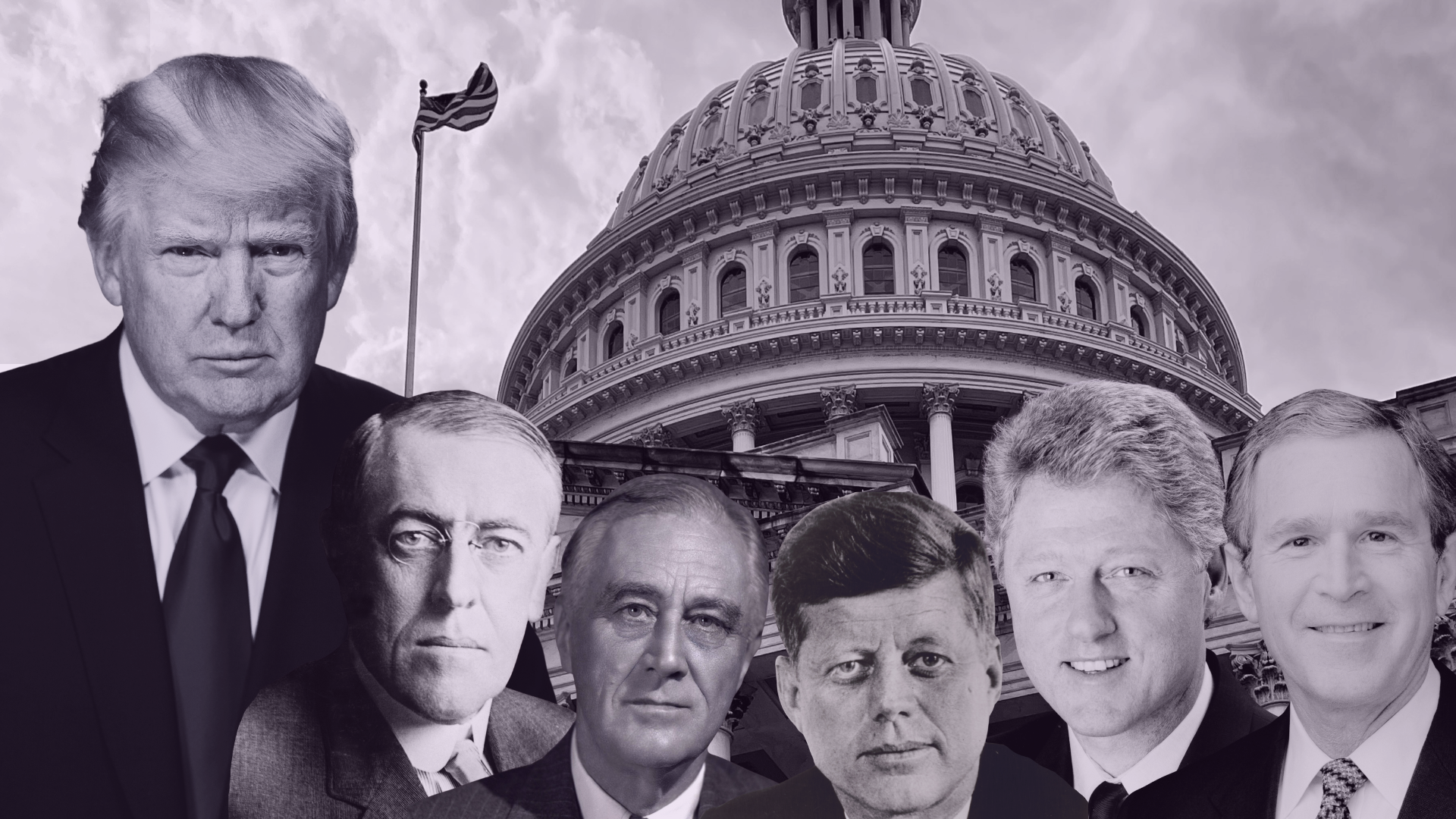
In this op-ed, David Harley, FPC Advisory Council member and former EU diplomat, offers an insider perspective on the historical continuities in US foreign policy and their implications for the future of transatlantic relations.
The slogan ‘America First’ has a long history. Often used by President Donald Trump, the phrase was first coined by President Woodrow Wilson during his 1916 presidential campaign, when he pledged to keep the United States (US) out of the First World War. The US nevertheless entered the war in April 1917. The non-intervention movement in America remained strong during the inter-war years, personified by the pro-Nazi stance taken by Joseph P. Kennedy, the US ambassador to the UK from 1938 to 1940 and father of John F. Kennedy.
Despite strong pleading from Winston Churchill, President Franklin Roosevelt would not commit the US to enter the Second World War after the start of hostilities in September 1939. It was only after the Japanese attack on Pearl Harbor on 7 December 1941 that Congress, at Roosevelt’s bidding, unanimously voted to declare war. Six days later, in conditions of utmost secrecy, Churchill set sail for America in the battleship Duke of York. At Roosevelt’s invitation, he was to stay for three weeks in the White House: from their conversations, often until long into the night, the special relationship was born and an alliance forged with the ultimate goal of defeating Nazi Germany and restoring freedom to Western Europe.
Transatlantic relations today are, in many respects, very different, yet with certain similarities. Trump 2.0 and the machinations of the President himself represent and greatly accentuate a deep-seated historical trend of US foreign policy. Once again, Britain and Europe are under threat of war, this time from Russia, but Trump is clearly no Roosevelt, and clear, decisive leadership on the European side is notably absent. Moreover the scourge of populist nationalism is on the rise, on both sides of the Atlantic. The strong likelihood is that the US under President Trump will disengage from Europe and NATO.
Not since the Suez crisis in 1956 has an American president treated Britain with such disdain as the current incumbent. A particularly low point was reached by Trump’s remarks at Davos regarding British soldiers who lost their lives in Afghanistan. These comments have intensified concerns about the future of the transatlantic partnership. The British government now faces an urgent strategic question: how did the UK reach this position, and what should its next course of action be? The current British government’s line of refusing to choose between the US and the EU is becoming increasingly less tenable.
As a senior EU official, I witnessed at first hand, at various meetings in Washington and New York, the continued trend of ruthlessly promoting American interests as they defined them. This was evident both under President Clinton and President George W. Bush. In the case of Iraq, both administrations used unproven allegations of WMD (weapons of mass destruction) held by Sadam Hussein as justification for first bombing and then waging war. The Blair government seemed to swallow the American line unquestioningly.
President Trump’s recently stated objective of taking over Venezuela’s oil reserves echoes words spoken by Vice-President Dick Cheney at a meeting I attended at the White House in July 2002. Cheney made clear that the primary US concern about Iraq was that ‘Saddam is sitting on 10% of the world’s oil reserves, which it cannot allow to fall into the hands of a rogue state or a murderous dictator who refuses to cooperate with the international community’. At the time, Cheney had recently served as CEO of the oil and gas company Haliburton (1995-2000), and as Vice-President he still retained significant stock options.
At a meeting later that day with Condoleezza Rice, national security adviser to President Bush, she began with a little joke that policy differences between Europe and the US had always existed, ever since American independence and even to the burning of the White House by British Forces in 1814. She went on to state forcefully the US’s ‘profound reservations’ about ever submitting to judgments of the International Criminal Court. Rice made it abundantly clear that the US would only recognise or cooperate with international institutions ‘such as the UN or even the EU if and when it served their national interest’.
Although Britain backed the Bush administration over Iraq, other political leaders in mainland Europe were not blind to these long-standing features of US foreign policy and took a very different view. During a lunch I attended in June 2003 at the Élysée Palace, President Jacques Chirac launched into a furious diatribe against US policy. I discreetly noted down the President’s words as follows: ‘Since the fall of the Berlin Wall, Europe has no longer been strategically important for the US. The Balkans conflict masked this change. The main objective of US foreign policy is to break up Europe.’
If Chirac’s analysis may have sounded exaggerated at the time, over 20 years later his words have proved prescient. The warnings from the patterns of history were there but we – Britain and Europe – chose to ignore them. We must hope that it is not too late to change course as we face the dual threat of Russian expansion and American withdrawal. As Mark Carney memorably said earlier this month in Davos ‘nostalgia is not a strategy.’ In today’s turbulent times, nor is the special relationship.
David Harley is a former EU diplomat, political communications consultant, and author. Posts held include Deputy Secretary-General of the European Parliament and Senior Advisor at the Brussels public affairs agency Burson Cohn & Wolfe. He holds a degree in Modern Languages from the University of Cambridge and a Diploma in Creative Writing from the University of East Anglia. In 2021 David published the transcription of his political diaries in ‘ Matters of Record – Inside European Politics’ and in 2022 co-edited ‘The Forgotten Tribe – British MEPs 1979-2020’. He is currently a member of the Foreign Policy Centre’s Advisory Board, and is a regular speaker and commentator on UK-EU relations.
Disclaimer: The views expressed in this piece are those of the individual author and do not reflect the views of The Foreign Policy Centre.