
Democracy, for me, means accountable institutions anchored in the rule of law. It is not just about elections. Rather, it is everything that happens between elections to ensure people have access to three core values: dignity, safety, and a sense of belonging to a healthy and free society.
Moldova is experiencing the ruptures in the international rules-based order deeply. As Ukraine’s neighbour, we are close to the frontline of its efforts to defend its sovereignty and European security. From the first day of Russia’s full-scale invasion, we have faced threats to our own security, concerted efforts to undermine our democratic institutions, and a huge influx of refugees.[1]
Moldova is a small country of 2.6 million people, yet in the first months of the war we hosted nearly one million Ukrainian refugees. Our society has not fractured – and Moldovan civil society has been instrumental in sustaining that cohesion, working alongside government and international partners.
The bravery and resilience shown by both Ukrainians and Moldovans is a source of hope. Ukraine continues to resist Russian aggression. And despite unprecedented Russian misinformation and interference in the 2024 EU referendum and our presidential and parliamentary elections, Moldova remains on the path towards EU integration.[2]
But we should not take our democracy, or public support for it, for granted.
Leaders say that we are living in a complex and chaotic world. Yet acknowledging this complexity is far from enough. We need our leaders to develop a realistic vision rooted in the value of human life – and to calibrate their promises to people’s basic expectations. This requires the courage to listen to what the electorate tells them, especially when they are saying they need to live safe, dignified, and meaningful lives.
I believe the first expectation is to maintain peace and security. This is the core request any population makes of its leaders. The second is sustainable development, which means development rooted in democratic values. These are the foundations upon which citizens choose to place their trust in elected representatives and institutions.
Accountability when It matters most
At the same time, in any healthy democracy, our leaders need to hold themselves accountable to high ethical standards, transparency, and respect for the rule of law. These principles matter most when they are politically inconvenient, and when applying them carries a cost. There can be no exceptions.
Democratic resilience cannot be measured only by how institutions respond to national crises. It must also be measured by how they respond to individual citizens in moments of vulnerability. An investigation into the death of Ludmila Vartic, in March 2026, is one such test – and it goes to the heart of what democratic accountability means in practice.[3] Ludmila was a mother of two and kindergarten teacher in Hâncești, who committed suicide after years of domestic abuse. Her husband held public office and carried a party card from the governing party. The criminal investigation was opened only after sustained pressure from her family. Dumitru Vartic was eventually charged with domestic violence resulting in death. The case remains ongoing.
Ludmila’s case highlights the wider societal problem of violence against women and girls in Moldova – a problem not unique to Moldova, but faced by societies around the world. It underscores the need for a more effective and consistent response from the state. A society that tolerates violence against women is not a society that offers freedom, safety, and dignity to all its citizens.
Moldova has the necessary legislation in place. It has ratified international conventions on violence against women. The question raised by the Vartic case is therefore not whether legal protections exist, but whether they are applied equally and consistently, regardless of who is implicated.
Accountability cannot be a selective virtue. Too often, in Moldova as elsewhere, politicians invoke democratic principles loudly from opposition and quietly set them aside once in office. The real measure of democratic maturity is not what leaders promise before they reach power – it is what they do when the inconvenient moment arrives: when the accused is an ally, when the investigation touches their own circle, when acting on principle carries a political cost. That is the moment that defines whether a democracy is real or merely performed.
The strongest argument Moldova can make for its European future is not the declarations its leaders make in Brussels. It is what its institutions do for people like Ludmila Vartic.
Moldova is at the most consequential moment in its post-Soviet history – granted EU candidate status in 2022, with accession negotiations opened in 2024. Some argue this is not the moment to risk destabilisation. I reject that framing: a democracy built on selective accountability is not one that Europe should admit, nor one that will endure.
The Vartic case is a reminder that democracy’s credibility is always being tested – not in grand moments of constitutional design, but in the ordinary and often painful questions of whether institutions show up for people when it matters. Moldova has demonstrated, through its response to the refugee crisis, that a society can hold together under extraordinary pressure when the conditions of dignity, belonging, and security are actively maintained. But these conditions are not self-sustaining. They require leadership that is honest enough to acknowledge when they are being undermined – and institutions willing to take action in response.
What democracy requires
Moldova’s experience is not unique. Across this series, contributors have approached these questions from different angles but arrived at a comparable place: that trust erodes slowly before it breaks visibly; that what autocrats destroy first is not infrastructure but dignity, memory, and the capacity for agency; that disengagement is rarely apathy – it is fear. The formal architecture of democracy rests on foundations that are human before they are political. When people lack security, dignity, and belonging, no institutional design recovers them. When they have them, extraordinary things become possible.
The work ahead is not to restore a model that has run its course. It is to understand, honestly, what people actually need to live free and meaningful lives – and to build the political, cultural, and civic conditions in which that becomes possible.
That requires courage: the courage to listen, as much as the courage to speak. And the courage to collaborate across diversity and divides.
Democracy, in the end, is not defined only by what happens on election day. It is defined by what happens every day.
Explore the full mini-series here.
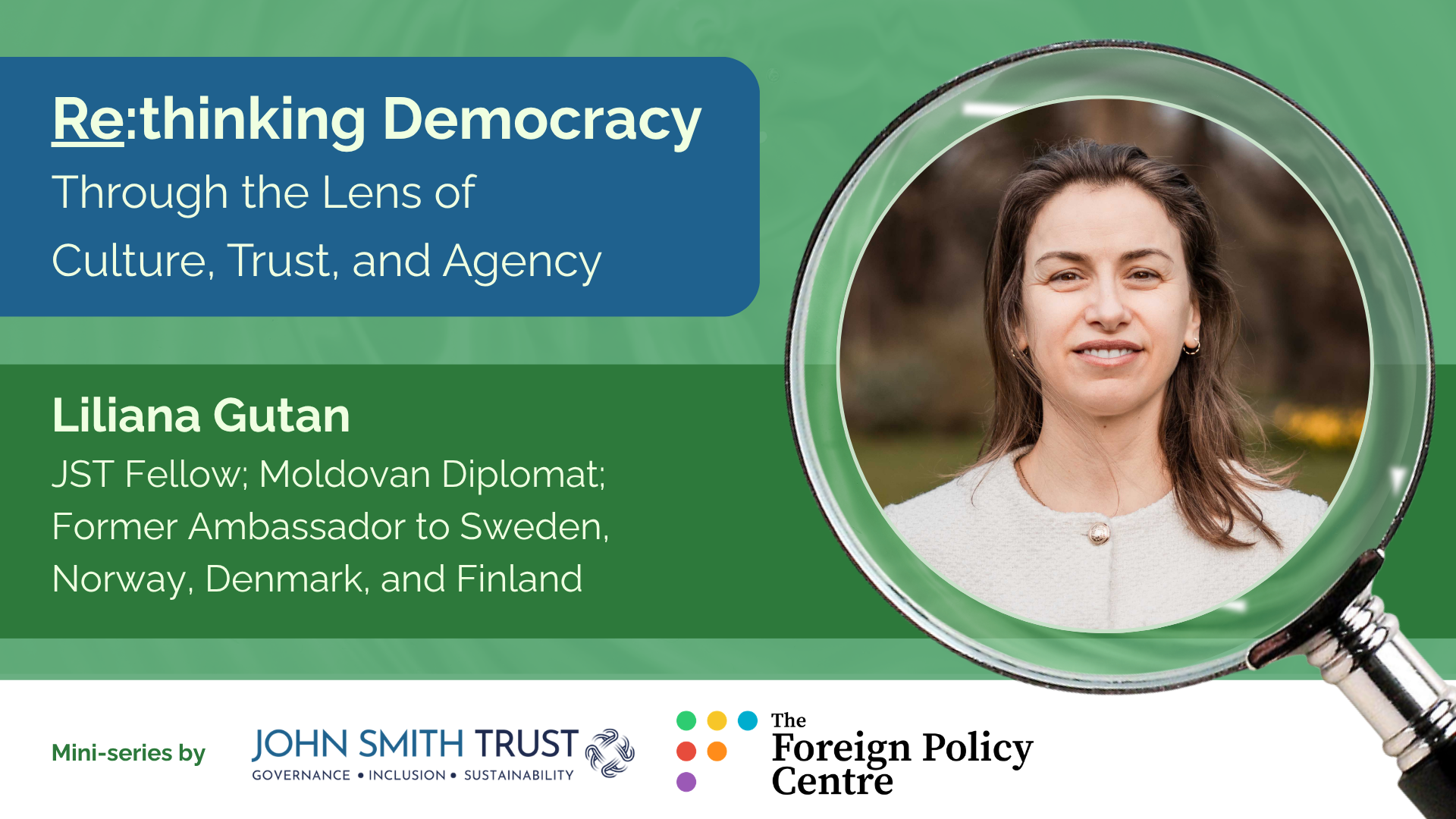
Liliana Gutan is a 2010 John Smith Fellow from Moldova. In her capacity as a member of the National Secretariat responsible for the successful implementation of these initiatives, the focus of Liliana’s work over the last three years has been on the Moldovan Chairmanships. This includes the organisation of numerous regional high level meetings, summits and conferences.
Disclaimer: The views expressed in this piece are those of the individual author and do not reflect the views of The Foreign Policy Centre.
[1] Benedicta Solf and Casey O’Neill, Moldova Shoulders Disproportionately Large Ukrainian Population, in the Shadow of the European Union and Russia, Migration Policy Institute, December 2025, https://www.migrationpolicy.org/article/moldova-ukrainian-refugees
[2] Stephen McGrath, Moldova narrowly votes to secure path toward EU membership after accusing Russie of interference, AP News, October 2024, https://apnews.com/article/moldova-elections-eu-referendum-russia-325cb2c13beb1d76565a6e2aadef971a; Claire Gilbody Dickerson, ‘Massive’ election interference by Russia, Moldovan officials say in decisive presidential vote, Sky News, November 2024, https://news.sky.com/story/massive-election-interference-by-russia-moldovan-officials-say-in-decisive-presidential-vote-13247385; Sarah Rainsford and Paul Kirby, Moldova’s pro-EU party wins vote mired in claims of Russian interference, BBC News, September 2025, https://www.bbc.co.uk/news/articles/cx2rdlj8ejgo
[3] Moldpres, Head of State on domestic violence and Ludmila Vartic case: We need justice, not speculation, May 2026, https://www.moldpres.md/eng/society/head-of-state-on-domestic-violence-and-ludmila-vartic-case-we-need-justice-not-speculation