
Legal Privilege: A double edged shield?
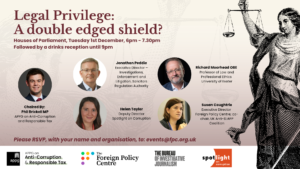
This is a parliamentary event co-hosted by the Foreign Policy Centre, Spotlight on Corruption, the Bureau for Investigative Journalists and the APPG on Anti-Corruption and Responsible Tax. If you would like to attend, please RSVP to events@fpc.org.uk, including your full name and organisation.
Legal professional privilege is a fundamental legal right which, when properly applied, allows a party to withhold disclosure of certain communications and documents. It flows from the established relationship of trust that exists between a client and their lawyer. However, the scope and appropriate application of legal professional privilege (LPP), and the statutory exceptions to it, have come under increasing scrutiny, particularly when it relates to investigations by regulators or law enforcement agencies into potential wrongdoing by lawyers.
In October the High Court ruled, in a case brought by Carter-Ruck Solicitors and their former client Mohamed Amersi, that the Solicitors Regulation Authority (SRA) does not have the power to compel the disclosure of LPP information when investigating solicitors for professional misconduct. In reaching this decision, which is currently pending appeal before the Supreme Court, the judge did not take into account whether it was desirable for the SRA to have these powers for the purpose of public interest regulation, instead recognising this is a question for Parliament.
Carter-Ruck has been subject to an investigation by the SRA linked to strategic lawsuits against public participation (SLAPPs) for their conduct of claims on behalf of Mr Amersi against Charlotte Leslie, a former MP, which prompted serious criticism by the High Court in striking out the claims. However, the High Court ruling will not only have an impact on potential SLAPPs investigations, but into any matter that requires review of legally privileged information to investigate. This challenge comes at a time when there are growing concerns that some within the legal profession may be utilising legal privilege to blanket cover communications with third parties, such as PR firms or private investigators instructed to undertake non-legal work for a client.
This panel discussion will examine the High Court’s ruling, its implications particularly for regulators or law enforcement agencies, and the potential for LLP to be misused – to not only protect client interests but to ‘shield’ the conduct of lawyers from scrutiny and accountability. It will be followed by a drinks reception and opportunity for networking.
The event will be chaired by Phil Brickell MP, Chair of the APPG on Anti-Corruption and Responsible Tax.
Speakers:
– Jonathan Peddie, Executive Director – Investigations, Enforcement and Litigation, Solicitors Regulation Authority
– Helen Taylor, Deputy Director, Spotlight on Corruption
– Richard Moorhead OBE, Professor of Law and Professional Ethics, University of Exeter, Member, Horizon Compensation Advisory Board and Professor of Law, Monash University
– Susan Coughtrie, Executive Director, Foreign Policy Centre and co-chair of the UK Anti-SLAPP Coalition
Palace of Westminster.
If you would like to attend, please RSVP to events@fpc.org.uk, including your full name and organisation.
Chair: Phil Brickell MP, Chair of the APPG on Anti-Corruption and Responsible Tax.
Jonathan Peddie, Executive Director – Investigations, Enforcement and Litigation, Solicitors Regulation Authority
Helen Taylor, Deputy Director, Spotlight on Corruption
Richard Moorhead OBE, Professor of Law and Professional Ethics, University of Exeter, Member, Horizon Compensation Advisory Board and Professor of Law, Monash University
Susan Coughtrie, Executive Director, Foreign Policy Centre and co-chair of the UK Anti-SLAPP Coalition