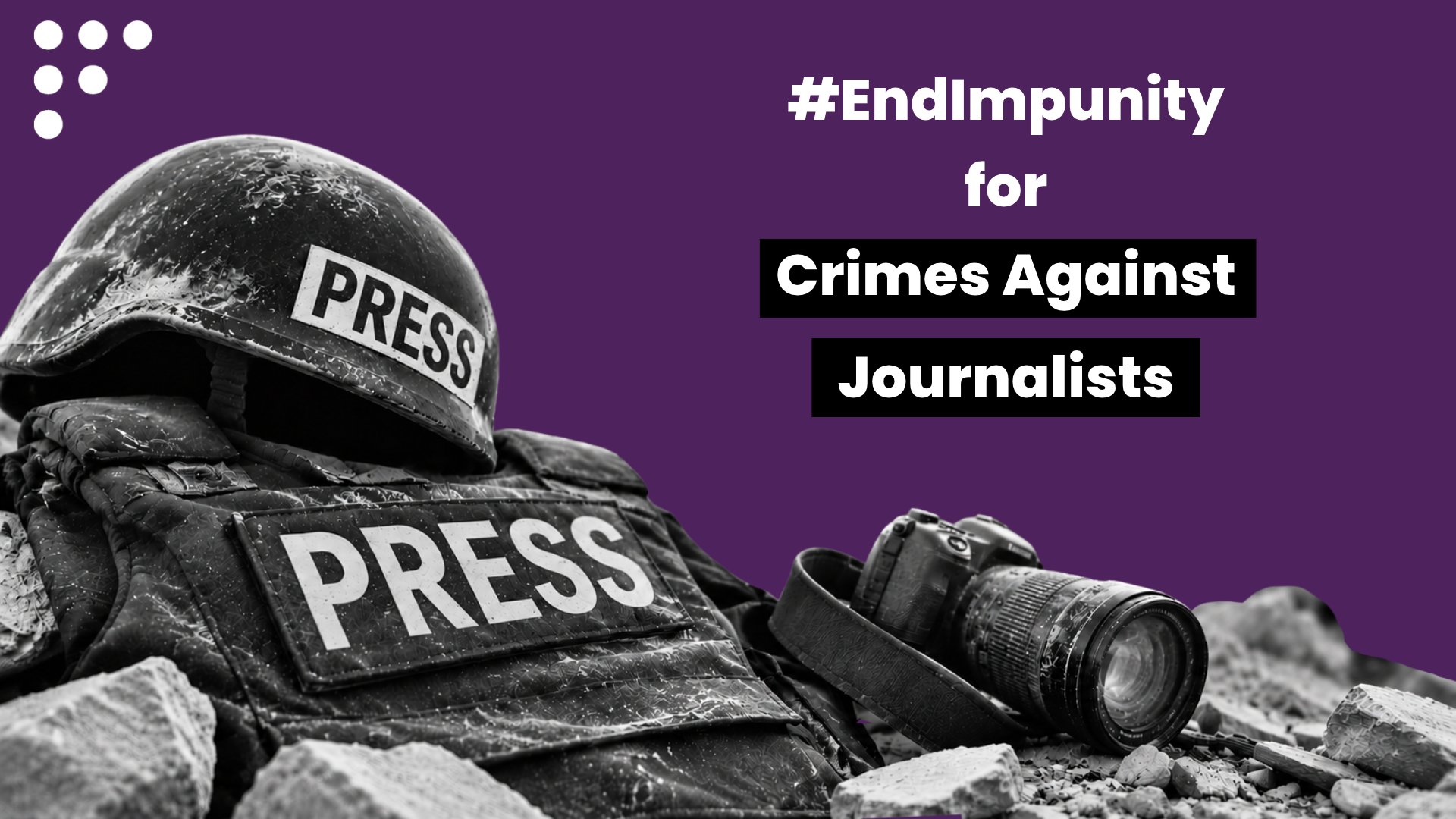
On the International Day to End Impunity for Crimes Against Journalists, IFEX exposes the gulf between governments’ commitments to media freedom and their failure to deliver justice. From the unprecedented number of journalists killed in Gaza to the question of who ordered the assassination of Daphne Caruana Galizia in Malta, those responsible continue to evade accountability. Meanwhile, civil society organisations and international institutions pursuing accountability face growing pressure.
The murder of a journalist is rarely an isolated crime. It is an attempt to suppress information, obstruct scrutiny and deny the public the truth. When perpetrators escape justice, sources are silenced, colleagues are intimidated and those who abuse power emboldened.
More than 100 IFEX member organisations document attacks, support journalists at risk and demand accountability. The scale of the crisis is stark: nine in ten cases involving the killings of journalists and media workers go unpunished.[1] In 2025, the Committee to Protect Journalists (CPJ) recorded 129 journalists and media workers killed, the highest annual toll since the organisation’s records began in 1992.[2]
Nowhere is the gulf between governments’ commitments and their actions more evident than in Gaza. At least 191 Palestinian journalists and media workers have been killed by Israeli forces in Gaza since 7 October 2023.[3] CPJ describes Israel’s actions as “the deadliest and most deliberate effort to kill and silence journalists” it has ever recorded.[4] With foreign journalists largely barred from entering Gaza independently, Palestinian journalists have risked their lives to document a genocide. The killing of journalists and destruction of media infrastructure not only silence reporting on atrocities as they unfold; they also destroy the means of documenting them, leaving evidence harder to gather and the pursuit of justice harder to sustain. In her report on Gaza, UN Special Rapporteur Francesca Albanese describes this broader assault as “mediacide”: the systematic destruction of the media’s public function.[5] IFEX members MADA, 7amleh and I’lam have documented attacks and pressed for accountability while preserving evidence vital to future investigations.[6]
Governments that profess to defend media freedom have failed to match their words with action as Palestinian journalists are killed in Gaza and Lebanon and are attacked and arrested in the West Bank. Declarations of concern mean little without meaningful efforts to protect journalists. Under international humanitarian law, journalists working in conflict zones are civilians and must be protected as such, unless and for such time as they directly participate in hostilities. That protection is not a matter of political discretion; it is an obligation.[7]
Impunity is not confined to war zones. Nine years after the assassination of Daphne Caruana Galizia, impunity persists at the heart of the European Union. On 2 September 2026, a Maltese jury acquitted businessman Yorgen Fenech of complicity and criminal association in her 2017 murder. While five men have been convicted of carrying out the killing or supplying the bomb, no one has been held legally responsible for ordering her murder. The Attorney General has appealed.[8] If a case so closely watched by Europe and the international press freedom community still cannot deliver full accountability, what hope is there for journalists killed where scrutiny is weaker?
Organisations pursuing accountability are increasingly under attack. The Belarusian Government designated IFEX member the Belarusian Association of Journalists an “extremist organisation”. In Ecuador, a court ordered Fundamedios, also an IFEX member, to remove a monitoring alert and publish an apology.[9] Palestinian organisations, including 7amleh, have warned of restrictions on groups documenting human rights violations and pursuing international accountability. They have also raised concerns about proposed legislation that could criminalise cooperation with the International Criminal Court.[10]
These organisations gather evidence and keep cases alive when authorities fail to act. Yet the institutions that could act on that evidence also face pressure. Crimes against journalists are among those being examined by the ICC Prosecutor’s Office in its investigation into Palestine.[11] The Trump administration rejects the Court’s jurisdiction over Americans and US allies, including in connection with the ICC’s arrest warrants for Israeli leaders over alleged crimes in Gaza. On 9 October 2026, the United States imposed sanctions on the Court itself, following earlier sanctions against judges and prosecutors. The Court said the measures were intended to disrupt its work and intimidate those cooperating with it.[12]
This is how impunity becomes entrenched: journalists are attacked, organisations exposing abuses are constrained, and institutions pursuing accountability face retaliation. Governments committed to media freedom must defend all three.
The UK, co-chair of the Media Freedom Coalition, has identified tackling impunity as a priority.[13] The Coalition’s High Level Panel of Legal Experts on Media Freedom has proposed a standing International Investigative Task Force to support national authorities where they lack the capacity or political will to investigate.[14]
The International Day to End Impunity for Crimes Against Journalists on 2 November must be measured by action, not statements.[15] Governments must support independent investigations, preserve evidence, protect witnesses and sustain civil society organisations working under threat. They must also defend international justice mechanisms against intimidation and political obstruction, and back the proposed International Investigative Task Force with the resources and political commitment needed to investigate when national authorities cannot or will not act.
Impunity is not inevitable. Governments must turn their commitments to media freedom into action: protect those who expose abuses, ensure accountability and bring those responsible for killing journalists to justice. The public’s right to know depends on it.
Sarah Clarke is Director of Communications and Advocacy at IFEX
Disclaimer: The views expressed in this piece are those of the individual author and do not reflect the views of The Foreign Policy Centre.
[1] IFEX, No Impunity, IFEX, undated, https://ifex.org/campaigns/no-impunity/
[2] Committee to Protect Journalists (CPJ), Record number of journalists killed in 2025; Israel responsible for two-thirds of deaths, 25 February 2026, https://cpj.org/2026/02/record-number-of-journalists-killed-in-2025-israel-responsible-for-two-thirds-of-deaths/
[3] CPJ, Journalist casualties during the Israel–Gaza war and related regional conflicts, updated September 2026, https://cpj.org/2023/10/journalist-casualties-in-the-israel-gaza-war/
[4] CPJ, Israel-Gaza War, CPJ, https://cpj.org/issue/israel-gaza-war/
[5] United Nations, Situation of human rights in the Palestinian territories
occupied since 1967, October 2026, https://docs.un.org/en/A/81/249
[6] IFEX, Palestinian Center for Development and Media Freedoms (MADA), IFEX, undated, https://ifex.org/members/palestinian-center-for-development-and-media-freedoms-mada/; IFEX, 7amleh – Arab Center for the Advancement of Social Media, IFEX, undated, https://ifex.org/members/7amleh-arab-center-for-the-advancement-of-social-media/; IFEX, I’lam – Arab Center for Media Freedom, Development and Research, IFEX, undated, https://ifex.org/members/ilam-arab-center-for-media-freedom-development-and-research/; FEX, Courage under fire: How IFEX member voices and research are helping shape global action for Palestine, IFEX, date to be confirmed, https://ifex.org/courage-under-fire-how-ifex-member-voices-and-research-are-helping-shape-global-action-for-palestine-2/
[7] International Committee of the Red Cross (ICRC), Frequently asked questions: How does international humanitarian law protect journalists?, 2 June 2026, https://www.icrc.org/en/article/international-humanitarian-law-protect-journalists-armed-conflict
[8] The Malta Independent, Prosecution appeals Yorgen Fenech acquittal in Daphne Caruana Galizia murder case, 22 September 2026, https://www.independent.com.mt/articles/2026-09-22/local-news/Prosecution-appeals-Yorgen-Fenech-acquittal-in-Daphne-Caruana-Galizia-murder-case-6736293080
[9] IFEX, Ecuador: IFEX and IFEX-ALC express concern over ruling against Fundamedios, IFEX, https://ifex.org/ecuador-ifex-and-ifex-alc-express-concern-over-ruling-against-fundamedios/; IFEX, OSCE and IFEX members condemn designation of BAJ as ‘extremist organisation’, IFEX, https://ifex.org/osce-and-ifex-members-condemn-designation-of-baj-as-extremist-organisation/
[10] 7amleh, Israel Must End Its Assault on Humanitarian Action and Civil Society, 12 January 2026, https://7amleh.org/post/protect-aid-and-civic-space-en; 7amleh, Open Letter: Stop the Israeli Government’s Systematic Assault on Civil Society, 2 April 2025, https://7amleh.org/post/open-letter-stop-the-israeli-government-s-systematic-assault-on-civil-society-en
[11] Reporters Without Borders (RSF), RSF secures inclusion of crimes against journalists in ICC investigation into Palestine, ReliefWeb, https://reliefweb.int/report/occupied-palestinian-territory/rsf-secures-inclusion-crimes-against-journalists-icc-investigation-palestine
[12] International Criminal Court (ICC), ICC strongly rejects US sanctions against the institution, https://www.icc-cpi.int/news/icc-strongly-rejects-us-sanctions-against-institution
[13] Media Freedom Coalition (MFC) Secretariat, The United Kingdom becomes co-chair of the Media Freedom Coalition, 14 February 2026, https://mediafreedomcoalition.org/news/2026/the-uk-becomes-co-chair-of-the-mfc/
[14] High Level Panel of Legal Experts on Media Freedom, Advice on Promoting More Effective Investigations into Abuses Against Journalists, Fourth Report, 2020, Media Freedom Coalition, https://mediafreedomcoalition.org/who-is-involved/high-level-panel-of-legal-experts/reports/
[15] UNESCO, International Day to End Impunity for Crimes against Journalists, UNESCO, https://www.unesco.org/en/days/end-impunity