
There was a time when war took my voice away. When reality becomes unbearable, reflection is reduced into mere observation. Silence ceases to be calm – it turns into the anticipation of terror from the sky. Under conditions of total war, people lose not only their homes, but also the capacity to narrate what is happening to them. Reason narrows to instinct. And everything that requires sensitivity – art, in particular – seems to fall mute. This is how we begin to treat culture as a luxury, as something that can be postponed until more stable times.
Yet the opposite is true: culture is not an adjunct to democracy; it is a precondition for agency.
We live in a time of eroding trust. Governments, media, and institutions are losing credibility. The frameworks that once defined democratic order no longer feel sufficient. Reality itself has fragmented. Policies and protocols may create structure, but they cannot resolve what is, at its core, a crisis of narratives – a rupture between identities, experiences, and meanings. This is not only a Ukrainian question. It is a European one.
Almost five years ago, storytelling and cinema became, for me, a way of resisting this fragmentation. A feature film script about the first months of the Russian full-scale invasion felt not like documentation, but rather reconstruction – an attempt to reclaim authorship over my own experience. In this sense, culture is not representation. It is a safe space where meaning is restored, and with it – the capacity to act.
Since 2022, I have noted a new habit: I catch myself observing people in large European cities as though through an invisible yet dense membrane. This distance is not geographical, but experiential. War creates a rupture that resists translation. And this gives rise to an uneasy question: is agency possible without the experience of existential risk?
Our unprocessed histories – colonial pasts, totalitarian traumas, genocide – return through narratives as recurring threats. This is why the figure of the antagonist is so central to contemporary storytelling. Yet the antagonist is not only what we fight against. It is what we recognise, ‘other’ and refuse to integrate.
Popular culture now offers telling examples. Squid Game does not invent a dystopia – it exposes the future shock of a traditional society. Adolescence does not resolve the problem of contemporary masculine identity – it renders the “accursed questions”[1] even more complex. These stories resonate because they name what society already senses, but cannot yet articulate.
Post-totalitarian cultures – particularly in Eastern Europe, the Caucasus, and Central Asia – face a different problem. They have inherited a cultural hero who is fundamentally passive: the silent dissident, the ironic observer, the one who survives but does not act. In such contexts, silence is mistakenly perceived as strength. In reality, it is often a symptom of learned helplessness. If this narrative remains unchanged, it will continue to reproduce itself – even under democratic conditions. A society that tells itself stories of endurance rather than action will continue to endure, but not to transform.
One of my most sincere sources of inspiration in recent months has been Václav Havel’s essay ‘The Power of the Powerless’, invoked by the Prime Minister of Canada during the 2026 forum in Davos. This text is not merely political commentary in the conventional sense. It is a cultural essay that describes how agency arises not from systems, but from small acts of redefinition – moments when individuals choose to refuse reproducing the scripts imposed upon them.
It seems that our societies today need not simply new content, but a new narrative structure, a different kind of cultural hero – one who acts without guarantees, speaks without certainty, and accepts vulnerability not as weakness, but as a condition of agency.
In Ukraine, the Revolution of Dignity of 2013-14 marked a defining moment when society’s agency not only became unmistakably visible, but also emerged as a force capable of safeguarding democratic values. Since the first months of Russia’s aggression in 2014, volunteer initiatives have quite literally helped keep the Ukrainian state functioning. Their work extends far beyond procuring military equipment and tactical medical supplies. Volunteers have built evacuation networks, supported internally displaced people, and helped devastated communities begin the long process of rebuilding.
The same spirit of initiative has also shaped Ukraine’s soft power abroad. Many of the country’s most effective international cultural and civic initiatives have not been orchestrated by the state but have grown organically through self-organisation and the networks of the Ukrainian diaspora. Ukraine has also demonstrated a remarkable ability to embrace digital innovation, with civil society playing a pivotal role not only in developing and implementing these innovations but also in rigorously testing their effectiveness and holding them to account.
Equally fundamental to Ukraine’s contemporary sense of agency is the ongoing reimagining of local identities across its towns and villages. In recent years, communities have explored their own histories through a wide range of cultural and civic initiatives, rediscovering local heritage, engaging with the complexities of multicultural memory, and dismantling narratives imposed from outside. In doing so, they are reclaiming the right to tell their own stories, and, ultimately, to define themselves on their own terms.
Not all our societies are ready for such a shift. Many are still organised around survival rather than transformation. And this is precisely why the delicate work within the realm of the sensuous – cultural practice – cannot be secondary. Without it, political change lacks psychological grounding.
Our current moment is marked by simultaneities. For some, agency now signifies the basic capacity to act; for others, it denotes a deeply existential experience of subjecthood.
Until quite recently, the ‘Old World’ reliably provided institutional frameworks through which an individual could choose a profession, a way of life, political convictions, partners, or a place to live. Yet reality is unsettlingly clear that no structure can guarantee any longer either meaning or safety.
At such a moment, action becomes inseparable from responsibility: values come at a cost; freedom is not a default condition; neutrality, as an avoidance of choice, no longer functions.
Our identity now is action. It is our daily practice, be it screenwriting, art, human rights advocacy, or a commitment to the rule of law. Alternatively, it can also be the rejection of all the above in surrender to a totalitarian trend.
Democracy today does not begin with institutions. It begins with a shift in how we tell our stories.
Explore the full mini-series here.
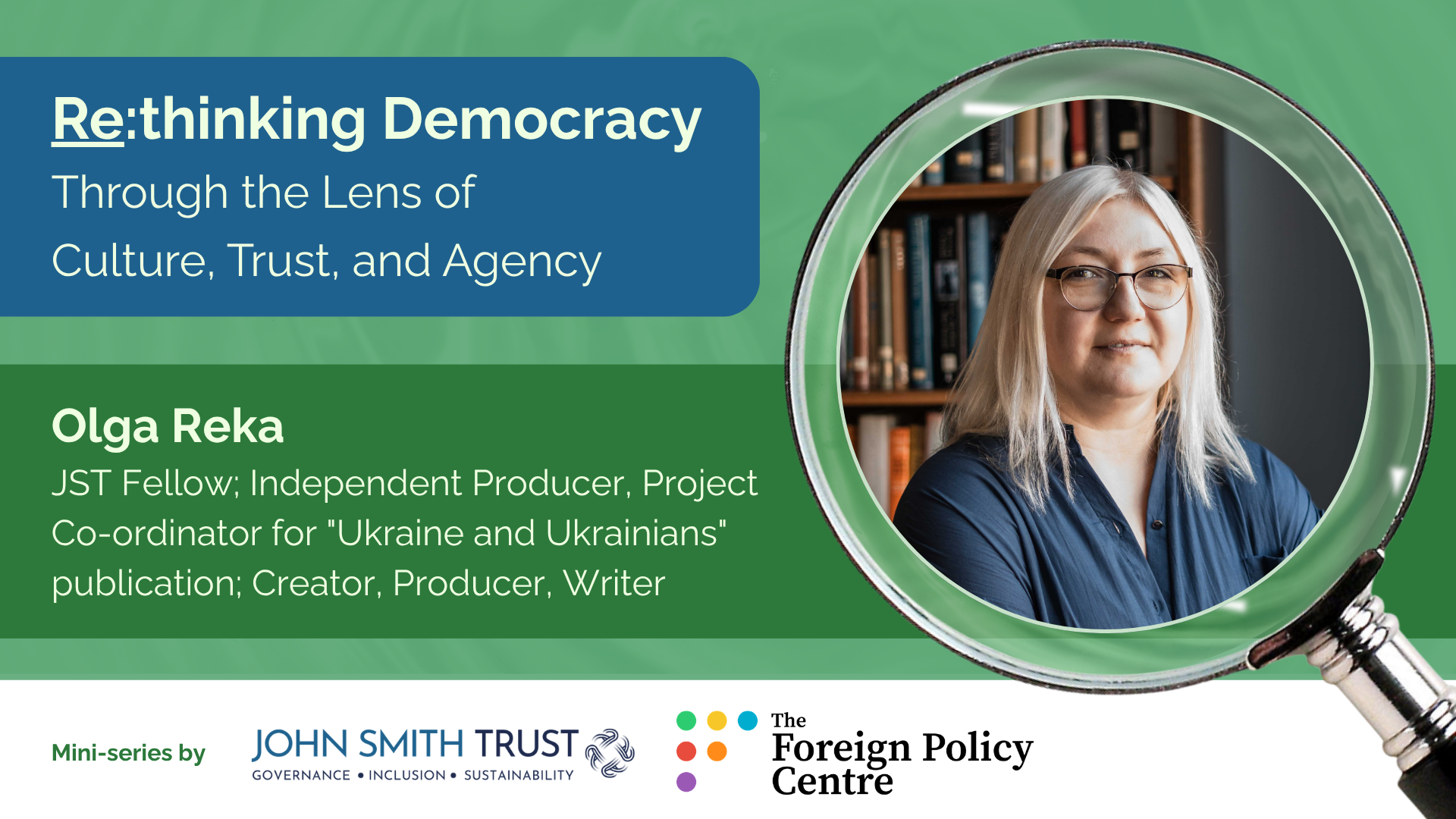
Olga Reka is a Ukrainian producer, writer and cultural storyteller whose work explores archetypal and transformational narratives shaped by themes of war, dignity, trauma and cultural memory. With over 150 hours of national television to her credit, she has created award-winning fiction projects and is known for story worlds that reflect the contemporary Ukrainian experience. She currently co-ordinates the publication project “Ukraine and Ukrainians”, a historical ethnographic art album of the NCFC “The Ivan Honchar Museum”, Gunia Project and The Ivan Honchar Charitable Foundation. Her recent films include the features “Nodokasa”, “Zenith” and “Misty in Places”; and the short “In the Shadows” (Grand Prix – Ukraina Festiwal Filmowy 2021; Special Jury Mention – Short of the Year 2021). Olga was also the showrunner and co-writer of “5baksiv.net”, Ukraine’s first web series and winner of the Grand Prix at Bilbao Web Fest 2017.
Disclaimer: The views expressed in this piece are those of the individual author and do not reflect the views of The Foreign Policy Centre.
[1] “Accursed questions” (often called proklyatye voprosy in Russian) are universal, foundational inquiries about human existence that never have a single, final answer.