
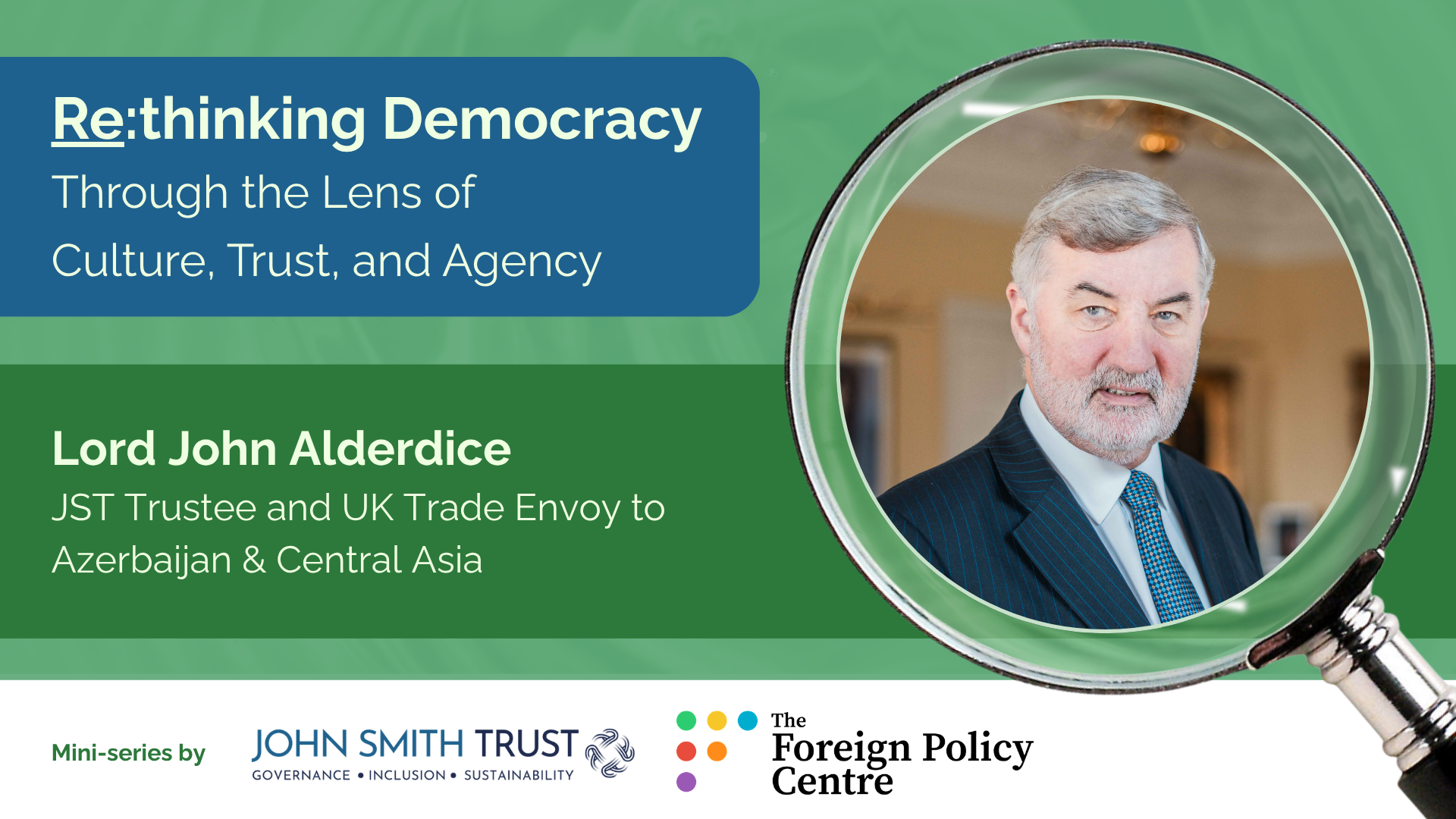
This article introduces a new series of short essays by JST Fellows – leaders working across Europe, the South Caucasus and Central Asia – exploring how societies can build the trust, agency and resilience needed for an era of fracture and flux.
We are living through a period of profound change and uncertainty. The erosion of the rules-based international order is causing instability on a global scale. Familiar frameworks and alliances, such as NATO, are no longer seen as providing security guarantees and a basis for shared understanding between states. The institutions that form the foundations of healthy democracy – the media, government, judiciary, and civil society – are not functioning in the way that they should. Media ecosystems no longer offer a shared factual reference point; governments struggle to deliver on the concerns of those they represent; judiciaries face growing pressure on their independence; and civil society is increasingly recast – through propaganda and hostile narratives – as a threat rather than a mechanism for accountability and civic action. It all adds up to a climate of social and political polarisation, creating distrust: in governments, in one another, and in democracy itself.
Added to this, the rapid development of artificial intelligence (AI) presents both opportunities and threats to how our societies and economies function. The political emergence of Gen Z, with youth-led protests in countries as disparate as Georgia, Nepal, Peru and Madagascar, is seen as evidence of growing frustration of young people with inequality, corruption, and the failure of existing institutions to respond to people’s concerns.[1]
These forces are not temporary disruptions but structural shifts reshaping political and social life. As such, they demand a new approach. This is not a time for nostalgia but for a collective rethink. Throughout this mini-series, our contributors delve into experiences of culture, trust and agency in their societies to explore a central question: What actions do we need to take and what stories must we ensure are heard, in order to shape and secure a healthy political and social order for the emerging global era?
In the articles that follow, JST Fellows explore this question in depth, offering diverse perspectives on what it means to rethink democracy through the lens of culture, trust, and agency. They look at opportunities and challenges emerging in media, technology, and information systems. They look at the power of identity and narratives, and their effect on social cohesion. And they look at agency and engagement, with a focus on young people.
These are not separate strands but interwoven dynamics that reinforce each other. Technology drives identity narratives. Identity politics shape how young people engage. And youth movements reshape information ecosystems.
Our Fellows, who come from countries across Europe, the South Caucasus and Central Asia, write about how these forces are playing out in the contexts in which they live and work. Questions of identity, culture and memory also run throughout the series. Olga Reka, from Ukraine, writes about the critical role of the arts, culture, and storytelling in creating meaning and agency as a precondition for democracy. Botagoz Zhumabekova examines the psychological foundations of democratic participation, arguing that active citizenship depends not only on political opportunity but also on people feeling safe enough to engage.
Trust – or its absence – is a common theme. Gulshat Ayydova and Aaron Campbell look at what we can learn from the way young people already engage in informal spaces to encourage meaningful participation and build trust in political processes. Joldoshbek Osmonov, from Kyrgyzstan, looks at the legitimacy crisis facing civil society and how organisations can rebuild trust in the face of propaganda that presents them as a threat. Farrukh Irnazarov explores the role of education in building trust in institutions and civic responsibility across Central Asia.
Looking at democratic renewal through a political lens, Palina Brodik reflects on the future of the Belarusian democratic movement, arguing that preserving collective memory while remaining adaptable is essential to sustaining political agency in exile.
The series concludes with Liliana Gutan’s reflection on Moldova, where democracy is measured not only by elections but by what institutions deliver between them. Her article brings together many of the themes explored throughout the series, arguing that democratic resilience ultimately depends on whether people experience dignity, security, and belonging in their everyday lives.
I hope these articles offer both provocation and possibility – showing what it looks like when values-driven leaders think seriously about the challenges of our time. They are part of the generation of diverse leaders needed in this moment, to shape a new order in which people can live in sustainable, peaceful and just societies.
Explore the full mini-series here.
John Alderdice, Professor, the Lord Alderdice. UK Trade Envoy to Azerbaijan & Central Asia and JST Trustee.
Disclaimer: The views expressed in this piece are those of the individual author and do not reflect the views of The Foreign Policy Centre.
[1] Daniel Boffey, ‘We are very strong’: Georgia’s gen Z drives protests against return to past, The Guardian, May 2024, https://www.theguardian.com/world/article/2024/may/16/georgia-gen-z-drives-protests-against-return-to-past-foreign-agents-law; Omkar Khandekar and Yam Kumari Kandel, How Gen Z-led protests put Nepal’s 1st female prime minister in power, NPR, September 2025, https://www.npr.org/2025/09/20/nx-s1-5545760/nepal-protests-gen-z; Marco Aquino and Alexander Villegas, Peru’s Gen Z rallies against President Boluarte, protesting over pensions and corruption, Reuters, September 2025, https://www.reuters.com/world/americas/perus-gen-z-rallies-against-president-boluarte-protesting-over-pensions-2025-09-27/; AP News, How Gen Z protesters brought down Madagascar’s government and now want the president out, October 2025, https://apnews.com/article/madagascar-protests-gen-z-rajoelina-e39ef11bd1f4a92f1f4b353900348219