
Securitisation of foreign (and domestic) policy is leading to a prioritisation of hard power approaches over civilian-led, soft power approaches, leaving many wondering about the future. As Europe rearms in response to the Russian threat to its collective security, and as the US proves itself an unreliable security partner, the UK finds itself repositioning within a fractured Euro-Atlantic alliance. This raises a broader question: how to de-securitise and return to “normal” politics?[1]
If militarism shapes the next generation’s approach to public policy, what are the prospects for addressing the root causes of violence that are driving the skyrocketing humanitarian needs and record levels of forced displacement? The impact of armed conflict is increasingly more severe and violence is becoming the new normal, while political solutions are de-funded and militarised approaches take precedence.[2]
As the UK and many other democratic states reduce investment into peacebuilding and other soft power efforts, resource constraints are affecting the very institutions that help prevent and mitigate conflict, support collective security, and promote diplomatic solutions.
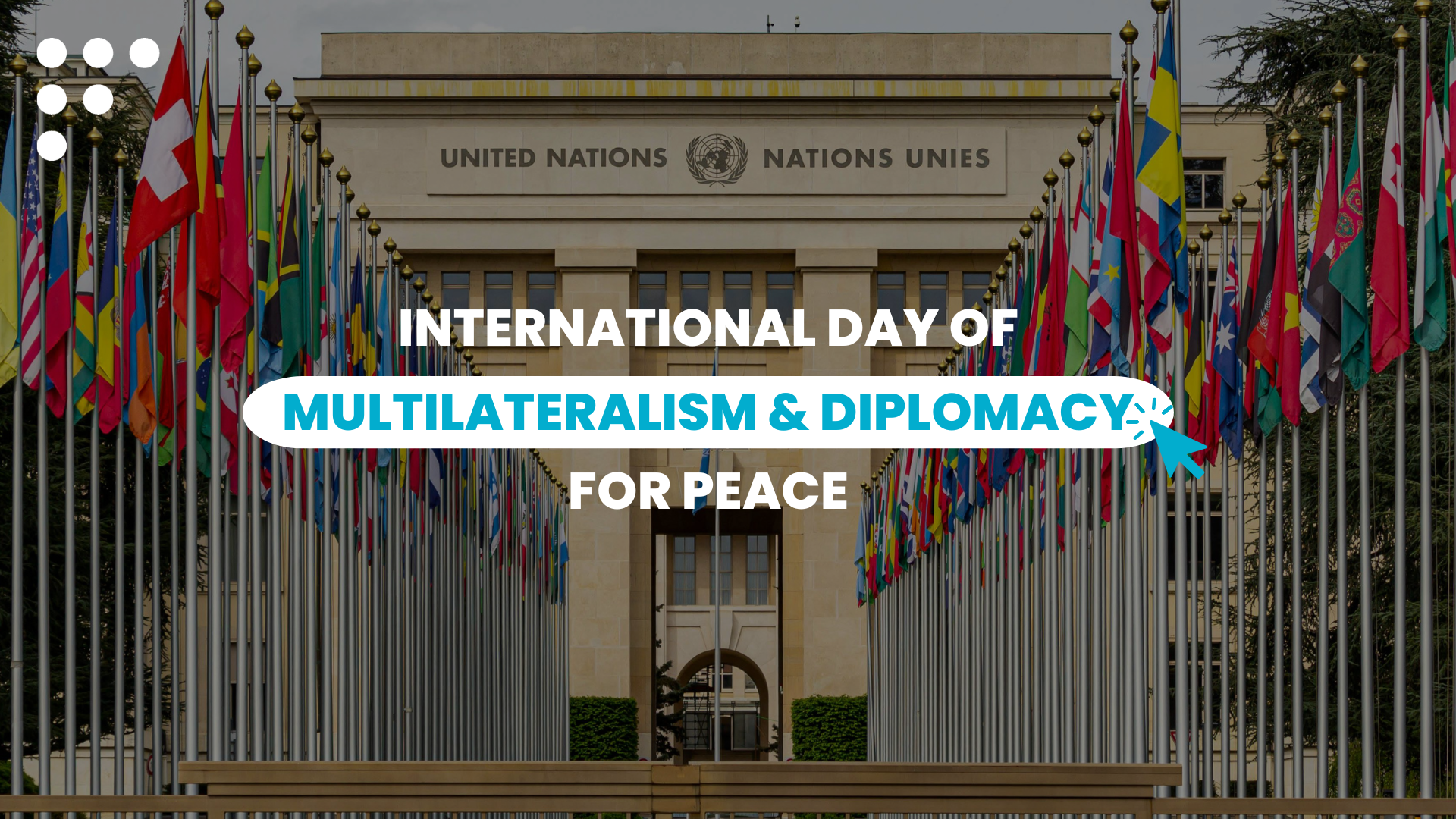
Today, the international community marks the importance of multilateralism and diplomacy for peace.
This takes place in a context of increasing global arms transfers, the proliferation of non-state armed groups, a resurgence of international armed conflicts, and systematic violations of the UN Charter across continents.[3] The low cost of entry into conflict for both state and non-state actors (in part enabled by globalisation, including access to technology, finance, and information), combined with social, economic and environmental factors, is undermining peace and other development goals. In a globalised order, military escalations in one region risk pushing millions into poverty, including in already conflict-affected contexts.[4]
This dynamic is also unfolding alongside increasing inequalities and restrictions on civic space. Democratic backsliding has reduced agency for civil society, including humanitarian actors, women’s rights groups, LGBTQI+ movements and many others relying on a rights-based, rules-based international world order – particularly in contexts where the states are unwilling or unable to adhere to a viable social contract. Without multilateral spaces, civil society voices risk further marginalisation and isolation in the face of expanding authoritarianism.[5] Without civic space, the positive peace agenda is undermined.
At the same time, significant reductions in aid are reshaping the UN and the multilateral architecture underpinning diplomacy for peace. Regional and global multilateral institutions and their civil society partners are grappling with a steadily increasing wave of violence and militarism with dwindling resources. The private sector, philanthropy, and new donors (e.g. in the Gulf) seem willing to meaningfully engage in ways that come close to replacing USAID’s contribution to pathways for peace, and the wider Nexus approach that brings together Humanitarian Development and Peace.[6]
Human Development progress, particularly around Women, Peace and Security and gender justice, are stalling and regressing. These trends point to the continued importance of investment in soft power, including support for democracy, human rights, gender equality, the rule of law, and security sector reform. While the UK has historically positioned itself as a leader in this area and continues to recognise its importance, current policy choices suggest a growing gap between this recognition and the protection of funding for peacebuilding, development and humanitarian relief.[7]
Where does this leave the UK role in the wider European neighbourhood and globally?
A renewed focus on human security is needed. A purely state-centric approach, driven by self-interest among a growing number of undemocratic and unequal states is likely to lead to a more violent world order that will not yield the desired collective human development dividends. The UK’s historic role in championing human security approaches in institutions like NATO, and reflected in its approaches at the UN Security Council is more needed than ever. In a shifting global order, where collaboration among middle powers around shared geographic or sectoral interests and values is becoming critical, the UK’s track record on human security lends value regionally and globally.
The UK’s Ministry of Defence review of strategic trends flagged important human security dimensions, outlining risks around inequalities and other socio-economic factors that are likely to drive instability and diminish UK’s global role and its national security.[8] Yet despite the availability of such detailed and well-considered analysis, foreign policy and national security decision-makers continue to defund the human security agenda, and inadvertently make the world (and the country) less safe.
With civic space narrowing, citizens and states must be represented in regional and global dialogues, as well as in the institutions that underpin them. While the UK prides itself on a long historic track record of soft power, particularly through its academic institutions, think tanks, vibrant media, and civil society – these all require public investment. Without a well-resourced and stable civil service to help deliver on these objectives, this historic soft power asset risks weakening, with implications for peacebuilding outcomes.
Holding the pen, and running out of paper: what happens to penholding at the UN Security Council?
A major factor in the UK’s global security positioning is in the power of its permanent seat on the UN Security Council. The UK holds the pen on some key thematic and geographic files, convening peace and security conversations across a wide range of diverse states.
For a post-Brexit middle-power, the UK retains an impressive amount of influence in these soft power spaces. However, much of the political credit goes to historic investments by DFID and the Foreign Office in regional institutions such as the Organization for Security and Co-operation in Europe, the UN aid systems, and the Human Security agenda within NATO. Without sustained investment in these spaces, including in the civil service staff and structures, the UK’s soft power positioning will not be sustainable and it will not be able to build on its impressive historic track record of conflict resolution and peacebuilding through collective security and human security approaches.
Without diplomacy and resources to civilian-led processes, military solutions will be increasingly seen as “normal” and viable. A growing share of the population, particularly younger generations coming of age in a renewed period of geopolitical competition, may come to view conflict as an inevitable feature of international relations. Without diplomacy, there will be more bullets.[9]
Anna Chernova has a background in foreign policy and international development, with a focus on human rights, conflict resolution and humanitarian action. She has worked in diplomatic and non-governmental sectors in Eurasia and West Asia. At the Parliamentary Assembly of the Organization for Security and Co-operation in Europe, she led work on human rights and democracy, including parliamentary diplomacy efforts in conflict resolution, election observation and inquiries. Prior to joining the OSCE, Anna managed large-scale humanitarian operations in Russia’s North Caucasus at the close of the second Chechen war, and had worked on refugee issues with the UN in Bulgaria. Since 2014, she has been advising humanitarian organisations on foreign policy analysis, political risk and transnational threats. Her research and policy work focuses on gender and conflict, human security, counter-terrorism and human rights. She is particularly interested in conflict prevention and addressing root causes of violence driving humanitarian crises, such as extreme inequalities and authoritarianism. Anna’s academic background is in International Studies, Russia/Eastern Europe and Global Security. She is a US Fulbright Research and IREX Public Service Fellow, and is based in the UK.
Disclaimer: The views expressed in this piece are those of the individual author and do not reflect the views of The Foreign Policy Centre.
[1] Jonathan Luke Austin, Philippe Beaulieu-Brossard, “(De)securitisation dilemmas: Theorising the simultaneous enaction of securitisation and descuritisation,” Review of International Studies (2017) https://www.cambridge.org/core/journals/review-of-international-studies/article/desecuritisation-dilemmas-theorising-the-simultaneous-enaction-of-securitisation-and-desecuritisation/FE45D2C1D20870EC0E74DF54FA487C06
[2] ACLED Conflict Watchlist 2026, “What is driving conflict today? A review of global trends,” (2025) https://acleddata.com/report/whats-driving-conflict-today-review-global-trends
[3] ICRC https://www.icrc.org/sites/default/files/document/file_list/challenges-report_ihl-and-non-state-armed-groups.pdf; SIPRI, Trends in International Arms Transfers, 2025 https://www.sipri.org/publications/2026/sipri-fact-sheets/trends-international-arms-transfers-2025
[4] UNDP, “Military escalation in the Middle East could push more than 30 million people into poverty worldwide,” (2026) https://www.undp.org/press-releases/military-escalation-middle-east-could-push-more-30-million-people-poverty-worldwide-un-development-programme-warns
[5] Freedom House – Freedom in the World 2026, “The Growing Shadow of Autocracy,” https://freedomhouse.org/report/freedom-world/2026/growing-shadow-autocracy
[6] World Bank Group, “Pathways for Peace: Inclusive Approaches to Preventing Violent Conflict,” (2018) https://www.worldbank.org/en/topic/fragilityconflictviolence/publication/pathways-for-peace-inclusive-approaches-to-preventing-violent-conflict
[7] International Development Committee, “Future of UK aid and development assistance: interim report, Government Response,” https://committees.parliament.uk/publications/52758/documents/293937/default/
[8] Ministry of Defence, “Global Strategic Trends out to 2055,” 7th edition (2024) https://assets.publishing.service.gov.uk/media/68dba439dadf7616351e4bf8/GST_7_Final_post_pic_change_WEB.pdf
[9] Forbes, “Heed General Mattis’ Warning, D.C.: Less Diplomacy Means ‘More Ammunition’”, June 2025https://www.forbes.com/sites/andrewtisch/2025/06/18/heed-general-mattis-warning-dc-less-diplomacy-means-more-ammunition/