
In Central Asia, citizens have not simply lost faith in institutions. They have stopped expecting institutions to deserve it.
Citizens are curious about reform, transparency, opportunity, participation, and modernisation. However, their everyday experience may be shaped by uneven services, opaque decision-making, limited civic space, or institutions that respond more readily to status than to need. And yet the instinct is to treat this as something politics alone can fix. It cannot. Trust is not primarily a political product; it is a learned disposition.
In such an environment, ‘leading by example’ is not a soft moral appeal. It is the structural basis of credibility. Where authority is culturally important, public conduct carries unusual weight; people watch whether officials, educators, business leaders, and civic actors behave according to the standards they ask others to accept. Trust is built when words and actions repeatedly meet.
Education as democratic infrastructure
Trust is too often treated as a political problem to be solved only by policy: new laws, new strategies, new platforms, or new communications campaigns. These matter, but they are not enough. People learn, often early, whether cooperation is safe, whether disagreement is dangerous, whether success requires domination, and whether institutions deserve patience when they make mistakes. Education is therefore the overlooked foundation of democratic resilience, not because schools can replace politics, but because they form the habits of mind that make healthy politics possible.
This requires thinking about education more broadly than curriculum reform. It means treating classrooms, youth programmes, universities and informal learning spaces as laboratories of social behaviour. One powerful mechanism is gamification – designing learning environments that teach the logic of mutual gain. This is not about points and prizes. It is about showing young people, through experience, that achievement and contribution are not opposites. Too much public life is organised around zero-sum instincts: if one group advances, another must lose; if one entrepreneur succeeds, society has been exploited; if one community receives attention, another has been forgotten.
A better educational design can show young people that achievement and contribution are not opposites. A student can ‘win’ by building a business model that also solves a local problem. A team can score higher when it helps another team improve. A simulated city, school budget, or environmental challenge can reward cooperation, long-term thinking and shared benefits rather than only individual victory.
This matters in Central Asia because social cohesion cannot be imported through abstract democratic language. The region’s histories, hierarchies, kinship networks, respect for elders, and expectations of authority differ from Western European civic models. A copied template may sound progressive while failing to speak to local trust dynamics. Gamified education can translate democratic habits into lived experience: negotiation, responsibility, reciprocity, compromise, and service. It can show that success does not have to mean someone else’s defeat. That lesson, absorbed early, is a quiet defence against polarisation later.
A second mechanism is debate culture. Debate is not simply public speaking, nor is it the performance of defeating an opponent. At its best, it teaches a harder civic discipline: to hold a position firmly while remaining genuinely open to being changed by another argument. This is one of the deepest foundations of democratic life. A person who has practiced fair debate learns that disagreement is not betrayal, that criticism is not always an attack, and that losing an argument need not mean losing dignity. In societies where authority is often protected from challenge, debate culture can create respectful forms of questioning. It does not require young people to reject elders, institutions or tradition. It teaches them how to examine claims, ask for evidence and recognise complexity without collapsing into cynicism.
The difficulty is that most policy thinking moves in the opposite direction. It is top-down, structural and short-cycle. Governments and donors want measurable outcomes within a funding period. NGOs, especially in Central Asia, often work with precarious financing and constrained civic space, which pushes them toward safe projects, narrow indicators, and cautious language. But trust grows slowly. It needs continuity, repetition, and relationships. A three-month campaign cannot undo years of suspicion. A digital platform cannot substitute for credible behaviour. The most important work may be the least visible: a teacher who models fairness, a youth mentor who allows disagreement, a local project that proves cooperation can produce real results.
Technology, trust and democratic resilience
Technology intensifies both the problem and the possibility. Disinformation widens the gap between rhetoric and reality. It makes it harder for leaders to maintain credibility and harder for citizens to know what deserves belief. In information environments shaped by rumours, propaganda, influencer politics and fragmented media, distrust can become self-protective: people stop believing not only false claims but also true ones. This is especially dangerous in societies where institutional trust is already fragile.
However, technology should not be treated only as a threat. In Central Asia, its effects are already mixed. Kazakhstan’s eGov system, for example, has shown how digital public services can reduce everyday friction between citizens and the state: when people can access documents, payments or applications online without relying on personal connections or opaque bureaucracy, technology can make institutions feel more predictable and less distant. Yet the same region has also shown the limits of digital trust, especially when online spaces are shaped by disinformation, surveillance fears, or sudden restrictions on access. The point is not to promise technological salvation. The point is to try low-risk, low-cost experiments – digital debate clubs, local problem-solving games, transparent community budgeting tools, media-literacy simulations, or platforms that allow citizens to track small public commitments – and to learn honestly from failure. Even attempting imperfect solutions can build trust when the process is transparent. People do not need institutions that never fail. They need institutions that admit limits, correct mistakes, and keep showing up.
In a region with civic actors may face pressure, where respect matters, where authority is personal as well as formal and where young people are navigating both traditional and global digital culture – this is not an abstract principle. Trust between citizens, communities, and institutions must be built from where people actually stand. Education, in this wider sense, is where the bridge can begin.
The African proverb captures the choice: “if you want to go fast, go alone; if you want to go far, go together”. Trust cannot be rushed into existence by decree, branding, or institutional design alone. It is slow, collective work. It is learned through games that reward mutual success, debates that dignify disagreement, technologies that connect rather than manipulate, and leaders who make credibility visible through example. There are no shortcuts worth taking.
Explore the full mini-series here.
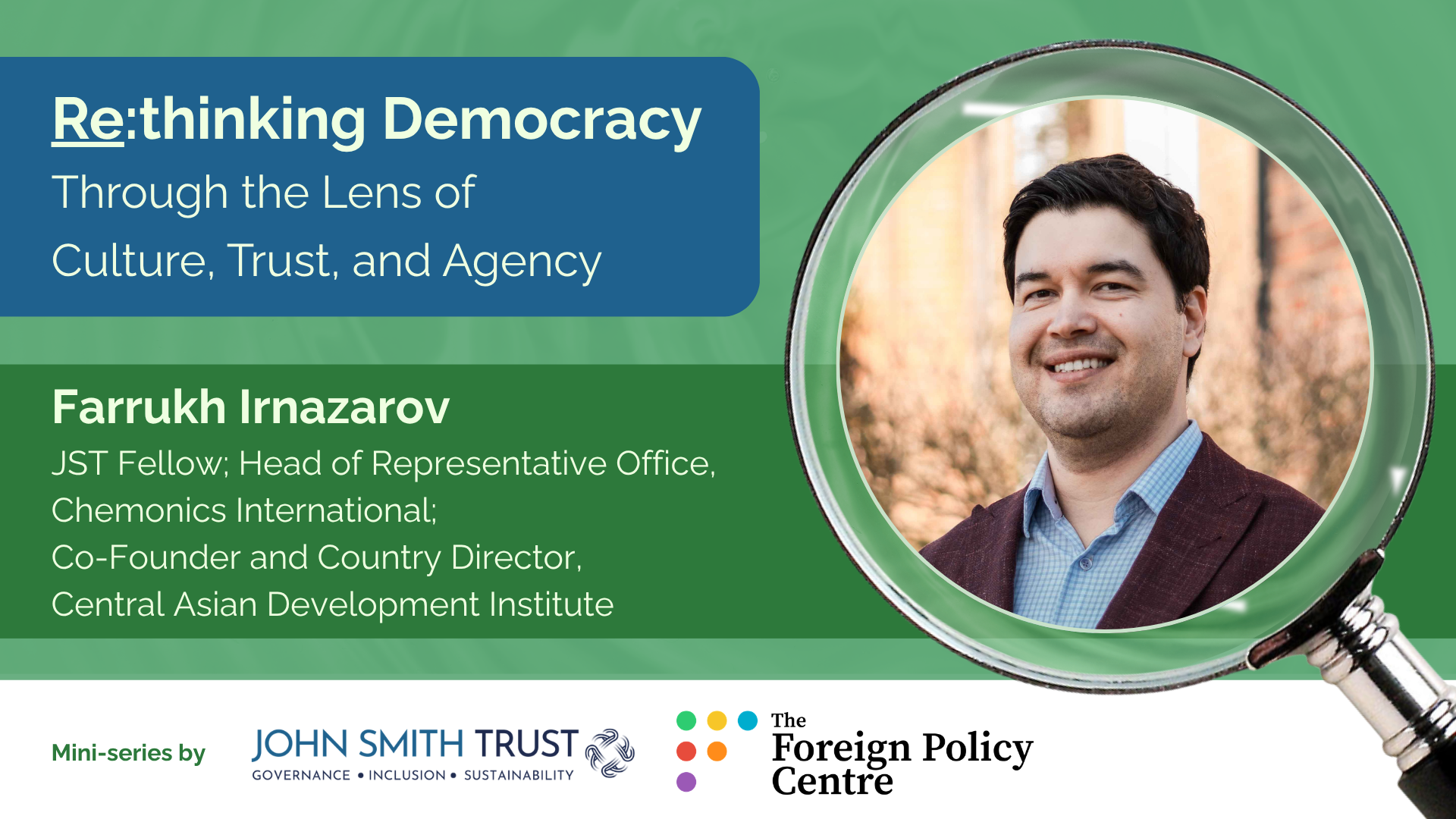
Farrukh Irnazarov is an international development expert with over 15 years of experience in economic policy, investment strategies, labour migration, trade, and agribusiness. He is the Co-Founder and Country Director for Uzbekistan at the Central Asian Development Institute (CADI) and Co-Founder of the RANSIF Group, a policy and research platform promoting responsible and transparent investment in Central Asia. Farrukh’s focus is on fostering constructive capital, designing investment screening mechanisms, and advancing private sector development across the region.
Disclaimer: The views expressed in this piece are those of the individual author and do not reflect the views of The Foreign Policy Centre.