
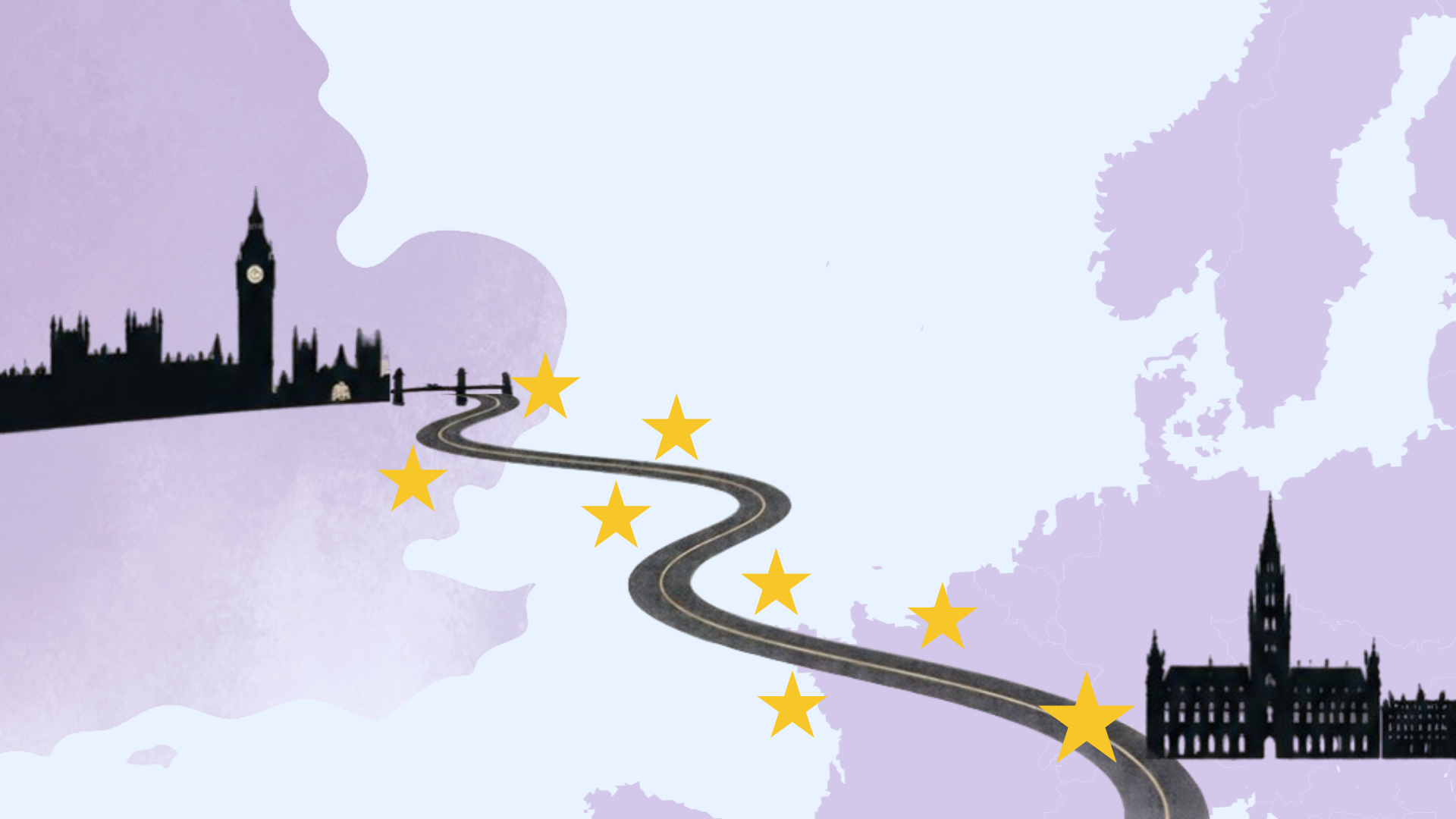
Andy Burnham’s recent party conference speech marked a fundamental shift in the UK’s position on a future relationship with the European Union, effectively abandoning the post-Brexit ‘red lines’ set out in Labour’s 2024 election manifesto. The four options mentioned by the Prime Minister are preserving the status quo, joining a customs union, joining the single market, or full EU membership (‘going all the way’). The 2024 manifesto had explicitly ruled out returning to the customs union or the single market or allowing freedom of movement. Beyond acknowledging that Brexit has done ‘more harm than good’, Burnham has so far given no indication of his preferred option.
Pessimists might say that, ten years after the Brexit referendum, coming up with four theoretical options is hardly a political masterstroke. But this sea-change in Government policy holds out hope that, after all those wasted years, these issues, so vital for the British economy and for Britain’s place in Europe at a critical time, are at last being addressed. Initial reactions from the EU Member States – in particular from France, Spain and Poland – have been largely positive in general terms. But the devil will very much be in the detail and necessary ‘trade-offs’.
The Government has triggered what is bound to be a long and complex process, particularly given the bad blood that has been spilled in the relationship over those ten fruitless years. At this stage it is hard, even unwise, to predict the final outcome. Several procedural hurdles need to be overcome, at both domestic and external level, before negotiations can get seriously under way: Burnham needs to get his party behind the new approach, ensure that it is included in the manifesto for the next general election, and above all, win that election outright or at least be in a position to form a government with like-minded pro-European forces if the result so dictates. Only then can he get down to serious business with the EU.
Burnham has proved himself to be an adroit communicator and it will now be largely up to him to demonstrate that, as seen both from Brussels and Westminster in their different ways, the positives outweigh the negatives in this new situation. The task will not be easy. Although rarely stated in public, the fragility and negativity of UK domestic politics has been noted with considerable concern in Brussels. They well know of Reform Party leader Nigel Farage after his lengthy tenure as a Member of the European Parliament and subsequent actions and statements, as well as his poll ratings. Nor has Brussels forgotten the way negotiations were mismanaged under successive governments, particularly under the Johnson administration, which damaged the UK’s reputation as a reliable partner. Warm words are not enough: it is now up to Andy Burnham to fundamentally transform and burnish Britain’s image in the chancelleries of Europe and the EU Commission.
The Prime Minister will also have to deal with another negative factor in the current European political landscape, but one for which in this case the UK bears no responsibility – the resurgence of authoritarian and nationalist-populist parties in many EU countries, not least in France, Germany, Spain, Italy and Romania. This will form an unavoidable backdrop to any UK attempt to place relations with the EU on a surer and mutually beneficial footing. Far-right parties across these countries all share, if to varying degrees, the ambition to reduce the powers and effectiveness of the EU. This depressing trend is likely to further complicate Burnham’s already challenging task. Nor are relations with the current President of the United States – a staunch opponent and critic of the EU and, at best, a fair-weather friend of the UK – likely to facilitate negotiations with the EU, although standing up to Trump may win Burnham plaudits in some quarters.
Nevertheless, one should not underestimate the positive benefits that Britain can bring to the table, particularly in defence and security and its significance as a ready market for mutually beneficial trade and economic cooperation. There are also specific opportunities in the fields of energy and emission trading (the carbon pricing system). It is often said that renewing relations with the EU ‘is all about trade-offs’. But given the unparalleled threats and challenges facing Europe and the UK, in order to renew and secure Britain’s relations with our closest trading partner, a fundamental change of emphasis is needed.
The world and the European continent have seen profound changes and grave developments since the Brexit referendum in 2016. The UK’s approach to renewing negotiations should reflect this changed landscape, and the need for a corresponding fresh approach on both sides. Rather than repeating the negative mantras of the past, both the EU and the UK should define their common challenges and consider how they can work together to address them in their mutual interest. The geostrategic interest should come first, followed by the necessary economic, trade and regulatory considerations. Britain’s approach should go beyond the purely transactional, given that fundamental principles and values – peace, freedom and democracy – are at stake. For the sake of future generations of Europeans, Britain and the European Union cannot afford to fail.
PS. One of Liverpool’s most famous sons, Paul McCartney, wrote the song ‘The Long and Winding Road’ and described it as ‘about the unattainable’ and ‘too emotionally charged’. It nevertheless went on to great critical acclaim and to sell millions of copies. Remainers and Rejoiners can only hope that Andy Burnham, no mean guitarist himself as we saw when playing recently with the Ukrainian soldier in Kyiv, has as much success in revitalising Britain’s relationship with the EU.
David Harley is a former EU diplomat, political communications consultant, and author. Posts held include Deputy Secretary-General of the European Parliament and Senior Advisor at the Brussels public affairs agency Burson Cohn & Wolfe. He holds a degree in Modern Languages from the University of Cambridge and a Diploma in Creative Writing from the University of East Anglia. In 2021 David published the transcription of his political diaries in ‘ Matters of Record – Inside European Politics’ and in 2022 co-edited ‘The Forgotten Tribe – British MEPs 1979-2020’. He is currently a member of the Foreign Policy Centre’s Advisory Board, and is a regular speaker and commentator on UK-EU relations.
Disclaimer: The views expressed in this piece are those of the individual author and do not reflect the views of The Foreign Policy Centre.