Skip to content

Op-ed | Standing up to the Kremlin: Lessons from Moldova for Defeating Russian Election Interference

Article by Philip J. Javens and Stefan Wolff

March 25, 2026

Op-ed | Standing up to the Kremlin: Lessons from Moldova for Defeating Russian Election Interference

Foreign Information Manipulation and Interference (FIMI) has been high on the agenda of liberal democracies for years.[1] The European External Action Service has just published its fourth annual report on the subject, and the UK Parliament’s Foreign Affairs Committee is due to release the result of its inquiry into disinformation on 27 March.[2] The threat to liberal democracies from hostile autocrats is real and growing, but democratic states and societies are far from defenceless, as the case of one Europe’s smallest and poorest countries vividly illustrates.


On 28 September 2025, Moldova held its parliamentary elections in the shadow of the Russian war against Ukraine while itself being under relentless attack from the Kremlin – not by enemy soldiers, missiles, and drones, but by an army of chatbots, covert operators, and willing proxies.[3] The choice before the Moldovan people was simple: to cast their vote in support of EU integration or to back parties prioritising an amicable relationship with Russia.


In many ways it was a litmus test: could a small nation of 2.5 million people preserve the integrity of its electoral process in the face of Russia’s hybrid war? With President Maia Sandu’s pro-European Party of Action and Solidarity (PAS) winning more than 50% of the votes, Moldova has become a success story for how a democracy under attack by a revanchist Russia can protect its sovereignty.[4]  This offers vital lessons for the broader efforts to make liberal democracies more resilient and future-proof them against autocratic subversion.


It is estimated that the Russian regime spent between €100m and €200m in its effort to undermine Moldova’s parliamentary elections.[5] These resources were partly poured into a multi-layered interference architecture that applied behavioural insights, cross-platform access, and AI-generated content to coordinate its reach. Pro-Russian narratives were pushed on a myriad of fabricated websites employing deepfakes designed to mimic legitimate news media from across the world to create the illusion of an international consensus aligned to the Kremlin’s interests.


In one instance, hackers impersonated the Council of Europe and “fabricated a story portraying Moldova as condemned by European institutions”. Moldova’s government institutions were also targeted by hackers “to gain access to sensitive information”.[6] Evidence has shown that “on TikTok alone, 1,347 fake accounts generated 42 million interactions”, demonstrating Russia’s capability to bypass traditional media to push pro-Kremlin content directly to its targets.[7]


Importantly, Russia’s manipulation campaign was not just limited to the digital realm. Another significant part of the resources that Moscow mobilised was used to transfer money to around 130,000 Moldovan citizens in an attempt to buy their votes. Cash from Russia was also used to bribe groups and individuals to provoke disorder and spread fear, including through bomb threats against polling stations for expatriates living in Italy, Romania, Spain and America.[8] The Kremlin even went as far as enlisting Moldovan Orthodox priests to post pro-Russian and anti-European messages on dedicated Telegram channels.[9]


Russia’s attempts to manipulate the outcome of the elections clearly presented a grave threat to Moldova’s future. Yet despite the vast resources the Kremlin mobilised and the sophistication of its tools, Moldova’s democracy proved remarkably resilient, offering important insights for strategies to counter election interference.


Moldova’s political leaders, civil society, and European partners pushed back against Russia’s unprecedented influence operation on multiple fronts. To pre-empt election fraud, strategic communication was harnessed.[10] Russian lies were proactively exposed in government communications. Senior EU officials and leaders from key member states visited the country in the run-up to the elections to show their support against Russian manipulation efforts.[11]


Moldova’s government not only worked to denounce Russian interference, but the country’s law enforcement agencies also made sustained and successful efforts to dismantle Russia’s vote-buying network. This included banning two political parties from participating in the elections, issuing 25,000 fines to individuals who sold their votes and a large-scale public awareness campaign that exposed this fraud through billboards, traditional media and social media.[12]


Moldovan authorities also coordinated closely with EU neighbours to defend itself against Russian cyberattacks by sharing intelligence and collaborating on investigations. This cross-border cooperation successfully thwarted major disruptions in the days leading up to the vote and thus protected the integrity of Moldova’s electoral process.[13]


EU institutions and Moldovan NGOs also worked together to highlight the benefits of integration into the EU in a campaign that engaged with celebrities, popular magazines, artists and religious leaders to promote EU values and partnership. By focusing on the concrete results of the EU-funded and Moldovan government-led “European Village” programme, that supports local community projects from building playgrounds to repairing roads, the message to voters was very clear: Moldovans will benefit much more from a future inside the EU rather than outside of it.[14] Ultimately, this too, was a message that cut through the fog of Russian disinformation.


Moldova’s experience highlights both the vulnerability of countries in the crosshairs of Russian interference campaigns and the limits that these campaigns have in the face of well-conceived and coordinated resistance. Russia’s well-funded and highly sophisticated ‘hybrid war’ poses a real threat. However, European democracies are not defenceless. As the Moldovan experience demonstrates, they can emerge more resilient from the fight back against foreign information manipulation and election interference.


Philip J. Javens is a Writer/Producer currently studying an MA in International Relations at the University of Birmingham. His professional credits include working on documentaries for Amazon Prime, Netflix, Apple TV+ and more.


Stefan Wolff is Professor of International Security in the Department of Political Science and International Studies, at the University of Birmingham. A political scientist by background, he specialises in the management of contemporary security challenges, especially in the prevention and settlement of ethnic conflicts, in post-conflict state-building in deeply divided and war-torn societies, and in contemporary geopolitics and great-power rivalry. Wolff has extensive expertise in the post-Soviet space and has also worked on a wide range of other conflicts elsewhere, including in the Middle East and North Africa, in Central Asia, and in sub-Saharan Africa. Wolff holds degrees from the University of Leipzig (Erstes Staatsexamen), the University of Cambridge (M.Phil.), and the LSE (Ph.D.).


Disclaimer: The views expressed in this piece are those of the individual authors and do not reflect the views of The Foreign Policy Centre.


[1] Camilla Cavendish, Britain must be more vigilant to the risk of sabotage by hostile states, Financial Times, March 2026, https://www.ft.com/content/720543d3-bdfc-4008-b64d-5a8abbdb0d61

[2] European External Action Service, 4th EEAS Annual Report on Foreign Information Manipulation and Interference Threats, March 2026, https://www.eeas.europa.eu/eeas/4th-eeas-annual-report-foreign-information-manipulation-and-interference-threats_en; UK Parliament, Foreign Affairs Committee, Disinformation diplomacy: How malign actors are seeking to undermine democracy, https://committees.parliament.uk/work/8818/disinformation-diplomacy-how-malign-actors-are-seeking-to-undermine-democracy/

[3] David Smith, Engineering Doubt: Cyber Operations and Hybrid Election Interference in Moldova’s 2025 Elections, Watchdog.md, 2026, https://watchdog.md/wp-content/uploads/2026/03/Cyberwarfare-Moldovas-Elections.pdf

[4] Stefan Wolff, Moldova: pro‑EU party wins majority in election dominated by Russian interference, The Conversation, September 2025, https://theconversation.com/moldova-pro-eu-party-wins-majority-in-election-dominated-by-russian-interference-266179

[5] The Stimson Center relies on an interview with a senior Moldovan police officer by the Moldovan state information agency for the lower figure, while the Economist cites the Moldovan government as a source of the higher figure. See Sanda Sandu, Moldova’s 2025 Elections: A Test Case for Russia’s Hybrid Warfare, September 2025, https://www.stimson.org/2025/moldovas-2025-elections-a-test-case-for-russias-hybrid-warfare/; Moldpres, Interview with the Head of the General Inspectorate of Police, March 2026, https://www.moldpres.md/rom/interviuri/interviu-moldpres-seful-igp-viorel-cernauteanu-federatia-rusa-fie-prin-interpusul-ilan-sor-fie-prin-alte-elemente-va-incerca-continuu-sa-gaseasca-anumiti-algoritmi-prin-care-sa-ajunga-la-dezordini-si-destabilizari; The Economist, Moldova defies Russia by re-electing its pro-European government, September 2025, https://www.economist.com/europe/2025/09/29/moldova-defies-russia-by-re-electing-its-pro-european-government

[6] Ancuța (Anna) Hansen, How Russia tried to manipulate Moldova’s election – and what it reveals, The Interpreter, November 2025, https://www.lowyinstitute.org/the-interpreter/how-russia-tried-manipulate-moldova-s-election-what-it-reveals

[7] Ibid.

[8] Leo Litra and Gabrielė Valodskaitė, From success to strategy: Three lessons from Moldova’s election, https://ecfr.eu/article/from-success-to-strategy-three-lessons-from-moldovas-election; RFE/RL’s Moldovan Service, EU Monitoring Threats To Moldova’s Elections Amid Alleged Russian Plot To Train Provocateurs In Serbia, September 2025, https://www.rferl.org/a/moldova-russia-parliamentary-election-arrests-provocation-marta-kos-european-commission-maia-sandu/33539603.html; Anna Hansen, How Russia tried to manipulate Moldova’s election, November 2025. https://www.lowyinstitute.org/the-interpreter/how-russia-tried-manipulate-moldova-s-election-what-it-reveals

[9]  Christian Lowe, Polina Nikolskaya and Anton Zverev, Holy war: How Russia recruited Orthodox priests to sway Moldova’s voters, Reuters, September 2025, https://www.reuters.com/investigations/holy-war-how-russia-recruited-orthodox-priests-sway-moldovas-voters-2025-09-26/

[10] The Moldovan parliament established a Centre for Strategic Communication and Countering Disinformation in 2023. See Parliament of Moldova, ‘Law No. 242 of 31 July 2023’, https://www.legis.md/cautare/getResults?doc_id=138661&lang=ro. The website of the Centre for Strategic Communication and Countering Disinformation can be accessed here: https://stratcom.md/en/

[11] EU Neighbours East, European Commissioner for Enlargement Marta Kos visits Moldova, September 2025, https://euneighbourseast.eu/news/latest-news/european-commissioner-for-enlargement-marta-kos-visits-moldova/; Alexander Tanas and Andreas Rinke, German, Polish, French leaders visit Moldova in pre-election show of support for pro-EU president, Reuters, August 2025, https://www.reuters.com/world/german-polish-french-leaders-visit-moldova-pre-election-show-support-pro-eu-2025-08-27/

[12] Abbey Fenbert, Moldova bans 2 pro-Russian parties on eve of key election, The Kyiv Independent, September 2025, https://kyivindependent.com/moldova-bans-2-pro-russian-parties-on-eve-of-key-election/; Reuters, Moldova bans another pro-Russian party from Sunday’s vote, September 2025, https://www.reuters.com/world/moldova-bans-another-pro-russian-party-sundays-vote-2025-09-27/; ECFR, Leo Litra and Gabriele Valodskaitė, From success to strategy, October 2025, https://ecfr.eu/article/from-success-to-strategy-three-lessons-from-moldovas-election

[13] Ibid.

[14] The European Village programme (https://www.euvillages.eu/) is a long-standing Europe-wide EU initiative to invest in local rural infrastructure. Its most recent renewal in Moldova was announced in April 2025. See Moldpres, Two new EU-funded government programs launched in Moldova, April 2025, https://www.moldpres.md/eng/economy/two-new-government-programs-launched-in-moldova-funded-by-european-sources; Leo Litra and Gabrielė Valodskaitė, From success to strategy: Three lessons from Moldova’s election, October 2025, https://ecfr.eu/article/from-success-to-strategy-three-lessons-from-moldovas-election

Footnotes
    Related Articles

    Four Years On: Europe’s Strategic Test in Ukraine

    Article by Prof Stefan Wolff

    February 24, 2026

    Four Years On: Europe’s Strategic Test in Ukraine

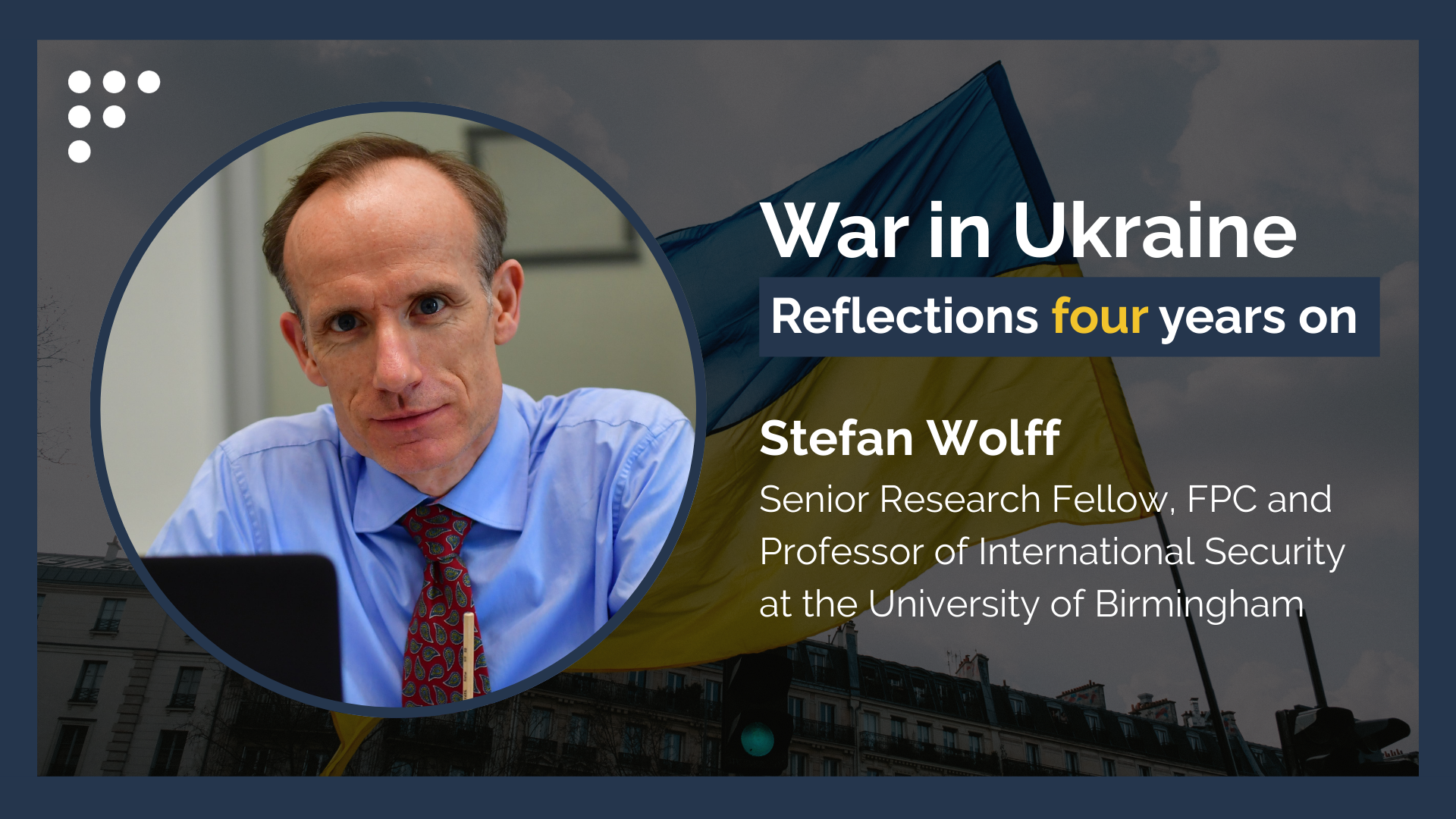
    Four years into Russia’s full-scale invasion of Ukraine, the conflict remains unresolved and the strategic landscape increasingly complex. In this analysis, Stefan Wolff, FPC’s Senior Research Fellow, examines the evolving diplomatic scenarios, the limits of US-led negotiations, and the choices confronting the UK and its European partners as the war enters a fifth year.


    As Ukraine heads into a fifth year of defending itself against the unprovoked Russian full-scale invasion, the prospects of a just and sustainable peace agreement remain distant. On the ground, the land war continues to be in a stalemate, with the pace of Russian territorial gains now slower than some of the most protracted battles of trench warfare during the First World War. 


    In the air war, Moscow has demonstrated a ruthless and brutal efficiency in destroying much of Ukraine’s energy infrastructure. The repeated destruction of power generation and distribution facilities has taken a serious toll on the Ukrainian population and economy. Yet beyond inflicting hardship, these strikes have not had the kind of strategic effect Russia needs to achieve in order to turn the military tables decisively on Ukraine.


    All in all, the Kremlin narrative of inevitable victory looks more like Soviet-style propaganda than a reflection of battlefield reality. President Vladimir Putin, however, is not the only world leader guilty of wishful thinking. His American counterpart, President Donald Trump, at times, also appears to make policy untethered from the real world. First, there was his claim on the campaign trail that he could end the fighting in Ukraine within 24 hours. Upon returning to the White House, Trump issued multiple ceasefire demands and associated deadlines that Putin simply ignored without incurring any cost. The latest plan from Washington is for a peace deal to be concluded between Moscow and Kyiv, approved by a Ukrainian referendum, and followed by national elections — all before June.


    Scenarios for a US-Mediated Settlement

    The timeline for the American plan aside, a US-mediated deal between Russia and Ukraine remains possible. However, It is unlikely that it will take the form of the just and sustainable settlement that Kyiv and its European allies demand. If it comes to pass as a result of the ongoing trilateral negotiations currently underway, it is highly probable that Ukraine will have to make significant concessions on territory in exchange for US-backed security guarantees and a mostly European-financed package of post-war reconstruction measures. 


    An additional bitter pill to swallow for Ukraine and Europe would be an unashamed US-Russia rapprochement with a simultaneous end to American sanctions on Russia, a flurry of economic deals between the two countries, and pressure on Ukraine’s other allies to follow suit, at least on sanctions relief and possibly on the release and return of Russian frozen assets.


    The other — and more likely — possibility is that not even a bad deal will be forthcoming. The Russian side has given no indication that it is willing to make any significant concessions. Moscow’s position is that Kyiv should relinquish control over the entirety of the Donbas, including territory in Ukraine’s fortress belt that Moscow has so far been unable to take by military force. In return, or under the terms of what Russia refers to as the ‘Anchorage formula’ allegedly agreed between Putin and Trump at their Alaska summit in August 2025, the Kremlin is apparently willing to freeze the current frontlines elsewhere along the more than 1,000 km long line of contact. 


    Even at the very remote possibility that this was acceptable, or that Ukraine would be pressured into agreeing to such a deal, this would hardly seal a settlement, given that Russia continues to oppose the security guarantees currently on the table between Kyiv and its Western partners. Without them, territorial concessions make no sense for Ukraine, especially as there is no imminent danger of a collapse of Ukrainian defences. 


    The Hungarian blockage of the EU’s €90 billion loan to Ukraine — likely instigated by the country’s Prime Minister, Victor Orbán, at the behest of both Trump, whose Secretary of State, Marco Rubio, had visited the country just before the announcement, and Putin, with whom Orban has had close ties for a long time — is not going to change Kyiv’s calculations significantly. Not only is the EU surely going to find a work-around to deal with this blockage but Orban’s days as Ukraine’s principal foe inside the EU might be numbered given that he is trailing in opinion polls ahead of April’s parliamentary elections. As any embrace of and by Trump and Putin is unlikely to improve Orban’s prospects for another term, the Hungarian blockage might ultimately prove temporary regardless of the outcome of April’s elections.


    If, as is therefore likely, Trump’s latest deadline passes without a deal being reached, the question arises what next? Trump could simply walk away from the war. He threatened to do so in the past but a likely mix of ego and the prospect of economic deals in the event of peace prevented him from doing so. Nothing suggests at the moment that this time will be different. There might be some angry exchanges and finger pointing, but after that, the current, deeply flawed negotiation process is likely to resume in some form because the alternatives are worse for all sides, Trump included.


    The US President could walk away and finally realise that Putin is simply not interested in peace, no matter what is on offer. But this will not lead Trump to ramp up pressure on Russia in a significant way. He has had reason and opportunity to do so on multiple occasions since returning to the White House in January 2025. He has not done so then, and there is no reason to believe that he would do so now. 


    Trump could then instead pursue a bilateral deal with Russia. But without European participation, such a deal will be of limited benefit to both sides. The bulk of Russian foreign assets remain frozen in Europe, and would very likely stay so in the absence of coordinated transatlantic action. Russia has little of value to export to the US and lacks the market conditions to make it an attractive destination for US foreign direct investment. Some US companies might return or expand their still existing operations in the country, but these will hardly be the trillion-dollar deals that Trump, and possibly Putin, envisage.


    Even if any such separate US-Russia deal would be of limited economic value, it would still be politically damaging, especially to transatlantic relations. That, however, also makes it less likely to happen. By June, primaries in the United States ahead of the November midterm elections will largely have concluded and Republican candidates will be less susceptible to pressure from the White House. As was already obvious in the context of Trump’s threats to take over Greenland, if necessary by force, there remains a segment of foreign policy realists among congressional Republicans who, unshackled from the leverage Trump may have held over them in the primaries, are likely to push back more against his most disruptive foreign policy stances, including when it comes to any dealing with Russia reached at the expense of the transatlantic alliance.


    What Europe Must Do Now

    All of these scenarios, and a likely myriad of more or less minor variations of them, contain the ingredients of a British and European strategy for what is probably another year of Russia’s war against Ukraine. 


    The first is the utmost importance of unity behind Ukraine’s defence efforts. Across the multiple overlapping multi- and mini-lateral formats of EU, NATO, coalition of the willing, etc., there needs to be a clear message to Russia, the US, and Ukraine alike: Russia’s aggression is also Europe’s problem and will be treated as such for as long as the threat from Moscow — not just against Ukraine but against the fundamental tenets of the European security order as such — remains credible.


    This means, second, that Ukraine needs to be supported materially with military economic aid and politically when it comes to pushing back against both American and Russian designs for a deal to serve the interests of the current incumbents of the White House and the Kremlin first. For a more effective political pushback, Europe needs to cultivate relations with those in the US foreign policy establishment who continue to see value in established alliance structures, especially if they reflect more balanced burden-sharing.


    Third, the UK and its European allies also need to think beyond Ukraine — because this is what Russia is doing as well, despite the demands of its war of aggression. Though it need not be limited to the EU-Russia borderlands, this is where the focus needs to remain for the foreseeable future. 


    Moldova, for example, remains particularly vulnerable to Russian interference, notwithstanding the success of pro-European forces in the country in presidential and parliamentary elections in 2024 and 2025. Moscow still retains multiple channels of influence, including through the unresolved conflict in the Transnistrian region, which, if left to fester, could significantly impede Moldova’s EU accession process and provide opportunities for renewed destabilisation. 


    Similarly, parliamentary elections in Armenia in June will create an opportunity for the Kremlin to destabilise another of its neighbours that has increasingly turned away from Moscow and towards Brussels. Given the role of the US, and of Trump personally, in the peace process between Armenia and Azerbaijan, this also offers an opportunity to cooperate with Washington in working towards constraining Russian influence in the South Caucasus region as a whole. 


    A fourth and final ingredient in an evolving British and European strategy is a focus on becoming a credible player in the emerging new international order. This requires a certain amount of realism and modesty in aspirations and messaging. The UK is not pursuing a fast track to rejoining the EU, but closer alignment and cooperation across the English Channel is essential. 


    Equally important is that declarations of intent, be they about a UK-EU reset or an expanding coalition of the willing, are followed with concrete action — especially on investment in defence and a more credible European deterrence posture. This means both a more capable defence industrial base and doctrine for the kind of war being fought in Ukraine and improved defence readiness and resilience at the level of society. 


    A reconstituted European alliance, with a coalition at its heart that is not just willing but also capable of deterring Russia, is not beyond the reach of the UK and Europe. It may not be, nor ever become, a traditional great power, but by continuing to back Ukraine today and integrating it tomorrow, it will feel, and be, less vulnerable to the whims of the current or any future mercurial leader in the White House or the Kremlin. Crucially, it preserves the opportunity to rebuild the transatlantic alliance in the future, and to do so on stronger European foundations.


    Disclaimer: The views expressed in this piece are those of the individual author and do not reflect the views of The Foreign Policy Centre.


    Stefan Wolff is Professor of International Security in the Department of Political Science and International Studies, at the University of Birmingham. A political scientist by background, he specialises in the management of contemporary security challenges, especially in the prevention and settlement of ethnic conflicts, in post-conflict state-building in deeply divided and war-torn societies, and in contemporary geopolitics and great-power rivalry. Wolff has extensive expertise in the post-Soviet space and has also worked on a wide range of other conflicts elsewhere, including in the Middle East and North Africa, in Central Asia, and in sub-Saharan Africa. Wolff holds degrees from the University of Leipzig (Erstes Staatsexamen), the University of Cambridge (M.Phil.), and the LSE (Ph.D.).

    Footnotes
      Related Articles

       Join our mailing list 

      Keep informed about events, articles & latest publications from Foreign Policy Centre

      JOIN