
When I first became a JST Fellow in 2018 I had a very clear answer to the question: does change come from the topdown or the bottom-up? For years, working at the intersection of government and public life, I assumed the answer was obvious. Systems change systems. Institutions reform institutions. If you want a better democracy, you build better structures.
I no longer think that is quite right.
For the past nine years, I have been working as a psychotherapist specialising in leadership and occupational psychology. I work with individuals and the leaders who shape organisations, workplaces, and communities. And what I keep seeing is something that formal political analysis tends to overlook: the degree to which people’s relationship to civic life is shaped not by policy, but by psychology – and, specifically, by fear.
Particularly the fear of being punished for being different. For speaking when you were not supposed to. For having an opinion that diverges from the group. This is the legacy of authoritarian and post-totalitarian cultures, and it does not disappear when constitutions change. It lives on in families, in workplaces, in the habits people develop around whether it is safe to show up, speak up, or push back.
When people disengage from democratic life, we tend to reach for familiar explanations: apathy, cynicism, misinformation, or low trust in institutions. These are real. Yet I think they often describe symptoms rather than causes. Beneath them, frequently, is a deeply internalised belief that participation carries risk – that visibility invites punishment, that difference is dangerous.
Comparative research across post-Soviet societies has long demonstrated a pattern of strong trust within families and close networks, combined with weak trust in institutions and public life. This suggests that democratic disengagement is not simply a political phenomenon, but a social and psychological inheritance: people learn where it is safe to trust, and where it is not.[1]
Democracy, on this account, does not only fail because of bad institutions. It fails because those institutions are built on top of societies where the psychological conditions for participation have never been properly established. You cannot ask people to show up as active citizens if they have never been given reason to feel safe enough to do so.
This brings me to what I think is one of the most underrated questions in democratic renewal: what do people actually need before they can engage?
At our recent JST Ideas Exchange Forum – where we were re-thinking democracy for a new era – we kept returning to the values of security, dignity, and belonging. And I think these are right, but I want to be precise about what they mean at the level of individuals and communities. They mean acknowledgement, first. Being seen. Having your history, your pain, and your particular experience of the world recognised before anyone asks anything of you.
The question of technology is inseparable from this. Digital spaces and social media have dramatically amplified the speed at which identity narratives travel – and in fragmented, polarised information environments, those narratives increasingly reward performance over authenticity, outrage over nuance. For people who are already uncertain whether it is safe to hold a distinct view, this only compounds the problem. The algorithmic incentive is to affiliate with a tribe, not to think independently. The psychological toll is a further erosion of the inner conditions that genuine civic participation requires.
And yet I remain genuinely optimistic – not naively, but because of what I see in my work. When people are given the conditions to take authority and responsibility for their own lives – when they feel safe enough to have a view, to act on it, to lead from where they stand – that capacity does not stay contained. It extends outward. It moves into families, workplaces, communities, and eventually into the political sphere. The circle of influence grows.
This is the bottom-up work that I believe is essential – not as a replacement for institutional reform, but as its necessary foundation. Top-down change without this is architecture built on unstable ground.
What would it mean to take this seriously at scale? It would mean that democracy promotion stops leading with structures and starts asking about the human conditions those structures are meant to serve. It means that leaders – of governments, organisations, and communities – learn to acknowledge before they ask. It means that the people who design civic participation processes understand something about the psychology of participation, not just its mechanics.
At the same time, taking the psychology of participation seriously does not mean removing responsibility from citizens themselves. Psychological safety is not the destination – it is the precondition. Democratic cultures cannot be built on safety alone. They require the gradual development of civic maturity: the capacity to tolerate disagreement, to remain engaged despite uncertainty, and to accept that participation inevitably involves risk, accountability and compromise. The task of democratic renewal is not to protect citizens from that burden, but to create the conditions in which they are able – and willing – to take it on.
This may be particularly important in post-authoritarian societies, where generations have learned that safety lies in conformity, silence or deference to authority. Democratic participation, in these contexts, is not only a political act but a psychological transition: from protected subjecthood to active citizenship, from seeking permission and certainty to exercising judgement and responsibility.
Perhaps the question is not whether change comes from the top-down or the bottom-up. Democracies ultimately depend on both: institutions that are trustworthy enough to invite participation, and citizens who have established a sense of political safety that enables them to embrace the psychological challenge of freedom itself.
None of this is quick or linear. However, I think we are, collectively, arriving at a moment that calls for rethinking – and that is, in its own way, a cause for hope.
Explore the full mini-series here.
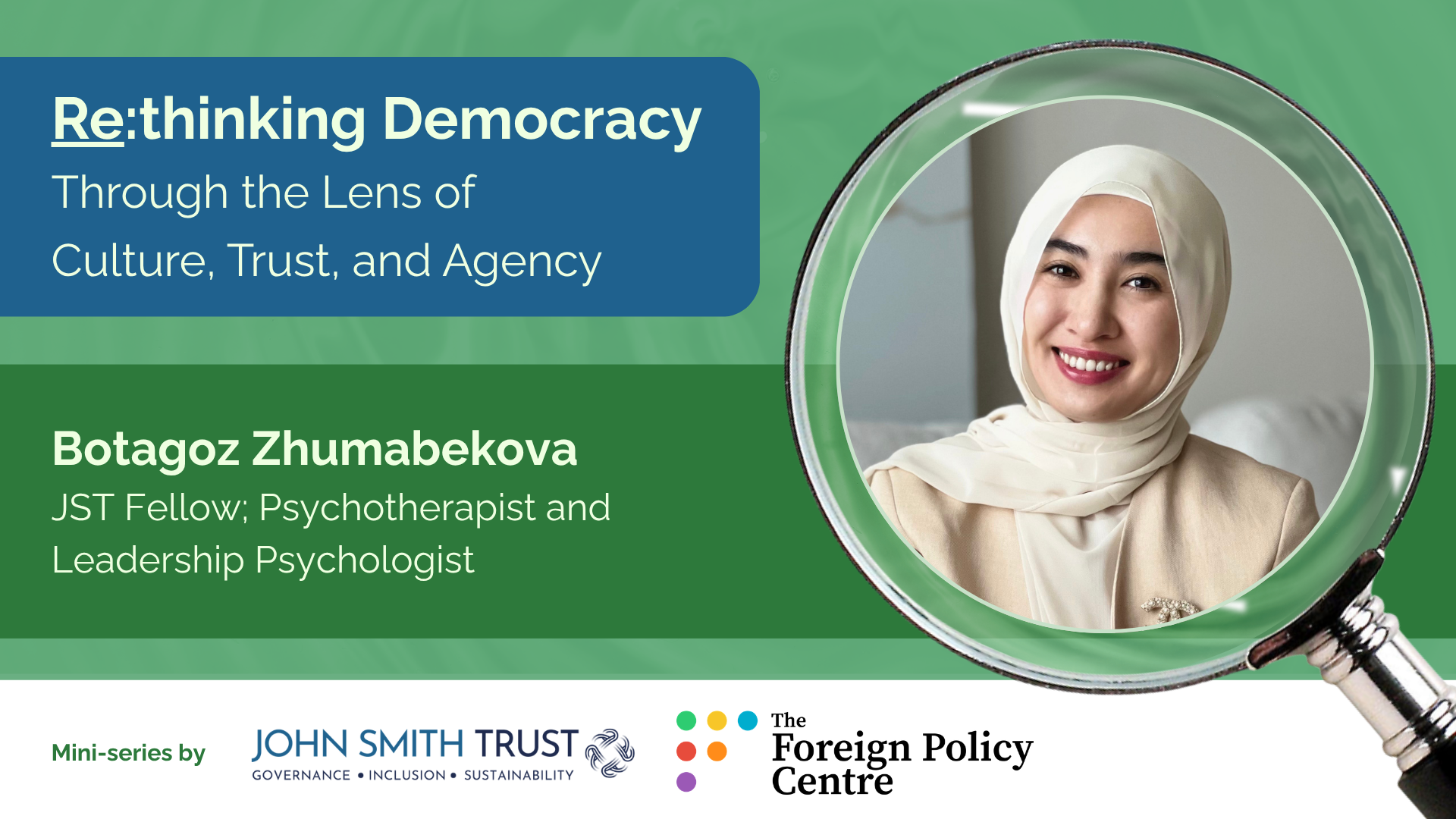
Botagoz Zhumabekova is a psychotherapist and leadership psychologist, working at the intersection of emotional resilience, trauma-informed practice, and social change. Her professional background spans consulting for major international institutions, including serving as an independent consultant for European Bank (EBRD) projects. Botagoz is the author of a research project on leadership psychology and self-esteem, conducted in collaboration with senior women leaders and partners from major international corporations. In her therapeutic and group work, she specialises in the psychology of leadership, intergenerational trauma, and the emotional patterns that influence civic behaviour and decision-making.
Disclaimer: The views expressed in this piece are those of the individual author and do not reflect the views of The Foreign Policy Centre.
[1] Roger Sapsford and Pamela Abbott, Trust, confidence and social environment in post-communist societies, Communist and Post-Communist Studies, Volume 39, Issue 1, March 2006, pp. 59-71, https://www.sciencedirect.com/science/article/pii/S0967067X05000668