In 2023, Professor Martin Scott examined the early performance of the Media Freedom Coalition in an article for the Foreign Policy Centre, reflecting on whether the initiative had achieved the “re-set” recommended in an independent evaluation. As the UK now retakes the Coalition’s co-chairmanship, this article considers what practical steps the government should take to strengthen international support for media freedom.
The UK has just become the new co-chair of the Media Freedom Coalition (MFC), alongside Finland.[1]
This is a welcome move given the current vacuum in leadership for supporting media freedom on the international stage. However, this new role must be accompanied by demonstrable improvements in both the scale and scope of the UK’s international support for independent journalism.
The MFC is a global partnership of 51 countries working together to promote press freedom both domestically and internationally.
As a G7 country and permanent member of the UN Security Council, the UK’s leadership of the MFC provides an opportunity to bring significant visibility and political weight to its work.
The UK also has a comparatively large diplomatic service making it well placed to strengthen the activities of the MFC’s embassy network – which monitors specific court cases, engages in private diplomacy, and coordinates joint statements.[2]
In addition, as one of the MFC co-founders in 2019 and an inaugural co-chair until 2022, the UK has valuable institutional knowledge and established relationships with civil society organisations linked to the Coalition.
However, the UK’s recent track record in supporting media freedom internationally is not as strong as that of many other MFC member states. In 2025, the UK was ranked joint 12th out of 30 on the International Media Freedom Support (IMFS) Index – qualifying for the lowest, ‘bronze’ category.[3] The IMFS Index evaluates 30 states based on their contributions to diplomatic, financial and safety initiatives that promote media freedom. A fuller discussion of the IMFS Index can be found in a recent FPC article by Martin Scott and Professor Mel Bunce.
Sweden (2nd), the Netherlands (3rd), Germany (=5th), France (=5th), Canada (8th) – and even some countries with significantly lower state capacity such as Lithuania (1st) and Estonia (4th) – all scored significantly higher than the UK on the 2025 IMFS index.
Given this, the UK must make demonstrable improvements to the scale and scope of its international support for independent journalism if it is to offer credible international leadership on media freedom.
Here are 5 ways the UK can achieve this:
1. Introduce a dedicated emergency visa scheme that explicitly includes provision for media workers in exile. The MFC’s independent legal advisory arm – the High-Level Panel of Legal Experts on Media Freedom – has consistently designated this a priority area and provided MFC states with clear guidance on how to implement a suitable scheme for journalists at risk.[4] Unfortunately, only five MFC member states – Canada, Czechia, Estonia, Latvia and Lithuania – have so far implemented such a scheme. Between them, they have issued over 1,000 visas or residence permits to media workers in exile under these schemes since 2020. Implementing a similar scheme in the UK will require stronger internal collaboration between the Foreign, Commonwealth & Development Office (FCDO) and the Home Office.
2. Support a national initiative that promotes the protection and safety of media workers in exile. Journalists at risk require not only legal protection – but also practical support to rebuild their lives and continue their work. Germany, for example – who the UK is replacing as MFC co-chair – supports the Hannah Arendt Initiative, a network of civil society organisations that protects and supports journalists from Afghanistan, Ukraine, Russia, Belarus and elsewhere.[5] As co-chair of the MFC, the UK should be supporting a similar initiative.
3. Increase the proportion of international aid allocated to supporting independent media. In 2023 – the most recent year we have figures for – the UK allocated just 0.1% of its international aid to media development. This is nowhere near the benchmark of 1.0% recommended by the Forum on Information & Democracy and even lower than the average of 0.16% for all 30 states measured in the IMFS Index.[6] As its aid budget is reduced, support for media development must be retained as a strategic priority if the UK is serious about defending press freedom internationally.
4. Ensure consistent, long-term financial support for the BBC World Service. As one of the most trusted international news providers – reaching 435 million people each week – the BBC World Service is one of the most effective instruments in the world for supporting access to reliable information.[7] Speaking at the UK Media Freedom Forum, Foreign Affairs Select Committee Chair Emily Thornbury highlighted its strategic importance, asking: ‘Why aren’t we tripling funding to the BBC World Service? It should be a major priory for this country… Particularly with the cutbacks we are making on aid… Let’s at least have a really good presence in terms of helping people understand what’s going on in the world’.[8]
5. Contribute to multilateral pooled funds dedicated to supporting international journalism. The UNESCO-administered Global Media Defence Fund (GMDF) and other similar, pooled funds can, in principle, provide an effective way of coordinating resources, providing core support to local entities, reducing the earmarking of contributions, and supporting the principle of multilateralism. [9] However, in 2024, the UK only contributed to one such fund – the GMDF. By comparison, in 2024, France awarded funding to all four qualifying multilateral pooled funds and in 2025 hosted a high‑level conference on information integrity and independent media at the Paris Peace Forum – where further financial support was pledged. [10]
According to the 2025 IMFS Index, no country is currently performing consistently well across all three dimensions of support for media freedom: diplomacy, funding and safety.[11] As MFC co-chair, the UK has the opportunity – and obligation – to fill this gap in international leadership.
Achieving this does not require reinventing the wheel. Just the political will to deliver on existing commitments.
As Chris Elmore, FCDO Minister for Multilateral and Human Rights, recently said, “What I want to see, through us retaking the chair of the Media Freedom Coalition, is a move back to the original pillars of this work to ensure that we have meaningful outcomes”.[12]
I agree.
Martin Scott is a Professor of Media and Global Development at the University of East Anglia. His publications include, ‘Capturing News, Capturing Democracy’ (2024), ‘Humanitarian Journalists’ (2022), ‘Media and Development’ (2014) and ‘From Entertainment to Citizenship’ (2014).
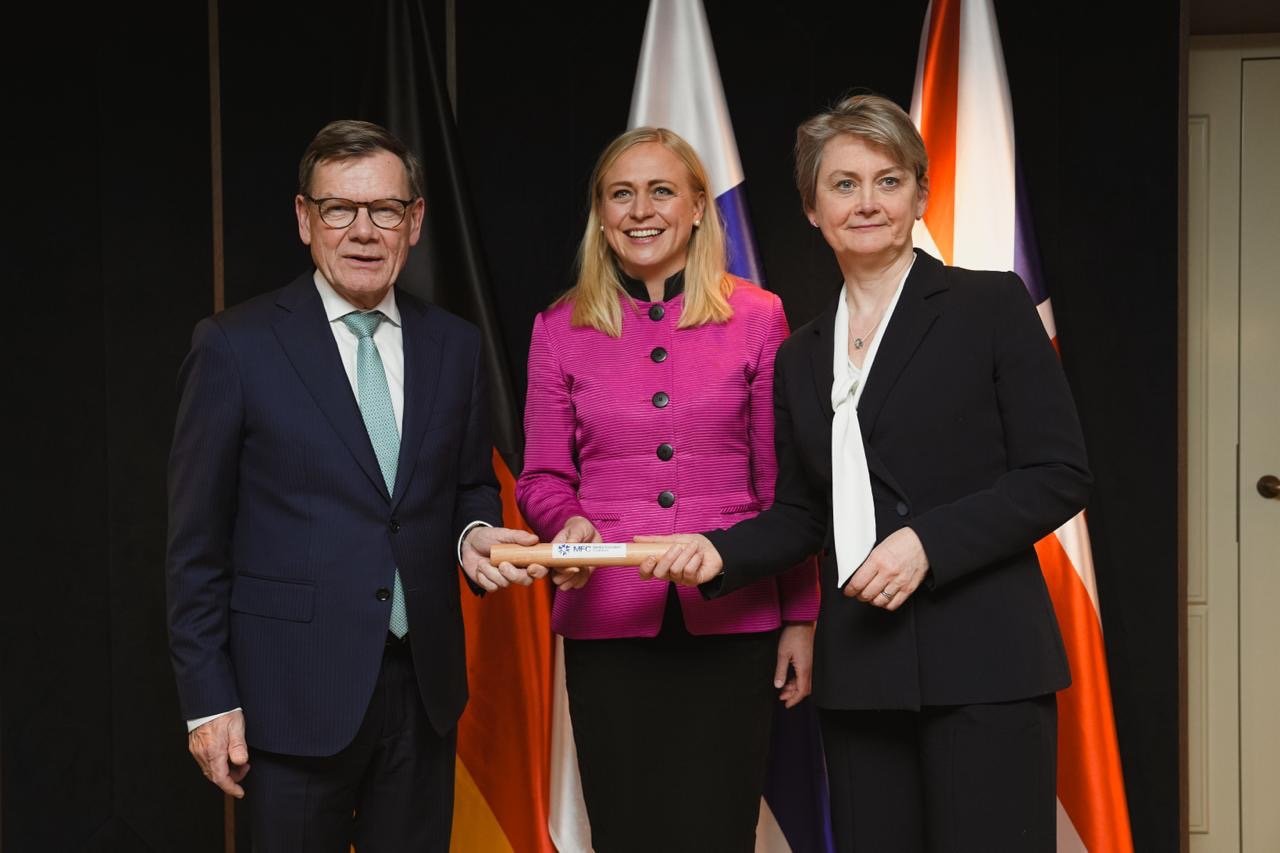
Image: Johann Wadephul, Federal Minister for Foreign Affairs of Germany (left), Elina Valtonen, Minister for Foreign Affairs of Finland (centre), and Yvette Cooper British Foreign Secretary (right); credit: Ben Dance / UK Foreign, Commonwealth & Development Office
Disclaimer: The views expressed in this piece are those of the individual authors and do not reflect the views of The Foreign Policy Centre.
[1] Media Freedom Coalition, Home Page, https://mediafreedomcoalition.org/
[2] Media Freedom Coalition, MFC Embassy Networks, https://mediafreedomcoalition.org/activities/embassy-networks/
[3] Centre for Journalism and Democracy, The Index on international Media Freedom Support (IMFS) 2025, 2025, https://jdem.org/wp-content/uploads/2025/10/IMFS-full-report.pdf
[4] Media Freedom Coalition, High-Level Panel of Experts, N.A., https://mediafreedomcoalition.org/who-is-involved/high-level-panel-of-legal-experts/
[5] Network for the protection of journalists and media worldwide, Hannah Arendt Initiative, https://hannah-arendt-initiative.de/en/hannah-arendt-initiative/
[6] Forum on Information and Democracy, The Forum on Information and Democracy calls for a New Deal for Journalism, June 2021, https://informationdemocracy.org/2021/06/16/the-forum-on-information-and-democracy-calls-for-a-new-deal-for-journalism/
[7] BBC, BBC’s response to global news events drives audience growth, July 2025, https://www.bbc.co.uk/mediacentre/2025/bbc-response-to-global-news-events-drives-audience-growth
[8] UK Media Freedom Forum, Home Page, https://mediafreedomforum.co.uk/
[9] UNESCO, Global Media Defence Fund, https://www.unesco.org/en/global-media-defence-fund
[10] French Embassy and Consulates General in the UKParis Peace Forum: 29 States commit to information integrity and independent media, November 2025, https://uk.diplomatie.gouv.fr/en/paris-peace-forum-29-states-commit-information-integrity-and-independent-media
[11] Centre for Journalism and Democracy, The Index on international Media Freedom Support (IMFS) 2025, 2025, https://jdem.org/wp-content/uploads/2025/10/IMFS-full-report.pdf
[12] UK Parliament, Foreign, Commonwealth and Development Office
Volume 781, March 2026, https://hansard.parliament.uk/Commons/2026-03-04/debates/8C008AEB-0F64-4A12-A157-368EA0118C0A/ForeignCommonwealthAndDevelopmentOffice#contribution-490D078B-AA2C-4241-8EE2-3F4DDDF44EF0