When Hungarians head to the polls on 12th April 2026, there will be more at stake than whether the country’s current Prime Minister, Viktor Orbán, wins another term. The outcome of the elections will reverberate well beyond Hungary, particularly in relation to the dynamics surrounding the Russian war against Ukraine.[1] As a member of both the European Union (EU) and the North Atlantic Treaty Organisation (NATO), the next Hungarian government will have significant influence over a range of major, and closely connected geopolitical issues, especially Russia’s ongoing war in Ukraine and the future of the transatlantic alliance.
The current Hungarian government, and Orbán personally, have had strong pro-Kremlin leanings for years.[2] This has on many occasions delayed crucial EU support for Ukraine and the imposition of further sanctions on Russia.[3] At the time of writing, Hungary is holding up the disbursement of an already agreed €90 billion loan to Ukraine over a dispute about the delivery of Russian oil via the Druzhba pipeline that crosses Ukraine. The pipeline was damaged by a Russian strike in late January, and Hungary alleges that Ukraine is deliberately dragging its feet in repairing it.[4] EU leaders, in turn, have accused Hungary of blackmail over the issue; but despite their collective outrage, they have so far failed to release the funds because of the Hungarian veto, which Orbán has also turned into a key campaign issue.[5]
While Orbán’s defeat could mean progress on this specific issue, it would hardly shift the dial on two other related issues. One is the Hungarian dependence on Russian oil: with the opposition candidate, and Orbán’s main challenger, Peter Magyar, already stating that there is no short-term alternative to the continued imports of Russian oil.[6] This potentially sets up a new battle between Budapest and Brussels, as the EU is firmly committed to ending Russian oil and gas imports.[7] A proposal to legally ban any imports of Russian oil into the EU may be currently on hold, but is hardly off the agenda.[8]
The second issue is that this is not only a ‘Hungarian problem’ for the EU. Orbán’s stance on the loan to Ukraine has also been backed by the leaders of Slovakia (another Russian oil customer) and the Czech Republic, Robert Fico and Andrej Babiš respectively.[9] Both have expressed similar EU- and Ukraine-sceptic views as Orbán, and are likely to continue acting as a thorn in the side of other EU member states and the institutions in Brussels that are more supportive of Ukraine. They also share Orbán’s framing of Ukraine as an economic burden and a security threat, which has been one of the dominant themes of the Hungarian election campaign.[10]
To complicate matters further, Magyar takes a very similar line and is likely to uphold Hungary’s veto on Ukraine’s fast-track EU accession.[11] Orbán’s election defeat, if it were to happen, might be welcomed in Brussels and other European capitals,–but as others have already commented Magyar’s “victory would not signal an overnight thaw in ties with Kyiv”[12]. Nor would it be an end to divisions within the EU over how to support Ukraine and deal with Russia.
There is also an important transatlantic angle. Orbán has received strong endorsements from US President Donald Trump and his Secretary of State, Marco Rubio, with the latter telling him that “your success is our success”.[13] This underlines Orbán’s role in the broader global alliance of illiberal populists, ranging from Trump’s MAGA movement in the US to the far right parties the National Rally in France and the AfD in Germany, as well as the Hungarian Prime Minister’s Czech and Slovak allies.[14] The concept of ‘the West’ pushed by this alliance sits comfortably with Trump’s vision of a new world order, as articulated by Rubio at the Munich Security Conference earlier this year.[15] However, it is fundamentally at odds with the hitherto prevailing European vision of a rules-based international order.
This order of old is now under threat from both Russia and the US. A win for Orbán would therefore clearly be as much a setback from a European perspective as it would be celebrated in the White House, as the endorsement of an illiberal Christian nationalist vision of the West. It would potentially boost other ideological allies of the Trump administration in upcoming elections elsewhere in Europe, such as in France and Poland next year (for which the Hungarian elections could be an important bellwether); as well as further fragment and disrupt what is left of the once solid Euro-Atlantic alliance that underpinned the rules-based international order.
Despite the setbacks that can be expected, a win for Orbán will not necessarily spell the complete end of a liberal democratic model anchored in the EU. Yet the space within which this model can survive will be a shrinking one in need of allies.
The Hungarian elections crystallise both the fragility of the EU consensus on Ukraine and the rupture in the transatlantic alliance. Regardless of their outcome, they are a symptom of, and a catalyst for, the further acceleration of the institutional remaking of the European security order, especially around the core of EU and NATO members that have come together in the ‘coalition of the willing’. Such a core, once it has become more firmly established, could also become a more effective counterweight to the undoing of the rules-based order and the unmaking of the West. It would not preserve the liberal order that has already been eroded, but might anchor a new order that is less illiberal than that envisaged by Orbán and his transatlantic and Eurasian supporters and allies.
Mayank Sethi is a final year Master’s student in International Relations from the University of Birmingham. Mayank has previously served with the Embassy of Denmark in India and other diplomatic missions in Delhi. He has been an active debater and has participated in national and international debates. He actively participates in forums and policy events in London which are hosted by Embassies and think tanks.
Tamzin Trigg is an MA International Security student at the University of Birmingham, with a BA in Law with Humanities. She is currently a Research Intern at the State Capture Accountability Project.
Stefan Wolff is Professor of International Security in the Department of Political Science and International Studies, at the University of Birmingham. A political scientist by background, he specialises in the management of contemporary security challenges, especially in the prevention and settlement of ethnic conflicts, in post-conflict state-building in deeply divided and war-torn societies, and in contemporary geopolitics and great-power rivalry. Wolff has extensive expertise in the post-Soviet space and has also worked on a wide range of other conflicts elsewhere, including in the Middle East and North Africa, in Central Asia, and in sub-Saharan Africa. Wolff holds degrees from the University of Leipzig (Erstes Staatsexamen), the University of Cambridge (M.Phil.), and the LSE (Ph.D.).
Disclaimer: The views expressed in this piece are those of the individual authors and do not reflect the views of The Foreign Policy Centre.
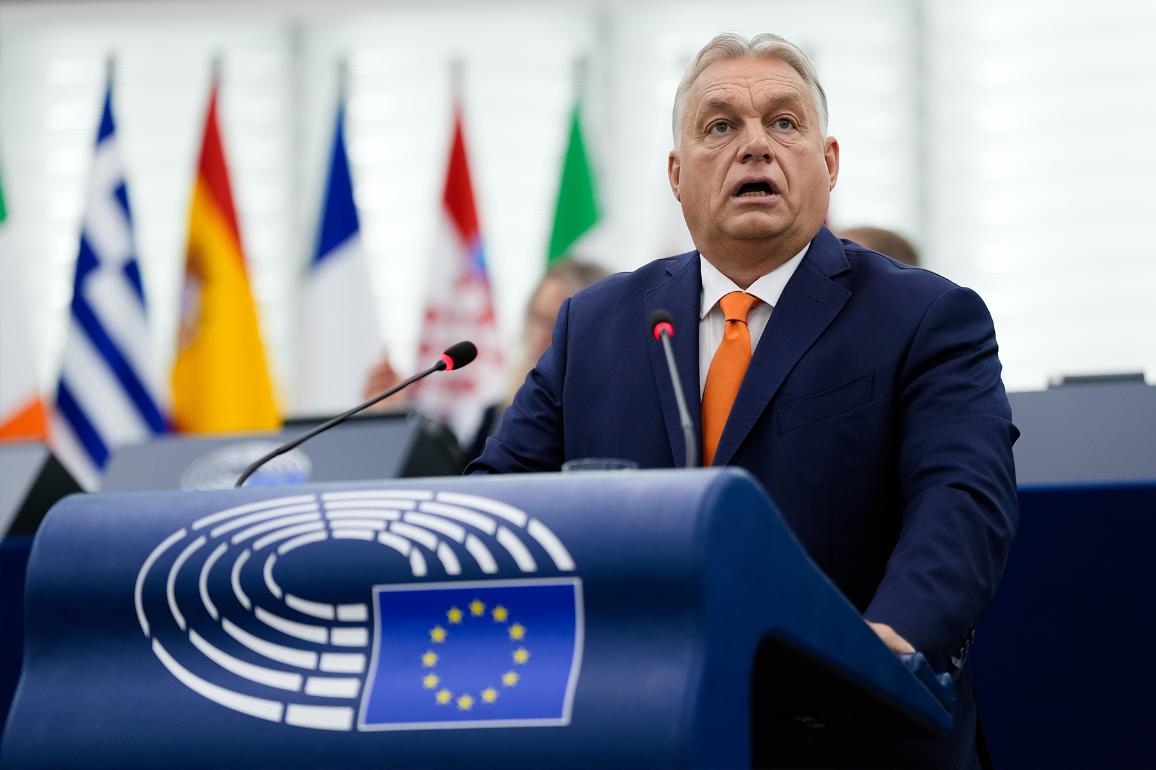
Image: Prime Minister Viktor Orbán addresses the plenary on the priorities of the Hungarian Council Presidency © European Union 2024 – EP
[1] Donatienne Ruy and Maria Snegovaya, What Is at Stake in Hungary’s Election?, Center for Strategic and International Studies, March 2026, https://www.csis.org/analysis/what-stake-hungarys-election.
[2] Jamie Dettmer, How Viktor Orbán became Vladimir Putin’s best friend in the EU, Politico, March 2026, https://www.politico.eu/article/viktor-orban-vladimir-putin-eu-hungary-russia/.
[3] Richard Whitman and Stefan Wolff, EU agrees €90 billion loan to Ukraine, but squabbles over frozen Russian assets expose the bloc’s deep divisions, The Conversation, December 2025, https://theconversation.com/eu-agrees-90-billion-loan-to-ukraine-but-squabbles-over-frozen-russian-assets-expose-the-blocs-deep-divisions-272095.
[4] Nick Thorpe and Vitaliy Shevchenko, Ukraine-Hungary oil pipeline row threatens EU loan, BBC, March 2026, https://www.bbc.co.uk/news/articles/cr71rkeg7xxo.
[5] Alys Davies, Hungary’s Orbán accused of disloyalty and blackmail over Ukraine loan veto, BBC, March 2026, https://www.bbc.co.uk/news/articles/cq6jrvgqeejo.
[6] Pablo Gorondi and Ray Furlong, Hungarian Opposition Leader Magyar Tells RFE/RL No Quick End To Russian Energy Imports, RFE/RL, October 2025, https://www.rferl.org/a/hungarian-opposition-leader-magyar-russia-energy-imports/33559475.html
[7] European Council, Timeline – Ending Russian energy imports, https://www.consilium.europa.eu/en/policies/ending-russian-energy-imports/timeline-ending-russian-energy-imports/.
[8] Lili Bayer and Kate Abnett, EU to propose permanent ban on Russian oil after Hungary election, document shows, Reuters, February 2026, https://www.reuters.com/business/energy/eu-propose-permanent-ban-russian-oil-after-hungary-election-document-shows-2026-02-24/ and Kate Abnett, EU delays April 15 proposal to permanently ban Russian oil imports, Reuters, March 2026, https://www.reuters.com/business/eu-delays-april-15-proposal-permanently-ban-russian-oil-imports-2026-03-24/
[9] Alex Stezhensky, Hungary, Czech Republic, Slovakia refuse to join €90 billion EU loan program for Ukraine, The New Voice of Ukraine, December 2025, https://english.nv.ua/nation/hungary-czech-republic-slovakia-opt-out-of-eu-s-90b-loan-plan-to-support-ukraine-in-2026-2027-50569771.html
[10] Flora Garamvolgyi and Ashifa Kassam, Hungary’s Viktor Orbán seeking to drum up votes by doing down Ukraine, The Guardian, February 2026, https://www.theguardian.com/world/2026/feb/27/hungarys-viktor-orban-seeking-to-drum-up-votes-by-doing-down-ukraine. Hungarian (and/or Czech and Slovak) opposition to Ukrainian EU accession could also impede the prospects of neighbouring Moldova and cause further delay to EU enlargement in the Western Balkans.
[11] Bohdan Babaiev, Orbán’s top rival shocks with mixed message on Ukraine and Russia, RBC Ukraine, July 2025, https://newsukraine.rbc.ua/news/orb-n-s-top-rival-shocks-with-mixed-message-1753550644.html
[12] Max Griera, Zoya Sheftalovich and Nicholas Vinocur, Orbán’s gambit to revive his election hopes: A battle against the EU, Politico, February 2026, https://www.politico.eu/article/hungary-viktor-orban-gambit-to-revive-his-election-hopes-a-battle-against-the-eu/
[13] Ellen O’Regan, “Trump affirms ‘total endorsement’ of Orbán ahead of Hungary election”, Politico, 21 February 2026, https://www.politico.eu/article/trump-affirms-complete-and-total-endorsement-of-orban-amid-clash-with-eu/; Milena Wälde, “‘Golden age’: Rubio praises Orbán ahead of Hungary election”, Reuters, 16 February 2026, https://www.politico.eu/article/golden-age-marco-rubio-gushes-over-viktor-orban-pre-election-meeting/
[14] Gellert Tamas, The global authoritarian right loves Orbán – and that could cost him in Hungary’s elections, The Guardian, March 2026, https://www.theguardian.com/commentisfree/2026/mar/24/viktor-orban-hungary-elections-global-authoritarian-right.
[15] Felicia Schwartz, Rubio calls on Europe to join Trump’s new world order, Politico, February 2026, https://www.politico.eu/article/marco-rubio-msc-europe-we-belong-together/