
Civil society is how citizens can hold power to account. But what happens when organisations that exist to defend democratic life are no longer trusted to do so?
In functioning democracies, the answer barely needs asking. Transparent government, free expression, the right to challenge power and insist on the truth, all depend on a civil society that people believe in. It is through civil society that citizens engage with one another, mobilise in times of need, protect human rights, and advocate for change. When that belief erodes, so does the accountability it sustains.
For authoritarian governments, this erosion is not a problem. It is a strategy.
We are living in a time of profound uncertainty. The international rules-based order is no longer guaranteed. As authoritarianism and populism gain ground and democratic values come under pressure, civil society finds itself on the front line – and the forces working against it are organised and deliberate.
Propaganda, legal threats, and institutional failings are making civil society more vulnerable
Kyrgyzstan is a clear example of how civil society can become vulnerable. In April 2024, the country passed a law on ‘foreign representatives’, requiring NGOs that receive foreign funding to register with the government – echoing Russia’s and Georgia’s foreign agent laws, though without the same criminal liability.[1] This reflects a broader trend: growing authoritarianism and a shrinking civic space that make it harder for citizens and organisations to speak out.
Kyrgyzstan is not an isolated case. Across countries like Russia, Belarus, Georgia, and other Central Asian countries, the pattern is the same: governments are using legal pressure and narrative control to delegitimise the organisations that hold them accountable. In Russia, organised civil society and NGOs have been systematically portrayed as a threat to traditional values and national identity – and that same propaganda playbook is being exported across the region, eroding credibility of civil society organisations beyond its borders.
The threat is not solely external however. Parts of the NGO sector have been undermining their own credibility by remaining overly donor-centric, lacking transparency and failing to communicate their work and impact effectively to the public.
The effect of this sustained pressure on civil society and internal shortcomings is a loss of trust. People no longer believe that civil society organisations tell the truth, stand for something, or have anything meaningful to offer.
And when the connection between people and civil society breaks down, civil society can no longer fulfil its democratic function. The gap between organisations and the communities they exist to serve becomes a gap that weakens democracy.
So how should civil society respond?
Some of the challenges are practical: funding, legal pressure, hostile information environments. But the deeper challenge is rebuilding trust and relevance. Old approaches and instruments are no longer enough. Civil society organisations need to think critically about how they are reaching people, how they come across, and whether they truly understand the context in which they operate.
Starting internally: transparency, accountability, and effectiveness are vital. Suspicions that NGOs are ineffective or opaque are widespread, and organisations need to take this seriously. Trust is rebuilt through actions, not just communication.
Yet internal renewal is only half the work. The deeper challenge is rebuilding the connection with communities – and that begins with an honest reckoning about how that connection was lost in the first place. It means going to where people already are: the school gate, the local market, the community group, the places where trust is built through presence rather than broadcast. It means speaking in a language that people recognise and not jargon that requires explaining. And it means reducing financial dependence on external donors by developing more diversified, locally rooted funding – through the public sector, social entrepreneurship, and direct community support.
Organisations need to be clear about both the work they do and what they stand for. The issues that civil society organisations address are often the issues that matter to people. When organisations can clearly demonstrate their relevance and impact, trust becomes easier to build and sustain.
Finally, where possible, constructive dialogue with governments should not be abandoned. Civil society organisations should seek to cooperate on practical, less politically contested challenges, building confidence and relationships before attempting to address more difficult issues.
What leaders need in this moment
Civil society may be losing the narrative battle – but that does not mean war is lost. Leaders need a clear-eyed understanding of how we got here and what is at stake.
The forces working against democracy and civil society – authoritarianism, populism, propaganda, misinformation – are organised, deliberate, and adaptive. Responding to these forces requires not just resilience, but the willingness to change: to be honest about failure, to engage with people where they are, and to earn trust rather than assume it.
The goal is not simply to survive. It is to rebuild the kind of civil society that people feel belongs to them, one that reflects their concerns, speaks to their realities, and importantly, one that they would fight to defend.
Ultimately, trust cannot be demanded, it must be earned, sustained, and renewed over time.
Explore the full mini-series here.
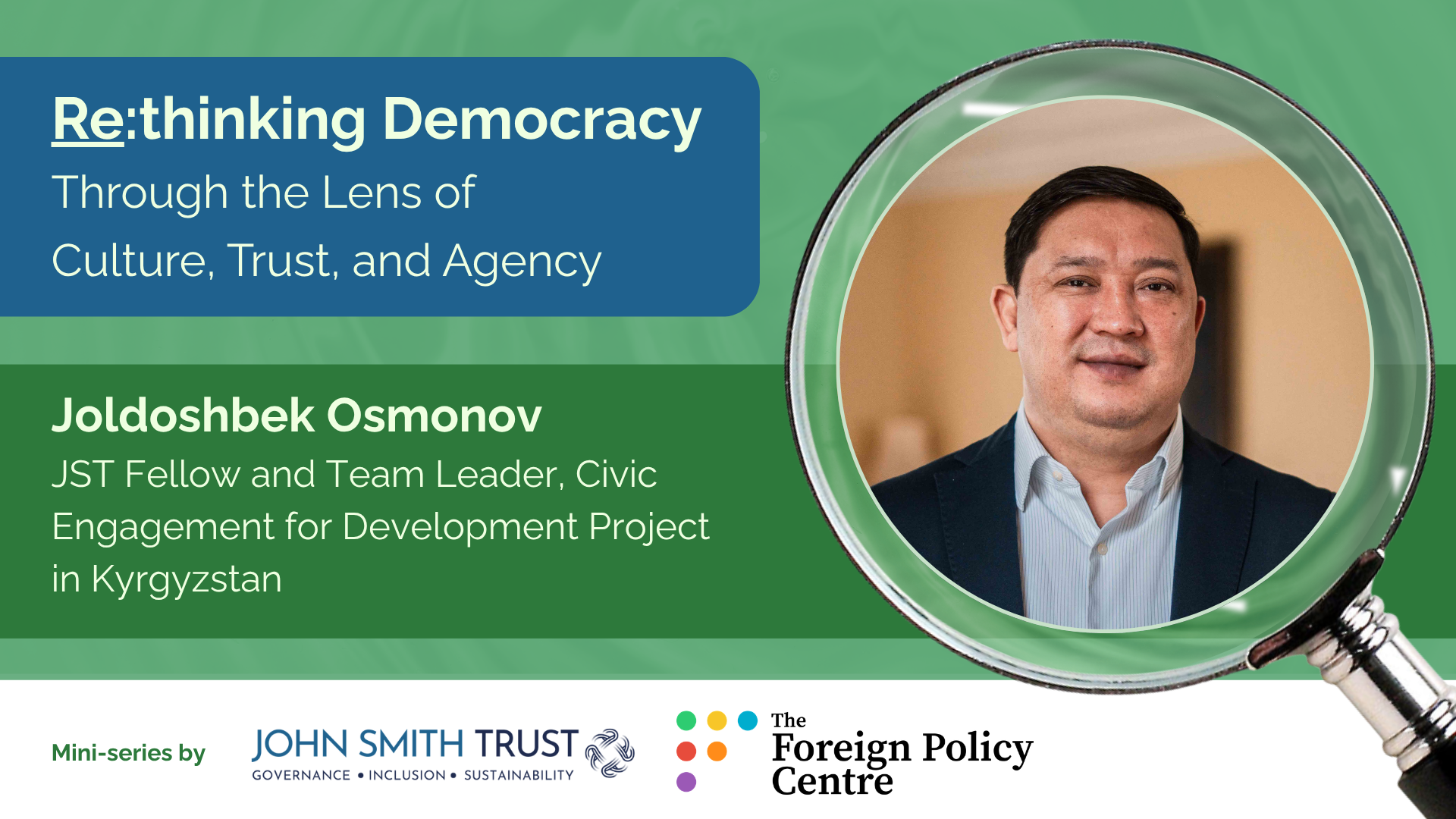
Joldoshbek Osmonov is the team leader of the Civic Engagement for Development Project in Kyrgyzstan funded by the Swiss Development Agency. He has extensive work experience in international development organisations, think tanks, and the civil society sector and possesses strong expertise in civil society, governance, public policy, and local politics. Joldoshbek holds a master’s degree in public administration from the University of Pennsylvania, the United States, and BA in international relations from the American University of Central Asia, Kyrgyzstan.
Disclaimer: The views expressed in this piece are those of the individual author and do not reflect the views of The Foreign Policy Centre.
[1] Radio Free Europe/ Radio Liberty, April 2024, Law Targeting Foreign-Funded NGOs Sends Chill Through Kyrgyz Civil Society, https://www.rferl.org/a/kyrgyzstan-foreign-agents-chill/32893000.html