Conflict and humanitarian crises have devastating consequences for healthcare systems, often leaving children without access to essential medical treatment. Yet the need for surgical care does not disappear when international attention shifts elsewhere. In this piece, Yusra Mardini and Sarah Masiyiwa explore why children’s surgical care must be a priority in humanitarian responses and long-term recovery.
In December 2024, the fall of the Assad regime, after nearly 14 years of devastating civil war, brought hope to many Syrians. But the end of a regime does not mean the end of a country’s suffering. When Yusra returned to Syria in 2025, ten years after being forced to leave her home, she found a country both familiar and profoundly changed. Beyond the physical destruction lay the enormous challenge of rebuilding the services and institutions people depend on every day.
Among them is surgical care for children.
Across Syria, an estimated 7.2 million children need humanitarian assistance Years of conflict have left healthcare facilities damaged, medical professionals displaced and families struggling to access even basic care. For children who need surgery, the consequences can be devastating. An injury that could be treated, a condition that could be corrected, or an infection that could be stopped can instead become a lifelong disability or cost a child their life.
Pictured: Yusra during her return to Syria in March 2025, ten years after fleeing the country. Photograph: Courtesy of UNHCR, via ELLE.
It is this challenge that has brought us together. Through the Yusra Mardini Foundation and Kids Operating Room, where Sarah serves as a trustee, we are joining forces to help strengthen children’s surgical care in Syria, working alongside local hospitals and medical teams as they rebuild the country’s healthcare system.
But Syria is one part of a much bigger challenge.
Around the world, children living through conflict, displacement and natural disasters face similar barriers to receiving essential surgical care. Through Kids Operating Room’s work in places such as Kakuma Refugee Camp in Kenya, the West Bank, Afghanistan, Ukraine and Haiti, we have seen how fragile healthcare systems can leave children without access to treatment that could transform or save their lives.
Children do not stop needing surgery because a country is at war. Babies are still born with conditions that require operations. Children still develop cancers, suffer injuries and experience infections that need urgent treatment. Yet damaged hospitals, unavailable equipment and medical staff forced to leave can put that care beyond reach. Amid the immense demands of a humanitarian crisis, these children risk becoming the unnoticed among the unseen.
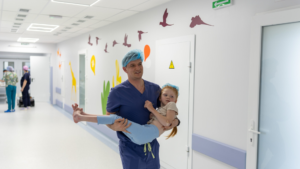
Pictured: Dr Bohdan carries a young patient through St Nicholas Hospital in Ukraine, where Kids Operating Room has installed a dedicated paediatric surgical facility, supporting local medical teams to provide essential care for children amid the challenges of war.
The tragedy is that the knowledge to treat many of these conditions already exists. What is missing is the capacity to put it into practice, where and when children need it.
And as crises continue for months or years, the problem can become even less visible. The headlines move on, international attention shifts, and emergency funding becomes harder to sustain. But children continue to need surgery.
For these children, waiting for healthcare systems to recover can mean losing years of their childhood, living with avoidable disabilities or not surviving at all.
Yet when surgery is possible, so much else becomes possible too: returning to school, playing with friends, growing up without pain and having the chance to pursue whatever future they choose.
We believe there needs to be a different approach.
Emergency humanitarian assistance will always be necessary. But we also need to think about what comes next, and what we leave behind. Too often, the urgent work of responding to a crisis is disconnected from the longer-term task of rebuilding the services communities depend on.
And when rebuilding begins, there is a risk of simply restoring what existed before, including the limitations and weaknesses that left healthcare systems struggling in the first place.
There is an opportunity to do things differently.
Rather than relying solely on temporary solutions or transferring children elsewhere for treatment, we should also be investing in local hospitals, specialist equipment and the medical teams who will continue caring for children long after international attention has moved on.
The best investments can meet urgent needs today while building stronger, more resilient healthcare systems for tomorrow.
This is what drives Kids Operating Room’s work around the world. The charity works alongside local surgical teams in some of the toughest places, where conflict, displacement and disaster have made safe surgery extraordinarily difficult. Together, they create the facilities, provide the equipment and strengthen the systems needed to deliver life-changing care to children.
It is also what has brought our two organisations together. The Yusra Mardini Foundation brings its commitment to advocating for refugees and communities affected by crisis, empowering people and creating opportunities for them to shape their own futures, while Kids Operating Room brings its experience of building lasting surgical capacity. Together, our ambition goes beyond simply building operating rooms. We want to make children’s surgery a lasting part of the healthcare systems that communities can depend on.
Syria is where we are putting that shared ambition into action.
Our first project together will be a rapidly deployable paediatric surgical unit at Al-Arbaeen Hospital in Ariha, Idlib Governorate, a region of Syria deeply affected by conflict and displacement. We are seeking approximately £1 million to create a fully equipped facility with dedicated operating, recovery and ward spaces, designed around the needs of local surgical teams. Drawing on modular healthcare projects in Juba, South Sudan, and the planned facility in Jericho, West Bank, this approach makes it possible to establish high-quality surgical facilities in a matter of days, providing a lasting foundation for children’s surgical care.
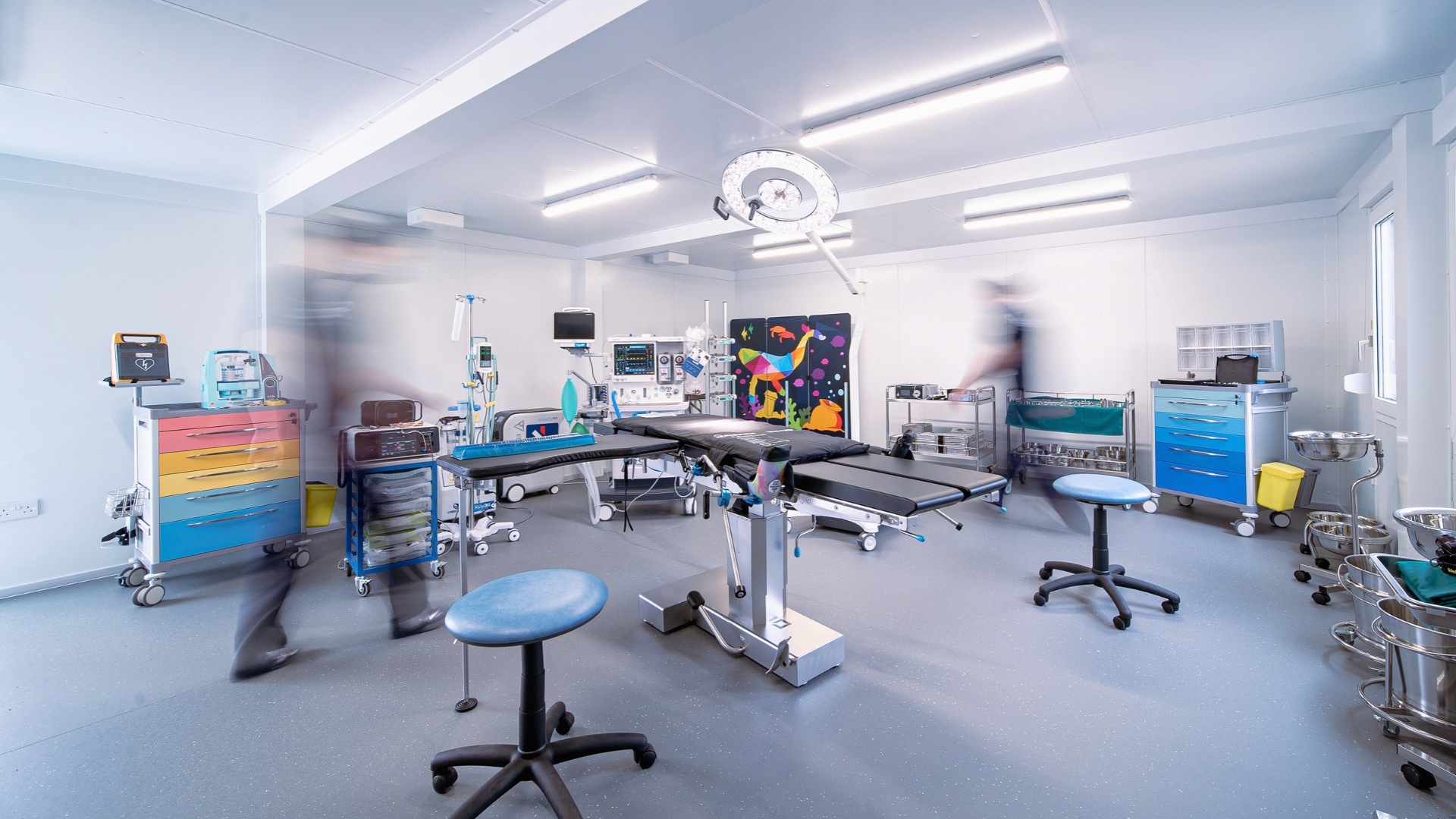
Pictured: Inside Kids Operating Room’s Field Readiness Hub in Dundee, Scotland. Assembled in just 48 hours, the facility demonstrates how high-quality, modular surgical environments can be rapidly established. A similar facility is planned for Syria, providing a lasting foundation for children’s surgical care.
The project’s significance extends well beyond the facility itself. It means giving Syrian surgical teams the tools to care for more children, reducing the need for families to make difficult journeys for treatment, and rebuilding essential healthcare capacity that will serve communities for years to come.
Our ambition goes beyond any single hospital or country.
We want children’s surgery to be recognised as an essential part of how the world responds to humanitarian crises, and how healthcare systems are rebuilt afterwards.
That means bringing governments, humanitarian organisations, funders and local medical teams together to think differently about what is possible. It means ensuring that children’s surgical needs are not overlooked as emergency assistance gives way to longer-term recovery. And it means backing practical investments that leave local hospitals stronger and better equipped to serve their communities.
This November, alongside the Foreign Policy Centre, we are bringing this conversation to Westminster. We hope it will be an opportunity not only to draw attention to an overlooked challenge, but also to build the partnerships and support needed to do something about it.
If we are serious about helping communities recover from conflict and crisis, we must recognise that rebuilding healthcare means more than responding to the next emergency. It means ensuring that children can access the treatment they need to grow up healthy and live their lives to the full.
Because surgery does more than save children’s lives. It gives them the chance to return to school, to play, to dream and to shape futures of their own choosing. Making safe surgery possible means giving children the chance to make anything possible.
Children who need surgery cannot afford to wait until the world’s attention returns. And they should not have to.
Yusra Mardini is a two-time Olympian, founder of the Yusra Mardini Foundation and UNHCR Goodwill Ambassador.
Sarah Masiyiwa is a Zimbabwean media producer and investor with a background in journalism and documentary filmmaking, committed to advancing Africa’s future through storytelling, investment and philanthropy. A trustee of Kids Operating Room since 2019, her philanthropy focuses on building and strengthening health and education systems.
Disclaimer: The views expressed in this piece are those of the individual author and do not reflect the views of The Foreign Policy Centre.
[1] UNICEF, Syrian Arab Republic Appeal, Humanitarian Action for Children, August 2026, https://www.unicef.org/appeals/syria; European Union Agency for Asylum (EUAA), 4.6. Health care, Syria: Country Focus, July 2026, https://www.euaa.europa.eu/syria-country-focus/46-health-care