
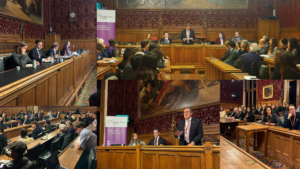
On 10 November, the Foreign Policy Centre (FPC) and Leiden University brought together policymakers, academics, practitioners, students, and members of civil society in a packed Committee Room at the Palace of Westminster to examine what the 2026 US midterm election results mean for the United States and its partners around the world.
Chaired by Lord Robertson of Port Ellen, the event brought together Dr Andrew Gawthorpe, Associate Professor at Leiden University and Senior Research Fellow at FPC; Kevin Maloney, Chief Public Affairs Officer at Carnegie Council for Ethics in International Affairs; Laurel Rapp, Director of the US and North America Programme at Chatham House; and Professor Mel Bunce, Professor of International Journalism and Politics at City St George’s, University of London.
The event focused on three broad questions: what the midterms revealed about US politics; how the new balance of power could affect US foreign policy; and what developments the UK, Europe and other partners should now be watching.
“These midterm elections gave us the first hint of what a post-Trump political landscape might look like. That landscape seems to be dominated by economic concerns, with cultural and ideological clashes fading somewhat into the background. Yet it remains one in which America’s focus is turned inwards rather than outwards, which is important for the country’s allies to bear in mind”
Dr Andrew Gawthorpe, Associate Professor at Leiden University
Senior Research Fellow at FPC
Democratic resilience, but no room for complacency
Andrew Gawthorpe argued that the election demonstrated that democratic feedback mechanisms remain capable of responding to public dissatisfaction. The results also call into question the durability of the Republican Party’s political coalition under President Trump and force both parties to face questions about how to position themselves ahead of the 2028 presidential election
Mel Bunce similarly highlighted the need to avoid overly deterministic assumptions about the role of campaign spending – i.e that money is power – this election showed it was not sufficient for Republicans to hold their seats and that this may mark a shift in thinking about campaign spending in the future. However, while misinformation and disinformation remain significant challenges, their influence on electoral outcomes proved less straightforward than some expectations had suggested.
At the same time, panellists cautioned against treating one election result as evidence that deeper institutional vulnerabilities have disappeared. The discussion highlighted the weakening of parts of the US democratic and information infrastructure in recent years, and the importance of considering what may be difficult to rebuild even where electoral processes continue to function.
Congress gains leverage, but the presidency still matters
Laurel Rapp noted that the Democratic gains had exceeded even the party leadership’s ‘wildest expectations’. She also outlined a number of areas in which Congress could exert greater influence, including through oversight and investigations, control over budgets, scrutiny of appointments, and powers relating to treaties and military action.
These levers could become particularly important on issues including Ukraine, Iran, tariffs and the US’ relationships with key partners.
However, the discussion also stressed the limits of congressional power over foreign affairs. The President retains considerable authority over diplomacy, national security and international deal-making, meaning that changes in Congress will not necessarily translate into equally dramatic changes in US foreign policy.
Andrew Gawthorpe particularly noted that the appointment of Stephen Miller as White House Chief of Staff was a signal that Trump did not anticipate engaging constructively with Congress and in particular any investigations into potential wrongdoing by his administration.
What values will the US project internationally?
Kevin Maloney examined the role of political and moral ideas in shaping how the US defines its interests and responsibilities abroad. He described the Trump administration’s approach to foreign policy as increasingly transactional, warning that disregarding international law could ultimately undermine US interests and its international standing. The discussion went beyond individual policy decisions to consider what the US is signalling internationally through its approach to alliances, humanitarian engagement, trade and the use of force.
For allies and partners, this raises wider questions about continuity and reliability. The challenge is not simply to assess the impact of one election result, but to understand whether the political ideas shaping US engagement with the world are changing in more lasting ways.
“The changing balance of power in Washington, D.C., combined with the coming end of Trump’s second term, provides fertile ground for serious debates about the value systems that will inform U.S. foreign policy moving forward. Over the next two years, we will see robust discussion both between Democrats and Republicans and within the parties about which principles will serve as a north star.”
Kevin Maloney, Chief Public Affairs Officer
Carnegie Council for Ethics in International Affairs
The road to 2028
Although the midterms were the immediate focus of the discussion, attention repeatedly turned towards the next presidential election. For Democrats, the results are likely to shape an open primary and continuing debate over the future direction of the party. For Republicans, 2028 marks the first presidential race in a decade without Donald Trump himself on the ballot. The party will have to decide how to deal with Trump’s legacy at a time when the president is likely to remain highly unpopular.
This creates an important strategic question for Republican candidates: how closely to remain aligned with Trump while also developing an independent political identity.
The answer will matter not only for domestic politics, but also for foreign policy. Positions on China, Russia, alliances and trade could become increasingly important points of differentiation as the next election cycle develops. There could be an attempt in this period by Democrats to try to reset some norms and consequences for actions that violate those norms.
What should America’s partners watch next?
For the UK, Europe and other US partners, the key message from the discussion was that the significance of the midterms will become clearer over time.
The balance of power in Congress matters, but so too do the choices made by the administration, the evolving positions of both parties and the resilience of US institutions. Developments around Ukraine, Iran, tariffs, relations with China and the wider transatlantic relationship will provide important indications of how far the election changes the direction of US foreign policy.
As the discussion made clear, the midterms are not an endpoint. They are an important moment in a longer political transition that will shape both American democracy and the country’s role in the world over the next two years.
You can read more details about the event here.
Disclaimer: The views expressed in this piece are those of the individual contributors and do not reflect the views of The Foreign Policy Centre.