
On 19 and 20 May Astana held a symposium on the Golden Horde, a descendant state of the Mongol Empire.[1] This was not, however, an event limited to academics discussing an obscure topic, but rather the culmination of a historical narrative process that has been taking place in Kazakhstan over the past few years.
Since Kassym-Jomart Tokayev became president of Kazakhstan, the authorities have embarked on a quest for a new historical narrative, and they found it in the shape of the Golden Horde. This medieval khanate, which emerged from the descendants of Jochi, the eldest son of Genghis Khan, ruled the Eurasian steppe for three hundred years before disintegrating in the 15th century. It was a state that had been purposely overlooked by Tokayev’s predecessor, Nursultan Nazarbayev, and that had been much maligned during the Soviet period as it had dominated the Russian principalities.[2]
The process of embracing the Golden Horde started back in 2019. Since then, interest in the Ulus of Jochi has materialised in the establishment of a dedicated institute for its study, archaeological finds, history articles in non-specialised media, and even a TV series, among other developments.[3]
The timing and use of the Golden Horde by the Kazakh authorities are no coincidence. Tokayev’s New Kazakhstan was missing a national narrative to provide cohesion and distinguish itself from Nazarbayev’s discourse. The need for a historical narrative stretching back centuries became more acute in 2022, after Russia launched its full-scale invasion of Ukraine. Kazakhstan’s large neighbour to the north has on multiple occasions questioned Kazakhstan’s sovereignty and national identity, especially in the past few years.[4] The use of the Ulus of Jochi reaffirms the country’s own history centuries before Russian colonisation. In fact, for much of its existence, the Golden Horde exercised authority over the Russian principalities, but that is not the message Astana wants to emphasise in this New Kazakhstan.
The use being made of the Ulus of Jochi stays away from a bellicose tone or a strong nationalist sentiment. Instead of building the narrative around the Horde’s rulers, famous battles or monuments, Kazakhstan approaches it from a different perspective. It calls upon the medieval state’s diversity, role in global trade, intellectual and financial legacies. There are no bloody conquests or feats that could raise eyebrows in neighbouring countries.
As Tokayev put in the recent symposium: “this [the Golden Horde] is one of the most important pages in the chronicle of our country and all humanity.”[5] In other words, Astana aims to portray the Ulus of Jochi as a state whose legacy extends beyond modern Kazakhstan and possesses a universal rather than exclusive character.
The Golden Horde in the 21st century
The use of the Golden Horde by Tokayev for his New Kazakhstan can be considered a right choice for the purpose it seeks to articulate. Although over five centuries have passed since it ceased to exist, some of its characteristics can be useful to the Kazakh authorities in this day and age.
The Ulus of Jochi presents Astana a state in accordance with its current foreign policy aspirations. These descendants of Genghis Khan ruled an extensive empire that, at its height, stretched from the Black Sea in the west to Siberia in the east. At the same time, it maintained diplomatic relations with a wide range of states: from other Mongol successor empires, to European kingdoms and Islamic states. A true Eurasian empire that matches Kazakhstan’s role in modern geopolitics and its multi-vector foreign policy that includes China, Russia and the EU as key partners.
Like Kazakhstan today, the Jochid Ulus was also a multiethnic state. The Horde was home to Mongols, Turkic peoples and Slavs, among others. Despite Kazakhs being now the majority of the population, the country continues to preserve a diverse ethnic and linguistic mix. More than 70 ethnic groups live in the country, with large minority groups such as Russians (14.9% of the population), Uzbeks (3.3%) and Ukrainians (1.9%).[6] The Golden Horde, despite its strong turco-mongol character, existed before the emergence of nationalism, an ideology that can be harmful to the country’s multiethnic background.
Despite the reasons above, the choice of the Golden Horde as a national narrative is not without its issues and controversies.
This medieval polity occupied territories well beyond Kazakhstan, and Astana is not the only state that can claim its legacy, although so far no other has actively done so. Its principal capitals, for example, were located along the Volga in what is now Russia, even if they were less central to the state than the capitals of more sedentary medieval polities because of the Horde’s nomadic character.
Another key characteristic of the Golden Horde is missing from its modern interpretation: its military might and conquests. Among its most significant achievements was its domination of the Russian principalities and their vassalage to the Horde. This is not a pleasant topic for Moscow, which could use Kazakhstan’s embrace of Jochi’s descendants in its nationalist discourse and usual verbal attacks from its propagandists and officials against Tokayev’s government.
The way the narrative is being built also raises other questionable points. The virtues of the Horde are exalted, as expected, but it lacks historical figures with whom people can identify with. Contrary to what happens in Uzbekistan with Amir Timur (i.e. Tamerlane) and, to a much lesser extent, his descendants Ulugh Beg and Babur, Kazakhstan’s is shying away from the main historical figures of the Jochid Ulus.[7] And there is no shortage of them: from Batu (r. 1227-55), founder of the Golden Horde, to his brother Berke (1257-66), Uzbeg Khan (1313-41) or Jani Beg (1342-57), to name a few. But besides some mentions of Jochi himself, most other rulers and conquerors are overlooked.
The composition of the Golden Horde is another interesting subject. In its origin it was a Mongol state, and while later the Turkic component would gradually come to predominate, the link with the modern Kazakhs is not straightforward. The same happens from a state perspective. The Golden Horde is not the direct ancestor of Kazakhstan. The Ulus of Jochi fragmented permanently into different khanates in the 15th century, including those of Crimea, Kazan and Astrakhan, located in modern Ukraine and Russia, as well as the Uzbek and Kazakh khanates. The link between the latter and Kazakhstan is stronger than with the Golden Horde.
Why not the Kazakh Khanate?
There is a loser of Kazakhstan’s new interest in the Golden Horde and that is the Kazakh Khanate. This state established in the mid-15th century by Kerei and Janibeg, two nomadic leaders who broke away from the Uzbek Khanate in what is now southern Kazakhstan, is the most direct link modern Kazakhstan has to a historical past. It not only occupied roughly the current territory of the republic but was also the state that was later colonised by the Russians before Kazakhstan achieved its independence in 1991.
The Kazakh Khanate had been used to some extent by Kazakhstan’s first president, Nursultan Nazarbayev, notably when confronted by a familiar threat: Russia. While a statue of the khanate founders was unveiled in Astana back in 2010, it was not until 2014 that this state rose to prominence. This was a result of Vladimir Putin’s words a year earlier suggesting that “Kazakhs never had a statehood.”[8] Nazarbayev’s reaction was to celebrate the 550th anniversary of the khanate’s establishment the following year.
This Central Asian state produced notable rulers that could have been prominently promoted by Astana if the Kazakh Khanate was given more importance within the national narrative.
The khans Kerei and Janibeg might have been considered the principal founding fathers of the Kazakh nation. Kasym Khan could have been elevated as the national figure. Tauke Khan, together with his Zheti Zhargy (Seven Charters), could have been used to prove the existence of the Kazakh statehood from a legalistic perspective back in the 17th century.[9] Kenesary Khan (d. 1847), in turn, would have provided a heroic, yet ill-fated, national liberation figure centred on resisting the Russian invaders. However, beyond their presence through a small number of statues, commemorative coins, and educational curricula, these historical figures have largely played a supporting role in Kazakhstan’s nation-building process, rather than occupying a central symbolic position.
However, there are reasons why the Ulus of Jochi may be a more suitable choice for Kazakhstan’s aspiring role in the world. While the Golden Horde spanned the Eurasian steppe, the Kazakh Khanate’s borders were limited to modern-day Kazakhstan. It was a regional power, as the Uzbek Khanates found out through constant wars in the 16th century, but its role in world history is much more limited. In addition, it had a stronger Kazakh ethnic component, which works well when striking a nationalist chord, but lies out of place in a more diverse Kazakhstan that the authorities seek to promote today.
Conclusion
Five centuries after its dissolution, the Golden Horde is experiencing a revival in one of its former territories. The rediscovery of this medieval state in the 21st century reflects an attempt to build a historical narrative that supports modern Kazakhstan’s state identity and foreign policy objectives. By elevating the Ulus of Jochi, a Eurasian empire characterised by its territorial extension, multiethnic composition and transregional connectivity, Astana seeks to shape its current aspirations by drawing on the past.
At the same time, this new narrative highlights the limitations and shortcomings of a state-led historical construction. As outlined above, the direct link between the Golden Horde and modern Kazakhstan is open to debate, especially when compared to the Kazakh Khanate. Moreover, many of its key characteristics are deliberately overlooked in the search for a sanitised narrative that can be accepted both at home and abroad. The result is a balancing act that reflects both the opportunities and constraints of using the past as an instrument of modern nation-building.
Francisco Olmos is a Research Fellow at the Foreign Policy Centre. He is a researcher and analyst specializing in Central Asian affairs, focusing on nationalism, power transitions, and the geopolitics of the post-Soviet space. He is a Senior Researcher at GEOPOL 21, where he contributes analysis on Central Asia’s relations with Russia, China, and Western actors. Holding an MA in International Relations and World Order from the University of Leicester, Olmos frequently writes for think tanks and media outlets, participates in academic forums and podcasts, and was awarded the Beca Ruy de Clavijo for his work on Spain’s relations with Central Asia.
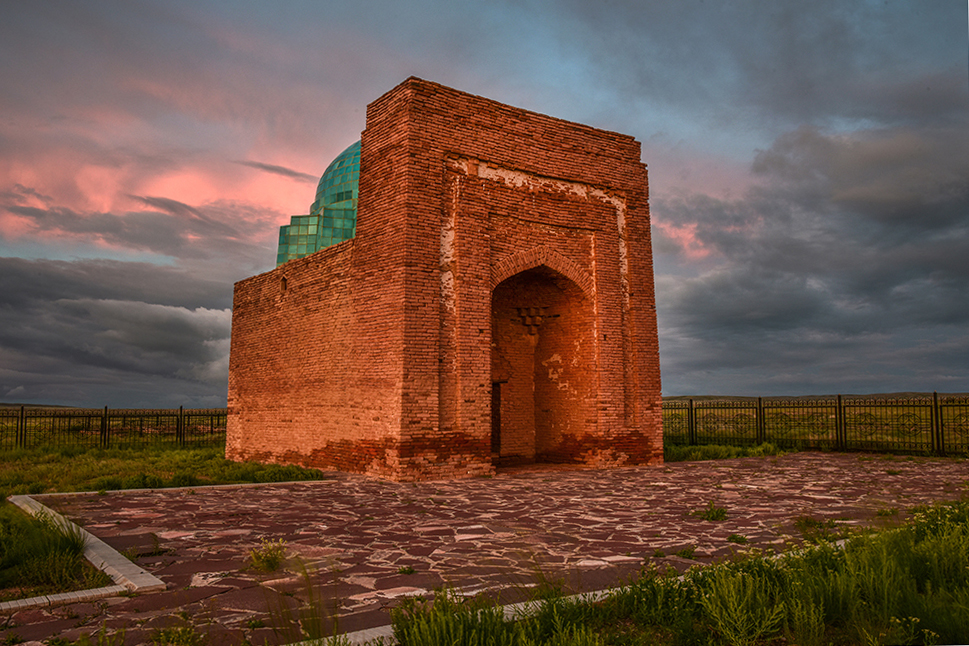
Image: © The Mausoleum of Jochi Khan
Disclaimer: The views expressed in this piece are those of the individual author and do not reflect the views of The Foreign Policy Centre.
[1] UNESCO, International Symposium on the Golden Horde Held in Astana under the Patronage of UNESCO, UNESCO, May 2026, https://www.unesco.org/en/articles/international-symposium-golden-horde-held-astana-under-patronage-unesco
[2] Bakhytzhan Kurmanov, Zhaxylyk Sabitov, and Rustem Kudaibergenov, Making the Golden Horde “Great Again”: Historians as Memory Actors and Reinterpretation of the Historical Narratives in Independent Kazakhstan, Nationalities Papers, Cambridge University Press, October 2025, https://www.cambridge.org/core/journals/nationalities-papers/article/making-the-golden-horde-great-again-historians-as-memory-actors-and-reinterpretation-of-the-historical-narratives-in-independent-kazakhstan/057D6F6125AE71CE3A62B0B5D6B4F147
[3] Aibarshyn Akhmetkali, Kazakhstan’s Ulus of Jochi Institute Explores Forgotten Eras of Statehood, The Astana Times, January 2025, https://astanatimes.com/2025/01/kazakhstans-ulus-of-jochi-institute-explores-forgotten-eras-of-statehood/; Aibarshyn Akhmetkali, Everything You Need to Know About Ulus of Jochi, The Astana Times, August 2024, https://astanatimes.com/2024/08/everything-you-need-to-know-about-ulus-of-jochi; Dana Omirgazy, The Golden Empire: Everything We Know So Far, Qazinform, July 2025, https://qazinform.com/news/the-golden-empire-everything-we-know-so-far-e7b35d
[4] Francisco Olmos, La sombra del nacionalismo ruso en Asia Central, Geopol 21, September 2024, https://geopol21.com/la-sombra-del-nacionalismo-ruso-en-asia-central/
[5] Office of the President of the Republic of Kazakhstan (Akorda), Address by the Head of State Kassym-Jomart Tokayev at the International Symposium “The Golden Horde as a Model of Steppe Civilization: History, Archaeology, Culture, Identity”, May 2026, https://www.akorda.kz/ru/vystuplenie-glavy-gosudarstva-kasym-zhomarta-tokaeva-na-mezhdunarodnom-simpoziume-zolotaya-orda-kak-model-stepnoy-civilizacii-istoriya-arheologiya-kultura-identichnost-1945730
[6] Bureau of National Statistics of Kazakhstan, [Statistical Report / Data File], 2024, https://stat.gov.kz/api/iblock/element/178068/file/en/
[7] Francisco Olmos, State-building Myths in Central Asia, The Foreign Policy Centre, October 2019, https://fpc.org.uk/state-building-myths-in-central-asia/
[8] Farangis Najibullah, Putin Downplays Kazakh Independence, Sparks Angry Reaction, Radio Free Europe/Radio Liberty, September 2014, https://www.rferl.org/a/kazakhstan-putin-history-reaction-nation/26565141.html
[9] Rafail N. Zinurov, “«Жеті Жарғы» («Семь установлений») Тауке-хана как великий памятник права: правовой обычай, судопроизводство и наказание” [“Zheti Zhargy (‘Seven Charters’) by Tauke Khan as a Great Monument of Law: Customary Law, Judicial Procedure, and Punishment”], Pravovoe gosudarstvo: teoriya i praktika, no. 4 (58) (2012): 32–37