Skip to content

Op-ed | International Aid as a Line of Defence: What Happens to Human Security Without Soft Power?

Article by Anna Chernova

April 24, 2026

Op-ed | International Aid as a Line of Defence: What Happens to Human Security Without Soft Power?

Securitisation of foreign (and domestic) policy is leading to a prioritisation of hard power approaches over civilian-led, soft power approaches, leaving many wondering about the future. As Europe rearms in response to the Russian threat to its collective security, and as the US proves itself an unreliable security partner, the UK finds itself repositioning within a fractured Euro-Atlantic alliance. This raises a broader question: how to de-securitise and return to “normal” politics?[1]


If militarism shapes the next generation’s approach to public policy, what are the prospects for addressing the root causes of violence that are driving the skyrocketing humanitarian needs and record levels of forced displacement? The impact of armed conflict is increasingly more severe and violence is becoming the new normal, while political solutions are de-funded and militarised approaches take precedence.[2]


As the UK and many other democratic states reduce investment into peacebuilding and other soft power efforts, resource constraints are affecting the very institutions that help prevent and mitigate conflict, support collective security, and promote diplomatic solutions.


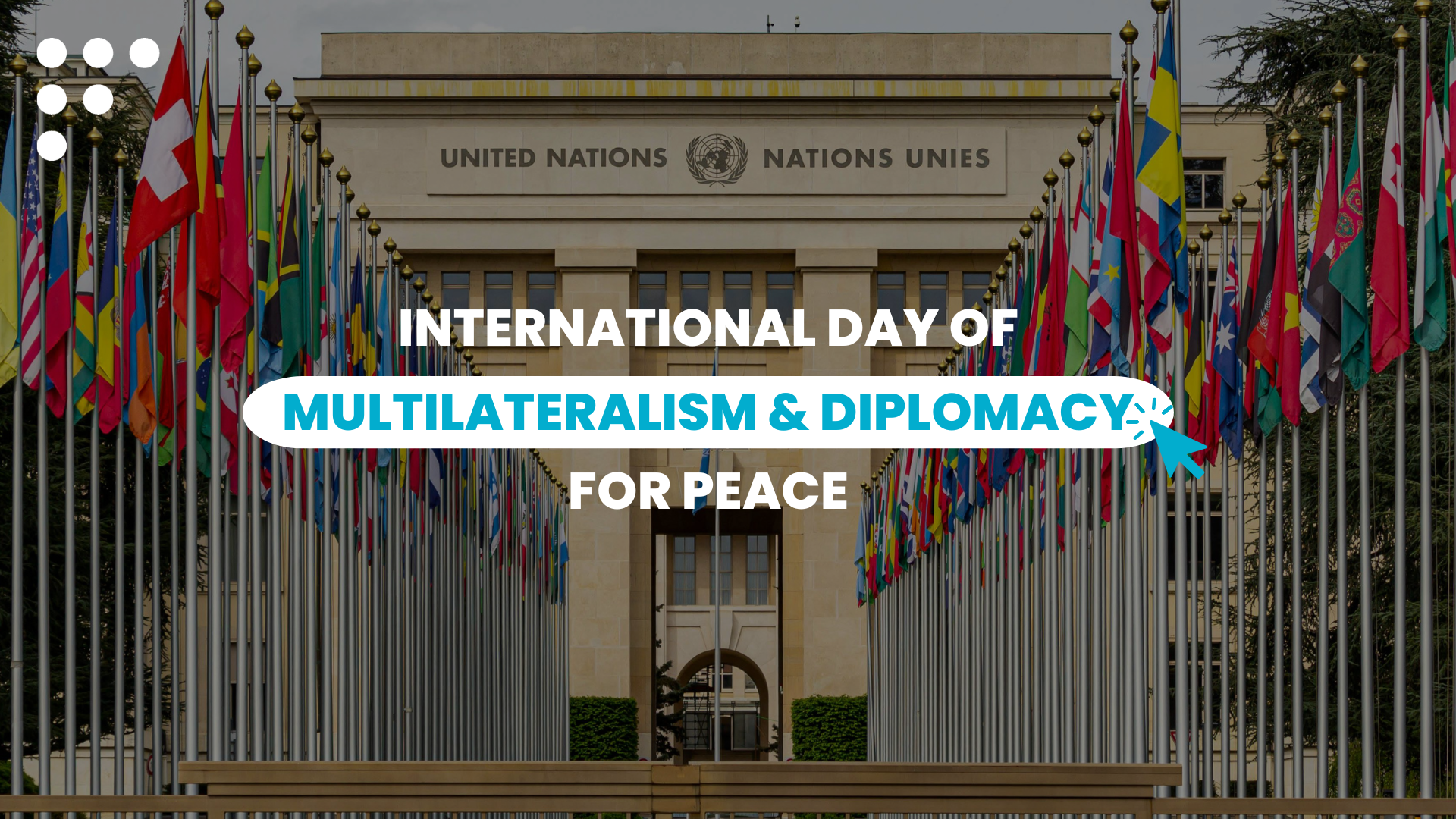
Today, the international community marks the importance of multilateralism and diplomacy for peace.


This takes place in a context of increasing global arms transfers, the proliferation of non-state armed groups, a resurgence of international armed conflicts, and systematic violations of the UN Charter across continents.[3] The low cost of entry into conflict for both state and non-state actors (in part enabled by globalisation, including access to technology, finance, and information), combined with social, economic and environmental factors, is undermining peace and other development goals. In a globalised order, military escalations in one region risk pushing millions into poverty, including in already conflict-affected contexts.[4]


This dynamic is also unfolding alongside increasing inequalities and restrictions on civic space. Democratic backsliding has reduced agency for civil society, including humanitarian actors, women’s rights groups, LGBTQI+ movements and many others relying on a rights-based, rules-based international world order – particularly in contexts where the states are unwilling or unable to adhere to a viable social contract. Without multilateral spaces, civil society voices risk further marginalisation and isolation in the face of expanding authoritarianism.[5] Without civic space, the positive peace agenda is undermined.


At the same time, significant reductions in aid are reshaping the UN and the multilateral architecture underpinning diplomacy for peace. Regional and global multilateral institutions and their civil society partners are grappling with a steadily increasing wave of violence and militarism with dwindling resources. The private sector, philanthropy, and new donors (e.g. in the Gulf) seem willing to meaningfully engage in ways that come close to replacing USAID’s contribution to pathways for peace, and the wider Nexus approach that brings together Humanitarian Development and Peace.[6]


Human Development progress, particularly around Women, Peace and Security and gender justice, are stalling and regressing. These trends point to the continued importance of investment in soft power, including support for democracy, human rights, gender equality, the rule of law, and security sector reform. While the UK has historically positioned itself as a leader in this area and continues to recognise its importance, current policy choices suggest a growing gap between this recognition and the protection of funding for peacebuilding, development and humanitarian relief.[7]


Where does this leave the UK role in the wider European neighbourhood and globally?

A renewed focus on human security is needed. A purely state-centric approach, driven by self-interest among a growing number of undemocratic and unequal states is likely to lead to a more violent world order that will not yield the desired collective human development dividends. The UK’s historic role in championing human security approaches in institutions like NATO, and reflected in its approaches at the UN Security Council is more needed than ever.  In a shifting global order, where collaboration among middle powers around shared geographic or sectoral interests and values is becoming critical, the UK’s track record on human security lends value regionally and globally.


The UK’s Ministry of Defence review of strategic trends flagged important human security dimensions, outlining risks around inequalities and other socio-economic factors that are likely to drive instability and diminish UK’s global role and its national security.[8] Yet despite the availability of such detailed and well-considered analysis,  foreign policy and national security decision-makers continue to defund the human security agenda, and inadvertently make the world (and the country) less safe.


With civic space narrowing, citizens and states must be represented in regional and global dialogues, as well as in the institutions that underpin them. While the UK prides itself on a long historic track record of soft power, particularly through its academic institutions, think tanks, vibrant media, and civil society – these all require public investment. Without a well-resourced and stable civil service to help deliver on these objectives, this historic soft power asset risks weakening, with implications for peacebuilding outcomes.


Holding the pen, and running out of paper: what happens to penholding at the UN Security Council?

A major factor in the UK’s global security positioning is in the power of its permanent seat on the UN Security Council. The UK holds the pen on some key thematic and geographic files, convening peace and security conversations across a wide range of diverse states.


For a post-Brexit middle-power, the UK retains an impressive amount of influence in these soft power spaces. However, much of the political credit goes to historic investments by DFID and  the Foreign Office in regional institutions such as the Organization for Security and Co-operation in Europe, the UN aid systems, and the Human Security agenda within NATO. Without sustained investment in these spaces, including in the civil service staff and structures, the UK’s soft power positioning will not be sustainable and it will not be able to build on its impressive historic track record of conflict resolution and peacebuilding through collective security and human security approaches.


Without diplomacy and resources to civilian-led processes, military solutions will be increasingly seen as “normal” and viable. A growing share of the population, particularly younger generations coming of age in a renewed period of geopolitical competition, may come to view conflict as an inevitable feature of international relations. Without diplomacy, there will be more bullets.[9]


Anna Chernova has a background in foreign policy and international development, with a focus on human rights, conflict resolution and humanitarian action. She has worked in diplomatic and non-governmental sectors in Eurasia and West Asia. At the Parliamentary Assembly of the Organization for Security and Co-operation in Europe, she led work on human rights and democracy, including parliamentary diplomacy efforts in conflict resolution, election observation and inquiries. Prior to joining the OSCE, Anna managed large-scale humanitarian operations in Russia’s North Caucasus at the close of the second Chechen war, and had worked on refugee issues with the UN in Bulgaria. Since 2014, she has been advising humanitarian organisations on foreign policy analysis, political risk and transnational threats. Her research and policy work focuses on gender and conflict, human security, counter-terrorism and human rights. She is particularly interested in conflict prevention and addressing root causes of violence driving humanitarian crises, such as extreme inequalities and authoritarianism. Anna’s academic background is in International Studies, Russia/Eastern Europe and Global Security. She is a US Fulbright Research and IREX Public Service Fellow, and is based in the UK.


Disclaimer: The views expressed in this piece are those of the individual author and do not reflect the views of The Foreign Policy Centre.


[1] Jonathan Luke Austin, Philippe Beaulieu-Brossard, “(De)securitisation dilemmas: Theorising the simultaneous enaction of securitisation and descuritisation,” Review of International Studies (2017) https://www.cambridge.org/core/journals/review-of-international-studies/article/desecuritisation-dilemmas-theorising-the-simultaneous-enaction-of-securitisation-and-desecuritisation/FE45D2C1D20870EC0E74DF54FA487C06

[2] ACLED Conflict Watchlist 2026, “What is driving conflict today? A review of global trends,” (2025) https://acleddata.com/report/whats-driving-conflict-today-review-global-trends

[3] ICRC https://www.icrc.org/sites/default/files/document/file_list/challenges-report_ihl-and-non-state-armed-groups.pdf; SIPRI, Trends in International Arms Transfers, 2025 https://www.sipri.org/publications/2026/sipri-fact-sheets/trends-international-arms-transfers-2025

[4] UNDP, “Military escalation in the Middle East could push more than 30 million people into poverty worldwide,” (2026) https://www.undp.org/press-releases/military-escalation-middle-east-could-push-more-30-million-people-poverty-worldwide-un-development-programme-warns

[5] Freedom House – Freedom in the World 2026, “The Growing Shadow of Autocracy,” https://freedomhouse.org/report/freedom-world/2026/growing-shadow-autocracy

[6] World Bank Group, “Pathways for Peace: Inclusive Approaches to Preventing Violent Conflict,” (2018) https://www.worldbank.org/en/topic/fragilityconflictviolence/publication/pathways-for-peace-inclusive-approaches-to-preventing-violent-conflict

[7] International Development Committee, “Future of UK aid and development assistance: interim report, Government Response,” https://committees.parliament.uk/publications/52758/documents/293937/default/

[8] Ministry of Defence, “Global Strategic Trends out to 2055,” 7th edition (2024) https://assets.publishing.service.gov.uk/media/68dba439dadf7616351e4bf8/GST_7_Final_post_pic_change_WEB.pdf

[9] Forbes, “Heed General Mattis’ Warning, D.C.: Less Diplomacy Means ‘More Ammunition’”, June 2025https://www.forbes.com/sites/andrewtisch/2025/06/18/heed-general-mattis-warning-dc-less-diplomacy-means-more-ammunition/

Footnotes
    Related Articles

    Four Years On: Journalism Under Drones, Beyond Blackouts

    Article by Sergiy Tomilenko

    February 24, 2026

    Four Years On: Journalism Under Drones, Beyond Blackouts

    Four years into Russia’s full-scale invasion of Ukraine, the war’s impact on media and information integrity remains profound. In this anniversary reflection, Sergiy Tomilenko, President of the National Union of Journalists of Ukraine, examines how journalism has adapted to new battlefield realities and why sustained international support for independent media is essential. As the character of the war evolves, so too does the environment in which Ukrainian journalists operate.


    As Ukraine approaches the fourth anniversary of Russia’s full-scale invasion, the character of the war has changed – and so has the daily work of journalists. Missiles still strike. Artillery still destroys cities. But increasingly, it is the persistent, humming presence of drones above our towns and villages that defines this phase of the war.


    Shahed drones fly low over residential areas at night. First-person-view (FPV) drones hunt vehicles near the frontlines. Surveillance drones monitor movement even in places far from the battlefield. For Ukrainian journalists, this has created a new professional reality. The danger is no longer episodic, it is ambient. It hovers.


    At the same time, Ukraine is enduring one of its most difficult winters since 2022. Repeated attacks on energy infrastructure have triggered rolling blackouts across major cities. Heating failures have left entire districts without warmth in sub-zero temperatures. Internet and mobile networks periodically collapse when power supply fails.


    And yet, journalism continues. Not because it is easy. Not because it is safe. But because it is essential.


    Reporting Under Drones

    In recent months, safety protocols for journalists have evolved once again. Reporters covering frontline regions now routinely carry drone detectors — small handheld devices that warn of incoming unmanned aircraft.


    One Ukrainian fixer I recently met works with international correspondents in high-risk zones. He carries such a detector every day. Not long ago, he found himself under shelling after detecting drone activity nearby. Later, when we spoke, he asked me not to publicly describe the incident in detail.


    “Please,” he said quietly, “I don’t want my wife to worry.”


    That sentence captures the human dimension behind the statistics.


    We often speak in numbers – journalists killed, injured, detained, captured. These figures matter. But behind each one is a family, a daily calculation of risk, and a professional decision to continue.


    The Russian army does not distinguish between civilian and media targets. Journalists wearing “PRESS” markings remain vulnerable. Media vehicles have been hit. Newsrooms have been damaged. In occupied territories, journalists face detention and torture.


    Yet Ukrainian reporters continue to document war crimes, verify information, and provide context in an environment saturated with disinformation and propaganda.


    The Harsh Winter  and the Information Vacuum

    This winter has tested resilience in new ways. Blackouts are not new in Ukraine, but their scale and unpredictability have intensified. In some districts of Kyiv and other cities, electricity follows a fragile schedule — three hours on, seven hours off. In frontline regions, there is no schedule at all.


    For journalism, electricity is not a convenience. It means the ability to upload footage, confirm sources, publish missile alerts, verify rumours, and correct false information circulating online.


    When power disappears, connectivity follows. LTE signals may appear strong on a smartphone screen, yet nothing loads. Journalists drive to petrol stations to charge batteries. They work from cars, stairwells, and temporary co-working spaces.


    In many frontline areas, printed newspapers remain essential.


    This may surprise international audiences accustomed to digital-first ecosystems. But where electricity is unstable and internet access unreliable, local printed newspapers are often the most trusted and accessible source of verified information.


    Frontline newspapers in regions such as Kherson, Zaporizhzhia, Sumy, and Kharkiv continue to publish and distribute under extraordinary conditions. Delivery routes pass through areas regularly shelled or monitored by Russian drones. Advertising revenues have collapsed while printing costs rise. Staff members are sometimes mobilised to the armed forces, leaving skeletal editorial teams.


    Yet they persist because they understand something fundamental: when the information space collapses, disinformation fills the void.


    Russian propaganda adapts quickly. It exploits blackouts and uncertainty. It spreads fabricated narratives through Telegram channels and anonymous accounts. It seeks to undermine morale, inflame divisions, and distort battlefield realities.


    Journalism on the ground is the antidote. It sustains communities when uncertainty grows and prevents fear from turning into chaos.


    Just as electricity grids and heating systems are critical for survival in winter, reliable information is equally vital.


    During missile attacks, verified updates save lives. During evacuations, accurate reporting prevents panic. In de-occupied territories, local media help rebuild trust in institutions and reconnect fragmented communities.


    This is not abstract theory. It is visible in daily practice.


    Local editors receive calls from elderly readers asking whether evacuation rumors are true. Journalists coordinate with authorities to clarify curfews and safety measures. Reporters debunk fake announcements about chemical threats or mobilisation.


    Journalism in wartime requires discipline. It means resisting the temptation to publish unverified information for speed. It requires balancing transparency with operational security. It demands constant ethical judgment.


    Over the past four years, Ukraine’s media community has matured significantly. Newsrooms have strengthened verification standards. Journalists collaborate across outlets to counter disinformation. International partnerships have expanded investigative capacity.


    Yet the sustainability of this ecosystem remains fragile.


    The Role of the Journalists’ Solidarity Centres

    One of the most important developments since 2022 has been the expansion of the Journalists’ Solidarity Centres, coordinated by the National Union of Journalists of Ukraine with international partners.

    Located in cities including Kyiv, Lviv, Ivano-Frankivsk, Dnipro, Zaporizhzhia and Kharkiv, these Centres function as safe hubs for media professionals. They provide protective equipment, stable co-working spaces with electricity and internet, emergency power and Starlink access during blackouts, as well as psychological and legal support. They also assist international correspondents reporting from Ukraine.


    During the harshest weeks of this winter, these Centres once again became lifelines. When offices went dark, journalists relocated there to file stories. When regional outlets lacked charging capacity, equipment was shared. When trauma accumulated quietly, conversations provided relief.


    Beyond practical assistance, these Centres symbolise solidarity — domestic and international alike.They also demonstrate that press freedom support must adapt to wartime realities. Traditional media development models are insufficient when infrastructure is deliberately targeted and economic stability collapses.


    The Human Cost Continues

    We cannot mark this anniversary without acknowledging the ongoing human cost.

    Ukrainian journalists remain in Russian captivity. Others are missing. Families wait for news. Sisters, brothers, fathers, mothers, and spouses carry the burden of uncertainty.


    Recently, I met the sister of a journalist from Melitopol who remains detained. Her voice did not tremble with anger. It carried a quiet exhaustion — the exhaustion of waiting, of not knowing.


    The struggle for press freedom in Ukraine is not only about institutions, it is deeply personal.


    Why the World Should Still Care

    International fatigue is real. The news cycle shifts. Other crises emerge. Yet Ukraine remains a frontline for democratic resilience in Europe.


    If Russian aggression succeeds in silencing independent media in Ukraine, the consequences will extend far beyond our borders. It would signal that violence can erase truth.


    Conversely, every functioning newsroom in a frontline town is evidence that democratic values endure even under bombardment.


    Supporting Ukrainian journalism today is not an act of charity. It is an investment in a broader European security architecture where information integrity matters.


    What Is Needed Now

    The solutions are not complex, but they require sustained commitment.


    Local and regional media need predictable emergency funding that does not vanish when headlines shift. Journalists — particularly those working near the front — require long-term support for both physical safety and psychological resilience. Those still held in Russian captivity need consistent international attention, because silence around their cases risks becoming another form of abandonment.


    Two additional realities deserve clearer recognition. Disinformation does not stop at borders, and confronting it demands genuine cross-border cooperation. A frontline newspaper serving a shelled town in Zaporizhzhia or Kherson is not a lesser form of journalism; it is as strategically important as any national broadcaster.


    Beyond Resilience

    “Resilience” has become one of the defining words of these four years. Ukrainians are resilient. Ukrainian journalists are resilient.


    But resilience should not be romanticised.


    Journalists do not aspire to work under drones. Editors do not aspire to plan print runs around artillery strikes. Fixers do not aspire to calculate risk in order to shield their families from anxiety.

    What Ukrainian journalists aspire to is simple: to work safely, to report truthfully, and to serve their communities.


    Until that day arrives, their work will continue.


    I still think about that fixer — the way he looked at me before speaking, and then quietly asked that I not describe what had happened. He was not afraid for himself. He was afraid of what his wife would feel if she knew.


    Behind every statistic, every damaged newsroom, every equipment list and safety protocol, there are people doing necessary work — and trying to protect those they love from understanding just how dangerous that work has become.


    In wartime, truth does not sustain itself automatically. It endures because individuals choose, day after day, to protect it.


    And Ukrainian journalists continue to make that choice.


    Disclaimer: The views expressed in this piece are those of the individual author and do not reflect the views of The Foreign Policy Centre.


    Sergiy Tomilenko is the President of the National Union of Journalists of Ukraine (NUJU). With over two decades of experience in journalism and media advocacy, Tomilenko has been at the forefront of defending press freedom and journalists’ rights in Ukraine.


    Footnotes
      Related Articles

      Op-ed | International law, institutional collapse, and the danger of selective concern

      Article by Laura Vidal

      January 15, 2026

      Op-ed | International law, institutional collapse, and the danger of selective concern

      In the immediate aftermath of Nicolás Maduro’s military extraction by the United States, protests erupted across major cities in Europe and the Americas calling for respect for Venezuela’s sovereignty. Venezuelans themselves, however, were largely absent from these protests. This contrast is not incidental. It reflects a deeper misalignment in how the crisis is being framed and debated.


      For Venezuelans abroad, this moment has triggered yet another cycle of incomprehension. Many are confronted with responses that center almost exclusively on international law and precedent, while leaving aside the humanitarian and human rights crisis that has driven millions into forced migration or exile. This tension mirrors the ambivalent position of the region itself: shaken by a military intervention, yet unable to deny nearly two decades of institutional dismantling under authoritarian rule.


      In the days following Maduro’s extraction, expressions of joy and relief within Venezuela circulated widely on social media platforms, often accessed through VPNs. Such reactions, however, carry real risks. Reports indicate that individuals have been detained, had their phones searched, and faced extortion when authorities discovered any reference to the intervention or signs of celebration.[1]


      Critics of the intervention have rightly underscored the gravity of violating territorial integrity and the risks such actions pose to international law. Carolina Sandoval, president of Washington Office on Latin America (WOLA), pointed at regional concerns by the precedent being set, particularly given the long history of US military action in the hemisphere.[2] At the same time, Sandoval also acknowledges a second, unresolved dimension: Venezuela has endured years of systematic repression under an authoritarian and violent government, and the need for accountability and a democratic transition remains urgent.


      As political actors reposition themselves and new details emerge, another uncomfortable reality has become harder to ignore. Despite decades of anti-imperialist rhetoric, it appears increasingly evident to many analysts that negotiations with the United States were not imposed from the outside, but actively pursued by actors within the regime itself. This contradiction between discourse and practice further complicates efforts to interpret the moment through clean ideological binaries. Meanwhile, the continued presence of chavismo deeply hurts the hopes of a genuine transition to democracy.


      As Atlantic Council senior research fellow Iria Puyosa has noted, key figures within the governing coalition now face an unprecedented challenge: meeting Washington’s demands while preventing internal fracture or a military coup. Those demands include regulatory stability and transparent property frameworks, precisely the institutional environment that chavismo systematically dismantled over years of rule.[3]


      Language also matters in this context. For Venezuelans, particularly victims of human rights violations, an exclusive focus on sovereignty and legal neutrality is not a technical debate but a political act. As journalist and human rights defender Luis Carlos Díaz told me, “framing the crisis solely in terms of territorial violation without acknowledging the criminal capture of the Venezuelan state produces a concrete effect: it normalises and protects those responsible for destroying constitutional order and committing crimes against humanity. From the perspective of victims, this is not neutrality: it is discursive revictimisation”.


      This is not an isolated rupture

      Any attempt to understand the current moment collapses if it treats the US intervention as an isolated rupture caused by a single set of actors. Venezuela was not a space free of foreign influence prior to this operation.


      Cuban involvement in intelligence and repressive structures has been documented for years, facilitated through political and economic exchanges that included preferential access to oil.[4] Russian military presence is also well established, including documented operations linked to the Wagner Group.[5] Venezuela remains deeply indebted to Chinese creditors, owing roughly 20 billion dollars in loans that have shaped economic dependency and constrained policy autonomy. Iran has provided technological support that has translated into tools of repression, including the reported use of drones during demonstrations in 2024.[6] This record complicates claims that a previously respected red line was suddenly crossed.


      Venezuela’s institutional dismantling and democratic struggle did not begin recently. It spans nearly three decades, with the past ten years marking the most intense phase, one in which legal frameworks, state resources, and institutional checks were stretched or eliminated to extinguish meaningful separation of powers. Within this trajectory, the 2024 elections stand out as a critical turning point. For many Venezuelans, they represented the last available democratic mechanism, despite conditions that were neither free nor fair and despite widespread expectations of fraud.


      International responses to these elections revealed a familiar pattern. While condemnations were issued, institutional action stalled. In late July 2024, the Organization of American States rejected a resolution calling on the Venezuelan government to provide transparency regarding the election results, with 17 votes in favor, none against, and a notable number of 11 abstentions.[7] To this day, Maduro’s government has failed to present evidence substantiating its claimed victory.[8]


      None of this justifies violent interventions. It does, however, situate recent events within a longer history of institutional collapse, abandoned justice, and power vacuums already exploited by multiple actors across ideological lines. As the Venezuelan civil society organisation CEPAZ has warned, “the international community now faces one last major opportunity to mitigate a crisis that its own prolonged ineffectiveness helped create”.[9]


      Human rights cannot be bracketed out

      Any analysis of Venezuela that sidelines human rights is analytically incomplete. The situation of political prisoners offers a stark entry point. Detention in Venezuela is constantly referred to by human rights defenders as a “revolving-door” system marked by deaths in custody, forced disappearances, and torture.[10] So-called “releases” are often conditional, opaque, and reversible, functioning as instruments of control rather than steps toward justice. The pace of releases has been extremely slow, and new detentions are feared.[11]


      These practices are not confined to isolated events.[12] Nearly a third of the population has fled the country, many under precarious conditions that expose them to exploitation and trafficking networks along migration routes. Inside Venezuela, the humanitarian crisis remains complex and multidimensional, affecting access to food, healthcare, and other basic services. Independent media has been blocked or captured, while transnational repression extends surveillance and intimidation beyond borders.[13] Internet access is limited, unreliable, and often dangerous.[14] Vulnerable groups, including Indigenous communities, face persistent attacks despite having once served as a central pillar of the regime’s legitimacy.[15]


      This reality is often misrepresented as the consequence of international sanctions alone, despite the fact that economic collapse and institutional erosion began years before sectorial sanctions came into force.[16] The persistence of this narrative obscures responsibility and diverts attention from corruption and deliberate policy choices that hollowed out the state.


      Amid widespread confusion and the difficulty of making sense of incomplete and often contested data, many of the most reliable sources on Venezuela today are civil society organisations, some of them working in exile. These organisations have been essential in documenting the multiple, overlapping layers that define the crisis, offering analyses that move beyond fixed or binary narratives. They continue to play that role despite operating under constant persecution, threats, and criminalisation inside the country, while simultaneously facing defunding and diminishing support from international partners and allies.


      Weighing what already broke

      It is expected that governments, political parties, and institutions interpret events through their own lenses and fears. The rupture represented by a US military extraction is serious, and the concerns it raises regarding its precedent and international law are legitimate. But treating this moment as the beginning of the problem distorts the balance of what is at stake.


      The Venezuelan crisis ceased to be solely a domestic problem years ago. It has reshaped migration routes across the hemisphere, strained regional economies, and generated humanitarian emergencies well beyond national borders. It has also been sustained by economic interests and political arrangements in which multiple actors benefited from the regime’s permanence, even as institutions collapsed and accountability disappeared.


      Focusing exclusively on the legality of a single act, while ignoring the accumulated damage that made such an act conceivable, risks repeating the same error that has defined international engagement with Venezuela for over a decade: reacting to moments of rupture while tolerating the slow dismantling that precedes them. If international law is to retain meaning, it cannot be invoked only at the point of intervention. It must also reckon with the long record of impunity, complicity, and selective concern that paved the way.


      Laura Vidal is a digital rights researcher and civil society observer working across Latin America and international spaces. For nearly two decades, she has followed and documented Venezuela’s crisis from multiple vantage points, with a focus on authoritarianism, technology, and gender. She currently works with IFEX and Digital Action, and her research, analysis, and essays have been published by organisations such as Internews, The Engine Room, Mozilla, APC, EFF, and Global Voices, among others. Her work sits at the intersection of digital power, civic resilience, and the lived experiences of communities navigating repression and displacement.


      Disclaimer: The views expressed in this piece are those of the individual author and do not reflect the views of The Foreign Policy Centre.


      [1] Espacio Público, Detienen a cinco ciudadanos por celebrar detención de Maduro, Espacio Público, January 2026, . https://espaciopublico.ong/detienen-a-cinco-ciudadanos-por-celebrar-detencion-de-maduro/

      [2]In interview with Efecto Cocuyo, Efecto Paz #11 – Presos políticos después del 3E, January 2026, https://www.youtube.com/watch?v=EhV_CpfoBpw&t=2821s

      [3]Iria Puyosa, Delcy Rodríguez’s untenable balancing act, Atlantic Council, January 2026, https://www.atlanticcouncil.org/dispatches/delcy-rodriguezs-untenable-balancing-act/

      [4] Angus Berwick, Imported repression: How Cuba taught Venezuela to quash military dissent, Reuters Investigates, August 2019, https://www.reuters.com/investigates/special-report/venezuela-cuba-military/; Armando.Info, La bitácora de los tanqueros fantasmas al servicio de la revolución, Armando.Info, April 2020, https://armando.info/la-bitacora-de-los-tanqueros-fantasmas-al-servicio-de-la-revolucion/

      [5] Silja Thoms, Más allá de Rusia: la actividad del Grupo Wagner en Venezuela, Deutsche Welle, June 2023, https://www.dw.com/es/m%C3%A1s-all%C3%A1-de-rusia-la-actividad-de-grupo-wagner-en-venezuela/a-66048041

      [6] Conexión Segura y Libre / VE sin Filtro, Censura y represión digital en las elecciones presidenciales en Venezuela, 2025, https://vesinfiltro.org/res/files/informe-presidenciales_2024-VEsinFiltro.pdf; Laura Bicker, Trump’s Venezuela raid has created chaos — and that is a risk for China, BBC News, January 2026, https://www.bbc.com/news/articles/cly92dkxqvko

      [7] Yurani Arciniegas, Fracasa en el Consejo de la OEA resolución que pedía transparencia al Gobierno de Venezuela, France 24, July 2024, https://www.france24.com/es/am%C3%A9rica-latina/20240731-%F0%9F%94%B4-en-directo-petro-afirma-que-hay-graves-dudas-sobre-los-comicios-en-venezuela-y-pide-transparencia

      [8] Tiago Rogero, How Venezuela’s opposition proved its election win: ‘A brilliant political move’, The Guardian, August 2024, https://www.theguardian.com/world/article/2024/aug/10/gonzalez-proof-win-venezuela-election-vote-tally-maduro

      [9] Centro de Justicia y Paz (CEPAZ), La comunidad internacional tiene una última gran oportunidad en Venezuela de mitigar la crisis que su propia ineficacia ocasionó, January 2026, https://cepaz.org/la-comunidad-internacional-tiene-una-ultima-gran-oportunidad-en-venezuela-de-mitigar-la-crisis-que-su-propia-ineficacia-ocasiono/

      [10]Deutsche Welle, Muere bajo custodia un policía detenido en Venezuela, November 2026, https://www.dw.com/es/muere-bajo-custodia-un-polic%C3%ADa-detenido-en-venezuela/a-75463951

      [11] BBC News, “I thought I was going to die”: Jailed Venezuelan activist details brutality of prison life, January 2026, https://www.bbc.com/news/articles/ckgz5l6l7k7o

      [12] United Nations News, Venezuela’s National Guard linked to killings, torture and repression, UN probe finds, December 2025, https://news.un.org/en/story/2025/12/1166565

      [13] Matt Ford, Colombia: Venezuelan activists attacked in targeted shooting, DW (Reuters/AP), October 2025, https://www.dw.com/en/colombia-venezuelan-activists-attacked-in-targeted-shooting/a-74341871

      [14] Iria Puyosa, Andrés Azpúrua, Daniel Suárez Pérez, How Venezuela became a model for digital authoritarianism, Atlantic Council, July 2024, https://www.atlanticcouncil.org/in-depth-research-reports/how-venezuela-became-a-model-for-digital-authoritarianism/

      [15] FundaRedes, Boletín N.º 47: Grupos armados y Estado venezolano vulneran el derecho a la vida de los pueblos indígenas, FundaRedes, November 2023, https://www.fundaredes.org/2023/11/01/boletin47-grupo-armados-y-estado-venezolano-vulneran-el-derecho-a-la-vida-de-los-pueblos-indigenas/; Human Rights Watch, World Report 2025: Venezuela 2025, https://www.hrw.org/world-report/2025/country-chapters/venezuela

      [16] Nizar El Fakih, Aproximación al Régimen de Sanciones Internacionales y al caso de Venezuela, Discussion Document No. IDB-DP-840, Inter-American Development Bank, December 2020, https://www.google.com/url?sa=t&source=web&rct=j&opi=89978449&url=https://publications.iadb.org/en/node/29550&ved=2ahUKEwiWtLq81IiSAxWFVKQEHW0vBnUQFnoECBYQAQ&usg=AOvVaw3Ega3sYVRtvTyuCerIVUlw

      Footnotes
        Related Articles

         Join our mailing list 

        Keep informed about events, articles & latest publications from Foreign Policy Centre

        JOIN