
Skip to content

Op-ed | Conflict Prevention Has Never Been More Important

Article by Alex Ballinger MP and Alastair Carr

September 21, 2026

Op-ed | Conflict Prevention Has Never Been More Important

To mark the International Day of Peace (21 September), Alex Ballinger MP and Alastair Carr draw on Peace Works – a new report from a coalition of peacebuilding organisations – to argue that a more dangerous world requires the UK to protect the capacity to prevent conflict as well as respond to it.


In July 2011, the UK Government published its Building Stability Overseas Strategy, outlining three guiding principles for conflict prevention: early warning, rapid response and upstream prevention.[1]


Fifteen years on, these principles endure, but the world they were written for is gone. The institutions and assumptions of the liberal international order have weakened and fragmented, replaced by unilateralism, ad hoc alliances, and the arbitrary exercise of hard power.


More countries are currently involved in conflict than at any point since World War Two. Some 117 million people find themselves displaced by war and persecution, while humanitarian disasters rage in Gaza, Sudan and Afghanistan. Russia’s invasion of Ukraine has brought full-scale war to Europe. The US-Iran war, Israel’s campaigns and new Houthi offensives in Yemen risk dragging the Middle East into a messy, widening conflict zone.


Drones, cyber warfare, increasingly powerful AI systems, proxy networks and online disinformation have transformed how violence is waged, how far it can reach and how quickly it can spread, enhancing the lethality of superpower militaries and insurgent militias alike.[2]


The UK, its NATO allies, and governments across the world have reacted to this more volatile, violent period by increasing defence spending and rebuilding military strength after the relative optimism and stability of the post-Cold War years. Reinvestment in defence reflects serious, credible threats and the need to act more independently of a more unpredictable and unilateral US. But firepower alone will not keep us safe, and deterrence will not, by itself, stop conflicts from emerging.


In today’s volatile world peacebuilding and conflict prevention are needed more than ever, but investment in this vital work has cratered. The UK’s aid budget is due to fall to 0.3% of national income by 2027/28, its lowest share since 1999. These reduced resources are increasingly focused on ongoing humanitarian crises in Ukraine, Gaza and Sudan, and on accommodating refugees from these and other conflicts in the UK.


Prioritising current crises and people in urgent need is right and necessary. But neglecting conflict prevention, and the careful, local, long-term work of peacebuilding, carries real costs and risks for our security.[3]


That’s because peacebuilding works. In a world of increasing budgetary pressures, it can be a cost-effective way of ending otherwise intractable conflicts.


Six years of mediation support by the British NGO Conciliation Resources helped the Ethiopian Government and the Ogaden National Liberation Front reach a peace agreement in 2018, ending more than two decades of armed conflict – an effort that cost less than the cost of a Challenger 2 tank. In the southern Philippines, the UK-backed International Contact Group supported talks that produced the 2014 agreement with the Moro Islamic Liberation Front, which in turn led to a sharp fall in violence and mass displacement.[4]


These examples are neither exact templates nor guarantees of success for future conflicts. Failures to prevent conflict and mass atrocities are infamous – Rwanda, Srebrenica, Darfur – while successes are easily forgotten, and inherently hard to quantify: the lives saved by an attack never happening, a militia staying out of a civil war, or a ceasefire that held.


However, the economic evidence for the cost effectiveness of prevention is strong: the International Monetary Fund (IMF) estimates that every $1 invested in peacebuilding returns up to $103 in economic damage prevented and peaceful, productive activity enabled.[5] These costs are not contained within warzones: the UK incurs costs from conflicts around the world, through energy market shocks, global shipping disruption, housing refugees displaced by war, and increased public spending on defence.


Conflict prevention and peacebuilding are not just cost-effective forms of aid. They are an indirect investment in our own economy – and democracy – reducing prices, public spending pressures, and the polarising political effects of migrant crises and foreign conflicts.[6]


For all these reasons we believe the UK should enhance conflict prevention to a core component of foreign and security policy. That means giving peacebuilding and conflict prevention a demarcated, multi-year settlement, with funding allocations and priorities published in advance, and based on clear criteria. At present, these data are too often opaque and published retrospectively, leaving Parliament and civil society to reconstruct what has been spent, and why, long after decisions are made. Greater transparency would allow MPs, experts, and peacebuilding organisations to contribute to these decisions and provide constructive scrutiny.


Moreover, we should avoid a top-down, template approach to peacebuilding, directed from Westminster and Whitehall. What works better is tailoring UK strategies and programmes to specific communities, engaging with and listening to local stakeholders, and working through local organisations, wherever possible.


In 2023, less than 10% of peacebuilding funding from OECD donor countries went to local organisations and programmes, preferring large, multilateral institutions. Local peacebuilders bring knowledge and understanding of their communities and have the relationships and trust to effectively engage them in peacebuilding programmes. They are often best placed to analyse conflict, anticipate developments, and gauge the risks of escalation.


As such, their organisations would benefit from direct, flexible funding and the freedom to adapt as risks evolve. The Government’s commitment to ‘shift power and strengthen local leadership’ through its Global Partnerships Compact is an encouraging sign, suggesting decision-makers are beginning to recognise and adapt to these realities.[7]


A more dangerous world requires robust defence, humanitarian relief, and the foresight to invest in peace before crises develop. Conflict prevention is crucial to our security, and doing it well requires political recognition, predictable resources, and putting trust in local peacebuilders and their approaches.


Alex Ballinger is the Labour MP for Halesowen, and has been an MP continually since 4 July 2024.


Alastair Carr is Policy Manager at Conciliation Resources. He joined Conciliation Resources in November 2022, to support the organisation’s work shaping counter-terrorism sanctions and developing policy messages on issues including gender, peace and security, mediation and dialogue and climate change and conflict. In this role, he is the co-chair of the Bond working group on Sanctions and Counterterrorism. Beforehand, Alastair spent five years at Saferworld, another UK-based peacebuilding organisation, where he supported donors, financial institutions and INGOs integrate and promote conflict sensitivity into their work in Sudan, South Sudan and Somalia. Alastair holds a Masters Degree in Violence, Conflict and Development from the School of Oriental and African Studies (SOAS).


Disclaimer: The views expressed in this piece are those of the individual authors and do not reflect the views of The Foreign Policy Centre.


[1] UK Government, Building Stability Overseas Strategy, July 2011, https://www.gov.uk/government/publications/building-stability-overseas-strategy

[2] Peace Works: How we can build peace together in our volatile world, September 2026, https://www.c-r.org/news-and-insight/new-coalition-report-shows-uk-government-how-peace-works.

[3] House of Commons Library, UK aid: Reducing spending to 0.3% of GNI by 2027/28, August 2026, https://commonslibrary.parliament.uk/research-briefings/cbp-10243/

[4] Conciliation Resources, Conciliation Resources nominated for prestigious international development award, May 2021, https://www.c-r.org/news-and-insight/conciliation-resources-nominated-prestigious-international-development-award; Conciliation Resources, International Contact Group on Mindanao, https://www.c-r.org/our-work-in-action/international-contact-group-mindanao

[5] Hannes Mueller, Christopher Rauh, Benjamin Seimon and Rodrigo Espinoza, The Urgency of Conflict Prevention: A Macroeconomic Perspective, IMF Working Paper, December 2024, https://www.imf.org/en/Publications/WP/Issues/2024/12/20/The-Urgency-of-Conflict-Prevention-A-Macroeconomic-Perspective-559143

[6] Peace Works: How we can build peace together in our volatile world, September 2026,  https://www.c-r.org/news-and-insight/new-coalition-report-shows-uk-government-how-peace-works; UNHCR, Figures at a glance, June 2026, https://www.unhcr.org/about-unhcr/who-we-are/figures-glance

[7] Global Public Policy Institute, Peace and Security Aid in Crisis, July 2025, https://gppi.net/assets/GPPi_PeaceSecurityAidinCrisis_FullStudy2025_web.pdf.; Foreign, Commonwealth & Development Office, Global Partnerships Compact, May 2026, https://www.gov.uk/guidance/global-partnerships-conference-2026
Footnotes
    Related Articles

    Op-ed | International Aid as a Line of Defence: What Happens to Human Security Without Soft Power?

    Article by Anna Chernova

    April 24, 2026

    Op-ed | International Aid as a Line of Defence: What Happens to Human Security Without Soft Power?

    Securitisation of foreign (and domestic) policy is leading to a prioritisation of hard power approaches over civilian-led, soft power approaches, leaving many wondering about the future. As Europe rearms in response to the Russian threat to its collective security, and as the US proves itself an unreliable security partner, the UK finds itself repositioning within a fractured Euro-Atlantic alliance. This raises a broader question: how to de-securitise and return to “normal” politics?[1]


    If militarism shapes the next generation’s approach to public policy, what are the prospects for addressing the root causes of violence that are driving the skyrocketing humanitarian needs and record levels of forced displacement? The impact of armed conflict is increasingly more severe and violence is becoming the new normal, while political solutions are de-funded and militarised approaches take precedence.[2]


    As the UK and many other democratic states reduce investment into peacebuilding and other soft power efforts, resource constraints are affecting the very institutions that help prevent and mitigate conflict, support collective security, and promote diplomatic solutions.


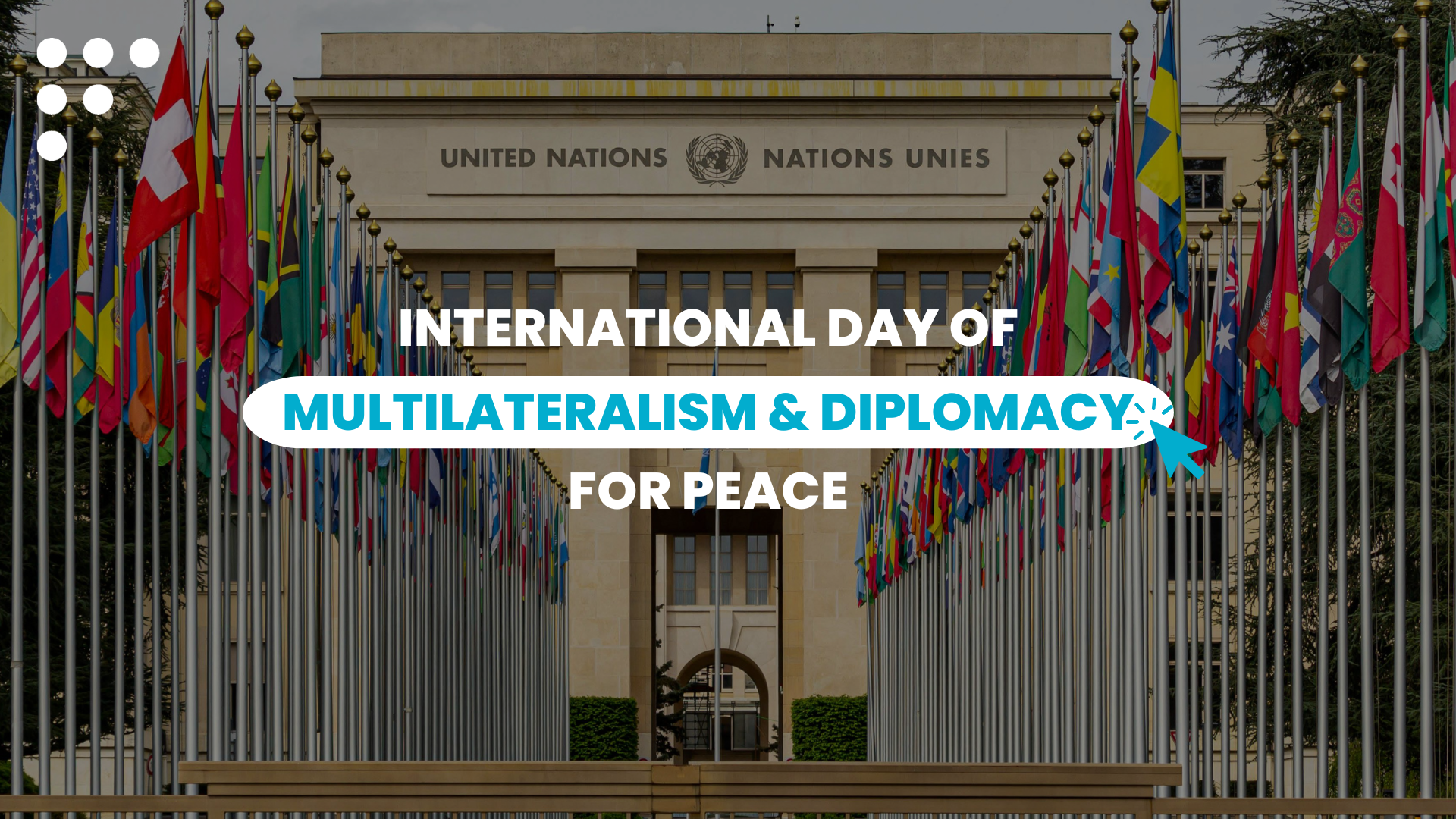
    Today, the international community marks the importance of multilateralism and diplomacy for peace.


    This takes place in a context of increasing global arms transfers, the proliferation of non-state armed groups, a resurgence of international armed conflicts, and systematic violations of the UN Charter across continents.[3] The low cost of entry into conflict for both state and non-state actors (in part enabled by globalisation, including access to technology, finance, and information), combined with social, economic and environmental factors, is undermining peace and other development goals. In a globalised order, military escalations in one region risk pushing millions into poverty, including in already conflict-affected contexts.[4]


    This dynamic is also unfolding alongside increasing inequalities and restrictions on civic space. Democratic backsliding has reduced agency for civil society, including humanitarian actors, women’s rights groups, LGBTQI+ movements and many others relying on a rights-based, rules-based international world order – particularly in contexts where the states are unwilling or unable to adhere to a viable social contract. Without multilateral spaces, civil society voices risk further marginalisation and isolation in the face of expanding authoritarianism.[5] Without civic space, the positive peace agenda is undermined.


    At the same time, significant reductions in aid are reshaping the UN and the multilateral architecture underpinning diplomacy for peace. Regional and global multilateral institutions and their civil society partners are grappling with a steadily increasing wave of violence and militarism with dwindling resources. The private sector, philanthropy, and new donors (e.g. in the Gulf) seem willing to meaningfully engage in ways that come close to replacing USAID’s contribution to pathways for peace, and the wider Nexus approach that brings together Humanitarian Development and Peace.[6]


    Human Development progress, particularly around Women, Peace and Security and gender justice, are stalling and regressing. These trends point to the continued importance of investment in soft power, including support for democracy, human rights, gender equality, the rule of law, and security sector reform. While the UK has historically positioned itself as a leader in this area and continues to recognise its importance, current policy choices suggest a growing gap between this recognition and the protection of funding for peacebuilding, development and humanitarian relief.[7]


    Where does this leave the UK role in the wider European neighbourhood and globally?

    A renewed focus on human security is needed. A purely state-centric approach, driven by self-interest among a growing number of undemocratic and unequal states is likely to lead to a more violent world order that will not yield the desired collective human development dividends. The UK’s historic role in championing human security approaches in institutions like NATO, and reflected in its approaches at the UN Security Council is more needed than ever.  In a shifting global order, where collaboration among middle powers around shared geographic or sectoral interests and values is becoming critical, the UK’s track record on human security lends value regionally and globally.


    The UK’s Ministry of Defence review of strategic trends flagged important human security dimensions, outlining risks around inequalities and other socio-economic factors that are likely to drive instability and diminish UK’s global role and its national security.[8] Yet despite the availability of such detailed and well-considered analysis,  foreign policy and national security decision-makers continue to defund the human security agenda, and inadvertently make the world (and the country) less safe.


    With civic space narrowing, citizens and states must be represented in regional and global dialogues, as well as in the institutions that underpin them. While the UK prides itself on a long historic track record of soft power, particularly through its academic institutions, think tanks, vibrant media, and civil society – these all require public investment. Without a well-resourced and stable civil service to help deliver on these objectives, this historic soft power asset risks weakening, with implications for peacebuilding outcomes.


    Holding the pen, and running out of paper: what happens to penholding at the UN Security Council?

    A major factor in the UK’s global security positioning is in the power of its permanent seat on the UN Security Council. The UK holds the pen on some key thematic and geographic files, convening peace and security conversations across a wide range of diverse states.


    For a post-Brexit middle-power, the UK retains an impressive amount of influence in these soft power spaces. However, much of the political credit goes to historic investments by DFID and  the Foreign Office in regional institutions such as the Organization for Security and Co-operation in Europe, the UN aid systems, and the Human Security agenda within NATO. Without sustained investment in these spaces, including in the civil service staff and structures, the UK’s soft power positioning will not be sustainable and it will not be able to build on its impressive historic track record of conflict resolution and peacebuilding through collective security and human security approaches.


    Without diplomacy and resources to civilian-led processes, military solutions will be increasingly seen as “normal” and viable. A growing share of the population, particularly younger generations coming of age in a renewed period of geopolitical competition, may come to view conflict as an inevitable feature of international relations. Without diplomacy, there will be more bullets.[9]


    Anna Chernova has a background in foreign policy and international development, with a focus on human rights, conflict resolution and humanitarian action. She has worked in diplomatic and non-governmental sectors in Eurasia and West Asia. At the Parliamentary Assembly of the Organization for Security and Co-operation in Europe, she led work on human rights and democracy, including parliamentary diplomacy efforts in conflict resolution, election observation and inquiries. Prior to joining the OSCE, Anna managed large-scale humanitarian operations in Russia’s North Caucasus at the close of the second Chechen war, and had worked on refugee issues with the UN in Bulgaria. Since 2014, she has been advising humanitarian organisations on foreign policy analysis, political risk and transnational threats. Her research and policy work focuses on gender and conflict, human security, counter-terrorism and human rights. She is particularly interested in conflict prevention and addressing root causes of violence driving humanitarian crises, such as extreme inequalities and authoritarianism. Anna’s academic background is in International Studies, Russia/Eastern Europe and Global Security. She is a US Fulbright Research and IREX Public Service Fellow, and is based in the UK.


    Disclaimer: The views expressed in this piece are those of the individual author and do not reflect the views of The Foreign Policy Centre.


    [1] Jonathan Luke Austin, Philippe Beaulieu-Brossard, “(De)securitisation dilemmas: Theorising the simultaneous enaction of securitisation and descuritisation,” Review of International Studies (2017) https://www.cambridge.org/core/journals/review-of-international-studies/article/desecuritisation-dilemmas-theorising-the-simultaneous-enaction-of-securitisation-and-desecuritisation/FE45D2C1D20870EC0E74DF54FA487C06

    [2] ACLED Conflict Watchlist 2026, “What is driving conflict today? A review of global trends,” (2025) https://acleddata.com/report/whats-driving-conflict-today-review-global-trends

    [3] ICRC https://www.icrc.org/sites/default/files/document/file_list/challenges-report_ihl-and-non-state-armed-groups.pdf; SIPRI, Trends in International Arms Transfers, 2025 https://www.sipri.org/publications/2026/sipri-fact-sheets/trends-international-arms-transfers-2025

    [4] UNDP, “Military escalation in the Middle East could push more than 30 million people into poverty worldwide,” (2026) https://www.undp.org/press-releases/military-escalation-middle-east-could-push-more-30-million-people-poverty-worldwide-un-development-programme-warns

    [5] Freedom House – Freedom in the World 2026, “The Growing Shadow of Autocracy,” https://freedomhouse.org/report/freedom-world/2026/growing-shadow-autocracy

    [6] World Bank Group, “Pathways for Peace: Inclusive Approaches to Preventing Violent Conflict,” (2018) https://www.worldbank.org/en/topic/fragilityconflictviolence/publication/pathways-for-peace-inclusive-approaches-to-preventing-violent-conflict

    [7] International Development Committee, “Future of UK aid and development assistance: interim report, Government Response,” https://committees.parliament.uk/publications/52758/documents/293937/default/

    [8] Ministry of Defence, “Global Strategic Trends out to 2055,” 7th edition (2024) https://assets.publishing.service.gov.uk/media/68dba439dadf7616351e4bf8/GST_7_Final_post_pic_change_WEB.pdf

    [9] Forbes, “Heed General Mattis’ Warning, D.C.: Less Diplomacy Means ‘More Ammunition’”, June 2025https://www.forbes.com/sites/andrewtisch/2025/06/18/heed-general-mattis-warning-dc-less-diplomacy-means-more-ammunition/

    Footnotes
      Related Articles

      Op-ed | Conflict Prevention Has Never Been More Important

      21/09/26
      Article by Camila Mateos Betancourt

      Op-ed | A Camel Called the Investor Visa

      29/07/26
      Article by Foreign Policy Centre

       Join our mailing list 

      Keep informed about events, articles & latest publications from Foreign Policy Centre

      JOIN