Skip to content

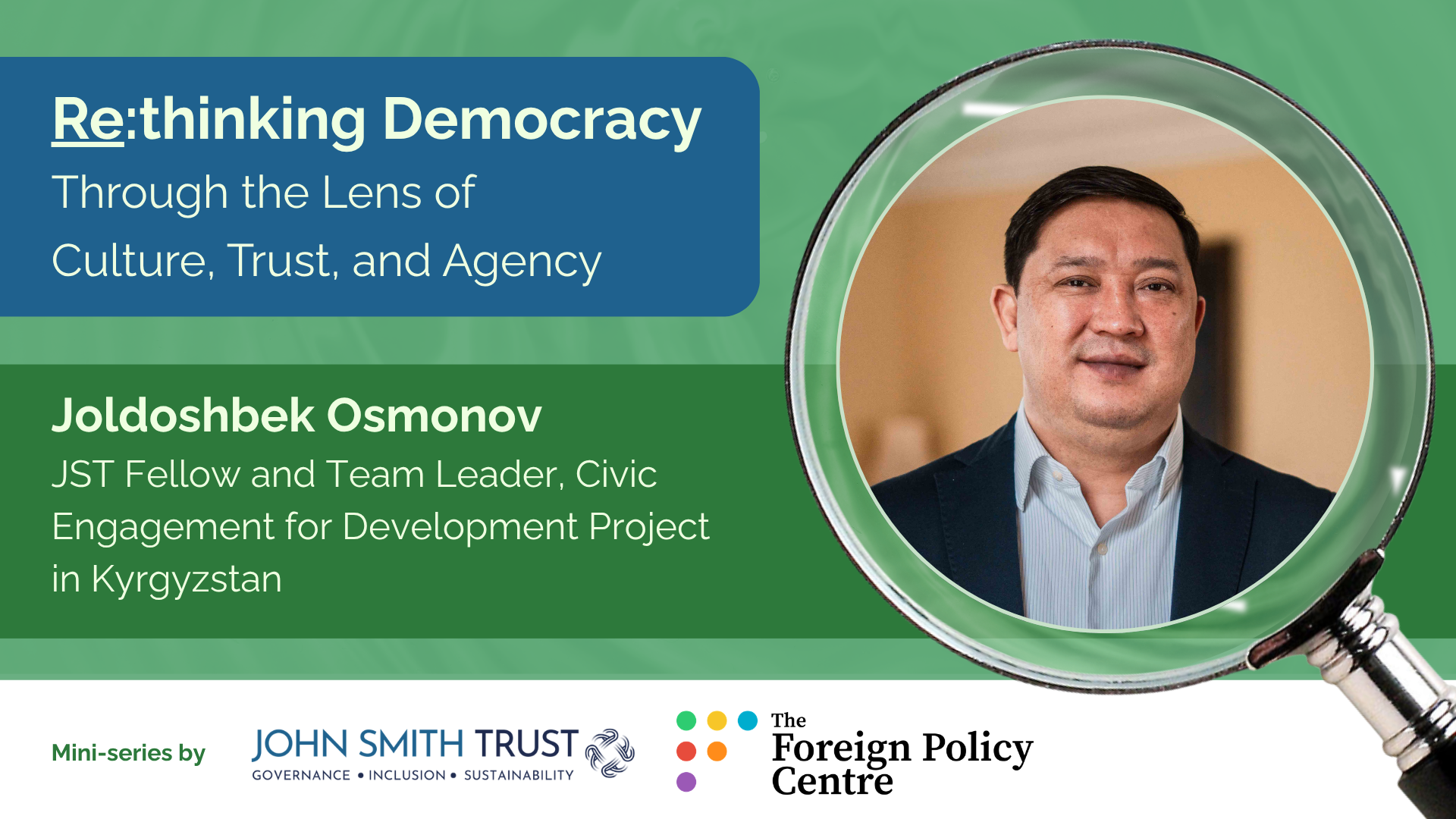
Civil Society Organisations Are Losing the Narrative War – How Can Trust Be Rebuilt?

Article by Joldoshbek Osmonov

July 20, 2026

Civil Society Organisations Are Losing the Narrative War – How Can Trust Be Rebuilt?

Civil society is how citizens can hold power to account. But what happens when organisations that exist to defend democratic life are no longer trusted to do so?


In functioning democracies, the answer barely needs asking. Transparent government, free expression, the right to challenge power and insist on the truth, all depend on a civil society that people believe in. It is through civil society that citizens engage with one another, mobilise in times of need, protect human rights, and advocate for change. When that belief erodes, so does the accountability it sustains.


For authoritarian governments, this erosion is not a problem. It is a strategy.


We are living in a time of profound uncertainty. The international rules-based order is no longer guaranteed. As authoritarianism and populism gain ground and democratic values come under pressure, civil society finds itself on the front line – and the forces working against it are organised and deliberate.


Propaganda, legal threats, and institutional failings are making civil society more vulnerable

Kyrgyzstan is a clear example of how civil society can become vulnerable. In April 2024, the country passed a law on ‘foreign representatives’, requiring NGOs that receive foreign funding to register with the government – echoing Russia’s and Georgia’s foreign agent laws, though without the same criminal liability.[1] This reflects a broader trend: growing authoritarianism and a shrinking civic space that make it harder for citizens and organisations to speak out.


Kyrgyzstan is not an isolated case. Across countries like Russia, Belarus, Georgia, and other Central Asian countries, the pattern is the same: governments are using legal pressure and narrative control to delegitimise the organisations that hold them accountable. In Russia, organised civil society and NGOs have been systematically portrayed as a threat to traditional values and national identity – and that same propaganda playbook is being exported across the region, eroding credibility of civil society organisations beyond its borders.


The threat is not solely external however. Parts of the NGO sector have been undermining their own credibility by remaining overly donor-centric, lacking transparency and failing to communicate their work and impact effectively to the public.


The effect of this sustained pressure on civil society and internal shortcomings is a loss of trust. People no longer believe that civil society organisations tell the truth, stand for something, or have anything meaningful to offer.


And when the connection between people and civil society breaks down, civil society can no longer fulfil its democratic function. The gap between organisations and the communities they exist to serve becomes a gap that weakens democracy.


So how should civil society respond?

Some of the challenges are practical: funding, legal pressure, hostile information environments. But the deeper challenge is rebuilding trust and relevance. Old approaches and instruments are no longer enough. Civil society organisations need to think critically about how they are reaching people, how they come across, and whether they truly understand the context in which they operate.


Starting internally: transparency, accountability, and effectiveness are vital. Suspicions that NGOs are ineffective or opaque are widespread, and organisations need to take this seriously. Trust is rebuilt through actions, not just communication.


Yet internal renewal is only half the work. The deeper challenge is rebuilding the connection with communities – and that begins with an honest reckoning about how that connection was lost in the first place. It means going to where people already are: the school gate, the local market, the community group, the places where trust is built through presence rather than broadcast. It means speaking in a language that people recognise and not jargon that requires explaining. And it means reducing financial dependence on external donors by developing more diversified, locally rooted funding – through the public sector, social entrepreneurship, and direct community support.


Organisations need to be clear about both the work they do and what they stand for. The issues that civil society organisations address are often the issues that matter to people. When organisations can clearly demonstrate their relevance and impact, trust becomes easier to build and sustain.


Finally, where possible, constructive dialogue with governments should not be abandoned. Civil society organisations should seek to cooperate on practical, less politically contested challenges, building confidence and relationships before attempting to address more difficult issues.


What leaders need in this moment

Civil society may be losing the narrative battle – but that does not mean war is lost. Leaders need a clear-eyed understanding of how we got here and what is at stake.


The forces working against democracy and civil society – authoritarianism, populism, propaganda, misinformation – are organised, deliberate, and adaptive. Responding to these forces requires not just resilience, but the willingness to change: to be honest about failure, to engage with people where they are, and to earn trust rather than assume it.


The goal is not simply to survive. It is to rebuild the kind of civil society that people feel belongs to them, one that reflects their concerns, speaks to their realities, and importantly, one that they would fight to defend.


Ultimately, trust cannot be demanded, it must be earned, sustained, and renewed over time.


Explore the full mini-series here.


Joldoshbek Osmonov is the team leader of the Civic Engagement for Development Project in Kyrgyzstan funded by the Swiss Development Agency. He has extensive work experience in international development organisations, think tanks, and the civil society sector and possesses strong expertise in civil society, governance, public policy, and local politics. Joldoshbek holds a master’s degree in public administration from the University of Pennsylvania, the United States, and BA in international relations from the American University of Central Asia, Kyrgyzstan.


Disclaimer: The views expressed in this piece are those of the individual author and do not reflect the views of The Foreign Policy Centre.


[1] Radio Free Europe/ Radio Liberty, April 2024, Law Targeting Foreign-Funded NGOs Sends Chill Through Kyrgyz Civil Society, https://www.rferl.org/a/kyrgyzstan-foreign-agents-chill/32893000.html
Topics
Regions
Footnotes
    Related Articles

    Kyrgyz Parliamentary Election’s Snapshot

    Article by Dr Aijan Sharshenova

    November 27, 2025

    Kyrgyz Parliamentary Election’s Snapshot

    The Kyrgyz Parliament – Jogorku Kenesh (Supreme Council) called for an early election in September on the grounds of avoiding an overlap of two important electoral campaigns in 2026 – presidential and parliamentary.[1] On November 30th, Kyrgyzstan will hold snap preliminary parliamentary elections.


    A brief history of Kyrgyz parliamentarism

    Since gaining independence in 1991, Kyrgyzstan has held eight parliamentary elections and had seven parliamentary convocations. In the early independence years, the country experimented with a bicameral parliamentary system, which consisted of the Legislative Assembly and the Assembly of People’s Representatives. Since 2007, however, the Kyrgyz parliament has been a unicameral body.


    Throughout the last 34 years, Kyrgyzstan oscillated between parliamentary, parliamentary-presidential, and presidential-parliamentary forms of governance. Kyrgyz politics, however imperfect they might have been, were dynamic, lively, and left space for public and political debate and contestation. The most recent constitutional amendments, initiated by the current President, Sadyr Japarov, marked an important shift to a strong presidential model of governance.[2]


    Notably, two out of three government coups in independent Kyrgyzstan were triggered by contested parliamentary elections, first in March 2005[3] and again in October 2020.[4] In a way, parliamentary elections often contain seeds of public unrest as proven by history. The seventh election’s results were annulled due to the mass protest and the government coup.[5] The sixth parliamentary convocation had its term extended until 2021. The eight elections, held later that year, formed the current convocation of the Parliament (seventh), which has lost a significant part of its powers in the aftermath of the constitutional referendum of 2021.


    A snapshot of the upcoming parliamentary election

    The upcoming election will stick to the previous Parliament’s composition of 90 members of parliament. However, there will be some important technical changes. Following the 2025 amendments to the Electoral Code, the electoral system shifted from a mixed system to a majoritarian one: MPs are elected from 30 multi-member constituencies, with each district electing three representatives via plurality voting (the top three candidates win). To ensure gender representation, it is a requirement that at least one woman must be among the top three in each district.[6]


    Kyrgyzstan’s current population stands at approximately 7.5 million people, with around 4.237 million citizens who are eligible and registered to vote.[7] Voting will occur at 2,492 polling stations across the country, with voters able to cast their ballots at any station. This marks a departure from the country’s Soviet legacy, which tied voters to polling stations based on their registered address. Before, internal migrants had to travel back to their registered address to get a letter allowing them to vote in their current (temporary or permanent) location.


    The candidates finished their registration by November 10. At the moment, a total of 467 candidates have been registered (276 men and 191 women). The electoral campaign has officially started and will finish at 08:00 on November 29 2025 – 24 hours before voting begins. Eligibility requirements state that candidates must be at least 25 years old, hold a higher education degree, have resided continuously in Kyrgyzstan for the last five years, and have no criminal record.[8]


    Why this election matters but why it feels stale

    The upcoming parliamentary election might lack the usual dynamism of Kyrgyz political scene, but it is important for three reasons.[9]


    First, this election signifies a return to the pre-2007 single mandate voting system. While it might seem like an electoral reform element, this shift is de facto the last nail in the Kyrgyz political party system. In this mode, candidates’ resources, public profile, and local networks tend to outweigh their party affiliations or ideological positions. This probably is an honest move, but it does make political parties and political ideologies even less relevant than before. The changes were approved in June 2025, suggesting the plans to hold this snap election must have been in the making for a while.


    Second, there are some changes in the electoral process. These include the administrative division of electoral districts, the possibility to register and vote in different polling stations, and the use of social media and social media influencers in electoral campaigns. The Central Electoral Committee approved 30 multi-mandate districts incorporating roughly 142 thousand voters each in October 2025.[10] Most of these changes reflect on the current reality of digitalisation and the extended use of social media among populations, as well as the final acknowledgement of the extreme mobility of the electorate. Kyrgyzstan is a country of fluid external and internal migration after all.


    Finally, this election consolidates the constitutional changes of 2021, which have significantly reduced the Parliament’s powers while strengthening the presidency. As such, this election effectively closes the chapter on previous efforts to develop a more democratic parliamentary or parliamentary-presidential system. Kyrgyzstan is now a strong presidential system.


    Although not directly related to the election, it is important to note two significant developments that are taking place against the background of the electoral campaign. President Putin is expected to make an appearance at the upcoming Collective Security Treaty Organisation’s Council meeting in Bishkek from 25-27 November 2025. A few days before this, several opposition politicians and activists were detained on allegations of plotting mass protests and attempting a coup.[11]


    The parliamentary election in Kyrgyzstan feels less dynamic this year. However, it marks two important departures from all previous political processes that have taken place in the country so far. First, it signals the diminishing relevance of political party competition and, to an extent, the existence of political parties in the Kyrgyz political landscape. Second, it signifies the consolidation of a strong undemocratic presidential regime.


    Dr Aijan Sharshenova, FPC Senior Fellow. Aijan is the Executive Director at Crossroads Central Asia, an independent think tank in Bishkek, Kyrgyz Republic, and a Leading Visiting Researcher at the Riga Stradins University, Riga, Latvia. She holds two Masters in the EU and Central Asian Studies and in International Studies, and a PhD in Politics from the University of Leeds. Aijan’s research interests include foreign policy, public diplomacy and soft power, as well as democracy promotion and autocracy diffusion. She published extensively on Central Asian politics, focusing on the region’s relations with the EU, Russia and China. Aijan authored a book on the EU democracy promotion in Central Asia and co-edited a recent book on navigating positionality in research.


    Disclaimer: The views expressed in this piece are those of the individual author and do not reflect the views of The Foreign Policy Centre.


    [1] Council of Europe (Venice Commission), ‘Opinion No. 1021/2021 (CDL(2021)021) – Joint Opinion on the Draft Constitution of the Kyrgyz Republic’, March 2021, https://docs.un.org/en/A/RES/68/163; Jogorku Kenesh of the Kyrgyz Republic, Tөрага Нурланбек Тургунбек уулу: “VII чакырылыш өз кызыкчылыгынан өлкөнүн кызыкчылыгын бийик коюп, өзүн‑өзү таратуу чечимин кабыл алдык’, September 2025, https://kenesh.kg/posts/14810; https://www.venice.coe.int/webforms/documents/default.aspx?pdffile=CDL(2021)021

    [2] Serik Rymbetov, Kyrgyzstani Parliamentary Elections Strengthen President Japarov’s Rule, Jamestown, July 2021,  https://jamestown.org/kyrgyzstani-parliamentary-elections-strengthen-president-japarovs-rule/

    [3] Global Nonviolent Action Database, Kyrgyz citizens overthrow President Ayakev (Tulip Revolution) 2005, n.d., https://nvdatabase.swarthmore.edu/content/kyrgyz-citizens-overthrow-president-ayakev-tulip-revolution-2005

    [4] Aijan Sharshenova, Kyrgyzstan elects a potential strongman: Implications for international partners and the future of Kyrgyz democracy, March 2021, https://fpc.org.uk/kyrgyzstan-elects-a-potential-strongman-implications-for-international-partners-and-the-future-of-kyrgyz-democracy/

    [5] Asel Doolotkeldieva, Uncovering the Revolutionaries from Epistemic Injustice: The Politics of Popular Revolts in Kyrgyzstan, Central Asian Affiairs, July 2023, https://brill.com/view/journals/caa/10/2/article-p99_1.xml

    [6] AKIpress, Выборы в Жогорку Кенеш: Сколько женщин баллотируются? Список, October 2025, https://kg.akipress.org/news:2347875

    [7] AKIpress, ‘В Кыргызстане насчитывается 4 млн 237 тыс. избирателей’, September 2025, https://kg.akipress.org/news:2336910

    [8] The Central Electoral Commission, ‘Кандидаты/Талапкерлер: Выдвижение кандидатов’, n.d., https://shailoo.gov.kg/ru/Kandidaty_Talapkerler/Vydvijenie_kandidatov/

    [9] Aijan Sharshenova, Is Politics Dead in Kyrgyzstan?, The Diplomat, November 2025, https://thediplomat.com/2025/11/is-politics-dead-in-kyrgyzstan/

    [10] oper.kaktus.media, ЦИК утвердил границы избирательных округов на досрочных выборах в Жогорку Кенеш. Список, n.d., https://oper.kaktus.media/doc/532638_cik_ytverdil_granicy_izbiratelnyh_okrygov_na_dosrochnyh_vyborah_v_jogorky_kenesh._spisok.html

    [11] Catherine Putz, Kyrgyz Authorities Arrest Alleged Protest Plotters Ahead of Election, The Diplomat, November 2025, https://thediplomat.com/2025/11/kyrgyz-authorities-arrest-alleged-protest-plotters-ahead-of-election/

    Footnotes
      Related Articles

       Join our mailing list 

      Keep informed about events, articles & latest publications from Foreign Policy Centre

      JOIN