
Skip to content

Five Priorities for the UK as it Retakes the Chair of the Media Freedom Coalition

Article by Martin Scott

March 12, 2026

Five Priorities for the UK as it Retakes the Chair of the Media Freedom Coalition

In 2023, Professor Martin Scott examined the early performance of the Media Freedom Coalition in an article for the Foreign Policy Centre, reflecting on whether the initiative had achieved the “re-set” recommended in an independent evaluation. As the UK now retakes the Coalition’s co-chairmanship, this article considers what practical steps the government should take to strengthen international support for media freedom.


The UK has just become the new co-chair of the Media Freedom Coalition (MFC), alongside Finland.[1]


This is a welcome move given the current vacuum in leadership for supporting media freedom on the international stage. However, this new role must be accompanied by demonstrable improvements in both the scale and scope of the UK’s international support for independent journalism.


The MFC is a global partnership of 51 countries working together to promote press freedom both domestically and internationally.


As a G7 country and permanent member of the UN Security Council, the UK’s leadership of the MFC provides an opportunity to bring significant visibility and political weight to its work.


The UK also has a comparatively large diplomatic service making it well placed to strengthen the activities of the MFC’s embassy network – which monitors specific court cases, engages in private diplomacy, and coordinates joint statements.[2]


In addition, as one of the MFC co-founders in 2019 and an inaugural co-chair until 2022, the UK has valuable institutional knowledge and established relationships with civil society organisations linked to the Coalition.


However, the UK’s recent track record in supporting media freedom internationally is not as strong as that of many other MFC member states. In 2025, the UK was ranked joint 12th out of 30 on the International Media Freedom Support (IMFS) Index – qualifying for the lowest, ‘bronze’ category.[3] The IMFS Index evaluates 30 states based on their contributions to diplomatic, financial and safety initiatives that promote media freedom. A fuller discussion of the IMFS Index can be found in a recent FPC article by Martin Scott and Professor Mel Bunce.


Sweden (2nd), the Netherlands (3rd), Germany (=5th), France (=5th), Canada (8th) – and even some countries with significantly lower state capacity such as Lithuania (1st) and Estonia (4th) – all scored significantly higher than the UK on the 2025 IMFS index.


Given this, the UK must make demonstrable improvements to the scale and scope of its international support for independent journalism if it is to offer credible international leadership on media freedom.


Here are 5 ways the UK can achieve this:


1. Introduce a dedicated emergency visa scheme that explicitly includes provision for media workers in exile. The MFC’s independent legal advisory arm – the High-Level Panel of Legal Experts on Media Freedom – has consistently designated this a priority area and provided MFC states with clear guidance on how to implement a suitable scheme for journalists at risk.[4] Unfortunately, only five MFC member states – Canada, Czechia, Estonia, Latvia and Lithuania – have so far implemented such a scheme. Between them, they have issued over 1,000 visas or residence permits to media workers in exile under these schemes since 2020. Implementing a similar scheme in the UK will require stronger internal collaboration between the Foreign, Commonwealth & Development Office (FCDO) and the Home Office.


2. Support a national initiative that promotes the protection and safety of media workers in exile. Journalists at risk require not only legal protection – but also practical support to rebuild their lives and continue their work. Germany, for example – who the UK is replacing as MFC co-chair – supports the Hannah Arendt Initiative, a network of civil society organisations that protects and supports journalists from Afghanistan, Ukraine, Russia, Belarus and elsewhere.[5] As co-chair of the MFC, the UK should be supporting a similar initiative.


3. Increase the proportion of international aid allocated to supporting independent media. In 2023 – the most recent year we have figures for – the UK allocated just 0.1% of its international aid to media development. This is nowhere near the benchmark of 1.0% recommended by the Forum on Information & Democracy and even lower than the average of 0.16% for all 30 states measured in the IMFS Index.[6] As its aid budget is reduced, support for media development must be retained as a strategic priority if the UK is serious about defending press freedom internationally.


4. Ensure consistent, long-term financial support for the BBC World Service. As one of the most trusted international news providers – reaching 435 million people each week – the BBC World Service is one of the most effective instruments in the world for supporting access to reliable information.[7] Speaking at the UK Media Freedom Forum, Foreign Affairs Select Committee Chair Emily Thornbury highlighted its strategic importance, asking: ‘Why aren’t we tripling funding to the BBC World Service? It should be a major priory for this country… Particularly with the cutbacks we are making on aid… Let’s at least have a really good presence in terms of helping people understand what’s going on in the world’.[8]


5. Contribute to multilateral pooled funds dedicated to supporting international journalism. The UNESCO-administered Global Media Defence Fund (GMDF) and other similar, pooled funds can, in principle, provide an effective way of coordinating resources, providing core support to local entities, reducing the earmarking of contributions, and supporting the principle of multilateralism. [9] However, in 2024, the UK only contributed to one such fund – the GMDF. By comparison, in 2024, France awarded funding to all four qualifying multilateral pooled funds and in 2025 hosted a high‑level conference on information integrity and independent media at the Paris Peace Forum – where further financial support was pledged. [10]


According to the 2025 IMFS Index, no country is currently performing consistently well across all three dimensions of support for media freedom: diplomacy, funding and safety.[11] As MFC co-chair, the UK has the opportunity – and obligation – to fill this gap in international leadership.


Achieving this does not require reinventing the wheel. Just the political will to deliver on existing commitments.


As Chris Elmore, FCDO Minister for Multilateral and Human Rights, recently said, “What I want to see, through us retaking the chair of the Media Freedom Coalition, is a move back to the original pillars of this work to ensure that we have meaningful outcomes”.[12]


I agree.


Martin Scott is a Professor of Media and Global Development at the University of East Anglia. His publications include, ‘Capturing News, Capturing Democracy’ (2024), ‘Humanitarian Journalists’ (2022), ‘Media and Development’ (2014) and ‘From Entertainment to Citizenship’ (2014).


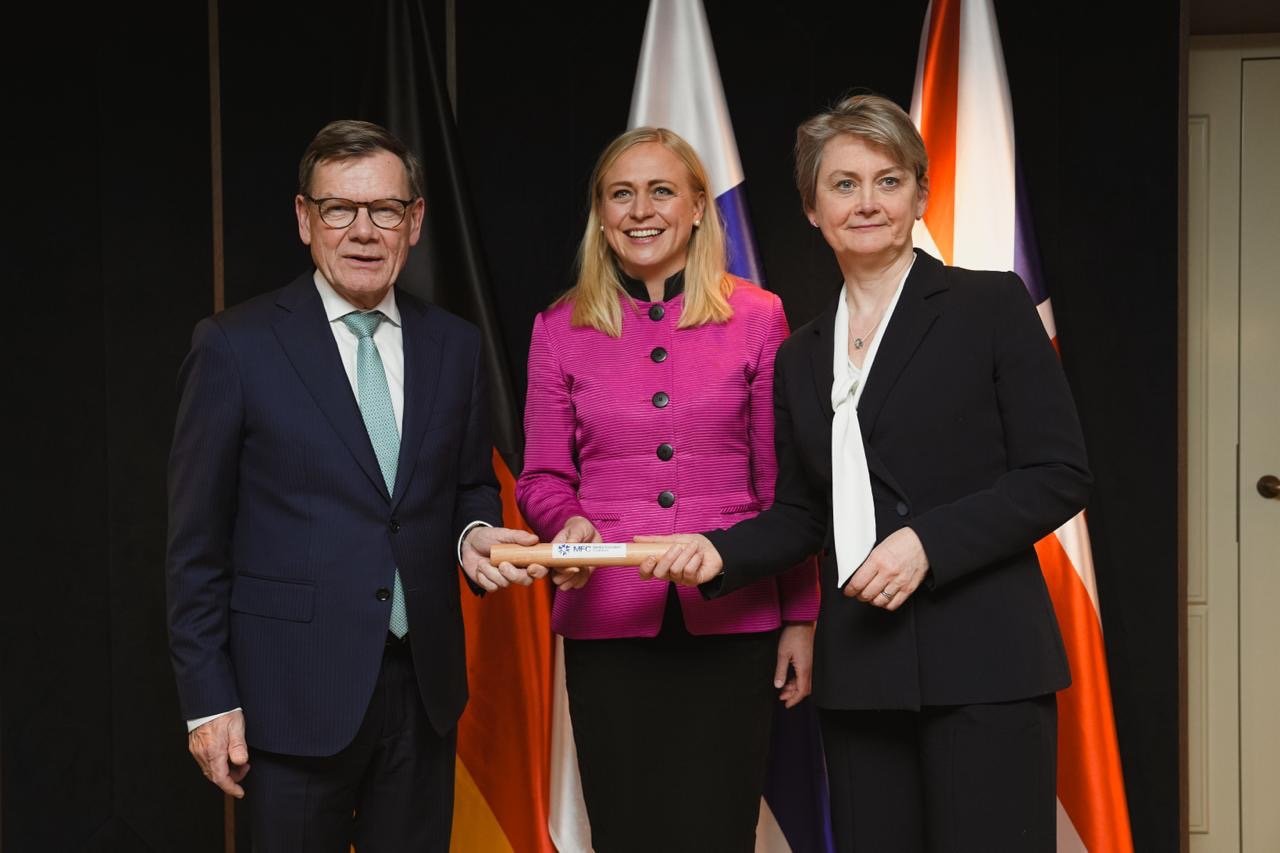
Image: Johann Wadephul, Federal Minister for Foreign Affairs of Germany (left), Elina Valtonen, Minister for Foreign Affairs of Finland (centre), and Yvette Cooper British Foreign Secretary (right); credit: Ben Dance / UK Foreign, Commonwealth & Development Office


Disclaimer: The views expressed in this piece are those of the individual authors and do not reflect the views of The Foreign Policy Centre.


[1] Media Freedom Coalition, Home Page, https://mediafreedomcoalition.org/

[2] Media Freedom Coalition, MFC Embassy Networks, https://mediafreedomcoalition.org/activities/embassy-networks/

[3] Centre for Journalism and Democracy, The Index on international Media Freedom Support (IMFS) 2025, 2025, https://jdem.org/wp-content/uploads/2025/10/IMFS-full-report.pdf

[4] Media Freedom Coalition, High-Level Panel of Experts, N.A., https://mediafreedomcoalition.org/who-is-involved/high-level-panel-of-legal-experts/

[5] Network for the protection of journalists and media worldwide, Hannah Arendt Initiative, https://hannah-arendt-initiative.de/en/hannah-arendt-initiative/

[6] Forum on Information and Democracy, The Forum on Information and Democracy calls for a New Deal for Journalism, June 2021, https://informationdemocracy.org/2021/06/16/the-forum-on-information-and-democracy-calls-for-a-new-deal-for-journalism/

[7] BBC, BBC’s response to global news events drives audience growth, July 2025, https://www.bbc.co.uk/mediacentre/2025/bbc-response-to-global-news-events-drives-audience-growth

[8] UK Media Freedom Forum, Home Page, https://mediafreedomforum.co.uk/

[9] UNESCO, Global Media Defence Fund, https://www.unesco.org/en/global-media-defence-fund

[10] French Embassy and Consulates General in the UKParis Peace Forum: 29 States commit to information integrity and independent media, November 2025, https://uk.diplomatie.gouv.fr/en/paris-peace-forum-29-states-commit-information-integrity-and-independent-media

[11] Centre for Journalism and Democracy, The Index on international Media Freedom Support (IMFS) 2025, 2025, https://jdem.org/wp-content/uploads/2025/10/IMFS-full-report.pdf

[12] UK Parliament, Foreign, Commonwealth and Development Office

Volume 781, March 2026, https://hansard.parliament.uk/Commons/2026-03-04/debates/8C008AEB-0F64-4A12-A157-368EA0118C0A/ForeignCommonwealthAndDevelopmentOffice#contribution-490D078B-AA2C-4241-8EE2-3F4DDDF44EF0

Footnotes
    Related Articles

    Four Years On: Journalism Under Drones, Beyond Blackouts

    Article by Sergiy Tomilenko

    February 24, 2026

    Four Years On: Journalism Under Drones, Beyond Blackouts

    Four years into Russia’s full-scale invasion of Ukraine, the war’s impact on media and information integrity remains profound. In this anniversary reflection, Sergiy Tomilenko, President of the National Union of Journalists of Ukraine, examines how journalism has adapted to new battlefield realities and why sustained international support for independent media is essential. As the character of the war evolves, so too does the environment in which Ukrainian journalists operate.


    As Ukraine approaches the fourth anniversary of Russia’s full-scale invasion, the character of the war has changed – and so has the daily work of journalists. Missiles still strike. Artillery still destroys cities. But increasingly, it is the persistent, humming presence of drones above our towns and villages that defines this phase of the war.


    Shahed drones fly low over residential areas at night. First-person-view (FPV) drones hunt vehicles near the frontlines. Surveillance drones monitor movement even in places far from the battlefield. For Ukrainian journalists, this has created a new professional reality. The danger is no longer episodic, it is ambient. It hovers.


    At the same time, Ukraine is enduring one of its most difficult winters since 2022. Repeated attacks on energy infrastructure have triggered rolling blackouts across major cities. Heating failures have left entire districts without warmth in sub-zero temperatures. Internet and mobile networks periodically collapse when power supply fails.


    And yet, journalism continues. Not because it is easy. Not because it is safe. But because it is essential.


    Reporting Under Drones

    In recent months, safety protocols for journalists have evolved once again. Reporters covering frontline regions now routinely carry drone detectors — small handheld devices that warn of incoming unmanned aircraft.


    One Ukrainian fixer I recently met works with international correspondents in high-risk zones. He carries such a detector every day. Not long ago, he found himself under shelling after detecting drone activity nearby. Later, when we spoke, he asked me not to publicly describe the incident in detail.


    “Please,” he said quietly, “I don’t want my wife to worry.”


    That sentence captures the human dimension behind the statistics.


    We often speak in numbers – journalists killed, injured, detained, captured. These figures matter. But behind each one is a family, a daily calculation of risk, and a professional decision to continue.


    The Russian army does not distinguish between civilian and media targets. Journalists wearing “PRESS” markings remain vulnerable. Media vehicles have been hit. Newsrooms have been damaged. In occupied territories, journalists face detention and torture.


    Yet Ukrainian reporters continue to document war crimes, verify information, and provide context in an environment saturated with disinformation and propaganda.


    The Harsh Winter  and the Information Vacuum

    This winter has tested resilience in new ways. Blackouts are not new in Ukraine, but their scale and unpredictability have intensified. In some districts of Kyiv and other cities, electricity follows a fragile schedule — three hours on, seven hours off. In frontline regions, there is no schedule at all.


    For journalism, electricity is not a convenience. It means the ability to upload footage, confirm sources, publish missile alerts, verify rumours, and correct false information circulating online.


    When power disappears, connectivity follows. LTE signals may appear strong on a smartphone screen, yet nothing loads. Journalists drive to petrol stations to charge batteries. They work from cars, stairwells, and temporary co-working spaces.


    In many frontline areas, printed newspapers remain essential.


    This may surprise international audiences accustomed to digital-first ecosystems. But where electricity is unstable and internet access unreliable, local printed newspapers are often the most trusted and accessible source of verified information.


    Frontline newspapers in regions such as Kherson, Zaporizhzhia, Sumy, and Kharkiv continue to publish and distribute under extraordinary conditions. Delivery routes pass through areas regularly shelled or monitored by Russian drones. Advertising revenues have collapsed while printing costs rise. Staff members are sometimes mobilised to the armed forces, leaving skeletal editorial teams.


    Yet they persist because they understand something fundamental: when the information space collapses, disinformation fills the void.


    Russian propaganda adapts quickly. It exploits blackouts and uncertainty. It spreads fabricated narratives through Telegram channels and anonymous accounts. It seeks to undermine morale, inflame divisions, and distort battlefield realities.


    Journalism on the ground is the antidote. It sustains communities when uncertainty grows and prevents fear from turning into chaos.


    Just as electricity grids and heating systems are critical for survival in winter, reliable information is equally vital.


    During missile attacks, verified updates save lives. During evacuations, accurate reporting prevents panic. In de-occupied territories, local media help rebuild trust in institutions and reconnect fragmented communities.


    This is not abstract theory. It is visible in daily practice.


    Local editors receive calls from elderly readers asking whether evacuation rumors are true. Journalists coordinate with authorities to clarify curfews and safety measures. Reporters debunk fake announcements about chemical threats or mobilisation.


    Journalism in wartime requires discipline. It means resisting the temptation to publish unverified information for speed. It requires balancing transparency with operational security. It demands constant ethical judgment.


    Over the past four years, Ukraine’s media community has matured significantly. Newsrooms have strengthened verification standards. Journalists collaborate across outlets to counter disinformation. International partnerships have expanded investigative capacity.


    Yet the sustainability of this ecosystem remains fragile.


    The Role of the Journalists’ Solidarity Centres

    One of the most important developments since 2022 has been the expansion of the Journalists’ Solidarity Centres, coordinated by the National Union of Journalists of Ukraine with international partners.

    Located in cities including Kyiv, Lviv, Ivano-Frankivsk, Dnipro, Zaporizhzhia and Kharkiv, these Centres function as safe hubs for media professionals. They provide protective equipment, stable co-working spaces with electricity and internet, emergency power and Starlink access during blackouts, as well as psychological and legal support. They also assist international correspondents reporting from Ukraine.


    During the harshest weeks of this winter, these Centres once again became lifelines. When offices went dark, journalists relocated there to file stories. When regional outlets lacked charging capacity, equipment was shared. When trauma accumulated quietly, conversations provided relief.


    Beyond practical assistance, these Centres symbolise solidarity — domestic and international alike.They also demonstrate that press freedom support must adapt to wartime realities. Traditional media development models are insufficient when infrastructure is deliberately targeted and economic stability collapses.


    The Human Cost Continues

    We cannot mark this anniversary without acknowledging the ongoing human cost.

    Ukrainian journalists remain in Russian captivity. Others are missing. Families wait for news. Sisters, brothers, fathers, mothers, and spouses carry the burden of uncertainty.


    Recently, I met the sister of a journalist from Melitopol who remains detained. Her voice did not tremble with anger. It carried a quiet exhaustion — the exhaustion of waiting, of not knowing.


    The struggle for press freedom in Ukraine is not only about institutions, it is deeply personal.


    Why the World Should Still Care

    International fatigue is real. The news cycle shifts. Other crises emerge. Yet Ukraine remains a frontline for democratic resilience in Europe.


    If Russian aggression succeeds in silencing independent media in Ukraine, the consequences will extend far beyond our borders. It would signal that violence can erase truth.


    Conversely, every functioning newsroom in a frontline town is evidence that democratic values endure even under bombardment.


    Supporting Ukrainian journalism today is not an act of charity. It is an investment in a broader European security architecture where information integrity matters.


    What Is Needed Now

    The solutions are not complex, but they require sustained commitment.


    Local and regional media need predictable emergency funding that does not vanish when headlines shift. Journalists — particularly those working near the front — require long-term support for both physical safety and psychological resilience. Those still held in Russian captivity need consistent international attention, because silence around their cases risks becoming another form of abandonment.


    Two additional realities deserve clearer recognition. Disinformation does not stop at borders, and confronting it demands genuine cross-border cooperation. A frontline newspaper serving a shelled town in Zaporizhzhia or Kherson is not a lesser form of journalism; it is as strategically important as any national broadcaster.


    Beyond Resilience

    “Resilience” has become one of the defining words of these four years. Ukrainians are resilient. Ukrainian journalists are resilient.


    But resilience should not be romanticised.


    Journalists do not aspire to work under drones. Editors do not aspire to plan print runs around artillery strikes. Fixers do not aspire to calculate risk in order to shield their families from anxiety.

    What Ukrainian journalists aspire to is simple: to work safely, to report truthfully, and to serve their communities.


    Until that day arrives, their work will continue.


    I still think about that fixer — the way he looked at me before speaking, and then quietly asked that I not describe what had happened. He was not afraid for himself. He was afraid of what his wife would feel if she knew.


    Behind every statistic, every damaged newsroom, every equipment list and safety protocol, there are people doing necessary work — and trying to protect those they love from understanding just how dangerous that work has become.


    In wartime, truth does not sustain itself automatically. It endures because individuals choose, day after day, to protect it.


    And Ukrainian journalists continue to make that choice.


    Disclaimer: The views expressed in this piece are those of the individual author and do not reflect the views of The Foreign Policy Centre.


    Sergiy Tomilenko is the President of the National Union of Journalists of Ukraine (NUJU). With over two decades of experience in journalism and media advocacy, Tomilenko has been at the forefront of defending press freedom and journalists’ rights in Ukraine.


    Regions
    Footnotes
      Related Articles

       Join our mailing list 

      Keep informed about events, articles & latest publications from Foreign Policy Centre

      JOIN