
Skip to content

Four Years On: Journalism Under Drones, Beyond Blackouts

Article by Sergiy Tomilenko

February 24, 2026

Four Years On: Journalism Under Drones, Beyond Blackouts

Four years into Russia’s full-scale invasion of Ukraine, the war’s impact on media and information integrity remains profound. In this anniversary reflection, Sergiy Tomilenko, President of the National Union of Journalists of Ukraine, examines how journalism has adapted to new battlefield realities and why sustained international support for independent media is essential. As the character of the war evolves, so too does the environment in which Ukrainian journalists operate.


As Ukraine approaches the fourth anniversary of Russia’s full-scale invasion, the character of the war has changed – and so has the daily work of journalists. Missiles still strike. Artillery still destroys cities. But increasingly, it is the persistent, humming presence of drones above our towns and villages that defines this phase of the war.


Shahed drones fly low over residential areas at night. First-person-view (FPV) drones hunt vehicles near the frontlines. Surveillance drones monitor movement even in places far from the battlefield. For Ukrainian journalists, this has created a new professional reality. The danger is no longer episodic, it is ambient. It hovers.


At the same time, Ukraine is enduring one of its most difficult winters since 2022. Repeated attacks on energy infrastructure have triggered rolling blackouts across major cities. Heating failures have left entire districts without warmth in sub-zero temperatures. Internet and mobile networks periodically collapse when power supply fails.


And yet, journalism continues. Not because it is easy. Not because it is safe. But because it is essential.


Reporting Under Drones

In recent months, safety protocols for journalists have evolved once again. Reporters covering frontline regions now routinely carry drone detectors — small handheld devices that warn of incoming unmanned aircraft.


One Ukrainian fixer I recently met works with international correspondents in high-risk zones. He carries such a detector every day. Not long ago, he found himself under shelling after detecting drone activity nearby. Later, when we spoke, he asked me not to publicly describe the incident in detail.


“Please,” he said quietly, “I don’t want my wife to worry.”


That sentence captures the human dimension behind the statistics.


We often speak in numbers – journalists killed, injured, detained, captured. These figures matter. But behind each one is a family, a daily calculation of risk, and a professional decision to continue.


The Russian army does not distinguish between civilian and media targets. Journalists wearing “PRESS” markings remain vulnerable. Media vehicles have been hit. Newsrooms have been damaged. In occupied territories, journalists face detention and torture.


Yet Ukrainian reporters continue to document war crimes, verify information, and provide context in an environment saturated with disinformation and propaganda.


The Harsh Winter  and the Information Vacuum

This winter has tested resilience in new ways. Blackouts are not new in Ukraine, but their scale and unpredictability have intensified. In some districts of Kyiv and other cities, electricity follows a fragile schedule — three hours on, seven hours off. In frontline regions, there is no schedule at all.


For journalism, electricity is not a convenience. It means the ability to upload footage, confirm sources, publish missile alerts, verify rumours, and correct false information circulating online.


When power disappears, connectivity follows. LTE signals may appear strong on a smartphone screen, yet nothing loads. Journalists drive to petrol stations to charge batteries. They work from cars, stairwells, and temporary co-working spaces.


In many frontline areas, printed newspapers remain essential.


This may surprise international audiences accustomed to digital-first ecosystems. But where electricity is unstable and internet access unreliable, local printed newspapers are often the most trusted and accessible source of verified information.


Frontline newspapers in regions such as Kherson, Zaporizhzhia, Sumy, and Kharkiv continue to publish and distribute under extraordinary conditions. Delivery routes pass through areas regularly shelled or monitored by Russian drones. Advertising revenues have collapsed while printing costs rise. Staff members are sometimes mobilised to the armed forces, leaving skeletal editorial teams.


Yet they persist because they understand something fundamental: when the information space collapses, disinformation fills the void.


Russian propaganda adapts quickly. It exploits blackouts and uncertainty. It spreads fabricated narratives through Telegram channels and anonymous accounts. It seeks to undermine morale, inflame divisions, and distort battlefield realities.


Journalism on the ground is the antidote. It sustains communities when uncertainty grows and prevents fear from turning into chaos.


Just as electricity grids and heating systems are critical for survival in winter, reliable information is equally vital.


During missile attacks, verified updates save lives. During evacuations, accurate reporting prevents panic. In de-occupied territories, local media help rebuild trust in institutions and reconnect fragmented communities.


This is not abstract theory. It is visible in daily practice.


Local editors receive calls from elderly readers asking whether evacuation rumors are true. Journalists coordinate with authorities to clarify curfews and safety measures. Reporters debunk fake announcements about chemical threats or mobilisation.


Journalism in wartime requires discipline. It means resisting the temptation to publish unverified information for speed. It requires balancing transparency with operational security. It demands constant ethical judgment.


Over the past four years, Ukraine’s media community has matured significantly. Newsrooms have strengthened verification standards. Journalists collaborate across outlets to counter disinformation. International partnerships have expanded investigative capacity.


Yet the sustainability of this ecosystem remains fragile.


The Role of the Journalists’ Solidarity Centres

One of the most important developments since 2022 has been the expansion of the Journalists’ Solidarity Centres, coordinated by the National Union of Journalists of Ukraine with international partners.

Located in cities including Kyiv, Lviv, Ivano-Frankivsk, Dnipro, Zaporizhzhia and Kharkiv, these Centres function as safe hubs for media professionals. They provide protective equipment, stable co-working spaces with electricity and internet, emergency power and Starlink access during blackouts, as well as psychological and legal support. They also assist international correspondents reporting from Ukraine.


During the harshest weeks of this winter, these Centres once again became lifelines. When offices went dark, journalists relocated there to file stories. When regional outlets lacked charging capacity, equipment was shared. When trauma accumulated quietly, conversations provided relief.


Beyond practical assistance, these Centres symbolise solidarity — domestic and international alike.They also demonstrate that press freedom support must adapt to wartime realities. Traditional media development models are insufficient when infrastructure is deliberately targeted and economic stability collapses.


The Human Cost Continues

We cannot mark this anniversary without acknowledging the ongoing human cost.

Ukrainian journalists remain in Russian captivity. Others are missing. Families wait for news. Sisters, brothers, fathers, mothers, and spouses carry the burden of uncertainty.


Recently, I met the sister of a journalist from Melitopol who remains detained. Her voice did not tremble with anger. It carried a quiet exhaustion — the exhaustion of waiting, of not knowing.


The struggle for press freedom in Ukraine is not only about institutions, it is deeply personal.


Why the World Should Still Care

International fatigue is real. The news cycle shifts. Other crises emerge. Yet Ukraine remains a frontline for democratic resilience in Europe.


If Russian aggression succeeds in silencing independent media in Ukraine, the consequences will extend far beyond our borders. It would signal that violence can erase truth.


Conversely, every functioning newsroom in a frontline town is evidence that democratic values endure even under bombardment.


Supporting Ukrainian journalism today is not an act of charity. It is an investment in a broader European security architecture where information integrity matters.


What Is Needed Now

The solutions are not complex, but they require sustained commitment.


Local and regional media need predictable emergency funding that does not vanish when headlines shift. Journalists — particularly those working near the front — require long-term support for both physical safety and psychological resilience. Those still held in Russian captivity need consistent international attention, because silence around their cases risks becoming another form of abandonment.


Two additional realities deserve clearer recognition. Disinformation does not stop at borders, and confronting it demands genuine cross-border cooperation. A frontline newspaper serving a shelled town in Zaporizhzhia or Kherson is not a lesser form of journalism; it is as strategically important as any national broadcaster.


Beyond Resilience

“Resilience” has become one of the defining words of these four years. Ukrainians are resilient. Ukrainian journalists are resilient.


But resilience should not be romanticised.


Journalists do not aspire to work under drones. Editors do not aspire to plan print runs around artillery strikes. Fixers do not aspire to calculate risk in order to shield their families from anxiety.

What Ukrainian journalists aspire to is simple: to work safely, to report truthfully, and to serve their communities.


Until that day arrives, their work will continue.


I still think about that fixer — the way he looked at me before speaking, and then quietly asked that I not describe what had happened. He was not afraid for himself. He was afraid of what his wife would feel if she knew.


Behind every statistic, every damaged newsroom, every equipment list and safety protocol, there are people doing necessary work — and trying to protect those they love from understanding just how dangerous that work has become.


In wartime, truth does not sustain itself automatically. It endures because individuals choose, day after day, to protect it.


And Ukrainian journalists continue to make that choice.


Disclaimer: The views expressed in this piece are those of the individual author and do not reflect the views of The Foreign Policy Centre.


Sergiy Tomilenko is the President of the National Union of Journalists of Ukraine (NUJU). With over two decades of experience in journalism and media advocacy, Tomilenko has been at the forefront of defending press freedom and journalists’ rights in Ukraine.
 

Regions
Footnotes
    Related Articles

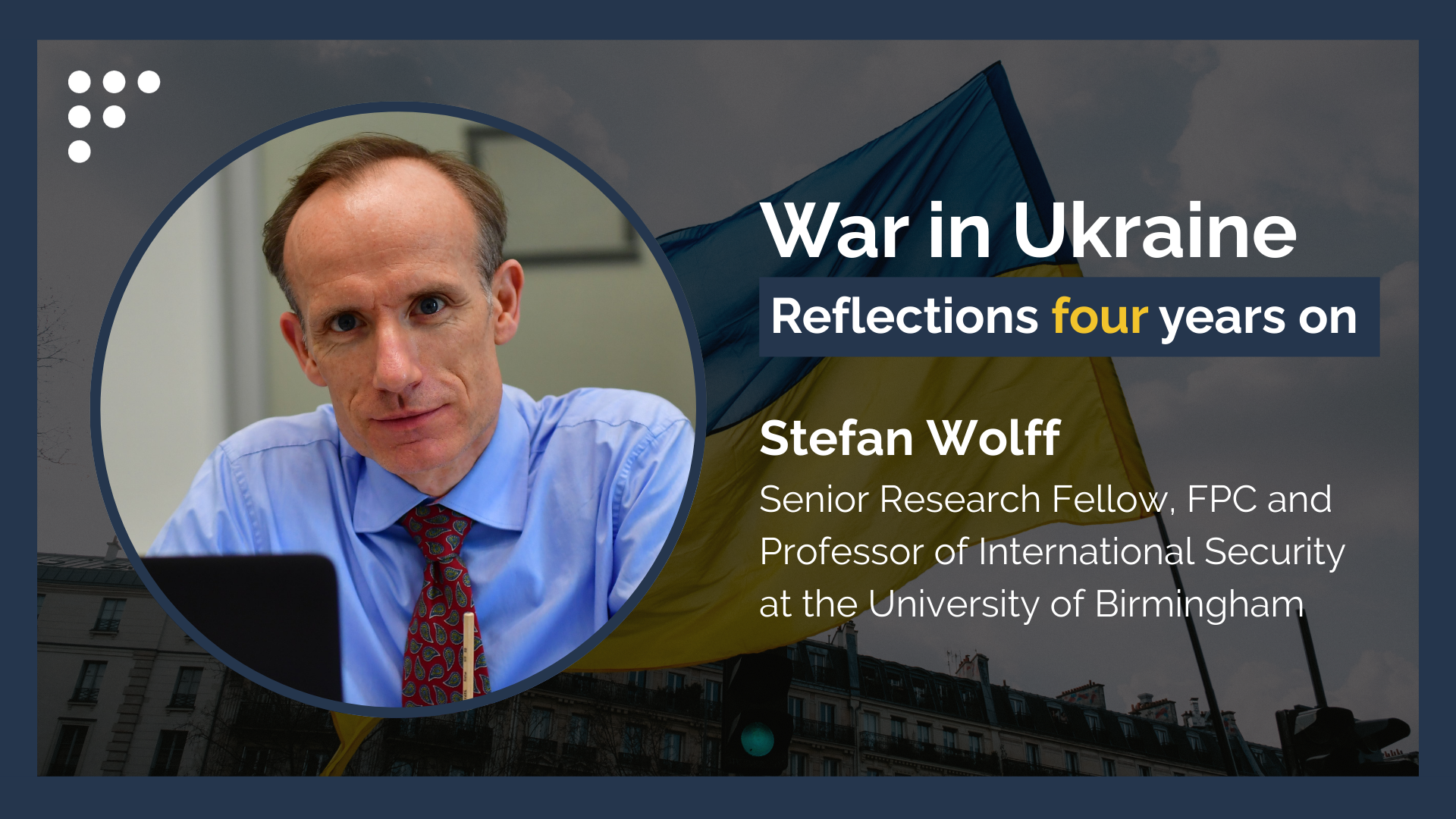
    Four Years On: Europe’s Strategic Test in Ukraine

    Article by Prof Stefan Wolff

    Four Years On: Europe’s Strategic Test in Ukraine

    Four years into Russia’s full-scale invasion of Ukraine, the conflict remains unresolved and the strategic landscape increasingly complex. In this analysis, Stefan Wolff, FPC’s Senior Research Fellow, examines the evolving diplomatic scenarios, the limits of US-led negotiations, and the choices confronting the UK and its European partners as the war enters a fifth year.


    As Ukraine heads into a fifth year of defending itself against the unprovoked Russian full-scale invasion, the prospects of a just and sustainable peace agreement remain distant. On the ground, the land war continues to be in a stalemate, with the pace of Russian territorial gains now slower than some of the most protracted battles of trench warfare during the First World War. 


    In the air war, Moscow has demonstrated a ruthless and brutal efficiency in destroying much of Ukraine’s energy infrastructure. The repeated destruction of power generation and distribution facilities has taken a serious toll on the Ukrainian population and economy. Yet beyond inflicting hardship, these strikes have not had the kind of strategic effect Russia needs to achieve in order to turn the military tables decisively on Ukraine.


    All in all, the Kremlin narrative of inevitable victory looks more like Soviet-style propaganda than a reflection of battlefield reality. President Vladimir Putin, however, is not the only world leader guilty of wishful thinking. His American counterpart, President Donald Trump, at times, also appears to make policy untethered from the real world. First, there was his claim on the campaign trail that he could end the fighting in Ukraine within 24 hours. Upon returning to the White House, Trump issued multiple ceasefire demands and associated deadlines that Putin simply ignored without incurring any cost. The latest plan from Washington is for a peace deal to be concluded between Moscow and Kyiv, approved by a Ukrainian referendum, and followed by national elections — all before June.


    Scenarios for a US-Mediated Settlement

    The timeline for the American plan aside, a US-mediated deal between Russia and Ukraine remains possible. However, It is unlikely that it will take the form of the just and sustainable settlement that Kyiv and its European allies demand. If it comes to pass as a result of the ongoing trilateral negotiations currently underway, it is highly probable that Ukraine will have to make significant concessions on territory in exchange for US-backed security guarantees and a mostly European-financed package of post-war reconstruction measures. 


    An additional bitter pill to swallow for Ukraine and Europe would be an unashamed US-Russia rapprochement with a simultaneous end to American sanctions on Russia, a flurry of economic deals between the two countries, and pressure on Ukraine’s other allies to follow suit, at least on sanctions relief and possibly on the release and return of Russian frozen assets.


    The other — and more likely — possibility is that not even a bad deal will be forthcoming. The Russian side has given no indication that it is willing to make any significant concessions. Moscow’s position is that Kyiv should relinquish control over the entirety of the Donbas, including territory in Ukraine’s fortress belt that Moscow has so far been unable to take by military force. In return, or under the terms of what Russia refers to as the ‘Anchorage formula’ allegedly agreed between Putin and Trump at their Alaska summit in August 2025, the Kremlin is apparently willing to freeze the current frontlines elsewhere along the more than 1,000 km long line of contact. 


    Even at the very remote possibility that this was acceptable, or that Ukraine would be pressured into agreeing to such a deal, this would hardly seal a settlement, given that Russia continues to oppose the security guarantees currently on the table between Kyiv and its Western partners. Without them, territorial concessions make no sense for Ukraine, especially as there is no imminent danger of a collapse of Ukrainian defences. 


    The Hungarian blockage of the EU’s €90 billion loan to Ukraine — likely instigated by the country’s Prime Minister, Victor Orbán, at the behest of both Trump, whose Secretary of State, Marco Rubio, had visited the country just before the announcement, and Putin, with whom Orban has had close ties for a long time — is not going to change Kyiv’s calculations significantly. Not only is the EU surely going to find a work-around to deal with this blockage but Orban’s days as Ukraine’s principal foe inside the EU might be numbered given that he is trailing in opinion polls ahead of April’s parliamentary elections. As any embrace of and by Trump and Putin is unlikely to improve Orban’s prospects for another term, the Hungarian blockage might ultimately prove temporary regardless of the outcome of April’s elections.


    If, as is therefore likely, Trump’s latest deadline passes without a deal being reached, the question arises what next? Trump could simply walk away from the war. He threatened to do so in the past but a likely mix of ego and the prospect of economic deals in the event of peace prevented him from doing so. Nothing suggests at the moment that this time will be different. There might be some angry exchanges and finger pointing, but after that, the current, deeply flawed negotiation process is likely to resume in some form because the alternatives are worse for all sides, Trump included.


    The US President could walk away and finally realise that Putin is simply not interested in peace, no matter what is on offer. But this will not lead Trump to ramp up pressure on Russia in a significant way. He has had reason and opportunity to do so on multiple occasions since returning to the White House in January 2025. He has not done so then, and there is no reason to believe that he would do so now. 


    Trump could then instead pursue a bilateral deal with Russia. But without European participation, such a deal will be of limited benefit to both sides. The bulk of Russian foreign assets remain frozen in Europe, and would very likely stay so in the absence of coordinated transatlantic action. Russia has little of value to export to the US and lacks the market conditions to make it an attractive destination for US foreign direct investment. Some US companies might return or expand their still existing operations in the country, but these will hardly be the trillion-dollar deals that Trump, and possibly Putin, envisage.


    Even if any such separate US-Russia deal would be of limited economic value, it would still be politically damaging, especially to transatlantic relations. That, however, also makes it less likely to happen. By June, primaries in the United States ahead of the November midterm elections will largely have concluded and Republican candidates will be less susceptible to pressure from the White House. As was already obvious in the context of Trump’s threats to take over Greenland, if necessary by force, there remains a segment of foreign policy realists among congressional Republicans who, unshackled from the leverage Trump may have held over them in the primaries, are likely to push back more against his most disruptive foreign policy stances, including when it comes to any dealing with Russia reached at the expense of the transatlantic alliance.


    What Europe Must Do Now

    All of these scenarios, and a likely myriad of more or less minor variations of them, contain the ingredients of a British and European strategy for what is probably another year of Russia’s war against Ukraine. 


    The first is the utmost importance of unity behind Ukraine’s defence efforts. Across the multiple overlapping multi- and mini-lateral formats of EU, NATO, coalition of the willing, etc., there needs to be a clear message to Russia, the US, and Ukraine alike: Russia’s aggression is also Europe’s problem and will be treated as such for as long as the threat from Moscow — not just against Ukraine but against the fundamental tenets of the European security order as such — remains credible.


    This means, second, that Ukraine needs to be supported materially with military economic aid and politically when it comes to pushing back against both American and Russian designs for a deal to serve the interests of the current incumbents of the White House and the Kremlin first. For a more effective political pushback, Europe needs to cultivate relations with those in the US foreign policy establishment who continue to see value in established alliance structures, especially if they reflect more balanced burden-sharing.


    Third, the UK and its European allies also need to think beyond Ukraine — because this is what Russia is doing as well, despite the demands of its war of aggression. Though it need not be limited to the EU-Russia borderlands, this is where the focus needs to remain for the foreseeable future. 


    Moldova, for example, remains particularly vulnerable to Russian interference, notwithstanding the success of pro-European forces in the country in presidential and parliamentary elections in 2024 and 2025. Moscow still retains multiple channels of influence, including through the unresolved conflict in the Transnistrian region, which, if left to fester, could significantly impede Moldova’s EU accession process and provide opportunities for renewed destabilisation. 


    Similarly, parliamentary elections in Armenia in June will create an opportunity for the Kremlin to destabilise another of its neighbours that has increasingly turned away from Moscow and towards Brussels. Given the role of the US, and of Trump personally, in the peace process between Armenia and Azerbaijan, this also offers an opportunity to cooperate with Washington in working towards constraining Russian influence in the South Caucasus region as a whole. 


    A fourth and final ingredient in an evolving British and European strategy is a focus on becoming a credible player in the emerging new international order. This requires a certain amount of realism and modesty in aspirations and messaging. The UK is not pursuing a fast track to rejoining the EU, but closer alignment and cooperation across the English Channel is essential. 


    Equally important is that declarations of intent, be they about a UK-EU reset or an expanding coalition of the willing, are followed with concrete action — especially on investment in defence and a more credible European deterrence posture. This means both a more capable defence industrial base and doctrine for the kind of war being fought in Ukraine and improved defence readiness and resilience at the level of society. 


    A reconstituted European alliance, with a coalition at its heart that is not just willing but also capable of deterring Russia, is not beyond the reach of the UK and Europe. It may not be, nor ever become, a traditional great power, but by continuing to back Ukraine today and integrating it tomorrow, it will feel, and be, less vulnerable to the whims of the current or any future mercurial leader in the White House or the Kremlin. Crucially, it preserves the opportunity to rebuild the transatlantic alliance in the future, and to do so on stronger European foundations.


    Disclaimer: The views expressed in this piece are those of the individual author and do not reflect the views of The Foreign Policy Centre.


    Stefan Wolff is Professor of International Security in the Department of Political Science and International Studies, at the University of Birmingham. A political scientist by background, he specialises in the management of contemporary security challenges, especially in the prevention and settlement of ethnic conflicts, in post-conflict state-building in deeply divided and war-torn societies, and in contemporary geopolitics and great-power rivalry. Wolff has extensive expertise in the post-Soviet space and has also worked on a wide range of other conflicts elsewhere, including in the Middle East and North Africa, in Central Asia, and in sub-Saharan Africa. Wolff holds degrees from the University of Leipzig (Erstes Staatsexamen), the University of Cambridge (M.Phil.), and the LSE (Ph.D.).

    Regions
    Footnotes
      Related Articles

       Join our mailing list 

      Keep informed about events, articles & latest publications from Foreign Policy Centre

      JOIN