
The upcoming Armenian elections are often framed as a choice between Russia and the West. In reality, the outcome will shape the country’s evolving relationship with Russia, the West, and its neighbours in the strategically important South Caucasus. This article forms part of the Foreign Policy Centre’s work on democracy and elections.
In the shadow of war in the Middle East and Russia’s ongoing war waged against Ukraine, Armenia is heading into parliamentary elections on 7 June that will not only be critical for the country’s own direction but are also likely to have an impact for the wider South Caucasus region; itself of broader geopolitical significance at a crucial north-south and east-west crossroads.
At stake is first of all the future of incumbent Prime Minister Nikol Pashinyan and his Civil Contract party government, which came to power in 2018 after the Velvet Revolution. The movement ousted the government of long-term leader Serzh Sarkisian, who had tried to prolong his stay in power “by moving from the office of president to that of prime minister”.[1] This triggered nation-wide protests propelling Pashinyan to the premiership that May and to electoral victory in December.
Under Pashinyan, who was re-elected in 2021, Armenia has generally gravitated towards the European Union and away from Russia.[2] The latter is mostly a result of Russia’s failure to support Armenia during the Azerbaijani offensive in Nagorno-Karabakh in September 2023. The offensive resulted in Azerbaijan retaking control over the territory, which Armenia had illegally occupied since the first Karabakh war in the early 1990s – causing the displacement of around 100,000 Armenians from the region. These events unfolded in the presence of Russian ‘peacekeepers’ deployed under the terms of a cease fire agreement that ended the second Karabakh war in 2020.[3]
Armenia’s election on 7 June therefore marks an important milestone not only domestically, but also for the wider region. Pashinyan campaigns on a platform “to reopen the country’s borders, lower dependence on Russia, and diversify its foreign and economic profile by normalising relations with traditional adversaries Azerbaijan and Turkey”.[4] If Pashinyan secures another term, this would give him the mandate to carry out a major shift in Armenia’s foreign policy orientation, and in this sense, the elections are also a “strategic referendum on Armenia’s geopolitical orientation.”[5]
A popular endorsement of Pashinyan’s agenda would enable the continuation of three important trends in the region: first, the gradual emergence of regional ties between Georgia, Armenia and Azerbaijan; second, further declining Russian influence in a region where Moscow once was the undisputed hegemonic power; and third, a strengthening foothold for the EU and the US in a region that is a strategic land bridge towards Central Asia and China.
The relationship between Moscow and Yerevan has steadily deteriorated over the past decade.[6] Since the beginning of Russia’s full-scale invasion of Ukraine in 2022, the weight and significance of Russia in the region has clearly diminished, but this has been a gradual process, rather than an abrupt rupture.[7]
While Russia retains significant influence in Georgia, and the Georgian Dream government in Tbilisi is, for now, seemingly more closely aligned with Moscow than with either Brussels or Washington, it is also trying to balance its relationship more carefully between Russia and the West. This includes forging closer ties with Azerbaijan and Türkiye.[8] A victory for Pashinyan and his pro-Western agenda is likely to reinforce the trend towards the geopolitical re-orientation of the region, but this will remain a more careful multi-vector balancing act – with a mixture of political, economic, and cultural relationships to different actors outside the region – rather than a more one-directional pivot towards the West.[9]
Although Russian influence may be declining, Moscow’s strategic interests in the South Caucasus, including in Armenia, remain strong. Russia is poised to use whatever tools and leverage it still has to prevent a further decline of its role as erstwhile regional hegemon, including by using cultural and religious channels of influence.[10] Economically, Russia remains Armenia’s most important trade partner and energy supplier.[11] Many opposition forces also remain closely aligned with Russia, including the Strong Armenia bloc led by billionaire Samvel Karapetyan.[12] Most Armenians favour diversification of relations rather than an outright rejection of Russia. According to recent polling, 43% see Moscow as the country’s most important partner, compared to 42% who think of Washington in that way, and 29% who think of Brussels.[13]
The geopolitical dynamics in and around Armenia are therefore more complex and nuanced than the political rhetoric accompanying them. Yet, Russia’s capacity to exercise real influence effectively – and comparably to its previous dominance – is more constrained than ever. For example, Armenia has completely shifted away from Moscow as a security provider not only rhetorically but also in terms of who now supplies most of its arms: where Russia once accounted for over 90% of Armenia’s weapons purchases, its share has now dropped to somewhere between 5% and 10%, while France and India have become Armenia’s primary defence partners.[14]
Armenia, thus, has not, and most likely will not, replace its close alignment with Russia with one that solely relies on the West. However, the change in foreign policy direction under Pashinyan has clearly shifted away from Russia and towards Brussels and Washington. On the European side, this has been reciprocated with the back-to-back European Political Community summit and first bilateral Armenia-EU summit held in Yerevan in May 2026.[15]
The United States under President Donald Trump has also demonstrated a continuing interest in the region, which is most evident in Trump’s engagement in trying to broker a permanent peace agreement between Armenia and Azerbaijan. While this has yet to be achieved, several pieces of this puzzle have been put in place, including, most recently, a bilateral framework agreement on the Trump Route for International Peace and Prosperity (TRIPP).[16] Given the transactional and erratic nature of much of Trump’s foreign policy, this is unlikely to be a pivotal game changer either for peace between Armenia and Azerbaijan or for long-term US commitment to the country or the region, but it is part of the broader picture of the geopolitical importance of Armenia and the South Caucasus – and the opportunities that this may create for Pashinyan’s agenda.
A careful balance therefore needs to be struck between dismissing Armenia’s parliamentary elections as the continuation of Armenia’s historic dependence on Russia, and exclusively reorienting strategic alignment in the much bigger geopolitical game surrounding the South Caucasus. The outcome of the elections will be important for the country’s direction, and speed of travel: whoever forms the next government in Yerevan will still have a range of pre-existing problems to resolve in an environment where external support is neither certain nor dependably benign.
James Stanley is an M.A. International Relations student at the University of Birmingham. He has experience in policy research and public engagement, including contributing to the Helios exhibition at The Exchange. His research interests include Russia, European security, and the wider Eurasian region.
Stefan Wolff is Senior Research Fellow at the Foreign Policy Centre and Professor of International Security in the Department of Political Science and International Studies, at the University of Birmingham. A political scientist by background, he specialises in the management of contemporary security challenges, especially in the prevention and settlement of ethnic conflicts, in post-conflict state-building in deeply divided and war-torn societies, and in contemporary geopolitics and great-power rivalry. Wolff has extensive expertise in the post-Soviet space and has also worked on a wide range of other conflicts elsewhere, including in the Middle East and North Africa, in Central Asia, and in sub-Saharan Africa. Wolff holds degrees from the University of Leipzig (Erstes Staatsexamen), the University of Cambridge (M.Phil.), and the LSE (Ph.D.).
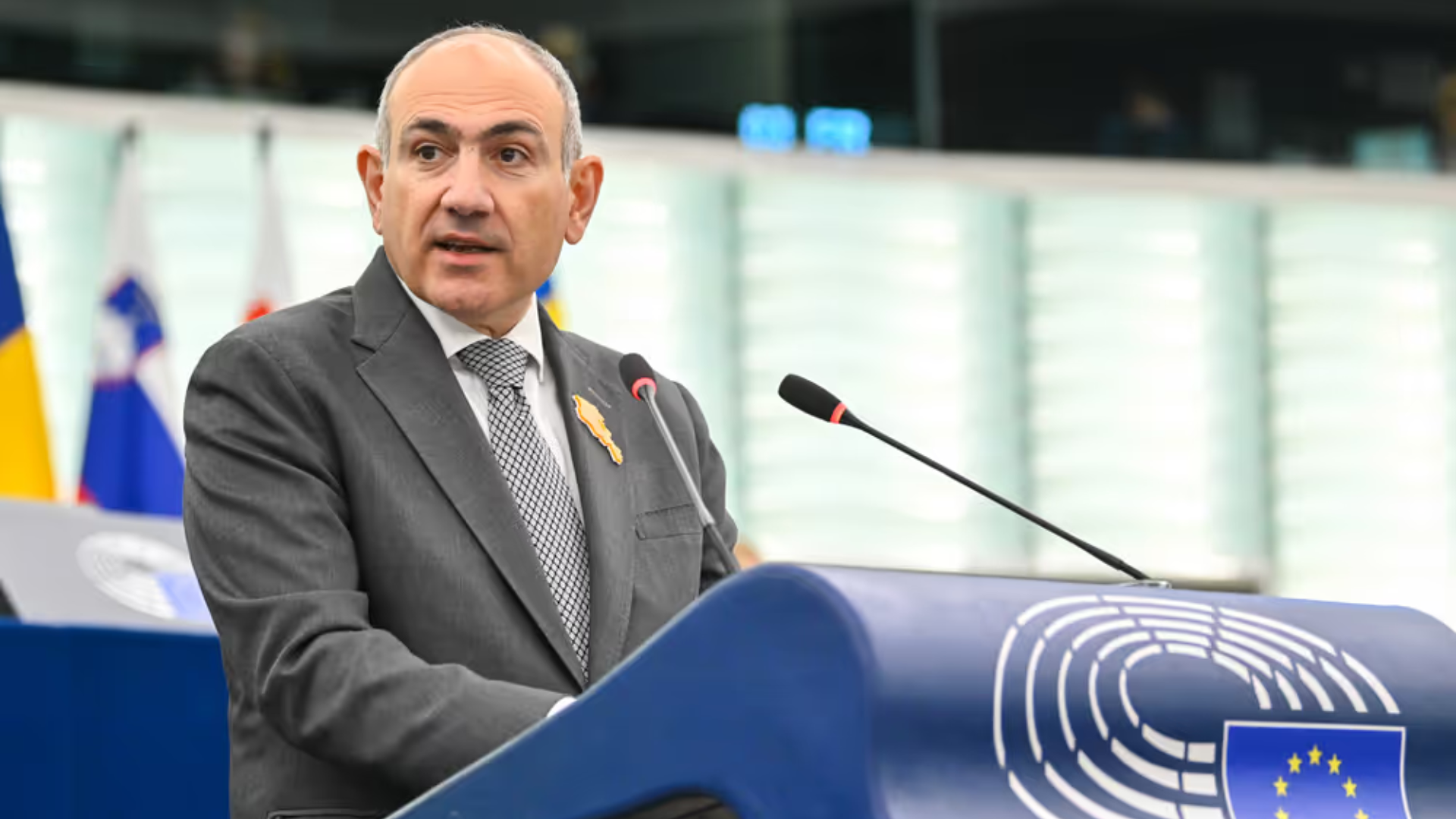
Image: © European Union 2026 – Source : EP
Disclaimer: The views expressed in this piece are those of the individual authors and do not reflect the views of The Foreign Policy Centre.
[1] Miriam Lanskoy and Elspeth Suthers, Armenia’s Velvet Revolution. Journal of Democracy, April 2019, https://dx.doi.org/10.1353/jod.2019.0027
[2] Council of the European Union, EU Relations with Armenia, https://www.consilium.europa.eu/en/policies/armenia/
[3] Michael Ertl, Nagorno-Karabakh: Conflict between Azerbaijan and Armenians explained, BBC News,September 2023, https://www.bbc.co.uk/news/world-europe-66852070
[4] Thomas de Waal, Armenia’s Election Is a Foreign Affair, Strategic Europe, November 2025, https://carnegieendowment.org/europe/strategic-europe/2025/11/armenias-election-is-a-foreign-affair
[5] Robert Lansing Institute, Armenia’s Parliamentary Elections 2026: A Battle for the State’s Geopolitical Future,May 2026, https://lansinginstitute.org/2026/05/18/armenias-parliamentary-elections-2026-a-battle-for-the-states-geopolitical-future/
[6] Ulviyya Asadzade, Russia’s Grip Weakens In The South Caucasus, Opening Doors To New Players, Radio Free Europe/Radio Liberty, July 2025, https://www.rferl.org/a/south-caucasus-russia-losing-influence-armenia-azerbaijan/33475018.html
[7] Emil Avdaliani, “Russian Influence Drains Away in the South Caucasus”, Center for European Policy Analysis, 22 May 2026, https://cepa.org/article/russian-influence-drains-away-in-the-south-caucasus/
[8] Mark Temnycky, Caught Between NATO And Russia, Georgia Turns To The South Caucasus, Forbes, December 2025, https://www.forbes.com/sites/marktemnycky/2025/12/13/caught-between-nato-and-russia-georgia-turns-to-the-south-caucasus/
[9] Laurence Broers, Armenia’s election: Voters to decide on Pashinyan’s peace agenda”, Chatham House, May 2026, https://www.chathamhouse.org/2026/05/armenias-election-voters-decide-pashinyans-peace-agenda
[10] Mikayel Zolyan, “Russia Won’t Give Up Its Influence in Armenia Without a Fight”, Carnegie Politika, 3 February 2026, https://carnegieendowment.org/russia-eurasia/politika/2026/01/armenia-russia-drifting-apart; Davit Gasparyan, Russian Religious Networks and Armenia’s Church-State Confrontation, Central Asia-Caucasus Institute, March 2026, https://substack.com/home/post/p-188618614
[11] SpecialEurasia, Trade as Leverage: Russia’s Enduring Economic Role in Armenia, March 2026, https://www.specialeurasia.com/2026/03/11/trade-russia-armenia-leverage/
[12] Sergey Kanev, Grabbing him by the ‘Beard’: The Insider identifies the FSB, GRU, and SVR agents Russia sent to Armenia to take on PM Nikol Pashinyan, The Insider, May 2026, https://theins.press/en/inv/292740
[13] International Republican Institute, Public Opinion Survey: Residents of Armenia, February 2026, March 2026, https://www.iri.org/resources/public-opinion-survey-residents-of-armenia-february-2026/
[14] Leonid Nersisyan and Sergei Melkonian, Escaping Russia’s Backyard: Armenia’s Strategic Defense Shift, War on the Rocks, November 2024, https://warontherocks.com/escaping-russias-backyard-armenias-strategic-defense-shift/
[15] Rayhan Demytrie, European leaders converge on Armenia as Russia looks on, BBC News, May 2026, https://www.bbc.co.uk/news/articles/cgkp1124y3yo
[16] Office of the Spokesperson, The United States and Armenia Announce the Trump Route for International Peace and Prosperity (TRIPP) Framework Agreement and Sign the Strategic Partnership Charter and Critical Minerals Memorandum of Understanding, US Department of State, May 2026, https://www.state.gov/releases/office-of-the-spokesperson/2026/05/the-united-states-and-armenia-announce-tripp-framwork-agreement-and-sign-the-strategic-partnership-charter-and-critical-minerals-mou/