
Introduction: Examining the pressure on human rights in Kyrgyzstan
This publication, Retreating Rights, is an attempt to take stock of another period of rapid and chaotic change in Kyrgyzstan, looking at how the country arrived at its current situation and assessing what can be done next.[1] The roots of where the country now finds itself run deep, deeper than many of the institutions Kyrgyzstan has built up over the years, and a more detailed analysis of these structural questions is covered in the second half of this introduction and in many of the essay contributions.
When this project was initially conceived in Autumn 2019 the storm clouds of nationalism and corruption over the country had been gathering for some time (and in many respects had always been there), before a weak response to COVID and pent-up frustration with a self-interested ruling class triggered the third overthrow of a government in little over 15 years. Kyrgyzstan’s relative openness, at least when compared to its Central Asian neighbours, has often masked some of the deep and deepening challenges on governance and human rights issues. The roiling intra-elite competition and concerns over corruption have driven two previous revolutions, a contentious election in 2017 and the violent siege and arrest of former President Almazbek Atambayev in August 2019. The country is also dealing with the legacy of inter-communal violence targeted mainly at the ethnic Uzbek minority in Southern Kyrgyzstan, with discrimination against that community and the suppression of their language and property rights not satisfactorily resolved. The tragic death of political prisoner Azimjan Askarov in 2020 is a legacy of this grim situation and a symbol of the continuing communal tensions.
Over the last decade, and particularly in recent years, civil society activists have tried to raise the alarm about the increasing challenges they faced from the bureaucratic pressure, security service snooping and nationalist backlash, but too often these concerns have been minimised, informed in part by a desire to retain the idea of Kyrgyzstan as the Central Asian success story when it came to human rights and civic freedoms, even as poverty and other development metrics showed much more limited progress. As recently as June 2020 international partners such as the EU were arguing that ‘the overall human rights situation remained stable and is considered as the most advanced in the region. The government remained committed to its human rights agenda and adopted relevant documents for its implementation, e.g. the National Human Rights Action Plan 2019-2021.’[2] Incremental mounting concerns were too often overlooked until it became too late to stop more profound change. The ‘frog’ of Kyrgyzstan’s political wellbeing had been gently boiled over several years before the pan bubbled over in late 2020, leaving serious, overdue questions about the long-term health of that metaphorical amphibian that this publication seeks to answer.
How we got here: a brief history of Kyrgyzstan
The land that is now Kyrgyzstan has been home to a series of step civilisations including the Yenisei Kyrgyz Khaganate (likely to have been formed by ancestors of the modern Kyrgyz people) before its conquest by other step peoples including most notably the Mongol Empire in the thirteenth century.[3] The folk history of this initial founding period (in the ninth century) is shaped by the events told in the Epic of Manas, one of the world’s longest poems, which has been used heavily by modern Kyrgyzstan as the basis for its national identity.[4] The Kyrgyz remained predominantly as nomadic tribes in what is now Kyrgyzstan and the surrounding regions, interacting with the Chinese and other settled empires such as the Timurids to the south. First contact between the Kyrgyz tribes and Katherine the Great’s Russia took place in 1775 and just over a 100 years later (in 1876) the land and its people were taken and absorbed into the Russian Empire. The Soviets established the Kara-Kirghiz Autonomous Oblast within the Russia Soviet Socialist Republic (SSR) in 1924 which would gradually evolve in 1936 into the Kirghiz Soviet Socialist Republic, a full constituent republic of the Soviet Union. Shortly before the dissolution of the Soviet Union the President of the Kirghiz Academy of Science Askar Akayev won the Presidency after stalemate between more established Communist Party figures. Akayev would lead the new Republic of Kyrgyzstan until 2005, moving further than his Central Asian peers down the road of economic and political liberalisation. Although less authoritarian than his fellow post-Soviet Central Asian leaders the level of corruption steadily grew through his time in office.
How we got here: 2005- 2020
Despite having previously promised to retire as mandated at the end of his third term in 2005, rumours swirled that Akayev planned a managed transfer of power to one of his children or to break the term limits that would have prevented him standing again. Protests against his government escalated across the country, particularly in response to strong concerns of ballot rigging in the February 2005 parliamentary election, that culminated in Akayev fleeing the country (and resuming his academic career in Moscow), a sequence of events known as the Tulip Revolution.[5]
Leader of the protest movement, former Prime Minister Kurmanbek Bakiyev became both interim Prime Minister and Acting President and would subsequently win the July 2005 elections that followed Akayev’s ouster. Like his predecessor Bakiyev would promise reform and then became mired in increasingly egregious corruption, as a number of authors in this collection note. Amid an energy crisis (with rolling blackouts and spiralling costs), opposition to Bakiyev’s corruption crystallised into protests and riots that escalated into the capture of key government buildings and the White House (home to the Parliament and Presidential Administration) with around 65 deaths before the resignation of Bakiyev in April 2010. However his supporters would continue to mobilise in the south of the country leading to unrest that culminated in the June 2010 riots in Osh that predominantly targeted the ethnic Uzbek population who had been seen to be supportive of those who had ousted Bakiyev, though the roots of the dispute lie much deeper as explained in this publication. Bakiyev, along with many of his family and entourage, sought and gained asylum in Belarus, including the bizarre case of former Prime Minister Daniyar Usenov who is believed to have changed is name and now serving as the director of the Belarus National Biotechnology Corp, while Bakiyev’s son Maxim gained asylum in the UK.[6] Roza Otunbayeva, who had previously been a key figure alongside Bakiyev in 2005, served as President on a short-term basis following the passage of the July 2010 Constitution in a referendum that saw the transfer of significant powers from the Presidency to the Parliament (the Jogorku Kenesh or Supreme Council).
Otunbayeva was succeeded as President in December 2011 by the Prime Minister Almazbek Atambayev. Again, as a number of authors in this collection show, he came in promising reform and left with a reputation for corruption and mismanagement. However, so far uniquely in post-Soviet Kyrgyzstan, he made it to the end of his term of office. Atambayev was able to hand over power in 2017 to his hand-picked successor and Social Democratic Party of Kyrgyzstan (SDPK) colleague, the Prime Minister Sooronbay Jeenbekov, in an election that was broadly free but far from entirely fair, marred by misuse of vote buying and use of administrative resources.[7] Yet upon taking office the relationship between the two men swiftly fractured with a flurry of legal cases against Atambayev and his inner circle, culminating in an armed stand-off at Atambayev’s home compound and his subsequent arrest and conviction for 11 years on corruption charges and manslaughter charges still pending. The SDPK fractured between pro-Jeenbekov and pro-Atambayev factions, with many of the former ultimately coalescing around the Birimdik (Unity) party to act as the ‘party of power’ ahead of the 2020 elections.
Kyrgyzstan’s reputation as an ‘Island of Democracy’ has been repeated often throughout the country’s post-Soviet history as a point of comparison to its neighbours, but throughout said history there have been significant concerns about its political health.[8] At the very least it is worth pointing out that every elected President has either been removed from office by protests or been subsequently imprisoned after their term had expired.[9] The country remains the second poorest in the post-Soviet space, with a GDP per capita of $1,309 (actual USD or $5,485 PPP) and massive levels of migration, in particular to Russia that sees remittances form 28.5 per cent of the Kyrgyzstan’s GDP.[10] The Transparency International Corruption Perception Index (CPI) places the country at 124th in the world and despite the lingering perception of Kyrgyzstan’s democratic bona fides Freedom House’s Nations in Transit Report has repeatedly classified Kyrgyzstan as a Consolidated Authoritarian Regime, with an overall score for political freedoms of 11 out of 100 and an albeit slightly better 27 out of 100 for Civil Liberties.[11] In 2016, Kyrgyzstan only narrowly avoided introducing a Russia-style foreign agents law after intense pressure from Kyrgyz civil society and Western donor governments and many NGOs have reported continuing pressure from the authorities and non-state actors linked to powerful interests.[12]
As set out later in this section and in many of the essays, nationalism has been on the rise over the last ten years to become a major mobilising force in Kyrgyzstan’s public life.[13] This has manifested itself in many different ways, but particularly in the form of both anti-Western and anti-Chinese sentiments, a growing hostility to local Russian speakers (though rarely to Russia itself) and ongoing tensions over women’s rights issues and with ethnic and sexual minorities.
From late 2018 onwards a series of protests began against Chinese migrants (both real and perceived), Chinese investments in the country and around the treatment of ethnic Kyrgyz in China.[14] In August 2019, protests erupted at the Solton-Sary mine, owned by the Zhong Ji Mining Company, over allegations of environmental damage and poor treatment of Kyrgyz employees.[15] As well as the ethnic and geo-strategic dimension in relation to such protests, the protests tapped into wider concerns about lack of economic progress and the sense that those benefiting from Kyrgyzstan’s resource wealth are not the local population but international investors (and domestic elites). Dissatisfaction and protests against foreign ownership of the Kumtor Gold mine, owned by Canadian mining firm Centerra and accounting for around nine per cent of Kyrgyz GDP, have been a recurring theme of Kyrgyz political debate and was the source both of now President Sadyr Japarov’s initial popularity and his criminal conviction for a kidnapping that occurred as part of pro-nationalisation protests he led in 2013.[16] 2020 began with further protests against perceived Chinese economic encroachment, ultimately leading to plans for a $275 million Sino-Kyrgyz logistics center in the Naryn Free Economic Zone near the Chinese border to be scrapped.[17]
Women’s rights have become a particular flashpoint between women’s rights protesters (along with their supporters in liberal civil society) and nationalist counter-demonstrators. In late 2019, the Femminale of Contemporary Art, an exhibition of feminist art by Kyrgyz and international artists at the National Museum of Fine Arts in Bishkek became the centre of protest.[18] The backlash by protesting nationalists groups against the display (that included Kazakh artist Zoya Falkova’s Evermust, a punching bag made into the shape of a female torso to highlight domestic violence) lead to the Ministry of Culture censoring some of the exhibits and forcing the resignation of the Museum’s curator amid death threats against her.[19] International Women’s Day (March 8th) has also long been a flashpoint between the two faces modern Kyrgyzstan and in 2020 it again became a point of conflict. As Eric McGlinchey puts it in his essay, ‘on March 8, 2020—International Women’s Day—a group of masked men wearing Ak-kalpaks, traditional Kyrgyz hats, attacked a group of activists who had gathered on Victory Square to highlight the persistence and acceptance of widespread domestic violence, bride kidnapping, and rape.[20] Revealingly, while the violent attackers were not detained, 50 women’s rights activists were arrested.’[21]
How we got here: March-October 2020
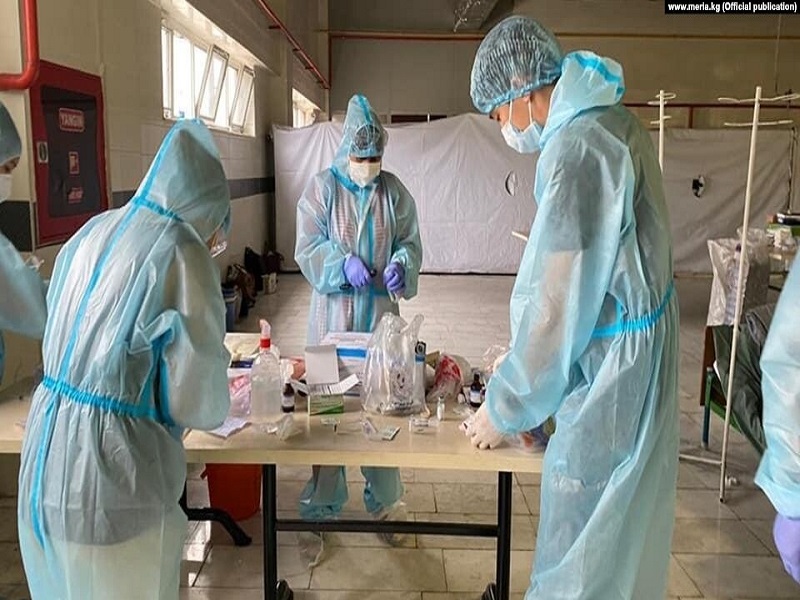
Ten days after the International Women’s Day protests however normal political life would come shuddering to a halt as the first cases of COVID-19 were identified in Kyrgyzstan. By March 22nd a state of emergency was declared and public transport was shut down in Bishkek, which would evolve into a more substantial lockdown and curfew.[22] As with so many countries around the world, including this author’s own, the ensuing crisis fully exposed the strengths and many weaknesses of the Kyrgyz state. As Ryskeldi Satke’s essay in this collection shows the pandemic overwhelmed the capacity of Kyrgyzstan’s health system (both in terms of beds and staff) and laid bare the endemic problems with governance, lack of transparency and corruption that undermined the country’s ability to cope. Problems included a lack of oxygen and ventilators and the virus running rampant through healthcare workers who were struggling with the lack of PPE and other protections.[23] In the first few months of the pandemic the true picture was also somewhat obscured by cases regularly being misrecorded as cases of pneumonia.
Much of the initial response was characterised by an intra-elite blame game. By April 1st President Jeenbekov fired the heads of his COVID taskforce, Health Minister Kosmosbek Cholponbayev and Deputy Prime Minister Altynai Omurbekova over perceived failings in the initial response.[24] Cholponbayev would subsequently be arrested in September 2020 amid claims of negligence and concerns over a consulting contract he had negotiated.[25] Prime Minister Mukhammedkalyi Abylgaziev would take a leave of absence on May 27th, mid-crisis, and would subsequently resign two weeks later over corruption allegations relating to the sale of national broadcasting frequencies.[26] At Abylgaziev’s leaving party ministers were caught on camera not wearing masks and breaking social distancing rules leading to 28 politicians and officials being fined.[27]
Ordinary citizens found the situation chaotic. The implementation of internal movement controls created havoc for the many people whose jobs relied on commuting into major cities such as Bishkek or who had been living in those cities without the formal propiska registration documents.[28] The crisis also saw Kyrgyzstan take on significant amounts of emergency funding from international institutions, $627.3 million by July 2020, triggering further concerns about transparency and accountability of how the money was spent.[29] However, as so often in cases of state failure in Kyrgyzstan, volunteers stepped into the breach to provide support in hospitals and other health care facilities.[30] Come 2021 and the Japarov administration would announce that the previous Government significantly under counted the death rate, with more than 4,000 having died in the initial 2020 outbreak compared to the previously quoted figure of 1,393.[31]
The crisis also not only necessitated the restriction of civil liberties on public health grounds seen around the world but it provided the Government with opportunities to further restrict media and political freedoms. As Elira Turdubaeva points out in her essay, independent media was not able to operate outside during the lockdown period, the Parliament tried to proceed with laws designed to increase bureaucratic measures on NGOs and the security services ramped up arrests of social media users who criticised the Government response to the pandemic (including medical workers protesting the lack of PPE).[32]
Despite the social and economic turmoil ahead of the Parliamentary elections, it initially seemed that the contests would simply act as an intra-elite competition between oligarchs and local power brokers, as the party system reshaped itself following the implosion of the SPDK.[33] It soon became clear that much of the activity was centred around jostling between forces directly aligned with President Jeenbekov (including his brother Asylbek), which coalesced around the Birimdik party (Party of Democratic Socialism—Eurasian Choice ‘Unity’), and forces close to the powerful Matraimov family network (about more of which below), which acted through the also notionally pro-Jeenbekov Mekenim Kırgızstan (‘My Homeland Is Kyrgyzstan’) party.
Rules prohibiting the use of volunteers entrenched the capacity gap between the well-resourced efforts of Birimdik, Mekenim Kirgizstan and Kanatbek Isaev’s Kyrgyzstan party (also seen as being pro-Jeenbekov), and their rivals.[34] However, perhaps more important than formal campaign spending was the continuation of large-scale vote buying, a common practice in past elections, which this time also included the abuse of pandemic related charitable initiatives, as well as the traditional abuse of administrative resources (the coercion of state institutions and employees) to back pro-Jeenbekov candidates (albeit often against one another in internecine contests that devolved into brawls on more than one occasion).[35] 16 of the 17 Parties in the October election signed up to the Central Election Commission (CEC) code of conduct on hate speech but this was often ignored online during in the campaign.
Here: October 2020 onwards
On election day itself, October 4th, social media was awash with images of electoral shenanigans including videos of vote buying, voting for multiple people and suspected ‘carousel’ voting (where people vote in multiple polling locations, potentially abusing the ability to temporarily change voting addresses).[36] The OSCE Final Election monitoring report subsequently noted that its observation mission had received ‘numerous credible reports from interlocutors throughout the country about instances of vote buying and abuse of administrative resources.’[37]
In the preliminary results, Birimdik narrowly bested Mekenim Kirgizstan by 24.50 per cent to 23.79 per cent (which would have equated to 46 and 45 seats respectively in the 120 seat Supreme Council (Jogorku Kenesh), with Kyrgyzstan some way behind on 8.7 per cent and 16 provisional seats.[38] The fourth party to scrape over the seven per cent electoral threshold was the only party not to be openly and explicitly aligned with President Jeenbekov, the nationalist Bütün Kırgızstan (‘United Kyrgyzstan’), led by 2011 and 2017 Presidential election also-ran Adakhan Madumarov. This result was despite pre-election polling clearly showing that only a third of the electorate approved of the incumbent Government’s pandemic response.[39]
Protests on Bishkek’s Ala-Too Square and outside the CEC began as early as the announcement of the provisional results on the evening of October 4th, led by campaigners for the many parties that had failed to clear the electoral threshold and therefore would not hold seats in the new Supreme Council. By the following morning protesters were on the streets of Bishkek in significant numbers protesting the results and the open levels of fraud that had gone on the day before. By that afternoon and into the evening Ala-Too Square was full with thousands of protesters, waving flags and singing the national anthem.[40] By this stage sources in President Jeenbekov’s Birimdik were already saying that they were open to the election being re-run.
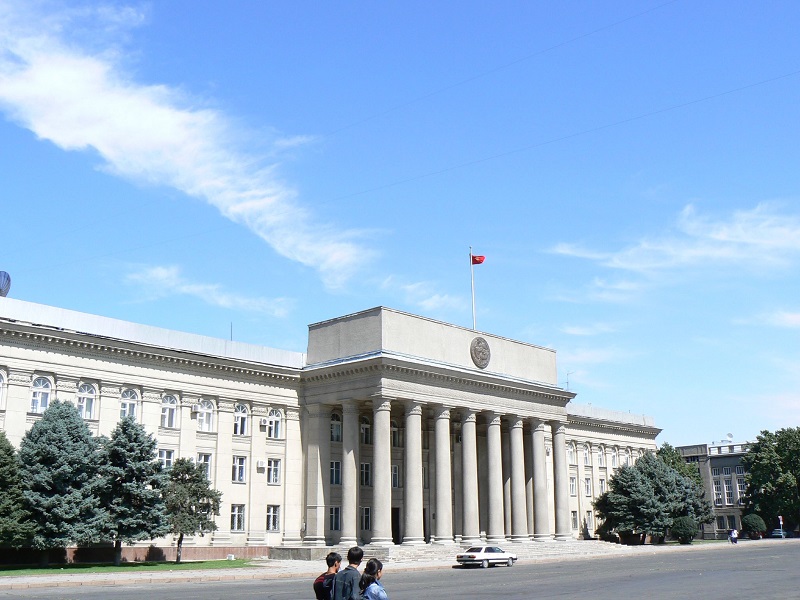
However, later into the evening the situation deteriorated into violence as police attempted to disperse the protestors, both those outside the White House and the square with water cannon, stun grenades and tear gas, escalating the tension.[41] By 3am the protesters had broken into the White House, including into President Jeenbekov’s office, and the State Committee for National Security (GKNB).[42] Among those released from the GKNB building included former President Atambayev and a former Member of Parliament Sadyr Japarov.[43] While Atambayev would attempt to somewhat awkwardly join the protesting opposition groups in Ala-Too Square, something that weakened the liberal camp’s legitimacy and that Asel Doolotkeldieva argues fundamentally weakened its negotiating position with Jeenbekov, Japarov was joined by his own supporters, that included amongst their number mixture of nationalist groups and ‘Sportsmeni’, who would ultimately coalesce around the City’s Old Square.[44] Less than a day after his release from prison Japarov would be find himself proclaimed as the country’s interim Prime Minister, late on October 6th, by a group of Parliamentarians from the pre-October 4th Supreme Council who had hunkered down in the Dostuk Hotel, though this meeting would be broken up by opposition supporters decrying the legitimacy of this impromptu, inquorate gathering. With President Jeenbekov absent from the scene, beyond the occasional video calling for calm, competing factions on the street proclaimed the support for their own leaderships, with young entrepreneur Tilek Toktogaziev being proposed by the liberal opposition. Tensions would ultimately come to a head on October 9th with street brawls between Japarov and opposition supporters, including a shot being fired at former President Atambayev’s car, that help to firmly tilt the balance of power in favour of Japarov’s supporters at the expense of the disorganised opposition movement and more liberally minded protestors.
As Bishkek was gripped by political upheaval another force made its presence felt on the streets in the absence of effective police control, the druzhinniki (volunteer civil defence units).[45] These volunteers fanned out across the city to protect shops and other businesses to prevent a repeat of the looting that followed the revolutions in 2005 and 2010.[46]
Japarov would again be declared Prime Minister on October 10th and 14th in incrementally more formal votes of the Parliament and amid claims of intimidation of its members by Japarov’s supporters.[47] On October 15th, Jeenbekov finally resigned and Japarov would take his place (and that of Prime Minster) on an interim basis, completing his transition from prisoner to President in ten days.[48]
In summary, the brief hopes that the opposition was uniting and able to come up with an alternative to the status quo came to naught as the enthusiastic but unprepared activists could not decide on how to seize their momentum, beset by tensions between younger activists and older, often discredited, opposition politicians who tried to ride the nascent revolution back to relevance.[49] Into the vacuum stepped a more organised alternative in Japarov, combining new mobilisation techniques, an outsider persona and a genuine personal following but with ties to old players, particularly those around former President Bakiyev and suspicions of ties to many of the shadowy forces that had previously participated in the rigged election.[50]
The rise of Japarov
Sadyr Japarov first came to limited public notice in the wake of the 2005 Tulip Revolution as a Parliamentarian and then advisor to then President Kurmanbek Bakiyev, serving a stint at the National Agency for the Prevention of Corruption at a time of widespread corruption allegations against those close to Bakiyev. Following the 2010 revolution Japarov initially followed Bakiyev to Osh and was present in the city during the inter-ethnic conflict between Kyrgyz nationalists and ethnic Uzbeks.[51] He resurfaced after the violence as an MP for former Minister of Emergency Situations Kamchybek Tashiev’s nationalist Ata-Zhurt party, which supported overturning the 2010 referendum that watered down the powers of the Presidency and argued for the return of Bakiyev.
However it was through his campaign against the Canadian ownership of the Kumtor mine that brought him to prominence, popularity and notoriety.[52] In 2012 a protest Japarov organised, protesting the amount of tax the mine owner Centerra was paying and calling for the nationalisation of the mine, turned violent after an incendiary speech by Tashiev that was seen by some as implying that they should occupy the White House. Some of the protesters duly tried to break in and there were claims that Tashiev tried to lead protesters over the fence.[53] Both Japarov and Tashiev faced criminal charges and they were stripped of their seats in Parliament as part of the settlement of the case.[54] In 2013 Japarov’s campaign against Kumtor escalated into months of protests in the Issyk Kul region near the mine. In October 2013 Government representative Emil Kaptagaev, who had attempted to speak to protestors, was bundled into a car that was then doused with petrol and threatened to be set alight.[55] Japarov himself was not present at this point, having travelled abroad a few days earlier, but was charged with inciting the violence. He would stay in exile until 2017 when he returned to Kyrgyzstan and was subsequently jailed for an 11.5 year term for his role in the kidnapping of Kaptagaev, this was despite Kaptagaev himself criticising the trial and saying that “fairness in the justice system has died”.[56] During the time Japarov spent in pre-trial detention and in prison his son and parents would pass away and he survived a suicide attempt, adding to a public persona of a politician who was personally suffering for his campaigning against vested interests.
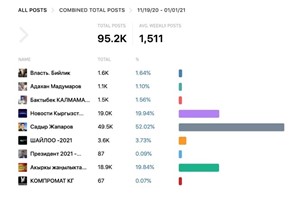
Despite being in prison Japarov served as leader of the Mekenchil (‘Patriotic’) party alongside his longstanding political partner Tashiev who served as its chairman. In the disputed elections of October 4th Mekenchil would receive the highest share of the vote of those parties not due to enter the new Supreme Council with 6.85 per cent, just below the seven per cent threshold for receiving seats. However, given the scale of vote buying by other parties, this was not a particularly helpful indicator of Japarov’s support, or at least his potential support. Joldon Kutmanaliev and Gulzat Baialieva show, in their essay in this collection and in their previous research, how Facebook played a crucial role in building his political brand; how WhatsApp was crucial in marshalling supporters to fill the crucial political vacuum that followed the rigged elections, and how he and his team built a following on Instagram and the Russian social network Odnoklassniki to create an organic social media presence that dwarfed other political figures who were more reliant on traditional methods of political horse-trading and vote buying.[57] The political messages that would churn within these groups sought to burnish Japarov’s reputation as a popular hero who stood up against the corrupt elite over Kumtor and was unjustly imprisoned, an economic populism and nationalism that was a central part of his image. Such narratives would overlap with more socially conservative nationalist rhetoric and anti-Western sentiment, particularly around pages linked to the Mekenchil party, built on the ground swell of nationalist and neo-conservative sentiment that had fermented in recent years.[58] These narratives and numbers were able to mobilise Japarov’s supporters, particularly amongst the rural population and unemployed former migrant workers returned from Russia, to build their own independent presence on the streets of Bishkek that would ultimately overwhelm the forces of the State, the liberally minded (and often urban) young activists and the more traditional opposition groups.
What Sadyr did next
The day after his assentation to the Interim Presidency Japarov installed his long-time political partner Kamchybek Tashiev as head of the security services, solidifying his hold on the levers of power.[59] At Tashiev’s direction a number of well publicised, and some would argue stage managed, moves took place to signal that the new leadership was taking action on corruption.[60] This included the arrest and pre-trial detention of Raiymbek Matraimov and the announcement of an investigation into 40 people believed to be part of his network.[61] As part of a 30 day ‘economic amnesty’ whereby former officials and other past beneficiaries of corruption could repay their ill-gotten gains to the Government, it was claimed Matraimov agreed to transfer two billion soms ($23.6 million) back to the state in return for a pardon.[62] At the same time it was noted that the network of fake accounts run by organised troll farms linked to Matraimov and who had previously been actively promoting Mekenim Kırgızstan turned their attention to supporting the new interim President.[63]
Around the country, local officials with ties to the Jeenbekov Government were removed from their posts. In the initial chaos figures from the Bakiyev-era, such as former Mayor of Bishkek Nariman Tuleev and Melis Myrzakhmetov, the controversial former Mayor of Osh heavily implicated in the 2010 inter-ethnic violence, tried to return in their former posts (and in Tuleev’s case briefly succeeded) before less contentious supporters of the new regime could be installed in acting control of key posts.[64]
Amid the chaos and factional horse-trading, positions of power in the cabinet and institutions were rapidly filled with people with personal and political connections to Japarov and Tashiev. One of the few exceptions, an attempted olive branch to opposition protesters, was the entrepreneur, turned opposition activist, turned less successful self-proclaimed president Tilek Toktogaziev who would find himself Minister of Agriculture in the interim administration.[65]
Attempts at formal legitimacy for all manoeuvres taken by the interim Government rested on the approval of members of a Supreme Council whose mandate had ended on October 15th. However instead of swiftly pursuing efforts to re-run the Parliamentary elections, the initial demand of the protestors who had filled the Bishkek streets, Japarov instead focused on his own political priorities.[66] These priorities included legitimising his hold on power through a new Presidential Election and delivering a long-held political goal of unravelling the post-2010 constitutional settlement in order to increase the power of the Presidency, a role which of course he now held. A one million dollar public affairs and PR contract was agreed, apparently funded by a supportive businessman, to help bolster the international image of the new political setup.[67]
So, after less than a month in the job, on November 14th Japarov relinquished the role of interim President in order to campaign for snap Presidential elections that were now to take place on January 10th 2021. Talant Mamytov, a deputy from Tashiev’s former Ata-Zhurt party, became the new Acting President having been elected as the speaker of the zombie Parliament earlier in November in a choreographed move to enable Japarov to run.[68] Artem Novikov, a young civil servant who had been acting as Japarov’s First Deputy Prime Minister, became the acting Prime Minister.
The second half of the double bill also announced for January 10th was Japarov’s promised constitutional referendum to approve a return to a strong Presidential system. The referendum that was initially due to approve the draft constitution was agreed on November 17th by the Supreme Council, with only four Parliamentarians voting against the plebiscite (Dastan Bekeshev, Aisuluu Mamashova, Natalya Nikitenko and Kanybek Imanaliev). However only 64 MPs (out of 120) were actually present for this huge decision, a reflection not only of the controversial nature of the proposal but that a constitutional process was being directed by a body sitting unconstitutionally beyond its original mandate.[69] In the wake of publication there was widespread confusion about what had happened with a number of the listed signatories denying they had seen or approved it and did not actually support some of the measures.[70]
The initial draft of the new constitution was, unsurprisingly, in-line with Japarov’s thinking and the priorities for reform of some of the nationalist groups that had coalesced around him.[71] This included articles that would create the long-mooted ‘People’s Kurultai’, a deliberative forum based on the traditional consultative body of nomadic tradition. The Kurultai movement was seen by both some of its proponents and opponents as a way to usurp the role and function of the existing Supreme Council.[72] Regional examples that claim some link to this heritage include the Assembly of People of Kazakhstan, comprising representatives of local assemblies, and the People’s Council in Turkmenistan (at times called the Council of Elders) both which act as rubber stamp bodies for those country’s political leadership given authoritarian control over the way members are elected. The proposed constitution incorporated Japarov’s priorities for strengthening the Presidency including allowing the office holder to stand for two five year terms and enshrining the President’s appointment of and control over the Prime Minister and the Cabinet, as well as agency heads and local officials. It also proposed reducing the size of the Supreme Council from 120 to 90 members. A source of significant international outcry was to be found in draft clause 23 that sought to prohibit the distribution of media or information that ‘contradict generally recognised moral values, traditions of the peoples of Kyrgyzstan’ or which ‘can be harmful morality and culture’.[73]
The work of determining what this new proposed constitution actually would mean in practice was handed to a new Constitutional Council, who were to publicly deliberate and expand on the proposed changes.[74] However by December 10th, amid internal wrangling, protests from civil society and backlash from the international community, attempts to put a full constitutional draft on the ballot in January were scrapped with instead voters being asked if they would prefer a Presidential or Parliamentary Republic, with the details to be determined after later.[75]
The liberal leaning elements of the opposition, demoralised after the October events focused on challenging the process as illegitimate and on successfully watering down the scope of the referendum to prevent it adopting the initial draft. As the overwhelming front-runner and despite facing no challengers who could plausibly find a path to victory Japarov took a cautious approach to the campaign, avoiding public debates between the candidates.
The election and referendum day itself was far less eventful than in October.[76] Turnout was low, 39.75 per cent and 39.88 per cent respectively, but of those that did vote Japarov won comfortably with 79 per cent of the vote while the Presidential model was supported by 80 per cent of people in the referendum.[77] A number of factors can be seen to lie behind the drop in turnout, including the time of year, concerns over the pandemic and the perception that the result was not in any doubt. Many opposition figures were disputing the legitimacy of the process and, as a number of our authors note, Japarov’s campaign used a notably lower amount of direct vote buying than in October or other previous elections. This is in part due to it not being needed as much given the capture of administrative resources in the period since October, Japarov’s own personal following and a recognition that gratuitous displays of corruption could potentially undermine that support. Public support for radically empowering the Presidency, which carries clear risks of a slide into authoritarianism, can be seen not only as a response to recent chaos and the roiling sea of factions and faces over the last ten years but perhaps also a recognition that after having three Presidents removed from power the last 15 years some people believe it is easier to remove a President than it is to truly shift the wider web of political forces that underpin the parties and Parliament, at least according to some local observers.
By early February a new, smaller Cabinet was formed of 16 members rather than 48, with many ministries and government agencies being consolidated.[78] The Cabinet is led by the former President of the Court of Auditors Ulukbek Maripov, with Artem Novikov reverting to the role of first Deputy Prime Minister.[79] Critics of Japarov who had been co-opted into the interim cabinet, such as Elvira Surabaldieva and Tilek Toktogaziev unsurprisingly did not retain their posts.[80] Upon the announcement that Maripov would take charge of the Government, small protests were held against the appointment focused on allegations against the new Prime Minister’s father, a former Parliamentarian.[81] As so often happens in the wake of a shift in power in Kyrgyzstan, legal action is ramping up against officials of the former regime implicated in wrong doing and/or who had punished those close to the new ruling elite when they were out of power. However the speed and scale (including two of Japarov’s previous Presidential rivals and many senior figures in the previous Government) of this process gives additional cause for concern.
On February 9th Parliament published the revised draft constitution following the deliberation of the Constitutional Convention.[82] The Legal Clinic Adilet note that there had been a number of positive changes compared to the November draft due to public pressure and the work the Convention. They note that ‘Multiple references to the supremacy of moral values have been excluded, standards are provided for the inadmissibility of slavery and exploitation of child labour, as well as the principle of ensuring the best interests of the child etc. There are new provisions that strengthen human rights guarantees, in particular regarding the provision of social, economic and cultural rights.’[83] The proposals for the People’s Kurultai seem to have been watered down, with the body having fewer formal powers than initially suggested, playing a more consultative and advisory role to the existing branches of government, though it is now proposed to play a role in the selection of judges. The draft proposes creating a new ‘chairman of the cabinet of ministers’ who is also head of the Presidential Administration, in effect replacing the position of Prime Minister.
However there remain two areas are likely to generate potential concern for NGOs and international observers. The draft Article 8.4 would create a requirement that ‘Political parties, trade unions and other public associations ensure the transparency of their financial and economic activities’, something that may seem innocuous but there are fears it may give constitutional weight to efforts to increase burdens on NGOs as discussed below. As Adilet have said the sections on ‘moral values’ have been watered down but the revised draft still contains Article 10.4 which states that ‘In order to protect the younger generation, events that contradict moral and ethical values, the public consciousness of the people of the Kyrgyz Republic may be limited by law.’ Those involved with the Constitutional Convention have suggested that this revised wording echoes Western constitutional provisions on protecting children from things like pornography.[84] However similarly framed commitments in places like Russia have been used to restrict discussion and activism on social and cultural issues including LGBTQ and women’s rights, as well as to censor art or content some find in conflict with ‘traditional’ values on the basis that children might view such content, even when they are not target audience. With President Japarov confirming his intention to put the new constitution to the vote on the same day as the local elections, on April 11th 2021, there is limited time for civil society to press for further changes.[85]
For now President Japarov is unchallenged at the top of Kyrgyzstan’s political hierarchy and is busily reshaping the system in his image. However Kyrgyzstan still faces huge economic, social and public health challenges and the pressure is now on for him to deliver on his promises. He has faced widespread international scepticism around his assent to power, which hampered relations with Russia, China, the West and international institutions prior to his election. In part to reassure foreign investors and donors he has already rowed back on some elements of his economic nationalism, conscious of the need for international support to help the country move out of its current predicament. This has included distancing himself from calls to nationalise Kumtor, the issue that raised him to prominence (and prison), though a medium term review of the mine’s taxation arrangements to ensure the Canadian company pays more into the Kyrgyz treasury would seem very likely.[86] Japarov has repeatedly said that no new mining contracts will be given to international companies, but that existing contracts would not be impacted, raising questions about how local businesses will gain the relevant technical knowhow to fill this gap in a crucial export sector for Kyrgyzstan.[87] However on February 24th, Turkey and Kyrgyzstan announced a new framework agreement to draw a line for enhanced cooperation in the field of mining, Energy and Natural Resources, which raises questions over these previous assurances.[88]
Given that anti-elite economic nationalism has been core to his personal political brand this new caution carries real political risks for him and leaves open the question of whether his populist focus will shift to new targets. As Aksana Ismailbekova points out ethnic nationalism has not been a central feature of his politics (despite the Bakiyev links), however given the broader cultural and conservativism of many of his online supporters, and the ethnic nationalism and religiosity of some of them, there is concern that minority groups may come under increasing pressure if things do not start to go well. The analogy between President Japarov and Trump has been often made. As Georgy Mamedov puts it they share an understanding of ‘politics as confrontation’ and indeed Japarov has used some similar rhetoric including “the country has become mired in a swamp because of the interests of a narrow group of people” (though he has tried to distance himself from being described as populist).[89] His passion for a strong Presidency, which long predates his holding of the role, is part of a desire to see state consolidation after years of fragmentation, bureaucratic inefficiency and chaos, has clear echoes of the way in which Putin sought to strengthen the state to provide legitimacy for his rule.
How we got here: The systemic challenges
It is perhaps stating the obvious that Kyrgyzstan finds itself where it is today because what came before clearly was not working for far too many people. To some extent the international communities desire to praise and encourage Kyrgyzstan’s comparative openness, in contrast to the often horrendous regional picture, has perhaps led some to downplay or overlook the deep structural problems that have faced the country for some time. This is not only due to the perhaps understandable desire for a good news story but that the country’s comparative freedom has made it a regional hub for many organisations, something that may add to an unwillingness to rock the boat. However, the is a need for some reflection that the often poor outcomes that ‘democracy’ was providing for ordinary citizens in ‘Central Asia’s only democracy’ has weakened some of democracy’s attractiveness and undermined faith in liberal institution building amongst Kyrgyzstanis (and some others in region who comment on the ‘chaos’) .
As Asel Doolotkeldieva, Jasmine Cameron and others note in their contributions, the country’s elites have failed time and time again to learn the lessons of previous revolutions.[90] Shirin Aitmatova and others have also pointed out many of the formal institutions that have been established in Kyrgyzstan since the collapse of the Soviet Union have too often been a something of a façade, beneath the surface of which true power lies and rents are sought and distributed. This is despite, and in some cases the result of, billions of pounds in international assistance.[91] In 2017 it was estimated that Kyrgyzstan had received over nine billion USD in loans and grants (of which over $2.5 billion had been given as grants), compared to a pre-COVID overall annual GDP of around $8.5 billion.[92] Since the collapse of the Soviet Union successive leaders have followed the orthodox (neo-liberal) policy prescriptions proposed by the international financial institutions that replaced a sclerotic and controlling state, with a hollowed out one, captured by politically connected players that can benefit from it (including through the divestment and privatisation of state assets).
The weakness of state institutions has been mirrored by the fluidity of its political party system where political groupings are little more than loose affiliations, led by individual personalities, with limited ideological coherence (though sometimes with shared approaches to broad themes such as nationalism, liberalism, pro-Russia or to specific policies such as a preference for a presidential or Parliamentary system). In too many cases the parties’ primary function can be best conceived as a sorting mechanism for oligarchic interests and societal networks.[93] A recurring theme is that to win a top position on the party list can cost between $500,000 and one million in bribes, with the roles opening up both new opportunities for illicit earnings and providing immunity from prosecution.[94] Whatever the many legitimate concerns about the consolidation of power under the return to the strong Presidential system it is clear that the previous Parliamentary system was failing to deliver its intendent results and was doing little to hold those in power to account.
Corruption and organised crime
As set out clearly above, in many of the essays in this collection and much of the informed coverage of Kyrgyzstan it is clear that corruption is at the root of so many of the challenges that the country faces. Kyrgyzstan lacks the scale of natural resource wealth that fuels much of the grand corruption elsewhere in the region but nevertheless the problem is endemic, entwined with structures of power from the local level to the elite.
Kyrgyzstan’s location is an important part of problem. It acts as a key entry point for goods coming into the Eurasian Economic Union’s customs union comprising Russia, Belarus, Kazakhstan, Armenia and Kyrgyzstan. The transport of goods into the customs area, particularly from China (‘the Northern Route’ starting in Kashgar in north western China via the Torugart Pass into Kyrgyzstan and then on to Russia and Kazakhstan), creates significant opportunities for graft and informal monopolies by powerful players. Illicit earnings can be generated through the payment of bribes to pass through formal customs checkpoints, opportunities for smuggling and contraband where such formal procedures are ignored, and through the abuse of the power to allow goods into the country being used to dominate the transport and logistics sectors involved in bringing items across the border.[95] The second dimension to this is Kyrgyzstan’s position on what is also separately called the ‘Northern Route’ towards Russia and Europe, making it an important waystation for the smuggling of narcotics, most notably heroin from Afghanistan via Tajikistan.[96] As Shirin Aitmatova notes in her contribution the overall size of the shadow economy in Kyrgyzstan is enormous, with the most recent projection she quotes as being 42 per cent of GDP.[97]
The powerful forces alleged by journalists and international officials to be dominating these two sources of illicit funds respectively are Raiymbek Matraimov (customs) and Kamchybek Kolbayev (drugs). Matraimov had worked his way through the ranks of the customs department in the southern region of Kyrgyzstan, becoming its deputy head and then the head of customs in Osh in 2007 before being made head of customs across the South in 2013. In 2015 he was made deputy head of the national customs service, by which point however he had already acquired the nickname ‘Raiym million’ in recognition of the allegations of illicit earnings.[98] Although he was fired by President Atambayev shortly before the end of his term of office in 2017, Matraimov’s brother had already secured a Parliamentary seat in the then dominant SDKP and the family would ultimately found the Mekenim Kırgızstan party as described above.
Although the significant wealth and influence of a (mostly) mid-ranking customs official was widely understood in Kyrgyzstan it was investigative journalism by Radio Free Europe/Radio Liberty (RFE/RL), the Organized Crime and Corruption Reporting Project (OCCRP), and its Kyrgyz member center Kloop, which brought Matraimov to the centre of political debate in the country.[99] Their reporting initially centred on the Matraimov’s close connections to Khabibula Abdukadyr, an ethnic Uighur with a Kazakhstani passport based in Dubai but with major property holdings in London, Washington DC and Germany, who the investigative team argue is at the centre of a Central Asian cargo smuggling empire.[100] The investigation was made possible by the revelations of Aierken Saimaiti who claimed he acted as a middle man and money launderer, transferring $700 million over five years on behalf of these networks.[101] Saimaiti’s revelations included transfers of almost $2.4 to the Matraimov’s family foundation and information relating to alleged collaboration between the Matraimov’s and Abdukadyr over a Dubai property development. Saimaiti was murdered in a contract killing in Istanbul shortly before the publication of the expose. The reporting sparked anti-corruption protests in Bishkek and the UMUT 2020 movement led by Shirin Aitmatova who writes in this publication.[102]
The controversy reared its head again, shortly before the October 2020 elections at which Matraimov’s Mekenim Kırgızstan was closely challenging for first place, with more RFE/RL, OCCRP, Bellingcat and Kloop reporting centred on Matraimov, entitled the Matraimov Kingdom.[103] The reporting documented the mechanisms through which they argue that Matraimov built his business. A significant proportion of the investigation was made possible by Matraimov’s wife Amanda Turgunova flaunting her jet setting lifestyle and lavish spending on social media.[104] The reporting caused further outrage and helped fuel the further anger at the vote buying, by the Matraimov’s Mekenim Kırgızstan and others, in the October 4th election that led to the overthrow of President Jeenbekov.[105]
In the immediate aftermath of the elections and Japarov’s rise to power much show was made of investigations into Matraimov by the new authorities, with allegations that he was part of a wider scheme to attract ‘shadow revenues of up to £$700 million from the customs system’.[106] To that end Matraimov was arrested on October 20th and charged with having personally benefited by around two billion som ($23.6 million). However, as noted above, the approach taken by Japarov and his new chairman of the State Committee for National Security Kamchybek Tashiev was to encourage an economic amnesty whereby those who had benefited from past corruption were encouraged to return some of their ill-gotten gains in return for avoiding serious criminal penalties for their crimes. This provided a quick injection of cash into the public coffers and showed immediate ‘results’, whilst avoiding asking too many difficult questions or unsettling the delicate balance of power that was emerging. Of the two billion som ($23.6 million) that Matraimov agreed to return, 600 million som was provided in the form of a shopping mall and nine apartments in Bishkek. He ultimately pled guilty and accepted an additional $3,000 fine (in addition to the $23.6 million returned) and a three year ban from holding public office from February 2020.[107] Unsurprisingly this was seen by many in Kyrgyzstan as merely a slap on the wrist and the public outcry led to renewed protests.[108] In something of a surprise plot twist, at time of writing, Matraimov was rearrested by the GKND, less than a week after his previous trial on further allegations of money laundering and has been detained for two months on pre-trial detention.[109] Irrespective of his legal troubles in Kyrgyzstan, Matraimov and his wife has been subject to US Magnitsky Sanctions on the grounds of corruption since December 2020.[110]
Kamchybek ‘Kamchy’ Kolbayev has had a less direct impact on Kyrgyz politics but remains designated as a ‘significant foreign narcotics trafficker’ under the US Foreign Narcotics Kingpin Designation Act since 2011 and under an asset freeze by the US Treasury Department since in February 2012.[111] Kolbayev was subsequently extradited in December 2012 from the United Arab Emirates back to Kyrgyzstan where he was initially jailed for five and a half years, subsequently reduced to three years before being released in May 2014 on the grounds of time served. Charges of leading an organised criminal group were also dropped at the time.[112] The investigation by RFE/RL, OCCRP, Kloop, and Bellingcat into the Matraimovs also showed the links between Kolbayev and the Matraimovs, with the latter family staying at a villa believed to be owned by the former in Lake Issyk-Kul.[113] Kolbayev was detained as part of the much publicised anti-corruption push by Japarov and Tashiev in October 2020, but it remains unclear if action will be taken against him.[114]
These larger players sit atop an engrained culture of graft, as documented by Aksana Ismailbekova in her essay, which runs through both the criminal class and throughout the operation of the state. Business people have to adapt to a symbiotic relationship with the Government and criminal networks from the local to the national level through the paying of bribes in return for protection harassment (both official and informal) and for economic opportunities. Figures from Kolbayev and Matraimov all the way down to local politicians and officials run their own personal patronage and client networks. The big players effectively provide their own social welfare schemes that are able to step in where the state has failed. For example Matraimov’s family foundation has a considerable presence in the Kara-Suu running social programmes and funding students to go to University in Osh.[115] As Erica Marat noted, Kolbayev stepped into provided supplies and support in his native Issyk-Kul during the pandemic when support from the state collapsed.[116] At a local level, notably still in Osh and its surrounding areas, sports clubs and gyms act to supply local muscle (sportsmeni) that can act on behalf of the particular patron which funds them. These young men can be deployed to act as election observers on behalf of political parties and manage vote buying schemes on the ground on behalf of the party supported by their patron.
As set out above President after President have used the power of their office to line their own pockets. A 2016 study by Sarah Chayes of the Carnegie Endowment, sets out the dominant position the President (at the time Atambayev) has over other kleptocratic networks in the country, through his control of law enforcement and the courts.[117]
Faced with such an unpromising environment, it is little surprise that Western backed efforts at institutional reform to tackle corruption have struggled to gain deep purchase. Kyrgyzstan is currently part of the Open Government Partnership, the global organisation which works with governments to improve transparency and accountability, but despite some limited progress in improving access to information in some ministries and a useful but underused eProcurement system under Jeenbekov the Government prioritised the PR benefits of membership of the scheme, and of similar Governmental reform projects supported international donors, over meaningful reform.[118]
According to Aksana Ismailbekova, President Japarov has promised he would eliminate the system of ‘dolya’ (shares of business profits ‘given’ to state authorities) and as mentioned above the economic amnesty returned some funds to the state in a light shakedown upon the new leadership’s arrival in October. However as Ismailbekova points out not everybody who supports Japarov because they believe he will take action on corruption does so because they actually believe he will rid the country of corruption. Particularly away from Bishkek the perception in some quarters may be that Japarov, as an economic populist, will manage the engrained processes of corruption with the public’s interests more clearly in mind than his predecessors with action taken against egregious excesses. It is in this context the limited return of funds and slap on the wrists administered under the amnesty need not be fatal blow to Japarov’s support if he is clearly seen to take meaningful action to the petty corruption by local officials and police and the actions of organised crime that blights the lives of ordinary citizens. Such a shift would make it easier to maintain the type of grand corruption practiced behind closed doors (if it can be kept away from social media by its practitioners) that entrenches the structure of power. On potential example of this approach might be the recent arrest of alleged organised crime boss Kadyrbek Dosonov whose large properties were filmed and publicised by the State Committee for National Security.[119]
Nationalism, traditionalism, rights and religion
Alongside the rising corruption, nationalism and related populist socially conservative and traditionalist movements have been some of the key factors in the evolution of Kyrgyz politics. During and after the collapse of the Soviet Union the process of what it means to be a citizen of Kyrgyzstan has been evolving. While the Kyrgyz had been distinct ethnic group, Kyrgyzstan as such did not exist before its absorption into the Russian and Soviet empires and the territory of the country encompassed significant numbers of ethnic minority groups, most notably the Uzbek community in southern Kyrgyzstan and Russians who had moved there in Imperial and Soviet times.[120] Despite President Akayev’s ‘Kyrgyzstan is our common home’ approach he and subsequent politicians would seek to grow, shape and channel ethnic Kyrgyz nationalism to their political ends.[121] Tensions between the ethnic Kyrgyz (a dominant presence in the state structures of southern Kyrgyzstan) and ethnic Uzbeks (dominant in the private sector economy of the south until the events below) manifested in two major riots in and around Osh in 1990 (which would see over 300 killed in a dispute over control of a collective farm) and in 2010 (where the death toll remains unclear but is likely to be between 426, the figure given by the internationally criticised National Commission of local experts and upper estimates of several thousand).[122]
The 2010 violence was sparked following the ouster of President Bakiyev, who had returned to his political stronghold amongst the ethnic Kyrgyz in southern Kyrgyzstan. The evolving debate at the time over the country’s political future saw ethnic Uzbeks make demands for greater political representation and the ethnic Kyrgyz reiterated calls for land reform and in some cases for the expulsion of Uzbeks to redistribute their land to poor Kyrgyz.[123] Tensions escalated between April and early June before exploding into riots that peaked on May 19th in Jalal-Abad and most notably on the 9th and 10th of June 2010 in Osh.
In the wake of the riots, in addition to the locally led inquiry, an Independent International Commission of Inquiry into the Events in Southern Kyrgyzstan (Kyrgyzstan Inquiry Commission- KIC) was established after the President Otunbayeva invited Dr. Kimmo Kiljunen, Special Representative for Central Asia of the OSCE Parliamentary Assembly, to lead it.[124] The KIC found that in addition to the injuries and deaths, a figure it put at 470 (the majority of which were ethnic Uzbeks) though it suggested this could grow, it noted that around 111,000 Kyrgyzstani Uzbeks had been displaced to Uzbekistan and around 300,000 had been internally displaced within Kyrgyzstan. However, the Kyrgyz Parliament rejected the Commission’s findings on the grounds of, in their view, a pro-Uzbek bias and declared Kiljunen persona non-grata. As Eric McGlinchey ruefully notes in his essay ‘no Kyrgyz leader has sought to challenge (former Osh Mayor) Myrzakmatov’s—or any other Kyrgyz nationalist’s—one-sided narrative of the 2010 ethnic violence. To challenge this narrative would be political suicide. Thus, it is perhaps not surprising that, to this day, no Kyrgyz executive has sought to reverse the Kyrgyz judiciary’s gross miscarriage of justice conducted against ethnic Uzbeks in the aftermath of the 2010 riots.’
In the years that followed the violence the ethnic Kyrgyz community has expanded its role in the local economy of the south as long desired. The Uzbek population have had to resort to defensive approaches, noted in Ismailbekova’s essay, to limit the risk of further violence or political pressure, this has included ensuring they support the likely winners of elections and there has also been significant migration of the community to Russia and Uzbekistan. Efforts to promote a civic (non-ethnic) Kyrgyzstani identity that could encompass both Kyrgyz and Uzbeks have foundered in the intervening years amid the rising tide of nationalism.
However, as noted at the start of the publication, the growing manifestations of Kyrgyz nationalism over the last ten or so years have often not been focused on the domestic Uzbek minority but on challenging Western values, worrying about growing Chinese influence (as mentioned earlier) and on promoting the Kyrgyz language. Language is a growing dimension of the debate over Kyrgyz identity with a marked divide between an urban population, particularly in Bishkek that was educated in and predominantly uses Russian, rather than Kyrgyz and a rural population that may have limited or non-existent Russian.[125] So the promotion of the Kyrgyz language and literature is part of not only a nation building project, but a class and regional divide with Kyrgyz still holding connotations of backwardness in some Russian speaking quarters. In the current constitution Kyrgyz is currently the ‘state’ language, with Russian also designated as an ‘official language’. There had been some suggestions that Russian’s official status should be removed as part of the new Constitution but so far these have been resisted in the February 2021 draft, not least with Moscow watching developments.[126]
Growing hostility to ‘Western values’ has perhaps been the strongest driver of Kyrgyz nationalism in recent years. As in many countries this has focused on issues relating to women’s rights and LGBTQ rights, echoing narratives promoted in Russian propaganda, but with clear local roots in the evolving debate around ‘traditional’ Kyrgyz values and national identity.[127] Internationally backed efforts to tackle issues such as bride kidnapping (ala kachuu), abuse of daughters-in-law forced to work in the husband’s parents’ home (kelinism) and domestic violence are seen through a nationalist prism and a traditionalist conception of Kyrgyz manhood and a patriarchal construction of family life.[128] Reported cases of domestic violence have increased by 400 per cent since 2011.[129] The country lacks meaningful anti-discrimination laws or protections against hate speech, with a reliance on Article 16 in the current constitution as the basis for local practice.[130] Despite strong social pressures for ‘traditional’ gender roles women play a somewhat greater role in Kyrgyzstan’s political class than in many of its Central Asian neighbours, with a 30 per cent gender quota on party lists which led to 23 women MPs in the current (2015-2020) Supreme Council.[131] As noted above Otunbayeva was a leading political figure in the 00s and served as acting President, though only two of the 16 members of Japarov’s new cabinet are women, Minister of Justice Asel Chinbayeva and Minister of Transportation, Architecture, Construction and Communication Gulmira Abdralieva.
Similarly the limited efforts that have been made to try to protect LGBTQ people in Kyrgyzstan, through the work of supportive NGOs like Labrys, or including limited LGBTQ references such as demands for ‘equality for all’ or carrying rainbow flags at the 2019 International Women’s day march engendered significant political push back from nationalist groups and Parliamentarians such as Jyldyz Musabekova.[132] She wrote on Facebook that “the men who do not want to have children and the girls who do not want to pour tea…must not only be cursed, they must be beaten…We have to beat the craziness out of them, are there any decent guys out there [willing to do that]?” and later warned that “if we sit silently…Kyrgyzstan will become a ‘Gayistan.’” Such attitudes are common place amongst wider society and violence is widespread against members of the small LGBTQ community who are no longer able to meet publically since the closure of the last open LGBTQ venue, called London, in 2017.[133] Police are known not to take action against perpetrators of violence against the community and indeed are often alleged to demand bribes to avoid informing the victims’ family that they are gay. The current and revised draft constitution both define marriage as being between a man and a woman, something that was brought in through a referendum in 2016 to act as a ban against the future possibility of same sex marriage.[134] According to the 2017-19 World Values survey, 73 per cent of citizens of Kyrgyzstan said that they would not want a homosexual neighbour and 83 per cent said that it was never justifiable to be homosexual (with only 1.3 per cent saying it was always justifiable).[135] Such engrained public attitudes make efforts to protect LGBTQ rights a hugely difficult challenge for NGOs and the international community and an easy target for nationalist groups, such as the vigilante organisation Kyrk Choro (Forty Knights), to whip up public anger.[136]
While much of Kyrgyzstan’s social conservativism is rooted in traditionalism and nationalism, these attitudes are also being bolstered by its increasing religiosity, something that has happened in a more open way than elsewhere in Central Asia. Like the rest of the region during the Soviet period religion was heavily regulated by the SADUM (Spiritual Administration of the Muslims of Central Asia) and that supervision has continued in the form of the Spiritual Directorate of Muslims of Kyrgyzstan (SAMK). Despite the continuation of top-down control over official religion the nature of Islam is evolving through increased contact with the wider Muslim Ummah and investment by Arab, Pakistani and Turkish foundations not only in Mosque building (the number of mosques has gone from 39 in 1990 to 2,600 in 2019), but in religiously inspired social projects such as the provision of schools and access to water.[137] As a result the transition is underway from a more cultural form of Islamic identity based around tradition and family, with prayers only before dinner to a more observant one. The hijab is more openly worn than elsewhere in Central Asia but a de facto ban remains on its use in schools though the ubiquitous use of school uniform policy.[138] Rules against ‘aggressive proselytisation’ are only really applied in practice against Protestant and minority Muslim groups, particularly those who are not officially registered with the State Committee on Religious Affairs (SCRA).[139] During the 2020/21 constitutional redrafting process there was a debate about whether to remove the requirements that the state be ‘secular’ (Article 1), with pressure for change from the religious community and a potential conflation between secularism and soviet-style atheism in the public mind.[140] However, as of the February 2021 draft, the designation of the state as secular has remained in Article 1.
So the forces of nationalism and social conservatism have been growing in strength and putting liberal social movements under increasing pressure. Most Kyrgyz Presidents have courted the nationalist vote to some extent but Japarov’s political persona is that of a populist nationalist. So far however, despite the fairly standard expressions of social conservatism, his political pitch has been one of economic nationalism, based on his record in the Kumtor mine nationalisation campaign, and anti-elitist populism. However with the President already having to row back on nationalisation under pressure from international investors at a time of economic fragility, including the Chinese who are keeping a watchful eye on further bouts of sinophobia, this leaves a significant risk that the focus of his administration’s populist ire may fall on issues facing women and the LGBTQ community or the liberal, pro-Western NGOs that work on them.
Civil society
Despite the significant challenges listed above and below for now Kyrgyzstan remains a regional hub for civil society activity, both organisations that are active in Kyrgyzstan and those that operate across the rest of Central Asia. However it is clear that civil society in Kyrgyzstan has been under sustained pressure for several years and perhaps the worse situation elsewhere in the region has acted as a barrier to some international observers engaging fully with the depth of the problem the country faces. Local NGOs were in a reasonably strong position in the 2000s and their alumni were seen to play an active part in the 2005 and 2010 protests and their aftermath, something that gave even the politicians who were beneficiaries of the change they campaigned for cause to pause. In 2011 NGO’s were significantly more trusted than the state, with 77 per cent of respondents in a poll believing they acted for the benefit of social development and 62 per cent of respondents not trusting the Government to do the same thing.[141] However, they have been subject to a sustained campaign of de-legitimation and pressure over the last ten years, with Ernest Zhanaev’s essay noting a particular increase since 2014.
As has already been documented civil society has faced several attempts to add to the bureaucratic burdens they face, most notably the 2016 attempts to replicated the Russian Foreign Agents law and the attempts in 2019-2020 that would add significant new reporting requirements about details of their income and made it harder to recruit temporary staff.[142] Local NGO activists also report increasing pressure from the security services, including people being questioned by security officials and put under surveillance by both official methods and by unknown actors. Despite these pressures many civil society activists have been able to do vital work raising awareness of human rights abuses and exerting pressure that has been able to curb some of the worst excesses of the system, at least until now.
These direct actions are set in the wider context of sustained efforts at de-legitimation from nationalist groups and hidden sources using popup media outlets or social media campaigns of unknown origin, with concerns from activists about the potential involvement of the security services (Kyrgyz and, some claim, Russian). Russia does certainly play a part in promoting region wide narratives against NGOs that feed off and amplify local concerns. As noted above efforts NGOs working on women’s rights and LGBTQ issues, areas where activists face huge challenges in engaging entrenched conservative public opinion, have been weaponised by their opponents who argue the sector’s interests are more aligned with Western interests rather than local people. This perception helps to amplify the second charge, that of ‘grant eating’, with NGO’s being portrayed as only being interested in what they can raise donor money for rather than being focused on local priorities, a narrative which fuels further pressure on public reporting requirements.
Kyrgyzstan’s Supreme Council has also recently revived a draft law ‘on Trade unions’ that seeks to increase the regulation of trade union activity by forcing all regional and sectoral trade unions to join the Federation of Trade Unions of Kyrgyzstan, which would become the only national-level union body recognised by the Government.[143] This follows a politically charge fight for control of the Federation where the politically connected former General Secretary was removed from office and other union officials and activists were subjected to a campaign of harassment by the Government, including 50 criminal cases, according to the Central Asia Labour Rights Monitoring Mission and Human Rights Watch. The Federation was barred from holding its annual congress in late 2020 to elect his successor.[144]
Amid the deluge of bad faith accusations pointed at Kyrgyzstan’s civil society, it is tempting for the international community to take a purely defensive posture, circling the wagons in an attempt to keep on going and using diplomatic pressure to fight back against negative narratives being promoted by political figures. While it is right and necessary to continue to push back against these political pressures, after the third revolution in 15 years, it is clearly also time for a rethink on strategy.
Many essay contributors put forward ideas in this collection about how they believe donor priorities and operations might evolve in the current climate. Asel Doolotkeldieva has previously argued for the need for reconsider the depth of civil society impact in political areas given the relatively limited impact they have been able to have in the evolution of recent events, saying that a few ‘brave activists’ are not enough and calling for a greater focus on economic equality projects over democratisation in the short-term.[145] Doolotkeldieva’s contribution in this publication expands on her theme to suggest new ways of working. In her contribution, Shirin Aitmatova is blunt about her views on the need for change in Kyrgyzstan’s NGO sector, arguing for fresh voices, new thinking from donors and greater creativity in funding mechanisms. There will need to be further efforts to address long-standing questions of local accountability, with some donors perhaps needing to give partners the space to respond flexibly to local concerns as well as their strategic priorities.[146] They will also need to think about how they can most suitably engage with newly emerging groups of activists. From the volunteers who helped in the COVID response to the druzhinniki who protected businesses from potential rioting to the Bashtan Bashta (‘Start with your head’) protest movement, which in recent months has organised creative campaigns against elements of the proposed constitution, there are new social movements that are developing, often coordinated through social media rather than existing institutions, which show an enduring appetite for civic and social activism.[147]
Media and online freedoms
With respect to media and online freedoms again Kyrgyzstan’s relative freedom compared to the regional average can sometimes mask some of the deep structural challenges it faces. State television continues to draw the biggest media audience, closely followed by Russian domestic channels, and television overall still provides the primary source of news and entertainment in rural areas, while in the cities where internet penetration is higher online outlets are rapidly growing to outpace traditional media.
Some of the biggest challenges the sector faces are the local example of the problem facing journalism the world over around making independent media profitable in the context of growing dominance of online advertising (and its capture by social media and search providers) and the weak state of the local economy. Questions of media ownership and funding are the main source of censorship and journalistic self-censorship. The difficult media economy exacerbates the extent to which many outlets operate a ‘pay to play’ model where articles and editorial outlook are shaped by those able to fund them.[148] This not a situation unique to Kyrgyzstan but it manifests itself in everything, from direct influence of coverage by local business and political elites through to relying on produce placement and sponsorship which can limit independence. The latter includes partnerships with international agencies such as UNICEF to increase awareness of their activities, which is clearly preferable to other available funding sources that have been claimed to influence coverage. International support (from donors and social media companies) may be needed to help local outlets identify and generate new sources of income, including support to make their entertainment and lifestyle output more attractive to help draw audiences that stay to read the news. While more training for the sake of holding training should be avoided, there remain skills gaps, particularly in the Kyrgyz language sector and in local journalism. International partners perhaps can provide further assistance in helping local outlets package international news for a Kyrgyz audience.
As with NGOs the growing pressure on independent media is not only financial but has come from politicians, the security services and shadowy forces linked to the wealthy and powerful. COVID provided an opportunity for politicians to try to introduce a new ‘Law on Manipulating Information’.[149] A previous version of the bill was blocked by President Jeenbekov in July 2020 and referred back to Parliament for revisions, however following the change of Government Parliamentarians have confirmed their intention to bring back this legislation.[150] Ostensibly drafted to address misinformation being circulated in the wake of the pandemic, its framing is seen as too broad and overly vague by international observers. The obvious concerns about abuse of such legislation has been amplified by the ways existing laws were abused by the security services during the pandemic against those criticising the government response as noted earlier.[151] Journalists were also targeted, physically and online, for their reporting on potential electoral irregularities in the October 2020 election.[152] As Eric McGlinchey notes in his essay, President Japarov has pledged that ‘freedom of speech and the media will continue to be an inviolable value’, however, his post-election victory speech added a chilling caveat to that commitment, saying “while I will defend the media, I ask you not to distort my words or the words of politicians and officials, not to take our statements out of context. Do this and there won’t be any prosecutions.”[153]
Radio Azattyk, RFE/RL’s local station, and a major source of radio and online news in the country has been targeted publically by politicians in attempts at delimitation and its journalists have faced pressure from security services and potentially from the subjects of their investigations.[154] President Japarov has publically criticised Azattyk over coverage of allegations they published around possible links to those involved in organised crime.[155] It will be important for the Biden Administration, as part of its new relationship with the Japarov administration and as part of its wider reset of post-Trump RFE/RL strategy to actively defend the political space for RFE/RL and safety of its journalists. At the moment the BBC’s Kyrgyz service is not seen by local observers as a particularly significant player in the local media market and the BBC should consider ways in which this might change, including new content partnerships with local outlets.
Online trolling has become an increasing source of pressure on journalists (and NGO activists). Such trolling has two notable sources. Firstly, there are organised troll factory operations, though not at the industrial scale of their Russian equivalents they provide a paid presence that is used to harass and challenge journalists. Investigative reporting, published by openDemocracy, has shown the existence of operations that work on behalf of whoever is will to pay, some with alleged links to the Matraimovs that have been used to target journalists from Kloop, Azattyk and other independent outlets.[156] These networks have also been used to assist political campaigns, operating in support of Mekenim Kırgızstan ahead of the October elections and then Japarov and his campaign for constitutional changes in the post-election period and in the January 2021 Presidential poll.[157]
Secondly, the growing power of nationalist groups and Japarov’s genuine support in populist and nationalist online communities. As with populists in other country contexts this has led to the growth of organic, free range trolls, who can supplement and amplify the work of paid trolls in such a way, which may in time reduce the need for expensive and intensive troll farming.
The essays in this collection by Gulzat Baialieva and Joldon Kutmanaliev, Begaim Usenova and ARTICLE 19, and by Dr. Elira Turdubaeva explore the emerging online movements and trolling campaigns, notably in the Kyrgyz language sections of media where much of this harassment is situated.[158] Facebook, which provides three of the most used social media and messaging services in Kyrgyzstan (Facebook, Instagram and WhatsApp), looks after the Central Asia region including Kyrgyzstan as part of its Asia Pacific public policy team’s coverage. The public policy team also gets support from the company’s community operation team (which does the content moderation work), legal, and other teams for Facebook’s work in Central Asia. Facebook’s community operation also relies heavily on machine learning. Outside Facebook, the company is also understood to have expert ‘trusted partners’.[159] Given the nature of machine learning, which could result in mistakes or ignore certain issues due partly to lack of understanding in local culture and nuances by the AI, it will be important that Facebook looks at ways to expand its Kyrgyz language capabilities and add more Kyrgyz speaking human reviewers for content moderation, particularly around potential flashpoints such as elections and constitutional referendums, and to look at ways to provide quicker and easier access to human led review processes for journalists and activists facing organised harassment efforts.
Rule of law
As with so much in Kyrgyzstan’s public life the operation of the legal system is significantly undermined by endemic corruption and deference to those in power, a topic addressed in Jasmine Cameron’s essay in this collection which highlights the debilitating effect this has on the rule of law. It is clear that the Prosecutor General’s office, police and the judiciary operate under considerable political influence of whoever is in power at the time, from the Presidential Administration right on down to local power brokers. In cases where a clear political direction is not set from the top, further opportunities arise for lower level corruption. Local NGOs, such as the legal clinic Adilet, note that official oversight and disciplinary mechanisms for prosecutors and judges are ineffective, particularly in cases where officials are following orders, creating a culture of impunity.[160] Corruption and political favouritism is seen as impacting both who is selected for judicial training through the Higher school of Justice and who is selected by the Council for the Selection of Judges, two thirds of the whom are made up of political appointees (albeit notionally split between the Parliamentary majority and opposition).
Reform of judicial selection is included in the February 2021 draft Constitution, which states that ‘the Council for Justice Affairs (will be) formed from the number of judges who make up at least two thirds of its composition, one third are representatives of the President, the Jogorku Kenesh, the People’s Kurultai and the legal community’.[161] This change could potentially be helpful in the long-term to increase the formal distance between the judiciary and politicians, but will do little to change the existing pool of judges and their connections who may still perpetuate the current legal culture absent additional measures to tackle corruption and political direction. As potentially less helpful proposed constitutional change is the proposal to further increase the power of the Prosecutors office by giving them ‘the right to conduct inspections of citizens, commercial organisations, other economic entities, non-governmental, non-commercial organisations, institutions, enterprises, etc.’, which Adilet explain would ‘largely duplicate the activities of other state and law enforcement agencies, primarily the State Committee for National Security for Combating Corruption’ opening up the possibility for all such responsibilities to be centralised in one all-powerful prosecution service as in Soviet times.[162] While such a change may reduce opportunities for different agencies to be used in intra-regime spats it would hand prosecutors an even broader range of tools to apply pressure improper pressure if not handled with extreme caution and the kind of strong safeguards that have not often been applied in the past in Kyrgyzstan.
Cameron notes that 61 per cent of people who have had contact with the police in the last year reported having to pay a bribe and exposes the lack of oversight and enforcement of anti-corruption. Several authors in this collection give examples of particular extortion by police of vulnerable communities, including Uzbek business people and the LGBTQ community.
As Cameron points out, the combination of corruption and abuse of power creates a legal culture where citizens do not have trust in the legal process, so resort to other methods of trying to resolve their problems including violence in the court room against the opposing party, lawyers and court officials. More work needs to be done to improve the status of defence lawyers, including ensuring that they are present during the questioning of suspects, vis-à-vis the powerful Prosecutors operating under the aegis of the Prosecutor General’s Office.[163] Efforts are also underway to encourage the use of cameras in the court room to try to promote transparency and accountability, while international organisations such as the ABA and Clooney Foundation’s Trial Watch are attempting to provide official observers to monitor trial conditions in contentious cases.[164] However, as a number of different experts have noted, international investment in rule of law reform in Kyrgyzstan, including 38 million euros from the EU between 2014-2020, has so far generated limited results, particularly in controversial cases.[165] In a country where domestic violence is believed to be endemic Cameron notes that in 2019 there were only 9,000 cases of domestic violence recorded. ‘Of those, approximately 5,456 cases were registered with the authorities as administrative cases, and only around 784 were registered as criminal’, which seems indicative of lack of trust in the system as well as wider cultural barriers.[166]
The United Nations Human Rights Committee, the expert body that reviews legal cases and other alleged abuses against individuals that relate to the International Covenant on Civil and Political Rights (ICCPR) has played an important external role in requesting the review of controversial human rights cases, 25 in all including the case of Azimjan Askarov noted below.[167] However, efforts are underway in Kyrgyzstan to end the requirement for the local review of cases criticised by international legal bodies, reacting to international pressure over Askarov and echoing narratives deployed against international judicial scrutiny by Russia, the UK and USA amongst others.[168]
|
Azimjan Askarov By Aydar Sydykov Azimjan Askarov was a well-known human rights defender and journalist in the Kyrgyz Republic. He was recognised as a prisoner of conscience by Amnesty International and received international awards, including the CPJ International Press Freedom Award.[1] In 1996, he became involved in the protection of human rights, and in 2002 he established an NGO called Vozdukh to investigate and document human rights violations by the local police and penitentiary/detention facilities.
In 2010 Askarov was accused by local officials of participating and organising mass riots, inciting ethnic hatred and killing a police officer during the June clashes between Kyrgyz and Uzbeks in Bazar-Korgon (in the Jalal-Abad region) and was sentenced to life imprisonment. In the view of many human rights organisations, Askarov was convicted for his human rights activism, especially during the 2010 clashes when he documented pogroms, arson and gathered information about the dead and wounded (including civilians who were not involved as participants in the conflict). The investigation was conducted with gross violations of Askarov’s human rights. In detention Askarov was repeatedly subjected to torture, cruel treatment, while the state authorities did not provide access to judicial protection and a fair trial.
Despite the fact that Askarov’s advocate repeatedly filed complaints about the torture, ill treatment and other violations, on September 15th 2010, Askarov was found guilty of the charges against him and sentenced to life imprisonment. The sentence was upheld by higher courts. All medical documents proving his injuries, facts of torture during detention, including the results of two medical examinations conducted by a foreign medical expert, were consistently ignored by all court instances, prosecutor’s office and other state authorities.
After the final judgment of the Supreme Court of the Kyrgyz Republic, Askarov submitted individual complaint to the UN Human Rights Committee, alleging torture, Kyrgyzstan’s failure to provide effective remedies, arbitrary and inhuman detention and the violation of his rights to a fair trial and freedom of expression. In 2016, the UN Human Rights Committee in its decision found violations of Askarov’s rights in accordance with the International Covenant on Civil and Political Rights.[1] The Committee decided that Kyrgyzstan has to make full reparation to Askarov; to release him immediately; quash his conviction; and, if necessary, conduct a new trial with guarantees of fair trial.
On June 12th 2016, considering the UN Human Rights Committee’s decision as newly discovered facts, the Kyrgyz Supreme Court reversed previous court’s decisions and ordered a new trial to be started in the first instance court. Unfortunately, despite all the evidence submitted by Askarov and the UN judgement the lower courts declined to effectively reconsider the allegations of torture with no action to investigate the allegations of torture and bring its perpetrators to justice. In May 2020 the Supreme Court upheld the decision not to reopen the case passed by the lower courts, leaving the guilty verdict in place with still Askarov incarcerated for life. Sadly on July 25th 2020 Azimjan Askarov died in prison during the COVID-19 pandemic despite his advocate’s statements and international outcry about Askarov’s poor health and the urgent need for medical examination and treatment. |
Human rights
The Askarov case was, until his tragic death in 2020, one of the most high profile failings of the Kyrgyz judicial system, the country’s most significant case of the persecution of a human rights defender and an enduring symbol of the political paralysis engendered by the failure to equitably resolve the ethnic tensions in the south. Successive political leaders have found themselves beholden to powerful local interests in the south and afraid of sparking further anger amongst the region’s ethnic Kyrgyz population. With the chance to obtain justice, even posthumously, for Askarov within Kyrgyzstan seemingly remote, not least given the court decision to refuse his widow the right to continue the appeals process, focus must turn to what measures can still be taken by the international community.[169] One of the challenges in the case is the seemingly diffuse nature of systemic responsibility for his imprisonment, however, there is clearly a strong argument in favour of the deployment of Magnitsky sanctions by the US, UK, EU and others against officials involved in the case to send a clear message against impunity even if it is unlikely that many of those involved have a significant footprint in any of those jurisdictions.
The Askarov case is far from the only example where allegations of torture have been documented For example, in the first half of 2019, there were 171 allegations of torture registered in Kyrgyzstan with the Prosecutor General’s office.[170] Human Rights defenders, whether they be lawyers or NGO representatives routinely experience harassment from the security services and online nationalist trolling.[171] A number of international human rights activists and independent journalists remain banned from entering Kyrgyzstan including Mihra Rittmann from Human Rights Watch, AFP’s Chris Rickleton and Vitaly Ponomarev, the Central Asia director for Russian Human Rights NGO Memorial.[172] Kyrgyzstan also controversially accepted an extradition request from Uzbekistan for journalist Bobomurod Abdullaev, despite concerns over the risk of torture (something Abdullaev had previously experienced at the hands of the Uzbek authorities).[173]
International relations and their impact on Kyrgyzstan
As a relatively small country with a fragile economy a significant factor in Kyrgyzstan’s stability and success is its relationship to the regional neighbours and international powers. As has been set out above, the country is a member of the Russian-led Eurasian Economic Union, which has helped to further increase economic integration with Russia and Kazakhstan and to some extent improved the coordination of the large numbers of economic migrants it sends to them (predominantly, around 513,000 of which, to Russia).[174] Additionally, Chinese economic interests in the country have been expanding, with some controversy, in recent years and Kyrgyzstan is also part of the Beijing-led Shanghai Cooperation Organisation that focuses on security sector cooperation. Sensitive border and water disputes with Uzbekistan and Tajikistan in the Fergana Valley add to the febrile atmosphere in intercommunal relations with the Uzbek and other minority communities within southern Kyrgyzstan.[175]
With economic opportunities relatively scarce, for the most part Western strategic interests have been focused on issues around the drug trade and anti-terrorism concerns since the Manas airbase stopped being used for operations in Afghanistan in 2014. However, as discussed, Kyrgyzstan’s comparative openness by Central Asian standards has made the country the regional hub for Western international aid and activity.
Japarov’s sudden rise to power took Kyrgyzstan’s international partners by surprise. In addition to statements of concern by Western states, Putin’s frostiness towards someone who overthrew his predecessor was palpable, including a public snub at a November 10th CIS meeting, though relations have begun to normalise in the wake of President Japarov’s January election.[176] Prior to the electoral upheaval Kyrgyzstan had asked China, which holds around 43 per cent of Kyrgyzstan’s external debt and therefore significant leverage, for COVID-related debt forbearance as Bishkek struggled to manage repayments.[177] Following Japarov’s rise to power, and initial concern amongst the Chinese leadership, Kyrgyzstan has gone out of its way to reassure international investors (particularly Chinese ones) that they have nothing to fear despite the new President’s previous resource nationalism and the anti-Chinese sentiments amongst some of his supporters (though Carnegie’s Temur Umarov argues that Japarov himself has strong family and business backer ties to China).[178]
In terms of formal relations with Western partners, the EU-Kyrgyzstan Enhanced Partnership and Cooperation Agreement has yet to be ratified despite being initialled in July 2019, with translation delays blamed but also concerns around potential for issues, such as the human rights situation, impacting European Parliamentary ratification.[179] The UK is currently negotiating a partnership agreement, based on the existing 1999 EU-Kyrgyzstan Partnership and Cooperation Agreement, though the deal is likely to come after the conclusion of other deals with larger economic benefits for the UK (most relevantly and gallingly for Kyrgyzstan the deal with Kazakhstan). The UK could potentially generate good will and some limited leverage by basing the offer in its proposed deal on the 2019 rather than 1999 EU package and offering to speed up its passage in return for taking certain actions to protect human rights and improve governance standards.[180]
The EU and its member states have invested 907.69 million euros in aid to Kyrgyzstan between 2007 and 2020 (of which the Commission has been the largest donor at €391.3 million, followed by Germany at €349.69 million).[181] The most recent round of EU bilateral development cooperation was based around ‘the Multiannual Indicative Programme (MEP) for 2014-2020 with the total budget of €174 million’, which ‘focused on three main sectors: Education (€71.8 million), Rule of Law (€37.8 million) and Integrated Rural Development (€61.8 million)’, which was supplemented by a €36 million emergency COVID relief package in 2020.[182] Until recently, as noted here, Germany has been the largest bilateral donor amongst EU member states, but the Federal Ministry for Economic Development and Cooperation (BMZ) announced in May 2020 that it was pulling out of bilateral development spending in Kyrgyzstan as part of refocusing its efforts elsewhere in the world.[183]
The US Aid spend in 2020 was $40.17 million, of which Democracy, Human Rights, and Governance was the largest area of spending ($13.3 million or 33 per cent), followed by Education ($9.07 million 23 per cent), then Economic Development and Health.[184] The UK’s direct aid spend is scheduled to be £7.47 million for the 2020/21 financial year though this figure is scheduled to fall to £5.15 million by 2022/23 in the wake of the overall cut in UK Aid spending from 0.7 per cent to 0.5 per cent of a COVID impacted GDP.[185] The current UK Government priorities are: improving the transparency of public finance management, to tackle corruption and improve outcomes; working with Parliamentarians to improve scrutiny; and improving the regulatory environment for private sector investment.
As set out in a number of essay contributions and in the conclusion to this publication there is a strong case for looking again at the extent of progress achieved existing schemes and potentially reconsidering donor priorities in the context of the fragility and opacity of formal institutions and political parties in a system where, until now at least, much of the real decision making power has been found elsewhere. Irrespective of donor priorities around long-term capacity building, the rapidly changing situation on the ground should necessitate a renewed focus on preventing backsliding on Kyrgyzstan’s already tenuous freedoms.
Image by Sludge G under (CC).
[1] This publication is the first in a series that will comprise Kyrgyzstan, Tajikistan and Kazakhstan.
[2] EEAS, EU Annual Report on Human Rights and Democracy in the World 2019 Country Updates, https://eeas.europa.eu/sites/eeas/files/201007_eu_country_updates_on_human_rights_and_democracy_2019.pdf
[3] The precise details of this history are sometimes contested
[4] Francisco Olmos, State-building myths in Central Asia, FPC, October 2019, https://fpc.org.uk/state-building-myths-in-central-asia/. The historical existence of Manas is hotly debated but it seems likely that though carried for many years through oral tradition before its transcribing in the 18th Century, its origins are many centuries later than the time it recalls, making Manas a figure seen by scholars as more akin to King Arthur than a historical figure.
[5] BBC News Channel, Profile: Askar Akayev, April 2005, http://news.bbc.co.uk/1/hi/world/asia-pacific/4371819.stm
[6] Catherine Putz, Kyrgyzstan and Belarus: Congratulations and Notes of Protest, August 2020, https://thediplomat.com/2020/08/kyrgyzstan-and-belarus-congratulations-and-notes-of-protest/; Peter Leonard, Lukashenko appears alongside “dead” ex-Kyrgyz PM after protests, Eurasianet, August 2020, https://eurasianet.org/lukashenko-appears-alongside-dead-ex-kyrgyz-pm-after-protests; Bermet Talant, Twitter Post, Twitter, August 2020, https://twitter.com/ser_ou_parecer/status/1292758150333059072?s=11
[7] OSCE Office for Democratic Institutions and Human Rights, OSCE, October 2017, https://www.osce.org/odihr/elections/kyrgyzstan/333296
[8] International Crisis Group, Kyrgyzstan at Ten: Trouble in the ‘”Island of Democracy”, August 2001, https://www.crisisgroup.org/europe-central-asia/central-asia/kyrgyzstan/kyrgyzstan-ten-trouble-island-democracy
[9] Otunbayeva was appointed to the post.
[10] The World Bank, GDP per capita (current US$) – Kyrgyz Republic, https://data.worldbank.org/indicator/NY.GDP.PCAP.CD?locations=KG; The World Bank, Personal remittances, received (% of GDP) – Kyrgyz Republic, https://data.worldbank.org/indicator/BX.TRF.PWKR.DT.GD.ZS?locations=KG
[11] Transparency International, Corruption Perceptions Index – 2020, https://www.transparency.org/en/cpi/2020/index/kgz#; Freedom House, Nations in Transit 2020, Kyrgyzstan, https://freedomhouse.org/country/kyrgyzstan/nations-transit/2020; Freedom House, Freedom in the World 2020, Kyrgyzstan, https://freedomhouse.org/country/kyrgyzstan/freedom-world/2020
[12] Anna Lelik, Disputed ‘foreign agent’ law shot down by Kyrgyzstan’s parliament, The Guardian, May 2016, https://www.theguardian.com/world/2016/may/12/foreign-agent-law-shot-down-by-kyrgyzstan-parliament. For more information see: FPC, Sharing worst practice: How countries and institutions in the former Soviet Union help create legal tools of repression, May 2016, https://fpc.org.uk/publications/sharingworstpractice/
[13] Nationalism and religiosity in the country were addressed in the FPC’s 2018 publication ‘The rise of illiberal civil society in the former Soviet Union?’, https://fpc.org.uk/publications/the-rise-of-illiberal-civil-society-in-the-former-soviet-union/
[14] Kamila Eshaliyeva, Is anti-Chinese mood growing in Kyrgyzstan?, openDemocracy, March 2019, https://www.opendemocracy.net/en/odr/anti-chinese-mood-growing-kyrgyzstan/; Nurlan Aliyev, Protest Against Chinese Migrants in Kyrgyzstan: Sinophobia or Demands for Social Justice?, The Central Asia-Caucasus, April 2019, http://www.cacianalyst.org/publications/analytical-articles/item/13568-protest-against-chinese-migrants-in-kyrgyzstan-sinophobia-or-demands-for-social-justice; David Trilling, Poll shows Uzbeks, like neighbors, growing leery of Chinese investments, Eurasianet, October 2020, https://eurasianet.org/poll-shows-uzbeks-like-neighbors-growing-leery-of-chinese-investments; Reuters Staff, Kyrgyz police disperse anti-Chinese rally, Reuters, January 2019, https://www.reuters.com/article/uk-kyrgyzstan-protests-china-idUKKCN1PB1L7
[15] Catherine Putz, Tensions Flare at Kyrgyz Gold Mine, The Diplomat, August 2019, https://thediplomat.com/2019/08/tensions-flare-at-kyrgyz-gold-mine/
[16] RFE/RL’s Kyrgyz Service, Kyrgyz Protesters Again Block Highway In Gold-Mine Protest, RFE/RL, October 2013, https://www.rferl.org/a/kyrgyzstan-kumtor-gold-nationalization/25129980.html; RFE/RL’s Kyrgyz Service, Kyrgyz Protests Again Demand Nationalization of Major Gold Mine, RFE/RL, June 2013, https://www.rferl.org/a/kyrgyzstan-kumtor-mine-protest/25029473.html; RFE/RL’s Kyrgyz Service, Ex-Kyrgyz Lawmaker Japarov Jailed On Hostage-Taking Charge, RFE/RL, August 2017, https://www.rferl.org/a/kyrgyzstan-japarov-hostage-taking-charge-jailed/28655237.html; Sam Bhutia, Kyrgyzstan say its economy growing at a healthy clip. Really?, Eurasianet, November 2019, https://eurasianet.org/kyrgyzstan-says-its-economy-is-growing-at-a-healthy-clip-really#:~:text=The%20Kumtor%20mine%20alone%20contributed,remained%20stable%20in%20recent%20years.&text=Apart%20from%20depending%20on%20one,Kyrgyzstan’s%20exports%20are%20not%20diversified
[17] Catherine Putz, Kyrgyz-Chinese Joint Venture Scrapped After Protests, The Diplomat, February 2020, https://thediplomat.com/2020/02/kyrgyz-chinese-joint-venture-scrapped-after-protests/
[18] Ophelia Lai, Bishkek feminist art exhibition censored, ArtAsiaPacific, December 2019, http://www.artasiapacific.com/News/BishkekFeministArtExhibitionCensored
[19] Mohira Suyarkulova, Fateful Feminnale: an insider’s view of “controversial” feminist art exhibition in Kyrgyzstan, openDemocracy, January 2020, https://www.opendemocracy.net/en/odr/fateful-feminnale-an-insiders-view-of-a-controversial-feminist-art-exhibition-in-kyrgyzstan/
[20] For more on the symbolism of the Ak-kalpak, see: Ak-Kalpak Craftsmanship, Traditional Knowledge and Skills in Making and Wearing Kyrgyz Men’s Headwear, Intangible Cultural heritage, UNESCO, https://ich.unesco.org/en/lists
[21] Women’s Rights Rally Held in Kyrgyz Capital, BBC Monitoring Central Asia Unit Supplied by BBC Worldwide Monitoring, March 2020, https://advance-lexis-com.mutex.gmu.edu/api/document?collection=news&id=urn:contentItem:5YD2-42T1-DYRV-33TC-00000-00&context=1516831
[22] Reuters Staff, Central Asia tightens restrictions as coronavirus spreads, Reuters, March 2020, https://www.reuters.com/article/us-health-coronavirus-centralasia/central-asia-tightens-restrictions-as-coronavirus-spreads-idUSKBN218090; AFP, Kyrgyz health minister, vice premier sacked over coronavirus response, Business Standard, April 2020, https://www.business-standard.com/article/pti-stories/kyrgyz-health-minister-vice-premier-sacked-over-coronavirus-response-120040100745_1.html
[23] Bermet Talant, Bishkek is running out of hospital beds as coronavirus pneumonia cases surge, Medium, July 2020, https://medium.com/@ser_ou_parecer/bishkek-running-out-of-hospital-beds-as-coronavirus-pneumonia-cases-surge-4817a7a41e1d. A number of these challenges were being faced across the world but exacerbated by the prior lack of capacity in Kyrgyzstan’s health sector.
[24] AFP, Kyrgyz health minister, vice premier sacked over coronavirus response, Business Standard, April 2020, https://www.business-standard.com/article/pti-stories/kyrgyz-health-minister-vice-premier-sacked-over-coronavirus-response-120040100745_1.html
[25] Baktygul Osmonalieva, Ex-Minister of Health Kosmosbek Cholponbaev detained on suspicion of negligence, 24.kg, September 2020, https://24.kg/english/165292__Ex-Minister_of_Health_Kosmosbek_Cholponbaev_detained_on_suspicion_of_negligence/
[26] RFE/RL’s Kyrgyz Service, Kyrgyz Prime Minister Resigns Over Corruption Probe, RFE/RL, June 2020, https://www.rferl.org/a/kyrgyz-prime-minister-abylgaziev-resigns-corruption-probe/30672225.html
[27] Ruslan Kharizov, Members of Cabinet fined 140,000 soms for violation of mask requirement, 24.kg, June 2020, https://24.kg/english/157124_Members_of_Cabinet_fined_140000_soms_for_violation_of_mask_requirement/
[28] Maria Zozulya, Emergency in Kyrgyzstan: Government Without Masks and the Precious Passes, CABAR, April 2020, https://cabar.asia/en/emergency-in-kyrgyzstan-government-without-masks-and-the-precious-passes
[29] Kamila Eshaliyeva, Is Kyrgyzstan losing the fight against coronavirus?, openDemocracy, July 2020, https://www.opendemocracy.net/en/odr/kyrgyzstan-losing-fight-against-coronavirus/
[30] Ayzirek Imanaliyeva, Kyrgyzstan: Volunteers play heroic role in battle against COVID-10, Eurasianet, July 2020, https://eurasianet.org/kyrgyzstan-volunteers-play-heroic-role-in-battle-against-covid-19
[31] Zamira Kozhobaeva, COVID-19 in the Kyrgyz Republic: Real mortality may be three time higher than official data, Radio Azattyk, January 2021, https://rus.azattyk.org/a/covid-19-v-kr-realnaya-smertnost-vyshe-ofitsialnyh-dannyh-v-tri-raza/31053269.html
[32] Ayzirek Imanaliyeva, Kyrgyzstan: Draft bill threatens to drive NGOs against the wall, Eurasianet, May 2020, https://eurasianet.org/kyrgyzstan-draft-bill-threatens-to-drive-ngos-against-the-wall; IPHR, Central Asia: Tightening the screws on government critics during the Covid-19 pandemic, November 2020, https://www.iphronline.org/central-asia-tightening-the-screws-on-government-critics-during-the-covid-19-pandemic.html
[33] These two articles capture the dynamics of the change at different points in the contest: Bruce Pannier, No Coronavirus Postponement And No Front-Runners So Far In Kyrgyz Elections, RFE/RL, August 2020, https://www.rferl.org/a/no-coronavirus-postponement-and-no-front-runners-so-far-in-kyrgyz-elections/30771625.html and Ayzirek Imanaliyeva, Kyrgyzstan vote: New-look parliament but old-style politics, Eurasianet, September 2020, https://eurasianet.org/kyrgyzstan-vote-new-look-parliament-but-old-style-politics
[34] The OSCE’s election monitoring report notes that ‘According to bank reports, Birimdik incurred a total campaign spending of KGS 104.6 million, Kyrgyzstan – KGS 123.6 million and Mekenim Kyrgyzstan – KGS 142.5 million. All other parties reported expenditures below KGS 53 million each.’ ODIHR Limited Election Observation Mission, Final Report, Kyrgyz Republic, Parliamentary Elections, 4 October 2020, OSCE, December 2020, https://www.osce.org/files/f/documents/7/a/472461.pdf
[35] Catherine Putz, After Brawls and Protests, Kyrgyzstan’s Campaigns Near Election Day, The Diplomat, September 2020, https://thediplomat.com/2020/09/after-brawls-and-protests-kyrgyzstans-campaigns-near-election-day/
[36] For an example see: Chris Rickleton, Twitter Post, Twitter, October 2020, https://twitter.com/ChrisRickleton/status/1312649397168201729?s=20
[37] ODIHR Limited Election Observation Mission, Final Report, Kyrgyz Republic, Parliamentary Elections, 4 October 2020, OSCE, December 2020, https://www.osce.org/files/f/documents/7/a/472461.pdf
[38] Electoral Information System, Election of Deputies of the Supreme Council of the Kyrgyz Republic 4/10/2020, Overview of ballot counting, https://newess.shailoo.gov.kg/en/election/11098/ballot-count?type=NW_ROOT
[39] IRI, Kyrgyzstan Poll Suggests High Voter Intent Ahead of Parliamentary Elections, September 2020, https://www.iri.org/resource/kyrgyzstan-poll-suggests-high-voter-intent-ahead-parliamentary-elections
[40] Colleen Wood, Twitter Post, Twitter, October 2020, https://twitter.com/colleenwood_/status/1313086167248760832?s=20
[41] Bermet Talant, Twitter Post, Twitter, October 2020, https://twitter.com/ser_ou_parecer/status/1313195446463016963?s=20; Joanna Lillis, Twitter Post, Twitter, October 2020, https://twitter.com/joannalillis/status/1313129376976953344?s=20
[42] Bermet Talant, Twitter Post, Twitter, October 2020, https://twitter.com/ser_ou_parecer/status/1313234787029725186?s=20
[43] Peter Leonard, As dawn breaks in Kyrgyzstan, protesters control government buildings, Eurasianet, October 2020, https://eurasianet.org/as-dawn-breaks-in-kyrgyzstan-protesters-control-government-buildings
[44] Groups of young men often attached to sports clubs that act as social networks and in a number of cases of such groups there are perceived links to organised crime.
[45] Ayzirek Imanaliyeva, Kyrgyzstan: In an uprising low on heroes, defense volunteers shine, Eurasianet, October 2020, https://eurasianet.org/kyrgyzstan-in-an-uprising-low-on-heroes-defense-volunteers-shine
[46] Erica Marat, The incredible resilience of Kyrgyzstan, openDemocracy, October 2020, https://www.opendemocracy.net/en/odr/incredible-resilience-kyrgyzstan/
[47] RFE/RL’s Kyrgyz Service, Kyrgyzstan Lawmakers Approve Japarov As New Prime Minister Days After He Was Sprung From Jail, RFE/RL, October 2020, https://www.rferl.org/a/kyrgyz-japarov-new-prime-minister-political-turmoil-atambaev-arrest/30885681.html; DW, Kyrgyzstan’s parliament taps Sadyr Zhaparov, as new premier, October 2020, https://www.dw.com/en/kyrgyzstans-parliament-taps-sadyr-zhaparov-as-new-premier/a-55270788; IPHR, Post-election protests plunge Kyrgyzstan into crisis, October 2020, https://www.iphronline.org/post-election-protests-plunge-kyrgyzstan-into-crisis.html
[48] Bruce Pannier, Jeenbekov Failed To Tackle Kyrgyzstan’s Problems. Now He’s Gone, RFE/RL, October 2020, https://www.rferl.org/a/kyrgyzstan-jeenbekov-resignation-analysis-qishloq-ovozi/30896794.html
[49] Peter Leonard, Twitter Post, Twitter, October 2020, https://twitter.com/Peter__Leonard/status/1313052691610951680?s=20; Kaktus Media, Tolekan Ismailova: There is no hope for parliament, the president must come out the underground, October 2020, https://kaktus.media/doc/423327_tolekan_ismailova:_na_parlament_nadejdy_net_prezident_doljen_vyyti_iz_podpolia.html; Aksana Ismailbekova, Intergenerational Conflict at the Core of Kyrgyzstan’s Turmoil, The Diplomat, October 2020, https://thediplomat.com/2020/10/intergenerational-conflict-at-the-core-of-kyrgyzstans-turmoil/
[50] Bruce Pannier, A Hidden Force In Kyrgyzstan Hijacks The Opposition’s Push For Big Changes, RFE/RL, October 2020, https://www.rferl.org/a/a-hidden-force-in-kyrgyzstan-hijacks-the-opposition-s-push-for-big-changes/30891583.html
[51] Temur Umarov, Who’s In Charge Following Revolution In Kyrgyzstan?, The Moscow Times, October 2020, https://www.themoscowtimes.com/2020/10/26/whos-in-charge-following-revolution-in-kyrgyzstan-a71856
[52] Sam Bhutia, Kyrgyzstan says its economy growing at a healthy clip. Really?, Eurasianet, November 2019, https://eurasianet.org/kyrgyzstan-says-its-economy-is-growing-at-a-healthy-clip-really#:~:text=The%20Kumtor%20mine%20alone%20contributed,remained%20stable%20in%20recent%20years.&text=Apart%20from%20depending%20on%20one,Kyrgyzstan’s%20exports%20are%20not%20diversified
[53] Zairbek Baktybaev, Is the assault on the White House a planned action? Radio Azattyk, October 2012, https://rus.azattyk.org/a/kyrgyzstan_power_opposition/24736283.html; David Trilling, Kyrgyzstan: Nationalist MPs and Rioters Attempt to Storm Parliament, Eurasianet, October 2012, https://eurasianet.org/kyrgyzstan-nationalist-mps-and-rioters-attempt-to-storm-parliament
[54] David Trilling, Kyrgyzstan: Nationalist MPs and Rioters Attempt to Storm Parliament, Eurasianet, October 2012, https://cabar.asia/en/who-is-acting-president-of-kyrgyzstan-sadyr-zhaparov-here-s-the-explanation
[55] RFE/RL’s Kyrgyz Service, Kyrgyz Police Disperse Mine Protest, RFE/RL, October 2013, https://www.rferl.org/a/kumtor-kyrgyzstan-gold-mine-hostage/25129053.html
[56] Nurjamal Djanibekova, Kyrgyzstan: Two Opposition Trials Conclude With Lengthy Sentences, Eurasianet, August 2017, https://eurasianet.org/kyrgyzstan-two-opposition-trials-conclude-with-lengthy-sentences; Emilbek Kaptagaev, Facebook post, Facebook, August 2017, https://www.facebook.com/permalink.php?story_fbid=728676047334502&id=100005763398264
[57] Gulzat Baialieva and Joldon Kutmanaliev, How Kyrgyz social media backed an imprisoned politician’s meteoric rise to power, openDemocracy, October 2020, https://www.opendemocracy.net/en/odr/how-kyrgyz-social-media-backed-an-imprisoned-politicians-meteoric-rise-to-power/; Gulzat Baialieva and Joldon Kutmanaliev, In Kyrgyzstan, social media hate goes unchecked, openDemocracy, December 2020, https://www.opendemocracy.net/en/odr/kyrgyzstan-social-media-hate-goes-unchecked/; Elena Korotkova, “Made a revolution out of prison.” What Sadyr Zhaparov told about in an interview with Kommersant, kloop, January 2021, https://kloop.kg/blog/2021/01/11/sdelal-revolyutsiyu-iz-tyurmy-o-chem-rasskazal-sadyr-zhaparov-v-intervyu-kommersantu/
[58] Asel Doolotkeldieva, Twitter Post, Twitter, December 2020, https://twitter.com/adoolotkeldieva/status/1342036354335715332?s=11; FPC, The rise of illiberal civil society in the former Soviet Union?, July 2018, https://fpc.org.uk/publications/the-rise-of-illiberal-civil-society-in-the-former-soviet-union/
[59] Yuri Kopytin, Kamchybek Tashiev appointed Chairman of SCNS, 24.kg, October 2020, https://24.kg/english/169646_Kamchybek_Tashiev_appointed_Chairman_of_SCNS/
[60] Oksana Gut, “Corrupt officials should not be imprisoned, it is enough to return the stolen goods”, vb.kg, October 2020, https://www.vb.kg/doc/393327_korrypcionerov_ne_nado_sajat_v_turmy_dostatochno_vernyt_ykradennoe.html
[61] Oksana Gut, Matraimova, according to the agreement, will be fined and banned from holding public office for 3 years, vb.kg, October 2020, https://www.vb.kg/doc/393320_matraimova_po_soglasheniu_jdet_shtraf_i_zapret_zanimat_gosdoljnosti_3_goda.html; Radio Azattyk, The State Committee for National Security identified about 40 people from the closest circle of Matraimov involved in his corruption scheme, October 2020, https://rus.azattyk.org/a/30900569.html
[62] RFE/RL’s Kyrgyz Service, Kyrgyz Acting President Announces ‘Economic Amnesty’ After Powerful Oligarch’s House Arrest, RFE/RL, October 2020, https://www.rferl.org/a/kyrgyzstan-economic-amnesty-japarov-matraimov-house-arrest-oligarchs/30905101.html; Zdravko Ljubas, New Kyrgyz Authorities Act Against Graft, Matraimov, OCCRP, October 2020, https://www.occrp.org/en/daily/13272-new-kyrgyz-authorities-act-against-graft-matraimov?fbclid=IwAR20RcpzFEsE7Af_pFDWvvyus77DYUIfx5MyL1eKkiLBERmsQ5d5uw3nnlo
[63] Kamila Eshaliyeva, Real fakes: how Kyrgyzstan’s troll factories work, openDemocracy, November 2020, https://www.opendemocracy.net/en/odr/troll-factories-kyrgyzstan/?source=in-article-related-story; Kaktus Media, Matraimov and Japarov. When there is one “troll factory” for two, February 2021, https://kaktus.media/doc/432331_matraimov_i_japarov._kogda_na_dvoih_odna_fabrika_trolley.html
[64] RFE/RL, Ex-Bishkek Mayor Jailed For Corruption, July 2013, https://www.rferl.org/a/kyrgyzstan-bishkek-mayor-corruption/25060829.html; AKIpress, Nariman Tuleev became acting mayor of Bishkek, October 2020, https://akipress.com/news:649885:Nariman_Tuleev_became_acting_mayor_of_Bishkek/; Kaktus Media, Twitter Post, Twitter, October 2020, https://twitter.com/kaktus__media/status/1318467547138789376. However on October 22nd he was pushed out himself: Maria Orlova, Nariman Tyuleev refused the post and. About. Mayor of Bishkek: a dirty struggle of groups, 24.kg, October 2020, https://24.kg/vlast/170262_nariman_tyuleev_otkazalsya_otpostaio_mera_bishkeka_gryaznaya_borba_gruppirovok/
[65] Members of the government, Government of Kyrgyzstan, https://www.gov.kg/ky/gov/s/103
[66] The Central Elections Commission decision to order a re-run of the elections was blocked by the courts in line with the wishes of the interim President.
[67] Bermet Talant, Twitter Post, Twitter, November 2020, https://twitter.com/ser_ou_parecer/status/1324370570507620352?s=20
[68] Eurasianet, Kyrgyzstan: Parliament reshuffle paves way for Japarov to cement power, November 2020, https://eurasianet.org/kyrgyzstan-parliament-reshuffle-paves-way-for-japarov-to-cement-power?utm_source=dlvr.it&utm_medium=twitter
[69] The initial draft version of the constitution on the Supreme Council Website quoted here has now been replaced with the revised version produced in February 2021: Jogorku Kenesh of the Kyrgyz Republic, From November 17, 2020, the draft Law of the Kyrgyz Republic “On the appointment of a referendum (nationwide vote) on the draft Law of the Kyrgyz Republic One the Constitution of Kyrgyz Republic”, November 2020, http://www.kenesh.kg/ru/article/show/7324/na-obshtestvennoe-obsuzhdenie-s-17-noyabrya-2020-goda-vinositsya-proekt-zakona-kirgizskoy-respubliki-o-naznachenii-referenduma-vsenarodnogo-golosovaniya-po-proektu-zakona-kirgizskoy-respubliki-o-konstitutsii-kirgizskoy-respubliki; Kaktus Media, Deputies of the Jogorku Kenesh adopted the bill on referendum in two readings at once, December 2020, https://kaktus.media/doc/427740_depytaty_jogorky_kenesha_priniali_zakonoproekt_o_referendyme_srazy_v_dvyh_chteniiah.html
[70] Catherine Putz, What’s in Kyrgyzstan’s Proposed ‘Khanstitution’?, The Diplomat, November 2020, https://thediplomat.com/2020/11/whats-in-kyrgyzstans-proposed-khanstitution/
[71] The principles were set out by Japarov in this interview: Kaktus Media, Sadyr Zhaparov, said that he has a draft constitutional reform ready (video), October 2020, https://kaktus.media/doc/424039_sadyr_japarov_skazal_chto_y_nego_gotov_proekt_reformy_konstitycii_video.html
[72]Ayday Tokoeva, “The president is crushing the legislative and judicial branches of government.” Ex-MP of Sher-Niyaz on amendments to the Constitution, kloop, November 2020, https://kloop.kg/blog/2020/11/18/prezident-podminaet-pod-sebya-zakonodatelnuyu-i-sudebnuyu-vetvi-vlasti-eks-deputat-sher-niyaz-o-popravkah-v-konstitutsiyu/
[73] Abhi Goyal, Twitter Post, Twitter, November 2020, https://twitter.com/goyal_abhi/status/1328780940777230340?s=21
[74] RFE/RL’s Kyrgyz Service, Acting Kyrgyz President Says Constitutional Council Will Be Established To Implement Reforms, RFE/RL, November 2020, https://www.rferl.org/a/acting-kyrgyz-president-says-constitutional-council-will-be-established-to-implement-reforms/30927703.html; Radio Azattyk, Edil Baysalov proposed to rename the Jogorku Kenesh to Kurultai or National Assembly, November 2020, https://rus.azattyk.org/a/30975946.html
[75] Bektour Iskender, Twitter Post, Twitter, November 2020, https://twitter.com/bektour/status/1332613244310200320; Human Rights Watch, Kyrgyzstan: Bad Faith Efforts to Overhaul Constitution, November 2020, https://www.hrw.org/news/2020/11/21/kyrgyzstan-bad-faith-efforts-overhaul-constitution#; Tatyana Kudryavtseva, Referendum on form of government scheduled for January 10, 2021, 24.kg, December 2020, https://24.kg/english/176489_Referendum_on_form_of_government_scheduled_for_January_10_2021/
[76] ODIHR, Early Presidential Election, 10 January 2021, OSCE, https://www.osce.org/odihr/elections/kyrgyzstan/473139
[77] Electoral Information System, https://newess.shailoo.gov.kg/en/
[78] RFE/RL’s Kyrgyz Service, Trimmed-Down Kyrgyz Cabinet Sworn In After Parliament’s Approval, RFE/RL, February 2021, https://www.rferl.org/a/kyrgyz-lawmakers-approve-new-government-/31084236.html
[79] AFP, Kyrgyz Coalition Puts Forward New PM, Barron’s, February 2021, https://www.barrons.com/news/kyrgyz-coalition-puts-forward-new-pm-01612174805?tesla=y; Kaktus Media, Government without Surabaldieva. New line-up proposed by Ulukbek Maripov, February 2021, https://kaktus.media/doc/431074_pravitelstvo_bez_syrabaldievoy._novyy_sostav_predlojennyy_ylykbekom_maripovym.html; Ayzirek Imanaliyeva, Kyrgyzstan: Parliament approves new, streamlined government, Eurasianet, February 2021, https://eurasianet.org/kyrgyzstan-parliament-approves-new-streamlined-government
[80] Kaktus Media, Government without Surabaldieva. New line-up proposed by Ulukbek Maripov, February 2021, https://kaktus.media/doc/431074_pravitelstvo_bez_syrabaldievoy._novyy_sostav_predlojennyy_ylykbekom_maripovym.html
[81] Gulmira Makanbai, Rally against appointment of Ulukbek Maripov as Prime Minister held in Bishkek, 24.kg, February 2021, https://24.kg/english/182213_Rally_against_appointment_of_Ulukbek_Maripov_as_Prime_Minister_held_in_Bishkek/
[82] Jogorku Kenesh of the Kyrgyz Republic, The draft Constitution of the Kyrgyz Republic if posted on the official website of the Jogorku Kenesh, February 2021, http://kenesh.kg/ru/news/show/11009/proekt-konstitutsii-kirgizskoy-respubliki-razmeshten-na-ofitsialynom-sayte-zhogorku-kenesha;
Version of the Legislation with an updated draft attached: Jogorku Kenesh of the Kyrgyz Republic, From November 17, 2020, the draft Law of the Kyrgyz Republic “On the appointment of a referendum (nationwide vote) on the draft Law of the Kyrgyz Republic “On the Constitution of the Kyrgyz Republic”, November 2020, http://kenesh.kg/ru/article/show/7324/na-obshtestvennoe-obsuzhdenie-s-17-noyabrya-2020-goda-vinositsya-proekt-zakona-kirgizskoy-respubliki-o-naznachenii-referenduma-vsenarodnogo-golosovaniya-po-proektu-zakona-kirgizskoy-respubliki-o-konstitutsii-kirgizskoy-respubliki
[83] Adilet, Analysis of the draft Constitution of the Kyrgyz Republic, February 2021, https://adilet.kg/tpost/2i09a01nu1-analiz-proekta-konstitutsii-kirgizskoi-r
[84] The example cited was German Basic Law Article 5.2 which creates this caveat on free speech rights ‘These rights shall find their limits in the provisions of general laws, in provisions for the protection of young persons and in the right to personal honour’, Gesetze-im-internet.de, https://www.gesetze-im-internet.de/englisch_gg/englisch_gg.pdf
[85] AKIpress, Constitutional referendum and local elections set for April 11: Japarov, February 2021, https://akipress.com/news:654513:Constitutional_referendum_and_local_elections_set_for_April_11__Japarov/
[86] Chris Rickleton, Kyrgyzstan: Mining sector braces for regulatory blow, Eurasianet, November 2020, https://eurasianet.org/kyrgyzstan-mining-sector-braces-for-regulatory-blow?utm_source=dlvr.it&utm_medium=twitter
[87]Kanat Shaku, Foreign investors banned from future mining projects in Kyrgyzstan, BNE News, February 2021, https://intellinews.com/foreign-investors-banned-from-future-mining-projects-in-kyrgyzstan-201724/
[88] Daily Sabah, Turkey, Kyrgyzstan to sign framework deal for cooperation in mining. February 2021, https://www.dailysabah.com/business/energy/turkey-kyrgyzstan-to-sign-framework-deal-for-cooperation-in-mining
[89] Georgy Mamedov, “Japarov is our Trump”: why Kyrgyzstan is the future of global politics, openDemocracy, January 2021, https://www.opendemocracy.net/en/odr/japarov-is-our-trump-kyrgyzstan-is-the-future-of-global-politics/; Erica Marat, Twitter Post, Twitter, January 2021, https://twitter.com/Ericamarat/status/1348273098370519040; Toktosun Shambetov, What form of government do the candidates for the presidency of Kyrgyzstan choose?, Radio Azattyk, December 2020, https://rus.azattyk.org/a/31011983.html; The Economist, Sadyr Japarov is elected president of Kyrgyzstan in a landslide, January 2021, https://www.economist.com/asia/2021/01/14/sadyr-japarov-is-elected-president-of-kyrgyzstan-in-a-landslide
[90] Asel Doolotkeldieva, Twitter Post, Twitter, January 2021, https://twitter.com/ADoolotkeldieva/status/1348230029906489344?s=20
[91] Asel Doolotkeldieva, Twitter Post, Twitter, January 2021, https://twitter.com/ADoolotkeldieva/status/1348312032337133569?s=20
[92] Ryskeldi Satke, The Downside of Foreign Aid in Kyrgyzstan, The Diplomat, June 2017, https://thediplomat.com/2017/06/the-downside-of-foreign-aid-in-kyrgyzstan/; The World Bank, Kyrgyz Republic, https://data.worldbank.org/country/KG
[93] What a number of observers describe as clans: RFE/RL’s Service, OCCRP, Kloop, and Bellingcat, A Powerful Kyrgyz Clan’s Political Play, RFE/RL, October 2020, https://www.rferl.org/a/30870040.html
[94] Omurbek Ibraev, Cost of Politics in Kyrgyzstan, WFD, September 2019, https://www.wfd.org/wp-content/uploads/2017/09/Cost-of-Politics-Kyrgyzstan.pdf; Erica Marat, Kyrgyzstan’s Protests Won’t Keep Corrupt Criminals Out of Politics, Foreign Policy, October 2020, https://foreignpolicy.com/2020/10/22/kyrgyzstans-protests-wont-keep-corrupt-criminals-out-of-politics/
[95] RFE/RL’s Service, OCCRP, Kloop, and Bellingcat, The Matraimov Kingdom, RFE/RL, October 2020, https://www.rferl.org/a/the-matraimov-kingdom/30868683.html
[96] UNODC. Afghan Opiate Trafficking Along the Northern Route, June 2018, https://www.unodc.org/rpanc/en/Sub-programme-4/afghan-opiate-trafficking-along-the-northern-route.html
[97] Results of research by the international SHADOW project presented in Bishkek, IBC Members’ News, December 2020, http://ibc.kg/en/news/members/4807_results_of_a_research_of_the_international_shadow_project_presented_in_bishkek
[98] Eleanor Beishenbek, The secret of the success of “Rayima Million”, Radio Azattyk, August 2015, https://rus.azattyk.org/a/27215390.html
[99] Ali Toktakunov, Following in the footsteps of millions of dollars withdrawn from Kyrgyzstan, Radio Azattyk, May 2019, https://rus.azattyk.org/a/29971887.html; OCCRP, RFE/RL, and Kloop, The $700 million man, RFE/RL, November 2019, https://www.rferl.org/a/the-700-million-man/30284812.html
[100] OCCRP, RFE/RL, and Kloop, A Real Estate Empire Built on Dark Money, OCCRP, December 2019, https://www.occrp.org/en/plunder-and-patronage/a-real-estate-empire-built-on-dark-money
[101] OCCRP, RFE/RL, Kloop, and Bellingcat, ‘His Murder Is Necessary’: Man Who Exposed Kyrgyz Smuggling Scheme Was Hunted By Contract Killers, RFE/RL, November 2010, https://www.rferl.org/a/man-who-exposed-kyrgyz-smuggling-scheme-was-hunted-by-contract-killers/30940261.html
[102] Nurjamal Djanibekova, Kyrgyzstan: Impromptu rally signals new way of opposing corruption, Eurasianet, November 2019, https://eurasianet.org/kyrgyzstan-impromptu-rally-signals-new-way-of-opposing-corruption
[103] RFE/RL’s Service, OCCRP, Kloop, and Bellingcat, The Matraimov Kingdom, RFE/RL, October 2020, https://www.rferl.org/a/the-matraimov-kingdom/30868683.html
[104] OCCRP, RFE/RL’s Radio Radio Azattyk, Kloop, and Bellingcat, The ‘Beautiful’ Life of a Kyrgyz Customs Official, OCCRP, December 2020, https://www.occrp.org/en/the-matraimov-kingdom/the-beautiful-life-of-a-kyrgyz-customs-official
[105] The OCCRP Team, So Your Reporting Became a Factor in an Ongoing Revolution. What Do You Do Next?, Medium, October 2020, https://medium.com/occrp-unreported/so-your-reporting-became-a-factor-in-an-ongoing-revolution-what-do-you-do-next-54b993a11a39
[106] Zdravko Ljubas, Kyrgyz Authorities Arrest Raiymbek Matraimov, OCCRP, October 2020, https://www.occrp.org/en/daily/13282-kyrgyz-authorities-arrest-matraimov-the-700-million-man
[107] Currenttime, Ex-Deputy Head of Kyrgyz Customs Transferred Almost $ 6 Million to the State in Corruption Case, November 2020, https://www.currenttime.tv/a/matraimov-kazna-6-mln/30956200.html; OCCRP, Kyrgyz Ex-Customs Official Matraimov Pleads Guilty to Graft, Fined $3000, February 2021, https://www.occrp.org/en/daily/13850-kyrgyz-ex-customs-official-matraimov-pleads-guilty-to-graft-fined-3000; Oksana Gut, Matraimova, according to the agreement, will be fined and banned from holding public office for 3 years, vb.kg, October 2020, https://www.vb.kg/doc/393320_matraimova_po_soglasheniu_jdet_shtraf_i_zapret_zanimat_gosdoljnosti_3_goda.html; Radio Azattyk, Matraimov pleaded guilty to organizing corruption schemes at customs. He was sentenced to a fine of 260 thousand soms, February 2021, https://rus.azattyk.org/a/31097620.html
[108] RFE/RL’s Kyrgyz Service, Kyrgyz Activists Rally Against Corruption, RFE?RL, February 2021, https://www.rferl.org/a/kyrgyz-activists-rally-against-corruption/31102170.html
[109] Catherine Putz, In Kyrgyzstan, Controversial Former Customs Official Matraimov Rearrested, The Diplomat, February 2021, https://thediplomat.com/2021/02/in-kyrgyzstan-controversial-former-customs-official-matraimov-rearrested/; Catherine Putz, In Kyrgyzstan, Matraimov Placed in Pretrial Detention as Money Laundering Investigation Moves Ahead, The Diplomat, February 2021, https://thediplomat.com/2021/02/matraimov-placed-in-pretrial-detention-as-money-laundering-investigation-moves-ahead/
[110] U.S. Department of the Treasury, Treasury Sanctions Corrupt Actors in Africa and Asia, December 2020, https://home.treasury.gov/news/press-releases/sm1206
[111] Lydia Osborne, Kamchybek Kolbayev, OCCRP, June 2018, https://www.occrp.org/en/goldensands/profiles/kamchybek-kolbayev
[112] RFE/RL’s Kyrgyz Service, Reputed Kyrgyz Crime Boss To Be Released From Prison, RFE/RL, May 2014, https://www.rferl.org/a/reputed-kyrgyz-crime-boss-to-be-released-from-prison/25389844.html
[113] RFE/RL’s Kyrgyz Service, OCCRP, Kloop, and Bellingcat, The Kolbaev Connection, RFE/RL, December 2020, https://www.rferl.org/a/matraimov-kolbaev-kyrgyzstan-corruption/30996468.html
[114] RFE/RL’s Kyrgyz Service, Notorious Kyrgyz Crime Boss Detained In Bishkek, RFE/RL, October 2020, https://www.rferl.org/a/notorious-kyrgyz-crime-boss-detained-in-bishkek/30906562.html
[115] Chris Rickelton and Bekpolot Ibraimov, Kyrgyzstan: Kingmaker lurks behind curtain as politics heat up, Eurasianet, July 2019, https://eurasianet.org/kyrgyzstan-kingmaker-lurks-behind-curtain-as-politics-heat-up
[116] Erica Marat, Kyrgyzstan’s Protests Won’t Keep Corrupt Criminals Out of Politics, Foreign Policy, October 2020, https://foreignpolicy.com/2020/10/22/kyrgyzstans-protests-wont-keep-corrupt-criminals-out-of-politics/
[117] Sarah Chayes, The Structure of Corruption: A Systemic Analysis Using Eurasian Cases, Carnegie Endowment, June 2016, https://carnegieendowment.org/files/CP274_Chayes_EurasianCorruptionStructure_final1.pdf
[118] Open Government Partnership, Kyrgyz Republic, Member Since 2017, Action Plan 1, https://www.opengovpartnership.org/members/kyrgyz-republic/
[119] Yuri Kopytin, Crime boss Kadyrbek Dosonov brought to Bishkek from Osh city, 24.kg, February 2021, https://24.kg/english/183136_Crime_boss_Kadyrbek_Dosonov_brought_to_Bishkek_from_Osh_city/; Kloop, Twitter Post, Twitter, February 2021, https://twitter.com/kloopnews/status/1361950547486646274?s=20
[120] Albeit one whose name would often overlap with that used to describe ethnic Kazakhs.
[121] Alisher Khamidov, Brewing ethnic tension causing worry in south Kyrgyzstan, Refworld, November 2002, https://www.refworld.org/docid/46cc322dc.html
[122] Erica Marat, National Investigation of the Osh Violence Yields Little Results, Refworld, January 2011, https://www.refworld.org/docid/4d469cb52.html; Human Rights Watch, “Where is the Justice?” Interethnic Violence in Southern Kyrgyzstan and its Aftermath, August 2010, https://www.hrw.org/report/2010/08/16/where-justice/interethnic-violence-southern-kyrgyzstan-and-its-aftermath
[123] OSCE High Commissioner on National Minorities “Statement on Kyrgyzstan,” Vienna, May 6, 2010, www.osce.org/documents/hcnm/2010/05/45132_en.pdf
[124] Erica Marat, National Investigation of the Osh Violence Yields Little Results, refworld, January 2011, https://reliefweb.int/sites/reliefweb.int/files/resources/Full_Report_490.pdf
[125] Todar Pruss, The Fight for the Right to Speak Kyrgyz in Kyrgyzstan’s Capital, The Oxus Society, November 2020, https://oxussociety.org/the-fight-for-the-right-to-speak-kyrgyz-in-kyrgyzstans-capital/
[126] AKIpress, Russian language kept as official language in draft of Constitution of Kyrgyzstan, November 2020, https://akipress.com/news:651503:Russian_language_kept_as_official_language_in_draft_of_Constitution_of_Kyrgyzstan/
[127] FPC, Sharing worst practice: How countries and institutions in the former Soviet Union help create legal tools of repression, May 2016, https://fpc.org.uk/publications/sharingworstpractice/
[128] Adam Hug, Introduction: The Rise of Illiberal Civil Society?, FPC, July 2018, https://fpc.org.uk/introduction-the-rise-of-illiberal-civil-society/; Asylai Akisheva, “Kelinism” in Kyrgyzstan: Women’s Rights Versus Traditional Values, The Oxus Society, January 2021, https://oxussociety.org/kelinism-in-kyrgyzstan-womens-rights-versus-traditional-values/
[129] NDI, Forum of women members of parliament in Kyrgyzstan takes on domestic violence, May 2020, https://www.ndi.org/our-stories/forum-women-members-parliament-kyrgyzstan-takes-domestic-violence
[130] The Equal Rights Trust, Kyrgyzstan, March 2018, https://www.equalrightstrust.org/sites/default/files/ertdocs/180330%20ERT%20Submission%20to%20CERD%20on%20Kyrgyzstan%20REVISED.pdf; ECOM News, ECOM, PO “Kyrgyz Indigo” and the LGBT organization “Labrys” informed the UN HRC about the lack of antidiscrimination legislation for LGBT people in Kyrgyzstan, August 2020, https://ecom.ngo/en/kyrgyzstan-unhrc/
[131] Valeria Cardi, When Women Rule: Kyrgyzstan’s youngest female MP puts bride kidnapping, attacks on women in spotlight, Reuters, October 2017, https://www.reuters.com/article/us-women-rulers-kyrgyzstan-idUSKBN1CU01Q
[132] Labrys Programs, https://www.labrys.kg/; Pete Baumgartner, Rainbow Rage: Kyrgyz Rail Against LGBT Community After Central Asia’s ‘First’ Gay-Pride March, RFE/RL, March 2019, https://www.rferl.org/a/rainbow-rage-kyrgyz-rail-against-lgbt-after-central-asia-s-first-gay-pride-march/29825158.html
[133] Kate Arnold, Curtain Falls On Bishkek’s Lone LGBT Club Amid Worsening Atmosphere, RFE/RL, June 2017, https://www.rferl.org/a/kyrgyzstan-lgbt-club-closing-gay-rights-homophobia/28561339.html
[134] RFE/RL’s Kyrgyz Service, Kyrgyz Voters Back Amendments On Same-Sex Marriage, Presidential Power, RFE/RL, December 2016, https://www.rferl.org/a/kyrgyzstan-constitutional-referendum-voting/28168872.html
[135] Haerpfer, C., Inglehart, R., Moreno, A., Welzel, C., Kizilova, K., Diez-Medrano J., M. Lagos, P. Norris, E. Ponarin & B. Puranen et al. (eds.). 2020. World Values Survey: Round Seven – Country-Pooled Datafile. Madrid, Spain & Vienna, Austria: JD Systems Institute & WVSA Secretariat. doi.org/10.14281/18241.1 https://www.worldvaluessurvey.org/WVSDocumentationWV7.jsp
[136] Ryskeldi Satke, Illiberal forces put women’s rights under strain in Kyrgyzstan, Foreign Policy Centre, July 2018, https://fpc.org.uk/illiberal-forces-put-womens-rights-under-strain-in-kyrgyzstan/
[137] Asel Sooronbayeva, Kyrgyzstan: Hijab Not an Obstacle to Success, CABAR, February 2019, https://cabar.asia/en/kyrgyzstan-hijab-not-an-obstacle-to-success
[139] European Baptist Federation (EBF) and Baptist World Alliance, Universal Periodic Review Session 35 Kyrgyz Republic, Freedom of religion or belief Stakeholder Report, https://uprdoc.ohchr.org/uprweb/downloadfile.aspx?filename=7401&file=EnglishTranslation
[140] Constitute, Kyrgyzstan’s Constitution of 2010 with Amendments through 2016, https://www.constituteproject.org/constitution/Kyrgyz_Republic_2016.pdf?lang=en
[141] Civil Society Briefs, The Kyrgyz Society, November 2011, https://www.adb.org/sites/default/files/publication/29443/csb-kgz.pdf
[142] Ayzirek Imanaliyeva, Kyrgyzstan: Draft bill threatens to drive NGOs against the wall, Eurasianet, May 2020, https://eurasianet.org/kyrgyzstan-draft-bill-threatens-to-drive-ngos-against-the-wall; Civic Solidarity, Civic Solidarity Platform statement on legislative proposals to impose excessive reporting and control requirements on civil society organizations in Kyrgyzstan, February 2020, https://www.civicsolidarity.org/article/1644/civic-solidarity-platform-statement-legislative-proposals-impose-excessive-reporting
[143] Labour Start Campaigns, Kyrgyzstan: Stop pressure on trade unions, https://www.labourstartcampaigns.net/show_campaign.cgi?c=4639
[144] Human Rights Watch, Kyrgyzstan: Increased Interference in Trade Union Activities, December 2020, https://www.hrw.org/news/2020/12/23/kyrgyzstan-increased-interference-trade-union-activities
[145] Asel Doolotkeldieva, Twitter Post, Twitter, December 2020, https://twitter.com/ADoolotkeldieva/status/1336708028859604993?s=20
[146] Anara Musabaeva, Responsibility, transparency and legitimacy of socially-oriented NGOs in Kyrgyzstan, INTRAC, January 2013, https://www.intrac.org/wpcms/wp-content/uploads/2016/09/Briefing-Paper-34-Responsibility-transparency-and-legitimacy-of-socially-oriented-NGOs-in-Kyrgyzstan.pdf
[147] Ayzirek Imanaliyeva, Kyrgyzstan: Hundreds rally against constitutional tinkering, Eurasianet, November 2020, https://eurasianet.org/kyrgyzstan-hundreds-rally-against-constitutional-tinkering; Ayday Tokoeva, “There is no Han Constitution.” Peaceful march to be held in Bishkek against amendments to the country’s basic law, kloop, November 2020, https://kloop.kg/blog/2020/11/18/net-hanstitutsii-v-bishkeke-projdet-mirnyj-marsh-protiv-popravok-v-osnovnoj-zakon-strany/
[148] Editorial policies in outlets around the world are influenced by the political persuasions of powerful media owners but this relates to the transactional, ad hoc nature of whom some outlets criticise, which can be shaped by funders outside the companies themselves.
[149] ARTICLE 19, Kyrgyzstan: Law “On Manipulating Information” must be vetoed, July 2020, https://www.article19.org/resources/kyrgyzstan-law-on-manipulating-information-must-be-vetoed/
[150] Daria Podolskaya, MPs want to push thought controversial law on manipulating information, 24.kg, December 2020, https://24.kg/vlast/176430_deputatyi_hotyat_protaschit_skandalnyiy_zakon_omanipulirovanii_informatsiey/?fbclid=IwAR0USXJ0RVvpRQ16pFIUph8qUUew9XpJIl0DygCNNCqN5LCZjJkZTlt-1nk
[151] Ayzirek Imanaliyeva, Kyrgyzstan: Thin-skinned authorities hauling in commentators for questioning, Eurasianet, August 2020, https://eurasianet.org/kyrgyzstan-thin-skinned-authorities-hauling-in-commentators-for-questioning
[152] CPJ, Journalists attacked, obstructed during and after parliamentary elections in Kyrgyzstan, October 2020, https://cpj.org/2020/10/journalists-attacked-obstructed-during-and-after-parliamentary-elections-in-kyrgyzstan/
[153] Highlights from Central Asian Press, Websites 12 Jan 21, BBC Monitoring Central Asia Unit Supplied by BBC Worldwide Monitoring, January 2021, https://advance-lexis-com.mutex.gmu.edu/api/document?collection=news&id=urn:contentItem:61RP-B2W1-JC8S-C51G-00000-00&context=1516831; Aidai Tokoyeva, Ya prizyvayu opponentov obedinit’sya, menshestvo dolzhno podchinit’sya bolshinstvu–Zhaparov, KLOOP.KG – Новости Кыргызстана (blog), January 2021, https://kloop.kg/blog/2021/01/10/ya-prizyvayu-opponentov-obedinitsya-menshinstvo-dolzhno-podchinitsya-bolshinstvu-zhaparov/
[154] U.S. Agency for Global Media, RFE/RL Kyrgyz Service investigative reporter receives death threat, April 2020, https://www.usagm.gov/2020/04/07/rfe-rl-kyrgyz-service-investigative-reporter-receives-death-threat/
[155] Ayzirek Imanaliyeva, New Kyrgyzstan leader vilifying free press, Eurasianet, November 2020, https://eurasianet.org/new-kyrgyzstan-leader-vilifying-free-press?utm_source=dlvr.it&utm_medium=facebook&fbclid=IwAR0qz5Pn_RxN7mB_5N6_gqZoqQIYTf_-ulT_QEgD8LWasQVMs4pu1htj90s; Paul Bartlett, Bleak Outlook for Kyrgyzstan’s Free Press After Japarov’s Landslide Win in Presidential Poll, The Moscow Times, January 2021, https://www.themoscowtimes.com/2021/01/13/bleak-outlook-for-kyrgyzstans-free-press-after-japarovs-landslide-win-in-presidential-poll-a72594
[156] Kamila Eshaliyeva, Real fakes: how Kyrgyzstan’s troll factories work, openDemocracy, November 2020, https://www.opendemocracy.net/en/odr/troll-factories-kyrgyzstan/
[157] Elvira Kalmurzaeva, Twitter Post, Twitter, November 2020, https://twitter.com/Ekalmurzaeva/status/1330107952271937536?s=20
[158] Bakyt Toregeldi, Threats and intimidation in social networks of the Kyrgyz segment, Radio Azattyk, November 2020, https://rus.azattyk.org/a/30964989.html?fbclid=IwAR1JsYHLQsdksWN73HibIdJ1tI-gn0EM4e30gKpxDPCi558ibuJRpGitNwQ
[159] An example of the Trusted Partner scheme in a different context: EFHR, EFHR welcomed into Trusted Partner Channel of Facebook, January 2018, https://en.efhr.eu/2018/01/29/efhr-welcomed-trusted-partner-channel-facebook/
[160] Adilet: https://adilet.kg/
[161] Jogorku Kenesh of the Kyrgyz Republic, From November 17, 2020, the draft Law of the Kyrgyz Republic “On the appointment of a referendum (nationwide vote) on the draft Law of the Kyrgyz Republic On the Constitution of the Kyrgyz Republic”, November 2020, http://www.kenesh.kg/ru/article/show/7324/na-obshtestvennoe-obsuzhdenie-s-17-noyabrya-2020-goda-vinositsya-proekt-zakona-kirgizskoy-respubliki-o-naznachenii-referenduma-vsenarodnogo-golosovaniya-po-proektu-zakona-kirgizskoy-respubliki-o-konstitutsii-kirgizskoy-respubliki (As revised in February 2021)
[162] Adilet, Report: “The Bar and Lawyers of the Kyrgyz Republic under attack: persecution and external threats”, March 2020, https://adilet.kg/tpost/2i09a01nu1-analiz-proekta-konstitutsii-kirgizskoi-r
[163] Adilet, Analysis of the draft Constitution of the Kyrgyz Republic, February 2021, https://adilet.kg/tpost/escvd3gcr1-doklad-advokatura-i-advokati-kirgizskoi; Bar of the Kyrgyz Republic: http://advokatura.kg/; Official website of the State Enterprise of the Kyrgyz Republic: https://new.prokuror.kg/ru
[164] ABA, Trial Observation Report: Kyrgyzstan vs. Gulzhan Pasanova, May 2020, https://www.americanbar.org/groups/human_rights/reports/kyrgyzstan_vs_Gulzhan_Pasanova1/
[165] In conversations with the author and for example: Eurasianet, Kyrgyzstan: Will fury around Askarov death end up signifying nothing?, July 2020, https://eurasianet.org/kyrgyzstan-will-fury-around-askarov-death-end-up-signifying-nothing
[166] Human Rights Watch, Kyrgyzstan – Events of 2018, https://www.hrw.org/world-report/2019/country-chapters/kyrgyzstan#e81181
[167] JurisPrudence, https://juris.ohchr.org/search/results
[168] Human Rights Watch, Adoption of the outcome of the Universal Periodic, Review of Kyrgyzstan, September 2020, https://www.hrw.org/news/2020/09/28/adoption-outcome-universal-periodic-review-kyrgyzstan. For example Russia has passed constitutional amendments that assert the supremacy of its judicial decisions over those of the European Court of Human Rights (ECtHR), the Trump Administration launched international sanctions against Judges on the International Criminal Court who were investigating potential crimes by US service personnel and the UK has been debating watering down the application of the European Convention on Human Rights or leaving the ECtHR’s jurisdiction for much of the last ten years.
[169] Front Line Defenders, Azimjan Askarov Brings Lawsuit Against Government, https://www.frontlinedefenders.org/en/case/azimjan-askarov-brings-lawsuit-against-government
[170] ACCA, In Kyrgyzstan, every fifth detainee complains of torture, January 2020, https://acca.media/en/in-kyrgyzstan-every-fifth-detainee-complains-of-torture/
[171] Front Line Defenders, #Kyrgyzstan, https://www.frontlinedefenders.org/en/location/kyrgyzstan
[172] Hugh Williamson, Twitter Post, Twitter, December 2020, https://twitter.com/HughAWilliamson/status/1333784559314354177?s=20
[173] RFE/RL, U.S. ‘Concerned’ Over Fate of Uzbek Journalist Extradited By Kyrgyzstan, September 2020, https://www.rferl.org/a/u-s-concerned-over-fate-of-uzbek-journalist-extradited-by-kyrgyzstan/30824802.html
[174] Lira Sagynbekova, International Labour Migration in the Context of the Eurasian Economic Union : Issues and Challenges of Kyrgyz Migrants in Russia, University of Central Asia, Working Paper no.39, 2017, https://www.ucentralasia.org/Content/Downloads/UCA-IPPA-WP-39%20International%20Labour%20Migration_ENG.pdf
[175] Ryskeldi Satke, Twitter Post, Twitter, February 2021, https://twitter.com/RyskeldiSatke/status/1357704117418885121?s=20
[176] Chris Rickleton, Twitter Post, Twitter, November 2020, https://twitter.com/ChrisRickleton/status/1326397172053643266?s=20; TASS, Putin congratulates Japarov on winning Kyrgyzstan’s presidential election, January 2021, https://tass.com/politics/1243317
[177] Dirk van der Kley, COVID and the new debt dynamics of Kyrgyzstan and Tajikistan, Eurasianet, October 2020, https://eurasianet.org/covid-and-the-new-debt-dynamics-of-kyrgyzstan-and-tajikistan; Chris Rickleton, Kyrgyzstan’s China debt: Between crowdfunding and austerity, Eurasianet, November 2020, https://eurasianet.org/kyrgyzstans-china-debt-between-crowdfunding-and-austerity
[178] Niva Yau, China business briefing : Not happy with Kyrgyzstan, Eurasianet, November 2020, https://eurasianet.org/china-business-briefing-not-happy-with-kyrgyzstan; Eurasianet, Kyrgyzstan pleads for more Chinese help in building key infrastructure, December 2020, https://eurasianet.org/kyrgyzstan-pleads-for-more-chinese-help-in-building-key-infrastructure; Temur Umarov, Dangerous Liaisons : How China is Taming Central Asia’s Elites, Carnegie Moscow Center, January 2021, https://carnegie.ru/commentary/83756
[179] European Commission, EU and Kyrgyz Republic initial Enhanced Partnership and Cooperation Agreement, July 2019, http://trade.ec.europa.eu/doclib/press/index.cfm?id=2046#:~:text=On%206%20July%202019%2C%20the,Asia%20Ministerial%20Meeting%2C%20in%20Bishkek.&text=The%20seventh%20and%20final%20negotiating,on%206%2D8%20June%202019
[180] A list of possible suggestions for, which can be found in this publication’s conclusion and recommendations.
[181] European Commission, Recipients, https://euaidexplorer.ec.europa.eu/content/explore/recipients_en
[182] EEAS, Kyrgyz Republic and the EU, October 2020, https://eeas.europa.eu/delegations/kyrgyz-republic/1397/kyrgyz-republic-and-eu_en
[183] Tatyana Kudryavtseva, Germany announces reduction in cooperation with Kyrgyzstan, 24.kg, May 2020, https://24.kg/english/152054_Germany_announces_reduction_in_cooperation_with_Kyrgyzstan/; Federal Ministry for Economic Cooperation and Development, BMZ 2030 reform strategy: New thinking – new direction, https://www.bmz.de/en/publications/type_of_publication/information_flyer/information_brochures/Materilie520_reform_strategy.pdf
[184] Foreign Assistance, Kyrgyzstan, https://foreignassistance.gov/explore/country/Kyrgyzstan; Looking at the data via – USAID, U.S. Foreign Aid by Country, https://explorer.usaid.gov/cd/KGZ?measure=Obligations&fiscal_year=2020 – it can be seen that the main beneficiaries were US Development and Health NGO FHI 360, the Development Consulting firm Chemonics and health care and health systems consultants John Snow International. The top ten partners were all US firms, NGOs or Government Agencies.
[185] Development Tracker, Kyrgyzstan, FCDO, https://devtracker.fcdo.gov.uk/countries/KG