Skip to content

Long Read | Immigration Policy: The Backdoor to Transnational Repression

Article by Siena Anstis, Marcus Michaelsen and Kate Pundyk

August 3, 2026

Long Read | Immigration Policy: The Backdoor to Transnational Repression

Did the United States (US) help Iran track down its own dissidents?

On 7 July, the Iranian American Legal Defense Fund (IALDF) filed a lawsuit alleging exactly that. The Complaint alleges US immigration authorities shared confidential information about Iranian asylum seekers with the Iranian government to facilitate their removal from the United States. If substantiated, the allegations reveal more than an extraordinary instance of cooperation between geopolitical adversaries. They suggest that the US immigration system may have become a vehicle for transnational repression, enabling an authoritarian regime to reach dissidents beyond its borders.


As such, the case exposes a broader paradox: democratic governments present themselves as committed to countering transnational repression, yet their increasingly restrictive migration policies may be helping autocrats achieve precisely what those efforts seek to prevent.


The Complaint

The Complaint filed by IALDF in the US District Court for the District of Columbia alleges that, from March 2025, the Trump administration began sharing “confidential information from the immigration files of Iranians seeking asylum in the United States” directly with the Iranian government.[1] It further alleges extensive cooperation between US and Iranian officials, including that “the U.S. government allowed the Iranian government to select the Iranians deported to Iran” (paragraph 42).


According to the complaint, this cooperation included sharing asylum file information, coordinating deportation flights, and facilitating in-person meetings between Iranian officials and Iranians detained in US Immigration and Customs Enforcement (ICE) facilities. IALDF states that many of those affected are “pro-democracy protestors, members of religious minorities such as Evangelical Christians, or members of the LGBTQ community” who sought refuge in the United States because of the dangers they faced in Iran. If disclosed, such sensitive information could enable the Iranian regime to further target these individuals, whether in the United States, following their return to Iran, or indirectly through family members who remain there.


Political Responses to Transnational Repression

Transnational repression arises where perpetrating states seek to intimidate, silence or otherwise target human rights defenders, journalists, political dissidents and other members of civil society beyond their own borders. The US is home to many individuals at risk of such practices, including Iranian asylum seekers. This overlap is no coincidence. Asylum seekers are often fleeing persecution because they have criticised or challenged authorities in their country of origin. As a result, many belong to the very groups most frequently targeted by transnational repression, making immigration systems an important part of efforts to protect them.


Under the Biden administration, the US government emerged as a global leader countering transnational repression through a “whole-of-government” approach that mobilised law enforcement, intelligence, diplomacy and cybersecurity agencies.[2] It established dedicated reporting mechanisms, pursued criminal prosecutions, imposed sanctions and issued guidance to vulnerable communities.[3] Ironically, current Secretary of State Marco Rubio previously co-sponsored a bill which would have expanded training for US immigration officials on transnational repression, including on “how foreign governments may try to coopt the immigration system.”[4]


Other democratic governments have likewise come to recognise transnational repression as a threat to national security and state sovereignty. The Group of Seven (G7), in a public statement in 2025, described transnational repression as an “aggressive form of foreign interference” and adopted a common toolkit to strengthen and coordinate national responses.[5] The United Kingdom alongside countries such as Canada and Australia have expanded law enforcement capacities and introduced new legislative instruments to better detect, investigate and prosecute acts of transnational repression.[6] In June, the European Parliament similarly called on the Commission and the Member States to “identify, assess and mitigate structural vulnerabilities in EU and national administrative, legal and financial systems that may be exploited for transnational repression.”[7]


Restrictive Immigration Policies and Transnational Repression

These initiatives reflect a growing consensus that countering transnational repression requires a coordinated response across government agencies. Yet one crucial area has largely escaped scrutiny: immigration policy. This omission may undermine positive steps taken to counter transnational repression.


Across the US and Europe, governments have embraced more restrictive immigration policies, prioritising deterrence, accelerated removals and closer cooperation with countries of origin. Such policies are driven by domestic concerns about migration and the increasing influence of right-wing and populist tendencies. Yet they also create opportunities for authoritarian governments to exploit immigration systems in host states against asylum seekers. As a result, the same governments that are investing resources in combating transnational repression are simultaneously pursuing immigration policies that can inadvertently facilitate it.


In the US, this dynamic extends beyond the alleged cooperation with Iran and is part of a broader anti-immigration policy shift. For example, US immigration enforcement is “turning its back” on individuals fleeing Russia, including defectors and anti-war critics.[8] One prominent case is the detention of Kseniia Petrova, a Russian scientist who faced deportation after allegedly filing an improper customs declaration and feared return to Russia after having publicly criticised the invasion of Ukraine.[9] A similar case arose with the Chinese dissident Guan Heng, who was threatened with deportation despite his role in exposing detention facilities in Xinjiang.[10] At the same time, similar to the United Kingdom in 2022, the Trump administration has explored an agreement with the government of Rwanda to receive third-country deportations, disregarding Rwanda’s well-documented record as a prolific perpetrator of transnational repression.[11]


The Cases of Germany and the United Kingdom

In the European Union, Germany illustrates the tension between responses to transnational repression and restrictive immigration policies. The current federal government has explicitly committed to combatting transnational repression.[12] It has established dedicated task forces across key ministries and amended the German Criminal Code to strengthen penalties for crimes committed on behalf of a foreign government.[13] However, these measures risk being compromised by the government’s promised “turnaround” in migration policy which comes with tightened border controls and asylum procedures.[14] In June 2026, for example, authorities deported Tajik opposition activist Asadullo Boboev despite concerns that he faced persecution upon return.[15] The Government also suspended humanitarian admission programs that previously provided safe pathways for journalists and others at risk from countries such as Russia, Belarus and Iran.[16]


The United Kingdom presents a similar dynamic. While successive governments have demonstrated greater awareness of foreign states’ threats to national sovereignty and security, recent immigration reforms have prioritised deterrence and prolonged migrants’ legal precarity.[17] The Conservative government’s proposal to externalise asylum processing to Rwanda, terminated by Labour in 2024, illustrated how migration control can conflict with protecting individuals at risk of political persecution.[18]


More recently, a parliamentary report warned that politically motivated INTERPOL Red Notices issued by states such as China, Russia and Turkey can create “an automatic presumption of criminality”, affecting asylum and citizenship proceedings.[19] Similar concerns have arisen in immigration cases involving Hong Kong democracy activists, among them Chloe Cheung, whose application for leave to remain was temporarily withheld because of criminal charges arising from her participation in the 2019 pro-democracy protests.[20] Such cases show how immigration systems that fail to account for politically motivated prosecutions and other tactics of transnational repression aimed at punishing dissent risk becoming instruments of the very repression they claim to counter.


All these immigration policies were not adopted with transnational repression in mind. But these examples demonstrate how increasingly restrictive immigration policies can weaken protections for those living in exile and create opportunities for authoritarian governments to exert pressure across borders.


Fighting Transnational Repression Through a Whole-of-Government Approach

Authoritarian regimes quickly learn to weaponise the vulnerabilities created by host states’ immigration systems. Since September 2023, for instance, Belarus has denied its citizens abroad the ability to extend or renew their passports in Belarusian consulates.[21] Unless host state authorities recognise the resulting protection gap and issue alternative identity documents, Belarusians abroad may be forced to return home to obtain valid documents, exposing them to arrest or persecution. The Associated Press documented this dilemma in Germany, where one Belarusian exile explained: “I have a terrible choice to make: become an illegal immigrant in Germany, or return to Belarus, where I will probably be arrested.”[22] This tactic is not unique. Freedom House has documented at least 12 countries, including Saudi Arabia and China, that strategically withhold consular services from dissidents or targeted groups to force them to return home.[23]


Against this backdrop, the complaint filed by IALDF is but one illustration of the broader problem: states are fighting transnational repression without addressing the role their own immigration policies play in perpetuating it. Immigration authorities necessarily collect sensitive information about asylum seekers and routinely cooperate with countries of origin over identity verification, travel documents, and removals. However, as the political environment shifts to prioritise “migration control” over refugee protection, the incentives for the removal and deterrence of migrants are increasing. Administrative cooperation with authoritarian countries of origin, once constrained by concerns about persecution, becomes a convenient tool for achieving such objectives. The result is perhaps not necessarily an intention to facilitate transnational repression, but a growing willingness to engage in arrangements that perpetrator states can exploit.


Addressing this paradox requires governments to recognise that immigration policy is a central battleground in the fight against transnational repression. Measures of border externalisation, such as offshore processing, trap people fleeing persecution in third countries under weak rule of law, where authorities may be more willing to cooperate with perpetrator states.[24] Lengthy and uncertain asylum procedures also discourage victims from reporting threats to law enforcement for fear of jeopardising their immigration status. Therefore, individuals at heightened risk of transnational repression should benefit from additional safeguards, including expedited asylum procedures, robust due diligence before information is shared with countries of origin and strict limits on cooperation that could expose them to repression. Host states should also issue travel documents to individuals unable to obtain them from their countries of origin because of political persecution or blacklisting. Finally, immigration officials need better training to identify and respond to transnational repression.


For the new UK Government, these safeguards should form part of the implementation of its wider immigration reforms.[25] As the Burnham government with Home Secretary Shabana Mahmood proceeds with changes to the asylum and settlement system, it should ensure that immigration authorities are equipped to identify victims of transnational repression, recognise politically motivated criminal proceedings and avoid administrative cooperation that could expose individuals to persecution by the states they sought to escape.[26]


More fundamentally, a comprehensive response to transnational repression requires confronting an uncomfortable truth: restrictive immigration and asylum policies leave open a backdoor that governments engaging in transnational repression readily exploit. Host states cannot claim to counter repression across borders while ignoring the role their immigration policies play in enabling it.


Siena Anstis is a PhD fellow in law at the University of Oslo and a senior legal advisor and senior researcher at the Citizen Lab (University of Toronto).


Dr. Marcus Michaelsen is a senior researcher at the Citizen Lab (University of Toronto).


Kate Pundyk is a researcher at the Citizen Lab (University of Toronto) and a JD candidate at McGill University.


Disclaimer: The views expressed in this piece are those of the individual authors and do not reflect the views of The Foreign Policy Centre.  (more…)
Footnotes
    Related Articles

    Civil Society Organisations Are Losing the Narrative War – How Can Trust Be Rebuilt?

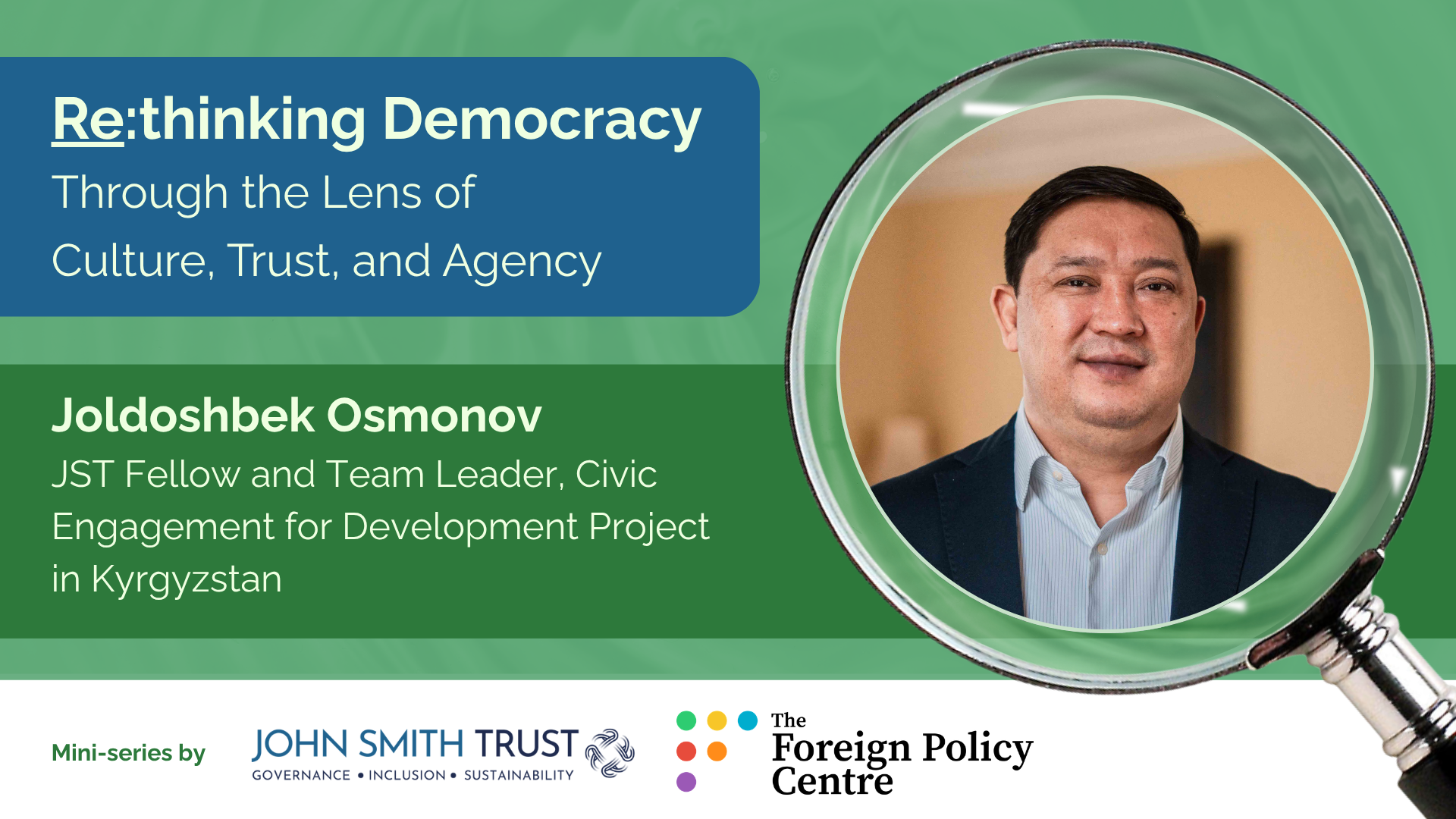
    Article by Joldoshbek Osmonov

    July 20, 2026

    Civil Society Organisations Are Losing the Narrative War – How Can Trust Be Rebuilt?

    Civil society is how citizens can hold power to account. But what happens when organisations that exist to defend democratic life are no longer trusted to do so?


    In functioning democracies, the answer barely needs asking. Transparent government, free expression, the right to challenge power and insist on the truth, all depend on a civil society that people believe in. It is through civil society that citizens engage with one another, mobilise in times of need, protect human rights, and advocate for change. When that belief erodes, so does the accountability it sustains.


    For authoritarian governments, this erosion is not a problem. It is a strategy.


    We are living in a time of profound uncertainty. The international rules-based order is no longer guaranteed. As authoritarianism and populism gain ground and democratic values come under pressure, civil society finds itself on the front line – and the forces working against it are organised and deliberate.


    Propaganda, legal threats, and institutional failings are making civil society more vulnerable

    Kyrgyzstan is a clear example of how civil society can become vulnerable. In April 2024, the country passed a law on ‘foreign representatives’, requiring NGOs that receive foreign funding to register with the government – echoing Russia’s and Georgia’s foreign agent laws, though without the same criminal liability.[1] This reflects a broader trend: growing authoritarianism and a shrinking civic space that make it harder for citizens and organisations to speak out.


    Kyrgyzstan is not an isolated case. Across countries like Russia, Belarus, Georgia, and other Central Asian countries, the pattern is the same: governments are using legal pressure and narrative control to delegitimise the organisations that hold them accountable. In Russia, organised civil society and NGOs have been systematically portrayed as a threat to traditional values and national identity – and that same propaganda playbook is being exported across the region, eroding credibility of civil society organisations beyond its borders.


    The threat is not solely external however. Parts of the NGO sector have been undermining their own credibility by remaining overly donor-centric, lacking transparency and failing to communicate their work and impact effectively to the public.


    The effect of this sustained pressure on civil society and internal shortcomings is a loss of trust. People no longer believe that civil society organisations tell the truth, stand for something, or have anything meaningful to offer.


    And when the connection between people and civil society breaks down, civil society can no longer fulfil its democratic function. The gap between organisations and the communities they exist to serve becomes a gap that weakens democracy.


    So how should civil society respond?

    Some of the challenges are practical: funding, legal pressure, hostile information environments. But the deeper challenge is rebuilding trust and relevance. Old approaches and instruments are no longer enough. Civil society organisations need to think critically about how they are reaching people, how they come across, and whether they truly understand the context in which they operate.


    Starting internally: transparency, accountability, and effectiveness are vital. Suspicions that NGOs are ineffective or opaque are widespread, and organisations need to take this seriously. Trust is rebuilt through actions, not just communication.


    Yet internal renewal is only half the work. The deeper challenge is rebuilding the connection with communities – and that begins with an honest reckoning about how that connection was lost in the first place. It means going to where people already are: the school gate, the local market, the community group, the places where trust is built through presence rather than broadcast. It means speaking in a language that people recognise and not jargon that requires explaining. And it means reducing financial dependence on external donors by developing more diversified, locally rooted funding – through the public sector, social entrepreneurship, and direct community support.


    Organisations need to be clear about both the work they do and what they stand for. The issues that civil society organisations address are often the issues that matter to people. When organisations can clearly demonstrate their relevance and impact, trust becomes easier to build and sustain.


    Finally, where possible, constructive dialogue with governments should not be abandoned. Civil society organisations should seek to cooperate on practical, less politically contested challenges, building confidence and relationships before attempting to address more difficult issues.


    What leaders need in this moment

    Civil society may be losing the narrative battle – but that does not mean war is lost. Leaders need a clear-eyed understanding of how we got here and what is at stake.


    The forces working against democracy and civil society – authoritarianism, populism, propaganda, misinformation – are organised, deliberate, and adaptive. Responding to these forces requires not just resilience, but the willingness to change: to be honest about failure, to engage with people where they are, and to earn trust rather than assume it.


    The goal is not simply to survive. It is to rebuild the kind of civil society that people feel belongs to them, one that reflects their concerns, speaks to their realities, and importantly, one that they would fight to defend.


    Ultimately, trust cannot be demanded, it must be earned, sustained, and renewed over time.


    Explore the full mini-series here.


    Joldoshbek Osmonov is the team leader of the Civic Engagement for Development Project in Kyrgyzstan funded by the Swiss Development Agency. He has extensive work experience in international development organisations, think tanks, and the civil society sector and possesses strong expertise in civil society, governance, public policy, and local politics. Joldoshbek holds a master’s degree in public administration from the University of Pennsylvania, the United States, and BA in international relations from the American University of Central Asia, Kyrgyzstan.


    Disclaimer: The views expressed in this piece are those of the individual author and do not reflect the views of The Foreign Policy Centre.


    [1] Radio Free Europe/ Radio Liberty, April 2024, Law Targeting Foreign-Funded NGOs Sends Chill Through Kyrgyz Civil Society, https://www.rferl.org/a/kyrgyzstan-foreign-agents-chill/32893000.html

    Topics
    Regions
    Footnotes
      Related Articles

      Expert Look | Venezuela in Focus: Human Rights, Geopolitical Dilemmas, and International Law

      Article by Foreign Policy Centre

      January 19, 2026

      Expert Look | Venezuela in Focus: Human Rights, Geopolitical Dilemmas, and International Law

      The capture of Nicolás Maduro by the US military has triggered an immediate and polarised international debate. Questions of sovereignty, legality, and precedent have rightly come to the fore, reviving anxieties about the erosion of the rules-based international order and the risks of unilateral military action.


      However, Venezuela’s collapse did not begin on the night of the intervention. It is the result of decades of institutional dismantling, systematic repression, and the hollowing out of democratic accountability. Over time, this internal erosion became entangled with external interests, regional power dynamics, and repeated failures of international engagement. The result is a crisis that is at once legal, political, humanitarian, and geopolitical, and one that resists explanation through any single analytical lens.


      This expert analysis brings together four perspectives that speak to different, but interconnected, dimensions of the Venezuelan crisis. Laura Vidal, digital rights researcher and civil society observer, centres the human rights reality inside Venezuela, highlighting that legal debates detached from lived experience risk normalising repression and compounding victimisation. Andrew Gawthorpe, FPC Senior Fellow, analyses the emerging US strategy towards Venezuela, arguing that Washington is moving away from ‘regime change’ towards a more coercive model of ‘regime management’, with uncertain leverage and destabilising consequences. Dame Audrey Glover, FPC’s Chair of Trustees, sets out the international legal implications of the US operation, underscoring the dangers posed by selective adherence to foundational legal norms. Stefan Wolff, FPC Senior Fellow, examines the dilemmas facing Europe as it seeks to reconcile its commitment to a rules-based order with alliance politics and shifting power realities.


      Taken together, these contributions expose the risks of selective concern: invoking international law only at moments of crisis, privileging geopolitical stability over accountability, or debating legality while disregarding human suffering. If Venezuela is to be understood and addressed in a meaningful way, these dimensions need to be held together, not treated as competing narratives.


      The Human Rights Dimension of Venezuela’s Crisis

      By Laura Vidal


      Any assessment of Venezuela’s current crisis that sidelines human rights is necessarily incomplete. The most visible entry point remains the situation of political prisoners.[1] Detentions continue to function as a revolving door: individuals are arrested, released under opaque conditions, and replaced by new detainees.[2] Deaths in custody, enforced disappearances, and prolonged incommunicado detention remain documented practices.[3] Torture centers continue to operate, and releases are often negotiated, partial, or discretionary rather than grounded in due process or judicial review. The pace of releases has been extremely slow, even as new arrests routinely follow moments of political tension, reinforcing a system based on fear rather than accountability.


      This pattern, however, represents only one layer of a much longer process of deterioration. Venezuela’s human rights crisis has unfolded over years through the systematic dismantling of institutions, the erosion of checks and balances, and the capture of the justice system. The result is a complex humanitarian emergency that predates recent geopolitical escalations. Nearly a third of the population has left the country, many under precarious conditions that expose them to exploitation, abuse, and trafficking networks along migration routes. Those who remain face chronic shortages of basic services, including healthcare, electricity, and access to potable water.[4]


      The media landscape has been progressively constrained through closures, licensing pressures, legal harassment, and digital censorship. Accessing information online increasingly requires the use of circumvention tools, exposing users to heightened risks of surveillance and criminalisation. Reporting, documentation, and civic organising have consequently become high-risk activities.[5]


      This reality is often misrepresented as the consequence of international sanctions alone, despite the fact that economic collapse and institutional erosion began years before sectoral sanctions were imposed. Framing the crisis exclusively through sanctions obscures its structural roots and diverts attention from long-standing patterns of repression, impunity, and state failure.[6] Human rights violations in Venezuela are not episodic; they are systemic, cumulative, and deeply embedded in the country’s governance model.


      From Regime Change to Regime Management

      By Andrew Gawthorpe


      The US military operation against Nicolas Maduro represents a novel approach to foreign policy. “Regime change” is out and “regime management” is in. The Trump administration’s intention appears to be to leave the current Venezuelan government formally in place, while coercing it into adopting policies that will benefit US security and economic interests. Washington’s main demands for the government in Caracas include opening up the country’s oil wealth to American investment and control, severing friendly relations with China and Russia, and ending support for the government in Cuba.


      Trump’s methods are nakedly imperial – a throwback to the “gunboat diplomacy” of the nineteenth century. It is notable that they even lack the justification, common in previous US military interventions, with the familiar claim that intervention will liberate the Venezuelan people from a dictatorial government. Instead, Washington is proposing to work with that dictatorial government in order to deliver profits for American oil companies.


      From the perspective of the Trump administration, this strategy has obvious appeal. It lacks the commitment of resources and potentially lives to a long-term military occupation designed to transform Venezuela’s government, as was attempted in Iraq and Afghanistan. At the same time, it remains unclear whether this approach gives the US enough leverage over the government in Venezuela to achieve its goals.


      Venezuela’s new leader, Delcy Rodríguez, has to avoid angering nationalist opinion at home – not least in her country’s military. She cannot go too far in appeasing the US. For their part, American oil companies also have little interest in investing in Venezuela, particularly while the current government remains in place. Meanwhile, President Trump’s attention seems to have wandered, with him now threatening new military action against Iran. As a result, what’s coming next in Venezuela remains highly unclear.


      International Law and the Erosion of Legal Restraint

      By Dame Audrey Glover


      Article 2(4) of the UN Charter states:

      “All members shall refrain in their international relations from the threat or use of force against the territorial integrity or political independence of any State, or in any other manner inconsistent with the Purposes of the United Nations.”


      This article, part of the foundation of the post-Second World War international rules-based order, establishes a core principle against aggression, subject only to narrowly defined exceptions: self-defence and UN Security Council authorisation. This provision is binding on all States, regardless of whether they are members of the United Nations.


      The action of US Forces entering Venezuela uninvited at night to detain President Maduro and his wife, Cilia Flores, and place them in custody in the US to await trial, constitutes a breach of Article 2(4). Under International law, only an assault on another country by military means qualifies as a trigger for self-defence.


      The consequence of the US operation is therefore a violation of Venezuela’s sovereignty, contrary to International Law. Furthermore, the intervention has not resulted in an attempt to restore democratic governance in the country. Maduro has been replaced by his Deputy, Delcy Rodríguez, without an election or consultation of the electorate and opposition– particularly significant given that Maduro himself overturned a prior electoral outcome to retain power. Her appointment undermines any argument that the intervention was undertaken in pursuit of democratic principles.


      For his part, President Trump has said he will ‘run’ Venezuela remotely, a proposition that raises serious questions about both feasibility and legitimacy. It also prompts broader concerns regarding regional security and the future of Venezuela’s oil sector, including how it might be rebuilt and governed under such circumstances.


      Stephen Miller, an adviser to President Trump, has said: “Forget international law. We live in a world that is governed by strength, that is governed by force, that is governed by power”. Such rhetoric reflects an explicit rejection of the legal norms that underpin international stability.


      Recent events including the ongoing Russian invasion of Ukraine, have further imperilled the rules-based international order at the core of which are the principles of individual liberty, intellectual and religious freedom, constitutional democracy and free trade. The most damaging has been the rejection of the principles of international law that the US helped to create. Venezuela stands as the latest example of this deterioration. The time has come to save these principles from extinction.


      Europe and the Dilemmas of the Rules-Based Order

      by Stefan Wolff


      The apprehension of Venezuelan President Nicolas Maduro by the US military on the night of 3rd January is the first time in over three decades that the White House has conducted such an operation. The operation reflects Washington’s new national security strategy and its emphasis on hemispheric dominance, even as it sits in clear tension with international law. For Europe, the operation, and how to respond to it, poses multiple dilemmas.


      The first dilemma concerns how to reconcile hitherto unwavering European support for a rules-based international order with the need to preserve what is left of the transatlantic alliance. This includes American security guarantees for European allies and continuing support for Ukraine’s war effort. The display of American capability and the meek reactions not only by Europe but also by Russia and China also demonstrated that for all the talk of a multipolar world order, Moscow and Beijing have few credible options to respond to American assertions of power. From a European perspective, this reality is in some respects reassuring, especially in the context of the Kremlin’s apparently insatiable revisionism in eastern Europe.


      Closely related is a second dilemma: US ambitions for absolute dominance in the western hemisphere have revived Trump’s designs for Greenland, returning them to the transatlantic agenda where they spell potential for disruption—both in the sense of distracting attention from the actual threat of the Russian aggression against Ukraine and Moscow’s broader hybrid campaign elsewhere on the continent, and of potentially diverting critical resources away from deterring further Russian adventurism in Europe towards Arctic security, an area long neglected by both Europe and the United States.


      The third dilemma is that the removal of Maduro from power is in line with long-stated European preferences for a democratic transition in the country, and as such should be welcomed. However, what seems to have resulted from the US operation is at best a face lift at the top of the Venezuelan regime, followed by internal power consolidation and increased external subservience to the demands of the mercurial incumbent of the White House. This dilemma also has wider implications. Europe may lack the hard power to effect regime change, but not the desire to do so. With probably more than half an eye on the situation in Iran, there are likely some figures in Europe’s political class who would not object too loudly or strongly if the US and/or Israel were adopting a more proactive stance on supporting protesters in Tehran and dozens of other cities. Yet externally driven regime change is hardly ever cost- or consequence-free, as the experiences in Afghanistan, Iraq, and Libya, among others, vividly demonstrate.


      European equivocation and prevarication in response to the US military operation against Maduro reflects the difficulty of navigating these dilemmas. Such ambivalence is neither a long-term solution nor will it allow Europeans to avoid discussing two equally unpalatable options: submitting to the whims of Trump, or an attempt to act independently in an increasingly hostile and lawless world. As so often, Europe is likely to fall back on muddling through: seeking to placate and flatter President Trump while ignoring the flaws and dangers of his foreign policy, and simultaneously trying to build towards the mythical promise of strategic autonomy. This approach rests on the hope that unconstrained, illiberal great power dominance within distinct spheres of influence does not become the new normal – one in which Europe is permanently downgraded to Washington’s, let alone Moscow’s or Beijing’s vassal.


      For a comprehensive examination of the decades-long institutional erosion, systemic human rights abuses, and profound humanitarian crisis that have shaped contemporary Venezuela, see Laura Vidal’s Op-Ed: International law, institutional collapse, and the danger of selective concern, which situates the country’s current situation within a broader history of democratic decay, international inaction, and the human cost.


      Disclaimer: The views expressed in this piece are those of the individual authors and do not reflect the views of The Foreign Policy Centre.


      [1] Human Rights Watch, Venezuela: Political Prisoners Cut Off From the World, September 2025, https://www.hrw.org/news/2025/09/22/venezuela-political-prisoners-cut-off-from-the-world

      [2] Efecto Cocuyo, Efecto Paz #11 – Presos políticos después del 3E, January 2026, https://www.youtube.com/watch?v=EhV_CpfoBpw&t=2821s

      [3] United Nations News, Venezuela’s National Guard linked to killings, torture and repression, UN probe finds, December 2025, https://news.un.org/en/story/2025/12/1166565

      [4] Human Rights Watch, World Report 2025: Venezuela, 2025, https://www.hrw.org/world-report/2025/country-chapters/venezuela

      [5] Puyosa, Azpúrua, Suárez Pérez, How Venezuela became a model for digital authoritarianism, Atlantic Council, July 2024, https://www.atlanticcouncil.org/in-depth-research-reports/how-venezuela-became-a-model-for-digital-authoritarianism/; VE sin Filtro, Censura y represión digital en las elecciones presidenciales en Venezuela, 2025, https://vesinfiltro.org/noticias/2025-03-12-reporte-elecciones-presidenciales/

      [6] Nizar El Fakih, Aproximación al Régimen de Sanciones Internacionales y al caso de Venezuela, IDB, December 2020, https://www.google.com/url?sa=t&source=web&rct=j&opi=89978449&url=https://publications.iadb.org/en/node/29550&ved=2ahUKEwiWtLq81IiSAxWFVKQEHW0vBnUQFnoECBYQAQ&usg=AOvVaw3Ega3sYVRtvTyuCerIVUlw

      Footnotes
        Related Articles

        Op-ed | Conflict Prevention Has Never Been More Important

        21/09/26
        Article by Camila Mateos Betancourt

        Op-ed | A Camel Called the Investor Visa

        29/07/26
        Article by Foreign Policy Centre

         Join our mailing list 

        Keep informed about events, articles & latest publications from Foreign Policy Centre

        JOIN