Skip to content

Civil Society Organisations Are Losing the Narrative War – How Can Trust Be Rebuilt?

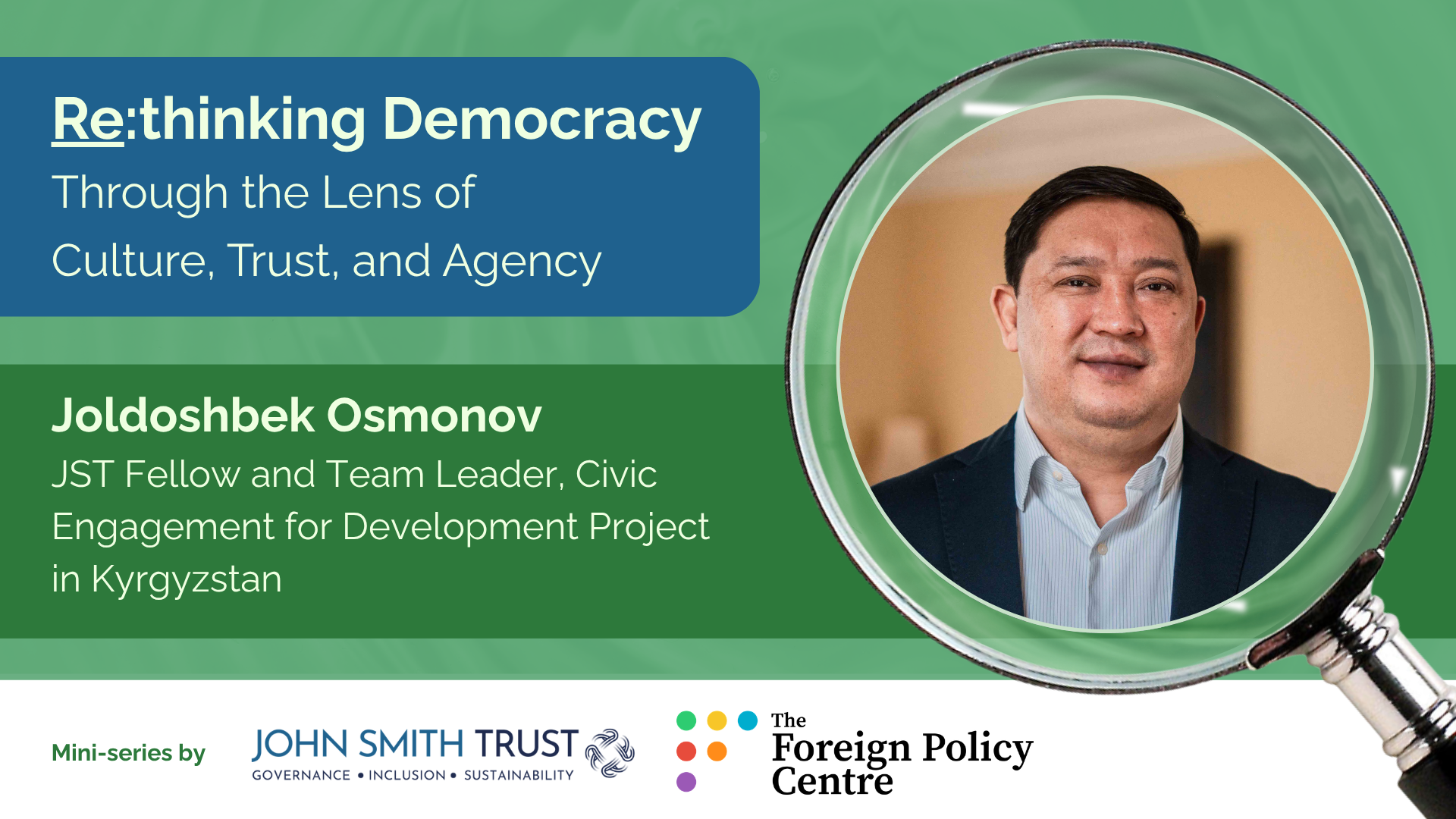
Article by Joldoshbek Osmonov

July 20, 2026

Civil Society Organisations Are Losing the Narrative War – How Can Trust Be Rebuilt?

Civil society is how citizens can hold power to account. But what happens when organisations that exist to defend democratic life are no longer trusted to do so?


In functioning democracies, the answer barely needs asking. Transparent government, free expression, the right to challenge power and insist on the truth, all depend on a civil society that people believe in. It is through civil society that citizens engage with one another, mobilise in times of need, protect human rights, and advocate for change. When that belief erodes, so does the accountability it sustains.


For authoritarian governments, this erosion is not a problem. It is a strategy.


We are living in a time of profound uncertainty. The international rules-based order is no longer guaranteed. As authoritarianism and populism gain ground and democratic values come under pressure, civil society finds itself on the front line – and the forces working against it are organised and deliberate.


Propaganda, legal threats, and institutional failings are making civil society more vulnerable

Kyrgyzstan is a clear example of how civil society can become vulnerable. In April 2024, the country passed a law on ‘foreign representatives’, requiring NGOs that receive foreign funding to register with the government – echoing Russia’s and Georgia’s foreign agent laws, though without the same criminal liability.[1] This reflects a broader trend: growing authoritarianism and a shrinking civic space that make it harder for citizens and organisations to speak out.


Kyrgyzstan is not an isolated case. Across countries like Russia, Belarus, Georgia, and other Central Asian countries, the pattern is the same: governments are using legal pressure and narrative control to delegitimise the organisations that hold them accountable. In Russia, organised civil society and NGOs have been systematically portrayed as a threat to traditional values and national identity – and that same propaganda playbook is being exported across the region, eroding credibility of civil society organisations beyond its borders.


The threat is not solely external however. Parts of the NGO sector have been undermining their own credibility by remaining overly donor-centric, lacking transparency and failing to communicate their work and impact effectively to the public.


The effect of this sustained pressure on civil society and internal shortcomings is a loss of trust. People no longer believe that civil society organisations tell the truth, stand for something, or have anything meaningful to offer.


And when the connection between people and civil society breaks down, civil society can no longer fulfil its democratic function. The gap between organisations and the communities they exist to serve becomes a gap that weakens democracy.


So how should civil society respond?

Some of the challenges are practical: funding, legal pressure, hostile information environments. But the deeper challenge is rebuilding trust and relevance. Old approaches and instruments are no longer enough. Civil society organisations need to think critically about how they are reaching people, how they come across, and whether they truly understand the context in which they operate.


Starting internally: transparency, accountability, and effectiveness are vital. Suspicions that NGOs are ineffective or opaque are widespread, and organisations need to take this seriously. Trust is rebuilt through actions, not just communication.


Yet internal renewal is only half the work. The deeper challenge is rebuilding the connection with communities – and that begins with an honest reckoning about how that connection was lost in the first place. It means going to where people already are: the school gate, the local market, the community group, the places where trust is built through presence rather than broadcast. It means speaking in a language that people recognise and not jargon that requires explaining. And it means reducing financial dependence on external donors by developing more diversified, locally rooted funding – through the public sector, social entrepreneurship, and direct community support.


Organisations need to be clear about both the work they do and what they stand for. The issues that civil society organisations address are often the issues that matter to people. When organisations can clearly demonstrate their relevance and impact, trust becomes easier to build and sustain.


Finally, where possible, constructive dialogue with governments should not be abandoned. Civil society organisations should seek to cooperate on practical, less politically contested challenges, building confidence and relationships before attempting to address more difficult issues.


What leaders need in this moment

Civil society may be losing the narrative battle – but that does not mean war is lost. Leaders need a clear-eyed understanding of how we got here and what is at stake.


The forces working against democracy and civil society – authoritarianism, populism, propaganda, misinformation – are organised, deliberate, and adaptive. Responding to these forces requires not just resilience, but the willingness to change: to be honest about failure, to engage with people where they are, and to earn trust rather than assume it.


The goal is not simply to survive. It is to rebuild the kind of civil society that people feel belongs to them, one that reflects their concerns, speaks to their realities, and importantly, one that they would fight to defend.


Ultimately, trust cannot be demanded, it must be earned, sustained, and renewed over time.


Explore the full mini-series here.


Joldoshbek Osmonov is the team leader of the Civic Engagement for Development Project in Kyrgyzstan funded by the Swiss Development Agency. He has extensive work experience in international development organisations, think tanks, and the civil society sector and possesses strong expertise in civil society, governance, public policy, and local politics. Joldoshbek holds a master’s degree in public administration from the University of Pennsylvania, the United States, and BA in international relations from the American University of Central Asia, Kyrgyzstan.


Disclaimer: The views expressed in this piece are those of the individual author and do not reflect the views of The Foreign Policy Centre.


[1] Radio Free Europe/ Radio Liberty, April 2024, Law Targeting Foreign-Funded NGOs Sends Chill Through Kyrgyz Civil Society, https://www.rferl.org/a/kyrgyzstan-foreign-agents-chill/32893000.html

Topics
Regions
Footnotes
    Related Articles
    Footnotes
      Related Articles
      Footnotes
        Related Articles

        How Can We Secure a Healthy Political and Social Order in a Fragmented World?

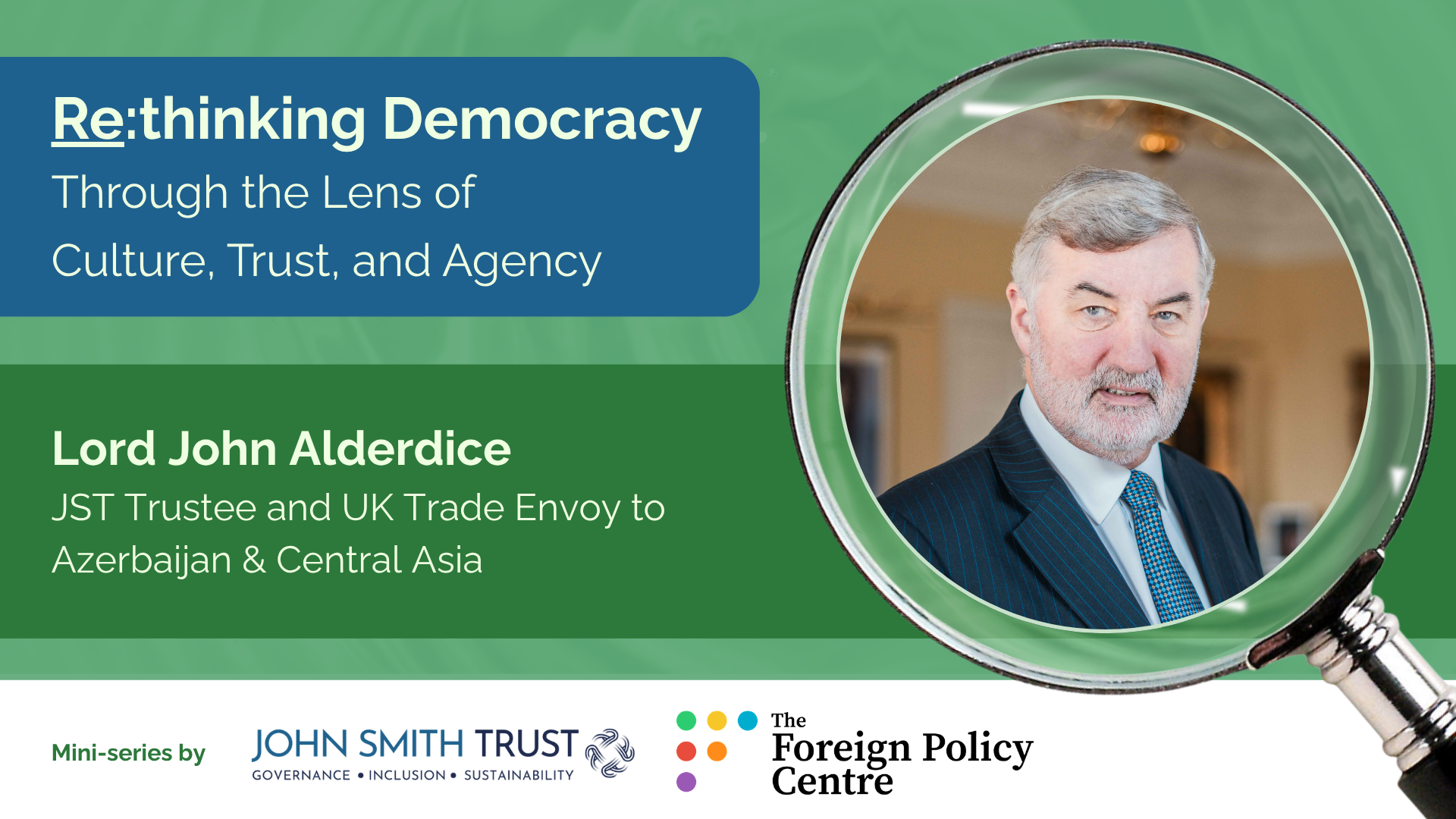
        Article by Lord John Alderdice

        July 13, 2026

        How Can We Secure a Healthy Political and Social Order in a Fragmented World?

        This article introduces a new series of short essays by JST Fellows – leaders working across Europe, the South Caucasus and Central Asia – exploring how societies can build the trust, agency and resilience needed for an era of fracture and flux.


        We are living through a period of profound change and uncertainty. The erosion of the rules-based international order is causing instability on a global scale. Familiar frameworks and alliances, such as NATO, are no longer seen as providing security guarantees and a basis for shared understanding between states. The institutions that form the foundations of healthy democracy – the media, government, judiciary, and civil society – are not functioning in the way that they should. Media ecosystems no longer offer a shared factual reference point; governments struggle to deliver on the concerns of those they represent; judiciaries face growing pressure on their independence; and civil society is increasingly recast – through propaganda and hostile narratives – as a threat rather than a mechanism for accountability and civic action. It all adds up to a climate of social and political polarisation, creating distrust: in governments, in one another, and in democracy itself.


        Added to this, the rapid development of artificial intelligence (AI) presents both opportunities and threats to how our societies and economies function. The political emergence of Gen Z, with youth-led protests in countries as disparate as Georgia, Nepal, Peru and Madagascar, is seen as evidence of growing frustration of young people with inequality, corruption, and the failure of existing institutions to respond to people’s concerns.[1]


        These forces are not temporary disruptions but structural shifts reshaping political and social life. As such, they demand a new approach. This is not a time for nostalgia but for a collective rethink. Throughout this mini-series, our contributors delve into experiences of culture, trust and agency in their societies to explore a central question: What actions do we need to take and what stories must we ensure are heard, in order to shape and secure a healthy political and social order for the emerging global era?


        In the articles that follow, JST Fellows explore this question in depth, offering diverse perspectives on what it means to rethink democracy through the lens of culture, trust, and agency. They look at opportunities and challenges emerging in media, technology, and information systems. They look at the power of identity and narratives, and their effect on social cohesion. And they look at agency and engagement, with a focus on young people.


        These are not separate strands but interwoven dynamics that reinforce each other. Technology drives identity narratives. Identity politics shape how young people engage. And youth movements reshape information ecosystems.


        Our Fellows, who come from countries across Europe, the South Caucasus and Central Asia, write about how these forces are playing out in the contexts in which they live and work. Questions of identity, culture and memory also run throughout the series. Olga Reka, from Ukraine, writes about the critical role of the arts, culture, and storytelling in creating meaning and agency as a precondition for democracy. Botagoz Zhumabekova examines the psychological foundations of democratic participation, arguing that active citizenship depends not only on political opportunity but also on people feeling safe enough to engage.


        Trust – or its absence – is a common theme. Gulshat Ayydova and Aaron Campbell look at what we can learn from the way young people already engage in informal spaces to encourage meaningful participation and build trust in political processes. Joldoshbek Osmonov, from Kyrgyzstan, looks at the legitimacy crisis facing civil society and how organisations can rebuild trust in the face of propaganda that presents them as a threat. Farrukh Irnazarov explores the role of education in building trust in institutions and civic responsibility across Central Asia.


        Looking at democratic renewal through a political lens, Palina Brodik reflects on the future of the Belarusian democratic movement, arguing that preserving collective memory while remaining adaptable is essential to sustaining political agency in exile.


        The series concludes with Liliana Gutan’s reflection on Moldova, where democracy is measured not only by elections but by what institutions deliver between them. Her article brings together many of the themes explored throughout the series, arguing that democratic resilience ultimately depends on whether people experience dignity, security, and belonging in their everyday lives.


        I hope these articles offer both provocation and possibility – showing what it looks like when values-driven leaders think seriously about the challenges of our time. They are part of the generation of diverse leaders needed in this moment, to shape a new order in which people can live in sustainable, peaceful and just societies.


        Explore the full mini-series here.


        John Alderdice, Professor, the Lord Alderdice. UK Trade Envoy to Azerbaijan & Central Asia and JST Trustee.


        Disclaimer: The views expressed in this piece are those of the individual author and do not reflect the views of The Foreign Policy Centre.


        [1] Daniel Boffey, ‘We are very strong’: Georgia’s gen Z drives protests against return to past, The Guardian, May 2024, https://www.theguardian.com/world/article/2024/may/16/georgia-gen-z-drives-protests-against-return-to-past-foreign-agents-law; Omkar Khandekar and Yam Kumari Kandel, How Gen Z-led protests put Nepal’s 1st female prime minister in power, NPR, September 2025, https://www.npr.org/2025/09/20/nx-s1-5545760/nepal-protests-gen-z; Marco Aquino and Alexander Villegas, Peru’s Gen Z rallies against President Boluarte, protesting over pensions and corruption, Reuters, September 2025, https://www.reuters.com/world/americas/perus-gen-z-rallies-against-president-boluarte-protesting-over-pensions-2025-09-27/; AP News, How Gen Z protesters brought down Madagascar’s government and now want the president out, October 2025, https://apnews.com/article/madagascar-protests-gen-z-rajoelina-e39ef11bd1f4a92f1f4b353900348219

        Footnotes
          Related Articles

          Long read | Recasting the Golden Horde in Kazakhstan

          Article by Francisco Olmos

          June 23, 2026

          Long read | Recasting the Golden Horde in Kazakhstan

          On 19 and 20 May Astana held a symposium on the Golden Horde, a descendant state of the Mongol Empire.[1] This was not, however, an event limited to academics discussing an obscure topic, but rather the culmination of a historical narrative process that has been taking place in Kazakhstan over the past few years.


          Since Kassym-Jomart Tokayev became president of Kazakhstan, the authorities have embarked on a quest for a new historical narrative, and they found it in the shape of the Golden Horde. This medieval khanate, which emerged from the descendants of Jochi, the eldest son of Genghis Khan, ruled the Eurasian steppe for three hundred years before disintegrating in the 15th century. It was a state that had been purposely overlooked by Tokayev’s predecessor, Nursultan Nazarbayev, and that had been much maligned during the Soviet period as it had dominated the Russian principalities.[2]


          The process of embracing the Golden Horde started back in 2019. Since then, interest in the Ulus of Jochi has materialised in the establishment of a dedicated institute for its study, archaeological finds, history articles in non-specialised media, and even a TV series, among other developments.[3]


          The timing and use of the Golden Horde by the Kazakh authorities are no coincidence. Tokayev’s New Kazakhstan was missing a national narrative to provide cohesion and distinguish itself from Nazarbayev’s discourse. The need for a historical narrative stretching back centuries became more acute in 2022, after Russia launched its full-scale invasion of Ukraine. Kazakhstan’s large neighbour to the north has on multiple occasions questioned Kazakhstan’s sovereignty and national identity, especially in the past few years.[4] The use of the Ulus of Jochi reaffirms the country’s own history centuries before Russian colonisation. In fact, for much of its existence, the Golden Horde exercised authority over the Russian principalities, but that is not the message Astana wants to emphasise in this New Kazakhstan.


          The use being made of the Ulus of Jochi stays away from a bellicose tone or a strong nationalist sentiment. Instead of building the narrative around the Horde’s rulers, famous battles or monuments, Kazakhstan approaches it from a different perspective. It calls upon the medieval state’s diversity, role in global trade, intellectual and financial legacies. There are no bloody conquests or feats that could raise eyebrows in neighbouring countries.


          As Tokayev put in the recent symposium: “this [the Golden Horde] is one of the most important pages in the chronicle of our country and all humanity.”[5] In other words, Astana aims to portray the Ulus of Jochi as a state whose legacy extends beyond modern Kazakhstan and possesses a universal rather than exclusive character.


          The Golden Horde in the 21st century

          The use of the Golden Horde by Tokayev for his New Kazakhstan can be considered a right choice for the purpose it seeks to articulate. Although over five centuries have passed since it ceased to exist, some of its characteristics can be useful to the Kazakh authorities in this day and age.


          The Ulus of Jochi presents Astana a state in accordance with its current foreign policy aspirations. These descendants of Genghis Khan ruled an extensive empire that, at its height, stretched from the Black Sea in the west to Siberia in the east. At the same time, it maintained diplomatic relations with a wide range of states: from other Mongol successor empires, to European kingdoms and Islamic states. A true Eurasian empire that matches Kazakhstan’s role in modern geopolitics and its multi-vector foreign policy that includes China, Russia and the EU as key partners.


          Like Kazakhstan today, the Jochid Ulus was also a multiethnic state. The Horde was home to Mongols, Turkic peoples and Slavs, among others. Despite Kazakhs being now the majority of the population, the country continues to preserve a diverse ethnic and linguistic mix. More than 70 ethnic groups live in the country, with large minority groups such as Russians (14.9% of the population), Uzbeks (3.3%) and Ukrainians (1.9%).[6] The Golden Horde, despite its strong turco-mongol character, existed before the emergence of nationalism, an ideology that can be harmful to the country’s multiethnic background.


          Despite the reasons above, the choice of the Golden Horde as a national narrative is not without its issues and controversies.


          This medieval polity occupied territories well beyond Kazakhstan, and Astana is not the only state that can claim its legacy, although so far no other has actively done so. Its principal capitals, for example, were located along the Volga in what is now Russia, even if they were less central to the state than the capitals of more sedentary medieval polities because of the Horde’s nomadic character.


          Another key characteristic of the Golden Horde is missing from its modern interpretation: its military might and conquests. Among its most significant achievements was its domination of the Russian principalities and their vassalage to the Horde. This is not a pleasant topic for Moscow, which could use Kazakhstan’s embrace of Jochi’s descendants in its nationalist discourse and usual verbal attacks from its propagandists and officials against Tokayev’s government.


          The way the narrative is being built also raises other questionable points. The virtues of the Horde are exalted, as expected, but it lacks historical figures with whom people can identify with. Contrary to what happens in Uzbekistan with Amir Timur (i.e. Tamerlane) and, to a much lesser extent, his descendants Ulugh Beg and Babur, Kazakhstan’s is shying away from the main historical figures of the Jochid Ulus.[7] And there is no shortage of them: from Batu (r. 1227-55), founder of the Golden Horde, to his brother Berke (1257-66), Uzbeg Khan (1313-41) or Jani Beg (1342-57), to name a few. But besides some mentions of Jochi himself, most other rulers and conquerors are overlooked.


          The composition of the Golden Horde is another interesting subject. In its origin it was a Mongol state, and while later the Turkic component would gradually come to predominate, the link with the modern Kazakhs is not straightforward. The same happens from a state perspective. The Golden Horde is not the direct ancestor of Kazakhstan. The Ulus of Jochi fragmented permanently into different khanates in the 15th century, including those of Crimea, Kazan and Astrakhan, located in modern Ukraine and Russia, as well as the Uzbek and Kazakh khanates. The link between the latter and Kazakhstan is stronger than with the Golden Horde.


          Why not the Kazakh Khanate?

          There is a loser of Kazakhstan’s new interest in the Golden Horde and that is the Kazakh Khanate. This state established in the mid-15th century by Kerei and Janibeg, two nomadic leaders who broke away from the Uzbek Khanate in what is now southern Kazakhstan, is the most direct link modern Kazakhstan has to a historical past. It not only occupied roughly the current territory of the republic but was also the state that was later colonised by the Russians before Kazakhstan achieved its independence in 1991.


          The Kazakh Khanate had been used to some extent by Kazakhstan’s first president, Nursultan Nazarbayev, notably when confronted by a familiar threat: Russia. While a statue of the khanate founders was unveiled in Astana back in 2010, it was not until 2014 that this state rose to prominence. This was a result of Vladimir Putin’s words a year earlier suggesting that “Kazakhs never had a statehood.”[8] Nazarbayev’s reaction was to celebrate the 550th anniversary of the khanate’s establishment the following year.


          This Central Asian state produced notable rulers that could have been prominently promoted by Astana if the Kazakh Khanate was given more importance within the national narrative.


          The khans Kerei and Janibeg might have been considered the principal founding fathers of the Kazakh nation. Kasym Khan could have been elevated as the national figure. Tauke Khan, together with his Zheti Zhargy (Seven Charters), could have been used to prove the existence of the Kazakh statehood from a legalistic perspective back in the 17th century.[9] Kenesary Khan (d. 1847), in turn, would have provided a heroic, yet ill-fated, national liberation figure centred on resisting the Russian invaders. However, beyond their presence through a small number of statues, commemorative coins, and educational curricula, these historical figures have largely played a supporting role in Kazakhstan’s nation-building process, rather than occupying a central symbolic position.


          However, there are reasons why the Ulus of Jochi may be a more suitable choice for Kazakhstan’s aspiring role in the world. While the Golden Horde spanned the Eurasian steppe, the Kazakh Khanate’s borders were limited to modern-day Kazakhstan. It was a regional power, as the Uzbek Khanates found out through constant wars in the 16th century, but its role in world history is much more limited. In addition, it had a stronger Kazakh ethnic component, which works well when striking a nationalist chord, but lies out of place in a more diverse Kazakhstan that the authorities seek to promote today.


          Conclusion

          Five centuries after its dissolution, the Golden Horde is experiencing a revival in one of its former territories. The rediscovery of this medieval state in the 21st century reflects an attempt to build a historical narrative that supports modern Kazakhstan’s state identity and foreign policy objectives. By elevating the Ulus of Jochi, a Eurasian empire characterised by its territorial extension, multiethnic composition and transregional connectivity, Astana seeks to shape its current aspirations by drawing on the past.


          At the same time, this new narrative highlights the limitations and shortcomings of a state-led historical construction. As outlined above, the direct link between the Golden Horde and modern Kazakhstan is open to debate, especially when compared to the Kazakh Khanate. Moreover, many of its key characteristics are deliberately overlooked in the search for a sanitised narrative that can be accepted both at home and abroad. The result is a balancing act that reflects both the opportunities and constraints of using the past as an instrument of modern nation-building.


          Francisco Olmos is a Research Fellow at the Foreign Policy Centre. He is a researcher and analyst specializing in Central Asian affairs, focusing on nationalism, power transitions, and the geopolitics of the post-Soviet space. He is a Senior Researcher at GEOPOL 21, where he contributes analysis on Central Asia’s relations with Russia, China, and Western actors. Holding an MA in International Relations and World Order from the University of Leicester, Olmos frequently writes for think tanks and media outlets, participates in academic forums and podcasts, and was awarded the Beca Ruy de Clavijo for his work on Spain’s relations with Central Asia.


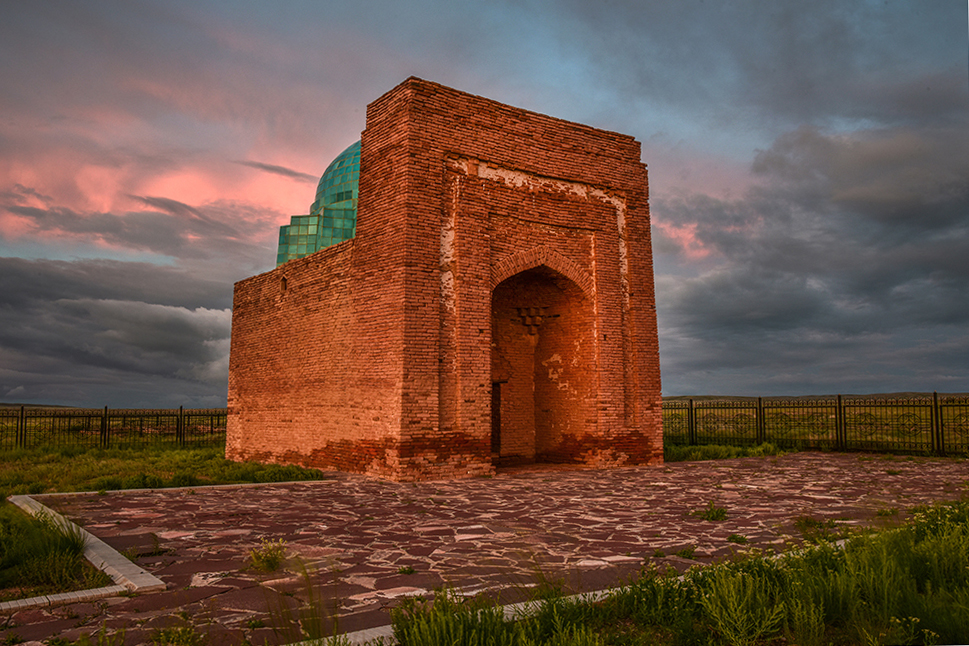
          Image: © The Mausoleum of Jochi Khan


          Disclaimer: The views expressed in this piece are those of the individual author and do not reflect the views of The Foreign Policy Centre.


          [1] UNESCO, International Symposium on the Golden Horde Held in Astana under the Patronage of UNESCO, UNESCO, May 2026, https://www.unesco.org/en/articles/international-symposium-golden-horde-held-astana-under-patronage-unesco

          [2] Bakhytzhan Kurmanov, Zhaxylyk Sabitov, and Rustem Kudaibergenov, Making the Golden Horde “Great Again”: Historians as Memory Actors and Reinterpretation of the Historical Narratives in Independent Kazakhstan, Nationalities Papers, Cambridge University Press, October 2025, https://www.cambridge.org/core/journals/nationalities-papers/article/making-the-golden-horde-great-again-historians-as-memory-actors-and-reinterpretation-of-the-historical-narratives-in-independent-kazakhstan/057D6F6125AE71CE3A62B0B5D6B4F147

          [3] Aibarshyn Akhmetkali, Kazakhstan’s Ulus of Jochi Institute Explores Forgotten Eras of Statehood, The Astana Times, January 2025, https://astanatimes.com/2025/01/kazakhstans-ulus-of-jochi-institute-explores-forgotten-eras-of-statehood/; Aibarshyn Akhmetkali, Everything You Need to Know About Ulus of Jochi, The Astana Times, August 2024, https://astanatimes.com/2024/08/everything-you-need-to-know-about-ulus-of-jochi; Dana Omirgazy, The Golden Empire: Everything We Know So Far, Qazinform, July 2025, https://qazinform.com/news/the-golden-empire-everything-we-know-so-far-e7b35d

          [4] Francisco Olmos, La sombra del nacionalismo ruso en Asia Central, Geopol 21, September 2024, https://geopol21.com/la-sombra-del-nacionalismo-ruso-en-asia-central/

          [5] Office of the President of the Republic of Kazakhstan (Akorda), Address by the Head of State Kassym-Jomart Tokayev at the International Symposium “The Golden Horde as a Model of Steppe Civilization: History, Archaeology, Culture, Identity”, May 2026, https://www.akorda.kz/ru/vystuplenie-glavy-gosudarstva-kasym-zhomarta-tokaeva-na-mezhdunarodnom-simpoziume-zolotaya-orda-kak-model-stepnoy-civilizacii-istoriya-arheologiya-kultura-identichnost-1945730

          [6] Bureau of National Statistics of Kazakhstan, [Statistical Report / Data File], 2024, https://stat.gov.kz/api/iblock/element/178068/file/en/

          [7] Francisco Olmos, State-building Myths in Central Asia, The Foreign Policy Centre, October 2019, https://fpc.org.uk/state-building-myths-in-central-asia/

          [8] Farangis Najibullah, Putin Downplays Kazakh Independence, Sparks Angry Reaction, Radio Free Europe/Radio Liberty, September 2014, https://www.rferl.org/a/kazakhstan-putin-history-reaction-nation/26565141.html

          [9] Rafail N. Zinurov, “«Жеті Жарғы» («Семь установлений») Тауке-хана как великий памятник права: правовой обычай, судопроизводство и наказание” [“Zheti Zhargy (‘Seven Charters’) by Tauke Khan as a Great Monument of Law: Customary Law, Judicial Procedure, and Punishment”], Pravovoe gosudarstvo: teoriya i praktika, no. 4 (58) (2012): 32–37

          Topics
          Footnotes
            Related Articles

            Kyrgyz Parliamentary Election’s Snapshot

            Article by Dr Aijan Sharshenova

            November 27, 2025

            Kyrgyz Parliamentary Election’s Snapshot

            The Kyrgyz Parliament – Jogorku Kenesh (Supreme Council) called for an early election in September on the grounds of avoiding an overlap of two important electoral campaigns in 2026 – presidential and parliamentary.[1] On November 30th, Kyrgyzstan will hold snap preliminary parliamentary elections.


            A brief history of Kyrgyz parliamentarism

            Since gaining independence in 1991, Kyrgyzstan has held eight parliamentary elections and had seven parliamentary convocations. In the early independence years, the country experimented with a bicameral parliamentary system, which consisted of the Legislative Assembly and the Assembly of People’s Representatives. Since 2007, however, the Kyrgyz parliament has been a unicameral body.


            Throughout the last 34 years, Kyrgyzstan oscillated between parliamentary, parliamentary-presidential, and presidential-parliamentary forms of governance. Kyrgyz politics, however imperfect they might have been, were dynamic, lively, and left space for public and political debate and contestation. The most recent constitutional amendments, initiated by the current President, Sadyr Japarov, marked an important shift to a strong presidential model of governance.[2]


            Notably, two out of three government coups in independent Kyrgyzstan were triggered by contested parliamentary elections, first in March 2005[3] and again in October 2020.[4] In a way, parliamentary elections often contain seeds of public unrest as proven by history. The seventh election’s results were annulled due to the mass protest and the government coup.[5] The sixth parliamentary convocation had its term extended until 2021. The eight elections, held later that year, formed the current convocation of the Parliament (seventh), which has lost a significant part of its powers in the aftermath of the constitutional referendum of 2021.


            A snapshot of the upcoming parliamentary election

            The upcoming election will stick to the previous Parliament’s composition of 90 members of parliament. However, there will be some important technical changes. Following the 2025 amendments to the Electoral Code, the electoral system shifted from a mixed system to a majoritarian one: MPs are elected from 30 multi-member constituencies, with each district electing three representatives via plurality voting (the top three candidates win). To ensure gender representation, it is a requirement that at least one woman must be among the top three in each district.[6]


            Kyrgyzstan’s current population stands at approximately 7.5 million people, with around 4.237 million citizens who are eligible and registered to vote.[7] Voting will occur at 2,492 polling stations across the country, with voters able to cast their ballots at any station. This marks a departure from the country’s Soviet legacy, which tied voters to polling stations based on their registered address. Before, internal migrants had to travel back to their registered address to get a letter allowing them to vote in their current (temporary or permanent) location.


            The candidates finished their registration by November 10. At the moment, a total of 467 candidates have been registered (276 men and 191 women). The electoral campaign has officially started and will finish at 08:00 on November 29 2025 – 24 hours before voting begins. Eligibility requirements state that candidates must be at least 25 years old, hold a higher education degree, have resided continuously in Kyrgyzstan for the last five years, and have no criminal record.[8]


            Why this election matters but why it feels stale

            The upcoming parliamentary election might lack the usual dynamism of Kyrgyz political scene, but it is important for three reasons.[9]


            First, this election signifies a return to the pre-2007 single mandate voting system. While it might seem like an electoral reform element, this shift is de facto the last nail in the Kyrgyz political party system. In this mode, candidates’ resources, public profile, and local networks tend to outweigh their party affiliations or ideological positions. This probably is an honest move, but it does make political parties and political ideologies even less relevant than before. The changes were approved in June 2025, suggesting the plans to hold this snap election must have been in the making for a while.


            Second, there are some changes in the electoral process. These include the administrative division of electoral districts, the possibility to register and vote in different polling stations, and the use of social media and social media influencers in electoral campaigns. The Central Electoral Committee approved 30 multi-mandate districts incorporating roughly 142 thousand voters each in October 2025.[10] Most of these changes reflect on the current reality of digitalisation and the extended use of social media among populations, as well as the final acknowledgement of the extreme mobility of the electorate. Kyrgyzstan is a country of fluid external and internal migration after all.


            Finally, this election consolidates the constitutional changes of 2021, which have significantly reduced the Parliament’s powers while strengthening the presidency. As such, this election effectively closes the chapter on previous efforts to develop a more democratic parliamentary or parliamentary-presidential system. Kyrgyzstan is now a strong presidential system.


            Although not directly related to the election, it is important to note two significant developments that are taking place against the background of the electoral campaign. President Putin is expected to make an appearance at the upcoming Collective Security Treaty Organisation’s Council meeting in Bishkek from 25-27 November 2025. A few days before this, several opposition politicians and activists were detained on allegations of plotting mass protests and attempting a coup.[11]


            The parliamentary election in Kyrgyzstan feels less dynamic this year. However, it marks two important departures from all previous political processes that have taken place in the country so far. First, it signals the diminishing relevance of political party competition and, to an extent, the existence of political parties in the Kyrgyz political landscape. Second, it signifies the consolidation of a strong undemocratic presidential regime.


            Dr Aijan Sharshenova, FPC Senior Fellow. Aijan is the Executive Director at Crossroads Central Asia, an independent think tank in Bishkek, Kyrgyz Republic, and a Leading Visiting Researcher at the Riga Stradins University, Riga, Latvia. She holds two Masters in the EU and Central Asian Studies and in International Studies, and a PhD in Politics from the University of Leeds. Aijan’s research interests include foreign policy, public diplomacy and soft power, as well as democracy promotion and autocracy diffusion. She published extensively on Central Asian politics, focusing on the region’s relations with the EU, Russia and China. Aijan authored a book on the EU democracy promotion in Central Asia and co-edited a recent book on navigating positionality in research.


            Disclaimer: The views expressed in this piece are those of the individual author and do not reflect the views of The Foreign Policy Centre.


            [1] Council of Europe (Venice Commission), ‘Opinion No. 1021/2021 (CDL(2021)021) – Joint Opinion on the Draft Constitution of the Kyrgyz Republic’, March 2021, https://docs.un.org/en/A/RES/68/163; Jogorku Kenesh of the Kyrgyz Republic, Tөрага Нурланбек Тургунбек уулу: “VII чакырылыш өз кызыкчылыгынан өлкөнүн кызыкчылыгын бийик коюп, өзүн‑өзү таратуу чечимин кабыл алдык’, September 2025, https://kenesh.kg/posts/14810; https://www.venice.coe.int/webforms/documents/default.aspx?pdffile=CDL(2021)021

            [2] Serik Rymbetov, Kyrgyzstani Parliamentary Elections Strengthen President Japarov’s Rule, Jamestown, July 2021,  https://jamestown.org/kyrgyzstani-parliamentary-elections-strengthen-president-japarovs-rule/

            [3] Global Nonviolent Action Database, Kyrgyz citizens overthrow President Ayakev (Tulip Revolution) 2005, n.d., https://nvdatabase.swarthmore.edu/content/kyrgyz-citizens-overthrow-president-ayakev-tulip-revolution-2005

            [4] Aijan Sharshenova, Kyrgyzstan elects a potential strongman: Implications for international partners and the future of Kyrgyz democracy, March 2021, https://fpc.org.uk/kyrgyzstan-elects-a-potential-strongman-implications-for-international-partners-and-the-future-of-kyrgyz-democracy/

            [5] Asel Doolotkeldieva, Uncovering the Revolutionaries from Epistemic Injustice: The Politics of Popular Revolts in Kyrgyzstan, Central Asian Affiairs, July 2023, https://brill.com/view/journals/caa/10/2/article-p99_1.xml

            [6] AKIpress, Выборы в Жогорку Кенеш: Сколько женщин баллотируются? Список, October 2025, https://kg.akipress.org/news:2347875

            [7] AKIpress, ‘В Кыргызстане насчитывается 4 млн 237 тыс. избирателей’, September 2025, https://kg.akipress.org/news:2336910

            [8] The Central Electoral Commission, ‘Кандидаты/Талапкерлер: Выдвижение кандидатов’, n.d., https://shailoo.gov.kg/ru/Kandidaty_Talapkerler/Vydvijenie_kandidatov/

            [9] Aijan Sharshenova, Is Politics Dead in Kyrgyzstan?, The Diplomat, November 2025, https://thediplomat.com/2025/11/is-politics-dead-in-kyrgyzstan/

            [10] oper.kaktus.media, ЦИК утвердил границы избирательных округов на досрочных выборах в Жогорку Кенеш. Список, n.d., https://oper.kaktus.media/doc/532638_cik_ytverdil_granicy_izbiratelnyh_okrygov_na_dosrochnyh_vyborah_v_jogorky_kenesh._spisok.html

            [11] Catherine Putz, Kyrgyz Authorities Arrest Alleged Protest Plotters Ahead of Election, The Diplomat, November 2025, https://thediplomat.com/2025/11/kyrgyz-authorities-arrest-alleged-protest-plotters-ahead-of-election/

            Footnotes
              Related Articles

               Join our mailing list 

              Keep informed about events, articles & latest publications from Foreign Policy Centre

              JOIN