
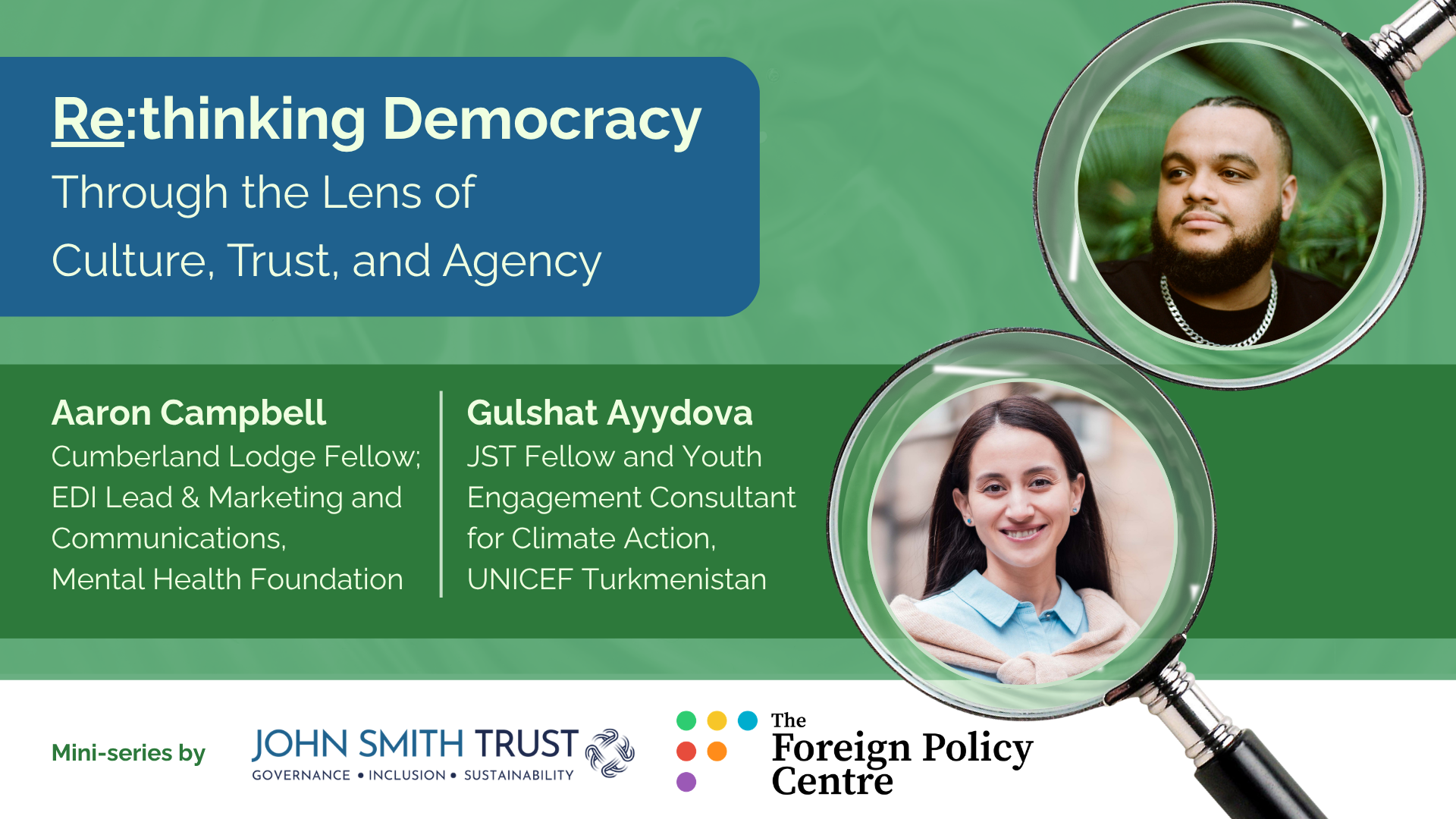
Young people are often described as the ‘future’, yet they are already shaping political life in the present. We are two young leaders from very different contexts: the UK and Turkmenistan. Even though our countries are culturally, socially and politically quite different, we found through indepth discussion in both – and we suspect across the globe – Gen Z are navigating complex barriers to formal participation while simultaneously creating new, constructive forms of civic engagement. If our leaders are serious about building resilient and peaceful societies, we have to transform our engagement with young people from tokenistic consultation to meaningful collaboration.
Young people’s agency is expressed not only through formal institutions such as voting or parliamentary participation, but also through civic activism, digital mobilisation, community leadership, and social entrepreneurship. However, our systems frequently fail to recognise this reality. Young people are invited into conversations symbolically rather than substantively, consulted without influence, and expected to participate in systems that were not designed with them in mind.
Through our work we hear from young people that they see themselves mentioned in speeches and strategies, but do not participate in decision-making spaces where power actually sits. Youth councils, consultations, and forums often exist without real influence over policy outcomes, reinforcing frustration and deepening distrust in institutions.
There are both formal and informal barriers for young people to engage with governance structures. These include limited access to policymakers, hierarchical political cultures, and a perception that the youth lack the experience or authority to contribute meaningfully. In formal settings, even practical factors such as language confidence, professional etiquette, and expectations around dress and behaviour can become invisible barriers that exclude young people from participation.
In the UK, organisations like My Life My Say and Flipgenn are actively breaking down these barriers – and it is working. In the lead-up to the most recent local elections, 444,874 young people registered to vote in April 2026 alone, and the Electoral Commission found that 81% of young people see living in a democracy as important.[1] Yet such organisations remain the exception rather than the rule, and the lack of meaningful institutional pathways for engagement remains one of the greatest barriers young people face.
When those pathways are absent, the consequences are significant. In the UK, polling shows that 63% of 18–24-year-olds doubt any major political party could improve their lives, and 73% feel politicians do not care about people like them.[2] In Turkmenistan, young people similarly describe a sense of distance from formal decision-making – feeling that their voices sometimes carry weight in community spaces but rarely reach the institutions where policy is shaped. In both contexts, the risk is the same: when young people feel that the system is not working for them, disengagement follows.
One example from Turkmenistan shows what becomes possible when this changes. Through the Organisation for Security and Co-operation in Europe (OSCE) seminars on Climate Negotiations, Model OSCE, and Inclusive Climate Governance, the United Nations International Children’s Emergency Fund (UNICEF) supported Youth Climate Summer School, and the annual Local Conference of Youth (LCOY) endorsed by YOUNGO, young people from across Turkmenistan have come together to learn, exchange ideas, and contribute to addressing environmental challenges.[3] These initiatives have been made possible thanks to the support of national institutions, including the Ministry of Foreign Affairs and the Ministry of Education, as well as international partners such as UNICEF, United Nations Development Programme (UNDP), the Deutsche Gesellschaft für Internationale Zusammenarbeit (GIZ), the OSCE, and diplomatic missions including the UK Embassy. Working together, these partners have created spaces where young people can develop their skills, collaborate with experts, and transform their ideas into practical initiatives that benefit their communities.
What has been most inspiring is seeing how young people respond when they are trusted and encouraged to contribute. Many participants have gone on to organise awareness campaigns, volunteer activities, and peer-learning initiatives, sharing their knowledge with others and inspiring more young people to get involved. They often speak about the pride and satisfaction they feel from being able to contribute to issues that matter to them and to their communities.[4] These experiences show that when young people are given opportunities to learn, collaborate, and take responsibility, they develop into confident and active citizens. Society, in turn, benefits from their creativity, enthusiasm, and commitment to building a more sustainable future.
Representation matters. When people see someone like themselves making a difference, they feel empowered to believe they can do the same – and their sense of belonging to their country is strengthened when they can see themselves working within its structures and contributing to its future. But representation must not mean simply inviting young people to the table: it must mean giving them the authority, trust, and resources to shape outcomes. Youth engagement should also extend beyond parliaments and ministries. Community centres, universities, coworking spaces, and local initiatives often provide more accessible and psychologically safe environments for young people to engage in public life.
Leaders and policy-makers concerned about social cohesion among the next generation should understand that empowering young people to be active members of their society – in the spaces where they live, study and work – is precisely how trust and social capital are built. If we are serious about building resilient and inclusive societies, youth engagement must move beyond tokenism and toward genuine representation, civic education, and structural support. It requires real investment and commitment, but the evidence from both our countries is clear: when young people are given the opportunity to contribute, they do – and society as a whole is stronger for it.
Explore the full mini-series here.
Aaron Campbell is located at the intersection of Mental Health, EDI & Liberation, Advocacy for Young People, Higher Education and Politics/Policy, with a passion, drive, and focus on making long lasting and meaningful change within society, particularly for those who are marginalised. They graduated from the University of East Anglia with a degree in Computing and Graphic Design and since have worked with many organisations across multiple sectors including government, mental health, legal and grassroots organisations.
Gulshat Ayydova is a climate and youth advocate from Turkmenistan. She founded the Youth Climate Action Network Turkmenistan and leads a range of initiatives to engage young people in climate action. Her work includes organising eco camps, eco festivals, climate hackathons, and national youth conferences on climate change, as well as co-developing policy recommendations for the government. She currently serves as a member of the EU Youth Sounding Board for Central Asia. Gulshat is committed to advancing inclusive and sustainable climate policies in Turkmenistan.
Disclaimer: The views expressed in this piece are those of the individual authors and do not reflect the views of The Foreign Policy Centre.
[1] The Electoral Commission, Young people’s views on politics and voting 2026, March 2026, https://www.electoralcommission.org.uk/research-reports-and-data/young-peoples-views-politics-and-voting-2026
[2] From a survey conducted by Opinium, https://www.opinium.com/insight/ and commissioned by My Life My Say, https://www.mylifemysay.org.uk/
[3] UNICEF, UNICEF Launches Youth Climate Summer School 2025, June 2025, https://www.unicef.org/turkmenistan/press-releases/unicef-launches-youth-climate-summer-school-2025; UN Turkmenistan, Raising a Generation of Climate Leaders: Gulshat and Selbi Empower Youth for Climate Action in Turkmenistan, November 2025, https://turkmenistan.un.org/en/305747-raising-generation-climate-leaders-gulshat-and-selbi-empower-youth-climate-action; OSCE, OSCE promotes youth engagement in climate change issues in Turkmenistan, July 2025, https://ashgabat.osce.org/centre-in-ashgabat/595459; OSCE, Model OSCE promotes youth leadership and climate diplomacy in Turkmenistan, April 2026, https://ashgabat.osce.org/news/centre-ashgabat/663259
[4] Statement based on participant feedback collected during workshops and informal discussions rather than a formal evaluation.