Skip to content

The UK and media freedom: An urgent need to lead by example

Article by Jessica Ní Mhainín

December 9, 2020

The UK and media freedom: An urgent need to lead by example

“As we forge a dynamic new vision for a truly global Britain, this Government are [sic] absolutely committed to the United Kingdom becoming an even stronger force for good in the world,” Dominic Raab said when he announced the first sanctions under the Global Human Rights Sanction Regime to the House of Commons earlier this year.[1] The UK’s decision to sanction 20 Saudi nationals involved in the death of journalist Jamal Khashoggi was widely commended, but was subsequently undermined by reports that Defence Minister Ben Wallace had phoned his Saudi counterpart to apologise for the sanctions.[2]


In fact, despite having pledged to “counter threats to media freedom” both “globally and locally” at the Global Conference for Media Freedom in July 2019, the UK government has repeatedly undermined its pledge at home.[3] Since the start of 2020 alone, journalists from at least four media outlets were denied access to a government briefing in February, a journalist was banned from asking questions at a government press briefing in May, and in September an investigative news outlet was blacklisted by a government department seemingly as a result of their reporting of the UK’s role in the Saudi-led coalition.[4] That’s to say nothing of the ongoing detention of Julian Assange or the Brexit-related legislation that would, by the government’s own admission “break international law”, which prompted the resignation of Amal Clooney from her role as Special Envoy on Media Freedom.


A UK Industry Aimed at Silencing Investigative Journalism

One of the most pervasive issues faced by investigative journalists is not as overt as being denied, banned, or blacklisted by the government. Vexatious legal threats and actions are insidious, frequently being used to quash investigations yet rarely brought to light. “I would say that over the years I have had hundreds of threatening letters from lawyers. They are intended to frustrate any attempts to tell the truth about things,” said Meirion Jones of The Bureau of Investigative Journalism. Many of these, he says are brought by wealthy individuals trying to silence their reporting. “If you make billions and billions of dollars a year, spending a few million on a case to try and shut down criticism is nothing.”


There is little doubt that the scale of these vexatious lawsuits – known as strategic lawsuits against public participation (SLAPPs) – is increasing, an increase supported by a London-based industry aimed at silencing investigative journalism. “It does appear that there are specialist PR/legal entities, especially operating out of London, who respond to journalistic requests with legal threats,” said Scottish investigative journalist Chris Smith.[5] “I’ve been doing this for 30 years – that’s definitely a big change in the last while.”


Journalists based outside the UK are not immune from receiving communications from these specialist PR/legal entities. Of the investigative journalists recently surveyed by the Foreign Policy Centre for their report into the pressures faced by journalists uncovering financial crime and corruption, 67 per cent in the US and 48 per cent in Europe reported receiving legal communications from UK-based PR/legal firms.[6] Journalists in the Middle East North Africa and Africa also reported receiving such communications from the UK (25 per cent and 20 per cent respectively).


“British law firms have a reputation for muscling in on journalists and silencing critics with the threat of ruinous court action,” MaltaToday’s executive editor Matthew Vella said, amid legal threats to his own publication in 2018.[7] Similarly, in an interview with Index on Censorship earlier this year, Jesper Nymark of the Danish investigative media outlet Danwatch said that they have also received such communications from British lawyers. “We can publish something in Danish without any legal risk but if we publish the same in English for example, we have experienced getting [legal letters] from British and Irish companies via a UK attorney.”


Far from being “an even stronger force for good in the world”, the UK is harbouring an industry that profits from the intimidation of journalists and suppression of information. It must take action – including legislative action – to protect journalists from wealthy and powerful individuals who are bending the laws to their interests. Several jurisdictions, including states in Canada, Australia, and the United States, have already introduced anti-SLAPP legislation. Such legislation, if implemented effectively, protects those facing a SLAPP from excessive costs and unduly time-consuming legal processes, while simultaneously safeguarding an individual’s entitlement to defend any infringements on their rights in the courts. The EU is considering similar legislation. The UK should do the same.


Economic Factors Are Further Undermining Investigative Journalism

While reform of legislation will be important – even essential – to protecting press freedom, it will not be a silver bullet. “These are all issues really fundamentally to do with the economic crisis within the newsprint industry,” said freelance journalist Chris Smith. Already struggling before the pandemic, many news outlets are facing an existential threat due to lack of funding. In a recent survey by the Reuters Institute, more than a third of news media organisations said that they expected a “severe drop of 30% or more” in their 2020 revenues.[8]


When funds are depleted, investigative reporting which is time-consuming and therefore costly is often the first to go. Some investigative journalists, particularly freelancers, are finding the current situation unsustainable. “I had a really good [investigative] story recently for which I was paid £250. It took me two weeks to do it,” Smith said. “You can get £250 for a story you did in a day. So why would you do that? And then if you’re also getting legal threats. Why? It would make no financial sense for a freelance journalist in particular to do that.”


Even the BBC has not escaped the crisis. With the announcement of 520 job losses in July, the investigative programme Newsnight was reported to have been subject to hefty cuts.[9] The reduced funding was, at least in part, due to the drop in commercial income caused by the pandemic but it came after months of government vitriol, including multiple hints from ministers about the scrapping the license fee – the BBC’s primary source of funding.[10]


“The real pressure – the real lever that politics holds is on funding,” said Noel Curran of the European Broadcasting Union (of which the BBC is a member) in a recent seminar on public service broadcasting, stressing the need for decisions on funding to be taken out of politicians’ hands in order for public service media be fully independent.[11] “People from outside of the UK look at the debate around the future of the BBC, which makes it sounds like its existential – like it’s an existential debate – and they are absolutely baffled,” Curran said, underlining the fact that the BBC is among the most trusted sources of crisis news in the UK.[12]


The National Committee for the Safety of Journalists: A Step in the Right Direction?

The establishment of a National Committee for the Safety of Journalists in 2020 is positive as it gives press freedom organisations, including Index on Censorship, the opportunity to regularly voice their concerns directly to the government. The Committee will have a key role in drawing up a National Action Plan for the safety of journalists, due to be published in Spring 2021, which the government hopes will be a model for other countries.


The establishment of the Committee is a step in the right direction, but the government has undermined its progress by repeatedly refusing to be interviewed by the media. Shortly after being elected, the government began boycotting the BBC’s flagship Today programme on the basis that the show speaks to a “pro-Remain metropolitan bubble”. No sooner had the boycott of the Today programme ended, than the boycott of ITV’s Good Morning Britain began in response to an “unnecessarily confrontational” interview with the health secretary about his handling of the pandemic.[13]


Moreover, one of the issues that Index on Censorship has raised at the Committee is that of the UK’s lacklustre engagement with the Council of Europe Platform to promote the Protection of Journalism and Safety of Journalists.[14] The Platform enables Council of Europe member states to be alerted in a timely and systematic way to media freedom violations, to take prompt action when necessary, and to update the Platform thereafter.[15] So far this year there have been twelve media freedom alerts in relation to violations in the UK. Only five have received a response. Neither a National Committee nor a National Action Plan can make up for lack of engagement with existing mechanisms aimed at defending media freedom. If the UK wants to be an example to other countries, it must lead from the front.


Northern Ireland: A Country of Pressing Concern

The situation facing the media in Northern Ireland is of particular concern. Despite accounting for less than three per cent of the UK’s population, it’s notable that Northern Ireland accounts for a third of the UK’s alerts on the Council of Europe Platform so far this year, all of which arise from violent threats from paramilitary organisations. In October, journalist Patricia Devlin filed a complaint to the Police Ombudsman due to what she feels has been the failure of the police to adequately investigate serious threats to her and her family, including her new born baby, as a result of her work.


Having spent decades reporting on Northern Ireland, journalist Ed Moloney knows all too well the physical dangers associated with investigating paramilitaries.[16] But in 2016, he also experienced legal threats in the form of a lawsuit was filed against him after he asked someone he was investigating to provide a comment on racketeering allegations. “I had been writing about the IRA for a long long time and I got quite a lot of information about them over the years,” explained Moloney, who published A Secret History of the IRA in 2002. “They had all sorts of reasons to come for me.” Mr Moloney believes that this was a case of libel laws being used to pursue a vendetta against him as a result of his journalism. The legal action against Moloney was ultimately dropped in June 2020, but it nonetheless succeeded in wasting valuable time, money, and energy.


“The libel laws in Northern Ireland are anti-diluvian. They are really so backward,” Moloney said. Northern Ireland’s defamation law is mostly determined by legislation conceived in the 1950s and 1960s when, as Lord Lexden pointed out as he was making the case for reform in 2013, “computing was in its infancy”.[17] This legislation remains in force despite calls for measures equivalent to the provisions of the Defamation Act 2013 to be introduced.[18] The Defamation Act 2013, which applies to England and Wales, has helped stem the flow of lawsuits by introducing a serious harm threshold and placing restrictions upon the types of cases that can be brought to court in that jurisdiction. Similar provisions must be brought forward in Northern Ireland.


Conclusion

“To focus on solving problems at home is not enough,” the government’s media freedom pledge states, but improving media freedom and safety of journalists domestically is a prerequisite to being seen as a bona fide actor in advancing media freedom internationally. The government must empower journalists to investigate and report in the public interest by ensuring that any threats against them are thoroughly investigated and the perpetrators brought to justice. It should reform laws or adopt new measures to prevent journalists from facing legal harassment as a result of their work. It must respect the role of the public broadcaster and ensure that adequate funding is available to public interest investigative journalism, which is essential to a healthy democracy.


“Where governments are not the source of the problem, they often fail to provide the solutions needed to counter the actions of those who attack media freedom,” the pledge says. The UK government must pay heed to ensure that their Global Pledge on Media Freedom is more than just a Brexit-era PR campaign.


Jessica Ní Mhainín is Index on Censorship’s Senior Policy Research and Advocacy Officer. She has experience in international human rights advocacy through her work at Front Line Defenders and the Office of the High Commissioner for Human Rights (OHCHR). She holds a Master’s degree in EU International Relations and Diplomacy Studies from the College of Europe (Bruges), where she specialised in peace and conflict studies.


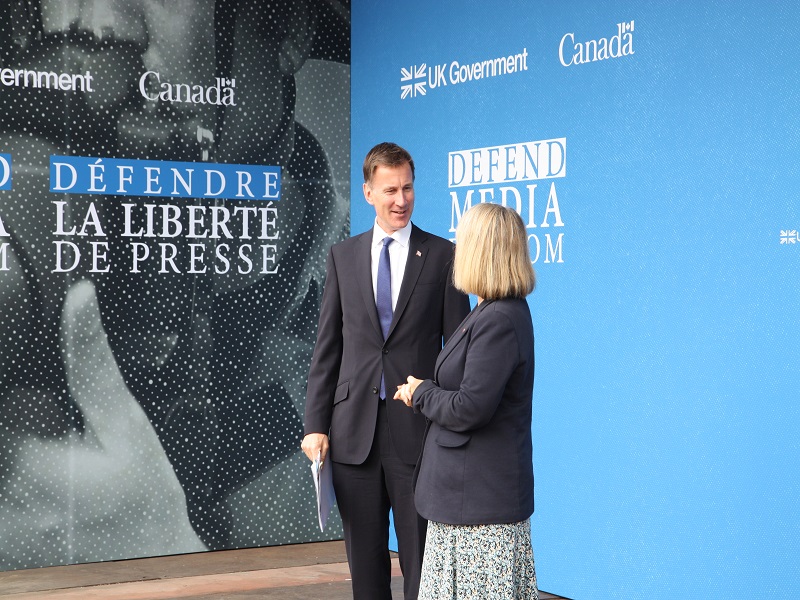
Image by FCO under (CC).


[1] Dominic Rabb, Global Human Rights Sanctions Regime, Volume 678: debated Monday 6 July 2020, Hansard, UK Parliament,  https://hansard.parliament.uk/Commons/2020-07-06/debates/24B78A01-061C-48A8-AA92-8E53C17516E3/GlobalHumanRightsSanctionsRegime?highlight=media%20freedom#contribution-6023AE47-5B98-4500-9204-5F73E302897A

[2] Jon Stone, UK government accused of phoning Saudi Arabia to apologise after imposing human rights sanctions, Independent, July 2020, https://www.independent.co.uk/news/uk/politics/uk-saudi-arabia-human-rights-ben-wallace-yemen-war-crimes-a9611221.html

[3] FCO and FCDO, Policy Paper: Global pledge on media freedom, Gov.uk, July 2019, https://www.gov.uk/government/publications/global-pledge-on-media-freedom/global-pledge-on-media-freedom

[4] Some Media Outlets Denied Access to a Government Briefing, United Kingdom, n° 11/2020, Council of Europe, February 2020, https://www.coe.int/en/web/media-freedom/detail-alert?p_p_id=sojdashboard_WAR_coesojportlet&p_p_lifecycle=0&p_p_col_id=column-4&p_p_col_count=1&_sojdashboard_WAR_coesojportlet_alertId=58681722; OpenDemocracy Journalist Banned from Asking Questions at UK Government’s Daily Press Briefings, United Kingdom, n° 62/2020, Council of Europe, May 2020, https://www.coe.int/en/web/media-freedom/detail-alert?p_p_id=sojdashboard_WAR_coesojportlet&p_p_lifecycle=0&p_p_col_id=column-4&p_p_col_count=1&_sojdashboard_WAR_coesojportlet_alertId=65156158; Investigative Media Outlet “Declassified UK” Blacklisted by the Ministry of Defence, United Kingdom, n° 100/200, Council of Europe, September 2020, https://www.coe.int/en/web/media-freedom/detail-alert?p_p_id=sojdashboard_WAR_coesojportlet&p_p_lifecycle=0&p_p_col_id=column-4&p_p_col_count=1&_sojdashboard_WAR_coesojportlet_alertId=70791320

[5] Journalist’s name has been changed as he asked to remain anonymous.

[6] Unsafe for Scrutiny, FPC, November 2020, https://fpc.org.uk/publications/unsafe-for-scrutiny/

[7] MaltaToday Staff, UK legal threat against MaltaToday over Azeri-Pilatus connection report, MaltaToday, May 2018, https://www.maltatoday.com.mt/news/national/86652/uk_legal_threat_against_maltatoday_over_azeripilatus_connection_report#.X60eNtP7RQK

[8] Prof. Rasmus Kleis Nielsen, Federica Cherubini and Dr. Simge Andi, Few winners, many losers: the COVID-19 pandemic’s dramatic and unequal impact on independent news media, Reuters Institute and University of Oxford, November 2020, https://reutersinstitute.politics.ox.ac.uk/few-winners-many-losers-covid-19-pandemics-dramatic-and-unequal-impact-independent-news-media#menu

[9] Jim Waterson, BBC announces further 70 job cuts in news division, The Guardian, July 2020, https://www.theguardian.com/media/2020/jul/15/bbc-announces-further-70-job-cuts-in-news-division

[10] Elizabeth Howcroft and Costas Pitas, Government hints BBC licence fee could be scrapped, Reuters, February 2020, https://uk.reuters.com/article/uk-bbc-licence/uk-to-consult-on-decriminalising-bbc-licence-fee-evasion-idUKKBN1ZZ00X; Tim Shipman, No 10 tells BBC licence fee will be scrapped, The Times, February 2020, https://www.thetimes.co.uk/article/no-10-tells-bbc-licence-fee-will-be-scrapped-hzwb9bzsx

[11] Noel Curran, The value and the future of public sector media, Reuters Institute and University of Oxford, November 2020, https://reutersinstitute.politics.ox.ac.uk/calendar/value-and-future-public-service-media

[12] Noel Curran, The value and the future of public sector media, Reuters Institute and University of Oxford, November 2020, https://reutersinstitute.politics.ox.ac.uk/calendar/value-and-future-public-service-media

[13] Kate Ng, Government minister confronted on air by GMB reporter over cabinet refusing to appear on show, Independent, May 2020, https://www.independent.co.uk/news/uk/home-news/good-morning-britain-piers-morgan-robert-buckland-boycott-itv-a9523736.html

[14] Platform to promote the protection of journalism and safety of journalists, Council of Europe portal, https://www.coe.int/en/web/media-freedom

[15] The Platform has 14 civil society partner organisations, including Index on Censorship.

[16] Admin, The Official IRA planned the murders of journalists Ed Moloney and Vincent Browne, Village, May 2020, https://villagemagazine.ie/the-official-ira-plot-to-murder-an-irish-times-journalist/

[17] Defamation Act 2013: Northern Ireland, Volume 746: debated on Thursday 27 June 2013, Hansard, UK Parliament, https://hansard.parliament.uk/Lords/2013-06-27/debates/13062786000273/DefamationAct2013NorthernIreland

[18] Andrew Scott, Reform of defamation law in Northern Ireland, LSE Research Online, August 2016, http://eprints.lse.ac.uk/67385/1/Scott_Reform%20of%20defamation%20law_2016.pdf

Footnotes
    Related Articles

    Unsafe for Scrutiny: Conclusions

    Article by Susan Coughtrie

    Unsafe for Scrutiny: Conclusions

    While the UK, and its offshore jurisdictions, are not the only locations used for the facilitation of financial crime and corruption, the extent to which the UK is a facilitator of financial crime, a destination for illicit money and the source of a wide range of enablers to support corrupt individuals as well as suppress public interest reporting is alarming. As the contributors to this publication have illustrated this undermines the UK’s claim to be both a global leader in the fight against illicit finance as well as a promoter of media freedom and safety of journalists around the world. If the UK is serious about taking steps to realise these important aims, the first must be to acknowledge and re-assess the gap between its aspirations and reality.


    Investigative journalists have repeatedly demonstrated their critical role in creating transparency by bringing financial crime and corruption to light, the crucial first step in ensuring accountability and redress. Successive large-scale transnational investigations, conducted by huge global networks of several hundred journalists, have evidenced how political and business elites, as well as organised crime groups, all over the world have avoided law enforcement and misused financial and legal systems to facilitate the theft of public funds, tax avoidance, money laundering, bribery and other forms of crime and corruption. Journalists, working as part of these networks or independently, have demonstrated that in a number of cases they are able to follow leads, pick apart complex schemes and identify individuals and entities involved in wrong-doing far more effectively than those working in law enforcement bodies, which often cite journalists’ findings in their official reports. It is the fallout of these journalists’ investigations that has led to high profile resignations; changes to financial regulation; arrests and indictments against criminal figures; as well as the recovery of several billion in fines and seizure of illicit funds.[1] Yet the importance of investigative journalism, and how the evidence journalists’ uncover can be utilised by the authorities, is woefully missing in official Government strategies, such as the UK’s 2019-2022 Economic Crime Plan and the 2017-22 Anti-Corruption Strategy.[2]


    Moreover, if the role of investigative journalists is threatened, if they are prevented from continuing their work, or unfairly restricted due to threats and harassments, it only increases the scope for financial crime and corruption to continue unchecked. Investigative journalism is hard enough, especially in countries where media freedom is not respected, without additional challenges – such as vexatious legal action or surveillance and smear campaigns – enabled by companies in the UK. Steps must be taken to redress issues in the UK legal system that allow for SLAPP cases, but UK law firms and other companies should also be vigilant in ensuring that their services are not being utilised to cover up financial crime and corruption.


    Tools such as encryption are crucial for shielding journalists against surveillance and fishing attempts for information that can be used to blackmail or smear them, as well as to protect their sources. The UK’s continued pursuit, as part of the Five Eye’s Alliance, to undermine end-to-end encryption can therefore be seen as regressive action towards media freedom.


    Ultimately, breaking the cycle of financial crime and corruption taking place with the facilitation of services in the UK’s borders should be the UK Government’s priority. This would go a long way to not only countering financial crime, but removing resources from those individuals who would wish to use utilise them to silence journalists who write about their wrongdoings. After all, prevention is better than cure.


    Image under (CC).


    [1] OCCRP, Impact to Date, March 2020, https://www.occrp.org/en/impact-to-date; ICIJ Story, https://www.icij.org/about/icijs-story/; Douglas Dalby and Amy Wilson-Chapman, Panama Papers helps recover more than 1.2 billion around the world, ICIJ, April 2019, https://www.icij.org/investigations/panama-papers/panama-papers-helps-recover-more-than-1-2-billion-around-the-world/

    [2] HM Treasury and Home Office, Policy Paper – Economic crime plan 2019 to 2022, Gov.uk, July 2019, https://www.gov.uk/government/publications/economic-crime-plan-2019-to-2022; Home Office, DFID, and FCDO, Policy Paper – UK anti-corruption strategy 2017 to 2022, Gov.uk, December 2017, https://www.gov.uk/government/publications/uk-anti-corruption-strategy-2017-to-2022

    Footnotes
      Related Articles

      The Foreign Policy of Joe Biden: Assessing His Vice Presidential Legacy

      Article by Andrew Mumford

      December 8, 2020

      The Foreign Policy of Joe Biden: Assessing His Vice Presidential Legacy

      As pundits and world leaders start to interpret what kind of foreign policy platform President-elect Joe Biden will enact, there is good reason to look back on his eight years as Vice President under Barack Obama to see just how his extensive foreign policy experience is and why it led one media profile to ask if he was the most influential Vice President in history.[1]


      Joe Biden initially rebuffed Obama’s request that he be vetted as a potential running mate, believing he could be more influential as Chairman of the Senate Foreign Relations Committee than as Vice President. Biden also later revealed that when discussing the running mate offer with his family it was his sons who argued that his foreign policy experience would help the ticket – and arguably it did.[2] During his eight year stint as Vice President, Joe Biden travelled to over two dozen countries as America’s envoy to help solve diplomatic crises.[3]


      Yet before being selected as Obama’s running mate, Biden was perceived as ‘a victim of terminal logorrhoea’, creating a reputation as an affable but serial gaffe-maker.[4] It soon became clear, however, that out of the three shortlisted vice presidential candidates (Virginia Governor Tim Kaine, Indiana Senator Evan Bayh, and Biden) that it was the Delaware senator that had the most foreign policy experience. Biden had been in the Senate for 36 years by that point, including four years as Chair of the Foreign Relations Committee. This foreign policy experience was important for Obama to harness as a way of countering criticism at his inexperience on the international stage.


      With a staff that included five foreign policy assistants Biden clearly staked a claim to be Obama’s most vocal foreign policy advocate – something the President himself acknowledged. When asked in 2014 where he felt his Vice President’s greatest impact had been, Obama replied: ‘On the foreign policy front, I think Joe’s biggest influence was in the Afghanistan debate.’[5] Just a week before their inauguration in January 2008, President-elect Obama sent Biden on a fact-finding mission to both Iraq and Afghanistan to assess the state of the two wars the new administration was going to inherit. This utilisation of Biden as a foreign policy point-man would be a trend that would continue for much of their term of office.


      Six months into his presidency, Obama gave Biden the responsibility for overseeing the American military withdrawal from Iraq – a war that Biden described as ‘the most frustrating issue of my forty year career in foreign relations.’[6] However, it was the war in Afghanistan – the original theatre of battle in the War on Terror – that came to dominate Obama’s foreign policy horizon. Biden immediately became the ‘in-house pessimist’ on Afghanistan and sought ways to minimise American involvement.[7] After receiving commanding officer Gen. Stanley McChrystal’s request for additional troops in Afghanistan in August 2009, President Obama spent the next two months chairing ten formal meetings in which key members of the administration, including Biden, discussed a review of the Afghan war strategy. Biden exploited his participation in these meetings as a way of demonstrating his influence in the foreign policy domain, even if it meant creating friction with other cabinet members.


      In these meetings Biden received the active encouragement of Obama to argue the case for an overt counter-terrorism approach to Afghanistan (which emphasised the targeted killing of key Taliban and Al-Qaeda leaders) in contrast to the counter-insurgency option preferred by Defense Secretary Robert Gates and Secretary of State Hillary Clinton (which emphasised nation-building as a prelude to a reduction in violence). Biden and Gates clashed repeatedly over Afghanistan, especially over the need to inject a ‘surge’ of troops into the country. Gates claimed in his memoirs that Biden was deliberately stoking ‘distrust’ between the White House and senior military officers over the way forward in Afghanistan.[8] Once Obama had set the course for a ‘surge’ in Afghanistan of an additional 30,000 extra troops Gates went further by accusing Biden of disloyalty by actively working to show that the President ‘had been wrong…and that the war on the ground was going from bad to worse.’[9] In March 2011 Biden convened a meeting at the Vice President’s residency inside the grounds of the Naval Observatory to discuss the Afghan strategy. Biden placed himself at the centre of this ‘off-campus’ debate in order to press Gates for a drawdown in troop numbers. The Defense Secretary resented Biden using his position as Vice President to muscle in on foreign and defense policy issues and for ‘poisoning the well with the President with regard to… Afghanistan.’[10]


      Despite these high profile clashes with Defense Secretary Gates (whose side-swipe at Biden in his memoirs for being ‘wrong on nearly every major foreign policy and national security issue over the past four decades’ grabbed headlines upon publication) Vice President Biden still enjoyed an enormous level of leverage over the direction of foreign policy in the Obama White House.[11] Biden would claim after he left office that Obama ‘did not look over my shoulder’ once he had tasked him with large foreign policy portfolios.[12] Like Dick Cheney before him, Biden continued to regularly attend the Principal’s Committee of the President’s top national security team.[13] He also tried to cultivate a diplomatic philosophy, which held that ‘all foreign policy is a logical extension of personal relationships.’[14] This was his way of building close working connections with world leaders ahead of talks – and is a trait we can expect to see manifest again once Biden enters the Oval Office in January.


      Andrew Mumford is a Professor in the School of Politics and International Relations at the University of Nottingham and a former fellow at the Eccles Centre for American Studies at the British Library. Twitter: @apmumford


      Image by Gage Skidmore under (CC).


      [1] Michael Hirsh, Joe Biden: The Most Influential Vice President in History?, The Atlantic, December 2012, https://www.theatlantic.com/politics/archive/2012/12/joe-biden-the-most-influential-vice-president-in-history/266729/

      [2] Joe Biden. 2017. Promise Me, Dad. Pan Macmillan. https://www.panmacmillan.com/authors/joe-biden/promise-me-dad/9781509890088

      [3] Jody C. Baumgartner, The Vice Presidency in the Twenty-First Century, Pepperdine Law Review, Volume 44, Issue 3 Symposium: The United States Vice Presidency: In History, Practice and the Future, Article 4, 2017, https://digitalcommons.pepperdine.edu/cgi/viewcontent.cgi?article=2442&context=plr

      [4] John Heilemann and Mark Halperin, Game Change: Obama and the Clintons, McCain and Palin, and the Race of a Lifetime, Harper Collins, October 2010, https://www.harpercollins.com/products/game-change-john-heilemannmark-halperin?variant=32205918076962

      [5] Evan Osnos, The Biden Agenda: Reckoning with Ukraine and Iraq, keeping an eye on 2016, The New Yorker, July 2014, http://www.newyorker.com/magazine/2014/07/28/biden-agenda

      [6] James Traub, After Cheney, The New York Times Magazine, November 2009, https://www.nytimes.com/2009/11/29/magazine/29Biden-t.html; Joe Biden. 2017. Promise Me, Dad. Pan Macmillan. https://www.panmacmillan.com/authors/joe-biden/promise-me-dad/9781509890088

      [7] Peter Baker, Biden No Longer a Lone Voice on Afghanistan, The New York Times, October 2009, https://www.nytimes.com/2009/10/14/world/14biden.html

      [8] Robert M. Gates. 2015. Duty: Memoirs of a Secretary at War. Penguin Random House. https://www.penguinrandomhouse.com/books/217977/duty-by-robert-m-gates/

      [9] Ibid.

      [10] Ibid.

      [11] Ibid.

      [12] Joe Biden. 2017. Promise Me, Dad. Pan Macmillan. https://www.panmacmillan.com/authors/joe-biden/promise-me-dad/9781509890088

      [13] Evan Osnos, The Biden Agenda: Reckoning with Ukraine and Iraq, and keeping an eye on 2016, The New Yorker, July 2014, https://www.newyorker.com/magazine/2014/07/28/biden-agenda

      [14] Steve Clemons, The Biden Doctrine: Has the vice president made a lasting contribution in foreign policy?, The Atlantic, August 2016, https://www.theatlantic.com/international/archive/2016/08/biden-doctrine/496841/

      Footnotes
        Related Articles

        Biden’s Democracy Summit

        Article by Dr Alex Folkes

        December 7, 2020

        Biden’s Democracy Summit

        Democracy is not exactly seen as a sexy topic for world discussion. Every year, at least in normal times, there are economic summits and climate change summits and occasionally there will be arms control summits too. But rarely are the building blocks of what makes our society function discussed on the world stage. Incoming US President Joe Biden seeks to address this void by including in his manifesto a commitment to holding a democracy summit within his first year, perhaps within the first few months. And, as Kevin Baron of Defense One notes: “Nobody on earth but the President of the United States has the power or clout to pull it off.”[1]


        To someone who works in the field of elections around the world, this is a significant proposal, but it comes with the risk of promoting countries whose democracies are troubling and of offending those who we should be looking up to. So what is Biden’s plan and what can it hope to achieve?


        Biden’s promise recognises that America is in need of democratic renewal herself. As Richard Luce in the FT has pointed out, America has proved in recent months that it might not be the perfect example to follow and two of their last six Presidential elections have resulted in ‘wrong winner’ scenarios. Luce also points out that Biden’s predecessor, George W Bush, advocated his war on Iraq on the basis that he was bringing democracy to the Middle East – and look how that has turned out. US democracy is clearly not as bad as President Trump would have us believe and the recent election was conducted – according to international observers and US law enforcement – without significant fraud, but it is still a system which needs improvement. Areas such as restoration of the Voting Rights Act, transparency in campaign finance, and the use of cyber and other resources to protect the voting systems are all covered in Biden’s plan, as is the need to restore America’s moral leadership in the world.[2]


        Biden says his summit will involve the world’s democracies and the aim will be “to strengthen our democratic institutions, honestly confront the challenge of nations that are backsliding, and forge a common agenda to address threats to our common values,” looking at areas including fighting corruption, defending against authoritarianism, improving election security, and advancing human rights. And he goes on to say that civil society organisations, technology corporations and social media giants will also be invited and will be asked to make their own commitments.[3]


        That Biden does not see elections as the be all and end all of democracy is very encouraging, as the conversation needs to be about the rule of law, freedom of speech and equality in addition to the mechanics of elections themselves.


        But to suggest that Biden is new to this debate would be wrong. He has long been an advocate for greater world wide democracy and in 2018 he gave a major speech on the subject at the Copenhagen Democracy Summit where he talked about the threat and reasons behind populism. Then he named Hungary, Poland and Romania as countries which were seeking to dismantle the checks and balances of the rule of law. He also listed Ukraine, Georgia and Moldova as nations which needed the support from more established democracies. In the case of Ukraine, he said the decision to send a new missile system to support the country’s fight against Russian-backed insurgents was right “but Javelins will neither win the war nor help Ukraine become a democracy.”[4]


        Some have suggested that there ought to be some sort of D10 – a club for the leading democratic nations including the countries of the G7 plus India, South Korea and Australia. But that would, I think, be a massive mistake for two reasons. First because of those it excludes. The G7 is created on the basis of economic size and power. Using this as the basis of some assessment of the best democracies will exclude many smaller countries who have far stronger, fairer and frankly better systems of governance. New Zealand, Sweden and Uruguay spring to mind. And this leads to the second point. By setting themselves up as the D10, these countries are giving the impression they think their democratic systems and structures are beyond reproach. Geopolitical need means that the US cannot afford to offend countries such as India and so creating a small clique would inevitably mean giving a complete thumbs up to countries which have shown worrying signs of degrading the human rights of some of their citizens.


        The second idea being floated is that this is somehow going to be used to target China. The Christian Science Monitor specifically calls for the summit to be used to take China to task for what is happening in Hong Kong.[5]


        It is certainly the case that China is an authoritarian state which abuses large numbers of its population and the tearing apart of the semi-democratic structures of Hong Kong is very concerning. But they are not unique in this regard and it is perhaps a wasted opportunity to use such a summit to make a point to one country which will not be listening. It is difficult to be on the democratic moral high ground if you ignore what is happening in many gulf states and treat those countries as your close allies whilst castigating China.


        A more humble approach, and one which would have far more chance of succeeding, would be for Biden to be as inclusive as possible. Freedom House suggests that 2019 was the 14th year of democratic decline in the world. Biden readily admits that the US system is not perfect. And if that is the case, then others can come together on the basis that their countries have their own degrees of democratic imperfection too.[6]


        This summit should be a United Nations of those countries which aspire to call themselves democracies. A seat at the table should be available to any nation that aspires to a better system of democracy and human rights than they currently have.


        So what might it achieve? I think there are five key outcomes.


        First, it may focus the minds of Americans on the flaws within their own country. There has not been a better time to get both Democrats and Republicans on board for the need to overhaul the system. It may be a bit of a stretch to imagine that they will agree on a constitutional amendment to remove the Electoral College. But if they can reach a consensus that having different systems and rules for each state, and often for each county, is a recipe for voter confusion and bureaucratic collapse, then that will be a massive step forward. For too long, the US has operated on the basis of winners justice. Whoever controls the levers of power seeks to address the biases that favour their opponents whilst ignoring, or exacerbating, their own advantages. Bi-partisanship is a tricky thing to pull off in the febrile atmosphere of American politics, but it is needed now more than ever.


        Second, it puts democracy, human rights and the rule of law at the top of the agenda. Not since the collapse of the Soviet Union has the world really thought about why democracy matters. And even in the 90s the focus was more on dragging the new countries over to western economic values rather than democratic ones. Moreover, the lack of focus means that autocrats can convince their populations that the electoral charade in their country is much the same as the fully fledged democratic exercise taking place elsewhere. Call it an election and no one will know how flawed it is. More publicity means an increased chance of populations demanding better. The rate of backsliding, even in the west, is concerning and even members of the EU have seen their regimes start to denigrate the concept of liberal democracy. As Sophie in’t Veld points out, there is a concern even among MEPs that they need help to reverse the rise of illiberalism and the Biden summit could provide that.[7]


        Third, it gives encouragement to those states which are far from perfect democracies to carry on improving. Those countries such as Uzbekistan which are responding positively, if partially, to the recommendations made to them by international election observers need encouragement as well as admonishment. Getting a seat at the table of this summit is a viable reward for a commitment to continue improving, whilst also acknowledging that there is still much to do.


        Fourth, this should be a summit not just for nations but for those groups who help to advance electoral and democratic ideals. This would include international groups such as OSCE, the Commonwealth, and African Union. But also the NGOs such as our own Westminster Foundation for Democracy. And there should be recognition of the work that domestic observer groups do both during the electoral period and between elections. For the bigger groups, there is the chance to discuss and refresh their methodologies to understand the particular problems facing elections at the present time. For the smaller groups, there is the chance to raise funding and learn from others so that they can be stronger advocates for human rights in their own country.


        However, as Biden himself points out, there are many private companies which have a significant effect on elections. And so the likes of Facebook and Twitter need a seat at the table to discuss what they are doing to respond to the needs of each country holding elections and how they can improve and uphold democratic ideals.


        Finally, it does indeed exclude some states. Kevin Baron, of Defense One takes a relatively absolutist position: “Biden should make it clear that government leaders of China, Russia, Iran, Syria, North Korea and their ilk are not invited. Frankly, neither should Middle East and Asian monarchs and dictators. Turkey? Debatable. Perhaps Biden could invite such nations to send representatives as observers — free to watch and support, but not to participate in any mainstage discussions, decisions, or sign any proclamations about democracy or human rights. This can’t be the UN Human Rights Council where, as Pompeo said, “brutal regimes” come to lecture the free world.”[8]


        And whilst he is clearly right about the majority of countries he lists, if this programme is to be more than a gesture then it needs to keep the semi-democracies involved and encourage them to move forwards.


        It may seem odd to argue that Russia should have a seat at the table – if they want to come – whilst excluding China and others. But whilst Russian elections are deeply flawed, they take place on a regular basis and there is a recognised path to improvement. Putin will not be around forever and there must be a hope that we can persuade whoever comes next to make more of a commitment to democratic ideals. In China there is no such thing. Keeping them out – as well as nations who show no commitment to progress – is the best means of persuading those where backsliding has taken place that a renewed effort is needed.


        Image by Gage Skidmore under (CC).


        [1] Kevin Baron, Give Us That Democracy Summit, President Biden, Defense One, November 2020, https://www.defenseone.com/ideas/2020/11/give-us-democracy-summit-president-biden/169967/

        [2] Edward Luce, Biden’s dilemma on global democracy, Financial Times, November 2020, https://www.ft.com/content/3c6f033d-6469-4e2e-bbf8-52a3f66fba1b

        [3] Joe Biden, Why America Must Lead Again, Biden Harris campaign website, July 2019, https://joebiden.com/americanleadership/#

        [4] Speech by Joe Biden, Democracy in an Age of Authoritarianism, Alliance of Democracies, June 2018, https://www.allianceofdemocracies.org/speech-by-joe-biden/

        [5] Monitor’s Editorial Board, A focal point for Biden’s democracy sumit, The Christian Science Monitor, November 2020, https://www.csmonitor.com/Commentary/the-monitors-view/2020/1120/A-focal-point-for-Biden-s-democracy-summit

        [6] Sarah Repucci, Freedom in the World 2020: A Leaderless Struggle for Democracy – Democracy and pluralism are under assault, Freedom House, https://freedomhouse.org/report/freedom-world/2020/leaderless-struggle-democracy

        [7] Sophie in’t Veld, How MEPs can help Biden’s ‘Global Democracy Summit’, EU Observer, November 2020, https://euobserver.com/opinion/150115

        [8] Adam Shaw, Pompeo says US critics at UN Human Rights Council ‘have the most to hide’, Fox News, November 2010, https://www.foxnews.com/politics/pompeo-us-critics-un-human-rights-council

        Footnotes
          Related Articles

          Projecting the UK’s values abroad: Executive Summary

          Article by Adam Hug

          December 3, 2020

          Projecting the UK’s values abroad: Executive Summary

          2021 is going to be an important year for the UK’s global ambitions. Exiting both the post-Brexit transition period and, vaccines permitting, the toughest COVID restrictions the UK will have an opportunity to set out its vision for the future through the publication of the Integrated Review of Security, Defence, Development and Foreign Policy and to put that new strategy into practice through its dual leadership of the G7 and the UN Climate Change Conference of the Parties (COP).


          This new publication sets out a wide range of ideas for how the UK can do things differently in the future to support and promote its values in its foreign policy. The UK should carve out a new niche that builds on its soft power strengths and history as a global hub to position itself as a, or even the, ‘library of democracy’ by providing the necessary tools to support those defending human rights and democracy around the world. This requires support for the UK’s world class universities, NGOs and media outlets and getting the Home Office to better provide sanctuary to activists in need and access for those wanting to visit the UK. The UK should build on the success so far of the new Magnitsky sanctions and use aid to better support open societies and human rights objectives.


          Given the tendency of kleptocratic autocrats and their hangers on to funnel their money to or through UK jurisdictions, the fights against corruption and to support democracy are mutually supportive. Delivering overdue legal reforms and enhancing the capacity of enforcement bodies will be crucial, as will be increasing the use of Unexplained Wealth Orders. The UK must also learn the lessons of its own COVID procurement issues to boost credibility on transparency and accountability.


          The UK’s new trade function needs to be made more accountable to Parliament and the public, with deals containing stronger human rights and environmental protections, as well as a focus on supporting developing country economies to flourish. It should seek to make trade one plank of broader and more comprehensive Strategic Partnership Agreements that combine it with more detailed plans for security, scientific, academic, cultural, aid and environmental collaboration.


          To help the UK deliver an ambitious agenda this research suggests several recommendations including:


          • Positioning the UK as a ‘library of democracy’, a global hub for supporting liberal democracy and human rights;
          • Increasing the use of Magnitsky sanctions, expanding their remit to cover corruption and giving Parliament a role in proposing relevant cases;
          • Passing the Registration of Overseas Entities Bill and planned reforms to limited partnership law, improving registry access and connectivity, and perhaps a new national asset registry;
          • Continuing to expand the investigative capacity of Companies House, the National Economic Crime Centre and its constituent agencies, and increase the use of Unexplained Wealth Orders;
          • Taking action on libel tourism and repression of international journalists by introducing UK anti-SLAPP legislation and improving conducts codes for lawyers and financial services;
          • Making trade negotiations more transparent and accountable to Parliament and the public, with deals containing a stronger development focus and more enforceable human rights and environmental clauses;
          • Integrating trade deals better alongside the UK’s other diplomatic objectives through more comprehensive Strategic Partnership Agreements;
          • Returning to the legal and manifesto commitment of 0.7 per cent GNI invested in Overseas Development Aid as soon as possible, with a sunset clause if any legal changes;
          • Improving Parliamentary and Ministerial oversight and setting an ethical framework for the deployment of cyber capabilities, with a focus on defensive and combat support functions; and
          • Delivering more ambitious commitments for climate action through the UK’s Nationally Determined Contribution, better use of the aid budget and the use of the financial sector.


          Image by Rian (Ree) Saunders under (CC).

          Footnotes
            Related Articles

            Projecting the UK’s values abroad: Introduction

            Article by Adam Hug

            Projecting the UK’s values abroad: Introduction

            This essay collection asks, and tries to answer, the question ‘what can Britain do now?’ It is an examination of the emerging tools and strategies the UK can use to support and promote its values in its foreign policy. While in a number of areas there is continuity in British rhetoric and policy, outside the European Union (EU) the UK is required to rethink the way it operates in order to continue to exert influence on the world stage.[1] Not only must it build on its existing strengths, as set out earlier in this publication series, but find new ways of working.


            Building on the cross-governmental principle behind the Integrated Review, the UK’s emerging foreign policy must effectively use all available resources inside and outside government, hard and soft power, to support its foreign policy objectives and its chosen values.[2] As set out in the first collection in this series, The principles for Global Britain, and in Cat Tully and Sophie Middlemiss’ essay in this publication, a sensible approach has to start from a clear understanding of Britain’s place in the world and buy in from the public, particularly the younger generation and others often excluded from the policy making process – a ‘whole of nation strategy’ as Tully and Middlemiss put it.[3] In their essay Ruth Bergan and David Lawrence make the case that this principle applies equally to ensuring public participation in discussions over trade policy. A positive and transformative agenda for the future of UK foreign policy and how it can be a force for good may, at least have a chance to begin healing some of the divisions over the country’s future. As a middle power in a fast changing world, enduring polarisation and division over the UK’s national strategy is not a luxury we can afford.


            Prior to Brexit, although participation in the EU’s Common Foreign and Security Policy did not prevent the UK from showing international leadership where there was the necessary political will, the need to participate in determining and supporting sometimes lowest common denominator positions generated by consensus dulled the edge of some of its decision making. The UK now has the opportunity, if it so chooses, to show greater speed of action, and greater creativity and skill in the delivery of its foreign policy to compensate for and potentially outweigh the loss of diplomatic clout given by EU membership.[4] In broad-terms, the UK’s foreign policy planners will need to recognise the implications of the UK being a less important market and partner for other world powers, most notably the US, seeking to access and influence the EU. It retains key strengths but will need to lean into the greater flexibility that the post-Brexit environment provides.


            There is a need for policy makers to accept the unavoidable fact of the UK’s ‘relative’ decline in geopolitical influence, but also understand that with the right level of political will it does not mean the UK has to do less in absolute terms and that it can still make a real impact with the right policies and strategies.[5] The politically expedient, but somewhat strategically confused, recent decisions of increasing defence spending while cutting international aid pull in opposite directions the effort to reposition the UK on the world stage.[6] However this shift, relative to other powers, makes it all the more important that it uses its time now wisely to help shape the international architecture that it will live with into the future and find innovative ways to burden-share in areas where the UK lacks capacity alone. Ignoring or denying the need to respond to these shifts in the geo-political landscape will hasten and exacerbate British decline, in both relative and absolute terms. Finding the right tone in the Integrated Review and the Government’s wider messaging will be key, focused on national pride about what Britain can do without resorting to jingoism, striving for the UK to be exceptional without claiming exceptionalism.


            Finding a new role: The ‘Library of democracy’

            It’s far from original to reference the old Dean Acheson quote about Britain having ‘lost an empire and has not yet found a role’, but it feels once again relevant with Brexit and shifting US priorities untethering the UK from its more recent mooring as a balancing force between European and US interests in the wider Trans-Atlantic partnership.[7] Often that recent role was described as being a bridge, something that led more cynical critiques to claim, usually unfairly, that Britain was being walked over by either of those partners. So part of the current process of reassessing the UK’s position post Brexit is trying to identify and agree on its new role in the international order. To help Britain find that niche it could well be worth seeking to adapt another mid-20th Century aphorism to meet today’s challenges.


            In the early phase of the Second World War, prior to Pearl Harbor, President Roosevelt described America’s role as being the ‘Arsenal of Democracy’, where the US would provide tools used by others in the fight for the future of democracy.[8] Despite recently promised increases in defence spending there is little public appetite to use such power widely to try to impose its values on others given the troubled legacy of operations in Iraq and Afghanistan. However, as set out in the FPC’s previous Protecting the UK’s ability to defend its values publication, in a number of overlapping areas including academia, NGOs, media outlets and cultural institutions the UK remains a leading global player.[9] If the UK wants to build on these strengths to be a force for good in the world, it could perhaps start to frame its emerging global role as becoming a, or even the, ‘Library of Democracy’.


            Like the role of the library in communities around the country, the UK could act as an important resource and meeting place for the community of democratic nations. Similarly, as with libraries, there have sometimes been questions about their role in the modern world but they have adapted to become hubs that provide access to technology, hosting support services and activities that enable citizens to make change in their own lives. This new positioning would build on the UK soft power strengths and longstanding role as an international hub.


            To play this role effectively care must be taken to protect the UK’s globally focused NGOs, academic centres of excellence and international media platforms (not least the BBC) during the current economic downturn. It must also look at ways, through a truly Integrated Review, to reform Home Office practice to ensure the UK is better able to provide asylum to human rights defenders, independent journalists and other dissidents seeking a place of refuge from persecution, while similarly making it easier for international experts to visit for conferences and other short-term research collaborations. There needs to be greater recognition amongst policy makers that, irrespective of the rights and wrongs of the UK’s negotiating objectives with the EU, the Government’s willingness to actively embrace even a ‘specific and limited’ breach of international law in undermining a treaty it had only recently signed has hurt its standing in the wider international community, not only amongst EU member states with whom the UK seeks to work with diplomatically in future. UK Aid must also fully support the Government’s Open Societies strategic objective by supporting human rights defenders and NGOs abroad, while working to avoid conflicts between human rights and development priorities.


            Some of the noises coming out of the initial stages of the Government’s now delayed Integrated Review suggest that it is thinking creatively about other ways for the UK to make its mark. These include placing a more active role in some of the more ostensibly mundane but important international bodies that set international standards and regulations, particularly in the digital space. In the past some authoritarian states obtained outsized roles in bodies such as the Internet Governance Forum by committing resources to them, including hosting the annual conferences, when others lacked the focus. If the UK wants to play a more prominent role it can build on its strong academic, legal, NGO and service sector resources to help take a more active role in global rule setting, and to compensate in part for no longer being able to directly influence the development of rules in its largest export market, the global rule and standard setting EU.


            Another way the UK hopes to enhance its role on the global stage is to be a place for mediation in the world’s conflicts. To support this objective it can draw on a strong pool of talent in the UK’s peacebuilding and development sector to assist its experienced diplomats in this endeavour. However the UK will need to be strategic around understanding where its history and present policies support (or at least do not hinder) it to play a brokering role, given that in large parts of the world Britain brings certain baggage to the table that a Norway or a Switzerland do not.


            The determination to make a policy pivot to the Indo-Pacific remains clear in the ongoing discussion around the Integrated Review, albeit it is less certain to what extent resources and capability will follow the shifting of policy focus. The narrative of burden sharing seems sensible in this context but needs clearer articulation of why our regional partners would want the UK to play a more active role in their backyard, what we might be able to bring to the table to support them and where they may wish to see reciprocal assistance elsewhere. The UK will need to find areas where it can ‘add value’ in a region that is not our own rather than simply mimic capability and roles played by the US, Australia, Canada, New Zealand, Japan and South Korea and other allied Pacific powers. As Ben Judah and Georgina Wright note in their essay strengthening bilateral partnerships with Australia and Japan will be important, as too could be exploring what membership of the Comprehensive and Progressive Agreement for Trans-Pacific Partnership (CPTPP) for the UK could mean, though many thorny issues around agriculture and labour rights may make this strategically appealing opportunity unviable.[10]


            The desire to root new partnerships in the principles and promotion of democracy is a positive response to the strategic challenge of rising authoritarian powers; a topic set out in the earlier The principles for Global Britain publication in this series. The topic of new organisations and groupings tasked with that purpose will be addressed again in the upcoming Partnerships for the future of UK Foreign Policy publication, but it also a feature of a contribution by in this collection by Jonas Parello-Plesner from the Alliance of Democracies. Parello-Plesner’s essay points out that democracy promotion is likely to feature highly in President-Elect Biden’s upcoming administration.[11] However, it is also worth noting that another major, often intersecting, policy theme in Biden’s administration is tackling the impact of kleptocracy and transnational corruption, an area where the UK still has a lot of work to do.[12]


            Transparency and accountability

            Getting Britain’s house in order on issues around transparency and tackling corruption are essential if the UK wants to play a positive role in the world. It is also an important part of efforts to improve how the Britain is perceived around the world, as for too many countries the UK and its territories and dependencies are where their unscrupulous leaders and oligarchs park their money, acting as a global hub of opaque financial practices and corruption. So there is a need for the Government, through the Integrated Review and wider work, to look at the extent to which money flows into UK jurisdictions, through the British property industry, its legal, public affairs and service sectors from authoritarian elites, shady businesses or criminal groups. It should look at the ways in which these illicit money flows are used to influence the UK and how UK firms that are complicit in enabling criminal or ethically dubious behaviour abroad undermine the reputation of this country.


            In these times of COVID pressure on the public finances there has never been a better opportunity to link these issues around tax justice, anti-corruption and transparency to ensure those benefiting from the UK’s property market and financial sector pay their fair share (both to the UK and to their home countries). Despite the ongoing challenges it is important to recognise that there have been some positive recent steps that start to tackle these long-standing problem. Proposed changes to improve and verify the data of Companies Households are welcome but will need to be built on, legislated and implemented.[13] Similarly, the current requirements on beneficial ownership and the use of Unexplained Wealth Orders are important but the institutions responsible for administering them need to be resourced properly. The Government must make Parliamentary time to introduce the Registration of Overseas Entities Bill to move this agenda forward.[14]


            The recent 2020 Spending Review has set out plans for ‘an additional £63 million to tackle economic crime, including support for the National Economic Crime Centre (NECC), along with £20 million for Companies House reform’.[15] Expanding the capacity of the NECC and the enforcement ability of its constituent partners such as the National Crime Agency, Serious Fraud Office and HMRC could facilitate more investigations into transnational corruption and to increase the use of Unexplained Wealth Orders but further funding is likely to be required.[16] Nevertheless, this cash injection should help to give Companies House greater capacity to conduct proper verification of the information provided to existing beneficial ownership registers. The Government should also look at ways to crack down on the use of paid proxies and examine possible restrictions on the ability of opaque corporate entities from jurisdictions without properly equivalent transparency rules from registering without proving information on their ultimate beneficial ownership. Further measures could also include ensuring that at least one accountable person for each UK registered entity should be based in the UK.[17]


            Beyond Companies House, improving and opening access to Land Registry data could assist investigative journalists and other researchers by potentially removing or reducing the access fees to help them cross check information with other registries. In the medium term the Government should look at how to better join up information about assets held by different institutions such as considering the development of a consolidated national asset registry, a case made strongly in the essay in this collection by Alex Cobham, Andres Knobel and Robert Palmer. Improved access to relevant data should support efforts to pressure the UK property industry to increase the number of Suspicious Activity Reports filed to HMRC when buildings are being bought by opaque international investment vehicles.[18]


            Despite progress being promised in 2018, the Government has yet to find Parliamentary time to address the transparency problems facing a number of forms of UK investment vehicle.[19] A notorious example are the Scottish Limited Partnerships that, unlike their English equivalent, have their own legal personality and combine both limited disclosure requirements but no taxes on the partnership itself. The term ‘Scottish Company’ has become synonymous with corruption across the Former Soviet Union and UK-based tax advisors promote them on the basis that: ‘there are no taxes in the UK, providing that the partnership does not trade in the UK and partners are not residents of the UK’; ‘no requirements to submit financial statements; ‘no requirements to submit tax declaration’; and crucially ‘high confidentiality’.[20] Irrespective of the Government’s anti-corruption commitments if the UK Government is keen to prevent further erosion of support for the Union then it should urgently consider removing something legislated in London that besmirches Scotland’s reputation.


            There remains a fundamental question: what benefits do corporate entities that register in the UK but do not provide goods or services in the country, do not pay tax here and do not have owners based here actually bring to Britain, other than damage to our national reputation? For example the UK’s reputation was recently brought into question when it was found by RFE/RL that a company believed to have been gifted a substantial slice of commercial development land in Tashkent, the capital of Uzbekistan, was in fact based in the Hertfordshire market town of Kington. Given that the companies’ directors are based in Belize and according to RFE/RL the owners are believed to be in Uzbekistan it is unclear how the UK gains from such an arrangement.[21]


            A related area where the UK needs to do better to improve its reputation is on libel reform. Worryingly, UK law firms are at the forefront of global efforts to intimidate journalists and other investigators into the proceeds of financial crimes through the use of strategic litigation against public participation (‘SLAPP’).[22] This form of vexatious legal action can have wide reaching consequences far beyond the UK’s borders. Despite the reforms made in the 2013 UK Defamation Act, there are still significant challenges for journalists and media organisations around the world when defending themselves against UK libel claims.[23] The cost of mounting a defence is extremely high, the burden of proof required places an enormous onus on the defendant, proceedings can be lengthy and a negative verdict can result in a potentially crippling damages pay-out.


            The UK libel system’s significant chilling effect makes journalists, researchers and activists uniquely mindful about the reach of potentially being dragged into the UK courts even if both they and the subject of their inquiries are based abroad. Journalists have reported that claimants often rely on the mere threat of the cost involved in UK libel proceedings being so intimidating that “journalists won’t even try to defend themselves” and remove the article in question.[24] Libel tourism, and the threat of such extra-territorial action, significantly undermines the UK’s values leadership internationally by chilling freedom of expression and undermining the UK’s global leadership on these issues.


            UK legal firms have been hired to send journalists all over the world cease and desist letters threatening legal action if they do not halt their investigations or remove investigations from their publications. For example at the time of her murder in October 2017, the Maltese investigative journalist Daphne Caruana Galizia had at least 42 civil libel suits open against her, many of which were brought through UK-based law firms, acting for foreign banks and wealthy individuals and continued to be pursued against her family after her death.[25] In January 2020, a libel case filed against Paul Radu, co-founder of OCCRP and a Romanian citizen, was due to go to trial in the UK. The claimant, who was named in an award-winning OCCRP report investigating concerns around money laundering, successfully filed the case by stating he lived in London despite being a serving MP in Azerbaijan.[26] On the eve of the trial, the claimant offered to settle on favourable terms for Radu, but as OCCRP noted this settlement ended almost two years of being embroiled in a costly and time-consuming lawsuit.[27] A common theme of SLAPPS is how they are used as an attempt to distract from important public interest reporting, harass journalists and tie them up in legal action as a way to disable their ability to continue investigating. Often cases might never reach court, having achieved their aim prior to that stage.[28]A recent Foreign Policy Centre survey of global investigative journalists networks found that the UK was by far the most common source of legal pressure on their activities and that 61 per cent of their investigations had found a link to UK financial or legal jurisdictions.[29]


            Many countries have struggled with meeting best practice standards when responding to pandemic procurement given the urgency of the crisis, but some of the concerns raised about close proximity between suppliers and the British Government raise issues not only domestically (some of which is beyond the scope of this publication) but it will have a lingering impact on the UK’s reputation and its ability to support international best practice standards. There needs to be a transparent and independent review into recent procurement problems in order to learn lessons for the future.[30] The need to improve transparency and accountability in domestic processes, as well as providing better value for money for tax payers, would help improve the UK’s reputation and give it greater credibility when advocating for change internationally.


            As mentioned earlier in this publication series the UK’s introduction of ‘Magnitsky’ personal sanctions against international human rights abusers, through an amendment to the Sanctions and Anti-Money Laundering Act 2018, has been an important step forward in giving the Government powers to put pressure on rights abuse around the world, particularly given the concentration of ill-gotten gains stashed in UK jurisdictions as mentioned above. The current Foreign Secretary has been a longstanding advocate of such measures and so far has been willing to use them against those of regimes traditionally friendly to the UK, such as Saudi Arabia over the murder of exiled journalist Jamal Khashoggi, as well as traditional rivals. There is a strong argument to ensure the relevant teams in the newly merged Foreign, Commonwealth and Development Office (FCDO) are properly resourced to ramp up the number of sanctions issued. The remit of the sanctions needs to be formally widened to include concerns around corruption as part of the wider suite of tools available to tackle that issue. One difference between the US Global Magnitsky Act and the UK provisions is the lack of a formal role for the British Parliament in proposing potential cases where such sanctions should be applied. While the differences in capacity between Parliamentary and Congressional staffs should be noted, giving Parliament a formal role could help ensure the tool is use to cover a wider range of cases and encourage the FCDO to overcome institutional or perceived diplomatic barriers to its use.


            Trade and aid

            This publication comes out just after an important decision about Britain’s role in the world, the decision to cut the proportion of national income spend on Official Development Assistance (ODA) aid from the legally mandated and manifesto committed 0.7 per cent to 0.5 per cent from 2021, and ahead of an even bigger one on the details regarding the UK’s future trading relations with the EU.[31] The aid cut is a decision taken ostensibly due to the impact of the pandemic on the public finances (something which had already triggered a separate £2.9 billion in year cut for 2020 as a function of the reduction in national income).[32] However given it occurred less than a week after a major uplift in defence spending, to tackle capacity shortfalls, it is clear that this represents the Government having ‘moved £4 billion from aid to defence’ in the words of Foreign Affairs Select Committee Chair Tom Tugendhat.[33] One small area of comfort for the cause of international development is that the Government restated its commitment to the OECD’s ODA rules in the face of backbench pressure to loosen requirements to enable UK funds to be spent in a wider number of ways to support the armed forces or trade promotion. This pressure on the ODA rules is likely to persist and must be guarded against for the UK’s credibility as a donor to be maintained. However, the Government does remain committed to attempting international reform of the shared criteria at some point. Part of that necessary reassurance to the development sector should be a swift and comprehensive completion of the review of the Independent Commission for Aid Impact (ICAI) in a way that protects and strengthens its independence and oversight.[34]


            Concern over the impact of aid reduction is not only, or indeed primarily, about damaging Britain’s reputation and influence, but at its core it is about the impact of an over £5bn cut (compared to 2019) on the lives of those most in need around the world.[35] Many Government decisions have significant real world impacts, for good or ill, on people but if former International Development Secretary Andrew Mitchell is correct that the scale of the cut could lead to 100,000 preventable deaths, mainly in children, this should have given the Government greater cause for pause.[36] The cut has been announced as a temporary measure in response to COVID-19, yet despite this stated framing of the action the Government has made it known that it seeks to repeal the 2015 International Development (Official Development Assistance Target) Act. This is because it believes, as a planned rather than accidental cut, legal change is required but it is a move that could pave the way to make the cut de facto permanent.[37] The Foreign Secretary has said both that the Government “cannot see a path back to 0.7% in the foreseeable, immediate future”, and the somewhat more positive but vague “we will revert to 0.7% as soon as the fiscal position allows”, which could mean anything from the point at which the economy initially rebounds through to any number of politically contingent assessments of the deficit or national debt.[38]


            Although the Integrated Review has yet to be completed the Foreign Secretary has announced in a letter to the International Development Select Committee that all aid spending will be focused on addressing seven global challenges: Climate Change and biodiversity; COVID and global health security; Girls’ education; Science, research, technology; Open societies and conflict resolution; Humanitarian preparedness and response; and Trade and economic development.[39] It also states that spending will focus only on countries where the UK’s development, security and economic interests align, such as sub-Saharan Africa and the Indo-Pacific region. While it may be that poverty reduction is a cross-cutting theme of these priorities it is not explicitly stated in either the letter or the subsequent Parliamentary Statement, despite previous ministerial statements that reiterated its importance. Therefore, if the Government wishes to retain a focus on poverty reduction as part of its plans it should publically state this in order to provide reassurance on this hugely important issue. Plans also announced to consolidate the FCDO’s strategic overview of ODA spending across Government and move away from reliance on enormous contracts with consultancies are broadly to be welcomed.


            The UK’s new ability to set its own international trade agenda provides a powerful tool for the UK to back its international values if it is willing and able to use it effectively. This publication builds on arguments set out in the earlier Finding Britain’s Role in a Changing World: Building a values-based foreign policy published jointly with Oxfam UK and The principles for Global Britain publication.[40] As set out briefly in the latter publication, new UK trade deals should seek to support rather than undermine regional trade integration by developing countries, learning from the initial mistakes of the EU’s Economic Partnership Agreements (EPAs) and with an emphasis on it being a full and inclusive partnership.[41] The UK should seek to build on the EU’s ‘Everything but Arms’ approach, but give developing country partners greater flexibility, including a more generous interpretation of the ‘substantially all’ requirement on rules of origin so that they can protect infant industries and support regional supply chains, allow for longer phasing periods and a pro-development use of schedules, as well as giving partner countries the maximum policy space possible to allow them to implement rules in ways most suitable to their development.[42] The UK should seek to move away from the use of Investor-State Dispute Settlements (ISDSs) and instead look to coordinate with its aid policy by supporting rule of law initiatives in partner countries where possible, something that should fit within the Government’s current ‘Trade and economic development’ priority.[43]


            The imminent withdrawal of the UK from the EU’s Single Market and Customs Union has led to a rush to try to conclude bilateral trade deals, many of which copy over existing arrangements that currently apply to the UK as part of EU membership. One area of ongoing dispute is around the extent of Parliamentary and public scrutiny around the development of trade deals, with both the Government and campaigners identifying examples that support their respective cases that the UK’s new arrangements are more or less transparent and accountable than their peers. What would seem undoubtedly true is that the UK’s Parliament and stakeholders have less structured input into the development and decision making around such deals than the European Parliament, and therefore UK representatives within it previously, has over the direction of EU trade deals. Getting these scrutiny arrangements right is important to help improve accountability and quality of the agreements entered into, not least given their potentially significant implications for domestic law and policy if a deal is substantive. In this collection Ruth Bergan and David Lawrence suggest a number of sensible suggestions for improving Parliamentary scrutiny, including publication of the Government’s initial negotiation objectives that is subject to a debate and vote, providing a regular release of negotiating texts (or at least headline information) after each round, leading to a final guaranteed debate and vote on the final deal. This enhanced Parliamentary scrutiny should be supported by ‘regular engagement with civil society, including environmental groups, businesses and trade unions, and the publication of an independent Sustainability Impact Assessment.’


            In terms of the deals the UK is currently trying to negotiate there is clearly scope to strengthen human rights and environmental clauses to make them actionable in the case of a breach by either party. Given that the UK is not envisaging formal human rights dialogues or other consultative mechanisms attached to its deals, greater enforceability will be required in order for these UK deals to not be seen as a diminishing the importance of values compared to the previous, still very imperfect, EU deals the UK used to be part of. Both the EU’s various different models of agreement (from Partnership and Cooperation Agreements to Association Agreements) and the innovative mechanisms such as the Agreement on Climate Change, Trade and Sustainability (ACCTS) created by New Zealand and others, as explained in Bergan and Lawrence’s essay, can provide a blueprint for the UK to frame trade as an integrated  strand of building improved bilateral relationships.[44] So as the UK moves forward and the immediate post-Brexit rush subsides, the UK should look at how it can better make trade an integrated plank in the development of new Strategic Partnership Agreements that bring trade agreements alongside more detailed plans for security cooperation, and scientific, academic and cultural collaboration; as well as environmental partnerships (including potentially new international carbon trading arrangements if the UK is unable to formally link with the EU ETS in future); people-to-people contact; and, finally, where relevant aid support.


            Emerging challenges

            In this collection, Luke Murphy and Dr Joe Devanny respectively tackle two of the most pressing global challenges, climate and cyber security, and give ideas for how the UK should respond to them.


            Along with the G7, the United Nations Climate Change Conference in Glasgow will be a huge opportunity for the UK to show global leadership to tackle a pressing challenge, if handled with care and the level of political focus required. It will also create an opportunity for engagement with China on an issue of shared interest, allowing for a parallel diplomatic track that maintains opportunities for dialogue, even as the UK takes action on the defence of democracy and human rights, digital security and other areas that recognise the risks of China poses to the values the UK espouses. Murphy outlines a number of practical measures in terms of domestic investment and regulatory change that can help boost Britain’s position but it is also in the diplomatic arena where the UK needs to show greater focus if they are to emulate the success of the French leadership of the COP that led to the Paris Agreement.


            While COVID-19 has understandably disrupted preparations, not least in delaying the Glasgow Conference by a year, between late January and early November the UK lacked a standalone lead for the process, between the removal of Claire O’ Neill as COP President and the arrival of former International Development Secretary Anne-Marie Trevelyan in a somewhat more constrained role as International Champion on Adaptation and Resilience for the COP26 Presidency. Trevelyan’s appointment may help take pressure off the somewhat overburdened Business Secretary who is formally acting as President of the COP, and it is to be hoped that her work will be backed by high level support from the Foreign Secretary and Prime Minister to show that the COP is a genuine diplomatic priority. Climate action provides a useful mechanism for engaging the incoming Biden administration, whose appointment of former Secretary of State and Presidential Candidate John Kerry as the US’s climate envoy is a signal of its importance to the new US leadership. Despite Trevelyan’s appointment and in light of Kerry’s there are still calls for the UK to appoint a more senior political figure, a ‘grand fromage’ in the words of Defence Select Committee Chair Tobias Ellwood MP, to act as full-time President of the COP.[45]


            The UK should also look at the history of successful interactions between Government and Civil Society, such as the Make Poverty History campaign in the 2000s around the UK’s 2005 G7 Presidency and the role that it played in the promotion of UK global values leadership and in their implementation. This may require wider work to build trust between Government and the third sector in light of recent disagreements over aid and other matters.


            The Government’s recent defence announcement makes clear that improving the UK’s cyber capabilities will be a central part of Britain’s security over the years to come.[46] As Devanny makes clear in his essay, along with the additional funding the UK needs a clearly defined ethical framework to underpin its new Cyber Strategy and there is also an important role for enhanced oversight. Devanny rightly urges a focus on cyber defence and limiting offensive capability to its role in tackling defence and security infrastructure rather than seeking ways to target civilian infrastructure.


            Brand Britain

            After several years of introspection around its relationship with Europe the UK now needs to get on the front foot facing the world; not only through its policies but also in how it is perceived. This approach needs to be based from a clear understanding on how other countries currently perceive the UK and the need to ensure the UK is still seen as being outward looking and engaged, exploring new ways to boost its soft-power attractiveness. To that end, work needs to be done to effectively map attitudes towards the UK, both in key power centres and in countries that the UK is looking to grow its influence and engagement.


            Presenting Britain’s message to the world should flow from the priorities and strategies set out in the Integrated Review. It is to be hoped that there is an emphasis on developing a positive vision for the country that can reach out beyond the domestic rancour of the last few years. A vision that rests on a narrowly partisan assessment of the UK’s interests and priorities would not achieve the buy-in of the wider public, including many that are critical to the UK’s soft-power success, and therefore lack the longevity only obtained through coalition building.


            The current Government should learn from the still relatively recent experience of the 2012 Olympics, which were used to present a clear positive vision of the UK (centred on the UK being a young, dynamic, diverse and tolerant country) and how the idea of sustainability and legacy were a core part of the message, showing the UK has a long-term plan. It will need to look at the scope for the Commonwealth Games and other cultural and sporting events over the coming years to help shape perceptions of the UK and enhance its soft power, helping these vital industries for Britain’s global standing recovery from the horrific toll of COVID-19. To that end, it is to be hoped that the Festival UK 2022 initiative can disentangle itself from the Brexit culture war, in part a product of its initially unhelpful genesis as Theresa May’s ‘Festival of Brexit Britain’, to be a genuinely inclusive showcase of the talent the UK has to offer and provide a focus on ideas and principles that can unite across political and ideological divides.[47]


            The Government needs to find a way of working collaboratively with the UK’s City Regions (Combined Authorities) and devolved nations to help promote the country on the world stage. Once the immediate impact of COVID has abated and the rancorous Mayoral elections have passed, the UK should look at the importance of retaining London’s position as a global city, while strengthening the ability of Metro Mayors, devolved nations and other regional and local leaderships to strengthen the country’s voice abroad as well as supporting trade and investment as part of the Government’s levelling up objectives.[48] The Government also needs to find a way to engage more effectively with the UK’s diaspora of British leaders in international institutions, businesses, NGOs and cultural institutions abroad to learn from them and provide new opportunities for dialogue.[49]


            Effectively projecting the UK’s values abroad will require a clear vision of what the Government intends to do, combined with sufficient resources, political commitment and a commitment to reform the status quo both at home and abroad. This publication hopes to give some suggestions about how it might deliver such an ambitious agenda.


            Image by Rian (Ree) Saunders under (CC).


            [1] Ben Judah, Surprise! Post-Brexit Britain’s foreign policy looks a lot like the old one, The Washington Post, July 2020, https://www.washingtonpost.com/opinions/2020/07/13/surprise-post-brexit-britains-foreign-policy-looks-lot-like-old-one/

            [2] What those values should be.

            [3] Finding Britain’s role in a changing world: The principles for Global Britain, FPC, September 2020, https://fpc.org.uk/publications/the-principles-for-global-britain/

            [4] Dominique Moisi, The isolation of the United Kingdom is no longer splendid, Institut Montaigne, July 2020, https://www.institutmontaigne.org/blog/lisolement-du-royaume-uni-na-plus-rien-de-splendide

            [5] Recent polling data suggests the British public is perhaps more attuned to the UK’s position than some it is political class by answering the question ‘Do the British overestimate or underestimate how important the UK is on the world stage?’ as  Overestimate: 44%, Underestimate: 19% and Get it about right: 17%. See: Twitter Post, YouGov, Twitter, November 2020, https://twitter.com/YouGov/status/1328378446565748736?s=20

            [6] In terms of managing the Government’s political coalition.

            [7] Like the many US leaders who would follow, with a brief interregnum during the Trump-era, Acheson was adamant that the UK’s future (and its future utility to the United States) lay through greater integration and cooperation with Europe. See: Guardian Century, Britain’s role in world, The Guardian, December 1962, https://www.theguardian.com/century/1960-1969/Story/0,,105633,00.html

            [8] Radio Address Delivered by President Roosevelt From Washington, December 1940, https://www.mtholyoke.edu/acad/intrel/WorldWar2/arsenal.htm

            [9] Finding Britain’s role in a changing world: Protecting the UK’s ability to defend its values, FPC, September 2020, https://fpc.org.uk/publications/protecting-the-uks-ability-to-defend-its-values/

            [10] Greater collaboration with likeminded Pacific partners could help increase the UK’s role in region in line with stated Government objectives. However there are clear concerns being raised by important stakeholders. See: Comprehensive and Progressive Transpacific Partnership: Submission to the Department for International Trade, TUC, https://www.tuc.org.uk/sites/default/files/TUC%20CPTPP%20consultation%20final%20response_0.pdf; and Government starts bid to join the CPTPP, NFU, https://www.nfuonline.com/news/eu-exit/eu-exit-news/government-starts-bid-to-join-the-cptpp/. The incoming Biden administration may seek to join the deal and in doing so may seek to renegotiate the deal in ways to mollify concerns of the US Trade Unions that form an important part of his political base which may have positive ramifications for the UK’s potential membership.

            [11] See: Dr Robin Niblett CMG, A New US-UK Democratic Agenda Could Be on the Horizon, Chatham House, November 2020, https://www.chathamhouse.org/2020/11/new-us-uk-democratic-agenda-could-be-horizon?utm_source=twitter.com&utm_medium=organic-social&utm_campaign=us-election&utm_content=uk-us-partnership

            [12] Josh Rudolph, Covert Foreign Money: Financial Loopholes Exploited by Authoritarians to Fund Political Interference in Democracies, Alliance for securing democracy, August 2020, https://securingdemocracy.gmfus.org/covert-foreign-money/

            [13] Department for Business, Energy & Industrial Strategy, Companies House, Lord Callanan and The Rt Jon James Brokenshire MP, Reforms to Companies House to clamp down on fraud and give businesses greater confidence in transactions, Gov.uk, September 2020, https://www.gov.uk/government/news/reforms-to-companies-house-to-clamp-down-on-fraud-and-give-businesses-greater-confidence-in-transactions

            [14] Department for Business, Energy & Industrial Strategy, Draft Registration of Overseas Entities Bill, Gov.uk, July 2018, https://www.gov.uk/government/consultations/draft-registration-of-overseas-entities-bill

            [15] HM Treasury, Spending Review 2020, Gov.uk, November 2020, https://www.gov.uk/government/publications/spending-review-2020-documents/spending-review-2020 

            [16] NECC, Improving the UK’s response to economic crime, NCA, https://www.nationalcrimeagency.gov.uk/what-we-do/national-economic-crime-centre; Ed Smyth, The UK’s new National Economic Crime Centre, Kingsley Napley, November 2018, https://www.kingsleynapley.co.uk/insights/blogs/criminal-law-blog/the-uks-new-national-economic-crime-centre

            [17] The Dark Money Files Podcast – Episode Companies House: It’s time to reform (maybe, if we can find the time and money), https://www.thedarkmoneyfiles.com/podcast

            [18] HM Revenue & Customs, Estate agency business guidance for money laundering supervision, Gov.uk, October 2020, https://www.gov.uk/government/publications/money-laundering-regulations-2007-supervision-of-estate-agency-businesses/estate-agency-guidance-for-money-laundering-supervision;  Estate Agents only made up 0.13% of SARs in 2019 according to the National Crime Agency. See: UK Financial Intelligence Unit: Suspicious Activity Reports Annual Report 2019, NCA, https://www.nationalcrimeagency.gov.uk/who-we-are/publications/390-sars-annual-report-2019/file

            [19] Department for Business, Energy & Industrial Strategy, Limited partnerships: reform of limited partnership law, Gov.uk, April 2018, https://www.gov.uk/government/consultations/limited-partnerships-reform-of-limited-partnership-law

            [20] Scottish Limited Partnership (SLP) and Main Advantages, TBA, https://www.tba-associates.com/company-formation-scotland/scottish-lp/limited-partnersh/advantages-and-uses/

            [21] “Gift” for $ 11.5 million – Mayor of Tashkent Artykkhodzhaev donated land to about a hundred entrepreneurs to a company associated with the president’s son-in-law, Radio Ozodlik, November 2020, https://rus.ozodlik.org/a/30975077.html

            [22] Unsafe for Scrutiny: Examining the pressures faced by journalists uncovering financial crime and corruption around the world, FPC, November 2020, https://fpc.org.uk/publications/unsafe-for-scrutiny/

            [23] A gathering storm: The laws being used to silence the media, Index on Censorship, July 2020, https://www.indexoncensorship.org/wp-content/uploads/2020/06/a-gathering-storm.pdf

            [24] Paul Radu, How to Successfully Defend Yourself in Her Majesty’s Libel Courts, Global Investigative Journalism Network, February 2020, https://gijn.org/2020/02/26/how-to-successfully-defend-yourself-in-her-majestys-libel-courts/

            [25] Letter: press freedom campaigners call for action on ‘vexatious lawsuits’, The Guardian, July 2019, https://www.theguardian.com/world/2019/jul/20/letter-press-freedom-campaigners-call-for-action-on-vexatious-lawsuits

            [26] Miranda Patrucic, Madina Mammadova and Ilgar Agha, AvroMed May Have Received Millions Through Laundromat, OCCRP, September 2017, https://www.occrp.org/en/azerbaijanilaundromat/avromed-may-have-received-millions-through-laundromat

            [27] OCCRP, OCCRP-Related Lawsuit Settled, January 2020, https://www.occrp.org/en/40-press-releases/presss-releases/11496-occrp-related-lawsuit-settled

            [28] The editor is thankful for the input of his colleague Susan Coughtrie who leads the leads the FPC’s Unsafe for Scrutiny project.

            [29] Unsafe for Scrutiny: Examining the pressures faced by journalists uncovering financial crime and corruption around the world, FPC, November 2020, https://fpc.org.uk/publications/unsafe-for-scrutiny/

            [30] To fix procurement, the UK has to open it up, Centre for the Study of Corruption, November 2020, https://scscsussex.wordpress.com/2020/11/30/to-fix-procurement-the-uk-has-to-open-it-up/

            [31] 2015 Act Michael Moore commits to 0.7% ODA. See: International Development (Official Development Assistance Target), Act 2015, UK Public General Acts, https://www.legislation.gov.uk/ukpga/2015/12/contents/enacted/data.htm; The Conservative and Unionist Party, Get Brexit Done – Unleash Britain’s Potential, Manifesto 2019, https://assets-global.website-files.com/5da42e2cae7ebd3f8bde353c/5dda924905da587992a064ba_Conservative%202019%20Manifesto.pdf

            [32] Department for International Development, Foreign & Commonwealth Office and Foreign, Commonwealth & Development Office, Official Development Assistance (ODA) spending for 2020: First Secretary of State’s letter, Gov.uk, July 2020, https://www.gov.uk/government/publications/official-development-assistance-oda-spending-for-2020-first-secretary-of-states-letter/official-development-assistance-oda-spending-for-2020-first-secretary-of-states-letter

            [33] Cristina Gallardo, UK curbs Global Britain ambitions as coronavirus bites, Politico.EU, November 2020, https://www.politico.eu/article/coronavirus-forces-uk-to-downsize-its-global-britain-ambitions/

            [34] Foreign, Commonwealth & Development Office, Independent and Commission for Aid Impact (ICAI) review: terms of reference, Gov.uk, October 2020, https://www.gov.uk/government/publications/independent-commission-for-aid-impact-icai-review-terms-of-reference

            [35] William Worley, Breaking: UK cuts aid budget to 0.5% of GNI, devex, November 2020, https://www.devex.com/news/breaking-uk-cuts-aid-budget-to-0-5-of-gni-98640

            [36] Eleanor Langford, A Foreign Office Minister Has Resigned From Government Over Plans To Cut International Aid, Politics Home, November 2020, https://www.politicshome.com/news/article/minister-resigned-international-aid-baroness-sugg-andrew-mitchell-spending-review

            [37] International Development (Official Development Assistance Target), Act 2015, UK Public General Acts, https://www.legislation.gov.uk/ukpga/2015/12/contents/enacted/data.htm

            [38] Official Development Assistance: Volume 684: debated on Thursday 26 November 2020, Hansard, https://hansard.parliament.uk/commons/2020-11-26/debates/A2442925-0DA2-4262-B564-1C6FEE24881A/OfficialDevelopmentAssistance

            [39] Rt Hon Dominic Raab MP, Letter to Sarah Champion MP, Foreign, Commonwealth & Development Office, November 2020, https://committees.parliament.uk/publications/3683/documents/36094/default/

            [40] Programme: Britain’s role in the world, FPC, https://fpc.org.uk/programmes/britains-role-in-the-world/

            [41] The EU’s new Africa strategy now has a clear pivot: High Representative of the Union for Foreign Affairs and Security Policy, Joint Communication to the European Parliament and the Council: Towards a comprehensive Strategy with Africa, March 2020, https://ec.europa.eu/international-partnerships/system/files/communication-eu-africa-strategy-join-2020-4-final_en.pdf

            [42] Preferential Market Access – European Union Everything But Arms Initiative, UN, LDC Portal, https://www.un.org/ldcportal/preferential-market-access-european-union-everything-but-arms-initiative/

            [43] For discussion on this issue see: Royal African Society and APPG on Africa, The Future of Africa-UK Trade and Development Cooperation Relations in the Transitional and Post-Brexit Period, February 2017, https://royalafricansociety.org/wp-content/uploads/2019/10/APPG-for-Africa_Future-of-Africa-UK-Relations-Post-Brexit.pdf; and the upcoming contributions by Ruth Bergan- who has kindly advised on some of these policy suggestions.

            [44] The UK has kept the title ‘Partnership and Cooperation Agreement’ in some of the deals rolled over from the EU but there is a need to expand more on the non-trade elements of the deal, which shorn of access to previous EU support mechanisms feel somewhat light’.

            [45] Jessica Parker, Alok Sharma ‘overloaded with day job’ to juggle UN summit role, BBC News, December 2020, https://www.bbc.co.uk/news/uk-politics-55143808

            [46] Prime Minister’s Office and 10 Downing Street, PM to announce largest military investment in 30 years, Gov.uk, November 2020, https://www.gov.uk/government/news/pm-to-announce-largest-military-investment-in-30-years

            [47] Also can provide much needed financial support to a Covid raddled arts sector. See: Gaby Hinsliff, Don’t snark – this ‘Brexit festival’ may turn out to be just the tonic we need, The Guardian, November 2020, https://www.theguardian.com/commentisfree/2020/nov/27/brexit-festival-eu-national

            [48] Aware of the challenges posed by the current position of the Scottish Government in that regard for a directly cohesive message though there remains opportunities both to sing from the same hymn sheet about the shared values irrespective of Scotland’s future in the UK and around the importance of

            [49] This was to be a larger section of this project but will now be a bigger piece of work in 2022.

            Footnotes
              Related Articles

              The UK needs a national strategy for the next generations to guide future foreign policy

              Article by Cat Tully and Sophie Middlemiss

              The UK needs a national strategy for the next generations to guide future foreign policy

              The NSxNG approach to making future UK foreign policy and wider national strategy

              In the context of Brexit and COVID-19, there is a growing sense that we need to collectively build ‘a new normal’ with a more uniting national narrative, and to ‘relaunch’ a refreshed Britain not just domestically but on the world stage. But to do that, we will need more than a new strategy document developed in the traditional way (closed-door, top-down) and closely held at the heart of Government.


              The national strategy we need will shape and define our country’s role in the world after a crossroads moment in our national story. The country – all generations, all ages – will have jointly experienced a period of uncertainty unprecedented in recent decades. As a result, many people are more willing to move beyond short-term self-interest and divisive narratives to focus on a better shared future.


              The time is thus ripe for a new approach to designing a long-term, outward-facing national strategy for the UK. Two of the most critical tools of future foreign-policy making will be structured long-term thinking (strategic foresight) and public participation (giving citizens a voice). In policymaking, these two are most effectively used in conjunction – as participatory foresight. Such approaches are – as yet – poorly utilised in national strategy development in the UK Government. While other areas of policymaking in the UK are opening up to public voice and participation, national strategy has remained an elite, government-led, behind-closed-doors endeavour.


              We at the School of International Futures (SOIF) and our partners in the National Strategy for the UK’s Next Generations (NSxNG) programme – who include the Democratic Society, the APPG for Future Generations, Today for Tomorrow, the University of Cambridge Centre for the Study of Existential Risk, Agora think-tank, Restless Development, Shout Out UK, RUSI and the Kings College London’s Grand Strategy Centre – are working to bring a diverse public voice, and in particular the voices of future generations, into the process of shaping our country’s future place in the world.


              Following the completion of a pilot phase focused on engaging public thinking about the UK’s future global role, we are launching a full programme in 2021. Our pilot phase activities engaged over 500 young people across the UK and included a ‘tester’ Citizens’ Assembly session, a series of structured futures workshops, historians’ seminar series, and an online survey.


              The NSxNG coalition unite around the belief that a resilient, long-term future national strategy (which would maximise the UK’s future position in the world across all the tools at our disposal) should:

              1. First, represent the interests of future as well as current generations of UK citizens
              2. Second, be participative, supporting all citizens to have a voice in national futures
              3. Build a more meaningful, united and plausible national narrative
              4. Draw on past, present and future insights about the UK’s role in the world – using the tools of applied history, public participation and strategic foresight.


              There is now strong interest both inside and outside the UK Government in: a) thinking from first principles about Britain’s role in the world, and b) designing a new long-term national vision and positioning that puts at its heart the needs, wellbeing and interests of future generations.


              Why focus on the long-term and the UK’s next generations?

              Being on the front foot in planning for the long-term can be hard, when confronted by major strategic shocks such as COVID-19 that dominate the short-term horizon and will have long-term implications. However, all-consuming current crises, however volatile and uncertain the present, the UK cannot afford strategic paralysis and a reactive posture. Strategic confidence and a proactive global posture for the UK require an open, structured approach to understanding the long-term global environment, the threats and opportunities it presents, and the UK’s possible role in it. Looking ahead only five to ten years – tempting in turbulent times – makes it harder for policymakers to think genuinely differently. We need to look out at least 25 years (a generation).


              SOIF’s work in long-term futures thinking with a range of international governments and organisations (from the UN to the OECD, Malaysia to Germany, Oman to Chile) demonstrates that a shorter time horizon also encourages linear thinking (people are typically tempted to forecast continuation, or worsening, of the current situation). Considering our future on a longer time horizon and exploring alternative scenarios opens up more optimistic dynamics and opportunities.


              Meanwhile, there is a growing recognition (both in the UK and internationally) of the need to build intergenerational fairness into policymaking, expanding our moral responsibility ‘forward’ to the future generations who will inherit the long-term consequences of our actions. Focusing on the next generations allows us to think through the human implications of decisions made today. It makes long-term consequences (often unintended) immediate and tangible. It makes a compelling moral case for long-termism.


              The global environment to 2045: why national strategy must be long-term

              Any scan of the horizon-scanning literature suggests that the next 25 years will bring changes in our external environment that will impact the UK significantly: from environmental and ecosystemic impacts, to emerging technology, shifting demography and value shifts that will have impact nationally as well as globally.[1] At the same time, when we step back and survey the long-term trajectory of the UK’s global role – as the participants in our NSxNG programme have been invited to do – the stark but unavoidable conclusion is that the UK’s global influence is declining relative to others’, and our ability to shape the external environment in which we operate diminishing.


              The UK’s political leaders – of any stripe – will be under increasing pressure to demonstrate impact and influence in addressing ongoing global challenges: poverty, development, peacekeeping, hybrid conflict, social justice, biodiversity, human rights, and governing emerging technologies such as AI. Government cannot navigate these emerging pressures and uncertain expectations in isolation, or by focusing on the short term. Only by taking a long-term strategic horizon and incorporating citizen engagement can Government develop a resilient national strategy that will equip the country to navigate this complex and ever more challenging environment.


              The role for public participation as a tool of foreign policy

              The British people are a key part of our national resilience. If our national security paradigm is – as many in the field tell us – expanding to be more centred on human security; if our national resilience and security depends ever more on the people (whether in terms of public health, innovation, cyber threats, disinformation, or polarised discourse), then the people need to be co-creators of policy.


              Harnessing the creative input and energy of citizens is not a nice-to-have but a must-have in uncertain times. We must build beyond one-off ‘set-piece’ national conversations or events to thicken the ‘connective tissue’ between Government and the public on national strategy issues (see Recommendations below). Participative conversations about the future require insights about the past. As forecaster Paul Saffo puts it: “To look ahead, one must first look back twice as far”.[2]


              Meanwhile, the development of future National Security Strategy should be expanded to be treated as the development of Whole-of-Nation Strategy, moving beyond the artificial division of foreign and domestic policy issues and apparatus. Technology, health, migration, data, reputation connect what happens at home to abroad, and are critically important for our posture and position overseas. Effectively linking the domestic and international requires both a whole-of-government approach (across Whitehall departments) and local engagement (in communities).


              Messages for the UK Government from the ‘next generations’

              Five key messages emerged from our recently concluded pilot into a ‘Next Generations’ approach to making national strategy. They demonstrate the ambition, but also the realism, with which young people look at the UK’s future role.


              1. It is time for an honest reassessment – perhaps a ‘managed, relative decline’. This emphasis on tackling head-on the issue of relative decline underlines the urgent need to work on a new national narrative that can inspire pride and hope in the UK’s future global role. That narrative work must emerge from a more participative approach to the development of national strategy.
              2. The UK must make the hard choices – and reorient fast to survive. Our work with young people to date in this programme has revealed an appetite for honest language and clear choice-making. Whatever choice is made about the UK’s future role, our respondents underlined that the world is changing fast and the UK cannot afford decades agonising over its own role.
              3. Keep putting values at the centre – acting as a force for good and steward for a rules-based system. We heard a strong sense that values and multilateral engagement must remain at the core of what the UK contributes – but that we must also address the domestic issues that undermine our moral authority. Participants emphasised that the UK has a global role to play, convening others — or leading — on climate change, social justice, welfare, challenging aggression, responsible innovation, mediating conflict, and disrupting the spread of corruption and misinformation.
              4. Build the assets to support UK influencing, especially on innovation. The UK has significant soft power levers, including through our networks, ideas, innovation and influence. A stronger role in ‘innovation diplomacy’ and building effective governance regimes should be supported by investing more in UK research, science and tech and building a strong base in innovation exports; improved social security; a ‘green transition’; and doubling down on education.
              5. Recognise we must put our own house in order domestically. Participants stressed that our future global role would hinge on ‘domestic’ issues such as devolution, State of the Union, health, the economy, social security, social mobility, affordable housing.


              Recommendations: making national strategy in a new way

              First and foremost, we recommend that the Integrated Review of Security, Defence, Development and Foreign Policy marks not the end-point of the national strategy development process for the years ahead, but the beginning of a five-year National Strategy journey to build a new national narrative and the supporting apparatus of government – such that the UK is better equipped to deliver integrated, future-facing and agile national strategy and policymaking.


              Progress in three key areas is necessary to sustain this journey. The UK needs:


              1. Political consensus around the need for public dialogue on the UK’s future role in the world – with our political leaders committed to the outputs of such a dialogue. Including:

              • Bringing political leaders, including next generation leaders, together to listen to public narratives that are optimistic but realistic;
              • Building a broad-based bipartisan understanding of the challenges and opportunities of the UK’s 2045 operating environment (trends, drivers, uncertainties, shocks); and
              • Develop cross-party approaches and mechanisms for responding to citizens’ proposals.


              2. To conduct an independent public dialogue on National Strategy that is well-designed and conducted. Including:

              • Use public participation to set high-level parameters, principles and direction.
              • Move beyond polling to listen to and understand public perspectives, drawing on expert input and data alongside modes of participative engagement (such as Citizens’ Assemblies; injecting discussions of the UK’s place/role in the world into existing local and community forums).
              • Look specifically at how different generations and communities see the UK’s past, present and future role in the world and how to give younger Britons a greater sense of national pride and role in our future national story.


              3. To build a national security apparatus that is orientated to support whole-of-government, agile and future-facing national strategy, and that encourages stewardship of future generations’ wellbeing. This cuts across many areas, but should include:

              • Building in the obligation to consider future generations’ wellbeing (setting new obligations on Ministers to act for the long-term, designating Select Committees and other oversight bodies – such as an ombudsman or Future Generations Commissioner).
              • Widening out to a concept of National Strategy that cuts across the whole of government and beyond. Taking previous approaches to integration across Government departments (such as Fusion and One HMG) much further into a truly cross-Whitehall strategic endeavour. Align domestic ministries (DfE, BEIS, HO, MOJ) and local authorities behind the UK’s National Strategy.
              • Introducing incentives into the civil service that drive behaviour and culture change towards more citizen engagement on national strategy/security and foreign policy issues (incorporate notions of ‘stewardship’ and ‘wellbeing of future generations’ into purpose and mission of civil service; develop a participatory long-term policy making guide for the Civil Service.
              • Review existing institutions, structures and processes to ensure they are long-term future-oriented. Reorient the Treasury and machinery of government (including NAO, Select Committees) around a long-term, systems approach, and a new National Strategy Council that replaces the NSC. Strengthen the work of existing institutions and teams with long-term perspectives, like MOD’s DCDC, BEIS GO-Science and the Government Foresight network.
              • Capability and skills development within the national strategy community and civil service. Broaden policymakers’ use of Horizon Scanning and Foresight. Radically improve the teaching of strategic thinking skills to civil servants, Ministers and MPs. Empower young people through an improved civic education offer, including on thinking about the long-term future.


              If we make these changes, we can equip the UK not only to make national strategy better in the future, but to make more impact on the world stage in a generation’s time.


              Cat Tully is the founder of SOIF, the School of International Futures. Cat has extensive experience as a practitioner, helping governments, civil society and businesses to be more strategic, more effective, and better prepared for the future. Prior to setting up SOIF, Cat was Strategy Project Director at the UK Foreign and Commonwealth Office, and Senior Policy Adviser in the Prime Minister’s Strategy Unit under Tony Blair and Gordon Brown. Before working in government, she worked in strategy and international relations across the not-for-profit and business sectors, including Christian Aid, Technoserve, and Procter and Gamble. Cat has also worked for the UN, the EU Commission and the World Bank. She is a trustee of the Foundation for Democracy and Sustainable Development, a global board member of Academics Stand Against Poverty, a member of United Nations Learning Advisory Council for the 2030 Agenda, and a member of the Advisory Group of the British Foreign Policy Group.

              Sophie Middlemiss (SOIF). Sophie leads on SOIF’s NSxNG Programme and its wider policy work. She joined SOIF from a decade in the UK Foreign & Commonwealth Office, where she worked in the Strategy Unit, as a Ministerial speechwriter, and on UK policy towards Russia, Georgia, Ukraine and India.  As a strat comms consultant, she has written for global figures including Bill Gates, Kofi Annan and Mo Ibrahim and been published in TIME, Newsweek and The Observer. She has also worked for the OSCE in Kosovo, joined election observation missions in Macedonia and Ukraine, and written for Rough Guides / Berlitz on travel in Russia, Hungary and (in a forthcoming book) Serbia. 


              [1] Global Trends. Paradox of Progress, Office of the Director of National Intelligence, United States, https://www.dni.gov/index.php/global-trends-home; Guidance: Global Strategic Trends, The sixth edition of Global Strategic Trends, Ministry of Defence, October 2018, https://www.gov.uk/government/publications/global-strategic-trends; and Global Trends to 2030. Challenges and Choices for Europe, European Strategy and Policy Analysis System (ESPAS), April 2019, https://www.iss.europa.eu/sites/default/files/EUISSFiles/ESPAS_Report.pdf

              [2] Paul Saffo, Six Rules for Effective Forecasting, Harvard Business Review, July 2007, https://hbr.org/2007/07/six-rules-for-effective-forecasting

              Footnotes
                Related Articles

                How the UK becomes a global force for Democracy and Freedom

                Article by Jonas Parello-Plesner

                How the UK becomes a global force for Democracy and Freedom

                The Government’s current Integrated Review of Security, Defence, Development and Foreign Policy seeks to position the UK after Brexit and in the context of a Biden-administration taking office.


                My suggestion to this new direction is for the UK to position itself as a global force on democratic values. It demands bold steps as seen with the UK’s handling of Hong Kong and secondly, it should be undertaken both through the proposed novel D-10 grouping and in a broader alliance of democracies, particularly on how to set the digital standards. Naturally, such an approach does demand consistency at home, so that UK’s own democratic practices underpin the global approach.


                These last years, the UK’s bandwidth has been consumed by Brexit. Undoubtedly, the effects of the departure will linger for years to come. The author being a Dane, will miss the UK inside the EU. Yet there is no doubt that the referendum on leaving the EU was also a radical democratic exercise. And on that basis, it is now time to shape a new future for the UK. The focus on Brexit has clouded a discussion of the novel ways the UK can contribute globally. The EU has many merits, but quick and bold-decision making is not one of them. The UK is now unhindered to be able to take quicker actions on its own.


                The UK’s swift actions following China’s implementation of the draconian National Security Law, which basically turned off the lights for Hong Kong’s remaining freedoms, stands out. By speaking truth to raw authoritarian power and calling out the Chinese breach of the Sino-British Joint declaration, the Johnson government took the needed moral high ground. And equally so by following it up with granting up to three million Hong Kong citizens with BNO-passports the right to prolonged residency in the UK and a path to full citizenship. The EU did not come out as forcefully. And the US forfeited its natural leading role on democracy promotion by President Trump’s overall transactional approach and in the case of Hong Kong. This example underlines the kind of role a ‘Global Britain’ should carve out for itself in the international system. Moreover, with a Biden-administration in Washington, there will be new-found demand for the UK playing such a role.


                That is why the concept of the D-10 – basically expanding the G-7 with the democracies of India, Australia and South Korea, is very timely but so far has remained a slogan without concrete follow up. The UK’s upcoming chairmanship of the G-7 allows it, to put it into practice.


                Meanwhile, President-Elect Biden also has a much stronger focus on democracy promotion and seeks to restore the US to a leading role among democracies. As part of his electoral platform, a Summit of Democracy is planned which will also include cooperation with civil society and with the technology sector, where our public democratic debate is increasingly, in particular during the pandemic, conducted online. Earlier, President-Elect Biden was also part of the efforts of the Alliance of Democracies Foundation chaired by former NATO Secretary General Rasmussen. Biden spoke at the Copenhagen Democracy Summit in 2018. He was a driving force in establishing the associated Transatlantic Commission on Election Integrity and its Election Pledge against election interference and disinformation. Biden signed as a presidential candidate. The next natural step would be to build an international alliance on election interference and more broadly on the rules of the road for our digital democracies. That could be one component for the D-10 to tackle.


                During the four years of fruitless discussion under President Trump around Russian election interference, China expanded its capabilities to thwart civil liberties through ubiquitous surveillance and face recognition tools. The situation in Xinjiang is the pinnacle of this nefarious approach. And globally, Chinese-run tech companies have expanded. There is a tension here with unfettered free trade and investments flows. Chinese companies often bring along the authoritarian standards of the motherland.


                The Huawei discussion about allowing that company to build the next 5-G generation of our wireless societies showed that democracies need to safeguard their critical infrastructure. After some initial flip-flopping, the UK took the correct and secure path on this by blocking Huawei. Both that is just a surface symptom of the bigger digital divide between the superpowers, China and the US. This battle for digital supremacy will not end with Trump’s departure from the White House. It is entrenched in the US administration and in Congress across the aisle. These days that is a rare occurrence.


                And many more topics lure in this battle for digital supremacy from facial recognition, artificial intelligence, to quantum computing. The UK can play a role in settings such standards and mediating between the US and EU regulation. Working with Japan, who has already lead initiatives on securing data flows could be beneficial. Yet there are also growth opportunities for the UK in becoming a hub for such democratic digital standards. A new report shows that ‘safety tech’ businesses is on the rise soon making UK the safest place to be online with more than 70 companies in London, Leeds, Cambridge and Edinburgh holding a quarter of global market share.[1]


                What is likely to change is that President Biden is expected to seek cooperation with allies to meet the challenge from China and other authoritarians in the technological realm. Trump’s brute tactics of announcing on Twitter, a sudden and uncoordinated ban on TikTok, will be a thing of the past. Instead allies, such as the UK, will likely be tasked by a new administration on how to help craft digital rules which ensure democratic standards around privacy and data collection are respected. In a certain way, this allies-first approach can become more demanding. Under Trump, allies would not always have to take a stance on Trump’s moves on China because he did not seek to coordinate or amplify them through allies. A Biden-administration will. Thus, the UK must be bold and pro-active on this agenda of a concerted democratic pushback on China’s digital authoritarianism. Looking at the many prominent members of the Inter-Parliamentary Alliance on China from the UK, it seems to indicate that, at least in Parliament, the moral backbone would be intact for such an approach even it could as a minimum lead to China threating the UK as it has done systemically with Australia, Canada, Sweden and other democracies over the years. Only by the UK working through a united front of democracies, will it be possible to dent China’s aggressiveness. As Tom Tugendhat MP, Chairman of the Foreign Affairs Committee, suggested in an article that historically, the UK Royal Navy was a front runner on establishing the rules of the sea waves. Now a similar approach means pulling partners together to shape the modern equivalent- the digital realm.[2]


                Such initiatives on behalf of the world’s democracies would also have a good underpinning. In the House of Commons Foreign Affairs Committee’s report, ’A brave new Britain? The future of the UK’s international policy’, an international survey by the British Council shows that a ‘substantial majority of respondents saw the UK as prioritising human rights and democracy in its foreign policy.[3] This was especially pronounced in responses from Commonwealth countries’. This indicates that the UK could also galvanise Commonwealth countries as a unique asset in developing cooperation among democracies.


                As my former colleague Ben Judah eloquently put it, jumping from G-7 to D-10 under UK stewardship could become ‘a grand strategy for the democracies that will work to keep China in check, India close, and the US steady in the turbulent years to come.’[4] That is also what I suggest that ‘Global Britain’ should carve out a new role for itself.


                Jonas Parello-Plesner is the Executive Director of the Alliance of Democracies Foundation chaired and founded by former NATO Secretary General Anders Fogh Rasmussen.


                Image by FCO under (CC).


                [1] New report reveals UK as world leader in online safety innovation, Department for Digital, Culture, Media & Sport and Caroline Dinenage MP, Government, May 2020, https://www.gov.uk/government/news/new-report-reveals-uk-as-world-leader-in-online-safety-innovation

                [2] Tom Tugendhat, Britian must play a key role on an increasingly competitive world stage, Raction, October 2020, https://reaction.life/britain-must-play-a-key-role-on-an-increasingly-competitive-world-stage/?utm_source=POLITICO.EU&utm_campaign=a264c5e4f2-EMAIL_CAMPAIGN_2020_10_22_05_09&utm_medium=email&utm_term=0_10959edeb5-a264c5e4f2-190445165

                [3] House of Commons Foreign Affairs Committee, A brave new Britain? The future of the UK’s international policy, Fourth Report of Session 2019-21, House of Commons, October 2020, https://committees.parliament.uk/publications/3133/documents/29251/default/?utm_source=POLITICO.EU&utm_campaign=a264c5e4f2-EMAIL_CAMPAIGN_2020_10_22_05_09&utm_medium=email&utm_term=0_10959edeb5-a264c5e4f2-190445165

                [4] Erik Brattberg and Ben Judah, Forget the G-7, Build the D-10, Foreign Policy, June 2020, https://foreignpolicy.com/2020/06/10/g7-d10-democracy-trump-europe/

                Footnotes
                  Related Articles

                  2021 – A pivotal year ahead for ‘Global Britain’

                  Article by Ben Judah and Georgina Wright

                  2021 – A pivotal year ahead for ‘Global Britain’

                  Ever since the referendum, Boris Johnson, Theresa May and other Conservative Party politicians have presented Brexit as the first step toward building a new ‘Global Britain’. As Johnson declared in a speech in late 2016, pointing to China, “as Global Britain, our range is not confined to the immediate European hinterland as we see the rise of new powers.”


                  But despite these promises, there has been little to no broader foreign policy debate in the country. Instead, Britons seem to have become caught between three temperaments. There are the catastrophists, who argue the UK will become irrelevant on the international stage as a result of Brexit; the nostalgics, who see a powerful Britain through the lens of a great colonial power; and the denialists, who refuse to accept that Britain must adapt to a changing global context. All are characterised by a surfeit of emotion and deficit of strategy⎯ and none have answers to the key questions their government must now answer if the UK is serious about remaining a global power.


                  2021 could go down in history as a turning point in British foreign policy. Downing Street hopes to finally have the capacity to deliver on ‘Global Britain’ and take it centre stage, with the UK chairing both the G7 and co-hosting the UN Climate Change Conference in Glasgow. The Government will publish a new national strategy, dubbed the Integrated Review, which will generate a roadmap of the UK’s long-term foreign policy commitments and priorities. And just last month, the Government pledged a £16.5 billion increase in the UK’s defence budget. But more needs to be done to make British foreign policy a success: it needs a long-term vision where it clearly sets out priorities and ambitions, and must ensure that it can deliver on them. This essay builds on the ideas set out in an earlier article co-authored for the World Politics Review.[1]


                  A realistic Britain

                  The UK remains an important player on the global stage. Despite low productivity, the British economy remains dynamic, as London has the highest concentration of fast-growing companies among cities in Europe.[2] The UK is still a respected partner with an extensive diplomatic footprint few can match, spanning most countries in the world. It plays a vital role in European security due to its top-class intelligence services and military presence in Europe and abroad. British officials play agenda-setting roles on the international stage, including at the G7, G20, NATO, the Organization for Security and Cooperation in Europe (OSCE), and the UN Security Council. As a stakeholder in the International Monetary Fund, the World Bank and the World Trade Organization, and thanks to the strength of its own financial jurisdictions, most of all the City of London, the UK has had enormous regulatory sway over the global financial system. The British government also remains a policy leader on everything from international development, to anti-corruption efforts, to the fight against climate change.


                  Still, it is undeniable that Britain’s reputation, leadership and influence in global affairs have all taken a hit. Since 2016, both of Britain’s most important partnerships, with Europe and the US, have come under huge stress. The complexity of Brexit has meant that much of the UK’s focus over recent years has been on untangling itself from the EU, rather than on crafting a new strategic partnership with the bloc. A month away from the end of the transition period, it is still unclear on what terms the UK will be cooperating with the EU from 1 January 2021.


                  Biden’s victory also changes things. After years of EU bashing under Trump, Biden has promised to repair the transatlantic relationship. His appointment for Secretary of State, Tony Blinken, has singled out the EU as one of the US’ most important partners. This raises important questions for the UK: what role does it want to play in the transatlantic relationship now that it has left the EU, but is still very much part of Europe?


                  A focused Britain

                  If you want to imagine what ‘Global Britain’ could be, a close look at Britain’s stand over Hong Kong this summer is a good place to start. In terms of actions, allies and openness, the measures taken by London contained the ingredients of what British foreign policy has been in the past and could be in the future: confident, values-driven and capable of swift action.


                  When news broke in May that Beijing was considering levying unprecedented restrictions on Hong Kong through a new national security law, the British government moved quickly to oppose the move and respond. Not only did the UK shift its geopolitical posture toward China, but it played a leadership role by setting the policy of opposing Beijing’s overreach, and getting like-minded countries, like France and Germany, to back it. British diplomacy also engaged strategically with allies, first gathering Australia and Canada and then the US to support its cause—demonstrating that the Anglosphere countries could work as an ‘action group’ to push back against China, and swiftly.


                  The UK’s decision to offer a pathway to citizenship to more than three million Hong Kong citizens was met with widespread acclaim in US policy circles, as it combined a principled defence of the rule of law with greater openness to immigration from Asia. British policy has not reversed China’s strategy toward Hong Kong, but it has sent a strong signal that the UK remains an independent player able to stand up for its interests and values.


                  These events, and the UK’s role in them, reveal that the country has an opportunity to participate in the reshaping of geopolitics in the Asia-Pacific. Australia, France, Germany and the US are all looking at new ways to engage there, but there is currently no global grouping structured around meeting the challenge of China’s influence, the way that NATO checks Russian ambitions. Britain has a unique opportunity to encourage one, if it leverages its strengths to create goodwill and work with allies, like it did for Hong Kong.


                  Steps toward this are happening already. There has been a sharp uptick this year in ministerial meetings of the Five Eyes intelligence alliance between the UK, the US, Canada, Australia and New Zealand. They have gone beyond its usual intelligence-sharing remit to discuss collaboration in the fight against the pandemic, and there is a mutual desire to deepen this cooperation further. Another proposal that has generated interest in Washington—and could be another conduit for action in the Asia-Pacific—is the potential D10 grouping, an alliance of ten democracies made up of the members of the G7, plus Australia, India and South Korea.[3]


                  The UK will also need to strengthen bilateral alliances. First, a successful ‘Global Britain’ would need to build an alliance with Japan. Luckily, London is knocking on an open door. Not only has Tokyo agreed in principle to Britain’s first post-Brexit free trade deal, it also wants Britain to join the Comprehensive and Progressive Agreement for Trans-Pacific Partnership ⎯ the successor to the US-led Trans-Pacific Partnership, which Trump scuppered after taking office in 2017 ⎯ and has expressed a keen desire to join Five Eyes.


                  The second alliance is with Australia. First and foremost, a ‘Global Britain’ will need to take a more realistic approach to its collective ties with Canada, Australia and New Zealand. Some Brexiteers dream of a new bloc around ‘CANZUK’ akin to the European Economic Community; this is an imperial fantasy. But there is still much that Britain could do to share burdens and coordinate foreign policy and security with Australia. Opportunities could include developing joint agendas and proposals for the future of Five Eyes and the G7. Given the bipartisan consensus within the US on the need for a tougher approach to China, this UK-Australia dialogue could eventually develop into an annual ‘G-Group’ style meeting for the UK, Australia and Canada to coordinate where they stand vis-á-vis the US. The UK and Australia could also make new, joint security investments and deployments in the Asia-Pacific, and allow close-to-free movement between the two countries, as well as between the UK and New Zealand.


                  The UK should also continue working closely with Canada. The two governments recently coordinated their responses to Hong Kong, Belarus’ flawed election and the recent flare-up between Armenia and Azerbaijan, and have co-funded a new Global Media Defence Fund at the UN. This could similarly grow into new joint security investments and deployments to meet threats posed by Russia and a new close-to-free movement travel agreement with Ottawa.


                  In terms of agility, Britain has much to learn from Tokyo, Canberra and Ottawa, as well as Oslo, about being a successful middle power, even if some in the UK still aspire to great-power status. Japan, for example, exists outside regulatory blocs, but has run a focused strategy supported by a successful domestic industrial policy, while Norway has chosen to concentrate its international efforts on conflict resolution and mediation. These are models for what ‘Global Britain’, with the right domestic reforms, could eventually be.


                  Much closer to home, the UK should aspire to become the EU’s partner of choice. The EU is also exploring the idea of smaller groupings, where one or a group of member states work together to tackle a specific foreign policy issue, like capacity-building in the Sahel or establishing safer routes for asylum-seekers. There may be scope for greater British involvement and input into the design of these projects, especially on issues where the UK and EU share common interests. London should embrace the EU’s offer of a comprehensive security and foreign policy deal—and push for one that gets it as close as possible to achieving permanent ‘observer status’ in its policymaking.


                  Britain should not be afraid to push for new formats too. It could, for example, consider broadening the remit of its E3 partnership with France and Germany beyond discussing Iran, to include European and international security. And where the UK is already influential, like in NATO and the UN, it should push for reform. A ‘Global Britain’ that invests in as many channels of influence as possible could come to enjoy privileged partnerships ⎯ or, to use a dated but still emotive term, ‘special relationships’ ⎯ with both Washington and Brussels.


                  Finally, Britain should seek to join as many multilateral trade agreements and bodies as possible. In addition to joining the CPTPP, it should launch a broader strategy in Asia to reinforce, associate or where possible even join key security bodies, including the Asia-Pacific Economic Cooperation forum; ‘the Quad’, a security dialogue among Australia, the US, India and Japan; and the recently proposed Resilient Supply Chains Initiative involving Australia, India and Japan.[4] These ties will also help the UK react to heightened competition between the US and China.


                  By expanding its alliances into the Global South, as well, the UK could buttress its ability to bring countries together. On tackling epidemics, for example, Britain could help countries that have strong research facilities, like the US, France, Germany and Switzerland, coordinate with countries that have frontline experience handling public health crises and new outbreaks, like South Africa. Through other alliances, it could put forward new ideas and launch multilateral regulatory processes on a range of issues that are vital for British interests, from eliminating kleptocracy and money-laundering, to adapting to climate change, to building better supply chains and new critical infrastructure like 5G.


                  This is what ‘Global Britain’ can be: a mid-sized country that reinforces the multilateral system through close alliances with the US and the EU, and new, deeper ties with democracies in the Asia-Pacific. Building trust and credibility with these allies can help the UK make up for its post-Brexit loss of regulatory influence and its vulnerability to US diktats over 5G and other emerging technologies. And at a time when many countries appear to be marching toward more individualism, Britain could choose to play a vital role in strengthening the multilateral system, and ensuring it is a fair and robust one.


                  A Britain that delivers

                  Ultimately, though, the UK will be judged not by what it promises on the international stage, but by what it does. The Government’s recent threat to breach the Withdrawal Agreement it negotiated with the EU less than a year ago has been seized upon by critics at home and abroad as proof that the country is heading toward political isolation. The House of Lords has removed the controversial provisions – though the Government has said it would reintroduce them unless talks with the EU over the Northern Ireland Protocol made progress. This has not gone down well in Brussels. And in his phone call to the Prime Minister, President-elect Biden warned that the Brexit outcome must respect the Good Friday Agreement. The Chancellor’s recent announcement that the UK would reduce aid spending from 0.7 per cent to 0.5 per cent of GDP has also disappointed partners across the developing world.


                  Building a good reputation can take years, but it can be lost in a matter of days. In the long-run, this behaviour could have serious consequences for the way the UK is perceived internationally, and damage the attractiveness of its domestic market for foreign direct investment. It might even prevent the British government from negotiating trade deals in the future. To create a ‘Global Britain’, the UK, above all, will need to command the trust of other countries. It will need to continue to invest in its diplomatic network, and it must be mindful of the tone it uses to convey its global ambitions.


                  The UK must ensure that it has the means to live up to those ambitions. COVID-19 will inevitably redirect the Government’s purse, with knock-on effects on public finances. British leaders will need to make careful and considered choices about where to invest and reallocate funding, ensuring that they prioritise the issues and regions singled out in its foreign policy review. The UK will also need to be honest about trade. Even if, by some miracle, it replicates all the deals the EU has with its trading partners and secures new deals with the US, India, China and the Gulf states, those arrangements would only increase Britain’s GDP by 0.2 per cent after 15 years, according to government projections.[5] If the UK is serious about becoming an export-oriented economy that is productive and grows in the long-run, its trade deals will need to be supported by a strong and well-considered industrial strategy.


                  The UK will need to protect some other budget lines; for example, it should continue to protect funding for the BBC World Service and the British Council, which are vital tools of soft power. It could do more to protect journalists abroad, perhaps through the Global Media Defence Fund with Canada. It should also quickly move to restore aid spending to 0.7 per cent. Beyond that, the UK should increase its efforts to support and fund research on artificial intelligence, quantum computing and life sciences to remain competitive in these areas with the tech powerhouses of the US and China.


                  The UK must also make sure that it can act decisively. Johnson’s decision in June to merge the Foreign and Commonwealth Office and the Department for International Development into one foreign policy department may be one step in the right direction, as it will centralise decision making, staffing and budgeting. But the Government must think about how to hone and hold onto that expertise. These offices typically experience very high levels of staff turnover, with officials often choosing to work on very different policy briefs every three years. This has long contributed to a loss of institutional memory and some short-sightedness, as demonstrated by the UK’s decision to drastically reduce the size of its Soviet desk shortly after the fall of the Berlin Wall. To avoid this kind of thing happening again, the UK should consider building up its in-house expertise, as well as drawing on foreign policy expertise outside of government, in think tanks, universities, civil society and the private sector.


                  Finally, the UK needs a much more inclusive public debate to generate support for foreign policy. Successive governments have not always done a good job of explaining what they were doing on the global stage or why it mattered. While Johnson’s government has promised a ‘Global Britain’ that delivers for Britons all across the country, it still must demonstrate how its new foreign policy plan will benefit the UK as a whole, especially Scotland and the other devolved governments.


                  With the Brexit saga slowly drawing to an end, Britain needs to think about its future. The world needs the UK to be an agile actor, with the right resources and strong networks to be effective on the global stage. When it comes to strategy, political promises and vision are not enough; it will also need to show leadership, trustworthiness and a commitment to being a force for good in the world. British leaders will need to have a strong sense of the country’s significant strengths and weaknesses, as well as a determination to use that knowledge to the greatest advantage. The longer Britain waits, the harder it will be to convince the global community that it is serious about the role it wants to play.


                  This essay was adapted from an article In the Aftermath of Brexit, What Can ‘Global Britain’ Be? published by World Politics Review in October 2020.


                  Ben Judah is a Nonresident Senior Fellow at the Atlantic Council and author of “This is London: Life and Death in the World City.”

                  Georgina Wright is a senior researcher on the Brexit team at the Institute for Government and a visiting fellow at the German Marshall Fund of the United States.


                  [1] Ben Judah and Georgina Wright, In the Aftermath of Brext, What Can ‘Global Britain’ Be?, World Politics Review, October 2020, https://www.worldpoliticsreview.com/articles/29149/how-a-global-britain-could-cope-with-the-brexit-consequences

                  [2] Maxine Kelly, FT 1000: the fourth annual list of Europe’s fastest-growing companies, Financial Times, March 2020, https://www.ft.com/content/691390ca-53d9-11ea-90ad-25e377c0ee1f

                  [3] Erik Brattberg and Ben Judah, Forget the G-7, Build the D-10, Foreign Policy, June 2020, https://foreignpolicy.com/2020/06/10/g7-d10-democracy-trump-europe/

                  [4] Amitendu Palit, The Resilient Supply Chain Initiative: Reshaping Economics Through Geopolitics, The Diplomat, September 2020, https://thediplomat.com/2020/09/the-resilient-supply-chain-initiative-reshaping-economics-through-geopolitics/

                  [5] EU Exit: Long-term economic analysis, HM Government, November 2018, https://assets.publishing.service.gov.uk/government/uploads/system/uploads/attachment_data/file/760484/28_November_EU_Exit_-_Long-term_economic_analysis__1_.pdf

                  Footnotes
                    Related Articles

                    Could the UK project positive values on financial transparency?

                    Article by Alex Cobham, Andres Knobel and Robert Palmer

                    Could the UK project positive values on financial transparency?

                    The global pandemic has put pressures on public services and on government revenue streams all around the world. Immediate measures being discussed include wealth taxes on those most able to contribute, and excess profits taxes on the few businesses that have benefited from state interventions to protect public health, such as Amazon. Underpinning such measures, and future possibilities for both revenue-raising and ending impunity for corruption, is the agenda for financial transparency and integrity.


                    The State of Tax Justice 2020 report identifies global revenue losses of $427 billion, due to the combination of corporate profit shifting and offshore tax evasion by individuals. Both types of tax abuse rely on a lack of financial transparency to go undetected. Together, as COVID-19 continues to thrive in each region of the world, they result in the loss of revenues equivalent to the annual salary of a nurse – every second.[1]


                    From the late 1990s to the mid-2010s, successive UK governments sought to project positive values abroad in the area of financial transparency, accountability and integrity. While that played differently under different governments, there was a common thread – a golden thread, if you will – around the importance of establishing the true ownership of assets and income streams, in order to fight corruption and to protect tax revenues.


                    For a variety of reasons including the legacy of the British Empire, that was always a complicated agenda. The UK has, in truth, pursued an ambivalent approach. Various policies designed to attract capital – both the shifted profits of multinational companies and the proceeds of outright corruption, have co-existed with efforts to limit at least some aspects of these behaviours. Nonetheless, the approach was largely successful in providing leadership opportunities to the UK and – to a degree – in supporting broader international progress. Events of recent years have complicated the position still further, but there remains a potentially powerful opportunity if the UK can make progress in cleaning out its own house in the coming years.


                    Specifically, the UK’s chairing of the powerful G7 group of countries in 2021 provides a platform immediately in the wake of Brexit becoming a reality, to re-establish a role at the forefront of efforts to promote financial transparency and integrity.


                    The problematic context is that the UK, together with its Overseas Territories and Crown Dependencies, is the largest international actor in the provision of both financial secrecy and in profit shifting by multinational companies. The State of Tax Justice 2020 identifies the UK and its network as responsible for $160 billion of tax losses around the world annually, or more than a third of the global revenue losses due to cross-border tax abuse by companies and individual.[2] The opportunity to project positive values will depend on taking genuine, substantive steps to curb these abuses – and working internationally to propagate the advances.


                    The ABC of transparency, and UK leadership

                    The Tax Justice Network’s ABC of transparency is a central element of the policy platform laid out after the organisation’s formal establishment in 2003, and provides a broad structure in which to understand the main areas of policy progress over recent decades. While initially derided as utopian, each element of the platform has subsequently been adopted onto the global policy agenda.


                    ‘A’ stands for the automatic exchange of financial information between countries, ensuring that the tax authorities in one country receive annual information on the foreign financial accounts of their tax residents. This area has arguably seen the greatest progress. The previous standard of information exchange ‘upon request’ has largely been consigned to history. The OECD Common Reporting Standard includes more than 100 signatories, including all significant financial centres except the USA, and provides for multilateral, automatic exchange. This has helped tax authorities around the world identify, and tackle, tax evasion.


                    The ‘B’ of the ABC relates to beneficial ownership transparency, and specifically the introduction of fully accessible, public registers of the ultimate beneficial owners of companies, trusts and foundations. The emphasis on beneficial owner is to distinguish from the legal owner, which is often simply another legal vehicle. To understand the potential for corruption, tax abuse and other crimes, it is necessary to know the identities of the warm-blooded human beings who stand behind legal entities. 80 countries have so far committed to disclosing beneficial ownership information.[3]


                    The ‘C’ refers to public, country by country reporting by multinational companies. This measure, based on an original draft accounting standard developed by the Tax Justice Network, effectively creates a transparency level playing field with small and domestic businesses that publish their annual accounts.[4] The measure, adopted into an OECD standard for all large multinationals in 2015, requires data on the economic activity, profits declared and tax paid, in each jurisdiction of operations. Publishing this data would lay bare the patterns of profit shifting, allowing both multinationals and the jurisdictions responsible for profit shifting to be held accountable. The OECD data remains privately provided to tax authorities only and has significant technical weaknesses; but the leading setter of sustainability standards, the Global Reporting Initiative, has now introduced a fully robust standard for voluntary public reporting which is seeing enthusiastic adoption from leading companies including Vodafone, Philips and Shell.


                    The UK’s role in progress in each area has been valued. In broad strokes, the Labour government of Tony Blair elected in 1997 had taken the important step of recognising the threat posed to international development by the financial secrecy offered by ‘tax havens’. The 2000 White Paper on Globalisation put down an important marker in this area, and coupled with the Oxfam report of the same year on the revenue losses imposed by havens, played a catalytic role in energising what became the international movement for tax justice.[5] The Blair government also initiated the Extractive Industries Transparency Initiative (EITI), which played a role in the gradual development of higher standards of disclosure of multinational companies’ payments to governments.


                    In terms of the ABC, the contributions are more specific and more recent. First, on automatic information exchange, the UK and its extended network of Overseas Territories and Crown Dependencies are among the signatories of the OECD Common Reporting Standard. In addition, the UK repeatedly pushed under David Cameron to ensure the full inclusion of lower-income countries, so that the benefits of the new transparency being created for OECD members would not be denied to others.


                    The UK has shown perhaps the greatest leadership on beneficial ownership, with David Cameron making the creation of the UK register for companies a central component of his ‘golden thread’ approach that underpinned both the G8 summit and his subsequent international statesmanship, including a 2016 anti-corruption summit where a number of additional countries committed to introduce company registers. The EU also acted on this agenda, committing to public registers not only for companies but also for trusts and foundations, while the UK government has been much more reluctant to take action on trusts. A backbench amendment in the UK parliament also led to a (pending) requirement for public registers for companies in the Overseas Territories.[6]


                    Lastly, the UK’s involvement in the rise of greater corporate transparency at country level dates back to the EITI but goes further. In 2016, an amendment to the Finance Bill made the UK government the first to legislate to make OECD country by country reporting data public. As yet, however, the Treasury has refused to make use of the powers granted, and it appears increasingly likely that the EU will move first.


                    A Global Asset Registry: Recommendations from the UK pilot

                    Critical to both international anti-corruption efforts and the prospects for effectiveness of wealth taxes, the proposal for a global asset registry relates to the creation of a searchable register, containing both public information and information accessible only to relevant tax and legal authorities, showing the beneficial ownership of all significant asset classes.[7] This would be achieved by enabling connectivity between existing registers, and creating additional data sources where necessary; and with the potential to extend within countries and across borders.


                    In 2019, the Independent Commission for the Reform of International Corporate Taxation (ICRICT) undertook a scoping study of asset ownership information available in the UK (with a final report due out in December 2020).[8] The UK was in part chosen because of its relatively advanced position in some areas, and the report found that most assets that could be subject to a national asset registry are already required to register some ownership information with a government authority (e.g. land, cars, yachts, jets and stock of non-listed companies) or at least their ownership information is centralised by one or few private players, such as the central securities depository (for some listed stock and other financial assets) or the seven custodians offering vaulting services for gold and other precious metals. However, the report identified shortcomings, including the fact that government registries are not always centralised, or they may have incomplete information (e.g. no price or value information), or they may contain no public access to ownership information. In addition, there is no registry at all (either by the government or a private actor) for art objects, antiques, jewellery, cash and crypto-assets such as bitcoins.


                    The study makes a series of recommendations to address the gaps in UK asset transparency. In addition to the creation or expansion of registers, and the inclusion of price and value data, the study highlights the need for information to be published online for free, in open data format; and, importantly, for the publication of more comprehensive statistics, for example by income level, and type of asset for those assets that are considered confidential, such as bank accounts. A complementary measure would be to require self-reporting of wealth information on worldwide assets, potentially based on a threshold. This would be easy to implement because the UK already requires most of this information under inheritance tax. It would also allow the estimation of wealth, both to measure inequality and in case there is a future decision to levy a wealth tax.


                    Regardless of the approach to be implemented, the scoping study considered that the UK is well positioned to establish a national asset register containing ownership information at the beneficial ownership level, for a number of reasons. First, there is political commitment towards becoming a champion in transparency and open data, as shown by the UK’s leadership in publishing companies’ beneficial owners in online public registries where information is available for free and in open data format. Second, the UK already has experience and interest in analysing and measuring wealth, as shown by the Office of National Statistics (ONS) publications based on the Wealth and Assets Survey and wealth statistics published by the UK tax authorities (HMRC) based on inheritance tax returns. Third, the UK has the technology and capabilities to process and apply advance analytics to millions of data from different sources, as exemplified by HMRC’s “Connect” software used to detect tax misreporting. Finally, the report notes that the UK’s recent experience with Unexplained Wealth Orders demonstrates the intention to take action, in response to the information it collects, by freezing and confiscating assets whenever the owner cannot explain how they were acquired.


                    Opportunities at the G7 and beyond

                    Post-Brexit, the UK faces major challenges in many areas, including in establishing a new regime for its international trade. With the decision to end the independence of the Department for International Development and to set aside the aid commitment of 0.7 per cent of national income, the prospects for influence and international policy leadership appear limited. But the history of the UK’s positioning on critical issues of financial transparency points to a potential opportunity.


                    Eight years on the UK’s chairing of the G8 group of countries in 2013, the 2021 meeting of the G7 provides a global moment to re-establish the country’s role in promoting financial transparency. Bold steps on transparency at home would be needed to set the basis; but the possibilities are clear and feasible. All major UK political parties are committed in principle to tackling tax avoidance and tax evasion, and polling for Tax Justice UK shows that 84 per cent of people want politicians to close loopholes to stop big companies and wealthy people avoiding paying tax, rising to 91 per cent for Conservative voters.[9]


                    In respect of the automatic exchange of financial information, the UK can set a standard for the publication of aggregate data on the financial account holdings of UK tax residents in each other jurisdiction, alongside the values reported to HMRC – providing an immediate accountability check on the extent of undeclared assets and related income streams, as well as identifying the most high-risk jurisdictions for non-declaration. The Australian and German governments have taken some steps in this area; the UK could create the standard. Adding in aggregate data on the holdings in UK financial institutions of tax residents of other countries would be world-leading, and a valuable service especially to those lower-income countries still excluded from the OECD exchange of data.


                    In terms of beneficial ownership, the UK should implement without further delay its stalled commitment to create a public register of the beneficial owners of foreign companies owning UK property, and could then build on its existing lead and announce steps towards joining up and addressing the gaps in the various ownership registers, setting a course for the broader asset transparency envisaged in the proposals for a global asset register to fight corruption and tax abuse.[10] And on country by country reporting, the UK could simply make use of the existing legislation and require multinationals to publish their OECD standard data – with effectively zero additional compliance costs, and the potential to bring in significant revenues.[11]


                    Finally, continuing to assist the Crown Dependencies and Overseas Territories to achieve the same standards would be valuable – while also indicating the need for financial support for these jurisdictions to pursue alternative development paths. This should be the bare minimum to reflect the UK’s historic and continuing responsibility for encouraging so many of these jurisdictions to pursue offshore financial services. That policy stance, based on reducing UK aid spending and bolstering the City of London’s pre-eminence by encouraging illicit inflows, reflected the scant regard of policymakers at the time for the economic distortions and needless inequalities that resulted, as part of the broader damage of the ‘finance curse’.[12]


                    Taking the opportunity to promote positive values of financial transparency, with the platform of the G7 chair in 2021, will not be easy – but could fundamentally reposition the UK, support its dependent territories to find new economic futures, and make a major contribution to global financial transparency and to curbing the scale of international corruption and tax abuse.


                    Recommendations

                    • The UK should leverage its chairing of the 2021 G7 and its preeminent position in international finance by taking leadership on financial transparency, with commitments to:
                      • publish aggregate data on the automatic exchange of financial information to curb further the threat of bank secrecy;
                      • extend, improve and connect public registers of beneficial ownership to eliminate anonymous ownership of assets; and
                      • put into practice the existing legislation to require public country by country reporting from multinational companies, to curtail profit shifting.
                    • The UK should ensure the rollout of all these measures across its network, by working with the Overseas Territories and Crown Dependencies – including through substantial financial support to repair the damage of the UK’s having promoted their offshore financial secrecy role over decades, and to assist the transition to alternative economic development paths.


                    Alex Cobham is chief executive of the Tax Justice Network, and a commissioner for the Scottish Government’s Poverty and Inequality Commission. Recent publications include The Uncounted (Polity Press, 2019); and Estimating Illicit Financial Flows (OUP, 2020, with Petr Janský).

                    Andres Knobel is a senior researcher at the Tax Justice Network. He has also worked as a consultant on financial secrecy for the Inter-American Development Bank, ICRICT and the UN High-Level FACTI Panel.

                    Robert Palmer is the Executive Director of Tax Justice UK, which works to ensure the UK’s tax system is fair and effective. Previously he helped establish the Open Data Charter secretariat. While at Global Witness, Robert led a global campaign to tackle the laundering of the proceeds of corruption, including by championing beneficial ownership transparency.


                    Image by Diliff under (CC).


                    [1] Tax Justice Network, Global Alliance for Tax Justice and Public Services International, State of Tax Justice 2020, Tax Justice Network, 2020, https://www.taxjustice.net/reports/the-state-of-tax-justice-2020/

                    [2] Tax Justice Network, Global Alliance for Tax Justice and Public Services International, State of Tax Justice 2020, Tax Justice Network, 2020, https://www.taxjustice.net/reports/the-state-of-tax-justice-2020/

                    [3] Open Ownership: https://www.openownership.org/

                    [4] Richard Murphy, A Proposed International Accounting Standard: Reporting Turnover and Tax by Location, Association for Accountancy and Business Affairs, 2003, http://visar.csustan.edu/aaba/ProposedAccstd.pdf; Alex Cobham, Petr Janský and Markus Meinzer, A half-century of resistance to corporate disclosure, Transnational Corporations 25(3), 1-26, 2018, https://unctad.org/system/files/official-document/diaeia2018d5a2_en.pdf

                    [5] HMG, Eliminating World Poverty: Making Globalisation Work for the Poor, White Paper on International Development, HMSO, 2000, https://dera.ioe.ac.uk/4613/1/whitepaper2000.pdf. Ruth Mayne and Jenny Kimmis, Tax Havens: Releasing the hidden billions for poverty eradication, Oxford, 2000, https://policy-practice.oxfam.org.uk/publications/tax-havens-releasing-the-hidden-billions-for-poverty-eradication-114611

                    [6] BBC, Ministers back down on tax haven company registers, May 2018, https://www.bbc.co.uk/news/uk-politics-43965546

                    [7] See e.g. the work of the UK Wealth Tax Commission at https://www.ukwealth.tax/, including its forthcoming report; and the recent Treasury Select Committee evidence session dedicated to the potential: https://committees.parliament.uk/event/2744/formal-meeting-oral-evidence-session/.

                    [8] Andres Knobel, Pilot study for a UK Asset Registry–Phase 1: An assessment of available asset ownership information, ICRICT, December 2019, https://static1.squarespace.com/static/5a0c602bf43b5594845abb81/t/5dfa0c37437fa7242cbe3793/1576668258459/Pilot+stydy+for+a+UK+Asset+Registry-Phase1-revised+version.pdf

                    [9] Tax Justice UK, Talking Tax: How to win support for taxing wealth, Tax Justice UK, https://www.taxjustice.uk/uploads/1/0/0/3/100363766/talking_tax_-_how_to_win_support_for_taxing_wealth.pdf

                    [10] Department for Business, Energy & Industrial Strategy, Draft Registration of Overseas Entities Bill, Gov.uk, July 2018, https://www.gov.uk/government/consultations/draft-registration-of-overseas-entities-bill

                    [11] Tax Justice UK, Simple tax avoidance measure could raise £2.5 billion, Tax Justice UK, 2018, https://www.taxjustice.uk/blog/simple-tax-avoidance-measure-could-raise-25bn

                    [12] On the UK government decisions and on the damage of an excessively dominant financial sector, including for the UK itself, see Nick Shaxson: 2011, Treasure Islands: Tax Havens and the Men who Stole the World, London: Palgrave Macmillan on the development of the UK’s network; and 2018, The Finance Curse: How Global Finance is Making Us All Poorer, London: Bodley Head.

                    Footnotes
                      Related Articles

                       Join our mailing list 

                      Keep informed about events, articles & latest publications from Foreign Policy Centre

                      JOIN