Skip to content

The pursuit of an uneasy balance: post-Karimov Uzbekistan and the Great Powers

Article by Dr Luca Anceschi and Dr Vladimir Paramonov

July 14, 2020

The pursuit of an uneasy balance: post-Karimov Uzbekistan and the Great Powers

Foreign policy continuity in the aftermath of leadership change has normally defined the evolution of Central Asian politics in the post-Soviet era. A strict policy of Neutrality characterised the international posture of Turkmenistan under Gurbanguly Berdimuhamedov just as it did in 1991 to 2006, when Saparmurat Niyazov held the presidency while ruling over a hyper-authoritarian regime.[1] Political constructs and ideas reportedly based on Eurasia have continued to define Kazakhstani foreign policy, even after the resignation of Nursultan A. Nazarbaev, who, during his long tenure (1991-2019), deliberately anchored his country’s external strategies in a firm, if at times rhetorical, neo-Eurasianist policy posture.[2]


A significant exception to this norm has been represented by the current president of Uzbekistan, Shavkat M. Mirziyoyev, who, since his accession to power, has sought to redesign extensively the international posture of the Uzbek state.[3] Mirziyoyev’s input contributed to dismantling the twin policies of self-imposed international isolation and economic autarky that so profoundly characterised the patterns whereby Uzbekistan interacted with the global community during the long mandate of Islam A. Karimov (1991-2016).


Mirziyoyev’s policies had an immediate impact on Uzbekistan’s relations with its neighbours. The government’s stated commitment to Central Asian connectivity reopened a series of borders that had been arbitrarily closed in the Karimov years, facilitating the re-establishment of air, rail and bus routes that were closed as Uzbekistan receded into a cocoon of self-imposed isolation. Beyond its positive contribution to the partial revitalisation of intra-regional trade, the net effect of this specific policy line has been represented by Uzbekistan’s return to the epicentre of Central Asian politics, with the government in Tashkent rising to a position of leadership in a series of policy coordination initiatives implemented at regional level.[4]


Uzbekistan’s relations with the Great Powers have to be seen as a further area upon which the policy revision work conducted in Tashkent since 2016 exerted a significant influence. Renewed centrality in Central Asian affairs raised a series of important questions about Uzbekistan’s perception of, and interaction with, Eurasia’s key players, namely the People’s Republic of China and the Russian Federation. In this short essay, we intend to unveil new patterns in the complex web of relations connecting Tashkent with Beijing and Moscow, reflecting on the strategies whereby the current Uzbek regime managed to strike the ultimately uneasy balance between its economic globalisation agenda and its perception of the ingress of foreign influences in Uzbekistan’s internal landscape. Islam Karimov and his supporting elites were always very resistant to the domestic expansion of foreign influences; providing an informed assessment of how the Mirziyoyev regime addressed this policy conundrum has to be seen as the key analytical end pursued in the next few paragraphs.


Geopolitical Balance vs Economic Benefits. The Chinese Vector in Mirziyoyev’s Foreign Policy

The progressive disengagement of Western actors—and the United States more in particular—from the Central Asian arena and, as we will see below, the ambiguous agenda promoted by Russia through the Eurasian Economic Union (EAEU) reduced the range of options available to Uzbekistan to achieve the economic growth agenda pursued by the regime in Tashkent.[5] In this sense, the strengthening of relations with China has to be seen as an inevitable foreign policy development for post-Karimov Uzbekistan.


A pragmatic approach, based on business relations rather than on political proximity, is underpinning Mirziyoyev’s approach to foreign partnerships in general and that developed with the People’s Republic of China more in particular. Through participation in China-led initiatives of infrastructure development, Uzbekistan intends to address the legacy of economic isolation bequeathed by the Karimov regime. The attraction of Chinese investment, moreover, appears instrumental to boost the Uzbek industrial and agricultural sectors. Perhaps due to the limited presence of Chinese nationals in Uzbekistan, the Uzbek public discourse has been generally defined by the absence of a number of distinct Sinophobic tropes that are conversely thriving in other Central Asian communities, and those living in Kazakhstan and Kyrgyzstan more in particular.[6] The latter consideration may be said to remove a key hurdle to the development of working economic relations between Uzbekistan and China.


Beyond the acceleration imposed in the post-Karimov era, the Sino-Uzbek partnership had come to experience a timidly upwards trajectory in the late 2000s. In 1992-2002, bilateral trade turnover did not exceed US$140 million a year; by 2008, this figure had increased tenfold to reach approximately US$1.3 billion.[7] The fundamental structure of this relationship conformed to the regional norm in Sino-Central Asian commerce: Uzbekistan’s trade with China, throughout the 2000s, developed around the export of raw materials purchased by Chinese partners and the import of industrial goods produced in China into the Uzbek domestic economy.[8] The overall partnership developed further with the opening of the China-Central Asia natural gas pipeline in late 2009, when Uzbekistan began to benefit from the transit fees associated with the delivery of Turkmen gas to the Chinese market. The entry into the pipeline had a substantive impact on Sino-Uzbek bilateral trade, which grew by approximately US$500 million in 2009, somewhat sheltering the rest of the Uzbek economy from the financial crisis ravaging the global economy at the time.


Yet, the most substantive input to the expansion of bilateral economic relations crystallised after Mirziyoyev’s accession to power in late 2016, as the economic liberalisation efforts put into practice by the post-Karimov leadership had an immediate impact on the Sino-Uzbek commercial partnership. At the end of 2019, bilateral trade exceeded US$7.6 billion, registering a fourfold increase from the 2010 baseline.[9] Before the COVID-19 outbreak and the economic downturn the pandemic is likely to bring forward, both parties had declared a stated interest in increasing trade volumes to US$10 billion in 2020.[10]


Data on capital circulation reflects a similarly upwards trend. At the end of 2008, the total volume of Chinese investments and loans in Uzbekistan did not exceed US$400 million.[11] By the end of 2019, Chinese involvement in the Uzbek economy had grown by more than 30 times: at the time of writing, there are approximately US$9 billion of Chinese investments and at least US$3-4 billion of loans active within the Uzbek economic landscape.[12] Numerically, a deeper engagement can also be grasped by looking at a related rise in the number of Chinese enterprises operating in Uzbekistan. In mid-2016, their number barely exceeded 650, while we observed that, at the end of 2019, no fewer than 1600 economic actors financed with Chinese capital were operating within the Uzbek economic framework.[13] A crucial step facilitating this remarkable expansion was represented by the establishment, in 2017, of the Association of Chinese Industrial and Commercial Enterprises, a body tasked to coordinate Chinese business activities in Uzbekistan.


There is perhaps no better way to capture the post-2016 intensification of Sino-Uzbek ties than focusing on joint connectivity projects, a policy area wherein the globalisation agenda of the Mirziyoyev regime intersects quite evidently with the large-scale infrastructure development plan brought forward by Xi Jinping under the One Belt, One Road initiative. There are two particular projects that illustrate with greater precision the recent progress made in this specific area.


Discussed since the 1990s, the Kashgar—Irkeshtam—Osh—Andijan highway had essentially failed to take off during the Karimov era. Mirziyoyev’s accession to power removed many of the political obstacles and trade barriers obstructing the completion of highway’s Uzbek sector; it is therefore no coincidence that the completion of this project came to fruition under the new Uzbek leadership. Corresponding agreements were finalised during Mirziyoyev’s visit to China in May 2017, and the route started functioning properly in February 2018. As part of the further development, the government in Tashkent is now committed to the construction of the road tunnel through the Kamchik pass.


Since the late 1990s, the parties involved in the Uzbekistan—Kyrgyzstan—China railway reiterated their interest in the project’s completion. Financial issues and political hurdles have so far impeded project development in the Kyrgyz territory. With the support of China, a significant amount of work has already been done in the railway’s Uzbek sector, with particular reference to the completion of the railway tunnel through the Kamchik pass and the electrification of the Andijan—Kokand—Pap segment of the railway, an outcome that, before the outbreak of COVID-19, was expected to be achieved in late 2020.


Interestingly, the intensification illustrated here had ultimately aligned the fundamental context wherein Uzbekistan interacts with China to the key dynamics defining China’s relations with other Central Asian states. Given the growing financial dependence and the development of transport communications with China, how can Uzbekistan—and the rest of Central Asia more broadly—avoid the scenario of becoming a raw material appendix of the Chinese economy? Unfortunately, there is no clear answer to this question yet, as the Mirziyoyev strategy to approach China is still in its early implementation stages, while early data confirmed that the economic immobility resulting from the COVID-19 outbreak is likely to indefinitely crystallise the core of the relationship around the specific range of issues treated in the preceding paragraphs.[14]


Dilemmas of (re-)Integration: Multilateralising Uzbekistan’s relations with Russia


A germane policy dilemma has been faced by Mirziyoyev and his associates in their endeavours to modulate the intensity of Uzbekistan’s engagement with the Russian Federation, an interactive framework that continues to represent a complex problem for Uzbek foreign policymakers.


To all intents and purposes, the reconciliation of the regime’s globalisation agenda with the neo-imperial policies that the third Putin Administration is supposedly pursuing across Eurasia presents a similar structural challenge to the one faced by Karimov in the early-to mid-1990s, when Uzbekistan’s early steps as a newly independent state were somewhat constrained by the agenda of post-Soviet re-integratsiya underpinning CIS multilateralism. Karimov and his associates claimed to be following a strict policy of mustaqillik (self-reliance) to justify their explicit disengagement from many of the multilateral initiatives led by Russia in the 1990s and 2000s.[15] A declared policy of self-reliance became in this sense the official vehicle for a progressive withdrawal to nearly total international isolation—Uzbekistan’s default foreign policy position for much of the Karimov era.


The isolationist option is not available to the Mirziyoyev regime, which is actively pursuing the reinsertion of Uzbekistan in the international community while attempting to enhance the degree of domestic economic integration with processes and collaborative frameworks operating at global level. A very similar objective—controlled distance from the influences emanated by the Kremlin—has to be therefore pursued through an opposite policy strategy, namely one that presents Uzbekistan as a dynamic player in regional and international arenas.


The core of this foreign policy dilemma intersects with the opportunity to formalise Uzbekistan’s accession to the EAEU, the multilateral organisation that is allegedly embodying Putin’s neo-imperial agenda in the former Soviet space. Before delving further into the Uzbek debate on EAEU accession, it may be worth to offer a snapshot of the multifaceted linkages currently connecting Uzbekistan with the EAEU.[16]


The Mirziyoyev years witnessed a substantive intensification of economic interaction between the parties: in 2016-2018, total commodity circulation with the economies integrating in the EAEU increased by 52 per cent to US$9.65 billion. At the end of 2019, about 40 per cent of Uzbek exports is directed to the EAEU area while approximately 80 per cent of Uzbekistan’s foreign trade cargo transits through the EAEU. People-to-people contacts feature heavily in the relationship’s equation: no fewer than 2.5 million Uzbek citizens are currently living in the EAEU area, with the largest community being located in Russia. The strengthening of Uzbekistan’s presence in the EAEU area occurred at a time wherein Tashkent’s partnership with Russia had entered a more positive juncture, characterised by the emergence of powerful private interests pushing for closer ties between the parties and, at a broader level, the intensification of bilateral economic cooperation.[17] Moreover, Uzbekistan’s partnerships with the Union’s Central Asian members—Kazakhstan and Kyrgyzstan—greatly benefited from Mirziyoyev’s attempts to re-centre Uzbekistan at the core of intra-Central Asia cooperation—a policy line that contributed directly to the improvement of regional relations in the most recent years.


This cursory survey suggests that, ultimately, Uzbekistan and the economies integrating in the EAEU have never been closer. The rapprochement captured in the preceding paragraph sat at the core of the official announcement made by government in Tashkent in early March 2020, when Uzbekistan formally acquired observer status in the EAEU. The benefits of full accession are intimately connected with the Union’s capacity to develop a common economic area; easier access to a larger market with fewer trade obstacles, entry into the regulatory framework developing in the EAEU and, most importantly, regularisation of the immigration status of the large community of Uzbek economic migrants working and living in Russia.


There are naturally downsides to full EAEU accession. Recent works on the integration of the Central Asian economies in the EAEU revealed that, ultimately, current integration patterns are strengthening each member’s economic linkages with Russia rather than facilitating the establishment of a genuinely working common market area.[18] A similar scenario may arise after Uzbekistan’s accession, with higher quality consumer goods from Russia, Belarus and Kazakhstan inundating the so far protected Uzbek domestic market, continuous monetary depreciation diluting the benefits of trade liberalisation and, most importantly, compounding in the medium-run the imbalances already existing in Uzbek-Russian trade.[19]


The post-pandemic economic downturn, in our view, has the potential to accelerate Uzbekistan’s accession to the EAEU. Full membership may offer a readily available solution to address the likely shrinkage in the labour markets of Russia and Kazakhstan, legalising the residency status of more than 2 million Uzbek economic migrants who operate in the EAEU area. Most importantly, the formalisation of membership may grant Uzbekistan full access to any post-pandemic Union-wide scheme to upstart production and revitalise trade across the Eurasian common market.


To our mind, the geopolitical implications of Uzbekistan’s EAEU membership have to be toned down. Our understanding of Mirziyoyev’s multilateral strategy intends to de-contextualise Uzbek foreign policy from analytical lenses somewhat related to Great Game narratives. Any rapprochement with forms of Russian-led multilateralism—and, correspondingly, the intensification of Uzbekistan’s economic ties with China that we described in the preceding segment of the essay—have to be seen as strategies supporting the globalising vector of Mirziyoyev’s foreign policy, rather than as indicators that a wider process of foreign policy realignment is currently at play in Tashkent. The COVID-19 pandemic, as well as the consequent global economic crisis, increased the relevance of arguments supporting regional integration across the post-Soviet space, somewhat reinforcing the essentially economic nature of the benefits associated with Uzbekistan’s entry into the EAEU. In any case, Uzbekistan’s foreign policy framework—and its incessant pursuit for independence on the international scene in particular—remained relatively unchanged since the new leadership rose to power; they only have to be achieved with a different strategy.[20]


Dr Luca Anceschi lectures in Central Asian Studies at the University of Glasgow, where he also edits Europe-Asia Studies. He can be followed on Twitter @anceschistan; Dr Vladimir Paramonov is the Founder of the Central Eurasia Analytical Group based in Tashkent (Uzbekistan), www.ceasia.org. 

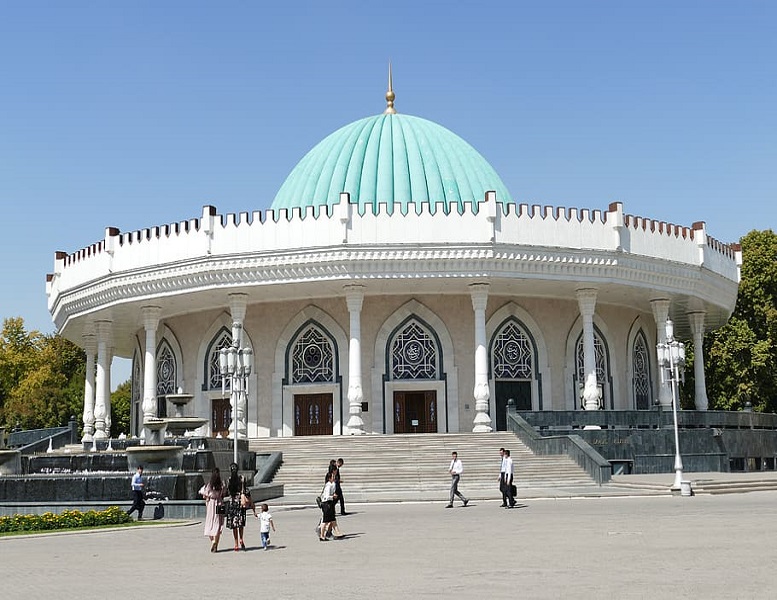
Photo by Kremlin, https://creativecommons.org/licenses/by/4.0/


[1] Anceschi, LUCA. 2009. Turkmenistan’s Foreign Policy. Positive Neutrality and the Consolidation of the Turkmen Regime. Abingdon: Routledge.

[2] On the relevance of Eurasianism for Kazakhstani foreign policy in the Tokayev era, see: Nargis Kassenova, The Elections and Kazakhstan’s Foreign Policy: Continuity but for How Long?, PONARS Blog Post, June 2019, http://www.ponarseurasia.org/article/elections-and-kazakhstan%E2%80%99s-foreign-policy-continuity-how-long\; Throughout the Nazarbaev era, Kazakhstan followed a foreign policy course that granted central relevance to Eurasia-related themes and constructs. In policy terms, the centrality of these themes translated into a consistently multilateralist inclination, which put a premium on inter-state association with partners located in post-Soviet Eurasia. On Kazakhstani neo-Eurasianism, see: Anceschi, Luca. 2020. Analysing Kazakhstan’s foreign policy: Regime neo-Eurasianism in the Nazarbaev years. London-New York: Routledge.

[3] For relevant overviews of Uzbek foreign policy in the Karimov era, see: Kazemi, Leila. 2003. Domestic Sources of Uzbekistan’s Foreign Policy, 1991 to the Present. Journal of International Affairs 56 (2): 205-216.

[4] Eldor Aripov, Uzbekistan Works to Reshape Central Asia, The Central Asia-Caucasus Analyst, November 2017, https://www.cacianalyst.org/publications/analytical-articles/item/13480-uzbekistan-works-to-reshape-central-asia.html; Luca Anceschi, The Resurgence of Central Asian Connectivity, The Diplomat, December 2017, https://thediplomat.com/2017/11/the-resurgence-of-central-asian-connectivity/; On Mirziyoyev’s coordinating role in the region during the Covid-19 pandemic, see: Bruce Pannier, Mirziyoev Steps Up As COVID-19 Crisis Increases Contact Among Central Asian Leaders, Radio Free Europe/Radio Liberty, April 2020, https://www.rferl.org/a/mirziyoev-steps-up-as-covid-19-crisis-increases-contact-among-central-asian-leaders/30523898.html

[5] The major reasons are the withdrawal of the US/NATO troops from Afghanistan, underway since 2014, and the implementation of a more isolationist US foreign policy since the accession to power of Donald J. Trump.

[6] For a wider discussion of this issue, see: Peyrouse, Sebastien. 2016. Discussing China: Sinophilia and sinophobia in Central Asia. Journal of Eurasian Studies 7 (1): 14-23.

[7] Paramonov, Vladimir, et al. 2009. Chinese Economic Express in the Center of Eurasia: The New Threat or Historical Chance? Barnaul: Altai Publishing House, www.ceasia.ru/pdf/book/book_chinese_express_2010.zip

[8] Vladimir Paramonov, China and Central Asia: Present and Future of Economic Relations, Conflict Studies Research Centre, May 2005, https://www.da.mod.uk/publications/category/69/China-Central-Asia-Present-Future-of-Economic-Relations0525E

[9] State Committee on Statistics of the Republic of Uzbekistan, Quarterly reports, 2020, https://www.stat.uz/ru/index.php?option=com_content&view=article&id=2780&catid=183&lang=ru-RU

[10] Malokhat Khusanova, Negotiations between the governments of Uzbekistan and China, UzA, November 2019, http://uza.uz/ru/society/peregovory-mezhdu-pravitelstvami-uzbekistana-i-kitaya–01-11-2019?sphrase_id=5735984

[11] Paramonov et al. Chinese Economic Express in the Center of Eurasia: The New Threat or Historical Chance?

[12] Khusanova, Negotiations between the governments of Uzbekistan and China; Authors’ estimate based on data included in: Vladimir Paramonov, Uzbekistan Initiative Papers No. 5, Central Asia Program, February 2014, http://centralasiaprogram.org/archives/7839.

[13] Press Service of the President of the Republic of Uzbekistan, Uzbekistan – China: A new stage of cooperation – a comprehensive strategic partnership, Ministry of Foreign Affairs of the Republic of Uzbekistan, June 2016, https://mfa.uz/ru/press/news/2016/06/7671/?print=Y; State Committee on Statistics of the Republic of Uzbekistan, Analysis of the demography of enterprises and organizations of the Republic of Uzbekistan, January 2020, https://stat.uz/ru/press-tsentr/novosti-komiteta/8241-2020-yil-1-yanvar-holatiga-yuridik-shaxs-bo-lgan-korxonalar-va-tashkilotlar-demografiyasi-bo-yicha-tahliliy-ma-lumot-2

[14] Commercial data revealed that Chinese imports from Uzbekistan decreased by 35 per cent across January-March 2020. See: Yau Tsz Yan, Chinese business briefing: Force majeure. Eurasianet, April 2020, https://eurasianet.org/chinese-business-briefing-force-majeure

[15] On Karimov’s foreign policy legacy, see: Teles Fazendeiro, Bernardo. (2017). Uzbekistan’s Defensive Self-Reliance: Karimov’s Foreign Policy Legacy. International Affairs 93 (2): 409–427.

[16] The statistical sketch that follows has been provided to the authors by the Embassy of the Republic of Uzbekistan to the United Kingdom.

[17] Rafael Sattarov, On the way to the oligarchy. Why is the new leadership of Uzbekistan moving closer to Usmanov, Carnegie Moscow Commentary, November 2017, https://carnegie.ru/commentary/74600\; In 2018 alone, trade and investments deals between the parties exceeded US$28 billion. See: Paul Stronski, Will Mirziyoyev’s Plodding Reforms Be Enough for Uzbekistan?, World Politics Review, January 2020, https://www.worldpoliticsreview.com/articles/28471/will-mirziyoyev-s-plodding-reforms-be-enough-for-uzbekistan

 [18]On Kazakhstan’s EaEU membership, see: Anceschi. Analysing Kazakhstan’s Foreign Policy. Regime neo-Eurasianism in the Nazarbaev Era. For a wider reflection on the dynamics regulating Kyrgyzstan’s accession to the EaEU, see: Dergousoff, Deborah. 2017. Kyrgyzstan’s Accession to the EEU: Why Do Apples Matter Anyway? World Review of Political Economy, 8 (2): 203-220.

[19] A first-class discussion of these issues is featured in: Fabrizio Vielmini, Uzbekistan and the Eurasian Economic Union: Pros and Cons, CPRO Policy Brief, March 2019, http://www.wiut.uz/images/FV_EAEU_PB03.pdf

[20] Sherzodkhon Kudrathodjaev, Uzbekistan Does Not Drift Among Great Powers, The Diplomat, June 2018, https://thediplomat.com/2018/06/uzbekistan-does-not-drift-among-great-powers/

Footnotes
    Related Articles

    Conclusion and recommendations: A road map for future reforms in Uzbekistan

    Article by Adam Hug

    Conclusion and recommendations: A road map for future reforms in Uzbekistan

    Spotlight on Uzbekistan has sought to examine the state of the reform process in the country across a wide range of areas, the perhaps unsurprising headline conclusion is that a lot has been done, and there is a lot still to do. The reform process is real, but so are the significant holes in it. To meet the aspirations set out in several of President Mirziyoyev’s proclamations a lot of work still needs to be done to create an open economy, pluralist politics and a free society, rather than the easier but less worthwhile transformation from Karmiov’s closed, autarkic authoritarian state to a sleek, shiny but oligarchic one. Mirziyoyev’s real end goal is still somewhat unclear- whether he intends only a limited authoritarian modernisation (as seen in neighbouring Kazakhstan where the limits of such a transition are now becoming ever more starkly exposed) or whether something more ambitious is planned, and whether that greater ambition extends to eventually becoming a fully functioning democracy and market economy.


    Since 2016 there has been appreciable economic progress for several sectors of society, a reduction in state interference in everyday life, and a notable increase in some freedoms, particularly for an emerging group of, predominantly Tashkent based, activists and experts who willing choose in some way to engage with the Government’s reform project. This has been genuine progress, which has garnered Uzbekistan much good will from the international community.


    However the lingering suspicion remains that, as Kristian Lasslett argues, while ‘modest accommodations have also been made to civil society by the Mirziyoyev government this appears to be driven more by reputational concerns that impact on investor/business confidence, rather than a conversion to liberal politics.’ Mirziyoyev’s desire to project a pro-business image, his connections to leading business people and nascent privatisation efforts have created new opportunities for politically connected individuals. He has also used this business elite influence to help solidify his power base against pressures from the old security elite. So how Uzbekistan addresses this emerging challenge will be critical to the overall success of the reform process. If the next few years merely see a reshuffling of political and economic power to new elites, under the cover of rhetoric about the reforms, it will create new structural problems and ultimately undermine how the ‘new’ Uzbekistan is seen around the world.


    Corruption, criminalising gay people and forced labour (despite real progress on the latter) are still major drags on Uzbekistan’s international image. The new freedoms, particularly in terms of freedom of speech have created a space for ‘constructive criticism’, where government delivery and the performance of officials and legislation can broadly be criticised. However, the ability of powerful figures to apply informal pressure or action in the civil courts remains and certain topics including harsh criticism of the President is still off limits. Under this approach of ‘managed freedom’ the Government may be more responsive but it is not accountable, other than to the limits imposed by public opinion in a country still slowly emerging from the heavy hand of Karimov.


    The response to recent crises, both the COVID-19 pandemic and the Sardoba Dam collapse, have highlighted the successes and failings of the new system. Decisive initial activity which helped control the virus spread and evacuate those displaced by the flood; a flurry of slightly disjointed regulatory and financial measures (though Uzbekistan is far from alone in this) were put in place that helped provide some economic stabilisation; extraordinary new powers (particularly on freedom of movement and assembly) have been used more responsibly than they would have been under Karimov but with still some abuse at the local level; a reticence to be open to past failings (in the case of Sardoba); and innovations such as the Sakhovat va Komak (‘Generosity and Assistance’) fund that have delivered important benefits to the worst affected by the crisis but have facilitated old habits around enforced or pressured participation in this national effort. In the difficult times ahead the Government will need to take further steps to make itself more accountable to the public and more effective in its operation to minimise the risk of social unrest as the country tries to put the economy back on track whilst absorbing large numbers of workers returning from Russia.


    Refining the Reforms

    When it comes to taking the reform process to the next stage the Presidential administration needs to try to stop acting like a shark who needs to keep pushing forwards in order to survive. The frenetic top down activity is not sustainable and its effectiveness is declining. Spending a bit more time getting legislation right the first time through early consultation with stakeholders will help reduce the need for clarifying decrees and further updates. More time for Parliament to scrutinise legislation and advise on Presidential decrees could be helpful for both institutions. There could also be a role for an independent committee, perhaps involving the new Civic Chamber, to review decrees, to help ensure they are aligned with international standards and do not contradict each other.


    Much has been written, both in this publication and elsewhere, about the need to improve the capacity in the Uzbek civil service and this will involve both culture and personnel changes. With some reforms lost in the long chain between Presidential Decree and implementation there is a need to change the internal incentive structures to allow greater space for risk taking, innovation and if necessary failure, to stop facilitating a culture of buck passing to avoid the wrath of the President that could grind down a new generation of officials. Instead there is a need to encourage them to find ways to implement change. As Yuliy Yusupov argues ‘Uzbekistan needs a fundamental administrative reform’ that will involve ‘the reconsideration and redistribution of the structure, tasks, functions and responsibilities of central authorities, as well as of administrative bodies at the sectoral level.’ There will need to be further steps taken, including the transparency initiatives set out below, to prevent officials being captured by sectoral special interests. Overstaffing and the ‘stamp culture’ need to be tackled to free up resources to be used more efficiently elsewhere in the public and private sector, including increasing resources for the social safety net that may become ever more critical when dealing with the COVID-19 aftermath.


    The need to improve recruitment has been identified by the Government as a strategic priority to expand administrative capacity. This should involve further steps to encourage recruitment based on merit rather than connections, improving salaries to encourage talent to join and to encourage the return of higher skilled professionals from the diaspora. Navbahor Imamova argues that in order to address the capacity gap ‘Uzbekistan needs a transparent, fair and professional recruitment system dedicated to hiring from abroad by establishing a central recruiting body, which should announce vacancies, act as a centralised clearing-house for applications, and provide a single point-of-contact for those seeking opportunities’. However, it is important that capacity constraints are not used as a universal excuse to cover times when political will is lacking or when the Government wishes to shield the President from criticism by blaming his officials.


    Kate Mallinson and Yuliy Yusupov have made a number of suggestions in their essays for furthering the reform of the wider economy that include strengthening ownership rights of land users to allow resale, sublease or borrowing against it and reviewing and implementing arbitration decisions in accordance with the United Nations (UN) Convention on the Recognition and Enforcement of Foreign Arbitral Awards. There remains the need to move away from protecting import monopolies owned by politically connected figures to developing a system of industrial support focused on more universally accessible tax incentives and other systems open to businesses irrespective of how well connected the owners are.


    Democracy and accountability

    If Uzbekistan is serious about making gradual moves towards democracy, or even achieving in its more limited short term goal of improving Parliamentary scrutiny, it will not be enough simply to loosen the regime’s control over the current parties and politicians. Uzbekistan will have to remove its prohibitive controls on new party formation (currently requiring signatures of 40,000 eligible voters with no more than eight per cent from one region) and allow independent candidates to stand.


    Creating a more open and competitive political environment is also necessary to make Mirziyoyev’s long promised but yet to be fully delivered reforms to local government effective. Direct elections of khokims could be transformative in improving local accountability and the performance of regional and local government but not if the process is merely rubberstamping the result of a rigged political decision made at the very top. If such local changes are not imminent, the President needs to be more assertive in removing rather than just berating government appointed local officials who are not meeting the needs of their residents.


    Local Kengeshs need to be supported both operationally (such as through internationally recognised scrutiny training) and more importantly politically (preventing reprisals if and when local representatives speak out) to be able to exercise meaningful scrutiny over the role of their khokims. Reforms of the planning system could include a requirement for Khokimiat to publically consult on masterplans and other decisions about proposed developments ahead of their adoption, and transferring the real power of decision making (rather than just ratifying the Khokim’s decision) on planning decisions to the Kengeshs where their final decisions could be made in public meetings so residents can both watch and have their say. Local khokims and Kengeshs must be more proactive in ensuring all legal procedures are followed when it comes to new developments in their local area, with a particular focus on preventing intimidation in the processes (notionally) in place to ensure resident consent for new buildings and in ensuring developers pay the compensation on time and in full. Matyakubova’s essay argues for revising the current decree to give stronger safeguards against forced evictions in line with international norms. Any revised legislation could include measures to safeguard payments to residents such as revised requirements for Khokimiat’s to publically certify that all residents had received the full legal compensation before construction is allowed to begin.


    National and local government should work together to develop a national heritage listing system for historic buildings to give greater protection against rapacious local developers. Particularly in the context of both the state’s ownership of land and the construction boom, more must be done to make developers contribute to the development of new social infrastructure in the new projects in partnership with the Khokimiat. If, as some fear, many of these new developments will contain a number of properties bought for investment purposes rather than permanent accommodation (or if post-pandemic they remain unsold) then further steps should be taken to simplify and professionalise the rental market. The recent reforms to the Propsika system have helped move things in the right direction but still leave too many people reliant on temporary registration.


    At all levels of government Uzbekistan could benefit from two things: more women and greater transparency. There is a clear need to appoint women to Cabinet posts and as regional khokims, while developing a clear pathway for women to move through the administrative structures, building on the recent comparative success in increasing women’s representation in Parliament. There is an urgent need for clear codes of conduct for politicians to declare any personal or financial links to schemes they are involved in approving or scrutinising, and transparency on if state funds are supporting businesses linked to elected officials. There is no explicable reason why the new disclosure requirements being proposed for Uzbek civil servants should not be applied to or adapted for use by holders of public office (particularly politicians and judges), so that they can be transparent about their external sources of income and relevant assets to restrict the scope for conflict of interest, and so that the public can know how their representatives are funded.


    Corruption and cotton

    Greater transparency for public officials needs to be combined with greater transparency in public procurement, with information about prospective and successful tenders made more openly in order to help make further inroads into tackling corruption. Systems have to change because at present it often seems that addressing individual instances of corruption or poor performance by Uzbek officials is correlated with the degree to which such problems create a public outcry, rather than directly based on the merits of the case. The recent increase in media freedom to address some forms of corruption and lower-level bureaucratic performance helps act as a pressure release valve, a mechanism through which issues that are causing widespread resentment at a local level can be raised to the leadership in Tashkent, and action can be taken to prevent such tensions building into pressure that could unsettle the wider political balance. Corruption is one of the biggest systemic risks the regime faces, particularly in these challenging times As Kristian Lasslett says ‘if a global recession is sparked, leading to serious downturn in Central Asia, the more predatory forms of racketeering observed in the Karimova case study may grow in appeal. If this coincides with diminished standards of living for the general population, these structural antagonisms could indeed provide the kindling for more radical forms of political challenge to the status quo’.


    Uzbekistan could also build international confidence in its wider commitment to tackling corruption by joining the Extractive Industries Transparency Initiative (EITI). It can and should also take further steps to make public the ownership information relating to all businesses (including their beneficial owners) in the Government’s new clusters, to assuage concerns that these structures are simply providing new opportunities for politically connected individuals to game the system for financial gain, and to help ensure that the power of the state is not being used at local level to assist them with their operations through forced labour. If not handled as a strategic priority corruption risks derailing the Uzbek reform process, which would vindicate critics who see the post-2016 period as merely being about providing new ways for the elite to enrich itself.


    Greater transparency over the management of clusters is essential in the context of completing and defending the gains made in tackling forced labour in the cotton sector. Pressure to lift the international boycott of Uzbek cotton had been growing in the wake of progress made in reducing forced labour but it has intensified further since the start of the pandemic. Arguments in favour of ending the boycott focus on the economic gains from opening international markets to being able to raise cotton picker wages and modernise the sector, thereby helping end the remaining forced labour more swiftly. While cotton campaigners worry, particularly in the context of unknown risks of the cluster model, that ending the boycott whilst more than 100,000 forced workers remain would remove the pressure to complete the job. The only realistic way out of this conundrum lies in a compromise that provides reassurance that future incidences of forced labour will be properly brought to light and addressed by the Government. This will require allowing local non-governmental organisations (NGOs), working in concert with international partners, to work freely to monitor the harvest and expose wrongdoing. The boycott needs to be brought to an end to secure the long-term survival of the sector and assist the Uzbek economy at this time of need, but to ensure international confidence this will at minimum require the registration of cotton monitoring NGOs and local independent trade unions, notably those of activists currently involved in monitoring for both the International Labour Organisation (ILO) and Cotton Campaign. Doing this would help build confidence in lowering the warning level on forced labour from red to amber, in the knowledge that if there is retrenchment, pressure on cotton exports could be renewed.[1] Putting the requisite political pressure on the Ministry of Justice to expedite these registrations should be a small price for the Government to pay to end this black mark on Uzbekistan’s reputation and protect the economy.


    Rights and freedoms

    Any measures to register cotton-monitoring NGOs must form part of a wider process of independent NGO registration in order to meaningfully develop civil society in Uzbekistan. The Ministry of Justice clearly has the ability to register independent NGOs, even with the laws that exist now, yet instead it pursues a policy of bureaucratic obstructionism to use minor form filling errors, both real and imaginary, to reject documents and stall processing indefinitely leading to a de facto bar on independent NGO registration. As set out above this could be resolved with the necessary political will and the Government needs to urgently make it happen. However, a revision process for the now delayed new NGO code could help move things further forward by removing spurious and burdensome reporting requirements, and the need for advanced approval for day-to-day activities; by lifting limits on international funding and other restrictions on contact with international organisations; by making government funding opportunities more transparent; and by producing guidance notes and example forms to help NGOs avoid wrangling over form filling.


    While NGOs are currently heavily restricted, journalists have experienced much greater freedoms, albeit within the boundaries of ‘constructive criticism’ discussed throughout the publication. Achieving true media freedom will require working to remove these boundaries, such as the regime needing to become more tolerant of direct criticism of the President and those close to him. That liberal regime figures talk about the evolution of the sector to achieve greater independence through greater professionalism still shows that they see their role as defining the terms of engagement in a way that seems incompatible with full media freedom. The bounds of fair comment by the media should instead be framed within the bounds of both robust public debate and fairer but functioning anti-defamation laws.[2] At present the proposed changes to the laws on ‘slander and insult’ that would remove the risk of prison have stalled, but the current draft would also see a substantial increase in the level of fines which, in an unreformed court system, could further add to the existing problem of aggrieved parties seeking to use the threat of financial ruin to silence criticism. One route to tackling the financial pressures on journalists investigating powerful forces would be, in the context of NGO liberalisation, allowing the development of donor funded investigative journalism such as Kloop in neighbouring Krygyzstan or the Organised Crime and Corruption Reporting Project internationally, adding to rather than replacing emerging journalistic initiatives in Uzbekistan.


    Reforming the courts is a key part of delivering progress on rule of law and it will be critical to underpinning real change across so many areas, from human rights to corruption, media freedom and Uzbekistan’s economic performance. Important steps to take include extending the new asset transparency requirements for civil servants to the judiciary while taking further steps to increase their official salaries and extend their term of office as part of measures to try to tackle both graft and institutional pressures on judges. Measures being taken to increase the number of independent lawyers (particularly registered advocates who can appear in court), including the expansion of legal education in Uzbek universities and improving the prestige of the profession, are very welcome and must sit alongside further steps to reduce the power of the Prosecutor General’s Office (PGO) in determining the outcome of the legal process and raising the chance of acquittal in court through fair trials.


    Further reform of the PGO needs to sit alongside continuing reform of the security services to end the continuing risk of arbitrary arrest and torture. As recent events show there is still work to do to fulfil the President’s promises on the eradication of torture and mistreatment of suspects, something which should see further pressure on the Government to allow independent monitoring of Uzbekistan’s prisons and other places of detention and to ratify the UN’s Optional Protocol to the Convention against Torture. The Government should also amend the vague and overbroad criminal code provisions relating to espionage and extremism that give too much leeway to the security services and are commonly used to criminalise dissent – particularly Articles 157, 159, 216, 244-1, and 244-2. As well as transforming the investigation of major crimes steps need to be taken to limit the routine abuse of administrative code punishments that lead to 15 day imprisonment for minor or invented infractions by activists. This should form part of a wider culture change (slowly underway but far from complete) to end the harassment of activists (including political activists, local bloggers or would be independent NGO activists) who fall outside the boundaries of ‘constructive criticism’. The Ombudsman’s office needs to continue its steps towards independence and receive the necessary funding required to investigate abuses, while avoiding it sometimes being overlooked in favour of the National Human Rights Centre’s more outward facing role.


    Removing the all-encompassing pressure of the Karimov presidency has helped people to start to address important questions around identity, belief and personal behaviour. It has provided opportunities for women to talk more openly about their desire for greater opportunities in the economy and public life, about the endemic culture of domestic abuse and to critique family structures that often subjugate younger women. At the same time there has been a slight loosening of restrictions on religious activity and many religious prisoners have been freed, though the authorities should make available a list of all persons currently serving sentences for extremism-related charges to help make clear the extent of recent changes. Expanding both freedoms in parallel creates certain challenges when rights may be seen to come into conflict and the process needs to be handled with care. For example, it is important that the Uzbek Government takes steps to end the restrictions on religious dress (which de facto creates a ban on the hijab and long beards) and to allow registration of independent religious organisations, while simultaneously taking steps to reassure women’s groups that action will be taken against rising social pressures against women choosing to wear jeans, shorts or skirts, which is as much – if not more – the product of traditionalist/nationalist sentiments being expressed openly on social media with issues of toxic masculinity as it is of growing religiosity. Uzbek leaders can also help by promoting a positive and open conception of Uzbek national identity and patriotism, potentially further revising ideas around the national concept of Manaviyat. Alongside creating a society where individuals are free to choose what they wear and think, all Uzbeks need the right to be able to openly and legally love who they love by ending the ban on male homosexuality that forces people into the shadows or exile and promotes the extortion of those at risk of arrest.


    Transitional justice

    As the Government of Uzbekistan becomes more self-confident about the progress of the reforms and the country’s place in the world, it needs to show a more self-confident approach towards discussing its own past. As Steve Swerdlow argues ‘President Mirziyoyev and the Uzbek government should acknowledge past abuses officially, provide concrete avenues for redress, and send a clear message that peaceful criticism of government policies and scrutiny of the past will be genuinely valued in Uzbekistan’. This has to be part of a national conversation involving those who suffered, human rights defenders, international experts and all relevant organs of the state. As Swerdlow suggests this should involve the creation of an inclusive national commission and a new law on Rehabilitation that builds on but goes further than Article 83 of Uzbekistan’s Criminal Procedure Code.


    Part of this historical reckoning should include the coming to a new accommodation with its critics in exile. There needs to be a pathway back for and reconciliation with human rights and political activists who left under Karimov. Allowing their safe return and softening the Government’s reactions to jabs from these activists, such as Nadejda Atayeva who in this collection gives a more critical assessment of the current situation than the other authors, would be a clear sign that the Government is in the reform process for the long haul. This in turn might help mollify some of the understandable cynicism about the state of the reform process by exile groups who have been persecuted for years by the Government of Uzbekistan. In turn, those who have so far been rejected by the new system may come to view some of the changes more positively, knowing that not everything is a fraud. The internal logic of a reform process that accepts Uzbekistan needs urgent and radical change implies that those who raised concerns about how it was before had a point and they should not be beyond the political pale today. The government’s current focus on supporting new independent journalists, state backed civil society initiatives and possibly in time more independent political figures and NGOs to grow organically in the ‘new’ Uzbekistan may have a forward looking dimension, but it creates the clear risk (both real and perceived) that they lack the freedom to fully hold the Government to account on all issues.


    Uzbekistan and the world

    How Uzbekistan relates to the outside world has been one of the biggest changes under Mirziyoyev, with the country becoming an active player in Central Asia while working to improve relationships with the main regional players (Russia and China) as well as engaging with the West. As a strategic approach it makes sense, replacing an approach under Karimov which alternated between a prickly multi-vector approach to ward off Russia and a no-vector approach of isolationism, with a more proactive, outward-looking but balanced policy. The debate about the Eurasian Economic Union (EAEU) clearly has a geo-political dimension (for Russia it remains primarily a political project), but the decision over Uzbek membership needs to be driven by whether it delivers real economic benefits for Uzbekistan in terms of its trade within Central Asia and its economic relationships with Russia (a calculus that may have changed if the reduction of migrant work remains supressed into the long-term post-pandemic). The parallel push for World Trade Organisation (WTO) membership should not meaningfully interfere with decision making on the EAEU (given that all but Belarus are also WTO members) and will help diversify Uzbekistan’s options. Western partners such the European Union, United States and United Kingdom (UK) can have an important part to play in engaging with Uzbekistan, providing partnerships than can help potentially balance (though not replace) Uzbekistan’s need to work with Russia and China. Years of diminishing regional engagement have reduced the West’s leverage but some remains and it needs to be focused on supporting Uzbekistan to keep moving forward on its reforms rather than retrenching. This does involve the scaling up of both technical and financial assistance, while ensuring that international partners and institutions on the ground retain the capacity to criticise when and where things are going wrong as well as championing what is being done right. Western jurisdictions need to take further action to prevent their financial systems being used to shelter illicit Uzbek wealth. In the UK for example this needs to involve prosecuting mysterious companies which submit false or improper filings, reforming the rules around ‘Scottish Limited Partnerships’ and applying further pressure for the transparency in the Crown dependencies.


    Regarding the important emerging partnerships in the education sector, if Western institutions and organisations are putting their names to campuses, courses and curriculums they need to play an active role in ensuring that student and academics working in those systems have greater academic freedom than would be possible in the wider Uzbek system. This is particularly relevant in higher education, and if the situation on Uzbek campuses does not move closer to achieving standards comparable with their own institutions they should rethink the partnerships.


    The international community faces a tricky balancing act, rewarding reformers for their efforts and ensuring these partners have the political capital within the Government to keep moving forwards, while not ignoring or excusing the considerable problems the country still faces. A clear test of this balancing act is the how to respond to Uzbekistan’s candidacy for the UN Human Rights Council and its bid for the Asian Games. A few years ago, the recommendation from independent observers would have been simple, it would not have been appropriate for Uzbekistan to get these honours. Now, in the context of ‘a lot done, a lot still to do’ finding an answer is more challenging. A potential solution would be making support for Uzbekistan’s membership of the Human Rights Council and hosting the games conditional on a human rights health check by international partners (both NGOs, institutions and international partner governments), and further action by the Uzbek Government on issues raised in this publication including NGO registration and torture in order for the international community to be able to give the green light.


    Recommendations


    Based on the findings of the research in this publication and the details set out in the conclusion above, in order to help Uzbekistan continue to fulfil the promise of recent reforms and address the outstanding problems there are a number of recommendations for action by the Government of Uzbekistan and the international community.


    The Government of Uzbekistan should seek to:

    • Continue reforming the civil service to improve structures and capacity while being more measured and consultative when creating new legislation and decrees.
    • Develop a more competitive political environment in Uzbekistan by removing restrictions on registering new parties and allowing independent candidates to stand for election.
    • Reform local government by requiring the direct elections of Khokims, with greater public consultation about developments and giving Kengeshs real power to decide on planning decisions. Empower it to take action on compensation and forced evictions, to ensure developers contribute to social infrastructure and help protect historic buildings.
    • Require transparency for all holders of public office including politicians and judges with declarations of external sources of income and assets, while making public the ownership details of firms involved in the new ‘clusters’.
    • Move beyond ‘constructive criticism’ to true freedom of expression and association by delivering new anti-defamation laws without the threat of prison or massive fines, allowing independent NGOs to register and helping them do so.
    • Help facilitate the end of the boycott of Uzbek cotton by urgently registering cotton monitoring NGOs and independent trade unions.
    • Continue the reform of the Prosecutor General’s Office and security services to prevent the harassment of activists and political opponents.
    • Deliver transitional justice and greater openness about the Karimov legacy helping the rehabilitation of victims of past abuse.
    • Continue to expand both religious and social freedoms that prioritise individual choice over community pressure, with more women in senior government positions, action on domestic violence, ending laws against the LGBTQ community and stopping the pressure on independent religious groups.


    International institutions and Governments should seek to:

    • Continue their engagement with the Government of Uzbekistan whilst ensuring they remain open to criticism and pressure where necessary as well as praising successes.
    • Support an international human rights health check ahead of decisions to elect Uzbekistan to the UN Human Rights Council or award it the right to host the 2027 Asian Games.


    [1] If the garment industry were to end the Pledge on Uzbek cotton, reinstating it in the event of renewed forced labour would be challenging as supply lines would have been re-established. However, some of this will need to be mitigated by explicit commitments from major garment companies of their continuing opposition to the practice being sought and triggered in the event of relapse.

    [2] And for broadcast television within the bounds of internationally recognised regulations that give greater scope for public debate.

    Footnotes
      Related Articles

      If Labour wants to put human rights at the heart of its foreign policy, it needs to talk more about Putin’s Russia

      Article by Lana Estemirova

      May 29, 2020

      If Labour wants to put human rights at the heart of its foreign policy, it needs to talk more about Putin’s Russia

      On April 4th 2020 Keir Starmer was voted in as new leader of the Labour Party by a considerable margin against his rivals. One of his key campaign pledges was a promise to put human rights at the heart of his foreign policy, calling for a return to what he called an ‘ethical foreign policy’ in line with the commitments expressed in Labour’s 2019 manifesto. [1] This is a laudable aim, but if the Labour Party is committed to pursuing ethical foreign policy, it must be more pro-active in exposing Putin’s regime – in contrast to his predecessor’s leadership. Russia has long meddled with British politics, whether it is oligarchs laundering dirty money though the City of London or assassins operating on British soil. Since human rights based foreign policy occupies such an important space in Labour’s commitments, it must ensure it is vocal in holding to account countries that abuse them. Labour will be out of power until at least 2024 and as Boris Johnson’s Conservative Party appears unlikely to seriously scrutinize Putin’s Russia, given the circumstances surrounding its refusal to publicise the infamous Russia report, Labour MPs and shadow cabinet ministers must step in.


      With Labour’s emphasis on the NHS and the Green New Deal during the 2019 election campaign in a vain attempt to move the national conversation away from Brexit – scrutiny of Labour’s foreign policy, other than on this central issue – was largely obscured. Within the 2019 Labour Manifesto, under the moniker of ‘New Internationalism’ Labour listed policy proposals to place human rights and international humanitarian law at the centre of decision making as part of an ‘ethical foreign policy.’ This included the deployment of human rights advisors to work alongside the Foreign Office. In a bid to place a curb on foreign adventurism, a key plank of the policy platform Corbyn had stood on, a War Powers Act was promised – alongside full implementation of every recommendation made by the Chilcot enquiry into the Iraq war[2].


      In step with the political currents from which Corbyn hailed, the policy proposals contained within the document presented a serious attempt to get to grips with Britain’s colonial legacy and re-orientate its role in foreign affairs away from the interventionism[3] (overt or otherwise) for which it is condemned by a broad swathe of the Labour left – for whom a long litany of involvement in CIA-backed coups in the Middle East, alongside more recent examples in Iraq and Libya are key points of contention. For the demographic that backed him within the Labour Party, condemning and ending complicity in these sorts of affairs is a long-desired policy outcome.


      While from Corbyn’s team and the broader left movement there was a strong critique of the Western Imperialism perpetuated by Britain and its allies – as well as the West’s willingness to support despotic regimes where it suited their interests; this level of critique was found wanting when it came to scrutinising the actions of other imperial powers – of which Russia is a crucial example.


      Much of Corbyn’s political career has been spent immersed in struggles against foreign adventurism, which is why he faced difficult questions on his links to Hezbollah and other groups[4]. Similarly, his opposition to what the left deems to be Western Imperialism has in the past led him to call for the abolition of NATO. Opponents cited his willingness to criticise Britain and her allies as proof that he could not be trusted to act in Britain’s interests[5] – and his handling of the Skripal poisoning only served to reinforce this perception.


      In March 2018, Corbyn drew criticism from across the British political spectrum over his response to the poisoning of Sergei Skripal, and his daughter Yulia. Despite evidence clearly indicating Russian involvement, including the fact that the Novichok nerve agent used had been manufactured in the country, the Labour leader called for the evidence to be examined carefully in order to avoid “hasty judgements that could lead to a new cold war”[6]. In one interview, he even suggested the poison sample be sent to Russia for its own examination. Even if Corbyn was acting with best intentions in an attempt to portray himself as statesmanlike and level-headed, this was obscured by poor communication, with his response perceived as weak and sympathetic to Kremlin.


      Corbyn’s caution would perhaps have been more justified had there not been a trail of assassinations left by the Kremlin on the British soil; the most notorious case being the murder of the former FSB officer turned regime critic Alexander Litvinenko, who was poisoned by radioactive polonium-210 on 1 November 2006[7]. Chechen strongman Ramzan Kadyrov’s operatives have also been linked to numerous high-profile assassinations across Europe[8]. In such a context, Corbyn’s comments made him appear naïve on foreign policy – and weak in the face of an opponent who had famously called the collapse of the USSR ‘the greatest geopolitical catastrophe of the 20th century’ and made the overriding goal of his presidency the preservation of Russian territorial integrity and spheres of influence, along with the revival of its superpower status.


      Ironically – Corbyn had been one of the first in the United Kingdom to condemn Putin for his bloody mindedness and appetite for repression. The start of Putin’s presidency was characterised by the launch of a bloody campaign of the restive breakaway republic of Chechnya, which had humiliated Russia during the first Chechen war 1994-96 when Russian President Yeltsin invaded after it declared independence from the Russian Federation. After the start of the second war in 1999, the capital, Grozny, was carpet bombed and virtually destroyed in a display of overwhelming firepower and disregard for civilian life which has since been replicated in the Russian intervention in Syria. Human rights abuses were extreme and atrocities against civilians commonplace, drawing heavy international criticism – including from a certain backbench Labour MP, Jeremy Corbyn.


      Corbyn criticised Tony Blair in 2000 for flying to meet Putin in St. Petersburg, stating:

      “When Tony Blair went to St Petersburg recently … that was certainly used [by Moscow] to indicate there was a sort of tacit approval of what the Russian government was doing in Chechnya… We have to say bluntly to Russia, you’ve signed up for all these international conventions, you have to abide by them, you have to stand by them otherwise we’re not going to do business with you.”[9]


      At a time when many Western leaders still perceived Putin as a potential partner and liberaliser, Corbyn questioned whether Britain had raised sufficient concern over bombings in Chechnya and whether Western intergovernmental organizations were doing enough to advance peaceful solutions to the conflict[10]. It is this which made Corbyn’s silence on Putin’s Russia throughout his leadership all the more questionable – and one wonders why a similar position was not advocated during his tenure as Labour leader.


      Today, Chechnya is a tightly controlled dictatorship run at Putin’s behest by the strongman Ramzan Kadyrov. Kadyrov presides over a reign of terror in Chechnya – with critics humiliated and silenced over the slightest infraction. A spate of assassinations, beatings and consistent harassment has driven all human rights organisations from the region, while abuses have continued unabated since the end of the second Chechen war. Kadyrov is permitted a free reign in Chechnya in exchange for so-called stability and support for Putin’s rule. The centuries-long anti-colonial resistance of a small nation has now been altogether crushed.  As the leader of a movement founded on international solidarity, anti-imperialism, human rights and ethical foreign policy, not including Russia’s position on Chechnya in its critique of international affairs was a glaring omission.


      After Chechnya Putin continued to aggressively police what he perceived as Russian interests along its periphery. As his grip on power strengthened, the pillars of his new Russia were set, in his narrative, to be autocracy, orthodoxy and militant patriotism. Putin viewed the ‘colour’ revolutions which swept through the former Soviet Union removing clientilist networks and replacing them with new Governments less sympathetic to his regime (in the case of Georgia and Ukraine) with extreme hostility and alarm.[11] The efforts to remove corrupt authoritarian governments and shift towards greater democracy and transparency alongside an orientation towards the West is seen by Putin as an attempt to encircle Russia by NATO in an ongoing campaign that had persisted since the fall of the USSR. In this vein, the 2008 invasion of Georgia after the overconfident Mikhail Saakashvili, armed with American weaponry and courting NATO, made the mistake of provoking Russia[12] – was a prelude to Putin’s actions to annex the Crimea and then invade Eastern Ukraine after it had the temerity to sign a trade deal with the EU over that proffered by the Kremlin.


      Fearing that he might also someday be subject to his own colour revolution – a view reinforced by the 2012 protest movement that shook his regime, Putin set about clamping down on freedoms and dismantling human rights organisations and NGOs within Russia under the notorious ‘foreign agents’ laws before turning his eyes on the West[13] – whose presence he saw lurking behind the populations of the Eastern Bloc’s greater demand for more freedom, transparency and economic justice. Having learnt that control over information flows within Russia was central to maintaining his power – he initiated a disinformation campaign abroad: powered by networks of troll factories on social media platforms, and the flagship Russia Today news channel on all the major European satellite networks. [14]


      In the aftermath of Brexit and Trump – alarm from what was considered by many on the left as the ‘centrist-neoliberal establishment’ about Russian interference was dismissed as an attempt to excuse their own failings and the intellectual exhaustion of neoliberal ideology by pointing the finger at the old enemy: a revived ‘red menace’ in the form of Putin. In avoiding this new feature of the political landscape post-2016, Jeremy Corbyn’s Labour Party made a strategic error. The very fact that a hostile state power could so easily disseminate disinformation and sow discord within British territory and interfere with its most sacrosanct democratic ritual could have been leveraged as evidence of the failings of the free-market orthodoxy they were criticising. In this instance, anybody with sufficient funds was permitted access to Facebook’s and the other social media platforms’ advertising algorithms – which could then be manipulated to try and produce outcomes perceived as advantageous to the Russian state. Once again, Labour could have wrapped its economic critique within the broader context of national security and sovereignty: Putin believes everyone has a price – and so far, he has not been proven wrong.


      This brings us neatly to Russian influence in UK affairs through the constellation of oligarchs with links to the Kremlin that mingle with the highest circles of power in Britain. This is a relationship which permeates to the extent that the day after his landslide 2019 election victory Boris Johnson and his partner Carrie Symonds dropped into a caviar-fuelled Christmas Party in London hosted by former KGB agent Alexander Lebedev[15]. It was revealed that Russian nationals had donated about £3.5 million since 2010[16] fuelling speculation that this is the motivation behind the government’s continued refusal to publicise the ‘Russian Report’ into Kremlin meddling in British affairs. British intelligence agencies have been known for some time to be concerned about the penetration of Russian organised crime in London and its murky and hybrid links to the Kremlin.


      Despite the surface hostility and diplomatic exchange of censures over the Skripal affair, the UK and Russia are intimately connected. The Russian rich provide funds and investment and in return the UK offers them a luxurious existence, accompanied by elite law firms they can hire to ensure that the British justice system work in their favour[17]. This relationship was called out by shadow chancellor John McDonnell in the aftermath of the Skripal poisioning[18] – who called for Labour MPs to stop making appearances on Russia Today. But as identified above, weak messaging from the outset saw Labour lose control of the narrative and this critique did not form a consistent plank of its criticisms against the Conservative Government.


      Corbyn was frequently accused of being soft on Russia because many in his leadership team were portrayed as former USSR sympathisers or seen as accepting of the Kremlin’s narrative. Many on the left dismissed this as another example of the smears used to discredit their leader, but in the context of Labour’s continued failure to engage substantively with the Russia question, it does warrant further examination – and raises some troubling links.


      In the context of resistance to what they characterised as Western Imperialism, there were some on the left in Britain who bought into Putin’s story about Russian resistance to an unfair unipolar order. In his 2015 article for the Guardian, Seamus Milne – who later became Jeremy Corbyn’s director of strategy – justified Russian aggression in Ukraine and the annexation of Crimea by arguing that NATO’s expansion in elsewhere in Eastern Europe had left Putin little choice but to intervene[19]. He made no mention of the Crimean Tatars, many of whom were expelled from their homeland for the second time in living memory (the first being under Stalin’s deportations.) Writing about the victims of non-Western aggression did not appear to fit into Milne’s narrative. A year earlier he had shared a stage with Russian president Vladimir Putin as he made a speech at the notorious pro-Kremlin Valdai discussion club. His views and affiliations might have been acceptable for an independent journalist but his later proximity to the leader of the opposition may leave one wondering what kind of advice he was giving regarding Russia.


      In the aftermath of Russia-Ukraine conflict, one of Corbyn’s closest advisors, Andrew Murray, founded a “Solidarity with Antifascist Resistance in Ukraine” group: “A new campaign in the UK against Western backing for the far-right regime in Kiev and in solidarity with those resisting fascist repression in Ukraine”. A quick browse of their Facebook reveals a screening of a documentary ‘MH17: Call for Justice’- ‘The first detailed documentary to challenge the Dutch-NATO version of events about the tragedy’. Directed by an ex Russia Today journalist Yana Erlashova, the documentary makes crude speculations about the MH-17 disaster and overinflated stories about ‘Fascist’ pro-Ukraine squads is the exact rhetoric deployed by Russian state channels, including Russia Today.[20] By choosing to view Russia’s geopolitical gambles solely through the prism of Western imperialism and suspicion for its motives, these key Labour advisors paid little regard to the victims of Putin’s political decisions. They also left themselves susceptible to the outputs of the Kremlin’s disinformation campaign.


      Missing an open goal

      Labour – pursuing a supposedly radical and humanist agenda with its foreign policy – missed out on a crucial opportunity to reiterate their economic message within the context of the controversy caused by the Conservative Party’s cosy relationship with Russia’s oligarchic class and the threat to British national interests that represents. In seeking to promote a human-rights based foreign policy, they failed to pay attention to abuses committed by states outside of Western spheres of influence. Yet human rights are universal in their claims – and any party seeking to act in their name must ensure the universal application of their principles regardless of where they fall across the fault lines of geopolitical boundaries. Advocacy and condemnation of abuses, even where more substantive support is not available is meaningful to victims – holding out the promise of justice and the reassurance that their suffering is seen and acknowledged.


      The same issues regarding Russia that Corbyn faced remain substantively the same, while the political opportunity against the Conservative party, in whatever context it is used, remains unchanged. The appointment of Lisa Nandy as shadow foreign secretary was taken as a surprise in some quarters – yet past remarks provide encouraging reading for those that would want to see the Labour Party adopt a clearer, more definitive approach towards Putin’s regime:

      “We stood with the Russian government, and not with the people it oppresses, who suffer poverty and discrimination. We failed the test of solidarity.”[21]


      Condemning an oppressive regime while demonstrating compassion and solidarity with its citizens does not equate to demonization of its people – nor does it simply provide a scapegoat for our own failings. Labour has a chance to occupy the moral high ground on this issue, let us hope that it can take it.


      At a time when anxiety is high in the West over Putin’s expansionist ambitions and evidently malign intent, Labour could weave a critique of Putin’s repressive mafia state and support for the dictatorship of Ramzan Kadyrov in Chechnya into a powerful narrative. Labour could make an argument that the Conservative’s pursuit of and comfort with excessive wealth left Britain compromised to outside interference: a narrative that would be consistent with Labour’s ambition under Starmer to be seen as more visibly patriotic and strong on defence. The Conservatives have continued to refuse to publish the Intelligence and Security Committee of Parliament Russia report that was so controversial during the 2019 campaign, leaving fertile ground for this kind of claim.[22]


      The Covid-19 pandemic will undoubtedly shape Russian domestic affairs and geopolitical dynamics, with the IMF predicting a global recession worse than the Great Depression. Putin’s plans to vote for amendment on constitution that would allow him to stay in power until 2036 have been stalled by the crisis, as was the Victory Day parade on 9th of May – an event intended to symbolically cement the constitutional changes[23]. Much remains uncertain about the future of Russia but with mercenary regiments deployed in Africa and Syria and intermittent talks over integrating Belarus into Russian territory, it is highly unlikely that Putin will abandon his geopolitical ambitions.


      If Starmer wants to lead on the global stage he needs to have a cognizant appraisal and strategy for dealing with a regime actively waging hybrid warfare against Britain and her allies and taking increasingly bold and dangerous steps on the world stage. A situation that will undoubtedly be exacerbated by Putin’s sense of anxiety at home over his disastrous handling of the coronavirus pandemic – the annexation of Crimea was also perpetuated against a background of declining domestic support. This is not to advocate a return to the ‘great game’ of European competition but to stress the point that any leader looking to champion human rights and democracy on the world stage will need to have a strategy and appreciation for those illiberal forces that will oppose him.


      Photo by Rwendland Keir Starmer speaking at the 2020 Labour Party leadership election hustings in Bristol on the morning of Saturday 1 February 2020, in the Ashton Gate Stadium Lansdown Stand. Licensed under Creative Commons

      [1] Keir Starmer, Leadership Campaign Website, https://keirstarmer.com/plans/10-pledges/

      [2] Labour Party 2019 Manifesto, It’s time for a real change- Labour’s manifesto 2019

      [3] ibid

      [4] Rajeev Syal, Jeremy Corbyn says he regrets calling Hamas and Hezbollah ‘friends’, The Guardian, July 2016, https://www.theguardian.com/politics/2016/jul/04/jeremy-corbyn-says-he-regrets-calling-hamas-and-hezbollah-friends

      [5] DW, UK election: What would Jeremy Corbyn’s foreign policy look like?, December 2019, https://www.dw.com/en/uk-election-what-would-jeremy-corbyns-foreign-policy-look-like/a-51211613

      [6] BBC News, Jeremy Corbyn: Salisbury attack ‘evidence points towards Russia’, March 2018, https://www.bbc.co.uk/news/uk-politics-43414185

      [7] Luke Harding, Alexander Litvinenko: the man who solved his own murder, The Guardian, January 2016, https://www.theguardian.com/world/2016/jan/19/alexander-litvinenko-the-man-who-solved-his-own-murder

      [8]Shaun Walker, The Guardian, September 2019, ‘We can find you anywhere’: the Chechen death squads stalking Europe, https://www.theguardian.com/world/2019/sep/21/chechnya-death-squads-europe-ramzan-kadyrov

      [9] Putin visit hit by war atrocities law suit, April 2020, Kim Sengupta, https://www.independent.co.uk/news/world/europe/putin-visit-hit-by-war-atrocities-law-suit-279869.html

      [10] Jeremy Corbyn, Written Question: Chechnya, January 2000, https://publications.parliament.uk/pa/cm199900/cmhansrd/vo000117/text/00117w20.htm#00117w20.html_sbhd3

      [11] In a post-Soviet context it particularly refers to the 2003 Rose Revolution in Georgia, 2004 Orange Revolution in Ukraine and the 2005 Tulip Revolution in Kyrgyzstan

      [12] Through the killing of Russian military personnel stationed in South Ossetia as part Georgia’s attempt to retake the region, a military operation that followed months of escalating tensions between Russia and Georgia and increased border violence between Georgian and South Ossetian forces (Russian provides support to the defecto authorities in South Ossetia)

      [13] BBC News, Russia to label individuals as ‘foreign agents’ under new law, December 2019, https://www.bbc.co.uk/news/world-europe-50643705

      [14] BBC News, Powerful ‘Putin’s chef’ Prigozhin cooks up murky deals, November 2019, https://www.bbc.co.uk/news/world-europe-50264747

      [15] Luke Harding and Dan Sabbagh, Johnson visit to Lebedev party after victory odd move for ‘people’s PM’, The Guardian, December 2019, https://www.theguardian.com/politics/2019/dec/22/johnson-visit-to-lebedev-party-after-victory-odd-move-for-peoples-pm

      [16] Seth Thévoz and Peter Geoghegan, Revealed: Russian donors have stepped up Tory funding, Open Democracy, November 2019, https://www.opendemocracy.net/en/dark-money-investigations/revealed-russian-donors-have-stepped-tory-funding/

      [17] Belton, C 2020, Putin’s People: How the KGB Took Back Russia and Then Took on the West, HarperCollins publishers

      [18] BBC News, Spy poisoning: Putin responsible for attack, says John McDonnell, March 2018, https://www.bbc.co.uk/news/uk-politics-43448563

      [19]Seumas Milne, The demonisation of Russia risks paving the way for war, The Guardian, March 2015, https://www.theguardian.com/commentisfree/2015/mar/04/demonisation-russia-risks-paving-way-for-war

      [20] The rise of far-right groups in Ukraine is a real problem but one that has both been exaggerated in Kremlin propaganda and has been exacerbated by the ongoing war with Russia.

      [21]Andrew Sparrow, Labour leadership contest: We failed on Russia under Corbyn’s leadership, says Nandy, The Guardian, January 2020, https://www.theguardian.com/politics/live/2020/jan/15/pmqs-boris-johnson-corbyn-labour-trump-praises-boris-johnson-for-suggesting-us-should-draft-new-iran-deal-live-news

      [22] Intelligence and Security Committee of Parliament Russia Report, http://isc.independent.gov.uk/news-archive/17october2019

      [23]Matthew Luxmoore, ‘It All Depends On The Body Count’: Pandemic Threatens Putin’s Spring Of Political Pageantry, April 2020, https://www.rferl.org/a/russia-victory-day-coronavirus-putin-pandemic-political-pageantry/30546645.html

      Footnotes
        Related Articles

        The curious case of the Republic of Karakalpakstan

        Article by Francisco Olmos

        May 28, 2020

        The curious case of the Republic of Karakalpakstan

        The fall of the Soviet Union led to the emergence of the Central Asian republics of Kazakhstan, Kyrgyzstan, Tajikistan, Turkmenistan and Uzbekistan. They all had been Socialist Soviet Republics (SSR) established as territories for the nominal nationalities reflected in their names. The diversity of their populations varied among them, but ethnic minorities were present in all of them. In general terms, these minorities could be divided into two groups: those with nominal states elsewhere (such as Russians Ukrainians, Azeris and Armenians) and those with no state where they represented a majority (such as Uyghurs and Dungans). There was however an exception to these. The Karakalpaks and their own republic within Uzbekistan’s borders.


        The Karakalpaks are the Central Asian minority, present in the region prior to the Russian conquest, with the greatest political representation and autonomy, at least de jure. They are a Turkic ethnic group that after roaming on the Central Asian steppe seem to have finally settled around the 18th century south of the Aral Sea. This took place at a time when national identities had not developed and were alien to the region. Linguistically, they are closer to Kazakhs than Uzbeks, given the Karakalpak language belongs to the Kipchak branch of the Turkic family, as Kazakh does, while Uzbek belongs to the Karluk branch.


        The number of Karakalpaks is uncertain. In Uzbekistan, home to the Republic of Karakalpakstan, figures range from 708,800 to 1.2 million, while in neighbouring Kazakhstan, a destination for Karakalpak migrants, the official figure from the Kazakh authorities is 2,800 although estimates put the figure close to 300,000.[1] However, what it is clearer is the demographic weight of Karakalpakstan within Uzbekistan. Although the Karakalpak republic accounts for roughly a third of Uzbekistan’s territory, its inhabitants represent around 5% of the country’s population. Despite its size, Karakalpakstan is mostly desert, surrounded by the dried-up Aral Sea to the north and the Karakum and Kyzylkum deserts to the south and east respectively.


        A sovereign state in name only

        Contrary to other ethnic minorities, Karakalpaks play a role as a political entity. Karakalpakstan as it is known presently emerged in the early Soviet years when the Karakalpaks were considered a nationality and therefore the Karakalpak Autonomous Oblast was established in 1925 within the Kazakh Autonomous Socialist Soviet Republic (ASSR). In 1932 itself Karakalpakstan was promoted to ASSR and in 1936 became part of the Uzbek Socialist Soviet Republic (SSR). While other ASSRs like the Kyrgyz and Tajik would eventually evolve to full SSRs, in 1936 and 1929 respectively, Karakalpakstan remained in the lower echelon and ended up being the only autonomous republic in Soviet Central Asia.


        The fall of the USSR, which led to a number of breakaway movements throughout its former territory, did also bring independence, de jure but not de facto, to Karakalpakstan as in 1990 its parliament adopted a declaration of state sovereignty. However, this was short-lived and in 1993 it was officially reincorporated to Uzbekistan. In return, the Uzbek authorities allowed for a referendum on independence to take place 20 years later. The right for independence is recognised in Article 1 of Karakalpakstan’s Constitution that reads: “Karakalpakstan is a sovereign democratic republic that is part of the Republic of Uzbekistan. […] The Republic of Karakalpakstan has the right to secede from the Republic of Uzbekistan on the basis of a nation-wide referendum held by the people of Karakalpakstan.”[2] However, such a referendum has not taken place.


        The Republic of Karakalpakstan, as it is currently known, has the national symbols of a sovereign state. This includes a flag (that is very similar to its Uzbek counterpart), a state emblem and an anthem. In terms of political administration, the city of Nukus is its capital, a role it has had since the 1930s when it took over from Turtkul. Like any other nation, Karakalpakstan’s legal framework is regulated by a constitution, mentioned above, with legislative, executive and judicial powers. Karakalpakstan’s Constitution was adopted in 1993 and it acts, at least theoretically, as its legal basis. Through 120 articles divided up in 26 chapters, the Constitution states the basic principles of the Republic, the rights, freedoms and duties of its citizens as well as its administrative, political and judicial organisation.[3] However, as it is common in authoritarian states, laws can be flexible, not always enforced and they can play a mere decorative role.


        The Republic of Karakalpakstan’s legislative power is represented by the Jokargi Kenes, a 65-seat chamber whose representatives are elected every five years, at the same time as Uzbekistan’s lower chamber. Consequently, elections for the Jokargi Kenes last took place in December 2019. In Karakalpakstan, as in the rest of Uzbekistan, the Uzbek President’s party won the elections but the other four performed differently.[4] The same five parties are represented both in Tashkent and Nukus. Karakalpakstan does not have unique political organisations.


        The responsibilities of Karakalpakstan’s legislative chamber are outlined in 19 sections within Article 70 of the Constitution and they include the passing of laws, the appointment of judges and the exercise parliamentary control. One of their duties is to elect the Chairman of the Jokargi Kenes, who is the republic’s leader and highest official.


        The executive power is exercised by 12 ministries (Economy, Finance, Preschool Education, Public Education, Internal Affairs, Labour, Health, Justice, Agriculture, Culture, Physical Culture and Housing), all lead by the Chairman of the Council of Ministers.[5] The latter, effectively acting like a Prime Minister, who also forms part of the cabinet of ministers of Uzbekistan, is chosen by the Chairman of the Jokargi Kenes, an appointment that has to be approved by the President of Uzbekistan.


        In regards to the judicial power, Karakalpakstan has two supreme courts, for civil and criminal cases respectively, as well as a dedicated economic court. Its Prosecutor General is elected by the Jokargi Kenes “in agreement with the Prosecutor General of the Republic of Uzbekistan.”[6] As it happens with the executive power, Tashkent has the last word over the appointments of senior judicial members.  In appearance, Karakalpakstan has the making of a true autonomous political body with its own laws, parliament, government and judges, but in reality it can be considered as a state in name only. Its Jokargi Kenes is a rubber-stamping body that approves the proposals and laws adopted by the Uzbek legislators back in Tashkent, while its Chairman of the Council of Ministers and Prosecutor General are effectively appointed by the Uzbek President. Besides cultural policies related to the Karakalpak language or localised issues, there is no room for manoeuvring. Despite the political, legislative and legal façade of autonomy, the Republic of Karakalpakstan acts in reality like another region within Uzbekistan.


        Even though their political role is very limited in Uzbekistan, culturally the Karakalpaks have their rights mostly respected. As per Karakalpakstan’s Constitution, the Karakalpak language has equal status to Uzbek and it is taught in schools and higher education institutions. The local government is mostly bilingual as well as the media.[7] Despite this, Uzbek and, to a lesser extent, Russian play an important role in the region as they are languages that have a stronger presence in Uzbekistan as a whole. Karakalpak cultural distinctiveness is acknowledged by the Uzbek authorities and there is no forced imposition of Uzbek.


        The Karakalpak language itself has gone through the same cycles as other Turkic languages in Soviet Central Asia, switching its alphabet from Arabic to Latin (1928), from Latin to Cyrillic (1940) and back to Latin after independence. Karakalpak is going through similar issues as Uzbek in regards to revisions of the Latin alphabet and the shortage of the latest learning and reading materials.


        An independent Karakalpakstan?

        What sets Karakalpaks aside in the region as an ethnic minority is the existence of fringe independence movements calling for a true sovereign Karakalpak nation. The “Free Karakalpakstan National Revival Party” and Alga Karakalpakstan emerged in the last two decades to voice the desire for independence from Uzbekistan.


        The “Free Karakalpakstan National Revival Party” appeared in 2008, mostly present online, asking for an independence referendum and accusing “the Uzbek authorities of genocide against Karakalpaks as an ethnicity.” However, little has been heard from the group since and its origins remain shrouded in obscurity.[8]


        Alga Karakalpakstan does have a real face and name behind it, Aman Sagidullayev. Former head of an agricultural equipment manufacturer, Sagidullayev fled to Kyrgyzstan escaping from the Uzbek authorities. Officially, he was wanted in Uzbekistan for allegedly embezzling around $1 million, although he claimed that the real reason behind the accusations was his role as head of Alga Karakalpakstan. In 2014 Sagidullayev went as far as to urge the IMF to reconsider $411 million in aid to Uzbekistan for their treatment of minorities, namely the Karakalpaks.[9] In 2019, with Sagidullayev already in Norway, he and his sympathizers established a self-proclaimed “government in exile of the sovereign independent Republic of Karakalpakstan.”[10] This organisation continues to denounce repressive practices by the Uzbek authorities but some of their claims, like that saying that “the government of Uzbekistan kills the people of Karakalpakstan with the coronavirus and uses this epidemic for genocide,”[11] seem far-fetched and hard to believe.


        The impact of such movements seems minimal. There are no indications that prove they enjoy wide support in Karakalpakstan and their actions have been limited to announcements that are hard to verify and that have not led to further actions in the ground. The Uzbek authorities will not hesitate to stop any such initiatives if they are perceived as a minimal threat as they would do with any movement that opposes the regime, and Karakalpak separatism is no exception.


        The Republic of Karakalpakstan is a unique case in Central Asia and is mostly unknown outside the region. An autonomous republic for an ethnic minority with the symbols, institutions and legal frameworks of an independent state within another country. Similar states, also inherited from Soviet times, currently exist in the Russian Federation (the 22 republics) but they do so within the framework of a federal state, which is not the Uzbek case, and they do not have the territorial weight that Karakalpakstan has in Uzbekistan.


        There are no changes envisioned for the Republic of Karakalpakstan. For the foreseeable future it will remain an oddity, a state in name only within Uzbekistan and yet another vestige of the Soviet Union’s delimitation and nationality policies in Central Asia.


        Picture by Aleksandr Zykov, The Karakalpakstan State Museum of Art, Nukus (under Creative Commons, no alterations)

        [1] Karakalpakstan: a little-known autonomy in the post-Soviet Central Asia, International Centre for Ethnic and Linguistic Diversity Studies, May 2018, https://www.icelds.org/2018/05/10/karakalpakstan-a-little-known-autonomy-in-the-post-soviet-central-asia/

        [2] Constitution of the Republic of Karakalpakstan, State Government Portal of the Republic of Karakalpakstan, http://sovminrk.gov.uz/uz/pages/show/4

        [3] Ibid

        [4] History of the Jokargi Kenes, Jokargi Kenes of the Republic of Karakalpakstan, August 2019, http://joqargikenes.uz/jo-ar-i-ke-es-tarijxi

        [5] Ministries, State Government Portal of the Republic of Karakalpakstan, http://sovminrk.gov.uz/qr/pages/show/6211

        [6] Constitution of the Republic of Karakalpakstan, State Government Portal of the Republic of Karakalpakstan, http://sovminrk.gov.uz/uz/pages/show/4

        [7] Uzbekistan: Keeping the Karakalpak Language Alive, IWR – Institute for War and Peace Reporting, May 2019, https://www.ecoi.net/en/document/2008893.html

        [8] Gulnoza Saidazimova, Uzbekistan: Shadowy Group Agitates For ‘Free Karakalpakstan’, RFE/RL, April 2008, https://www.rferl.org/a/1079744.html

        [9] Bruce Pannier, The Saga Of Aman Sagidullaev And Alga Karakalpakstan, RFE/RL, November 2014, https://www.rferl.org/a/alga-karakalpakstan/26704104.html

        [10] Decision on the creation of a government in exile of the sovereign independent Republic of Karakalpakstan, Alga Karakalpakstan, October 2019, https://www.algakarakalpakstan.com/karakalpakstan

        [11] New Government of Karakalpakstan in exile, The government of Uzbekistan kills the people of Karakalpakstan with the Coronavirus and uses this epidemic for the Genocide!, Alga Karakalpakstan, April 2020, https://www.algakarakalpakstan.com/single-post/2020/04/05/%D0%9F%D1%80%D0%B0%D0%B2%D0%B8%D1%82%D0%B5%D0%BB%D1%8C%D1%81%D1%82%D0%B2%D0%BE-%D0%A3%D0%B7%D0%B1%D0%B5%D0%BA%D0%B8%D1%81%D1%82%D0%B0%D0%BD%D0%B0-%D1%83%D0%B1%D0%B8%D0%B2%D0%B0%D0%B5%D1%82-%D0%BD%D0%B0%D1%80%D0%BE%D0%B4-%D0%9A%D0%B0%D1%80%D0%B0%D0%BA%D0%B0%D0%BB%D0%BF%D0%B0%D0%BA%D1%81%D1%82%D0%B0%D0%BD%D0%B0-%D0%9A%D0%BE%D1%80%D0%BE%D0%BD%D0%B0%D0%B2%D0%B8%D1%80%D1%83%D1%81%D0%BE%D0%BC-%D0%B8-%D0%B8%D1%81%D0%BF%D0%BE%D0%BB%D1%8C%D0%B7%D1%83%D0%B5%D1%82-%D1%8D%D1%82%D1%83-%D1%8D%D0%BF%D0%B8%D0%B4%D0%B5%D0%BC%D0%B8%D1%8E-%D0%B4%D0%BB%D1%8F-%D0%93%D0%B5%D0%BD%D0%BE%D1%86%D0%B8%D0%B4%D0%B0

        Footnotes
          Related Articles

          The impact of Covid-19: A case for maintaining external aid commitments and international cooperation

          Article by Craig Oliphant OBE

          May 12, 2020

          The impact of Covid-19: A case for maintaining external aid commitments and international cooperation

          In conflict affected and vulnerable regions around the world the impact from and reactions to Covid-19 are differentiated. Different countries find themselves at varying stages of the pandemic. The situation is variable according to the contexts of each country and how hard the virus is hitting. In contrast to identified virus hotspots, the number of infections and mortalities in some places are still relatively low. The one thing so far that has been consistent and regrettably noteworthy – with the exception of the 4th May online Summit to pledge funds for development of a coronavirus vaccine, but without the participation of US or Russia  – is the lack of a concerted or coordinated international  response. Some countries are in a particularly vulnerable position because of inadequate healthcare provisions where existing medical facilities and capacities risk being overwhelmed if or when the pandemic really takes hold locally.

          In traditional donor countries, including the UK which is currently among the hardest hit by Covid-19, pressing needs internally stemming from the crisis and urgent funding allocations for resources to deal with the pandemic and economic fallout, could – as pressures build on budgets – risk squeezing out available funding for overseas aid (ODA). For now, there is no explicit indication from London that such a false choice between internal and external priorities should be made.

          The UK has a strong record as a development and peacebuilding aid donor, including through its Conflict, Stability and Security Fund (CSSF), and it has played a leading soft power role internationally. The propositions hitherto around internal and external have managed to steer clear of ‘either/or’ and stay with ‘both/and’ – and thereby to promote the ‘win/win’ dimension of foreign aid in serving the interests and promoting the values of the UK. While there may inevitably have to be some re-calibration on allocations post-Covid, and possibly some adjustments to the work of the Department for International Development (DfID), it will send an important signal if the arguments of those in Whitehall keen to adhere to a commitment to 0.7% spending of national income (GNI) on external aid are able to prevail, and in what is sure to be a highly turbulent and uncertain period ahead. It is a period when, given all the challenges, the clamour of voices in certain circles – and not least the tabloid press – is set to grow to prioritise funding for domestic needs.

          These are key questions now for the medium and longer term. Already the percentage of what is (and will be) a diminished GDP in the UK, as in all countries worldwide, make for less spending in real terms for external projects. The essential issue about maintaining focused external aid spending, as part of a range of bilateral and multilateral inputs towards targeted vulnerable countries,  is that it is seeking to promote stability in these regions, enhance development, reduce migration – all part of key UK national interests.

          Based on what has already impacted hard on so many countries across the globe, it is clear the pandemic will have a sweeping range of effects. While there is a sense in which everything is changing, Covid-19 is also likely to accentuate and exacerbate existing trends that have long been underway.  For example, conflict prevention norms and management mechanisms are already eroding. The pandemic, which is likely to include another (anticipated) wave in the autumn, may further accelerate this effect as governments unfortunately put less emphasis on international cooperation in the prevailing circumstances.

          Current pressing challenges

          Governance institutions in heavily affected countries will be placed under enormous pressure in terms of the health systems, education systems, food supply chains, law enforcement, and border control. There is concern that in some cases this will impact on regime stability.

          National governments that are perceived to mount a less than effective response may lose legitimacy, whereas local governance actors and non-state actors who are able to support at least some basic needs may find their legitimacy increased.  Some governments may have to move to real-time budgeting which will increase uncertainty. Corruption in several aid-targeted countries is likely to increase as urgent medical needs and scarce supplies provide ample opportunities for graft, extortionate pricing and fraud.

          Sociopolitical cohesion may also be placed under severe strain in many contexts as the health crisis affects socioeconomic groups differently along the following axes: rich-poor; urban-rural; region-region; citizen-migrant. This is likely to sharpen socio-political divides, and may be exacerbated by the prolonged need for social distancing. Social distancing will have a devastating impact on the personal economy of many people in many countries. And, quite apart from the mortality rates from the pandemic, a chilling toll is already evident that will leave millions jobless.

          Economic inequality and rising unemployment are likely to interact with Covid-19 fallout in multiple and complex ways. That hits vulnerable communities hardest, and in particular refugees and displaced people, and increased fragility accentuates existing risks in conflict-affected or otherwise failing states. Covid-19 and the pandemic responses are predicted to interact with climate change and other natural disasters (e.g. the locust outbreak in East Africa) to create famine-like conditions in up to 30 countries, with Africa particularly adversely affected. In many areas, priorities centre around basic needs such as food security.

          Across the world we are seeing an expanded use of executive power and restrictions of human rights. Many countries have or are likely to adopt expanded state surveillance as part of their Covid-19 response. In countries where freedom of expression was already threatened, Covid-19 has become yet another front in repression. Overall the space for critique and holding governments to account is narrowing in many countries.[1] However, in many countries in urgent need of aid, civil society has been critical in mobilising a response to the pandemic, which may have increased its popular legitimacy. A number of countries have already postponed elections (a long and rolling list). Others still are experiencing a shifting balance of power between military and civilian authorities as the military gets involved in enforcing lockdowns.

          There are concerns at a number of levels. Firstly, that states may be slow to lift autocratic measures even as the threat of the virus tails off. Secondly, that in the medium term populations will accept more autocratic approaches as a necessary safeguard against the threat of the virus (as part of the ‘new normal’). The question about whether autocracy or liberal democracy is a better system in the face of a crisis like this is dismissed by some as a false line of inquiry.  But it is likely, nevertheless, to be part of the narrative for some time – and influenced by a strong perception bias, and partly shaped too through the tools of misinformation and disinformation by those seeking to promote autocratic government agendas.

          Balancing domestic and external priorities

          As already highlighted, there is a need to ensure that a preoccupation with major internal/domestic priorities does not preclude (now or going forward) an important role too for external assistance, particularly to help vulnerable regions and communities dotted round the globe. The portfolio and network of NGOs traditionally funded by donors like the British government needs to be encouraged and supported to work with their extensive networks,  in Covid-relevant ways.

          What ‘Covid-relevant’ actually means in specific and differentiated contexts still needs to be fully defined. Recovery from disaster is likely to be a key focus, with an emphasis primarily in terms of economic recovery and health support. However, there needs also to be some push-back to ensure that conflict prevention and peacebuilding, human rights and other long-standing structural priorities do not get completely squeezed out.

          The Covid crisis will self-evidently be the main lens or prism through which national and international donors look to engage with external projects for the near and medium term.  A focus on prevention and preparation, on relevant capacity-building, sharing know-how & skills will all be essential – and including through drawing on adaptive and flexible use of existing NGO platforms and local networks.

          Donors will be in response (‘fire-fighting’) mode for some months and the emerging strategy will be developed somewhat “on the hoof”. However, ultimately positive outcomes in this struggle will only come if politicians can also prioritise global interests, at the same time as ensuring national needs are met. It bears reiterating, once more, that there will be a key need for investment in prevention and preparation, as well as in know-how and skills capacity.

          The importance of the local level

          In all of this, it is crucial to keep a focus on the local level and on inclusive approaches and practices. NGO partners in different contexts are starting to play active roles in the response locally – be it in sensitising communities to the virus and public information in the absence of state capacity or trust in state information. There are some concerns that states are using the opportunity for securitised responses and restrictions on civic space. The scope for NGOs to do work with local partners and networks is much more limited. That is primarily because of the inability to travel and as the emphasis has been placed on providing online support remotely, strategising with partners, doing analysis and looking for innovative ways to adapt. Some remote mediation has been possible to keep dialogue processes moving.

          How should the UK Government position its external assistance to help prevent and tackle Covid-19, and its effects? 

          As governments across the world have been involved in intense crisis response internally, while also planning on next steps, different institutions are taking a while to properly coordinate and develop a coherence to plans. As a donor, the UK Government should look to:

          • Understand that where state capacity is lacking or the state is not trusted – the case in many conflict-affected contexts – intermediaries in civil society are going to make the difference to the course of the virus. It is vital to support them – both with resources and politically. And to recognise that it is often women and young people who are the ones playing vital roles – their voices need to be amplified (rather than further marginalised) in the response planning and analysis.
          • Talk to the sector as regularly as possible to gather information and ideas (but to coordinate internally so as not to overload people or duplicate tasks).
          • Not “Covid-ise” all programming.  Covid is, of course, a threat multiplier – and even more so points to the need to avoid cutting the links of existing NGO cooperation with local partners and networks in conflict-affected areas. Work at that level needs to continue – and that can be done in many contexts. It can help too to mitigate the effects of Covid as and when it hits further into some vulnerable regions. Clearly, conventional conflict resolution and prevention work have to adapt, and some new responses need to be developed.

          Something that demands urgent attention, and in a situation where most of the world’s children have been out of school, is the need for a massive effort and commitment to focus on the impact of this crisis on education. A particular concern must be in sustaining external support for this in the world’s poorest countries and especially in refugee/IDP communities, and at a time when there is and will be significant pressure on budgets and an understandable preoccupation with health systems and on boosting economies. There is a clear risk that education slips down the world’s priority list. Furthermore, donors need to redouble efforts to support youth-led initiatives as part of externally-funded projects since they will be the ones bearing the burden and cost of fallout from Covid-19 for years to come.[2]

          Overall, and notwithstanding the severity and depth of this global crisis and its accompanying competing demands, the UK (like other responsible donors) can & should play such an important part if it is guided, among others, by these four-fold considerations. Firstly, that conflict prevention and peacebuilding does not get side-lined in the global humanitarian response. All indications are that conflict will be exacerbated or new conflicts arise. Secondly, that conflict and gender-sensitivity are at the heart and core of humanitarian and development response and support for the most marginalised and vulnerable. Thirdly, that the UK at a global level is championing multilateral and collaborative responses to the pandemic.  And, fourthly, that the UK does not pull back on its commitment to overseas aid when we are into recovery. That would be a false economy.[3]

          More broadly, and finally, there is an overriding need to look for ways to use this momentous crisis also as a historic opportunity too – to promote systemic change. Let us hope that Covid-19 serves ultimately as a wake-up call for humanity.  And that the world, in shifting to a ‘new normal’, cannot go back to business as usual after this.


          [1] The latest data from V-Dem on ‘pandemic backsliding’ suggests that 48 countries have a high risk of democratic declines during the Covid-19 pandemic and 34 countries are at medium risk.  https://www.v-dem.net/en/our-work/research-projects/pandemic-backsliding/.  FPC Research Fellow Dr. Beata Martin-Rozumiłowicz has suggested that it is important to look at the impact that the Covid-19 is having on democratic practice in her recent FPC Briefing: How to Maintain Integrity of Elections during the Covid-19 Pandemic.

          [2] The points in this paragraph flow from the input of FPC Advisory Council Member Stephen Twigg

          [3] The points in this paragraph are developed from the input of Dr Teresa Dumasy and colleagues at Conciliation Resources

          Photo from UN Photo- Flags of member nations flying at United Nations Headquarters. 30/Dec/2005. UN Photo/Joao Araujo Pinto.

          Footnotes
            Related Articles

            FPC Briefing: How to Maintain Integrity of Elections during the Covid-19 Pandemic

            Article by Dr. Beata Martin-Rozumilowicz and Rasťo Kužel

            May 1, 2020

            FPC Briefing: How to Maintain Integrity of Elections during the Covid-19 Pandemic

            As the world faces its worse pandemic in over a century, there is little doubt where the virus originated and how it spread to the rest of the world. Nevertheless, it has become the subject of a massive propaganda and disinformation campaign, potentially impacting the quality of democracy and the practice of democratic elections.


            In this respect, there are at least two parallels between 2016 and 2020. Firstly, when Russia used disinformation to meddle in the U.S. and other countries’ elections in 2016, it caught the West by surprise and it was not prepared to react promptly. Russia’s main aim has been to undermine and weaken democracy as a system. In 2020, what could have been initially a Chinese damage control strategy (after the initial cover-up of the existence of a new and dangerous virus) turned quickly into a major (dis)information offensive. Perhaps following the rule that the best defense is a good offense, it again surprised the West and it has again been used to undermine the basic principles of democracy.


            The world’s autocrats quickly came up with a narrative that countries with a stronger grip on power are better prepared to overcome the current pandemic. They argue that it is much easier for autocrats to restrict fundamental freedoms that further spread the virus. Democratic countries also limit freedoms, but try to find a reasonable balance and justification for such actions. Importantly, what is described by autocrats as the biggest weakness – the discontent demonstrated by criticism from independent media and civil society against such restrictions (particularly if they are not well justified) – is actually their biggest strength. A well-informed person who generally trusts the government is more likely to accept and tolerate lockdowns and follow the rules than someone whose access to information is limited and who has been misinformed by their government in the past.


            What are the current dangers when it comes to instrumentalizing the pandemic for authoritarian ends and the modes of that happening? On one side, some leaders are imposing states of emergency to enlarge their competencies and cement their grip on power (Hungary, Turkey, Azerbaijan, Serbia). On the other side, some politicians have denied the dangers of the pandemic and hesitantly started with the implementation of measures against the virus for political considerations related to elections (United States, Belarus, Russia, and Kyrgyzstan).


            Is it actually possible to hold democratic elections under the current circumstances? And in what kind of environment? Vastly different epidemiologically than previous crises, like Ebola, responses in the Covid-19 environment need to potentially be rethought and refashioned. One key element is that with Covic-19, people can be infectious for long periods of time while being asymptomatic. Some experts also think that the 2-meter rule may not be enough. All of these aspects need to be factored in.


            Should we rush to switch online and start implementing e-voting the same way as we have embraced opportunities of online communication for conducting online trainings, webinars, virtual conferences, etc.? Is it possible to conduct campaigning and rallies/protests online? These are all important points that this briefing paper considers.


            How Does Democratic Life Continue Online

            Large gatherings are restricted everywhere as they can be sources of infection and so autocrats have an easy excuse for banning mass protests. In Russia, Vladimir Putin was quick to use the situation, ending months of speculations on how exactly he was going to extend his stay in power. Extending his presidency for another two, six-year terms was easier as the threat of Covid-19 effectively prevented his opponents from organizing any public protests. However, the last act in this well-choreographed political piece, namely a referendum to approve the constitutional amendments proposed by the parliament to allow Putin to run again, was postponed due to the pandemic. Given the Kremlin’s track record, however, few doubt the outcome of the referendum, which could be a reason for why the regime is not in a particular hurry to organize the plebiscite now.


            But Russia is not the only country to face a dilemma about whether to organize a vote despite the current circumstances. In France, the pandemic pushed voter turnout to a record low during the first round of local elections on 15 March (44.66 percent against 63.5 percent in 2014),[1] prompting the government to postpone the second round until 21 June. Low turnouts are often perceived as a problem for the legitimacy of any government winning the election.


            Another issue of concern is the ability of different segments of society to exercise their franchise under equal conditions, given the higher risks for older age groups. Elections belong to the people, and if it is impossible to ensure their integrity and credibility, it seems to be reasonable to postpone them until these essential conditions are guaranteed. To make the situation more complex, however, on the other side of the argument are potential attempts by incumbent governments to misuse the current pandemic and extend their mandate undemocratically. As such, at stake is not only the health of our citizens but also the health of our democracies. Is it possible to find the balance between the two and organize elections?


            Can Elections be Held Safely?

            The jury is still out on this question and many cases have been advocated on both sides of the argument. The most recent comparison has been made to voting during the time of the Ebola crisis in West Africa and the measures taken there at the time, such as protective equipment, thermometers, and disinfection measures.


            However, epidemiologically, Covid-19 is a very different virus and works in different ways. It is now clear that infection rates may be much higher than many societies imagine and that the incubation period may be much longer than experts initially hypothesized. Many people may be highly infectious while being asymptomatic. While elements like social distancing measures and the wearing of masks may go some way in helping to ensure that people who are infected don’t spread the disease to others, they don’t necessary protect against individuals getting infected. It’s clear that the only way to avoid infection altogether is to avoid all social contact.


            What does this mean for elections? In the first place, that we should clearly base our recommendations on the expertise and analysis of health care professionals, especially those at the front line of the pandemic responses and key organizations such as the World Health Organization (WHO). Antibody testing, when this available on a wide scale, will go some distance in helping societies to understand who has already contracted and survived the disease – although there still remains the question of whether and for how long survivors may be immune to further infection. Even WHO warned against issuing ‘immunity passports’ or ‘risk-free certificates’ to people who have recovered Covid-19 (that would enable them to travel or return to work based on the assumption that they are protected against re-infection), as there is no evidence that they will be protected from a second infection.[2]


            Then there is the issue of personal protective equipment (PPE). This is somewhat controversial, as in any society, we shouldn’t be taking vital resources out of the health care systems, which may suffer as a result. If it’s possible to procure and supply election management bodies with such materials in such a way and to develop procedural measures that ensure maximal protection against cross-contamination, we may be able to see a possible way forward during some time period. However, the recent example in the U.S. state of Wisconsin doesn’t give much room for optimism. With all the best practices known at the time, some 36 voters still managed to become infected while serving on election commissions or waiting in line and then voting in that state’s elections.[3]


            In the absence of this, some countries have started experimenting with other measures. In Poland, where a national presidential election is slated to take place on 10 May, the authorities are considering introducing full-scale postal voting throughout the country so as not to put their citizens in danger by having to go to polling stations. While on the surface of things, this may seem like a positive move, the decision is fraught with a number of fundamental problems; namely, it is a system that has not been widely tested, within a postal system that is widely considered ineffective, with a mobile population that may not necessarily reside at the address of their registration (on which voter lists are established), and is not observable by either citizen or international observers.


            So while the above is not heartening, it at least lays out the parameters of what needs to be considered as we move forward with ensuring that fundamental democratic value and principles, such as integral elections, don’t also become a victim of this pandemic crisis.


            South Korea was among the first countries to hold a national vote since the pandemic began. Given the fact that the country has never postponed an election (including the 1952 presidential election, which took place in the middle of the Korean War), changing the election date was considered problematic. Instead, the elections went ahead, following rigorous safety and social distancing measures.[4] If a voter had an elevated body temperature, he/she was taken to a segregated polling booth, which was disinfected after each use. The many voters who had been placed in self-isolation due to potential infections were allowed to vote, but only after the polling stations had been closed to all other voters, and provided that they were asymptomatic. Approximately one-third of votes were cast in advance, either by post or in special quarantine polling stations, which operated prior to election day. This example shows that it is possible to hold elections even in the current circumstances, although thanks to their previous experience with Middle East Respiratory Syndrome coronavirus (MERS) from 2015, South Koreans were clearly much better prepared.


            Disinformation in Times of Covid-19

            It is not a mere coincidence that autocrats around the world have realized that this is a great opportunity to grab more power for themselves with the rest of the world not paying enough attention due to the pandemic. According to the Economist, as many as 84 governments have enacted emergency laws vesting extra powers in the executive, which should be relinquished when the pandemic is over.[5] But in some cases, such as in Hungary, it may not. The parliament gave Prime Minister Viktor Orban the right to rule indefinitely by decree, prompting his critics to accuse him of misusing the health crisis to seize new powers. In many other countries, new emergency laws broaden state surveillance, infringing on the right to privacy and on freedoms of assembly and expression.


            Some leaders care more about their political lives than those of their citizens when they carry on with preparations for elections. In Belarus, to fight the coronavirus, Alexander Lukashenko has advised his compatriots to drink more vodka, turn the steam on in the bathhouse, eat more garlic and sit behind the wheel of the tractor in the fields. His critics believe that his negligence can be linked to the upcoming elections (30 August), as he is worried that the prolonged economic crisis in the country will get another serious blow if Belarus goes into lockdown and adopts similar measures that many other countries have implemented. While Belarus may offer an extreme example, similar political equations are being balanced by countries like Armenia, Kyrgyzstan, North Macedonia, Serbia, and Poland as they determine whether to continue with their elections in the coming months.


            Can Technology Help and What are the Risks?

            In this discussion, voices have put forward the suggestion of Internet voting as a possible mitigating solution in the current Covid-19 pandemic. Although it is laudable to want to keep citizens safe, while ensuring that genuine electoral processes can continue with full participation as a foundation stone to democratic institutions, there are many reasons to be skeptical of this as a panacea.


            In the first place, there is a lack of tried and tested technology in this area. Although some pilots have been conducted (such as the recent one for military voters in the U.S. states of Alaska and West Virginia), there is a lack of systems that have been tested on a statewide basis and there are still some fundamental concerns and challenges that exist. The first is in terms of encryption and end-to-end verifiability. While innovative techniques like blockchain, which was used in the West Virginia example, are often touted as offering some possible solutions, there are still significant enough concerns that the system is not without vulnerabilities.


            From a verifiability and electoral integrity standpoint, it is important to ensure that each individual voter can absolutely confirm that his/her vote has been cast as intended (individual verifiability) and that all votes have been counted as cast (universal verifiability). While progress has been made on this front in controlled environments that involve advanced cryptography techniques, these are elements that have been difficult to ensure absolutely in the internet pilots conducted. As legitimacy of elections is fundamentally based on citizen trust, it is essential that this not be eroded on the basis of dubious gain.


            As well, new and innovative best practices, such as the use of risk-limiting audits, where a certain random sample of ballots is recounted essentially require a voter-verified paper trail in order to be implemented. Internet voting fundamentally undermines this possibility and the resultant confidence-building measure that could be used. Another reason to be reasonably skeptical of internet voting as a possible quick solution in this current crisis.


            Finally, there is the issue of coercion. While even traditional electronic voting, such as on direct-recording electronic (DREs) voting machines, takes place in a controlled environment resembling polling stations, Internet voting essentially takes place in an uncontrolled environment that risks coercion and/or corruption. Just imagine a person holding a gun to someone’s head to vote a certain way in conflict scenarios, or a wife being voted for by a husband in traditional communities. These are elements that are difficult to overcome in locations where there is not the oversight to ensure neutrality and independence, as in the traditional polling station environments.


            Lastly, there is the issue of participation. While many have an assumption that this would increase in an online environment where people don’t have to travel to a physical location, the evidence may not be as clear as people think. In Estonia, which has conducted Internet voting for more than a decade, research indicates that people that traditionally vote will do so on different platforms (in person, via computer, etc.), and those that don’t have this habit don’t seem to be overly encouraged by a new platform. Thus, the question is civic engagement rather than voter vehicle. Not to make light of the argument that voting is a civic activity that finds its full expression in a social setting, such as a polling station.


            With these elements to the argument, it is necessary to fully consider the benefits and costs to each body politic before the last minute and sometimes not fully thought through solutions are advocated.


            Conclusions

            In conclusion, the Covid-19 pandemic offers many challenges, but also perhaps some opportunities in buttressing and protecting democratic norms and democratic elections. While authoritarian states and leaders spread significant disinformation and propaganda touting the efficacy of their form of government to combatting the global crisis, the reality may be more nuanced.


            Effective protection and buy-in of citizens to abide by protective measures necessitate open societies that make collective decisions through a democratic process that are based on evidence and facts, not on hearsay and disinformation. A key component of this democratic decision making process is the conduct of integral, democratic elections. While challenges exist that must be dealt with head-on, including in some cases postponing processes until proper measures can be put in place, this vehicle of societal consensus should not be sacrificed to more authoritarian proclivities.


            Thus, the focus should be placed on openly discussing and deciding on the measures that need to be implemented for voters to be able to make their choice in protected environments, with limited exposure to their personal health and well-being. In some cases, elements of this environment are known (such as PPE and social distancing) and should be the focus in the short term. On other fronts, technological solutions may be part of the solution in the longer terms, although Internet voting is not yet ready for primetime. But in the end, for the disinformation to be properly countered, the onus is on democratic systems to show that protection of citizens’ health and well-being is coterminous the respect of their fundamental, democratic rights and this will be the more enduing solution to the crisis.

            Dr. Beata Martin-Rozumilowicz is Regional Director for Europe and Eurasia at the International Foundation for Electoral Systems (IFES) and an FPC Research Fellow. Rasto Kuzel is Executive Director of Memo 98.


            [1]              https://www.interieur.gouv.fr/Elections/Elections-municipales-2020/Resultats-et-suivi-des-taux-de-participation-au-premier-tour-des-elections-municipales-et-communautaires-2020 and https://www.interieur.gouv.fr/Elections/Les-resultats/Municipales/elecresult__MN2014/(path)/MN2014/FE.html

            [2]               https://www.who.int/news-room/commentaries/detail/immunity-passports-in-the-context-of-covid-19

            [3]               “State and local health officials said they expected to see cases begin emanating from the election by the following week, but the Department of Health Services said it wouldn’t “have a full picture of the impact for several weeks,” noting the lengthy contact tracing process to track exposure of the virus.” https://www.politico.com/news/2020/04/27/wisconsin-tested-positive-coronavirus-election-211495

            [4]               These included requirement for voters to wear face masks and stay at least 1 metre apart when queueing or casting votes. Before they entered polling stations, voters were checked for fever using a thermometer. They were also required to use hand sanitiser and received disposable plastic gloves.

            [5]              https://www.economist.com/leaders/2020/04/23/autocrats-see-opportunity-in-disaster

            Footnotes
              Related Articles

              Balancing the conflict between the rights to health and religion in Georgia

              Article by Mariam Uberi

              April 7, 2020

              Balancing the conflict between the rights to health and religion in Georgia

              Health is a public good and a fundamental requirement necessary to enjoy a number of other rights including right to freedom of religion. The right to health has been codified in many international human rights treaties[1]. It encompasses the ‘the right to highest attainable standard of health’ and implies a clear set of legal obligations on states to ensure appropriate conditions for the enjoyment of health, including access to health-related education and information.[2]International law allows the right to manifest one’s religion to be restricted to further common goals, including public health. In fact, when faced with a choice between a policy grounded in religion and the one on health intervention, basing policy on science to promote health is consistent with international law.[3] It is also believed that the right to religion that undermines positive public health outcomes can negatively affect other rights guaranteed under the human rights conventions.


              A Presidential Decree ‘should not be understood ‘verbatim’

              Amidst efforts to protect ‘public health and reduce the looming threat’ related to the virus Covid- 19,  on 21 March the Georgian President declared a nationwide emergency limiting the right to freedom of association. Prior to its enforcement, the Prime Minister commented that the ban on public gatherings of ten people would be enforced universally and would include the churchgoers. Alarmed by the limitation, the Georgian Orthodox Church (GOC) sought for explanations and called the PM.  The Press secretary for the Patriarchate later suggested that ten people should not be taken ‘verbatim’ and the Presidential Decree did not contain numbers as such.[4] The number of worshipers allowed into a Church rather would depend on its size – with the essential criteria being to keep the required distance from others as per State recommendation. The Speaker of the Parliament also confirmed that the Decree did not limit the right to religious services and participating in religious rites was an inalienable right of the faithful.[5]


              On 23 March however, Government Ordinance spelled out that in fact the Presidential Decree was limiting freedom of assembly to ten people ‘both indoors and in any place outdoors.[6] In a bid to respond to an increasing public criticism, the Patriarchate showed its bewilderment at how government pressurised church goers to attend less frequently due to the virus. It said that the thousand year old tradition of a holy sacrament was being attacked by those who lack faith, concluding that those ‘who refuse communion from the same cup is refusing the Savior.[7]The church did tell worshippers not to spend long periods of time in churches, keep a two meter distance from each other and not to come if they were ill but rejected calls to abandon the reusing and sharing of sacramental spoons, claiming that it is not possible to get infected during the holy communion. On 30 March the Georgian government declared a curfew and further limited the maximum size of a group of people able to meet in public to three[8]. On 1 April the Patriarchate issued seven rules detailing how to behave while in a church. Nevertheless, the number of parishioners who attended the Sunday liturgy at each church was far more than three[9].  It is important to mention that other religious denominations have suspended their religious services in Georgia to avoid public health risk. Some healthcare professionals who were put in charge of the briefing on patients’ conditions admitted that as a member of the orthodox church parish, they will attend a liturgy for Easter night and do as was the Patriarch’s blessing.[10]Other health professionals emphasised that religious rituals can pose a risk of virus transmission and deterred churchgoers from attending the liturgies. The GOC’s insistence not to alter the rules of the holy sacrament was widely seen as undermining the government’s efforts to contain the highly-contagious coronavirus.


              The Church’s position versus the right to religious worship

              Georgia is a secular country. State and the GOC  separation is guaranteed by a constitutional agreement according to which the GOC is a legal  entity under public law and is governed by its canonical laws, Georgian national laws and the Constitution[11]. The Georgian Constitution makes clear that domestic normative acts should comply with international treaties and the norms of international law (Article 4) and that the constitutional agreement with the GOC must be in full compliance with universally recognised principles and norms of international law in the area of human rights and freedoms (Article 8).’[13] Hierarchically speaking the Constitution ranks higher over the Presidential Decree where religious freedoms can be restricted based on health.[14]On another note, the Governmental Ordinance limits the number of people to three notwithstanding the location, and strictly speaking is directly applicable to the number of people inside the Church too.


              The right to religion has been defined as protection of ‘freedom of thought, conscience and religion’ as it encompasses the adoption of a religion or belief as well as the public and private practice of the religion. This right distinguishes between two aspects of religious freedoms where the internal dimension of the right to freedom of religion, also called the forum internum, is inviolable in the sense that it cannot be subject to limitations. However, as freedom to manifest one’s religion can interfere with the rights of others or pose a danger to society, it can be restricted based on health, providing the respect of legal prescription, pursuance of a legitimate aim and necessity in a democratic society.[15] That said, the external dimension of the freedom of religion is not absolute[16].


              Article 18 of the International Covenant on Civil and Political Rights (ICCPR) says that right to manifest one’s religions must be established by law i.e. that prevents discrimination against minority religions and safeguards democratic process. It should be directly related and proportional to the goal of public health and States can only restrict manifestation of religion when it is custom made to the end goal. Finally, public health cannot be used in a discriminatory way.[17] By using these guidelines States should constrain the impact of religion on public health policy where necessary.


              The GOC however has long been an institution that enjoyed unfettered trust from the public and has received financial privileges, donations and great support from every Georgian government. Since the GOC holds an important role in national discourse, few elected public officials can contravene to its indications. The religion and the GOC became bearers of significant symbolic capital, led by the revered Georgian Patriarch Ilia II and its clergy. During their 2003 visit the UN Special Rapporteur on freedom of religion or belief recognised the special power of the Church and rightly observed that politicians tend to use Orthodox religion as a form of tool and few had taken an overtly critical attitude towards the Orthodox Church. On the other hand, it was also highlighted that Orthodox Church appeared to make regular use of its unchallenged influence and had bent government policy in certain directions.[18]


              Applying international human rights standards to the right to health

              Under International law, public health is recognised as an allowable basis to limit the right to religion. The Right to the highest attainable standard of health requires governments to create and maintain conditions that are conducive to the achievement of good health. The state obligation under this right is threefold: obligations to respect, protect and fulfil. The latter contains obligations to adopt appropriate legislative, administrative [..] and other measures towards the full realisation of the right to health.[19]


              Government officials in charge of health policy are faced to make a difficult decision when the religious practices conflict with public health concerns.[20]This involves protecting the right to health by constraining religious practices and taking positive measures that enable communities to enjoy the right to health. In fact, use of the common spoon during the pandemic when the spread of the virus occurs person to person requires State intervention. By basing health policy on science, the government fulfills its obligation before the right to health without violating the right to religion.[21]


              A number of human rights documents, including the Siracusa Principles, state that health professionals acting on behalf of the state, must restrict human rights and civil liberties to protect the health of the community, particularly during health emergencies.[22]Importantly because of their role in the investigation of health needs and implementation of policy—health professionals play a unique role in generating health-related human rights responses.[23] An understanding of the relationship between health and human rights and the use of a human rights based approach among health professionals prevents otherwise harmful practices in public health.[24] It can increase awareness among staff of their ethical duties and the potential for their public health practice to impact the human rights of the populations they serve[25]. In fact the World Conference on Human Rights included ‘Education in Human Rights’ as a priority area in the Vienna Declaration and Programme of Action calling for governments to train health professionals as a special group for participation in human rights education.[26]


              Public officials have a legal obligation to foster recognition of factors favouring positive health results including the dissemination of information[27] and education campaigns even if this undermines the practice of religion during the public health crisis. The Government has a ‘core obligation’ to provide education and access to information concerning ‘the main health problems in the community, including methods of preventing and controlling them’[28] That said providing adequate information about the risks of using a common spoon is important, otherwise by failing to largely publicise its effects the State will deny the public knowledge necessary for safeguarding their health.


              The COVID-19 infection underscores the indivisibility of health and a range of human rights. It also underlines the importance of human rights based approaches where duty bearers must assert human rights standards to protect public health. Similarly, health professionals should put behind their religious convictions where it conflicts with the science and guide the public using evidence based policy. Whilst some health practitioners and public officials have been adamant that religious rituals entail public health risks, it was not enough to curtail them all together; The Pandemic further exposed inequalities between the religious imperative and public health. Government responses to the Church have laid bare a secularism that is deeply flawed at its roots. At the moment it appears that the GOC stands above law, showing startling indifference to growing public health vulnerabilities.


              [1]The International Covenant on Economic, Social and Cultural Rights (ICESCR), the Convention on the Elimination of All Forms of Discrimination against Women (CEDAW) , the Convention on the Rights of the Child (CRC) and the  Declaration of Alma-Ata International Conference on Primary Health Care, Alma-Ata, USSR, 6-12 September 1978  are some of the central human rights instruments for the protection of the right to health.

              [2]ICESCR General Comment No. 14: The Right to the Highest Attainable Standard of Health (Art. 12). See also WHO: Human Rights and Health:https://www.who.int/news-room/fact-sheets/detail/human-rights-and-health.

              [3]L. Stone et al, When the right to health and the right to religion conflict: a Human Rights analysis. 12 Mich. st.j. Int’ L 247. 2003-2004.p.24

              [4]News On.ge. Jagmaidze: We would not understand the restriction verbatim; https://on.ge/story/52532-%E1%83%AF%E1%83%90%E1%83%A6%E1%83%9B%E1%83%90%E1%83%98%E1%83%AB%E1%83%94-%E1%83%9E%E1%83%A0%E1%83%94%E1%83%9B%E1%83%98%E1%83%94%E1%83%A0%E1%83%9B%E1%83%90-%E1%83%92%E1%83%90%E1%83%9C%E1%83%92%E1%83%95%E1%83%98%E1%83%9B%E1%83%90%E1%83%A0%E1%83%A2%E1%83%90-%E1%83%A0%E1%83%9D%E1%83%9B-10-%E1%83%9E%E1%83%98%E1%83%A0%E1%83%98%E1%83%A1-%E1%83%A8%E1%83%94%E1%83%99%E1%83%A0%E1%83%94%E1%83%91%E1%83%90-%E1%83%90%E1%83%A0-%E1%83%A3%E1%83%9C%E1%83%93%E1%83%90-%E1%83%92%E1%83%90%E1%83%95%E1%83%98%E1%83%92%E1%83%9D%E1%83%97-%E1%83%91%E1%83%A3%E1%83%99%E1%83%95%E1%83%90%E1%83%9A%E1%83%A3%E1%83%A0%E1%83%90%E1%83%93 21 March 2020.

              [5]Ibid.

              [6]State  Ordinance  204. 23 March 2020.

              [7]Jama news. Georgian Orhodox News:Refusing communion from a shared cup is refusing the Savior. 25 March, 2020

              ;https://jam-news.net/georgian-orthodox-church-refusing-communion-from-a-shared-cup-is-refusing-the-savior/

              [8]Radio Free Liberty.Announcement of the Patriarche the II.https://www.radiotavisupleba.ge/a/30523874.html

              [9]The government imposed a ban social gatherings and allowed groups of no more than three persons as per the Ordinance

              [10]News On.Ge. I as a practitioner will probably do as would be the blessing from the Patriarch. 2 April 2020. .http://go.on.ge/1idw

              [11]Article 1. Resolution of the Ceorgian Government Constitutional agreement between the Orthodox Autocephalous Church and the Georgian Government.

              [12]Article 8 – Relationship between the State and the Apostolic Autocephalous Orthodox Church of Georgia Constitution of Georgia, https://matsne.gov.ge/en/document/view/30346?publication=35.

              [13]Article 4, Legal State of the Constitution of Georgia;

              [14]Article 16 of the Constitution. Right to Religious Manifestation.

              [15]Article 18 (Freedom of Thought, Conscience or Religion) of ICCPR. It is listed to be a non derogable right, however similar provision on religious rights Article 9  can be derogated from during the emergencies.

              [16]Human Rights Committee, General Comment 22, Article 18 (Forty-eighth session, 1993). Compilation of General Comments and General Recommendations Adopted by Human Rights Treaty Bodies, U.N. Doc. HRI/GEN/1/Rev.1 at 35 (1994).

              [17]L. Stone et al, When the right to health and the right to religion conflict: a Human Rights analysis. 12 Mich. st.j. Int’ L 247. 2003-2004.

              [18] The UN Special Rapproteur on Freedom of Religion or Believe, country visit: Georgia. E/CN.4/2004/63/Add.1 1( 2003), para 41.

              [19]International Covenant on Economic, Social and Cultural Rights (CESCR) General Comment No. 14: The Right to the Highest Attainable Standard of Health (Art. 12), para 33.

              [20]L.stone et al.

              [21]Ibid.

              [22]J. Mann, “Health and human rights: If not now, when?,” Health and Human Rights (1997) in . r. hall-clifford, d. g. addiss, r. cook-deegan, and j. v. lavery / editorial, Global Health Fieldwork Ethics and human rights. pp, 1-5.

              [23]Siracusa principles on the limitation and derogation provisions in the international covenant on civil and political rights, E/CN.4/1985/4 (1985). Available at https://www. refworld.org/docid/4672bc122.html.

              [24]Article 12. WHO, International health regulations (2005). https://www.who.int/ihr/publications/9789241580496/en/.

              [25]S. Glowa-Kollisch, J. Graves, N. Dickey et al., “Data-driven human rights: Using dual loyalty training to promote the care of vulnerable patients in jail,” Health Human Rights 17/1 (2015), E124-E35.

              [26] Vienna declaration and programme of action, A/ CONF. 157/23 (1993).

              [27]General Comment No. 14, para 37 (i).

              [28] Ibid.para 44 (d).

              Footnotes
                Related Articles

                A global and deadly virus becomes a tool for political repression in Azerbaijan

                Article by Arzu Geybulla

                April 4, 2020

                A global and deadly virus becomes a tool for political repression in Azerbaijan

                Beaten students, poor hospital facilities, changes in legislation, arrests of political foes – this is how Azerbaijan has been dealing with COVID19 pandemic that has reached the country’s borders in February. As of April 2, there were over 400 reported cases in the country and five deaths. A government-backed website on virus updates (which at the time of writing of this story was undergoing “updates”), has been set up. Authorities in Baku have also set up a a response fund collecting donations to fight the pandemic with contributions from the President, the first lady, and other large and small businesses, as well as government institutions and individual donations. The most recent government-imposed restriction requires its citizens to inform law enforcement before leaving their apartment through an app.


                Worrying trends

                Among the measures introduced and steps taken to address the fight against the global pandemic within the country, some seem certainly far more drastic than the others. After the February 9 Parliamentary Election, where much of the vote and the results were contested by the local civil society and international observers such as the OSCE/ODIHR, authorities in Azerbaijan went ahead with approving the results of the election. In a usual approach to any criticism voiced against the government, the Azerbaijani leadership shrugged it all off (except for canceling the results in four of the precincts), ignoring the protests of the defeated independent parliamentary candidates. Yet again, any hope for a peaceful transition of political power or the inclusion of new voices into the domestic political debate (the makeup of the parliament stayed more or less the same) was swept under the carpet.


                With the “new” parliament came a set of new legal amendments that according to critics may only signal further restrictions on freedom of speech. On March 18, parliament approved amendments to the law on Information, Informatisation, and protection of Information. This piece of legislation sped up the process of blocking of scores of independent and opposition websites in 2017 when broad powers were vested into a single government institution – the Ministry of Transport, Communication, and High Technologies to take down online content.


                The new round of changes includes additional new clause covering the ‘information-telecommunication network’ and ‘information-telecommunication network users’. There is no definition of what the ‘information-telecommunication network [and its users]’ clause actually means but experts believe this brings social networks under scrutiny and control of the Azerbaijani authorities. The discussions over designing some kind of mechanism that would keep social media users in line have been a topic of the debate among national legislators for years but up until now, no legal measures were introduced. That, however, did not stop authorities from going after social media activists by questioning, detaining, and arresting them over the years. Already, several users have reported, they were questioned by the police. Some have even been charged.


                A day after fresh legislative amendments were put in place, President Ilham Aliyev delivered the national address ahead of Novruz holidays. While informing the people, that celebrations of the widely observed holiday were canceled due to the on-going pandemic, and the usual spiel about economic growth and the country’s successes, President Aliyev made time to speak of a few other things. “[…]We see open provocations. Where do these provocations come from? From the very fifth column, from the enemies who are among us, the elements calling themselves opposition, the traitors who receive money from abroad. Their main goal is to destroy Azerbaijan. The worse for Azerbaijan, the better for them. Look at their addresses on social networks, they are full of hatred and provocation. They seem to want riots to happen. They want turmoil. They want panic. And then they claim that they care about the Azerbaijani people. They are our enemies, and we must openly state this. It is not known what this disease will lead to. Therefore, during the existence of the disease, the rules of completely new relationships will apply. Let everyone know this. It is possible that a state of emergency may be declared at some point. In this case, the isolation of representatives of the fifth column will become a historical necessity […] But we cannot allow the anti-Azerbaijani forces, the fifth column, and national traitors to take advantage of this situation to commit various provocations. Let everyone know it.”


                Shortly afterwards, arrest spree began. On March 22, member of opposition Popular Font Party Anar Malikov was sentenced to ten days administrative detention on the grounds for allegedly violating the rules of the quarantine. The charges failed to specify which rules exactly.


                On March 24, authorities arrested veteran opposition activist and former political prisoner Tofiq Yaqublu in what appeared to be a fabricated car accident. The politicized nature of the government’s’ actions was also reflected in the early release of 200 inmates on March 26 – there were no political prisoners among them.


                How arrests of opposition activists or questioning of people about their commentary on social networks reflect the extent of the effectiveness of measures in place to address and fight the coronavirus outbreak inside the country is a question that is being asked by many. Although some government funds have been allocated to fight the pandemic there are still no clear government-backed incentives on how authorities intend to support those who are affected by the outbreak. Unlike Prime Minister Justin Trudeau who recently announced the government plans to aid Canadians who have lost their jobs due to COVID-19 with a 2,000USD check for the next four months President Aliyev instead, is asking for donations from the people while the parliament is adding new fines for ‘violating hygiene and quarantine regime’.


                In any other country, where rights and freedoms are in place, where there is a track record for efficient institutions, economic transparency, and trust to an existing government structure in place, any measures introduced would leave no question marks. But in a country marred by rights violations, rigged elections, corruption, and lack of trust the questions are abundant.


                Photo Source Official web-page of the President of Azerbaijan  http://en.president.az/articles/26802/images

                Footnotes
                  Related Articles

                  FPC Briefing: Liberalism and Geopolitics beyond COVID-19

                  Article by Dr Kevork Oskanian

                  April 1, 2020

                  FPC Briefing: Liberalism and Geopolitics beyond COVID-19

                  Spare a thought for my generation – Generation X, the generation born immediately following the Baby Boom, from the mid-1960s to the end of the 1970s. Mine was the generation that grew up during the final stages of the Cold War, and came of age just as the ‘End of History’ was supposedly beginning. Ours would be a brave new world, where liberal-democratic states, globalised markets, and International Law would generate unseen freedom, prosperity, and peace. The dangerous world of bi-polar superpower confrontation and ideological struggle had ended in the victory of liberalism which, now uncontested, would provide a framework for the final realisation of universal human progress.[1]


                  Instead, the past thirty years have seen a litany of broken promises and catastrophes. Instead of providing freedom, free-market forces have hollowed out the agency of democratic states, while economically empowering and globally embedding autocratic models of governance in China, and elsewhere. The prosperity generated by globalisation has been distributed unevenly, squeezing the middle in the West, creating an underclass of the permanently excluded, and a tiny billionaire oligarchy, tearing at the openness and tolerance aspired to by liberal societies as a result. Far from providing peace, well-meaning innovations in International Law and efforts at externally imposed regime change – more often than not selectively applied – have resulted in forever-wars, open-ended, half-hearted commitments, and unintended consequences in places from Bosnia, over Afghanistan and Iraq, to Libya.


                  These are but a few of the Liberal World Order’s broken promises; and, in many cases, they are based on a clinging to tried assumptions – the permanence of liberal-democratic legitimacy, the positive-sum outcomes of free-market globalisation, the universal attractiveness of liberal values – by policymakers, politicians and statesmen stuck in the intellectual certainties of policy inertia. Those assumptions may result in a gradual attrition of the system in the best of times; in times of crisis, they become dangerous blind spots. Beyond their material effects, the speed of ‘events’ combine with pent up tensions and contradictions to highlight, destabilise and de-legitimate counter-productive patterns of common sense, and sites of long-held authority.


                  Contrary to the promises of the past, the post-Cold War Liberal World Order has indeed become one of perennial crises; these started in relatively minor form during its heyday – as the Savings & Loan debacle, the Southeast Asian crisis, the Dot Com bust – but have now escalated to unparalleled scale and frequency, partly because of the very interconnected nature of the global systems that it created. The world had barely moved beyond the 2008 Financial Crisis and its aftershocks – the Euro crisis in particular – when COVID-19 emerged. While arguably exogenous to the system itself, no-one should be under the illusion that it will leave the Liberal World Order unchallenged: somewhere between ideologically charged claims that ‘this will change everything’, and the unjustifiably relaxed assumptions that ‘all will return to the old normal’ lies the truth, that, while they rarely end in a complete, fundamental systemic transformation, global crises always leave their mark, exposing and exploding tensions and contradictions which had usually accumulated – and been pointed out – long before the critical inflection point.


                  Beyond immediate considerations of public health and economic survival, the current pandemic is therefore likely to have lasting ideological and geopolitical effects. Some aspects of both are already on display in the heat of the crisis: the suddenly intensified relevance of nation-states – both as means of tackling the crisis, and as focal points of political identification – as opposed to a far less visible, and more abstract role for supra-national and international institutions, and appeals to ‘global/European solidarity’ and the ‘shared fate of humankind’; the abrupt transformation of normally beneficial interdependence into malicious dependence, and the consequent illustration of the fragilities – indeed, dangers – of global supply chains; and the apparently more effective responses shown by autocratic states – notably China – in the latter (although certainly not the earlier) stages of the crisis, and their demonstrative magnanimity towards later victims. All of these are likely to leave a yet-to-be specified, longer-term mark.


                  These effects both emerge from, and feed into, the broader crisis of the post-Cold War Liberal World Order. Does this imply the current world order is doomed? And, if it is, can certain aspects of it – specifically the liberal values that underpin it – be adapted for the more demanding conditions of the 21st century? How should liberal-democratic states, and their underlying societies, react to the contradictions within a project with universalist aspirations that is now, clearly, at a crossroads? The answers to these questions depend, above all, on the separation of the spurious assumptions underlying the crisis from empirical facts, and fundamental values, something I shall attempt to do below, in the three themes laid out above: the ‘revenge’ of the nation-state, the pitfalls of free-market interdependence, and the challenges posed to liberal universalism by an increasingly complex world order. I shall conclude by arguing for a scaling back of boundless liberal ambition, in favour of a universalism realised within the state, pragmatic and prudent foreign and trade policies, and the reinvigoration of liberal societies as examples, rather than models of good governance and the ‘good life’.

                  Assumption One: the Nation-State is Dead

                  The idea that the 21st century would see the death – or, at least, the dramatically reduced relevance – of the modern nation-state was surprisingly widespread only a decade or so ago. The underlying assumption was that, with the advent of complex interdependence and transnational forms of communication, new, ‘post-modern’ forms of political organisation would eclipse this holdover of a less enlightened, more nationalist age. Some posited that the globalised world would be a neo-medieval one, with states but one component in a multi-level system of governance including transnational corporations and organisations, supra-national entities exemplified by the EU, regions, intergovernmental organisations, and private military companies;[2] others argued that democracy would be displaced from the national to the regional through the creation of a truly global ‘civil society’;[3] and those of a more critical bend looked at the state as a social and historical artifice, subject to deconstruction.[4] In much of scholarship and policymaking, the nationalist conflicts and failed states of the 1990s were seen as a temporary anomaly, the lingering after-effects of a lack of political civility born from decades of autocratic rule, or plain misrule; instead, the future was one of constant and ever-tighter integration, and growing universalist identification with standard – liberal, interconnected, universal – forms of governance.


                  But the nation-state did not die or wither away; instead, especially following the 2008 financial crisis, it staged a dramatic comeback, a comeback that, especially in the West, engendered an existential crisis in the EU, and as-yet unresolved culture wars between national and universal forms of identification. Much has, and will be written about the underlying causes of this national resurgence, but one set of explanations does stand out: the inability of more technocratic forms of governance, and globalisation’s more diffuse forms of identification to displace the legitimacy of the state as the focus of democratic politics; a democratic deficit duly exploited by resurgent populist movements on the political left, and, especially, the right.[5]


                  One might venture to think that the COVID-19 crisis, and the current revalidation of medical, and, to a lesser extent, economic expertise, may lead to a move away from democratic to technocratic legitimacy in coming years, thus tempering this resurgence of national populist politics and forms of identification.[6] But appearances can deceive. The ‘revenge of the nation-state’ remains of relevance, as demonstrated by the simple answer as to who populations have first turned to in these times of extreme insecurity. In the EU and elsewhere, national heads of states and government have been the first port of call in devising national responses and providing reassurance, and national emergency measures devised by technocrats have still required their democratic stamp of legitimacy. The most visible symbolic acts have occurred primarily at the national level, within national communities, and, even in Europe, ‘solidarity’ has been performed between distinctive nation-states, rather than within an over-arching ‘polis’.


                  In the process, the much-vaunted ‘security communities’[7] of old – the EU, NATO, ‘the West’ – have been relegated into the background, in spite of playing essential, but often easily eclipsed supporting roles – especially in the economic realm, as in the case of the ECB and the European Commission.[8] The question remains to what extent these roles will be visible to, and appreciated by, anxious and insecure electorates in the affected states. Some reactions in Spain and Italy to the EU’s failure to enact fiscal in addition to symbolic solidarity are ominous in that regard, adding to the ability of right-wing populist narratives to discredit these alternative forms of identification and solidarity.[9] At a time when narratives cannot be centrally controlled or shaped – by gist of an information space distorted by malicious internal and external actors operating through conventional social media[10] – there is no reason to believe these appeals to national forms of legitimacy will be adequately tackled, and contained. The democratic deficit outside of the state, and the failure to construct strong forms of existential identification over and above the purely national will therefore likely continue to haunt transnational and supranational liberal projects like the EU for the foreseeable future.

                  Assumption Two: Interdependent, Free Markets are Always Good

                  The beneficial nature of free-market economic governance is the second of the long-standing elements of liberalism that may see a long-standing crisis of confidence intensified through COVID-19. One does not have to be a Marxist to recognise the crisis-prone nature of the post-Cold War economic system; but beyond the lingering, and largely unaddressed long-term effects of its preceding internal crises, two as yet unaddressed imbalances are relevant to the external shock that we are witnessing today. Firstly, the unequal distribution of the costs and benefits of the globalised, interdependent political economy; and, secondly, the re-emergence of economic governance as an object of contentious political choice, rather than, merely, of neutral technocratic management.


                  The first aspect – of inequality – goes beyond the inequities directly perceived at the societal level as a consequence of the COVID-19 pandemic. Such inequities – between the winners and losers, the billionaires and the ‘squeezed middle’ of globalisation – may only be partially tempered in societies where socialised medicine provides a buffer against the most blatant excesses of existential insecurity. Where such provisions do not exist, COVID-19 brings home the very real consequences of unequal access to care, a realisation amplified by the a-social behaviour of parts of the upper classes themselves: the wealthy firing employees en masse, or pleading for special treatment;[11] the super-rich purchasing pandemic survival packages, or hoarding life-saving respirators for exclusive personal use.[12]


                  This is significant in light of the populist challenge to the Liberal World Order, which, regardless of whether it emanates from the right or the left, is built precisely on the Manichean idea of pitting ‘corrupt’ elites against an ‘authentic’ people.[13] Nothing clarifies its underlying theme of ‘loss of control’ like a period of intense existential angst, coupled with visible privilege and what may possibly be an economy weakened over the longer term; a reliance by some on a revalidation of expertise or gestures of solidarity as long-awaited solutions to deeper-seated economic disillusionment therefore appears premature.


                  But globalisation’s long-engrained inequalities also operate at the inter-state level; and they have been exposed like never before. To those states and societies in the wrong positions within the global supply chain, interdependence has turned into dependence overnight; and while this is especially relevant today when it comes to issues related to biomedical and food security, it may conceivably crystallise into greater future sensitivity as to where, and by whom, other strategically significant products and commodities are manufactured.


                  The themes of self-sufficiency and redundancy may gain in relevance in coming years, as will a careful consideration of the nature of the regimes controlling the flow of vital supplies, whose political openness was, contrary to another assumption of a more liberal age, not facilitated by their modernising integration into the globalised economy.[14] Instead, the entanglement of liberal and illiberal economies has become a clear and present danger to the former through strategic, and broader commercial dependence, corrupt capital flows, and market-driven cultural and political (self-)censorship, especially in the realms of higher education and popular culture. COVID-19 has simply underlined the extent to which, within this broader context, globalisation can become a threat, rather than an asset to open societies with liberal values: difficult choices will, once again, have to be made as a result.


                  The second aspect – the revalidation of political control over market technocracy – relates directly to this recognition that the latter do not always work in favour of liberal polities, and that some political limits to free trade – in the name of safeguarding fundamental values from autocratic interference – are required. But it also taps into a broader understanding that entirely free markets are neither achievable, nor, in fact, desirable. Of course, the monetary and fiscal measures taken by central banks and governments in the heat of crisis are largely devised and executed by the very economists whose credibility took a (near) fatal hit in 2008-09; one might venture to think that success would lead to a revalidation of their ability to steer economic policy in the right direction.


                  There are, nevertheless, several ways in which they risk chipping away (or, more dramatically, destabilising) some long-held liberal orthodoxies in economic management, orthodoxies which were already substantially damaged by the – quite illiberal – corporate welfare seen during the 2008-09 crisis. Firstly, the long-term success of the dramatic measures taken, and their ability to undo the economic cost of the pandemic, remains to be seen: it is all too easy for populations to agree with and support free-spending rescue packages; even if they don’t fail, the real test will come when their bill becomes due. Secondly, a large part of these populations – especially those marginalised and squeezed by the forces of globalisation – will have suddenly discovered that the imperatives of the free market can be counter-acted with state intervention, which may become a possible policy choice where it was previously unthinkable (as in the case of socialised healthcare in the United States), or lead to an intensified rejection of market-driven austerity (notably in the Eurozone’s south). In the latter case, this might actually become a reality that forces the EU, and Eurozone into making a final choice between between fiscal union and sound economic governance on the one hand, and continued inequality and eventual disintegration on the other.[15]


                  Thirdly – and more broadly – the COVID-19 crisis has illustrated the extent to which, even in the most extreme of times, economic management is subject to moral and political choices, an important point in an age where ‘taking back control’ is a recurring theme in the West’s political processes. Nowhere is this better illustrated in the wrangling, within the United States and elsewhere, on the macabre trade-offs between the life-saving imperatives of preventative lockdowns, and the longer-term requirements of economic growth.[16] This competition between two logics – of the Coronavirus threat, and of the market – is one that will have to be ultimately resolved by a politics bolstered by democratic legitimacy, and where the economy, for once, does not lay claim to a taken-for-granted priority. Again, this is a precedent that may come to unseat liberalism’s adherence to market diktat in favour of more democratic, interventionist control in the post-COVID-19 age.

                  Assumption Three: Open Societies Are the Future, Always and Everywhere

                  This democratic choice highlights the importance of introspection and renewal in liberal societies’ attempts to tackle a third assumption that has come under increased pressure; namely that they will always and everywhere be able to lay claim to both practical and moral pre-eminence in the management of human affairs. This has, arguably, been the most dangerous assumption of all, its resulting overconfidence breeding both a lack of self-awareness and an overly messianic universalism, both of which have become more untenable in the 21st century – and both of which have been highlighted by the COVID-19 crisis.


                  The first – lack of self-awareness – is based on the taken-for-granted assumption that that liberal models will always be superior to autocratic ones; in the second decade of the twenty-first century, this argument – based on the comparative advantage over the failed and long-stagnant Soviet experiment immediately following its collapse – is no longer as straightforwardly obvious as it once was. Instead, it is now overshadowed by the longer-term fact that the top-heavy, statist Chinese economic system has consistently outperformed the West’s, famously lifting more people out of poverty than ever in the history of mankind, and creating a fledgling superpower in the process. China’s present ability to push back globally at Western points about its system being to blame for the COVID-19 crisis (or, in fact, the ongoing situation in Xinjiang) is but one expression of this trend, amplified by the ‘curation’ of the global information space by the Chinese regime.[17]


                  This problem goes beyond an ‘information war’ between the Chinese Communist Party, and the liberal West. It is also enabled by the structural socio-economic contradictions and systemic faults – many of them outlined above – which the Western policymaking elite has allowed to accumulate, unaddressed, for the past three decades. The crisis-prone nature of the Liberal World Order – with many of its crises emanating from lax regulation within its Western core – chips away at this comparative advantage from a practical perspective. The West’s moral comparative advantage is furthermore compromised by the hollowing out of democratic governance, and the inequalities and crises emerging from free-market orthodoxy. Both have resulted in the gradual transformation of Western democracies – especially the power at their core, the United States – from genuinely competitive liberal democracies rooted in vibrant, grass-roots civil societies, into increasingly unequal, socially fractured and polarised plutocracies dominated by a disproportionately influential millionaire and billionaire elite.[18] Coupled with permanent compromises on civil and human rights emanating from the ‘war on terror’, these have arguably also chiselled away at the comparative moral advantage long enjoyed by liberal, Western societies, creating vulnerabilities easily exploited by 21st-century information warriors.


                  In no small part, this crisis of confidence also has to do with post-Cold War liberalism’s activist universal ambitions: liberal-democratic forms of governance were not only seen as superior, they were also defined as universally applicable, regardless of historical or other structural conditions, and, as the expected end-point of modernising processes – something dramatically contradicted by recent democratic backsliding in ‘mature’ democracies like Hungary’s.[19] The expectation was that globalisation would facilitate liberal forms of governance at home and abroad; dictatorship was thus seen as an anomaly, to be overcome as the West, led by the United States, performed its role and – in the words of the latter’s first post-Cold War National Security Strategy – created ‘open, democratic and representative political systems worldwide’.[20] Overlooked was the possibility that these assumptions were born from the after-effects of Western colonialism, the resulting global cultural and material dominance of the West, and the boost of ideological victory in the Cold War – all three of which are now slowly fading into the background.


                  Failures in regime change and humanitarian intervention – in Iraq, Afghanistan, Libya, and elsewhere – were one illustration of the dangers of universalist hubris and resulting overstretch; and COVID-19 now amplifies these dangers in two ways. Firstly, by assuming modernity moves in one – liberal – direction, the West let down its guard, in expectation that China – and others – would, at some point adopt the same kind of ‘openness’ everyone was deemed to aspire to and reach after attaining a certain level of development; and, secondly, in expecting China, and others, to specifically respond to crises in ways they themselves would have responded, i.e. in the transparent and accountable ways seen in their own, open, and – all appearances to the contrary – more highly developed, mature economies.[21] In both these misconceptions, the liberal West both over-estimates its own capability to impose change in an increasingly post-Western world, over societies that may not at all be receptive to solutions born from liberal perspectives and socio-economic contexts that are quite different from their own.


                  In fact, Western liberals have all too often ended up reading the politics of non-Western societies that – like China’s, Russia’s, and Iran’s – diverge from the liberal-democratic norm, in ways that fit their ideological preferences: frustration at their repressive and opaque methods has led to one-size-fits-all liberal solutions being proposed, and longed for, often ignoring structural limitations, tortuous historical backstories and local political cultures that make these societies less than receptive to Western-style liberalism. As a result, unrepresentative dissidents have become preferred interlocutors; rumblings of localised discontent have been interpreted as heralding the imminent destabilisation of the regime; and attempts at revolution – however hopeless – have been prematurely embraced. This wishful thinking is dangerous, in that it hinders ideologically detached, pragmatic solutions to global problems that do not assume shaping societies according to Western preferences, or, alternatively, in that they base policies on expectations of change that are neither imminent, nor, indeed, probable. Both of these are perilous for liberal states, risking ineffectiveness, overstretch or aggravation through impositions that cannot be achieved, or internal change that won’t occur: the response to COVID-19 will, when the time comes, have to navigate between these two extremes, towards a pragmatism free from ideological imposition and expectation.

                  Conclusion

                  COVID-19 is thus an additional challenge to a Liberal World Order which was already under considerable strain from the multiple contradictions which have accumulated since the end of the Cold War. While it is too early to tell how the decisions taken during and after the crisis will shape the future, it is quite reasonable to assume that these tensions will not suddenly disappear, and that they will be, to an even greater extent, in want of solutions. The three ‘weak points’ highlighted above emerged during the high point of the Liberal World Order, in the first decade of the post-Cold War era; but the assumption that the state will just wither away, that markets will resolve everything, and that liberalism will always rule the roost may become even less tenable than before.


                  Firstly, when it comes to the nation-state, policymakers may, of course, continue hoping for the best, and the sudden disappearance of populism and retrograde nationalism in light of, among others, the revalidation of expertise, international cooperation and solidarity; this would, nevertheless, represent a considerable leap of faith, considering the extent to which COVID-19 has illustrated the continued relevance of the state, and identification with national forms of community, in the responses taken at times of crisis. The challenge posed by its continued status as the principal ‘container’ of democratic politics, and the main provider of security will remain, as will the question of how to reconcile this reality with more universal forms of legitimacy and identification. Issues like the recent wrangling over ‘Coronavirus bonds’ in the EU suggest this will be a difficult task indeed, whose kicking into the long grass might very well lead to the collapse of a number of liberal projects, including the EU itself.


                  Secondly, that markets are too important to be left to economists alone is another lesson that might – counter-intuitively – be drawn from the COVID-19 crisis. Indeed, at first sight, the emergency measures taken under the guidance of experts appear to bolster the case for technocratic governance; but beyond the immediate requirements of the crisis itself, they also open up the possibility of political and moral choice: against the taken-for-granted inequalities generated by its diktats, and against the idea that markets and interdependence are the best recipe for security. In a world where some do not play by these rules, but, instead, consistently subordinate the market to politics, interdependence may very well turn into dependence: a key insight to be kept in mind in the post-Coronavirus era.


                  Thirdly, and most importantly, comes the necessity for a redefined, more realistic universalism, one that does away with the expectation that other societies will automatically gravitate towards the tenets of an unreformed Liberal World Order that continues to find itself in crisis. The mistaken view that ‘there is no alternative’ to liberalism because it is the only ideology with universal appeal and applicability should be done away with in favour of the realisation that local, culturally specific solutions can, on aggregate, also form a challenge to its global ambitions, and become more relevant if the West’s long-held relative material dominance continues to fade. Shaping the world, and others, in liberalism’s image may very well become much more difficult in coming decades; instead, an effort at perfecting liberal democracy, and realising universalist value at home – within liberal democratic states and communities of liberal democratic states – should become the norm, as should safeguarding these states through flexible foreign policies, and the pragmatic management of global issues, including those related to public health – free from unrealistic expectation and ideological missionary ambition.


                  Whether or not this turning of Western, liberal societies into examples to be aspired to, rather than models to be imposed, will occur following COVID-19 may become the crucial question of the 21st century. The jury is still out – not least because of the weakening of liberal democracy at its very core – the United States – under an administration neither interested in its domestic invigoration, nor capable of formulating a coherent – let alone pragmatic – foreign policy. Yet, such post-crisis introspection will be crucial if liberal values are to survive for future generations; and, as the current crisis has shown, it is entirely overdue.


                  [1] Fukuyama, F. (1992) The End of History and the Last Man, New York: Free Press.

                  [2] Holsinger, B. (2016) Neomedievalism and International Relations. In: D’Arcens L (ed) The Cambridge Companion to Medievalism. Cambridge: Cambridge University Press, 165-179.

                  [3] Held, D. (1995) Democracy and the Global Order: From the Modern State to Cosmopolitcan Governance, Stanford: Stanford University Press.

                  [4] Tilly, C. (1990) Coercion, Capital and European States, AD990-1990, Cambridge: Basil Blackwell.

                  [5] Bertsou, E and Caramani, D. (2020) The Technocratic Challenge to Democracy. Oxford: Routledge.

                  [6] John Harris,The Experts are Back in Fashion as Covid-19’s Reality Bites, The Guardian, March 2020, https://www.theguardian.com/commentisfree/2020/mar/15/experts-fashion-covid-19-reality-bites-trump-johnson

                  [7] Adler, E and Barnett, M. (1998) Security Communities. Cambridge: Cambridge University Press.

                  [8] New Atlanticist, Is China Winning the Coronavirus Response Narrative in the EU?,Atlantic Council, March 2020, https://www.atlanticcouncil.org/blogs/new-atlanticist/is-china-winning-the-coronavirus-response-narrative-in-the-eu/

                  [9] Larry Elliott, The Coronavirus Crisis Has Brought the EU’s Failings into Sharp Relief, The Guardian, March 2020, https://www.theguardian.com/business/2020/mar/29/the-coronavirus-crisis-has-brought-the-eus-failings-into-sharp-relief; Silvia Amaro, Italy’s Death Toll Surpasses 10,000 as Prime Minister Warns of Rising ‘Nationalist Instincts’, CNBC, March 2020,https://www.cnbc.com/2020/03/30/italy-coronavirus-deaths-above-10000-conte-warns-against-anti-eu-sentiment.html

                  [10] Amil Khan, Coronavirus Response Shows Disinformation Is the New Normal, Foreign Policy Centre, March 2020, https://fpc.org.uk/coronavirus-response-shows-disinformation-is-the-new-normal/

                  [11] Business Leader, You Know Change Is in the Air When the Likes of Ashley and Martin Back Down, The Guardian, March 2020, https://www.theguardian.com/business/2020/mar/29/coronavirus-ashley-martin-high-street-business-scrutiny

                  [12] Zdravko Ljubas, Fearing COVID-19, Russian Oligarchs Buy Their Own Ventilators, OCCRP, March 2020, https://www.occrp.org/en/daily/11898-fearing-covid-19-russian-oligarchs-buy-their-own-ventilators; Robert Jackman, How the Super-Rich Self-Isolate, The Spectator, March 2020, https://life.spectator.co.uk/articles/how-the-super-rich-self-isolate/

                  [13] Mudde, C and Kaltwasser, CR. (2017) Populism : a Very Short Introduction. Oxford: Oxford University Press.

                  [14] Harding H, (1998) Will China Democratize? The Halting Advance of Pluralism. Journal of Democracy 9: 11-17; Pei M. (1995) ” Creeping Democratization” in China. Ibid.6: 65-79.

                  [15] Charlemagne, More Europe or Less? The EU Must Move Closer Together—or Let States Save Themselves, The Economist, March 2020, https://www.economist.com/europe/2020/03/21/more-europe-or-less

                  [16] Eric Levitz, No, Trump Can’t Revive the Economy Through Human Sacrifice, New York Magazine, March 2020, https://nymag.com/intelligencer/2020/03/trump-coronavirus-economy-recession-social-distancing.html

                  [17] Suzanne Nossel, China Is Fighting the Coronavirus Propaganda War to Win, Foreign Policy, March 2020, https://foreignpolicy.com/2020/03/20/china-coronavirus-propaganda-war-journalists-press-freedom/

                  [18] Hasen, RL. (2016) Plutocrats United: Campaign Money, the Supreme Court, and the Distortion of American Elections, New Haven: Yale University Press.

                  [19] Isabel Togoh, Death Of Democracy? Hungary Approves Orban’s Controversial Emergency Powers, Forbes, March 2020, https://www.forbes.com/sites/isabeltogoh/2020/03/30/death-of-democracy-hungary-approves-orbans-controversial-emergency-powers/

                  [20] USA. (1993) National Security Strategy of the United States. In: Council NS (ed). Washington: The White House.

                  [21] Jeffrey Wasserstrom, China’s Response to Coronavirus Exposes a Dangerous Obsession with Secrecy, The Guardian, February 2020, https://www.theguardian.com/commentisfree/2020/feb/05/china-response-coronavirus-obsession-secrecy; Shadi Hamid, China Is Avoiding Blame by Trolling the World, The Atlantic March 2020, https://www.theatlantic.com/ideas/archive/2020/03/china-trolling-world-and-avoiding-blame/608332/

                  Footnotes
                    Related Articles

                    Coronavirus response shows Disinformation is the new normal

                    Article by Amil Khan

                    March 30, 2020

                    Coronavirus response shows Disinformation is the new normal

                    The Coronavirus pandemic is becoming a watershed moment for how states tussle on the international stage. Spies, special operations and high-stakes negotiations are no longer the tools of choice. Instead, it has become clear that Disinformation, an information manipulation technique born in conflict zones, is becoming increasingly normalised as a political weapon – particularly in times of crisis.


                    The World Health Organization (WHO) declared on February 2nd 2020 that the Coronavirus outbreak (as it was described at the time) was accompanied by an ‘infodemic’.[1] WHO’s characterisation covered an array of false information. At this point, in late March, almost everyone has seen posts and gotten WhatsApp forwards suggesting dubious remedies and advice. Disinformation, however, is slightly different but highly toxic subset of the infodemic, and China has become the most recent convert to its benefits.


                    The UK’s Digital, Culture Media and Sport committee,[2] refers to Disinformation as the ‘deliberate creation and sharing of false and/or manipulated information that is intended to deceive and mislead audiences, either for purposes of causing harm, or for political, personal or financial gain.’[3]


                    Much of the information about homebrew treatments and even misplaced blame can be categorised as ‘misinformation’ because, although it may be false, is believed to be true by the people making and sharing it. This simple distinction gives rise to much more fundamental differences in the way the two forms of false information are created and spread. Since Disinformation is being done purposefully, for real-world advantage, it has evolved a ‘playbook’; certain techniques and (mostly digital) assets which are commonly used to make sure the information payload hits the right targets.


                    The digital Disinformation playbook started taking shape during the Crimea conflict in 2014. A number of Russia specialists have noted that the Kremlin used largely conventional means during the 2008 conflict with Georgia. Alongside the military effort, spokesman and media specialists were dispatched to engage the international media.[4] The Kremlin even contracted the services of Washington based public relations and lobbying firms much as Western allies tend to do.[5] The result, however, from the Kremlin’s perspective was disappointing. Josha Foust, a former US intelligence analyst and national security fellow at the Foreign Policy Research Institute, pointed out in an article on the influential US national security blog War on the Rocks that 18 months after the Georgia conflict, Russia published an updated military doctrine that laid out the policy framework for its use of information as a tool of international competition.[6]


                    In the document, the Russian ministry of defence outlined its view of effective modern conflict management as including; ‘[T]he prior implementation of measures of information warfare in order to achieve political objectives without the utilization of military force and, subsequently, in the interest of shaping a favourable response from the world community to the utilization of military force.’ It went on to add that to be more effective the Russian military needed ‘to develop forces and resources for information warfare.’[7]


                    It was during the conflict with Ukraine over Crimea that it became clear that one of the key characteristics of the new approach involved the use of traditional media, an official spokesman and online trolling to seed counter narratives (conspiracies) and cast doubt over well-established facts. Much has been written about how Russia used Disinformation as part of an ongoing tussle with the West. But it is as a crisis management tool that Disinformation is taking shape as an effective and widely accepted practice.


                    Russia, of course, used Disinformation as a crisis management tool when its allies were accused of shooting down Malaysian airlines flight MH17. But it was already being trailed abroad by Russia a year previously when very similar techniques were used in Syria to deflect blame from its allies in Damascus when they were accused of using chemical weapons for the first time. However, by 2017, as digital technology evolved and the techniques were refined through trial and error, it became clear social media would form the infrastructure for crisis communications by way of Disinformation.


                    As an adviser to Syrian opposition groups, I watched the playbook unfold when Damascus was again accused of using chemical weapons in 2017. The process by this point had become almost clock work; the core line of effort involved a ‘seed’ article published by a regime-controlled English-language outlet. This article, which claimed rebels had used the chemical weapons on themselves as a ‘false flag’ attack was then linked to and quoted by friendly Western conspiracy news outlets such as InfoWars. Anonymous internet accounts were used to amplify the narrative by tweeting links to the various outlets publishing the claims. Finally, the narrative reached right-wing mainstream US outlets like Fox News and became a legitimate – if not prevalent – point of view. All the while, Russian official figures including ministers and ambassadors would fall in behind the central effort, pointing out that ‘legitimate questions’ were being asked about the Western official version of events.


                    Networks of interlinked Twitter and Facebook accounts pumping out video, photos and graphics of false and misleading information form the digital backbone of an effective Disinformation campaign. As with many military innovations, although a state first developed this technique, it was inevitable it would become an offering on the open market. A number of investigations in the public domain show that with enough money, it is not difficulty to buy commercial support capable of building that infrastructure. In August last year, Facebook announced it had removed 102 pages engaged in what the company calls ‘coordinated inauthentic behaviour’ (an activity it does not allow on its platform).[8] Two firms, one in Egypt and the other in the UAE, were found to be running the accounts in order to support Libyan warlord Khalifah Haftar and other factions in the Middle East supportive of the foreign policy objectives of allies: Egypt, the UAE, Bahrain and Saudi Arabia.


                    Although it has yet to be investigated sufficiently, it is highly probable that similar capabilities were deployed in the UK 2019 general election when the Conservative Party faced a moment of crisis following public outcry after the photo of a sick young boy forced to lie down on the floor of a hospital in Leeds went viral. Questions were asked but we do not yet know where a post containing the counter narrative that the boy’s mother faked the photo originated from. It is also not clear who was behind the bot accounts on Twitter and Facebook that promoted the false narrative to prominent journalists.[9]


                    It is, therefore, hardly surprising that China has resorted to similar techniques to counter the Trump administration’s efforts to suggest the Chinese government bears the responsibility for the Coronavirus pandemic and its damage to the global economy.


                    Observers have noted that traditionally China’s approach to information operations did not include coordinated activity across multiple actors to promote alternative narratives (i.e. conspiracy theories) – the essence of the Russian Disinformation playbook. This has now changed. “What we see here is a story of action and distraction with a convergence in tactics between Russia and China that we haven’t previously seen,” said Edward Lucas, senior vice president at the Center for European Policy Analysis (CEPA) during an online panel discussion hosted by the think tank.[10] Whereas in the past, Lucas went on to explain, Chinese external messaging hinged around a narrative that portrayed China as a reliable partner in a joint mission to benefit mankind, the post-pandemic messaging was veering closer to Russia’s more conspiratorial and combative approach.


                    Alexandre Alaphilippe, Executive Director at EU DisinfoLab, made the point during the panel discussion that a new feature of the Disinformation playbook now being practised by China is the use of mass direct messaging via apps such as WhatsApp and Telegram on Western audiences, which had previously been confined to Asia and South America. The nature of these apps makes it easier for China to include content that ‘impersonates authority’, he added. In other words, messages that are mocked up to look like they are from local governments or other leadership figures.


                    There is little doubt that the Coronavirus pandemic represents a threat and an opportunity to China’s international standing, and therefore its national interests. The fact that the state chose to abandon its traditional approaches and adopt the Disinformation crisis communications approach demonstrates that this approach is here to stay. If anything, it is likely to be seen as effective and adopted and adapted further. Democracies and rules-based systems have to come to grips with this now not-so-new phenomenon and develop short-term counter measures, and re-examine their communications and influence practices from the ground up.


                    [1] WHO, Novel Coronavirus (2019-nCoV) Situation Report – 13, February 2020, https://www.who.int/docs/default-source/coronaviruse/situation-reports/20200202-sitrep-13-ncov-v3.pdf

                    [2] Digital, Culture, Media and Sport Committee, Disinformation and ‘fake news’: Final Report, House of Commons, February 2019, https://publications.parliament.uk/pa/cm201719/cmselect/cmcumeds/1791/1791.pdf

                    [3] Ibid. 2, p.10

                    [4] Clifford J. Levy, Russia Prevailed on the Ground, but Not in the Media, The New York Times, August 2008, https://www.nytimes.com/2008/08/22/world/europe/22moscow.html

                    [5] David Teather, PR groups cash in on Russian conflict, The Guardian, August 2009, https://www.theguardian.com/media/2009/aug/24/public-relations-russia-georgia-ketchum

                    [6] Joshua Foust, Can fancy bear be stopped? The clear and present danger of Russian info ops, War on the Rocks, September 2016, https://warontherocks.com/2016/09/can-fancy-bear-be-stopped-the-clear-and-present-danger-of-russian-info-ops/

                    [7] Carnegie Endowment, Text of newly-approved Russian military doctrine, Text of report by Russian presidential website on 5 February 2010, http://carnegieendowment.org/files/2010russia_military_doctrine.pdf

                    [8] Nathaniel Gleicher, Removing Coordinated Inauthentic Behavior in UAE, Egypt and Saudi Arabia, Facebook, August 2019, https://about.fb.com/news/2019/08/cib-uae-egypt-saudi-arabia/

                    [9] Factchecking service Full Fact tracked the information manipulation efforts around the incident:  https://fullfact.org/electionlive/2019/dec/10/LGI-photo-boy-facts/

                    [10] CEPA, Infektion Points: Russian and Chinese Disinformation on the Pandemic, YouTube, March 2020, https://youtu.be/sPQs2Eh28oI

                    Footnotes
                      Related Articles

                       Join our mailing list 

                      Keep informed about events, articles & latest publications from Foreign Policy Centre

                      JOIN