Skip to content

Tracking drugs in the MENA: proposing a new analytical lens

Article by Dr Lucia Ardovini

December 20, 2019

Tracking drugs in the MENA: proposing a new analytical lens

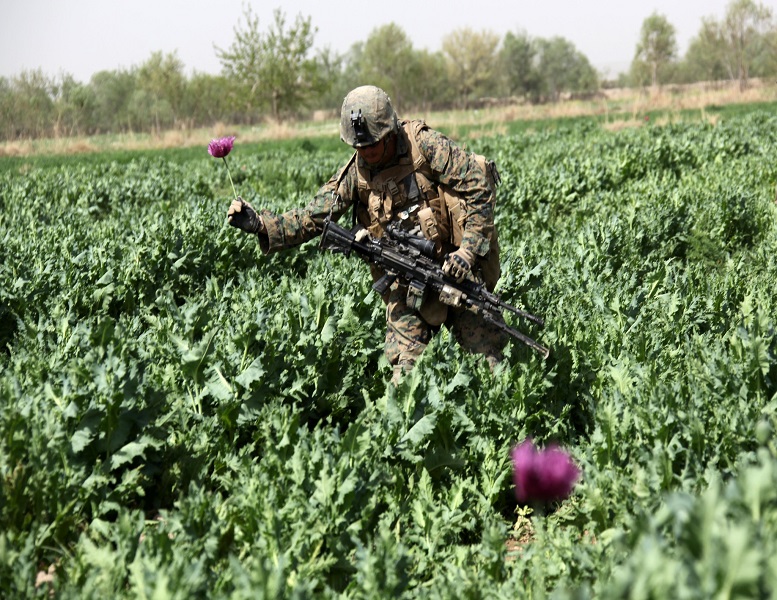
The Middle East and North Africa (MENA) region is at the centre of numerous investigations, which see international actors and policy makers tracking conflicts, resources and shifting alliances. Security and economic concerns generally identify territorial disputes, sectarian tensions, radicalisation and proxies as the key matters that explain general insecurity and authoritarianism in the region. However, there is a largely ignored matter that brings together all of these issues: drugs. Their production, usage, smuggling and criminalisation come with significant geopolitical concerns, and directly relates to state-society relations, porous borders, militias and dark economies. Yet, when it comes to the MENA region, this is still a remarkably unexplored topic. During the last decade, and especially following the worsening of the heroin epidemic in the United States (US), the Western-led ‘war on drugs’ has made a return to public and policy debates. There is a growing body of literature that focuses on a wide variety of drug-related challenges, ranging from their societal implications, the racial connotations of the war on drugs, Latin American cartels and smuggling channels. However, almost none of this research focuses on the MENA, or goes beyond identifying Afghanistan as a major opium producer and Turkey as a main harbour for transportation. This is surprising, especially given the growing European demands for cannabis and opiates. So far, the only region-wide study of drugs in the region is Philip Robins’ Middle East Drug Bazaar,[1] which lays the basis for a more complete geopolitical understanding of their consumption and trade.


Therefore, this brief aims at taking a step towards filling this gap, proposing that drugs – and the multifaceted dynamics surrounding them – can indeed be used as an analytical lens to gain original insights into state-society relations, militias, non-state actors, and transnational dynamics.


Setting the Context

Drug usage, production and transportation has significant geopolitical, societal, security and policy ramifications. While there is extensive scholarship on Latin America and on the effects that drugs have on European Union (EU) countries and Western societies, the issues and dynamics they cause in the MENA is still remarkably under-researched. Yet, it is no secret that the region is a major source, transit point and consumer of illicit substances, which both influences and is negatively affected by drug abuse and production.[2] This is somewhat ironic, as Arab states also flaunt some of the harshest penalties for drug-related crimes globally, and have often openly allied with the US-led ‘war on drugs’. To put things into perspective, Saudi Arabia and Iran alone executed 1,218 people for drug-related crimes between 2014 and 2016, while all of the Gulf Cooperation Council (GCC) countries have capital punishment for drug-related offences and Egypt has recently announced the introduction of the death penalty for drug dealers.[3]


Nevertheless, as a report by the European Union Institute for Security Studies (EUISS) notes, these trends are unlikely to shift anytime soon, because of the absence of alternative livelihoods for producers and the continuously escalating demand for illegal substances. Therefore, the insecurity and societal implications linked to the drugs ‘complex’ offer an innovative lens to look at the state of intra-states and state-society relations in the region, as drug trafficking and consumption have a mutually defining relationship with fragile areas and non-state actors.


Yet, despite the absence of focused research on these matters, it would be unfair to say that the importance of drug related issues in the MENA region is totally absent from the international radar.


Heroin trade is indeed understood as one key reason behind the US and UK ‘failure’ in Afghanistan, where opium has been the leading response to the devastation left behind by two decades of destructive warfare.[4] The heritage of geopolitical instability left behind by foreign intervention in the country has in fact allowed militia and non-state groups to thrive, building a parallel dark economy and essentially taking over the role of state institutions. Lebanon, and particularly Hizballah, have long been suspected of trafficking billions worth of drugs from Iran into the region and Europe, as a recently leaked CIA report reveals.[5] Meanwhile, drugs implication in Iran go beyond production and trade and have long constituted a growing societal concern, which is exponentially growing into an HIV crisis.[6] In Egypt drug abuse is double the international standards, with some 10.4 per cent of Egyptians using illicit drugs, a phenomenon that has steadily escalated in the aftermath of the 2011 uprisings and the growing authoritarianism it has left behind.[7]


Moreover, the recently released Arab Youth Survey 2019 devoted a whole section on drug use, for the first time, and found that the phenomenon is growing exponentially across the region. In particular, the survey reports that 76 per cent of youth in the Levant (Iraq, Jordan, Lebanon and the Palestinian Territories) agree that drug use is on the rise, followed by the 59 per cent in North Africa and 36 per cent in the GCC states.[8]


There are several reasons for the recent rise in consumption, and the region’s protracted instability is arguably the leading one. The destabilisation of decades old regimes, coupled with state failure and the escalation of proxy conflicts across the MENA, makes it considerably harder for governmental and armed forces to police drug production and distribution. In the case of Lebanon, while the country has always been at the centre of smuggling routes from the Af-Pak region through to Europe and neighbouring countries, it has also become a major producer of cannabis and opium in the aftermath of the civil war, with militia groups taking advantage of the unpatrolled porous borders with Syria.[9]


Societal Implications

As pointed out above, there are obvious advantages in using drug-related activities as an analytical lens. Doing so would offer a fresh perspective on porous borders, corruption and on the ever-evolving role of militias and non-state actors across the region. However, even more importantly, there is a lot that such an approach can tell us about state-society relations in the region. This is the case as there are clear class and racial connotations inherently linked to drug production and usage, which certain communities and societal groups being more discriminated against than others. In a region plagued by the remnants of sectarianisms and struggling to cope with almost 11 million of internally displaced people,[10] these nuances become incredibly significant.


While the recreational use of hashish seems to cut pretty consistently across all societal groups, party-goers and middle class citizens are known to routinely enjoy coke and ecstasy. This is particularly evident in any of Beirut’s clubs, with the city living up to its reputation as the Middle East’s ‘party city’, but is a widespread phenomenon across the region. On the other side, cheap opioids and methamphetamines are becoming increasingly common within the lower and working classes, as well as in refugee camps. Captagon, a lower-grade methamphetamine, is reported to have been used by fighters in Syria to enhance alertness and is referred to as ‘chemical courage’.


In Iraq, a country not usually associated to drug-related issues, crystal meth has increasingly afflicted thousands of users in the aftermath of the 2003 American invasion. Such a sudden escalation is a clear manifestation of the fragmentation of the social order that has plagued Iraq over the past few decades. Basra and Baghdad are the two most affected cities, with a recent investigation by the New York Times reporting that only in 2019 approximately 1,400 people were convicted on drug-related offences in Basra alone.[11]


This phenomenon is exacerbated by state’s failure to care for their citizens, especially in the aftermath of the 2011 uprisings. Rising rates of unemployment, regional instability and the growth of authoritarian measures are all disintegrating the already fragile state-society relation at the core of many regimes. In such a context, alienation and the lack of opportunities are directly linked to escalating rates of drug abuse, which also assume a further sectarian connotation in refugee camps across the MENA.  Even more importantly, the money flow generated by drug production and trafficking has grown into a parallel dark economy that is directly linked to corruption and ruling elites, which makes this phenomenon even harder to eradicate.


Conclusions

Therefore, it is evident that including drugs into the analysis of rising insecurities in the MENA region would offer a fresh analytical perspective into national as well as regional dynamics. This is not an easy task, as to do so would require a significant qualitative shift away from long established ‘lenses’ such as sectarianism, proxy conflicts and radicalisation. Nevertheless, drug-relates issues arguably cut intersectionally across societal, security and geopolitical matters, making their inclusion in the analytical framework incredibly valuable.


From the socio-political perspective, the recorded rates of growing drug consumption across the region during the past decade reveal that alienation, discontent and structural inequalities remain a feature of several Arab states. As corruption, authoritarianism and the gap between the general population and ruling elites continues to grow, several Arab states are being confronted with a drug-related societal crisis that they are unequipped to deal with. To put things into perspective, there are only 22 rehab facilities in Egypt, most of which are private and therefore inaccessible to those who need them the most.[12] Iraq, where the abuse of crystal meth is now a recognised as a crisis by international institutions such as the World Health Organisation, still lacks specialised rehabilitation centres and and suffers from a severe shortage of psychiatrists, psychologists and social workers.[13] This state of affairs is widespread across the region, with states relying on an unequipped criminal justice system to deal with this phenomenon, furthering social stratification and inequalities.


Economically, drug production and trafficking have come to constitute a parallel dark economy across the MENA, enriching both local and ruling elites, as well as constituting the only source of livelihood for a growing part of the population. As this phenomenon become more entrenched, its transformation into a structural issue will make it significantly harder to eradicate.


To conclude, carefully tracking drug production and smuggling would also offer new insights into the role of militias and non-state actors, enriching our understanding of the developing geopolitical dynamics across the region. Therefore, in the wake of renewed popular uprisings and instability in MENA, drugs and its related issues should be integrated into analytical and policy discussions.


[1] Robins, Philip. 2016. Middle East Drugs Bazaar: Production, Prevention and Consumption. London: Hurst Publishers.

[2] Georgios Barzoukas, Drug trafficking in the MENA: The economics and the politics, EUISS Brief Issue 29, 2017, https://www.iss.europa.eu/sites/default/files/EUISSFiles/Brief%2029%20MENA%20drugs.pdf

[3] Middle East Monitor, Substance abuse in Egypt double international levels, April 2019, https://www.middleeastmonitor.com/20190409-substance-abuse-in-egypt-double-international-levels/

[4] Alfred W McCoy, How the heroin trade explains the US-UK failure in Afghanistan, The Guardian, January 2018, https://www.theguardian.com/news/2018/jan/09/how-the-heroin-trade-explains-the-us-uk-failure-in-afghanistan

[5] Josh Meyer, The secret backstory of how Obama let Hezbollah off the hook, Politico, 2017, https://www.politico.com/interactives/2017/obama-hezbollah-drug-trafficking-investigation/

[6] John Calabrese, Iran’s War on Drugs: Holding the Line?, MEI, December 2017, https://www.mei.edu/publications/irans-war-drugs-holding-line

[7] Ibid. 3

[8] Sunniva Rose, Arab Youth Survey 2019: Drug use rising in Middle East party capital Lebanon, The National UAE, April 2019, https://www.thenational.ae/uae/arab-youth-survey-2019-drug-use-rising-in-middle-east-party-capital-lebanon-1.855195

[9] This happens especially in the Bekaa region, a fertile agricultural valley bordering Syria.

[10] Internal Displacement Monitoring Centre, 11 million people displaced within their countries across Middle East and North Africa [EN/AR], Relief Web, May 2019, https://reliefweb.int/report/world/11-million-people-displaced-within-their-countries-across-middle-east-and-north-africa

[11] Alissa J. Rubin, Iraq Faces a New Adversary: Crystal Meth, New York Times, September 2019, https://www.nytimes.com/2019/09/14/world/middleeast/iraq-drug-addiction-meth.html

[12] Ibid. 3

[13] The New Arab, Basra: The epicentre of Iraq’s drug problem, January 2018, https://www.alaraby.co.uk/english/society/2018/1/2/basra-the-epicentre-of-iraqs-drug-problem

Footnotes
    Related Articles

    Protest as a Tool for Political and Social Change

    Article by Mariam Uberi

    December 9, 2019

    Protest as a Tool for Political and Social Change

    Protests play an important part in the civil and political life of democratic societies. Georgia’s civil society has long been a good example of an engaged and informed citizenry, with the protests in June 2019 having largely secured a promise from the government that it would seek a change in Georgia’s election system from a mixed system to a fully proportional one.[1] The dropping of those proposed constitutional amendments in November 2019, however, triggered the biggest anti-government protest in years.[2] As suggested by the European Convention on Human Rights (ECHR), that Georgia has ratified, the right to peaceful assembly is a fundamental principle in a democratic society and, like the right to freedom of expression, is one of the foundations of such a society and cannot be interpreted restrictively.[3] Authorities’ attempts to shut down dissenting voices appear to be in violation of these rights. Disappointment expressed by the European Union (EU) on the failed constitutional reforms also hints to Georgia backtracking on some important reforms in the rule of law area.[4]

    On November 17th, all 44 members of the parliament’s opposition parties supported the constitutional changes on introducing a proportional system for 2020. The three lawmakers from Georgia’s Dream party however voted against the amendment while 37 abstained, making the constitutional amendment fall short of the 113 votes required, three quarters of the 150 sitting lawmakers.[5]

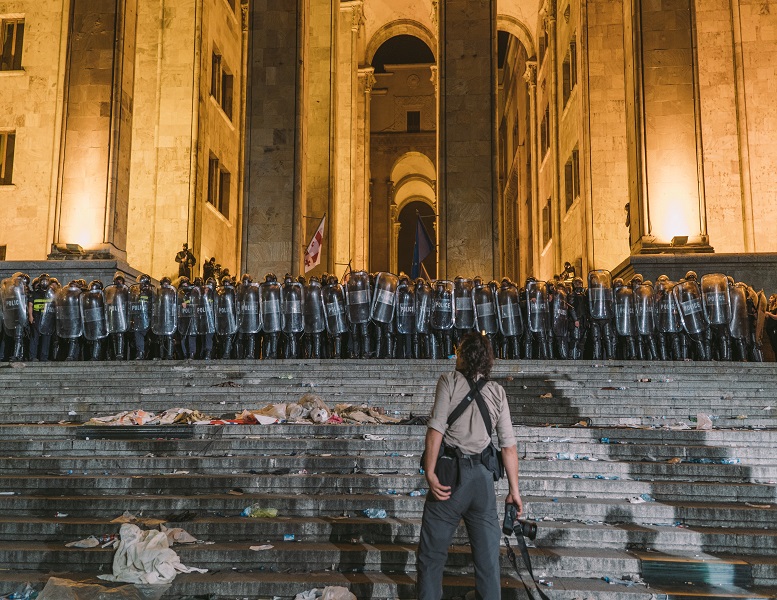
    This prompted waves of protests where in the events leading to the arrests of demonstrators, members of the opposition political parties vowed to block Parliament to ‘restore its legitimacy’ and use the lawful means available to them within Georgian legislation.[6] The protesters brought in sand bags and barricades and attempted to stop Members of Parliament (MPs) from entering Parliament.[7] In a bid to secure free passage to Parliament on November 18th, after a half an hour warning, the Interior Ministry’s riot police dispersed the protest rally. Many tried to resist and sat down in the street to block their movement. Following a brief confrontation, police used water cannons to remove protesters from the street and arrested 37 civil activists, including a political leader, on charges of petty hooliganism and disobedience to the police. [8]

    Some protesters, who had been ill treated by police during their arrests, required medical interventions after being badly hurt.[9] The peaceful protesters gathered again on November 25th with an intent to stop the ruling MPs attending the Parliament session the next day. The riot police used water cannons again in the early hours of November 26th, in sub-zero conditions to clear the entrance from behind the parliament building and arrested 28 individuals and injuring others.[10] Before the dispersal protesters were stopped from bringing wood to use for heating and bags were searched profusely. On November 28th, however, the protesters who wanted to gather around Parliament faced iron gates that blocked the streets leading to Parliament and were met with a police cordon across the barriers. 

    Events of November

    Georgian law expressly prohibits blocking administrative buildings, however, in retrospect the excessive number of anti-riot police deployed and the use of water cannons against passively resisting protesters were disproportionate and deemed unlawful by civil society.[11]The State under international law is responsible to protect peaceful protesters and ensure a safe and enabling environment for people to exercise their freedom of expression and right to peaceful assembly. The use of force must be minimum even when ‘roadblocks’ are used as a means of protest and which may warrant state intervention to disperse the protesters.[12] It is also stated that the State must resort to only the minimum use of force and only after less intrusive and discriminatory means of managing the situation have failed.[13] Generally, the States should be mindful that in some circumstances where a protest occurs in violation of applicable laws, use of force is not always justified and non-intervention might be the best approach.[14]

    On November 18th, the riot police after little warning rolled in with water cannons amid the absence of any communication with the leaders of the protest, which is an essential part of the authorities’ positive obligations to ensure the peaceful conduct of an assembly, to prevent disorder and to secure the safety of all involved.[15] The Venice Commission’s Guidelines on Freedom of Peaceful Assembly that the European Court of Human Rights (ECtHR) refers to, recommends negotiation or mediated dialogue if a stand-off or other dispute arises during the course of an assembly as a way of avoiding the escalation of conflict.[16]

    The United Nations (UN) Basic Principles on the Use of Force and Firearms by Law Enforcement Officials calls on the authorities to ‘‘exercise restraint and act in proportion to the seriousness of the offence and the legitimate objective to be achieved.’’[17] These principles are echoed in the national legislation regulating assemblies and demonstrations where among other requirements, the benefit protected by the restriction should exceed the damage caused by the restriction and should be necessary in a democratic society.[18] The notion of ‘necessary’ in a democratic society among others implies that the interference must be proportionate to the legitimate aim pursued. On November 26th authorities maintained that after seeing the blocked passages to Parliament they had to use the means provided by the law.[19] In reality the benefit does not seem to outweigh the measures or appear proportionate, whereas 28 people were arrested on administrative charges and four sustained injuries.[20] Among those arrested was a member of a political party, who in the words of his defence lawyer, his only fault was that he had ‘‘thrown beans in the air’’ during the rally. He was sentenced to eight days of administrative detention.[21]

    On both occasions the authorities showed no attempt to use less intrusive ways to deescalate the tension and conduct a dialogue with the protesters. It is also followed that subjecting the demonstrators to high-pressure water cannons requires specific justification.[22] The UN Principles further scrutinises the use of water cannons, not allowing the use of targeted jet water at an individual or group of individuals at short range with a view to avoid injury or blindness.[23] The water cannon can only be used when there is a ‘serious significant likelihood of loss of life’ or when property is being destroyed.[24] It should not be used in cold weather to avoid cold water shock.[25] In the absence of these conditions the use of water cannons does not appear legitimate especially considering that more people got injured then it was officially declared.[26] During these events, one protester suffered a broken hand after being forced down by a jet of water, another received an eye injury whilst a third got hypothermia. In response to the criticism that the cold water cannons should not be used in cold weather conditions, the Minister of Interior maintained that they will warm the water next time before using it against demonstrators.[27]

    The ECHR requires States to show a certain ‘degree of tolerance’ towards peaceful gatherings, even unlawful ones.[28] The State is also called to use its powers to protect its institutions and citizens from associations that might jeopardise them rather sparingly.[29] It is further claimed that the exceptions to the right of freedom of association has to be construed strictly and only convincing and compelling reasons can justify restrictions on that freedom.[30] Surprisingly, even the occupation of public buildings is generally regarded as peaceful conduct, despite its unlawfulness and the disruptions it may cause.[31] The authorities should not have dispersed the rally unless law enforcement officials had taken all reasonable measures to facilitate and protect the assembly from harm[32] and unless there was an imminent threat of violence.[33] Amidst the absence of previous violent clashes and the lack of imminent threat as protesters had no special equipment, breaking up the protest in such a manner does not have a compelling reason.[34]

    Finally, erecting iron gates later on November 28th to safeguard the normal functioning of the Parliament does not seem to be within the powers set-out in the Georgian law on policing.[35] The blocking of the street with iron barricades is not ‘proportionate to the expected threat’ and cannot be used against peaceful demonstrators unless there is a particular risk of a crime or disorder.[36] The Civil society further maintained that the general public were not duly informed on these restrictive measures either.[37]

    The trial of 37 people charged under administrative offences on November 18th attempted to normalise the restriction on freedom of expression through its conflation with resisting the police and hooliganism under the punitive Code of Administrative Offences.[38] The trial has been largely marred by procedural violations, at the time of writing this, 14 people have been tried and the cases of 23 are still under deliberation.

    Selective and unlawful arrests

    The Government should not have the power to ban a demonstration because of the ‘wrong message’ it sends against the government, especially when the main target of criticism is the very same authority which has the power to authorise or deny the public gathering.[39] Defence lawyers suggest that police have selectively targeted activists whereas some in their interviews given to the media said that they have been ill-treated during the arrest.[40] As suggested, police arbitrarily arrested those expressing criticism of the government and state officials, which does not make sufficient grounds to make an arrest. In light of many procedural violations, it was revealed that the police did not discharge their responsibilities duly. Arrest protocols were not drawn up on the spot as required. Police completed it with a significant delay and without interrogating the accused.[41] Many have not seen their arrest protocols whilst those who did do not agree with what it said.[42]

    Marred due process and a Telephone Justice

    The Code of Administrative Offences mandates a tight timeframe within which the case had to be deliberated. The distribution of the cases has somehow put one judge in charge of all 37 cases, which significantly curtails the procedural rights of the accused. A defence lawyer for the accused argues that the police had to set the activists free after filling out the detention protocols.[43] Nevertheless, they were kept handcuffed well beyond the prescribed time limit. The judge went well over time too, keeping them in detention over the 12 hour time limit prescribed by law.[44] To respond to the growing criticism on the flawed timeframes, Tbilisi City Court later made a formal announcement referring to the Constitutional guarantees on the inviolability of the judge and that the cases had been automatically distributed in line with the national law.[45] The process also undermined the right of the defence lawyers left with inadequate time to prepare for the defence, some given only two minutes. As suggested by the statement issued by the Georgian Young Lawyers’ Association present at the hearing, the judge often stepped out during to allegedly receive instructions.[46]

    Flawed Evidence and Lack of reasoning

    The evidence submitted by the police include arrest protocols, offence protocols and in rare cases video footage. In the case of the video footage, however, almost all police officers had difficulties identifying the arrested and could not recall the details leading to the arrest. This further questioned the validity of the requests the police had in relation to the accused and with the grounds they had made arrests. Contrary to the law, none of the police body cameras were working, whilst on one occasion a police officer confessed that he did not have time to examine the evidence that he had submitted.[47] Nonetheless, the judge gave weight to the evidence against the accused and did not require the police to justify interference with the accused right to freedom of assembly. Nor did he question the reliability and quality of the evidence.

    The accused were cleared of hooliganism charges, but ten were charged with police disobedience and sentenced to between three and 13 days administrative detention, three received warnings and one was fined.[48] There was no reasoning behind how the length of the sentence was calculated. It appears that the sentences were high for those who were especially active during the court proceedings and during the organisation of the protest rally in general.[49] The absence or lack of reasoning on how sanctions were determined are largely incompatible with the principle of non-arbitrariness when it comes to human rights standards. The ECtHR emphasised the need for courts to take seriously suggestions that real evidence introduced by police may have been planted[50] or fabricated[51]. Moreover, in cases where the only witness is the police who had a major role in the contested events, it is indispensable for the court to check their incriminating statements.[52] In the absence of these safeguards the hearings conducted appear to be in violation of the right to a fair trial.[53]

    The Repressive Law

    The commentators agree that the present Code of Administrative Offences is often used as an instrument for repression, with every government in power using it to punish dissenting voices rather than scrap it. The Code lacks judicial safeguards otherwise guaranteed by the national laws, as well as constitutional and international standards. The Code, which was adopted by the Resolution of the Supreme Soviet of the Georgian SSR in 1984, has seen some changes since its adoption. It does not entail a criminal record but allows sentencing of an individual for a maximum of 15 days without offering robust guarantees for a fair trial, or a standard beyond that of reasonable doubt otherwise required in the Criminal justice. It circumvents guarantees such as access to legal representation, adequate time and facilities to prepare a defence, the right to examine witnesses and introduce evidence. Eight provisions from the Code, including the provisions on hooliganism and police disobedience, were sent for appeal to the Constitutional Court of Georgia a year ago and have been pending before the court since.[54] The cases on excessive use of force perpetrated by police on November 19th have been picked up by the independent investigative mechanism that is tasked to take up cases of ill treatment and torture perpetrated by public agents. The mechanism that started functioning on November 1st of this year does not have prosecutorial functions and can only investigate the cases. It has nevertheless been a welcome initiative and will serve as a litmus test for the authorities in investigating the offences without bias.

    Conclusion

    The ECHR, the Venice Commission and the UN Special Rapporteur on the rights to freedom of peaceful assembly and of association have repeatedly stressed that there is a presumption in favour of holding peaceful assemblies; where an assembly should be presumed lawful and deemed as not constituting a threat to public order, until the Government put forward compelling evidence that rebuts that presumption. The authorities have not yet produced compelling evidence in this case. Moreover the use of repressive laws against activists and opposing political party leaders aimed to punish criticism against the Government, and to have a discouraging effect for others to participate in protest rallies and from engaging actively in opposition parties, has chilling effects. Furthermore, the effects of these sanctions are further amplified by inadequate administrative code procedures. On a political level, the backtracking on promised constitutional change is largely seen as fear by the ruling party of losing power. The authorities’ response to that fear seems to be the flagrant ignorance of the rule of law and the safeguards on freedom of expression and the right to peaceful assembly as they attempt to flatten the increased mistrust and heightened tensions between the ruling party, opposition and civil society.


    Photo by George Melashvili. No modifications to photo. Creative commons licence, https://creativecommons.org/licenses/by-sa/4.0/deed.en

    [1] BBC News, Georgiaprotests: Thousands storm parliament over Russian MP’s speech, June 2019, https://www.bbc.co.uk/news/world-europe-48710042

    [2] Civil.ge, Two Rallies Demand Snap Elections in Tbilisi; Parliament Blocked by Protesters, November 2019, https://civil.ge/archives/327189

    [3] Djavit An v. Turkey, § 56; Kudrevičius and Others v. Lithuania § 91.

    [4] EU Neighbours, EU reacts to on-going events in Georgia, November 2019, https://www.euneighbours.eu/en/east/stay-informed/news/eu-reacts-going-events-georgia

    [5] Civil.ge, Ex-U.S. Amb: There’s Concern in U.S. about Georgian Democracy, November 2019, https://civil.ge/archives/328588

    [6] Ibid. 2

    [7] Civil.ge, Georgian Opposition, Activists Keep Blocking Parliament Entrances, November 2019, https://civil.ge/archives/327415

    [8] Civil.ge, Riot Police Remove Barricades from Parliament Area, November 2019, https://civil.ge/archives/327545

    [9] Radio Free Liberty, Activist detained near parliament found fractured bones, November 2019, https://www.radiotavisupleba.ge/a/30288154.html

    [10] Ibid. 7

    [11] Amnesty International Public Statement, Georgia: Authorities Must Guarantee Freedom of Peaceful Assembly, Amnesty International, November 2019, https://www.amnesty.org/download/Documents/EUR5614802019ENGLISH.pdf

    [12] OHCHR, Lebanon: UN Experts decry incidents of excessive force in Lebanon. November 2019, https://www.ohchr.org/EN/NewsEvents/Pages/DisplayNews.aspx?NewsID=25354&LangID=E

    [13] Ibid.

    [14] Article 19, The Right to Protest: Principles on the protection of human rights in protests, 2016, https://www.article19.org/data/files/medialibrary/38581/Right_to_protest_principles_final.pdf

    [15] Frumkin v. Russia, § 128-129.

    [16] Ibid. referring to guideline 5.4, cited in Frumkin v. Russia § 80. See also Venice Commission and the OSCE/ODIHR Guidelines, July 2019, https://www.venice.coe.int/webforms/documents/?pdf=CDL-AD(2019)017-e

    [17] Facing Finance, UN Basic Principles on the Use of Force and Firearms by Law Enforcement officials, http://www.facing-finance.org/en/database/norms-and-standards/un-basic-principles-on-the-use-of-force-and-firearms-by-law-enforcement-officials/. Adopted by the eight UN Congress on the Prevention of Crime and Treatment of offenders. 27 August- 7 September 1990.

    [18] Article 2 (3). The Law of Georgia on Assemblies and Demonstrations. The restriction of the rights recognised and protected by this Law shall: a) be addressed to achieve the benefits protected by Article 24(4) of the Constitution of Georgia; b) be considered under the law; c) be necessary for a democratic society; d) be non-discriminatory; e) be proportionally restrictive; f) be such that the benefit protected by the restriction exceeds the damage caused by the restriction, https://matsne.gov.ge/ka/document/download/31678/10/en/pdf

    [19] The statement of the Ministry of Interior (MIA) of Georgia, November 2019, https://police.ge/ge/shinagan-saqmeta-saministros-gantskhadeba/13145

    [20] Democracy Research Institute (DRI), Authorities Again Use Disproportionate Force During Dispersal of Peaceful Rally., November 2019, http://www.democracyresearch.org/eng/109; See also an announcement by MIA on 26 November 2019.supra 20.

    [21] Formula News, Lasha Chkartishvili was sentenced to administrative detention, November 2019, https://formulanews.ge/new/index.php?m=41&news_id=16073&fbclid=IwAR1JD3Cm791cIqhcFZpJYatIdvwirw2RYll_uAtt4R19qgpOFpU_2pRfXCY#

    [22] Eğitim ve Bilim Emekçileri Sendikası v. Turkey, § 108.   

    [23] The United Nations Human Rights Guidance on Less Lethal Weapons in Law Enforcement, https://www.ohchr.org/Documents/HRBodies/CCPR/LLW_Guidance.pdf

    [24] Ibid.

    [25] Ibid.

    [26] Radio Free Liberty, Protester says that his hand was broken during a protest rally, November 2019,

    [27] 1TV.ge, Vakhtang Gomelauri – They criticise us for using cold water in cold weather, we will now try to warm the water before using it, December 2019, https://1tv.ge/news/vakhtang-gomelauri-gvlandzghaven-rogor-sheidzleba-siciveshi-wylis-gamoyenebao-akhla-vcdilobt-gavatbot-wyali-da-tbili-wyali-gamoviyenot/?fbclid=IwAR1PMVn34SRgdah5mQW-HsVAP3dyYmyzLVehgv7zbPnXgN4UTM1nMA1Dd9g

    [28] Navalnyy and Yashin v. Russia, § 63.

    [29] Magyar Keresztény Mennonita Egyház v Hungary, § 79.

    [30] Ibid.

    [31] Cisse v. France, §§ 39-40.

    [32] Including, for example, quieting hostile onlookers who threaten violence.

    [33] The Guidelines on Freedom of Peaceful Assembly adopted by the Venice Commission and the OSCE/ODIHR used in Furumkin v Russia §166.

    [34] Primov v Russia, § 144-148.

    [35] Democracy Research Institute, Democracy Research Institute Responds to the Blockage of Parliament Area by the Ministry of Internal Affairs, November 2019, http://www.democracyresearch.org/eng/115

    [36] Ibid.

    [37] Ibid.

    [38] Administrative Code of Offences in Georgia, http://www.parliament.am/library/varchakaniravaxaxtum19/vrastan.pdf

    [39] Navalnyy v. Russia, § 134.

    [40] Email correspondence with defence lawyer and the Deputy Director of the Georgian Young Lawyers’ Association, Nona kurdovanidze. See also Radio Free Liberty, Activists versus  the Soviet Code, November 2019, https://www.radiotavisupleba.ge/a/30285194.html?fbclid=IwAR0sKimGMfgqyDKgB5vzjZDDELdf6LXRQSpvk5RygLzd6NTW3XAzrrHxfiE

    [41] Ibid.

    [42] Ibid.

    [43] Ibid.

    [44] Ibid.

    [45] Georgian Young Lawyers’ Association, Trial conducted with serious violations, November 2019, https://gyla.ge/ge/post/dakavebuli-demonstrantebis-sasamartlo-procesebi-mdzime-darghvevebis-fonze-chatarda?fbclid=IwAR34pLLL_fKUKWLOZGMhOSPCCVnNIFUxFq7CQnH8dWtiPqLwo69dL4nOZ_g#sthash.q0AoSPak.4iTU4vnX.dpbs

    [46] Ibid.

    [47] Radio Free Liberty, Activists versus the Soviet Code, supra 38.

    [48] Correspondence with Nona Kurdovanidze, December 2019.

    [49] Defence Lawyer, Giorgi Mshvenieradze, at Radio Free Liberty, supra 38.

    [50] Sakit Zahidov v. Azerbaijan, §52.

    [51] Sand Gradinar v. Moldova, § 111.

    [52] Kasparov and Others, § 64.

    [53] Navalnyy v Russia § 74.

    [54] Interview with Nona Kurdovanidze. See also: The Public Defender even filed an amicus curiae brief with the Constitutional Court of Georgia in June 2019 regarding the constitutional lawsuit “Citizen of Georgia Zurab Japaridze v. Parliament of Georgia”. In the amicus curiae brief, the Public Defender referred to Articles 166  (petty hooliganism) and 173 (Disobedience to the Legal Orders or Instructions of Law Enforcement or Military Officers)  of the Administrative Offences on Misdemeanour and indicated that the judicial practice in that direction could not meet the constitutional standards, Public Defenders’ Office Georgia, November 2019.

    Footnotes
      Related Articles

      A Tale of Two Recycling Initiatives: State, Society and Waste Management in St Petersburg and Shanghai

      Article by Dr Catherine Owen

      December 4, 2019

      A Tale of Two Recycling Initiatives: State, Society and Waste Management in St Petersburg and Shanghai

      Its 7pm on a summery evening in a typical Shanghai housing estate, and the public courtyards are bustling with people.  Residents of all ages descend from their apartments carrying bags of rubbish, neatly sorted into different categories, in order to throw it into the brightly decorated public recycling bins. Since the new regulations came into force in July 2018, every evening at twilight the estate comes alive with the sounds of chatter as the recycling bins are unlocked and made available for people to use. Volunteers wearing green overalls guide their fellow residents to the correct bins, the local residents’ committee members who manage residential life mingle with citizens and oversee the volunteers, enthusiastic children explain the new waste categories to struggling family members, and at the back of the bins, recycling managers sort through residents’ incorrectly sorted waste. The whole community has been mobilised to carry out these new regulations.

      Volunteers and residents gather to collect recyclable waste in St Petersburg

      Seven thousand kilometres to the other side of the Eurasian continent, a very different approach to recycling is in operation. On the first Saturday of every month, environmental activists in the Russian city of St Petersburg organise recycling collections on a public driveway or street corner in each of the city’s 18 districts. Hardy volunteers hold large plastic bags where concerned citizens can bring the plastic bottles, polystyrene, Tetrapaks, and other recyclables they have been collecting over the previous four weeks. Boxes for old CDs, un-wanted medicines and plastic bottle tops are laid out on park benches. Some people set up tables nearby selling crafts made out of recycled materials. When the collection period has finished, the volunteers ensure that the recycling is collected by local companies for re-processing. These meet-ups, steadily increasing in popularity since their inception seven years ago, are co-ordinated by a local NGO, staffed entirely by volunteers, and take place every month throughout the year – even in the freezing, snowy months of January and February. The state is nowhere to be seen.

      Shanghai and St Petersburg make an interesting choice of city for a comparative exploration of recycling initiatives and the practices of citizen participation they generate. Both are the ‘second cities’ of their respective countries, are relatively wealthy and internationalised, and belong to political systems broadly characterised as authoritarian. Both have a huge problem with waste. St Petersburg, with a population of nearly 5.5 million, produces approximately 1.8 million tonnes of household waste per year. Shanghai’s 24 million residents produce over 9 million tonnes per year. Thus, the average St Petersburger produces 0.32 tonnes of waste a year, while the average Shanghaiese produces 0.37. In St Petersburg, the vast majority of this is sent to landfill; until very recently this was also the case in Shanghai.[1]

      Both Russian and Chinese governments recognise that waste management is a growing problem and, in the last year, have developed policy initiatives to deal with it. These initiatives, however, could not be more different. Following calls by Chinese President Xi Jinping for recycling to become part of a ‘fashionable new lifestyle’, recycling facilities are rapidly being rolled out across the country. 46 cities are expected to have established a comprehensive recycling system by 2020, with all cities expected to do so by 2025. Shanghai has trailblazed recycling, becoming the first to enforce city-wide regulations: recycling facilities exist in every estate, many of which are overseen by CCTV cameras and/or a team of volunteers, and bins for separated waste are dotted along the streets. Failure to recycle correctly in Shanghai is now punishable by a fine. Following initial confusion and scepticism regarding the new regulations – spawning viral memes in the Chinese internet asking ‘what type of rubbish are you?’ – public behaviour appears to be changing.[2] The amount of recyclable materials collected in the first three months following the introduction of the new regulations was five times the amount collected during the same period in the previous year. [3]

      An oblique sign with the words ‘Don’t you care?’, possibly commissioned by the government, but no one could say for sure

      In Russia, the national-level project ‘Ecology’ has promised to transform Russia’s waste management system by 2024, increasing recycling rates from their current 7 per cent to an ambitious 60 per cent.[4] These new regulations have been rolled out across the regions since 1 January 2019 and have required a single ‘regional operator’, selected by the regional governor following a competitive tender, to assume responsibility for the entire waste management process in each region – from collection to sorting and landfill – at a cost of 120 roubles per month to residents.[5] However, St Petersburg constitutes one of three cities that are exempt from the reforms, and it recently emerged that they would not be implemented until 2021 at the earliest, due to fears of social unrest.[6] Currently, citizens in St Petersburg have three options to recycle their waste: collect rubbish over the period of one month and take it to the self-organised meet-ups; drive to the few recycling points on the edge of the city; or pay 400 roubles to a small business to collect their waste and recycle it on their behalf.

      Therefore, unlike the rapidly transforming situation in China, residents across Russia are still not required to change their behaviour, since all waste sorting is to be done by the regional operator. And, while recycling in China is being touted[7] as a lucrative business opportunity that could create millions of new jobs, conflict has broken out in Russian regions where half of tariffs remain unpaid, rubbish is left rotting on the street, and regional operators are going bankrupt.[8]  While officials argue that Russian citizens are not yet ‘ready’ to start recycling, independent polls tell a different story. Most citizens would be quite happy to recycle their rubbish if there were facilities nearby.[9] 

      In St Petersburg, people who recycle tend to describe themselves as environmentalists or as activists. Many are also trying to cut down on meat, buy more items second hand, adopt other environmentally friendly behaviours, and influence the behaviour of friends and family. They are often also strident critics of the Putin regime. But rather than starting with an initial concern about the environment which lead to frustration with government inaction, for most it is the other way round: critical attitudes towards the regime had brought them to environmental issues. Being an environmentalist is one way in which people can show opposition to Putin.

      People at the recycling station in Parnas, St Petersburg, work out which bin in which to throw their recycling.

      This mentality is amplified in the small business owners who operate local recycling facilities. One explains, “I am basically an environmentally crazy person, an environmentalist. For about 13 years worked in Greenpeace until… it became clear that Greenpeace was working with the government. And it makes no sense to work with the government, it’s all just talk.” Another stated, “There is a myth that Russia is not ready to recycle. It is not true. Everyone is ready. But it’s convenient for the authorities to say that we’re not ready. If you come and ask the local administration to recycling containers installed, they will say no. Because everything is connected with the state and the administration; there, people sit in the warm and don’t want to move or change the system.” Thanks to government inaction, people who want to recycle must have in-depth knowledge about the numerous different types of plastic and must be able to find out for themselves how to recycle their waste.  One of the city’s main collection points for recyclables is on the edge of town, about an hour from the city centre by public transport and contains eight different sorting categories. One volunteer with the city’s recycling NGO explained, “You need a lot of motivation to recycle in St Petersburg. A lot of my friends are surprised to hear I’m a volunteer because they find it complicated to maintain an ecological lifestyle in Russia.”

      For St Petersburg’s citizens who do not currently recycle, many simply don’t trust the government with the recycling process. “We don’t know anything about what happens with the separated waste. I think that after the work, the company just takes the separated garbage and mixes it with the other waste and leaves it in the landfill.” Some were also sceptical that the Shanghai approach of fining residents for non-compliance would achieve behavioural change in St Petersburg: “All fines will be collected by the government. They will use it as some kind of trick. And then the people will just be thinking about and arguing about the fine, not thinking about sorting their rubbish.”

      A mural painted by volunteers in one of Shanghai’s housing estates.

      In Shanghai, residents’ views could not be more different: rather than hindering the development of recycling in the city, the local Party-state was seen as paramount to successful implementation. According to a local residents’ committee member, “After all, in China this is driven by the government and it’s compulsory. Right now, the Shanghai Municipal Government is promoting it. It is entirely the Party and the government. Party building is taking the lead.” On the role of local Communist party cadres in the recycling process, another stated, “Party members took the lead in propaganda, took the lead in sorting their waste, and took the lead to volunteer. We ask the party members in our community to stand up.”  

      At the level of the housing estate in Shanghai, citizens can do more than simply put their rubbish in the recycling bins every evening. Teams of volunteers are recruited in each district to assist struggling residents. One volunteer, an older lady in her 60s sitting by the recycling bins in one housing estate, stated, “We come here 365 days a year, in the heat, in the snow, and in the rain. At New Year, we are still on duty… Yes, we are proud of being volunteers.” Social organisations are frequently invited onto the estates to run workshops, quizzes and other training or themed social events for residents. One resident explained, “This is a response call. Everyone should do something for the country for environmental protection. Yes, I feel obligated. It’s your duty if you live in this place. Well, we’re all living here together and if I make it decent, everyone really feels more comfortable.”

      A volunteer and her friends catch up with each other while waiting for their neighbours to bring their recycling.

      How can the approach to a single public policy elicit two such different conceptions of citizen engagement? The Russian regulations require individuals to take no action since the responsibility for waste separation is managed by regional authorities. In China, a huge government campaign is enforcing comprehensive societal behavioural change. In St Petersburg, those wishing to engage in recycling processes must do so through the voluntary and private sectors – and expose themselves to a grassroots anti-regime politics. In Shanghai, engagement consists of activating your Party membership, becoming a volunteer or participating in the additional programme of events organised by local residents’ committees and NGOs. In short, the Russian approach disengages the majority of the population while cementing the politics of a kernel of activists; the Chinese approach breeds mass conformity and consent.

      The roots of these differences can be traced to four aspects of governance in which Russia and China differ substantially: the structure of political power, the management of the regional economy, levels of public trust in political institutions and the approach to land use. On the first, Russia, typically characterised as a ‘competitive authoritarian’ regime, allows space for limited levels of autonomous activity, while in China’s ‘hegemonic authoritarian’ regime, this space is much smaller and social control by the Communist Party is much greater. In terms of economy, Russian regional public finances have been characterised by fiscal austerity and recentralisation in recent years, while China’s sub-national units have pursued decentralisation, have substantial freedom to experiment with economic strategy and consequently have more finances at their disposal. Thirdly, public trust in the actors and institutions associated with recycling is a vital prerequisite for citizen compliance with the regulations; however, in Russia, citizens are deeply mistrustful of the authorities and levels of public trust are low, while public opinion polls in China consistently reveal high levels of trust in local authorities. And finally, Russia’s vast territory has meant that people have traditionally felt they need not worry about sending waste to landfill in a remote region, while China’s densely populated territory has not permitted this ‘luxury’.

      Most of these kinds of distinctions in governance are usually made at the macro level, through the comparative analysis of elite politics, regional-level economic policy or survey data; less is known about how different types of authoritarian governance shape the everyday experiences of public policy and the kinds of orientations towards state power they foster in their citizens. In the case of recycling, poor governmental policy decisions are politicising the issue and creating fertile ground for social conflict in Russia, while in China it is being used to engage citizens more deeply with the local state. It demonstrates that even within the single regime category of ‘authoritarianism’, local experiences of governance and state power can be remarkably different.


      All photos by the author

      Cover image: Recycling facilities in one of Shanghai’s housing estates


      [1] Novye Izvestia, Maybe not spill: ‘Red Bor become an eco-bomb for St. Petersburg, March 2019, https://newizv.ru/news/city/27-03-2019/avos-ne-prolietsya-krasnyy-bor-stal-eko-bomboy-dlya-peterburga

      [2]  Echo Huang, “What kind of rubbish are you?”: China’s first serious trash-sorting is driving Shanghai crazy, Quartz, July2019, https://qz.com/1659132/shanghai-is-giving-japanese-style-trash-sorting-a-try/

      [3] Alice Yen, Shanghai recycling scheme slips up on 9,000 tonnes of wet water churned out each day, South China Morning Post, November 2019, https://www.scmp.com/news/china/society/article/3035995/shanghai-celebrates-its-war-rubbish-slips-9000-tonnes-waste-it

      [4] Ministry of Natural Resources of Russia, Areas of Work: Directions of work of the Ministry of Natural Resources of Russia, 2019, http://www.mnr.gov.ru/activity/directions/natsionalnyy_proekt_ekologiya/

      [5] Dmitry Sarkisov, “In the 90s, huge landfills managed by bandits appeared”: The garbage reform has begun in Russia. What will she change?, Lenta.ru, February 2019, https://lenta.ru/articles/2019/02/26/musor/

      [6] The Moscow Times, St Petersburg Won’t See Citywide Recycling Until 2021, November 2019, https://www.themoscowtimes.com/2019/11/20/st-petersburg-wont-see-citywide-recycling-until-2021-a68250

      [7] Ben Halder, A Plastic Recycling Revolution is Brewing … In China, The Daily Dose, Ozy, April 2019, https://www.ozy.com/acumen/a-plastic-recycling-revolution-is-brewing-in-china/93680/

      [8] The Moscow Times, Activists Send Trash Parcels to Russian Deputies in Protest, January 2019, https://www.themoscowtimes.com/2019/01/21/activists-send-trash-parcels-russian-deputies-protest-a64208

      [9] Ksenia Agapeeva, From Opinions to Understanding – Press Releases: “Garbage Reform”, Levada.ru, May 2019, https://www.levada.ru/2019/05/15/musornaya-reforma/

      Footnotes
        Related Articles

        Pleasing China, appeasing at home: Central Asia and the Xinjiang camps

        Article by Francisco Olmos

        November 29, 2019

        Pleasing China, appeasing at home: Central Asia and the Xinjiang camps

        Around 1.5 million Uyghurs and other Muslim minority groups have been interned in China’s westernmost region of Xinjiang.[1] While the Chinese authorities say they are there of their own free will, recently leaked files from the Chinese government indicate that they are locked up in camps subject to mistreatment, from forced labour to sexual abuse.[2] The reaction of the United States (US) and Europe is known, with the US taking the strongest approach so far in condemning Beijing’s actions and blacklisting a number of organisations for their involvement in the campaign.[3] However, not much attention has been paid to the response of China’s closest neighbours to the west. These countries have closer ties to China, some of them even share a border with Xinjiang, and also have cultural and ethnic links to those minorities victimised by the Chinese authorities. The Central Asian republics have all supported China in regards to its treatment of the Muslim minorities, but the way the governments of these countries have responded to it differs depending on the role and strength of their own civil societies as well as the relationship they have with those being persecuted.

        The Uyghurs have not been the only minority, although they are the largest one, targeted by the Chinese authorities. Other Turkic groups, such as Kazakhs and Kyrgyz, and non-Turkic Central Asian groups such as Tajiks, have shared the same fate. However, unlike the Uyghurs, ethnic Kazakhs, Kyrgyz and Tajiks do have states where their kin is the titular nationality. This, together with the fact that in broad terms they share the same religion, puts Central Asian republics in a different position when it comes to dealing with China’s actions in Xinjiang. Nevertheless, rather than a romanticised solidarity of a shared ethnicity or religion, what is defining the Central Asian states’ response is political and economic pragmatism, despite domestic opposition in some cases.

        From the Caspian Sea in the west to the Tien Shan Mountains in the east, China is increasingly becoming the main trading and investment partner for the Central Asian nations. Some cases are more extreme than others, with Turkmenistan’s economy depending almost entirely on its exports to China and with Kyrgyzstan and Tajikistan heavily indebted to Beijing. The unwillingness of the republics to alienate their powerful neighbour is what defines their response to the current situation.

        While the five republics have publicly backed China in its actions in Xinjiang, they can be divided into two categories. The first group is made up of Tajikistan, Turkmenistan and Uzbekistan, who have voiced their support of Beijing whenever possible. The second group is formed by Kazakhstan and Kyrgyzstan, whose governments have also supported Beijing but have done so in a more tactful manner to better deal with those in their society who vocally oppose China’s repression of their ethnic peers at the other side of the border, fuelling the already existing anti-Chinese sentiment in their countries.

        No space for dissent

        In July 2019, 36 countries signed a letter supporting China’s policies in Xinjiang as a response to another letter sent to the United Nations Human Rights Council by mostly Western nations calling on China to halt its interment campaign. Two Central Asian republics were among those who defended Beijing: Turkmenistan and Tajikistan. A few weeks later, Uzbekistan joined them.

        It should come as no surprise that Turkmenistan stands firmly by China, even when signing the aforementioned letter contravened its policy of neutrality in the international arena. The nation ruled with an iron grip by Gurbanguly Berdimuhamedov is the country in the region that depends the most on the Asian giant. Through a series of trade blunders and lack of vision, China has become the sole market for Turkmenistan’s gas, notwithstanding Russia’s token imports. This means that China is now the destination for almost 80 per cent of Turkmenistan’s exports.[4] It is therefore expected for Ashgabat, also notorious for its lack of freedoms and human rights abuses, to unequivocally take Beijing’s side.

        Tajikistan similarly has links too close to China to be able to afford displeasing it. Dushanbe owes Beijing almost half of its foreign debt, $1.2 billion out of $2.9 billion.[5] Furthermore it has the closest relationship with China in security terms in the region. Up to 40 guard posts along the Tajik-Afghan border have been built or refurbished by the Chinese, who in addition have boots on the ground through an outpost in the Gorno-Badakhshan region.[6] Despite reports of ethnic Tajiks in the internment camps, Emomali Rahmon’s regime has explicitly supported China.

        Uzbekistan offers a different perspective to Turkmenistan and Tajikistan. Despite China already being a major trading partner, Tashkent may not be looking so much to its present situation but rather to the opportunities an increased collaboration with Beijing can bring. As part of President Mirziyoyev’s opening of the country to foreign investment, Uzbekistan is looking to bolster its relations with China. From infrastructure projects to attracting Chinese tourists by waving visas for short stays, Chinese-Uzbek relations are on the rise. As a result, Uzbekistan did not hesitate to deport Gene Bunin, an expert who collects data on the Xinjiang camps, or prevent a small gathering to commemorate the first president, an ethnic Uyghur, of the short-lived Second East Turkestan Republic (1944-49). Uzbekistan’s own Uyghur minority has no presence in wider society and its media does not cover the situation of the Uyghurs in China.[7]

        What Turkmenistan, Tajikistan and Uzbekistan have in common and which defines their stance on the Xinjiang camps is the lack of an active civil society due to the authoritarian nature of their respective regimes. Notwithstanding the differences among the three countries, there is little space for people to voice their discontent on local or national issues, let alone those concerning foreign countries. Therefore, their governments have no impediment to back China. The fact that Tajiks are in camps or that Uzbekistan has an Uyghur minority does not make much of a difference in the authorities’ stance in regards to Xinjiang.

        Balancing act

        Neither Kazakhstan nor Kyrgyzstan signed the letter in support of China that the other three republics did. This does not mean they do not stand by Beijing’s campaign in Xinjiang. Their governments do, but that view is not supported by some of its citizens. Both countries have to balance the need to be on good terms with China, as it is a vital economic partner, with the growing anti-Chinese sentiment in their populations.

        Kazakhstan is finding it the hardest to walk this tight rope. China is the main market for Kazakhstan’s exports, including an important proportion of its oil, bilateral trade that amounts to over $12 billion[8] and Nur-Sultan is a key partner in Beijing’s Belt and Road Initiative. As with the rest of the Central Asian republics, Kazakhstan cannot afford to alienate China and has no intention of doing so. However, unlike in the other republics, its demographics and rise of civil society result in a more complex situation. It is estimated that up to 1.5 million ethnic Kazakhs live in the province of Xinjiang and they are among those targeted by Chinese officials.[9] In addition, as a result of the oralman or return programme of ethnic Kazakhs promoted by the government after independence, thousands of families are now divided between Kazakhstan and China, with those that moved to the former playing an active role in defence of their relatives, who in many cases have been interned. Uyghurs, the major group persecuted in Xinjiang, are also present in Kazakhstan, numbering up to 250,000.[10] The diaspora has established organisations to defend the rights of Kazakhs and Uyghurs, like Atajurt Eriktileri, which are raising their voices in defence of those repressed in the neighbouring country.

        Kazakh authorities have responded by applying a policy of carrot and stick, with a preponderance of the latter, to navigate this situation. On the one hand, it has sent diplomatic notes to Beijing concerning itself with the situation of ethnic Kazakhs and it has given in to internal and external pressure in some high-profile cases like that of Sairagul Sauytbay, an ethnic Kazakh Chinese national who became a whistle-blower regarding the camps and avoided extradition to China from Kazakhstan to end up in Sweden. But more often than not, the Kazakh government has reacted as one would expect an authoritarian regime to by not allowing protestors to gather and dispersing them when they do. This includes the detention of the leader of Atajurt Eriktileri, Serikjan Bilash, and the co-optation of the group, now split in two.

        If the situation in Xinjiang was simply about the internment of people the Kazakh authorities would be able to dismiss such events and opposition since they do not appeal to a majority of the population. However, they add to the existing anti-Chinese sentiment that has been brewing in the country in the last years. The dread of Chinese influence has resulted in a number of protests, from the 2016 demonstrations against a land reform to those in September 2019 against plans for China to build 55 factories, to name the most relevant. Fear of the Chinese taking land, controlling the country and the influx of Chinese workers fuelled the protests. The issue of Xinjiang is now being absorbed, or sits alongside, these anti-Chinese movements. This is taking place at a time when the Kazakh state is experiencing a political transition and civil society is increasingly demanding freedoms and accountability through activist groups like Oyan, Qazaqstan and Qaharman.

        Kyrgyzstan faces a similar situation to that of Kazakhstan. Like Tajikistan, the Kyrgyz Republic is heavily indebted to China. In turn, Beijing invests in multiple infrastructure projects around the country, some of doubtful quality like the ill-fated power station that left residents of Bishkek without heating in the middle of winter in 2018.[11] Furthermore, Chinese companies exploit the country’s mineral wealth and employ Chinese workers to do so. All these factors have contributed to a rising Sinophobic sentiment that has also emerged in neighbouring Kazakhstan. The interment of ethnic Kyrgyz in camps in Xinjiang has become part of this wider issue.

        In the last year, at least five waves of anti-Chinese protests have taken place in Kyrgyzstan.[12] While expressing support for the ethnic Kyrgyz persecuted in China, the main aim of the demonstrators has been to protest against the inflow of Chinese workers, the way Chinese companies operate and their increasing presence in the country. In response to Beijing’s policies in Xinjiang, Kyrgyz president Sooronbai Jeenbekov has maintained a perceived neutrality that favours China, stating that Bishkek should not meddle in the internal affairs of their neighbour and that diplomacy would run its course on the Xinjiang camps. At the same time, Kyrgyzstan did not join Tajikistan, Turkmenistan and Uzbekistan in signing the letter officially backing Beijing’s policy in its western province.

        The issue of the interment of Muslim minorities in China does not concern the governments of Kazakhstan and Kyrgyzstan besides some minor reputational setbacks in public relations. The numbers of those demanding a stricter response solely in regard to the fate of ethnic Kazakhs, Kyrgyz and Uyghurs are not significant. The issue for the authorities arises when this feeds into wider anti-Chinese protests and it becomes another tool in the arsenal of demonstrators and, especially in Kazakhstan’s case, of far-reaching movements that call for change and the democratisation of the institutions. 

        The governments of the five Central Asian republics know where their economic present and future lies, and that is in China. There is no such thing as an ethnic or religious solidarity with those interned in Xinjiang. Pragmatism is the guiding principle of the authorities, who themselves have a poor track-record when it comes to human rights. The same applies to the majority of the citizens in those countries, who have few personal links to those detained and are suffering themselves from the lack of freedoms, namely in Tajikistan, Turkmenistan and Uzbekistan. It should come as no surprise that those three countries have been more vocal in the support of China. Only in the cases of Kazakhstan and Kyrgyzstan, the nations with the most open civil societies in the region, have authorities had to be tactful due to the increasing Sinophobia, whose impact should not be exaggerated but that could sour relations with China, while at the same time controlling the discontent to avoid it spilling into other segments of society. In the meantime, the fate of more than a million people interned in camps fades into the background in the midst of realpolitik.


        [1] Adrian Zenz, Brainwashing, Police Guards and Coercive Internment: Evidence from Chinese Government Documents about the Nature and Extent of Xinjiang’s ‘Vocational Training Internment Camps’, Journal of Political Risk, July 2019, http://www.jpolrisk.com/brainwashing-police-guards-and-coercive-internment-evidence-from-chinese-government-documents-about-the-nature-and-extent-of-xinjiangs-vocational-training-internment-camps/

        [2] Austin Ramzy and Chris Buckley, ‘Absolutely No Mercy’: Leaked Files Expose How China Organized Mass Detentions of Muslims, The New York Times, November 2019, https://www.nytimes.com/interactive/2019/11/16/world/asia/china-xinjiang-documents.html?module=inline

        [3] Charles Rollet, Xinjiang Backlash Is Hitting Chinese Firms Hard, Foreign Policy, October 2019, https://foreignpolicy.com/2019/10/18/xinjiang-sanctions-chinese-firms-surveillance/

        [4] Sam Bhutia, Turkmenistan’s mainline to China, Eurasianet, October 2019, https://eurasianet.org/turkmenistans-mainline-to-china

        [5] Farangis Najibullah, Silver Lining? Tajikistan Defends Controversial Decision To Give Mine To China, RFE/RL, October 2019, https://www.rferl.org/a/silver-lining-tajikistan-defends-controversial-decision-to-give-mine-to-china/30199786.html

        [6] Catherine Putz, China in Tajikistan: New Report Claims Chinese Troops Patrol Large Swaths of the Afghan-Tajik Border, The Diplomat, June 2019, https://thediplomat.com/2019/06/china-in-tajikistan-new-report-claims-chinese-troops-patrol-large-swaths-of-the-afghan-tajik-border/

        [7] Eurasianet, Uzbekistan’s invisible Uighurs, July 2019, https://eurasianet.org/uzbekistans-invisible-uighurs

        [8] Zhanna Shayakhmetova, Kazakhstan seeks high-tech, agricultural cooperation with China, Astana Times, September 2019, https://astanatimes.com/2019/09/kazakhstan-seeks-high-tech-agricultural-cooperation-with-china-says-tokayev-during-beijing-business-council-meeting/

        [9] Bruce Pannier, China’s New Security Concern – The Kazakhs, RFE/RL, August 2017, https://www.rferl.org/a/qishloq-ovozi-kazakhstan-china-deteriorating-relations-uyghurs/28665937.html

        [10] Ryskeldi Satke, Uighurs in Kyrgyzstan hope for peace despite violence, Al Jazeera, January 2017, https://www.aljazeera.com/indepth/features/2016/09/uighurs-kyrgyzstan-hope-piece-violence-160915133619696.html

        [11] Catherine Putz, Bitter Cold Hits Bishkek, Chinese-Repaired Power Plant Breaks Down, The Diplomat, January 2018, https://thediplomat.com/2018/01/bitter-cold-hits-bishkek-chinese-repaired-power-plant-breaks-down/

        [12] Elzbieta Pron and Emilie Szwajnoch, Kazakh Anti-Chinese Protests and the Issue of Xinjiang Detention Camps, CACI, October 2019, http://www.cacianalyst.org/publications/analytical-articles/item/13593-kazakh-anti-chinese-protests-and-the-issue-of-xinjiang-detention-camps.html

        Footnotes
          Related Articles

          Understanding the Romanian Diaspora: A Strategically Important Network 

          Article by Andra-Lucia Martinescu

          November 4, 2019

          Understanding the Romanian Diaspora: A Strategically Important Network 

          The Political Geography of In-betweenness

          There is often a complex relationship between Diasporas and their homelands. This issue was previously examined in the first paper of the ‘Understanding the Romanian Diaspora’ series,[1] particularly explaining how civic activism increasingly shapes the organisation of Romanian communities abroad. Surfacing in response to social and political dynamics affecting the home country such forms of political mobilisation are only beginning to shape diasporic identities. Protests across Europe brought to the forefront the civic and political demands and aspirations of those who decided to migrate towards better economic opportunities, or simply, where stability helped them build more manageable livelihoods, comparatively free from uncertainty. The effects of this widespread mobilisation echoed transnationally, and helped internationalise otherwise localised, domestic issues.

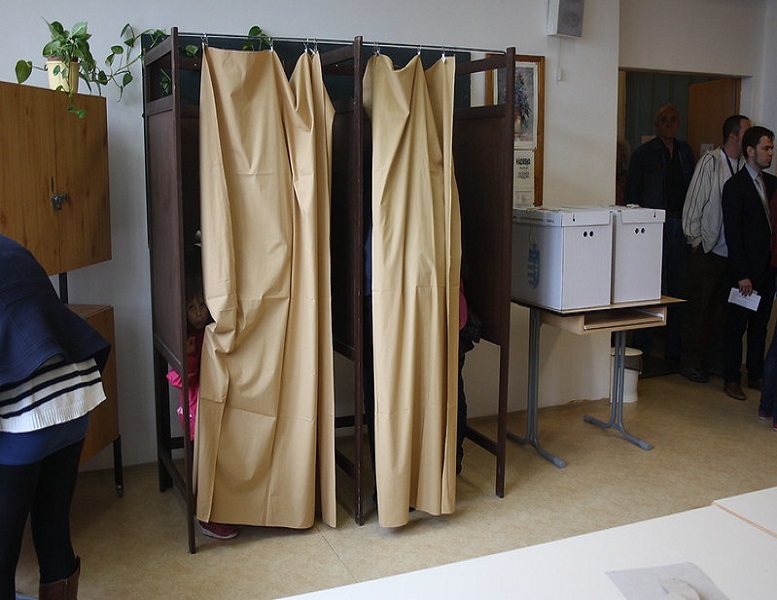
          During the 2019 European elections (and national referendum on anti-corruption laws),[2] as Romanians yet again queued for hours on end outside embassies expecting to cast their ballot (a great many did not vote)[3], I was frequently asked about more viable alternatives to the long and frustrating wait (voting by post, for example). Why were there so few voting stations across the country? Were Romanian authorities oblivious to the turnout? Was the poor organisation intentional, with bureaucratic hurdles deliberately imposed so as to hamper the process? Unaccustomed to such exasperating voting practices other citizens were baffled by our democratic enthusiasm. Almost every passer-by asked if the turnout was to be attributed to the Communist, authoritarian legacy, with people now eager to exercise a previously denied constitutional right. Such instances always make for interesting conversations because they open host societies to political, historical or even cultural realities, which in absence of transnational mobility would have remained peripheral. They also show how host societies tend to perceive and understand the multifaceted political contexts in which Diasporas are anchored, in relation to the state of origin, but also as a strategic constituency within countries of destination. Voting extended the participative space beyond the homeland into the very fabric of host societies, but perhaps more insightful to external audiences was the way in which the (voting) process itself was sanctioned and conducted by Romanian authorities.

          The mismanagement of polling stations abroad amply demonstrated how Romanian state institutions and a government captured by a ruling, but largely contested coalition[4] wilfully acted to disenfranchise this foreign-resident segment of the population. It also showed how homeland institutions tend to perceive the diaspora, thus exposing a fraught relationship and amplifying a tension that at the same time consolidated the political and civic identity of those abroad. Asked about the failure to foresee such a substantial turnout, the Minister of Foreign Affairs[5] deflected accusations by stating that ‘nobody knows how many Romanians live abroad’.[6] Over the years, there has been no consistent, institutionally-driven effort to gather data or engage in a nation-wide, informed conversation about migration. The statement is also revealing, because it epitomises a deeply entrenched institutional bias that governs official attitudes towards the diaspora. The more the diaspora becomes instrumental to regime change, demanding political accountability, the more officially sanctioned discourses curtail its actual influence. Consequently, lacking a knowledge basis, homeland engagement policies mostly stem from transitory, politicised interpretations of what the diaspora constitutes.

          Yet, the rift between homeland institutional narratives and the shared, transnational reality of the many who decided to migrate persists. The fracture is also visible in Romania’s pivotal strategy towards its diaspora, which centres on repatriation (relocation to the home country). The diaspora’s supposed return is incentivised through different schemes of relocation, spanning from business opportunities and tax rebates to funding for start-ups. There may be some nominal benefits attached to this, but even so there are no official statistics to help us gauge the effectiveness or merit of such policies. Despite the much-invoked nostalgia for the homeland, often subject to opinion polls and emotional populist pleas, structural impunity and systemic corruption continues to socially disempower and drive people away. As mentioned in our previous brief,[7] the diaspora is perceived as a financial resource, and depending on electoral cycles, either as a threat or an opportunity. This myopic view seeps into official narratives and political actions.

          It is also reminiscent of the Streetlight effect, an observational bias that ensues when individuals only search for something where it is the easiest to look. In the same way, institutional actors (in Romania) opt to perceive migration as temporary, and the diaspora through the benign prism of its ethno-cultural identity. Strategies of repatriation appeal to this affective component of belonging, the return to the homeland, without much consideration to the root causes that drive the ‘exodus’ in the first place. Diaspora engagement policies also lack an informed basis, a knowledge gap that became evident when we started researching the phenomenon.

          If migration is considered to be temporary then entire spaces of exclusion emerge, with home institutions negating the capacity or the will of certain segments of the diaspora to fully integrate and partake in the political and civic lives of their host societies. Evidently, not much is being done in terms of assisting with the process of integration,[8] or even encouraging political participation, apart from sporadic volunteer-based initiatives, both underfunded and localised. Consequently, despite its considerable demographic presence across Europe (but also North America) the diaspora’s transnational impact, reach and influence remain limited. The Romanians’ representation and participation in the politics of host countries are equally modest.  

          However, the two spaces inhabited by the diaspora, that of origin and of destination, are not mutually exclusive, but profoundly intertwined. As we have often witnessed in the many instances of mobilisation abroad, homeland-oriented politics are very much a reality lived and breathed within host societies; and perhaps more importantly, a reality that is continually mediated and conveyed through dialogue, albeit informally. Diasporic advocacy thus creates a hybrid political geography, an ‘in-betweenness’, where identity and agency are constantly negotiated. However, protests as repertoires of social action[9] are, in Charles Tilly’s words, cycles of contention. Civic mobilisation does impact governance in both countries of origin and destination, but it essentially remains an act of contestation, since institutions may or may not take heed, as is often the case.

          The Strategic Dimension of Diaspora Communities

          This is precisely why, we set out to explore new structures of opportunity that could enable a deeper engagement with host societies, by enhancing the civic and political participation of (Romanian) diaspora communities. We also investigate whether the diaspora itself can effectively advance Romanian foreign policy and strategic interests (as a non-state/ transnational actor), and to what extent bilateral relations (between countries of origin and destination) can be mediated through diaspora initiatives. In a nutshell, the upcoming publication and network analysis,[10] examines the strategic dimension of diaspora communities, as a means of bridging civic activism with national interests, pertaining to both the homeland and the countries of residence. This work aims to achieve several objectives.

          Firstly, we hope to challenge home country institutional attitudes and induce a strategic shift in policymaking. If repatriation has been the main objective so far, how can we broaden these assumptions to encapsulate other types of diaspora contributions that nonetheless benefit the homeland (through expertise, know-how, work ethos and professional networks to mention but a few)? The institutional willingness to formulate policies beyond the requirement of geographical presence (in the state of origin) and innovatively utilising this vast social capital will certainly pose challenges.

          Such a shift would require dismantling the centralised approach and entrenched patronage structures that govern the relationship between state and diaspora. Moreover, inter-institutional coordination, especially integrated funding mechanisms[11] that support capacity building for Romanian associations abroad ought to replace the bureaucratic processes that lack in transparency and hamper initiative. The institutions of external representation (embassies, Romanian cultural centres, etc.) are often passive, thus failing to meet the specific needs of diaspora communities. The preferred mode of engagement is mainly focused on the promotion of cultural and traditional events that, on the long term remain largely inconsequential. The cultural-populist model of engagement promoted by homeland institutions reduces otherwise complex and heterogenous diasporic communities to mere appendages of an ethno-linguistic/religious identity.

          This reductionist view from Romanian institutions also confines bilateral dialogue to mandated tropes, official discourses frequently disconnected from the grievances and aspirations of those seemingly represented. It is no wonder then that the voting queues create a more effective space of critical dialogue and exchange with host societies than most government endorsed public diplomacy efforts. How can bilateral dialogues, even the culturally oriented ones, have any meaningful impact in absence of legitimacy? How can diaspora communities wholeheartedly act on behalf of the same homeland institutions that repeatedly curtail its democratic freedoms?  Both aspects require first and foremost engaging in a process of building trust. Therefore, a failure to acknowledge and empower the diaspora as a political, strategic and civic actor, will only perpetuate a sense of disenfranchisement from national aspirations, in both Romania and host countries. Instead, diaspora communities will continue to engage in this dynamic of contestation, attuned to the homeland, through protests and civic mobilisation, but incapable of fully contributing towards its development (from wherever they may be).

          Secondly, through our vast mapping study of the Romanian diaspora, we hope to provide an institutional resource for host societies. Although the geographical scope is global, each analysis is tailored to reflect specific online as well as offline interactions in each country of residence. We analyse the different modes of association, the networks that emerge and their impact, whether local, national or transnational. We look into the scope and outreach of Romanian diasporic associations[12] not only in countries of destination but also in relation to the homeland, by examining financing patterns and evaluating the effectiveness of diaspora engagement policies so far. The networked approach also helps us visualise levels of political and civic participation in host societies and thus, the extent to which Romanian communities, access and navigate the structures of opportunity available to them.

          Findings from the Network Analysis

          Most importantly, we depart from the monolithic view that anchors Diasporas in the emotional rhetoric of identity politics. Our findings show a complex web of interactions, albeit fragmented. The overall network is centralised in its relationship to the home country, particularly with diaspora funding bodies, such as the Ministry for Romanians Abroad. The institutional preference for cultural engagement centred on folklore and traditions is also reflected in the financing trends. Associations purporting to organise culturally themed events have been the main beneficiaries of funding.

          We are not dismissing altogether the significance of cultural capital as an instrument for social cohesion (amongst members of the diaspora), as well as public diplomacy. Promoting and preserving the culture, language and traditions of the homeland are indispensable in mediating an understanding of national identity. However, so long as state-sponsored discourses focus exclusively on the cultural dimension to define and structure the relationship between the homeland and the diaspora, then the latter’s de facto influence will remain limited.

          The implications are far-reaching. Despite its considerable demographic presence, the diaspora’s associative models so far have had a limited impact. Besides its sporadic political mobilisation, transnational influence remains modest, which could also be attributed to reduced organisational capabilities, low visibility and online presence. The disproportionate interaction with host country institutions and low participation in the public sphere show that diaspora communities are not a fully-fledged political actor. As a consequence, the diaspora’s strategic dimension is yet to be realised. Part of the solution resides in changing the political geography of scope and aspirations. The diaspora is politically and civically anchored in the homeland, but institutions have done little to absorb and utilise its potential. In effect, its capacity to act has been limited to the repertoire of protest and contestation.

          These forms of political communication are undoubtedly useful and necessary, but they ought to be expanded. Homeland institutions (so far influenced by the different parties’ priorities and interests) have duplicitously politicised the diaspora, capturing initiatives through patronage, and often weakening the autonomy of diaspora associations by preferentially allocating funding to those most amenable. The centralised network also shows increased dependency on government support, which in turn (and given the circumstances) encourages a tactic of subsistence. As a consequence, since their priorities are misaligned, many diaspora organisations become disengaged from their communities, embroiled instead in a competition for political favours, or the outright syphoning of public funding. Leadership rivalries within and amongst associations further erode legitimacy and discourage participation from public life. The impetus to collaborate or even seek commonalities of interest remains low, and so does the impact. In many instances, diaspora communities tend to perceive associations as an interface with their host societies and public institutions. However, in absence of more structured support, people primarily rely on personal, mutual assistance networks. Provided their priorities are not misaligned, diaspora organisations can and should be viewed as a gateway towards active engagement and participation in the civic and political spheres of host countries, because they are uniquely placed to enable access to these structures of opportunities.

          For example, in the UK civic initiatives with a transnational impact (across multiple states or even continents) are more prominent than in other countries. This means that certain associations, even if volunteer-based, seek collaborative projects or partnerships with organisations beyond the UK (and not necessarily with other Romanians). Most diaspora associations in the UK have an online presence (website/social media or both), which fosters better communication and outreach. We found that online presence also increases the frequency of collaborations and partnerships amongst diaspora associations in the same country and beyond. Interactions with government bodies or institutions indicate some degree of participation in the host country’s public life and a more nuanced appraisal of local/national politics. This also demonstrates that communities are significantly more attuned to the structures of opportunity present in their host societies.

          The networked approach is not rigid or static, because the diasporic ecosystem, with its association patterns is constantly transforming. Our aim is to render diaspora organisations as well as state institutions more self-reflective, capable of identifying opportunities for engagement with wider publics and building the kind of legitimacy that would foster influence. We hope that with strategic foresight and collective support, we can use the diaspora ecosystem in the UK to build a case study of good practice. Given the current political climate, there is renewed urgency in exploring ways of maximising the diaspora’s relevance in the public sphere, by engaging in a strategic dialogue that could essentially shape the future of bilateral relations between Romania and the UK. Opening such a conversation would also make institutions more cognisant of the diaspora’s political remittances, of how the diaspora can innovatively contribute towards leveraging its countries’ strategic role and international posture.


          Contributions by Catalina Moisescu (University of Fribourg).

          Research from the Romanian Diaspora project – Funding for Romanian Diaspora Associations 2014-2019 – can be found here: https://public.tableau.com/profile/andra.lucia.martinescu#!/vizhome/RomanianDiasporaProjectsFunding2014-20192/Dashboard1 


          [1] Andra-Lucia Martinescu and Rares Burlacu, Understanding the Romanian Diaspora, FPC, February 2019, https://fpc.org.uk/understanding-the-romanian-diaspora/

          [2] The Parliament, dominated by the Social Democrats (PSD) voted to selectively amend the judicial system, particularly the code of criminal procedure by lowering sentences for some offences and the statute of limitations. The pervasive aim was to put an end to several corruption investigations and ongoing court cases involving high-ranking politicians and dignitaries (including then PSD leader Liviu Dragnea). Centre-right President Klaus Iohannis called for a non-binding referendum in a bid to combat the government’s (Social Democratic Party – PSD) controversial justice reforms, set to pardon and confer amnesty over graft-related crimes. Voters were asked if the government should be barred from using emergency decrees to change legislation on justice and whether they supported a ban on any amnesty for those convicted of corruption. 85% (including the Romanian diaspora) voted against the government holding such powers.

          [3] There are no official statistics as to how many Romanians failed to vote (in the diaspora), but estimates suggest tens of thousands.

          [4] A coalition led by the Social Democrats (PSD), which included ALDE (the Alliance of Liberals and Democrats Party) and UDMR (the Democratic Alliance of Hungarians in Romania Party). The coalition dissolved in August 2019 leaving PSD in charge of a problematic minority government.

          [5] The Ministry of Foreign Affairs was tasked with organising elections abroad; the same Minister (member of ALDE Party) was in charge of the 2014 Presidential elections abroad, which resulted in the same public outrage because of the poor organisation and misallocation of resources.

          [6] Translated from Romanian by the authors, original statement available online at: https://www.g4media.ro/ce-stiu-autoritatile-despre-numarul-romanilor-care-traiesc-in-afara-tarii-cea-mai-buna-estimare-vine-de-la-autoritatile-din-tarile-gazda-38-milioane-de-romani.html

          [7] Ibid.

          [8] Symptomatic of both homeland and at times host-country institutions.

          [9] Charles Tilly & Sidney G. Tarrow (2007). Contentious Politics (Boulder CO: Colorado). Passim. Within social movement theory, the term cycles of contention, also referred to as protest cycles or cycles of collective action, traces waves of protest and social mobilisation from their incipient phase to the very end, looking at outcomes, changes in participation and the tactics deployed by the different groups involved in the protest movement.

          [10] Soon to be published by Foreign Policy Centre the study analyses the Ecosystem of Romanian diaspora communities in the UK.

          [11] An analysis of funding patterns (allocated by the Ministry of Romanians Abroad) for diaspora associations can be accessed here (soon, in English): https://public.tableau.com/views/RADIALFinantareAsociatiiDPRRPStat/Romania?:display_count=y&:origin=viz_share_link; the graph shows which diaspora associations and what type of projects received funding (granted by the Ministry of Romanians Abroad). Based on the approved projects’ scope, we are able to gauge the government’s priorities in its policies of engagement, as well as the countries of residence where the diaspora associations which benefited from funding, are located.

          [12] Here we refer to the mostly volunteer based associations created by Romanian diaspora communities and officially registered in the countries of residence. They vary in scope and outreach, with most catering for local Romanian communities, offering legal support upon settlement, organising events and generally enabling socialisation (with varying degrees effectiveness).

          Topics
          Regions
          Footnotes
            Related Articles

            Divided Kingdom: How do Attitudes Towards Immigration Vary Based on Demographic Differences and Voting Preferences?

            Article by Cameron Boyle

            November 1, 2019

            Divided Kingdom: How do Attitudes Towards Immigration Vary Based on Demographic Differences and Voting Preferences?

            Since Brexit’s inception, immigration has been a hugely dominant theme. Theresa May’s government pledged to reduce net migration to the ‘tens of thousands’, a proclamation[1] aimed at capitalising on anti-immigrant public opinion. Yet attitudes towards the issue are far from simple, and closer inspection reveals a nation hugely divided in its views.

            Scotland and England vote very differently to each other. Recent referenda have brought this matter to the fore of public consciousness, with both Brexit and the campaign for Scottish Independence shedding light on the extent of divergence between the two electorates. Whilst the independence referendum ended in defeat for the Yes campaign, the process as a whole opened up the political discourse, demonstrating the continued support for progressive, left-of-centre policies north of the border. Immigration is an issue that encapsulates said differences- the Scottish National Party (SNP) promote the idea of Scotland as an inclusive, tolerant nation, and state that they will ‘stand firm’[2] against the demonisation of migrants and those without British citizenship.[3] The Yes campaign was framed in these progressive terms, with Scottishness celebrated as a civic identity. Such ideas stand in stark contrast to the rhetoric espoused by the Leave campaign in the EU referendum, which emphasised the need to end free movement and regain control over our borders.

            With this in mind, the way the respective countries voted in the EU referendum[4] was unsurprising; 62 per cent of Scots voted to remain in comparison with only 46.6 per cent of those in England. It is plausible to assume that, with the issue so central to our decision to leave,[5] Scotland’s vote communicates a much more positive view of immigration and its impact. However, closer analysis of attitudes towards immigration reveals a picture nowhere near as clear-cut. In a research project undertaken by NatCen,[6] Scottish and English participants were asked to rate both the economic and cultural impact of immigration. In spite of the perceived differences between Scottish and English public opinion on the matter, participants from both nations responded almost identically. Such similarities indicate that attitudes towards immigration in the respective countries are not as contrasting as is often believed. Is it in fact other demographic differences, rather than geographical location, that engender division in this area?

            Further analysis suggests that this is the case. When examining the relationship between educational background and attitudes towards immigration, 32 per cent of Scottish respondents with zero qualifications stated that immigration is bad for the economy. This percentage was almost mirrored by the equivalent English respondents, with 33 per cent giving the same answer. In light of these findings, it is apparent that educational background plays more of a role in determining one’s stance than which part of the UK one resides in. Similarly, NatCen’s[7] research found a strong correlation between age and attitudes to immigration, with 51 per cent of Scots aged 18-34 viewing immigration as culturally enriching, a viewpoint held by 52 per cent of those in the same age bracket south of the border. Millennials are repeatedly found to have softer attitudes towards immigration- Opinium’s figures[8] from June 2017 show that 59 per cent of those aged 18-24 agreed that immigration is generally beneficial for society. Only 28 per cent of those aged 55-64 held the same opinion.

            A study from Common Vision[9] attributes millennials’ positive attitudes towards immigration to their frequent exposure to ‘rapid exchange of information across borders’. Coming into contact with those from different backgrounds builds both tolerance and openness. With criteria such as age and educational background emerging as far stronger determiners of immigration stance than nationhood, other factors must be at work behind England and Scotland’s contrasting behaviour at the ballot box. The unignorable presence of the SNP is an important factor, with their progressive, multicultural ethos attracting the support of voters who view immigration as positive. Whereas the Conservatives reiterated their pledge to reduce net migration to the tens of thousands, the SNP stated that Scotland needed to continue to attract migrants in the wake of Brexit. Taking this into account, it stands to reason that those who voted ‘Yes’ in the Scottish independence referendum would look upon immigration favourably.

            This idea is corroborated by the numbers- 56 per cent of Yes voters viewed immigration as culturally beneficial, with only 16 per cent perceiving its impact as negative in this regard. Studying the link between the SNP and pro-immigration views further, 59 per cent of SNP voters[10] in the 2017 General Election viewed immigration as economically beneficial. Interestingly, this viewpoint was shared by exactly the same percentage of Labour voters in England and Wales. Such symmetry provides an explanation for why voting habits in the two countries differ, despite the notable similarity in overall attitudes towards the issue. Rather than Scots in general taking a far more positive view of immigration, the pro-immigration stance of their largest party creates this impression. However, this is counterbalanced by Labour and Liberal Democrats receiving lower levels of support from pro-immigration voters in Scotland than they do in England. 

            Honing in on the EU referendum, it is pertinent to examine why Scotland voted decisively to Remain despite overall attitudes towards immigration mirroring those in England. It is apparent that the Remain campaign in Scotland was more effective at securing voters less positive about the issue- 70 per cent of Remainers in England expressed positive views of its cultural impact, compared with 56 per cent in Scotland. NatCen[11] point out that no senior politicians from any party in Scotland endorsed Leave, which may explain why greater numbers of those sceptical about immigration voted to Remain. Brexit has created new political fault lines in this area. In addition to age, educational background and political affiliation, Leave and Remain are now indicators of one’s stance on the matter. A study by IpsosMORI[12] measured the issues most important in deciding the referendum vote. One such issue was ‘the number of immigrants coming to Britain’, a matter which 74 per cent of Leavers said influenced their vote. In contrast, only 14 per cent of Remainers cited this as an important factor.  

            Such disparity evidences how Brexit has added an additional layer of difficulty to an issue already hugely divisive. It is important to note that, despite immigration forming the crux of much referendum campaigning, the general public have actually become more positive about the matter since the vote took place. The reasons for this are uncertain, however IpsosMORI[13] postulate that our decision to leave may have reassured those who favour a reduction. Conversely, the copious amounts of anti-immigrant rhetoric may have sparked a countermovement in support of migrants.

            Attitudes towards immigration in the UK are complex and divided, although not in the way one might think. It is demographic differences and voting preferences where contrasting opinions are found. Additionally, attitudes towards the issue are softening in spite of its centrality to the Brexit debate.

            Cameron Boyle is a political correspondent for the Immigration Advice Service, an organisation of immigration solicitors who offer free legal support to asylum seekers.


            [1] BBC, Immigration: Tories to keep ‘tens of thousands’ target, https://www.bbc.co.uk/news/uk-politics-39840503

            [2] SNP, What is the SNP’s policy on immigration?, https://www.snp.org/policies/pb-what-is-the-snp-s-policy-on-immigration/

            [3] Immigration Advice Service, British Citizenship, https://iasservices.org.uk/british-citizenship/

            [4] John Curtice and Ian Montagu, Do Scotland and England & Wales Have Different Views About Immigration?, NatCen, December 2018, http://www.natcen.ac.uk/media/1672027/Do-Scotland-and-England-and-Wales-Have-Different-Views-About-Immigration.pdf

            [5] Ipsos Mori, Shifting Ground: 8 key findings form a longitudinal study on attitudes towards immigration and Brexit, IPSOS, October 2017, https://www.ipsos.com/sites/default/files/ct/news/documents/2017-10/Shifting%20Ground_Unbound.pdf

            [6] Ibid.

            [7] Ibid.

            [8] Brexit Watch, A Generation Together? What do millennials want from Brexit?, covi,  July 2018, http://www.covi.org.uk/wp-content/uploads/2018/07/Common-Vision-A-Generation-Together-July-2018-FINAL.pdf

            [9] Ibid.

            [10] Ibid.                                                                              

            [11] Ibid.

            [12] Ipsos Mori, Shifting Ground: 8 key findings form a longitudinal study on attitudes towards immigration and Brexit, IPSOS, October 2017, https://www.ipsos.com/sites/default/files/ct/news/documents/2017-10/Shifting%20Ground_Unbound.pdf

            [13] Ibid.

            Topics
            Footnotes
              Related Articles

              Hungarian opposition takes a crucial step, but still a long way to go for the left

              Article by Dr Gabor Scheiring

              October 14, 2019

              Hungarian opposition takes a crucial step, but still a long way to go for the left

              Gergely Karácsony defeated ruling party-backed incumbent István Tarlós in the Budapest mayoral election this Sunday. With 99% of votes counted, Karácsony gained 50.9% of the votes against the 44.1% for Tarlós. The opposition made enough of an advance in the capital to gain a majority in the Budapest Assembly as well. It now runs 14 districts out of the 23 in Budapest. Last time in 2014 Fidesz won in 14 out of the 23 districts. In addition to Budapest, there are 23 further cities – regional centres, so-called towns with county rights – in the country, here Fidesz fell back from 20 to 13 mayors and the opposition improved from 3 to 10. These are significant gains in an increasingly authoritarian hybrid regime.[1] However, outside the more populous towns, Fidesz gained even more seats than five years ago based on the county-level results. Further analysis is needed to assess the gains and losses in small towns and villages, but rural Hungary seems to be even more solidly Fidesz territory than before. Being present at the municipal level is a vital precondition for keeping alive the little political plurality that is left in Hungary, and is key for the organisational survival of the opposition. From this perspective, the local government elections brought advances for the opposition but also new challenges for the left.

              The most important outcome of the election is the fall of the myth of Fidesz’s invincibility. The opposition scored a critical symbolic victory that will allow it to regain momentum. After nine years of defeats, the opposition shows signs of vitality. There is a very long way to go to build a competitive alternative against Orbán’s Fidesz, but it became clearer what the crucial steps are. The strength of the opposition in cities lied in finding credible candidates, forming an electoral alliance and engaging in heavy fieldwork and grassroots outreach. This proved to be decisive even on a heavily tilted playing field, with the media and public institutions dominated by Fidesz. Gergely Karácsony, a former political scientist and campaign adviser, is a not a member of the pre-2010 left-liberal political elite, though not a total newcomer to politics either. He was the mayor of one of Budapest’s local districts for the last five years, scoring one of the few opposition victories at the 2015 municipal elections. He is chairman of a small left-green political party, Dialogue, a party formed by former LMP (Politics Can Be Different) politicians with an agenda of renewing the left and forging electoral alliances to re-democratise the country.

              Karácsony was championing the idea of using primaries to elect the candidates of the divided opposition. Although often criticised for being too friendly and avoiding conflicts, during the campaign Karácsony also showed his passionate side. At the same time, his cooperative attitude proved to be essential in forging the oppositional alliance. The primary was able to mobilise not only established parties but also social movements and activists. You cannot beat Fidesz’s imperial walkers with a bunch of uncoordinated rebels. This was the first time that parties agreed to this method, which proved to be a success, mobilising a large number of voters in Budapest in the summer to decide the mayoral candidate. As a result, the parties of the opposition were not preoccupied with infighting this time – a significant step ahead compared to previous elections. It took some time for politicians to learn to adapt their electoral strategy to the new regime, but it clearly paid off. Fidesz is no longer able to claim predominance over the ‘political centre’, a core tenant of Orbán’s illiberal regime that relied on competing oppositional forces to its left and right. With the electoral coalition between left-liberal parties and the deep-right Jobbik, the opposition looks competitive in size. This is important to further fracture the seemingly monolithic power bloc around Fidesz. The opposition needs enough weight to pull critical social groups out of the orbit of Fidesz.

              However, finding the technically optimal form to cooperate is just a crucial first step. Regaining credibility after the disastrous years in government between 2002 and 2010 also requires new faces, new messages and a novel political style. After long years of technocratic politics, Karácsony brought a new focus on social justice, sustainability and participatory politics. His program focused on social housing, improving health care, increasing the role of public transportation and expanding green areas. His party is advocating for guaranteed basic income, and as a mayor, he introduced the first municipal-level guaranteed minimum income scheme. Crucially, so far Karácsony managed to stay clear of the murky, informal political-financial dealings that caused so much trouble for the Socialists.

              At the same time, the pre-2010 elite learnt to step back. Ferenc Gyurcsány, the last prime minister of the Socialists who presided over the catastrophic collapse of the left has not yet retired, but has visibly withdrawn, leaving space for less-tainted figures to dominate the opposition. This is in sharp contrast to the last municipal elections when the opposition ended up backing Lajos Bokros as mayoral candidate in Budapest. Bokros, a former finance minister, is the most important symbolic figure of neoliberal austerity politics in Hungary, clearly connecting the opposition to the pre-2010 era much rejected by voters. Importantly, the opposition achieved these changes in political identity and style without deadly infighting this time. Cooperating and renewing the opposition in parallel seems to be thus feasible. From this Monday on, Hungary has several new mayors coming from progressive, social and environmental movements both in Budapest and outside the capital. Through Budapest, they will have a chance to show how they conceive of running a town – and a country. This is a crucial move towards disrupting Fidesz’s hegemony and building a viable political alternative against Fidesz for the 2022 national elections.

              Unlike the last few elections, this election was also different because of the scandals of the previous few weeks. In the past, these scandals were targeted against the opposition by the right-wing political-media machinery. This time, dissenting members of the right-wing economic elite in a crucial town, Győr, aired a video about a drug-fuelled orgy involving the town’s mayor, Zsolt Borkai. This culminated into a nationwide scandal, revealing not only how the mayor likes to ‘spend his free time’ but also his shady business dealings. Although Borkai managed to regain his seat – Győr is a strongly right-wing town – the affair contributed to the success of oppositional candidates in other municipalities. Elsewhere, I have showed that the domestic business elite sides with Fidesz[2] in the hope of access to state funds and protection against transnational competition. I argued that this is one of the crucial pillars of the new right-wing hegemony in Hungary’s authoritarian capitalist regime. As long as the opposition does not manage to rupture this coalition, it will be tough to gain a majority. The Borkai-affair shows that disgruntled members of the economic elite might turn against Fidesz, and this can indeed improve the chances of the opposition. It remains open how far Fidesz will be able to keep up his alliance with the national business class, or whether others will follow in turning against them.

              Another crucial pillar of the new right-wing hegemony is the working-class in medium sized towns, the rural middle class, small scale farmers and villages. The small-scale farmers and the rural middle classes have been historically leaning towards the right; it would be very hard to convince them to support the left. However, the collapse of the Socialist Party was in no small degree facilitated by the rightward turn of the working class disillusioned with the neoliberal agenda and the corruptness of the Socialists. Many of these towns voted solidly left until the second half of the 2000s; however, both Fidesz and the now-less-radical-right-wing Jobbik also made significant advances in the former working-class strongholds of the left. Although the few new mayors gained this Sunday in the large cities throughout the country contribute to the symbolic and organisational capital of the opposition, the disembedding of the left from small-medium sized towns has continued. This is what we have elsewhere called the ‘structural trap of labour politics’ in Hungary[3]: if the left remains confined to cities and their liberal-urban voters, it will be unable to forge a majority without the working middle classes of medium-sized towns. Due to Hungary’s electoral geography, with more than 3000 municipalities, it is unable to gain a majority without small-medium towns. Local electoral alliances led by Jobbik achieved several of the most significant victories in medium-sized municipalities. Former left-wing working-class strongholds are still solidly right-wing territories, even if Jobbik decided to ally with left-liberal forces. Such a tactical alliance seems to be crucial to re-democratise Hungary, but it also results in cementing the hegemony of the right in medium-sized towns. Furthermore, Fidesz is as strong as ever in villages and small towns. Using large towns to re-establish a foothold at least in medium-sized industrial cities is a crucial challenge ahead for the opposition. At the same time, the left will have a tough time to strengthen its networks in these territories, a vital task if it wants to be able to govern in the future without the support of the deep-right Jobbik.

              This Sunday, Hungarians decided not to put another nail in the coffin of Hungary’s dying democracy but to give it a chance with the defibrillator to revive it. Although Fidesz is as strong as ever in small towns and rural areas, in cities the opposition got stronger and regained control over Budapest. Similar to Turkey, this shows that competitive authoritarian regimes have their weak spots as long as they rely on elections to legitimate their rule. It is up to the opposition now to build the necessary social alliances required for a nationwide majority. At the same time, the left should not accept its role confined to the major cities, and be prepared to regain territory in industrial medium and small towns as well.


              Photo by OSCE PA/Andreas Baker, under Creative Commons.

              [1] Gabor Scheiring, Hungary’s regime is proof that capitalism can be deeply authoritarian, Open Democracy, April 2018, https://www.opendemocracy.net/en/can-europe-make-it/hungary-s-regime-is-proof-that-capitalism-can-be-deeply-authorita/

              [2] Gabor Scheiring, Lessons from the Political Economy of Authoritarian Capitalism in Hungary, tni, April 2018, https://www.tni.org/en/publication/lessons-from-the-political-economy-of-authoritarian-capitalism-in-hungary

              [3] Gabor Scheiring and Kristof Szombati, The structural trap of labour politics in Hungary, Rupture Magazine, August 2019, https://rupturemagazine.org/2019/08/04/the-structural-trap-of-labour-politics-in-hungary-gabor-scheiring-kristof-szombati/

              Footnotes
                Related Articles

                Back to the Future – Why a Human Rights-Focused Foreign Policy must keep up with Technology

                Article by Helen Goodman MP

                October 9, 2019

                Back to the Future – Why a Human Rights-Focused Foreign Policy must keep up with Technology

                 “Technology is, of course, a double edged sword. Fire can cook our food but also burn us.”

                • Jason Silva, the Venezuelan-American filmmaker and public speaker

                Last year marked the 70th anniversary of the Universal Declaration of Human Rights. The values and guiding principles underpinning this declaration may not have changed in 70 years, but the threats to human rights have. For those of us who still believe in the sanctity of human rights, we have to adapt to these threats.

                One such threat is technology. Technology and human rights have always been intricately intertwined. From the mastering of civilian bugging in the 1970s and 80s, to the mass expansion of CCTV in the 1990s and early 2000s, to contemporary concerns over data mining and privacy rights we see today; technology has carved open an entire new dimension to human rights concerns in the past 30 years or so.

                However, we are only really scratching the surface of the deepening complexities and growing capabilities of modern technology, and the seismic implications for human rights are only just becoming clear.

                A case in point is the plight of the Uighur Muslims in Xinjiang Province, West China. The Uighurs are an ethnic Turkic peoples originating from East and Central Asia who form the majority ethnic group in Xinjiang, numbering approximately 11 million. Unlike the Han Chinese – who constitute the predominant ethnic group in mainland China – the Uighur population is primarily Muslim and culturally distinct from the rest of China’s population.

                Since at least 1949, the Uighur community has been subject to systematic discrimination by the Chinese Communist Party (CCP). However in the past four years, following a series of riots and sporadic violent attacks by Uighur Islamist and separatist groups, state persecution of the Uighurs and other ethnic Turkic groups has intensified – according to Human Rights Watch – to ‘a scope and scale not seen in China since the 1966-1976 Cultural Revolution’.[1] The purported reason for this intensification is the ‘de-extremification’ of the region.

                This repression has involved the mass surveillance of the Uighur population and the reported internment of over one million Uighurs in ‘re-education camps’.[2] Where, according to detailed testimonies from former inmates, detainees are forced to undergo psychological indoctrination programmes designed to erase Uighur cultural and religious identity and foster loyalty to the Chinese state – including memorising CCP propaganda, giving thanks to President Xi Jinping and learning Mandarin.[3]

                State-of-the-art technology has been fundamental to the disturbing effectiveness of this state repression. Facial-recognition surveillance technology capable of identifying individuals by their ethnicity, supplied by surveillance giants Hikvision and Dahua, has been embedded ubiquitously across Xinjiang (and, incidentally, Tibet), including in gas stations and in hundreds of mosques. The Chinese government is also forcing Uighurs to download an app that monitors the content on their smart phones and searches for ‘illegal’ images,[4] and according to Human Rights Watch, is using ‘Wi-Fi sniffers’ that collect the unique identifying addresses of computers, smartphones, and other networked devices.[5]

                The data obtained from such ‘sensors’ is being fed into a predictive policing program called the Integrated Joint Operations Platform (IJOP), which has been fully implemented for the first time in Xinjiang.[6] This platform uses Big Data to analyse the movements and activities of the Uighur population and make predictive judgements on the threat level of individuals. Often after evaluation of IJOP data, individuals are detained and sent straight to re-education centres.[7]

                In short, technology has augmented a reality whereby the Chinese state has near Orwellian levels of omniscience and control over certain ethnic minorities. In Xinjiang, we are seeing just how long a shadow technology can cast over human rights.

                It is not all bad news however. Technology also has enormous potential to defend human rights.

                As the World Business Council for Sustainable Development (WBCSD) surmises, ‘Digital technologies are opening up numerous new possibilities to identify, analyse and remedy human rights risks.’[8] They identify a number of areas where technology is being harnessed to safeguard human rights. Data and information collection, for instance, has enormous potential. Satellites, drones, balloons and smart sensors like radio-frequency identification (RFID) can monitor and analyse land, ecosystems, movement of materials and product commodity chains to determine whether people’s land property rights are being violated, and whether products come from verified suppliers.[9] Apps and chatbots can also be employed to give workers a voice to express their concerns and report human rights abuses either directly to their own employers, to government authorities or to third parties.

                An innovative best practice example of this is Global Fishing Watch (GFW). GFW is using data obtained from satellite technologies and cloud computing to produce immense datasets that identify fishing patterns and produce highly detailed visual maps and infographics that are shared online. This information equips authorities and stakeholders to tackle human rights abuses in the fishing industry, such as spotting vessels that have been at sea for extended periods of time and are therefore denying their crew a break from work and violating their working rights.

                Furthermore, rather than being used for predictive policing and mass violations of privacy, the ‘Big Data’ generated by such technologies can feed into the business decision-making procedures and activities of private companies; enhancing the capacity of transnational corporations to identify and respond to human rights issues in their operations and commodity chains and make more human rights-centred decisions.[10]  

                Again, several examples are emerging of such practice. Once such example is Laborlink – a mobile app that allows factory workers to report workplace abuses and provide general feedback – either identified or anonymously.[11] Over one million workers in 16 countries have so far utilised the app, resulting in a vast improvement in workplace rights. For example in Bangladesh, through the Alliance for Bangladesh Worker Safety, Laborlink partnered with ELEVATE to build a first-of-its-kind technology-driven helpline that receives calls on over 500 issues a month, including complaints about wages and benefits and fire dangers inside and outside factories.[12]

                A similar app, WorkIt, has been instrumental in securing significant victories for Walmart workers in the United States – including substantially better corporate-wide pay and leave policies – through a campaign orchestrated by United for Respect.[13]

                Consequently, as well as posing a threat to human rights, technology provides a considerable arsenal that concerned governments, corporations and NGOs can – and must – utilise. However we cannot just fight fire with fire. Policy and legislation must also keep up with the technological dimension of human rights. Governments and legislators must therefore review the options available to them to abate human rights abuses made possible by technology. But just what options are available? The answer is several.

                An emerging legal vehicle that will have a crucial role to play is the Magnitsky powers. Leading for the Labour Party, I managed to secure the inclusion of Magnitsky clauses in the UK Sanctions and Anti-Money Laundering Act in Spring 2018 Magnitsky legislation grants government ministers the power to issue sanctions and other punitive measures against individuals or entities engaging in human rights abuses. Crucially, this includes private companies.

                On formally leaving the European Union, the UK will be able to autonomously apply sanctions using the Magnitsky clause more easily[14], and will therefore possess a much needed lever with which to target companies selling technologies being used to violate human rights for entering into contracts with the perpetrators. Like, for example, Hikvision – a move that is already being considered by the United States owing to their operations in Xinjiang. And Hikvision is just the tip of the iceberg. 

                A second lever available to states is export controls – a policy initiative encouraged by Human Rights Watch in the context of the Uighur crisis.[15] Identifying appropriate export control mechanisms to deny human rights abusing states from gaining access to the technology being used to violate basic rights is critical, and Labour has committed to strengthening export controls as part of our human rights-focussed foreign policy. By taking this simple step, concerned onlookers will stop unwittingly equipping the very human rights abusers they are condemning.  

                Thirdly, governments must engage with the technology sector. Technology companies need to be made aware of the human rights risk that their business operations can and do contribute to, and assurances must be sought that they will not enter into contracts with government authorities or any other organisation that is committing gross human rights abuses. If necessary, new regulations should be introduced to facilitate this. A bad reputation is bad for business, so encouraging leading tech sector giants to recalibrate their business models and tender policies in line with human rights realities could prove an effective tool in mitigating the detrimental impact technology can have on human rights, and hopefully others will follow their example.

                Fourthly, governments’ need to cooperate to introduce a clear international legal framework for internet governance. Currently the free for all resembles the 16th Century law of the sea as pirates abound – there are no shared controls on terrorism, child protection, intellectual property or tax and as more and more economic activity moves to the web more and more human activity takes place in an anarchic value free vacuum. As long as such a gap exists in the legal architecture, human rights abusers using the web to commit their crimes will continue to find dark corners to hide in.

                As we enter the third decade of the 21st century, the inexorable advance of technology will continue apace. We are entering the era of 5G (as we know all too well from the Huawei issue), artificial intelligence and potentially even commercial flights into space. If we are to realise the grand and noble vision of the Universal Declaration of Human Rights expounded 70 years ago democratic governments, civil society, human rights activists and other entities engaged in the global struggle for human rights must adapt to the new reality technology is presenting us. We must therefore recognise and respond to the deeply disturbing implications for human rights posed by technology, but also harness its enormous potential to take the fight to the worst perpetrators.

                Failure to do either may render the era since the Universal  Declaration of Human Rights a mere footnote in history, rather than a blueprint of a future reality for the millions being oppressed in the present.

                Helen Goodman MP is a Shadow Minister for Foreign and Commonwealth Affairs


                [1] Human Rights Watch, Eradicating Ideological Viruses: China’s Campaign of Repression Against Xinjiang’s Muslims (Human Rights Watch, 2018), https://www.hrw.org/report/2018/09/09/eradicating-ideological-viruses/chinas-campaign-repression-against-xinjiangs

                [2] Adrian Zenz, New Evidence for China’s Political Re-Education Campaign in Xinjiang China Brief, vol. 18, issue 10, May 15, 2018, https://jamestown.org/program/evidence-for-chinas-political-re-education-campaign-in-xinjiang (accessed 2019)

                [3] Malik, ‘Muslim inmates in China detention camp forced to eat pork, drink alcohol and physically tortured as some commit suicide’

                [4] Adam Lynch, App targeting Uighur population censors content, lacks basic security, Open Tech, August 2018, https://www.opentech.fund/news/app-targeting-uyghur-population-censors-content-lacks-basic-security/

                [5] Human Rights Watch, China: Big Data Fuels Crackdown in Minority Region, February 2018, https://www.hrw.org/news/2018/02/26/china-big-data-fuels-crackdown-minority-region

                [6] Ibid (footnote 5)

                [7] Ibid (footnote 5)

                [8] Davide Fiedler, Is technology a game-changer for human rights in corporate value chains?, WBCSD, November 2018, https://www.wbcsd.org/Overview/Panorama/Articles/Is-technology-a-game-changer-for-human-rights-in-corporate-value-chains

                [9] Ibid (footnote 8)

                [10] Ibid (footnote 8)

                [11] Ibid (footnote 8)

                [12] Good World Solutions, https://goodworldsolutions.org/

                [13] Teke Wiggin, Labour Organizers Look To Apps To Reach Wider Audiences, Huffington Post, July 2018, https://www.huffingtonpost.co.uk/entry/labor-organizers-apps-audiences_us_5b47a609e4b022fdcc577a47?ri18n=true

                [14] According to the Foreign Affairs Select Committee the FCO has been equivocating on the extent to which sanctions under the 2018 Act can be applied whilst the UK is still a member of the EU, particularly in relation to elements related to trade. Estonia, Latvia and Lithuania have their own Magnitsky legislation whilst being members of the EU https://publications.parliament.uk/pa/cm201719/cmselect/cmfaff/1703/170305.htm

                [15] https://www.hrw.org/sites/default/files/report_pdf/china0918_web2.pdf

                Footnotes
                  Related Articles

                  Brexit in the context of democracy under threat

                  Article by Dr Leila Alieva

                  October 3, 2019

                  Brexit in the context of democracy under threat

                  One of the most profound characteristics of the public debates on Brexit is the substantial lack of attention to its international implications.

                  The Brexit issue is naturally debated in the context of domestic affairs and is focused on the future of the relationship with the European Union (EU). However, the domination of the domestic and/or regional perspective on Brexit, combined with the absence of a global perspective, reveals the reduced sense of threat to both the United Kingdom’s (UK’s) hard and soft international power, and consequently less concern about the prospects of the West’s resilience. The threats are discussed but mainly in terms of economic competition, asymmetric threats and military conflicts, although the issue of resilience of the Western model is gradually gaining in visibility. Yet, as argued by Ann Applebaum[1], one of the problems of the West is that people have become complacent about their democratic systems and are slow to realise how they can change or deteriorate.

                  The meaning of Brexit is read in a polarising way by various different political and social groups – from triumph of democracy through isolationism and archaism to a liberation similar to the collapse of the Soviet Union. The author’s concern is for the effect of an exit of one of the major European states from the EU on the outcomes of political competition in the international sphere, with the rise of authoritarian powers, like China and Russia, coinciding with a decline of Europe and the West.

                  Post- cold war era and ‘invisible enemies’

                  The unfolding of the post-cold war era brought both predicted and unpredicted consequences. Once the EU opened its doors to the countries of the former Warsaw Pact, the EU enlarged and looked stronger than before. In the 2000s, however, we started to witness both a domestic and international decline of democracy in Eastern Europe and a rise of populism in the West. Most importantly, there was a decline in the commitment to the values of liberal democracy, which previously had been a key achievement and trait of Western and global democracies.

                  Russia appeared to be well prepared to meet the conditions of globalisation and free competition by mobilising its resources to play the role of a toxic partner, undermining liberalism, and a disrupter of liberal international relations. Unlike the cold war, when the Soviet Union was isolated economically and deterred militarily, post-Soviet Russia has been integrating into international trade and organisations since the early 90s. Russia’s increasingly autocratic rule quickly grasped the substance of pragmatism and engagement principles in the post-cold war world, and began  to manipulate them and to use its resources to split the foreign policy decisions of the EU, and affect the United States (US). For example, Mueller during his Congress testimony declared ‘alleged’ Russian election interference one of the greatest challenges to democracy he had encountered in his career.[2]

                  The EU in turn was re-shaping and re-formulating the rationale of the union. While in the post-World War II era it was attempting to prevent the domination of one power over Europe and keep Europe peaceful, the confrontation with the Soviet Union led to its new role in the global confrontation and deterrence of the totalitarian regimes. In the post-cold war era, the EU adjusted to the new conditions of peace by playing a role of a motivator of change and reforms in the former socialist bloc, and trying to cooperate and be an attractive model for Russia and the Eastern neighbourhood. Yet, the wave of illiberalism and right populism, accompanied by re-emerging xenophobia represents new challenges for post-cold war Europe.

                  International establishment, lack of transparency and corruption

                  However, the worst soft power threat, which is ‘an invisible enemy’ in contemporary international relations, is corruption. This is a channel which appears to be the most convenient way of world competing powers to undermine institutions of the West. A project by the Hudson institute[3] showed how oligarchs, close to the Russian government, are giving support to think tanks and Universities in the West; while Azerbaijani laundromat[4] showed how easy it was to buy off the deputies of the Council of Europe to vote against the objective and critical report on human rights violations in the country in 2013.    

                  The author’s observations of the few corruption scandals in the UK and the relatively weak reaction from the public suggests that corruption emerges as the most convenient channel for the erosion and weakening of the state fabric. Once the cover pages of the national newspapers reflected the information about dubious practices of the Members of Parliament (MPs), followed by investigations and proceedings that revealed the shortcomings of the institutional appointments.[5] Lack of public reaction also showed that in the public’s perception corruption and sleaze are almost routinely associated with politics and establishment.

                  Corruption and unethical behaviour has been undermining not only the resilience of the Western states to threats, but also its ability to support and project the values and power of liberalism beyond its borders. Western vulnerability to corruption promotes scepticism regarding the future of democracy and the validity of democratic values.  

                  International trade and economic relations are usually not under the radar of the national parliaments, media and non-governmental organisations (NGOs) to the same degree as the domestic decisions and relations are. This eventually leads to the creation of an ‘international establishment’, special circles of officials and politicians making deals with dictators and developing cosy and friendly personal relations with them. This is especially true in the case of oil rich states, when interstate relations are reduced to the inter-elite ones, closed to scrutiny by public institutions, and eventually making external sources of legitimacy to replace the domestic ones.  For example Azerbaijan’s leader, President Ilham Aliyev has not been too concerned with the revelations contained in the Panama Papers,[6] but he does get concerned if and when Europe or the US do follow up, investigate and prosecute those involved.

                  Usurping power – undermining institutions of ‘checks and balances’

                  Contemporary politics shows that there is a thin borderline between preserving the democratic institutions and gradual usurping their power.

                  Reliance on institutions of representative power is natural for citizens of the states with an old and mature democracy. But it may turn into being overly reliant, which would diminish the societal activity and personal form of activism. On the other hand, lack of influence of the public protests on the decision making is also contributing to this – especially frequently quoted reactions of the British public to the Iraq war, when large rallies did not affect the decision to join the coalition, consequently leading to apathy and the sense that it’s hard to reverse or simply influence the official decision. The other factors were stressed also. Political psychologist Shawn Rosenberg[7] considers the trend of fewer people taking ‘elites’ seriously, while simultaneously increased access to social networks facilitates the proliferation of fake news. He correctly stresses that ‘democracy is hard work’, but gives a deterministic perspective of the inevitability of democratic decline due to the nature of human brains to simplify things.

                  Coupled with society’s participation fatigue, withdrawal from politics, along with anti-establishment trends leaves institutions unprotected from the threat of being usurped, or monopolised, or penetrated by nepotism. The experiences in post-Soviet states showed this clearly. But traits which were usually associated with states in transition, have been expressing themselves in states with mature democracies – in the governance style of Trump, or the most recent shutting down of parliament in the UK, as examples.

                  Media and politicians

                  What seems to be a problem with the current media and politicians, is a failure to resolve the seeming contradiction between local and global. The role of the media and politicians is to bring the full picture, including the deep interconnections between the local and global. However, people and constituencies are often ‘protected’ by being fenced off from the responsibility for the global affairs’ consequences affected by the populism of their politicians. This is enabled by national leaders telling only partial stories, or partial truths.

                  Populists often reinforce a partial picture of the world, one limited by the ‘interests’ of the constituency. But the interests and motivations are an interactive process, when media and politicians can extend the borders of knowledge and understanding of the events, first of all by showing deep inter-connections between their own decisions and events happening in other parts of the world. For example, linking many years of energy trade that empowered autocrats in the Middle East to the resulting crises in the region, producing hunger, conflict and refugees. The migrants and refugees thus would look like the natural and inevitable price for the hot water and lights on in every house.

                  Conclusions

                  The political sphere nowadays is dominated by manipulation more than ever. The populist and right wing media points to the threats coming from migrants, portraying them as people who bring in high rates of crime, who steal jobs and social benefits, and consequently portrays the EU as the external vehicle promoting it. The political discourse, pointing to these ‘external enemies’, or reasons of the problems, is becoming even more mythological by simplifying the relations and securitising issues, which in actuality cannot be reduced to the simple ‘us’ versus ‘them’.

                  The reality is that the threat is not coming from migrants or from the EU, it comes from within the country as a weak response to the challenges characterising the current stage of politics and international relations. The new generation of politicians and media, who are adjusting to these challenges by resorting to populism, are balancing a tightrope of risks and dangers of moving farther away from what so far has constituted the identity and core of the democratic states; stable institutions resistant to absolutism, autocratism and illiberalism. It is then obvious that under current conditions of global soft power competition surviving individually is rather a luxury, which even such a global power as the US cannot afford anymore.


                  [1] Mathew Kupfer, The West lost faith in its values, but Ukriane should not, says columnist Applebaum, Kyiv Post, September 2019, https://www.kyivpost.com/ukraine-politics/the-west-lost-faith-in-its-values-but-ukraine-shouldnt-says-columnist-applebaum.html

                  [2] Eric Tucker, Mary Clare Jalonick and Michael Balsamo, ‘It is not a witch hunt’, Mueller says of his investigation, Boston Globe, July 2019, https://www.bostonglobe.com/news/politics/2019/07/24/mueller-take-center-stage-russia-probe-hearings/cc58otgLPVMpWmazDzGzPO/story.html

                  [3] Ilya Zaslavsky, How non-state actors export kleptocratic norms to the West, Hudson Institute, September 2017, https://www.hudson.org/research/13875-how-non-state-actors-export-kleptocratic-norms-to-the-west 

                  [4] OCCRP, The  Azerbaijani Laundromat, September 2017, https://www.occrp.org/en/azerbaijanilaundromat/

                  [5] A series of issues including the 2009 Expenses scandal that saw a number of former MPs convicted of crimes, concerns over party donors being offered peerages (becoming members of the House of Lords) and lobbying scandals where MPs were receiving pay for political influence.

                  [6] John Doe Manifesto, Panama Papers source offers documents to governments, hints at more to come, ICIJ, May 2016, https://www.icij.org/investigations/panama-papers/20160506-john-doe-statement/#_ga=1.164154486.836406132.1459807380.

                  [7] Rick Shenkman, The shocking paper predicting the end of democracy. Human Brains aren’t built for self-rule, says Shawn Rosenberg, Politico Magazine, September 2019, https://www.politico.com/magazine/story/2019/09/08/shawn-rosenberg-democracy-228045

                  Footnotes
                    Related Articles

                    State-building myths in Central Asia

                    Article by Francisco Olmos

                    October 1, 2019

                    State-building myths in Central Asia

                    Countries all over the world have gone through the process of forming and developing national myths that give them their raison d’être, inspiring its citizens looking back at the forefathers. From the legend of King Arthur in Britain, to the Reconquista in Spain or Charlemagne in France, myths based to a greater or lesser extent in history have evolved throughout centuries and have permeated the psyche of its citizens, especially since the 19th century. The Central Asian republics on the other hand had to create and adopt their myths abruptly when they became independent.

                    The current borders of the Central Asian republics where created in the 1920s and 30s by the Bolsheviks along ethno-linguistic lines that were all but clear. Nationalities, as the Soviets understood them, were a term unknown in the region, where individuals were defined by their family, tribes or places of origin rather than on ethnic terms. As a result, there were Persian speakers that where heavily Turkified, Turkic speakers that were Persanised, Turkmen tribes that identified themselves as Uzbek, Uzbeks who said they were Turkmen and with a confusion on the nomenclature of Kazakhs and Kyrgyz where some of the issues the Soviet authorities faced when drawing up the borders for the different Soviet Socialist Republics (SSRs) in the region.

                    Overnight, Kazakhstan, Kyrgyzstan, Tajikistan, Turkmenistan and Uzbekistan became sovereign nations and had to begin a state-building process that included creating a national narrative, which was an important factor for the nations’ cohesiveness. In most cases, the leaders of the republics looked back at the past in search of national heroes and splendour, overlooking actual historical facts and using them to their advantage for their own political purposes. As we will see, the way this was done varies from country to country owning to their different historical, demographic and political situations.

                    Uzbekistan, the land of Tamerlane  

                    Of the five Central Asian republics, Uzbekistan is the prime example of the use of a single historical figure to provide its narrative with a spine. It was Amir Timur (better known in the West as Tamerlane) who was chosen by then President Islam Karimov to be the country’s national hero.

                    Timur was a 14th century Turco-Mongol conqueror that established the last great Central Asian Empire that in its heyday stretched from Asia Minor (modern day Turkey) in the west to India in the east. Born in Shahrisabz (modern-day Uzbekistan), Timur was a skilful military leader that created his empire through a number of successful and ruthless military campaigns at the same time as he embellished his capital, the fabled Samarkand.

                    The choice of Timur, a brutal yet successful conqueror, as national hero suited Karimov’s aspiration for regional supremacy, for which it competed with Kazakhstan, as well as to its nationalist policies in country that had a sizeable Tajik-speaking minority. In addition, while Timur was a ruthless emir, he did create a powerful state during his lifetime, something which President Karimov, himself an authoritarian figure with a dismal human rights track record, aspired to and perhaps wanted to be compared to. Parallels between both rulers, intended or not, do not stop there. None of them were actually Uzbek, with Karimov believed to possibly be of ethnic Tajik origin[1] and Timur’s case explained below, and their legacy started to crumble soon after their deaths.

                    Timur was an obvious choice for Karimov and his government. However, there are problems with the conqueror being considered the founder of the Uzbek nation. In the first place, as mentioned above, he was not Uzbek. He was part of the Barlas tribe, a Mongolian confederation that had been Turkified after years spent in the region. As a matter of fact, the Uzbeks were enemies to his successors and in the late 15th century eventually settled in present-day Uzbekistan. From a historical perspective, the Uzbek Shaybanid dynasty that ousted the Timurids and established the Khanate of Bukhara in the 16th century would be a more accurate historical choice. Despite being a regional powerful state during that time, giving such a refined and effective ruler as Abdullah II Khan (r. 1583 – 1598), the Khanate of Bukhara or its neighbour, the also Uzbek-ruled Khanate of Khiva, cannot be compared with Timur’s grandeur and role in history. Uzbekistan needed a strong and even feared ruler, and Timur, despite historical and even linguistic and ethnic inaccuracies, fitted the part.

                    While Timur is the main character used by the Uzbek authorities in their nation building process, other historical figures have been used to create a narrative around Uzbek culture. The most prominent of those has been the poet Alisher Nava’i (1441-1501), famed for using a Turkic language instead of Persian as was common at the time. In this case, the project had already been started by the Soviet authorities who saw Nava’i as the great representative of the Uzbek language. As part of their project to create states along ethno-linguistic lines, the Soviets renamed Chagatai, the Turkic language used by Nava’i, as ‘old Uzbek’ despite the fact that it was a different language to the actual Uzbek spoken by the Uzbek tribes, who rapidly adopted Chagatai.[2] The modern Uzbek is a continuation of Chagatai and was not known as ‘Uzbek’ until the Soviets renamed it as such. Therefore, taking advantage of the narrative already established during Soviet times, it was only natural for Nava’i to continue his role as the founder of Uzbek literature.

                    Tajikistan, Samanid irredentism

                    Contrary to the other republics, which are of Turkic origin, Tajikistan is culturally and linguistically Persian. Rather than steppe empires and conquerors, the Tajik authorities had to look elsewhere to find their foundational myth, and it was an easier task. Once the civil war was over in 1997 and state-building could get properly started, President Emomali Rahmon looked towards the Samanid Empire for inspiration.

                    The Samanid Empire (819-999) was the last great Iranian state in Central Asia, with apologies the 12th century Ghurids. At its zenith, the Samanids were the powerhouse of their day and ruled from their capital at Bukhara over most of modern day Iran, as well as Afghanistan and the Central Asian republics. Before them, the region had fallen under the influence of the Arabs and after them it would be the different Turkic states who would take over. Resorting to the Samanids as the founders of the Tajik nation was a logical strategy which had a more solid base than, for instance, the Uzbeks claiming Timur as one of their own. Ismail Samani, the greatest of the Samanid rulers, has become the main character in the country’s history. He has given the name to the Tajik currency (the somoni), the highest mountain in Tajikistan, and a large statue of him stands proudly in the capital Dushanbe.

                    However, modern day Tajikistan is but a shadow of what the Samanids were. The Soviet delineation that created the Tajik SSR left the Tajiks with no major city. The great cultural lighthouses of Bukhara and Samarkand, the former capitals of the Samanids, who the Tajiks claim as their own and where sizeable Tajik-speaking populations still live, were given to Uzbekistan. By associating Tajikistan with the Samanid Empire in an effort to stress the importance of the Tajiks who once dominated the region, the government implicitly claimed the territory once occupied by the Samanids, and that includes Samarkand and Bukhara in neighbouring Uzbekistan.[3]

                    Reaching out of Tajikistan’s current borders has also been attempted by Rahmon and his government in cultural terms. The poet Rudaki (859-940/41), is rightfully seen as the main beacon of culture in Tajikistan. Born not far away from Dushanbe, he is considered to be the first great literary figure of neo-Persian literature and his poetry is read not only in Tajikistan but in the wider Persian-speaking world. However, Rahmon’s claim that Persian intellectuals like Ferdowsi, Hafiz, Omar Khayyam, Rumi and Avicenna, among others, are Tajiks can be considered taking a step too far.[4]

                    Turkmenistan, a living myth for the Turkmen

                    Out of all the Central Asian republics, Turkmenistan had one of the hardest tasks in creating a historical narrative as a result of its tribal structure prior to the Soviet-era and a lack of a historical state. Nevertheless, the Turkmen state did use a number of historical figures like the semi-mythical Oguz Khan, the father of the Turkic people, and Sultan Sanjar, the Seljuk ruler who established himself in Merv (in present-day Turkmenistan). However, the main founder of the Turkmen nation was not a distant figure who had been dead for centuries but Turkmenistan’s own first president, Saparmurat Niyazov.

                    Niyazov established an eccentric personality cult around him to cement his power at the head of the country. Without a strong family clan to support him, he ensured all authority in the country rested on him. He adopted the title of Türkmenbaşy (Head of the Turkmen), made himself ever-present in the life of ordinary Turkmens and wrote a pseudo-spiritual and revised historical guide called Ruhnama that became mandatory for students. Niyavoz established himself not only as the political leader of Turkmenistan but also as its historical and even spiritual reference point.

                    As in the case of Uzbekistan and Tajikistan, the Soviet authorities promoted literary figures in Turkmenistan as they were seen less contentious than historical leaders. In Turkmenistan’s case it was Magtymguly Pyragy (1724-c.1807), the undisputable master of Turkmen literature. Magtymguly not only wrote his verses in Turkmen, rather than Persian, about love, religion and spiritualism, but he also tried to promote the unification of the different Turkmen tribes ‘between the Amu-Darya and the Caspian.’ If one historical figure represents the desire for a unified Turkmen nation that is Magtymguly, but political motives have relegated the poet to only a literary role. 

                    Kyrgyzstan, an epic history

                    While some of the republics, namely Uzbekistan, pursued a nationalistic policy from the beginning, in Kyrgyzstan the process was more gradual as a result of the ethnic composition of the country. Rather than creating a national narrative based on the titular nationality, Kyrgyzstan’s first president, Askar Akayev, ideated the motto of ‘Kyrgyzstan is our common home.’ By doing so, Akayev wanted to accommodate the non-Kyrgyz living population to prevent their exodus following independence. At the same time, he started building a narrative for the Kyrgyz to help him retain his hold on power and that got a regular boost prior to the general elections the mid-1990s and early 2000s.[5]

                    Contrary to Uzbeks or Tajiks, Kyrgyz could not look back to a powerful empire. While different important states, such as the Karakhanids and the Kara Khitai, had occupied what is now modern day Kyrgyzstan prior to the Mongol conquest, they were not related to the Kyrgyz. Akayev decided to turn to literature instead in the form of the Epic of Manas.The narrative poem tells the adventures and struggles of Manas, a hero who battles his enemies and invaders of his land through around half a million verses. The character of Manas fits better with the nomadic heritage of the Kyrgyz than any other historical figure and benefitted the nation-building process with Manas possessing the positive attributes of a warrior, husband, father and a staunch defender of the unity of a nation against foreign enemies. Problems arose when the Kyrgyz authorities claimed that Manas as such actually existed, celebrating in 1995 its millennium anniversary and building a museum dedicated to the hero around a 14th mausoleum, where tradition says he was buried. However, the earliest manuscript of the epic dates back to the late 18th century and the plot seems to narrate events that took place in the region a century earlier.

                    In addition to the promotion of the Epic of Manas, whose eponymous hero now lends the name to different landmarks across the country including Bishkek’s airport and a mountain peak and whose story is represented in the flag of the country, Akayev promoted the celebration of the city of Osh’s 3,000 anniversary and the disputed 2,200 years of the Kyrgyz nation, none of which had the same repercussions as the poem.

                    Kazakhstan, the resurging khanate

                    While Kyrgyzstan had to deal with a diverse population post-independence, Kazakhstan’s case was more extreme. Kazakhstan was the only former Soviet republic where the titular nationality did not represent the majority of the population, with almost as many Russians as Kazakhs. Kazakhstan’s first president, Nursultan Nazarbayev, ably navigated the situation, not carrying out nationalist policies and striving for the different ethnic groups to coexist peacefully to avoid multi-ethnic conflicts.

                    As the years went by, the demographics in Kazakhstan changed. Emigration of non-Kazakhs coupled with the return of ethnic Kazakhs that lived in other parts of the USSR, or further away in China and Mongolia, meant that Kazakhs became by far the majority in their country. While still pursuing the policy of harmony among the different ethnicities, Kazakhstan started to look back on its founding figures. This process was probably accelerated by Vladimir Putin’s remarks in 2014, after the Russian intervention in Ukraine, in which he said that Kazakhs had never had a statehood. Nazarbayev implicitly responded the next year by celebrating the following year the 550th anniversary of Kazakh statehood, when he stated that ‘the anniversary of the Kazakh Khanate shows that the Kazakh nation and the Kazakh state have a long history.’[6]

                    The Kazakh Khanate that Nazarbayev alluded to was established in 1465 by Kerey and Janibek, two tribal leaders that broke away from the Uzbek Khanate. The nomadic Kazakh Khanate occupied roughly the same extension as modern day Kazakhstan and flourished in the mid-16th century after which it entered a steady decline before being incorporated into the Tsarist Empire. While the Kazakh Khanate did not have the characteristics of a modern state that Nazarbayev defended, it was the best option the government had, coupled with the promotion of the nomadic culture in the territory of Kazakhstan, through which it tried to include non-Kazakhs.  

                    Despite promoting the khanate through events, festivities and even films, Kazakhstan has not pushed as far as other countries have with their newly founded national myths. While Timur and Ismail Samani are strongly present in Uzbekistan and Tajikistan respectively, the Kazakh authorities have not sought the same for Kerey and Janibek. The country still has a diverse population, with a strong Russian presence in the north, and exacerbated nationalism can lead to instability.

                    The five Central Asian republics that emerged from the USSR had to create their own founding myths in a short period of time. In each of the countries, it was the political aims of the ruling classes that determined the national narrative the country should follow. The myths emanated from the top of the government and were promoted through state institutions, media and popular culture. While the different national identities are well established now, new rulers may seek to make minor alterations to the narratives in order to diminish their predecessor’s influence and make their own mark.

                    I would like to thank Almaty-based journalist Joanna Lillis for her insights on Kazakhstan’s state-building process


                    Photo by David Mulder, published under Creative Commons with no changes made.

                    [1] Bruce Pannier, Orphaned Dictator: The Making Of Uzbekistan’s Islam Karimov,  RFE/RL, March 2015, https://www.rferl.org/a/the-making-of-islam-karimov-uzbekistan/26917396.html

                    [2] Akhilesh Pillalamarri, “The Weird Case of the Uzbek Language”, The Diplomat, February 2016, https://thediplomat.com/2016/02/the-weird-case-of-the-uzbek-language/

                    [3] Foltz, Richard. 2019. A History of the Tajiks. London: I.B. Tauris

                    [4] Marat, Erica. 2008. National ideology and state-building in Kyrgyzstan and Tajikistan. Stockholm: Silk Road Studies Program

                    [5] Ibid.

                    [6] Lillis, Joanna. 2019. Dark Shadows: Inside the Secret World of Kazakhstan. London: I.B. Tauris

                    Footnotes
                      Related Articles

                       Join our mailing list 

                      Keep informed about events, articles & latest publications from Foreign Policy Centre

                      JOIN