Skip to content

In the end, it’s Ukraine, not Russia, that threatens to bring down Trump

Article by Lincoln Pigman

September 28, 2019

In the end, it’s Ukraine, not Russia, that threatens to bring down Trump

With Tuesday’s announcement by House Speaker Nancy Pelosi that Democratic lawmakers will launch a formal impeachment inquiry of Donald Trump, the US president’s latest alleged effort to recruit a foreign government to improve his chances of election poses the greatest threat yet to his political survival. Remarkably, however, it is because of Trump’s dealings with Ukrainian President Volodymyr Zelensky, not Russian President Vladimir Putin, that he is poised to become the fourth president in American history to face impeachment.

It is remarkable because many of the president’s critics have spent the thirty-two months that he has been in office awaiting the discovery of the smoking gun proving that his 2016 presidential campaign colluded with the Russian government. In their reading of the tea leaves, Ukraine’s role was that of a potential victim of a Russian-American grand bargain, to be struck by Putin and Trump at a presidential summit meeting without notetakers present. Kiev was in most US commentators’ eyes an actor without agency simply waiting for the axe to fall,[1] first in the form of US abandonment, then in the form of a conclusive Russian takeover of the country.

Far from being helpless, Ukraine has found itself able to either aid Trump in his upcoming showdown with the House of Representatives by denying any impropriety or deliver a blow to his presidency by confirming the worst fears of House Democrats. Zelensky has so far deftly navigated the affair, emphasising[2] that hundreds of millions of dollars in defence assistance are on their way to Kiev and promising[3] to invite Trump to the Ukrainian capital. He has assured that ‘no one can put pressure on me’,[4] while his top diplomat has stressed that ‘there was no pressure’ on Zelensky to reopen Kiev’s 2014–6 Burisma investigation,[5] which Trump’s allies insist then Vice President Joe Biden intervened to shut down because of his son’s role as a paid board member. Inside the Zelensky administration, officials have been prohibited from commenting on the matter,[6] but outside the Bankova’s walls there are hints of amusement at the present state of affairs. ‘[N]ow everyone understands what we [Ukraine] are capable of’, the former foreign minister Pavlo Klimkin recently quipped on Twitter.[7]

Ukraine only found itself in the crosshairs of Trump and his allies earlier this year, after conservative commentators turned their attention to the country’s role in assisting the FBI’s investigation of former Trump campaign manager Paul Manafort as well as their conspiracy theory regarding Joe Biden and the Burisma investigation. Although there had been murmurs in Trumpworld about a January 2017 Politico article claiming that Ukraine’s government had hoped for, and tried to bring about, Hillary Clinton’s election in 2016,[8] there was no real indication that Trump intended to punish Kiev until this past spring. Despite his allies’ 2016 removal of a call for the sale of lethal arms to Ukraine from that year’s Republican Party platform,[9] widely cited as evidence of Trump’s pro-Russian sympathies, Trump did not attempt to abandon, confront, or strong-arm Ukraine upon taking office.

On the contrary, Trump not only continued to morally[10] and materially support Ukraine in its war with Russian-backed separatists but also presided over an increase in military aid, quantitatively[11] and qualitatively[12]. Most ironically, his administration—not Congress—even crossed a line[13] left uncrossed by the Barack Obama administration, regarded[14] as dangerous by some of its alumni, and, as mentioned above, opposed by Trump allies in 2016 in deciding to sell lethal arms to Ukraine.

When the pressure campaign finally came, it was not in the context of Trump’s failed pursuit of improved relations with Russia. Rather, Trump acted to promote his own interests, not a foreign government’s, declining to rule out the provision of hundreds of millions of dollars in defence assistance and the sale of even more lethal weapons but implicitly tying such aid to the reopening of the Burisma investigation in his July 25 call with Zelensky. A move[15] that struck some observers as yet another concession to Moscow turned out to be for purely personal (and electoral) purposes. And far from being compelled by one post-Soviet government’s possession of kompromat, Trump, unforced, gave some to another, even if Washington’s release of a rough transcript of the call diminished its utility for Kiev.

Indeed, Moscow bears so little relevance to the Trump-Zelensky affair that few members of Congress have focused on its Russian dimension in their statements, preferring to stress the aspect that is most obvious and that most closely resembles an impeachable offense: Trump’s attempt to pressure a foreign government into assisting his re-election bid. For (most) House Democrats, there is no need to play up a Russian connection when the spectre of a Trump re-election blatantly aided by a foreign government wholly suffices.[16] Meanwhile, in Ukraine, Russia is presently viewed as a greater concern in the context of a renewed European push for peace in the east than it is in the context of the Trump-Zelensky affair.[17]

That said, many aspects of the story are unsurprising, affirming what we already know about the Trump administration and its foreign policy. Trump engages in what is widely understood to be self-dealing and, to this end, freely intervenes in other countries’ domestic affairs. He is open to the recruitment of foreign governments to improve his chances of election, as his campaign was in 2016. And his administration has no qualms about withholding defence assistance and other forms of foreign aid in service of its domestic political agenda.

As such, the Trump-Zelensky affair, which of course may yet fail to unseat the president, is an upset only insofar as it upends expectations regarding Trump’s dealings with Russia and Ukraine. The latter, after all, has already come closer to ousting him than the former—a far cry from the focus of Trump critics on the Mueller investigation and their view of Ukraine as a mere victim of Trump’s transactional foreign policy.

Instead, Trump’s transactional foreign policy has arguably inadvertently empowered Ukraine to shape the US president’s political future and reminded US lawmakers of the need to reaffirm and maintain support for reforms in Ukraine. And it has provided the latest evidence of what we already know to be true about his foreign policy, tendencies of his that will likely feature prominently in House Democrats’ case for impeachment.


Photo by The Presidential Office of Ukraine, published under Creative Commons with no changes made.

[1] Christopher Miller, Anxious Ukraine Holds Its Breath Ahead of Trump-Putin Summit, RFE/RL, July 2018, https://www.rferl.org/a/anxious-ukraine-trump-putin-summit/29357195.html

[2] Kim Sengupta, Zelensky defends relationship with US after Trump accused of pushing Ukraine to meddle in 2020 election, Independent, September 2019, https://www.independent.co.uk/news/world/americas/us-politics/trump-ukraine-joe-biden-military-aid-zelensky-kiev-a9111106.html

[3] Christopher Miller, Twitter post, September 2019, https://twitter.com/ChristopherJM/status/1176595764002414592

[4] Christopher Miller, Twitter post, September 2019, https://twitter.com/ChristopherJM/status/1176777713232896000

[5] Hromadske International, “Trump Did Not Pressure Zelenskyy, Ukraine Is Independent State – Foreign Minister Prystaiko, September 2019, https://en.hromadske.ua/posts/trump-did-not-pressure-zelenskyy-we-are-independent-state-prystaiko

[6] Christopher Miller, Amid Trump-Biden Tug-Of-War, Anxious Ukraine Ponders How to Proceed, RFE/RL, September 2018, https://www.rferl.org/a/amid-trump-biden-tug-of-war-anxious-ukraine-ponders-how-to-proceed/30177810.html

[7] Pavlo Klimkin, Twitter post, September 2019, https://twitter.com/PavloKlimkin/status/1176736459455422465

[8] Kenneth P. Vogel and David Stern, Ukrainian efforts to sabotage Trump backfire, Politico, November 2017, https://www.politico.com/story/2017/01/ukraine-sabotage-trump-backfire-233446

[9] Josh Rogin, Trump campaign guts GOP’s anti-Russia stance on Ukraine, Washington Post, July 2016, https://www.washingtonpost.com/opinions/global-opinions/trump-campaign-guts-gops-anti-russia-stance-on-ukraine/2016/07/18/98adb3b0-4cf3-11e6-a7d8-13d06b37f256_story.html

[10] RFE/RL, ‘Crimea Must be Returned to Ukraine,’ US Tells Russia, February 2019, https://www.rferl.org/a/us-tells-russia-crimea-must-be-returned/29794421.html

[11] RFE/RL, Pentagon To Give Additional $250 Million In Military Aid to Ukraine, June 2019, https://www.rferl.org/a/pentagon-to-give-additional-250-million-in-military-aid-to-ukraine/30006853.html

[12] Financial Times, Trump to supply Ukraine military with weapons, December 2017, https://www.ft.com/content/b872e268-e7ea-11e7-bd17-521324c81e23

[13] Josh Rogin, Trump administration approves lethal arms sales to Ukraine, Washington Post, December 2017, https://www.washingtonpost.com/news/josh-rogin/wp/2017/12/20/trump-administration-approves-lethal-arms-sales-to-ukraine/

[14] Charles Kupchan, Why giving Ukraine lethal weapons would be a massive mistake, Washington Post, August 2017, https://www.washingtonpost.com/news/global-opinions/wp/2017/08/07/why-giving-ukraine-lethal-weapons-would-be-a-massive-mistake/

[15] Karoun Demirjian, Josh Dawsey, Ellen Nakashima and Carol D. Leonnig, Trump ordered hold on military aid days before calling Ukrainian president, officials say, Washington Post, September 2019, https://www.washingtonpost.com/national-security/trump-ordered-hold-on-military-aid-days-before-calling-ukrainian-president-officials-say/2019/09/23/df93a6ca-de38-11e9-8dc8-498eabc129a0_story.html

[16] Alexandra Hutzler, Nancy Pelosi says Russia ‘had a hand’ in Trump Ukraine whistleblower debacle, September 2019, https://www.newsweek.com/nancy-pelosi-says-russia-played-role-trump-ukraine-whistleblower-1461792 

[17] Oleksiy Sorokin, What is the ‘Steinmeier Formula’ and why are so many Ukrainians against it?, Kyiv Post, September 2019, https://www.kyivpost.com/ukraine-politics/the-steinmeier-formula-isnt-bad-its-consequences-might-be.html


Footnotes
    Related Articles

    Disputed Territories, Disputed Rights: Executive Summary

    Article by Adam Hug

    September 26, 2019

    Disputed Territories, Disputed Rights: Executive Summary

    This Norwegian Helsinki Committee and Foreign Policy Centre publication seeks to draw attention to the human rights situation in some of Europe’s most contested but least well known places: Transnistria, South Ossetia, Abkhazia, Nagorno-Karabakh and Crimea. When unrecognised states or disputed territories are on the agenda it is usually about the unresolved nature of their conflicts with the countries they have tried to leave, and the role of external patronage and tight security grip exercised by Russia and (in the case of Nagorno-Karabakh) by Armenia, or indeed assessing the risks of ceasefire violations. These issues, and the thorny questions of status, provide the backdrop to this publication but this essay collection’s primary focus is what can be done to improve the human rights situation despite these challenges. It brings together a range of different perspectives, both from the ground and from international experts.

    The publication has three central observations. Firstly, that it is essential that more is done to support the work of local non-governmental organisations (NGOs), journalists and lawyers to help them build their capacity and to improve collaboration between them in challenging circumstances. It addresses how the international community needs to find ways to encourage the de facto authorities not to close civic space or place restrictions on NGO activity.

    Secondly, there is a need to improve access to international law and international monitoring processes. The publication highlights the importance of the European Convention on Human Rights, whose rights and responsibilities apply in the unrecognised states as a result of all the recognised state parties to the conflicts being signatories, both the states with de jure sovereignty and particularly for the powers that act as ‘patrons’ or occupiers. More can be done to support lawyers both on the ground and internationally in taking cases to the European Court of Human Rights (ECtHR) and courts operating under universal jurisdiction in third countries. Effective documentation of human rights abuses may also open up opportunities for the use of ‘Magnitsky’ legislation or other personal sanctions on human rights abusers from or operating in disputed territories. More must be done to enable United Nations (UN), Organisation for Security and Co-operation in Europe (OSCE), Council of Europe and other international human rights monitoring missions to overcome wrangling over ‘status’ issues to conduct their work in these territories.   

    Thirdly, that issues of conflict resolution and human rights come together in the vital issues of protecting both the rights of internally displaced person (IDP) communities (particularly the very large Azerbaijani and Georgian IDP populations) and the human rights of ethnic Georgians, Ukrainians, Crimean Tatars and Moldovans who are still trying to live in the disputed territories which have mainly been home to them since before the conflicts began. The international community must ensure these issues are an important part of their dialogue with the de facto authorities, as well as improving assistance to countries managing the needs of their IDP communities.

    Key Recommendations

    To the de facto authorities and recognised state governments

    • Abide by all international human rights standards and allow access for monitoring missions;
    • End pressures on NGOs, including those working with international partners or donors;
    • Protect the rights and welfare of IDPs and minority groups;

    To the International Community and Global Civil Society

    • Prioritise human rights issues in dialogue with the de facto authorities and the state parties;
    • Support capacity-building for civil society, journalists and lawyers in unrecognised states;
    • Improve access to international legal mechanisms (e.g. ECtHR) and universal courts;
    • Use sanctions, including ‘Magnitsky’ type provisions, against rights abusers in de facto states;
    • Improve support for IDP communities.
    Footnotes
      Related Articles

      Introduction: Addressing human rights challenges in Eastern Europe’s grey zones

      Article by Adam Hug

      Introduction: Addressing human rights challenges in Eastern Europe’s grey zones

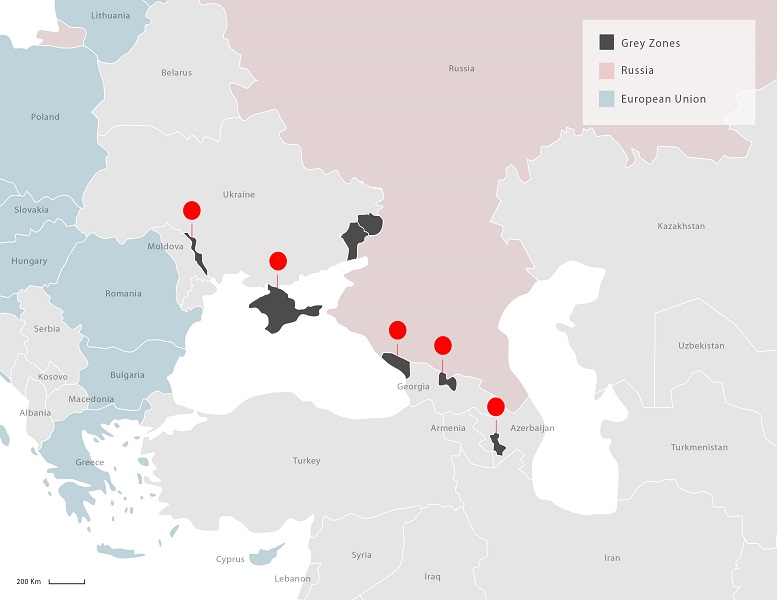
      If the defence of human rights is to be truly universal it is important to examine whether and how these rights can still be protected even in spaces that fall at the margins of the international system. The authors in this Norwegian Helsinki Committee and Foreign Policy Centre publication aim to shine a spotlight on the human rights situations in some of Europe’s most contested but least well understood spaces: Transnistria, South Ossetia, Abkhazia, Nagorno-Karabakh and Crimea. The international community’s focus on managing these conflicts can sometimes overlook the need for the inhabitants of these areas to enjoy the same rights and freedoms from persecution as those in established states.

      A very brief history

      This publication seeks, as much as possible, to avoid trying to tackle the huge and vexed issues around conflict resolution, the ongoing humanitarian tragedy of internally displaced persons (IDPs) or the status of de facto entities and their wider place in the world, which are much more fully addressed elsewhere.[1] Nevertheless they are issues that frame and shape the discussion so it is important to briefly set out the backgrounds to the conflicts. Each of these conflicts has their own unique challenges and dynamics but nevertheless there are some shared roots that underpin them.

      The existence of these conflicts and (broadly) unrecognised entities can trace their roots back to the way the patchwork of ethnicity and territory during Soviet times swiftly unravelled upon the Union’s collapse. Transnistria, South Ossetia, Abkhazia and Nagorno-Karabakh have all separated themselves from the larger entities to which they were attached during Soviet times. The flowering of national identity, and with it often radical nationalism, amongst the peoples of the collapsing Soviet Union manifested itself at many different and competing levels. The reassertion of national identity at the level of the former republics, now independent countries, came into conflict with the parallel flowering of identities amongst the national minorities and autonomous regions that sat within their borders, whose relationships with their regional centres and majority populations had been traditionally mediated and managed by Moscow. The newly emerging states saw the presence and divergent priorities of autonomous units within their territory as a challenge to their ability to consolidate their control of the state and national legitimacy. Efforts by these new states to define and build their national identities through cultural markers (such as national religious institutions) and to promote national languages in place of Russian or minority languages further widened the disconnect between local majorities and minorities.

      The Nagorno-Karabakh Autonomous Oblast was an ethnic Armenian-majority political entity situated entirely within the borders of the Azerbaijani Soviet Socialist Republic (ASSR). The movement to, unsuccessfully, persuade the Soviet Union to transfer Nagorno-Karabakh from the control of the Azerbaijani SSR to the Armenian SSR known as the Karabakh Committee was an important mobilising block within the rising Armenian national consciousness during the 1980s. The Armenian leadership of the Oblast called on the USSR in 1988 to transfer control of the territory from Azerbaijani to Armenian control and organised a local referendum that was boycotted by the Azerbaijani community. Tensions grew between Armenian and Azerbaijani communities across the region with significant inter-communal violence (in 1988 in Sumgait and 1990 in Baku against long-established Armenian minority communities) and significant transfers of population between the two republics. Following on running disputes and shortly before the dissolution of the Soviet Union in November 1991 the Parliament of the Azerbaijani SSR dissolved the legal status of the Nagorno-Karabakh Autonomous Oblast[2], triggering the Oblast’s leadership to declare independence. War was shortly joined by both the de facto authorities and the new states of Armenia and Azerbaijan, with significant loss of both combatant and civilian life, including the massacre of Azerbaijani civilians at Khojaly. By the time of the ceasefire declaration on May 5th 1994 the Armenian forces had been victorious, taking control of Nagorno-Karabakh, creating a new de facto administration called the Republic of Artsakh based out of Stepanakert and occupying the surrounding seven districts of Azerbaijan, forcing the Azerbaijani populations of those regions to flee as IDPs and who have since been unable to return, 644,000 in total.[3] In addition to the IDPs the flow of refugees between Armenia and Azerbaijan comprised 360,000 ethnic Armenians who arrived in Armenia from Azerbaijan[4]  and around 250,000 ethnic Azerbaijanis who arrived from Armenia from 1988 to 1994.[5]  

      Tensions along the line of contact remain fierce with sniper fire and border skirmishes claiming 20 to 30 lives each year, both military and civilian, with a notable flare-up in 2016 leading to even greater casualties (up to 300) and a small territorial advance by Azerbaijani forces.[6] The continuing risk of such incidents flaring into a wider conflagration remains ever present. The Organisation for Security and Co-operation in Europe (OSCE) Minsk Group under the auspices of the three co-chairs from France, Russia and the United States, brings together the Governments of Azerbaijan and Armenia for talks. Ceasefire monitoring is conducted under the Personal Representative of the OSCE Chairman-in-Office and his small staff of field advisers, but with the parties remaining far apart the overall international effort remains predominantly a conflict management rather than a resolution process. The de facto authorities of the self-styled ‘Republic of Artsakh’ are not represented at the talks.

      Abkhazia had the status of an Autonomous Soviet Socialist Republic with a greater freedom of local governance at the time of the USSR’s collapse than the other entities under examination here. Ethnic Abkhaz had a strong and separate identity but at the time of the collapse of the Soviet Union they only accounted for 17 per cent of the population withGeorgians forming a narrow majority of those living in the area.[7] Tensions around the status of the region were exacerbated by the centralising tendencies of the new nationalist President of Georgia, Zviad Gamsakhurdia, leading it to take steps towards independence. However it was during the chaos and conflict in the wake of Gamsakhurdia’s ouster that saw a military expedition against a pro-Gamsakhurdia militia by Georgian army commander Tengiz Kitovani, who decided to lead an assault on Abkhazia’s capital Sukhumi that triggered the outbreak of war. The war would see around five percent of the Abkhaz population either killed or injured. The majority of the Georgian population in Abkhazia fled or were expelled (over 200,000 IDPs)[8] in a victory for Abkhaz forces backed by elements of the Russian military and fighters from the north Caucasus.[9] The de facto authorities gained control over most of the territory of the region save for the Kodori Gorge which remained under Georgian jurisdiction and would prove a source of insecurity and tension between all stakeholders until 2008. The territory has also seen periodic waves of expulsion/flight and then return of portions of the pre-war Georgian population in Abkhazia, most notably to the Gali region adjacent to areas of full Georgian control, where between 45,000 and 55,000 Georgians are now believed to be living in the present day (fluctuations tend to happen around harvest time).[10]

      In the 1990s the conflict in the South Ossetian Autonomous Oblast between separatist forces and the Georgian government was somewhat overshadowed by the conflict in Abkhazia but was subject to similar trends and forces, with local autonomy clashing with the centralising tendencies of the new Georgian state and a resurgent Georgian national identity and nationalism. Again the war was won by separatist forces, with the local South Ossetian forces backed by local Russian military units, but Georgia was able to exercise considerable control both directly and informally over significant portions of the South Ossetian countryside until 2008. Between 1996 and 2004 the Ergneti market on the Georgian side of the (then) loose boundary line with South Ossetia served as a bustling meeting place between the two communities, bonding over the sale of contraband goods. The closure of Ergneti as part of Georgian President Mikheil Saakashvili’s anti-smuggling drive was seen as a significant blow to local community relations.

      The situation in both Abkhazia and South Ossetia changed dramatically as a result of the Russian-Georgian war of August 2008. Escalating geo-strategic tensions between Georgia and Russia, that manifested themselves in 2008 through Russia’s lifting of sanctions against the de facto Governments, increased Russian military activity in both entities and a series of attacks between Georgian forces and their Abkhaz and South Ossetian counterparts took place. After shelling and a number of skirmishes in early August, Georgian President Saakashvili ordered full-scale military action which initially took control of significant sections of South Ossetia from the de facto authorities. Russian forces declared war on Georgia, an action which it argued was in response to the death of its peacekeepers in the region, leading to a conflict from August 7th to 12th 2008. This conflict saw up to 850 dead,[11] the withdrawal of Georgian forces from the entirety of South Ossetia (including all areas it had held prior to 2008), the expulsion of Georgian forces and authorities from Kodori Gorge in Abkhazia, a significant new flow of Georgian IDPs from both regions[12] and for a brief period the Russian occupation of Georgian towns including Gori and Zugdidi. Shortly after the ceasefire on August 26th 2008 Russia formally recognised the independence of both Abkhazia and South Ossetia, setting the stage for the status quo in both regions today. [13]

      Transnistria’s break from Moldova was mainly political but also spurred by linguistic and cultural divides. In 1990 the leadership of Tiraspol, the Russian speaking second largest city in the Moldavian SSR attempted to claim independence from its Moldovan counterparts, joining with other areas on the east (left) bank of the Dniester River to proclaim membership of the Pridnestrovian Moldavian Soviet Socialist Republic. After the fall of the Soviet Union this area claimed independence amid the backdrop of movements in Moldova to increase ties with Romania, to transition linguistically from Russian to Romanian and from Cyrillic to the Latin script. A short military conflict took place between March and July 1992, with separatist forces achieving victory with support from Russia’s 14th Army and a mix of Cossacks and other irregular forces. Since the conflict a tri-lateral peacekeeping force and command structure between Moldova, Russia and the de facto authorities has managed the de-militarised zone at the international border with Ukraine. Compared to the current state of other conflict areas examined in this publication there has been a considerable degree of normalisation and engagement between the de facto authorities and their Moldovan counterparts, with trade, both legal and black-market, continuing and the political leadership of the breakaway region traveling freely to and from Chisinau airport as noted by Alina Radu in this publication.[14]

      Crimea at different times held both ASSR and Oblast status and sat within the Russian Soviet Federative Socialist Republic before its transfer to the Ukrainian Soviet Socialist Republic in 1954. Crimea’s Tatar population was expelled from the region in the 1940s under Stalin and were only able to return in the twilight days of the Soviet Union. Crimea’s status had been the subject of some debate both before and after the collapse of the USSR, with the Crimean Supreme Council attempting to declare independence in 1992 and trying to vote for greater autonomy in 1994. However after this initial burst of activism tensions subsided and began to be folded into the broad linguistic, political and cultural tensions within Ukraine. In the wake of the 2013-14 Euromaidan protests and the ‘Revolution of Dignity’ that saw President Yanukovych removed from office, the tensions over the post-independence territorial settlement resurfaced dramatically. Previous divisions provided an organising hook around which to frame the Russian annexation of Crimea and invasion of Donbass. Russia sent troops operating clandestinely without insignia (known as ‘little green men’) into Crimea on February 27th 2014 to capture major installations and surround Ukrainian military forces. The Russian backed ‘de facto authorities’ under the leadership of Sergey Aksyonov, who had previously led the small Russian Unity party in the Crimean Supreme Council[15], pushed through a referendum on Crimea’s status on March 16th 2014, boycotted by its opponents and rejected by the international community, which saw a declaration of support for joining Russia as a Federal Subject (Republic), although with thin turnout in substantially lower numbers than claimed by the Kremlin. The Russian authorities completed the annexation on March 18th 2014 declaring the creation of the Republic of Crimea as part of the Russian Federation. The conflict saw the displacement of some ethnic Ukrainians and Crimean Tatars from Crimea as IDPs. 

      Where we are today

      These conflicts have remained unresolved until the present day, with de facto authorities becoming more entrenched year by year. International attempts at mediation, primarily through the OSCE, have floundered between the Scylla and Charybdis of competing, and often opposing, rights to self-determination and territorial integrity, the involvement of parties to the conflict (primarily Russia) in the mediation mechanisms and the IDP issue.

      So as Dr Dennis Sammut points out in his piece perhaps the greatest humanitarian and human rights challenge falls outside the scope of this specific publication[16], the IDPs left in the wake of these conflicts. The numbers of IDPs and refugees[17] are greatly contested as noted above but remain in the hundreds of thousands[18], providing an enormous logistical strain on the governments taking care of them and a so far irreconcilable issue in the attempts at conflict resolution. This essay collection is not the best place to elucidate or litigate the IDP or conflict issue as there are already a number of major publications exploring this vital topic.[19]

      The publication’s aim is to focus on the situation on the ground in and around these disputed territories and what the status quo means for residents living under the control of the de facto authorities. In a number of cases there are new dynamics and potential uncertainties. Focusing on the human rights standards within the disputed territories the annual Freedom House rankings provide their usual brief pen picture of the situation with Abkhazia[20] and Nagorno Karabakh[21] listed as partially free, while Transnistria[22], South Ossetia[23] and Crimea[24] are listed as not-free.

      Abkhazia has seen internal tensions that, as well as personal rivalries, partially contain divisions between those wishing to build up its independent institutions and those wishing to promote (or who see no alternative to) closer integration with Russia, with Moscow more clearly supporting the latter project since the 2008 war. In 2014 when President Alexander Ankvab was forced to resign after public protests against corruption and mismanagement, then opposition leader Raul Khajimba defeated Aslan Bzhania in an election between candidates both seen as closer to Russia than Ankvab but where the victor’s supporters were alleged to have been influential in removing ethnic Georgians from the voter rolls.[25] Particularly in the area of security it is an open secret that the de facto authorities are expected to defer to Russian demands and with a significant presence of Russian security personnel on the ground.

      In April 2019 Aslan Bzhania, who was seen as a front runner in the 2019 de facto Presidential election, along with his bodyguards were hospitalised in Moscow with a mystery illness that was subsequently identified by a German laboratory as  mercury (and other toxic metal) poisoning.[26] Bzhania’s position towards the Russians has shifted overtime and in 2016 he was arrested by the Russian security services while he was seeking to build pressure on Khajimba to resign, so overall he was seen to be more wary over Moscow’s integration efforts towards Abkhazia than the current leadership.[27] With Bzhania’s health still recovering, including continued difficulty breathing, his ally Alkhas Kvitsinia stood as the main opposition candidate. Also worth noting is that a few weeks prior to the first round Khajimba had a well-publicised meeting with President Putin, seen as an indication of Russian backing.

      In the closely fought first round the incumbent President Khajimba received around 26 per cent of the vote to Kvitsinia’s just over 25 per cent, while the ally of former President Ankvab, former deputy minister Oleg Arshba, was narrowly beaten into third with just below 25 per cent.[28] In the horse trading that followed the first round former President Ankvab had endorsed the candidacy of Kvitsinia in return for an agreement for Ankvab to become Prime Minister in the event of victory. However despite this alliance Khajimba was able to defeat his rival by a mere 999 votes on September 8th 2019.[29]

      The United Nations High Commissioner for Human Rights (OHCHR) and other formal international human rights mechanisms have had access to Abkhazia (and South Ossetia) rejected by the de facto authorities.[30] However unlike their Ossetian counterparts the Abkhaz authorities have allowed some forms of international access. Former Council of Europe Commissioner for Human Rights, Thomas Hammarberg, in partnership with the International Crisis Group’s Magdalena Grono, were tasked by the European Union (EU) to undertake a review of the human rights situation in the disputed territory and were granted access. Their report became stuck in wrangling over the language used to discuss status issues between Georgia and the EU,[31] leading the authors in exasperation to release their findings independently via the Olaf Palme Centre.[32] Their report covered a broad range of issues noting the need for reform of detention facilities, corruption in law enforcement (particularly the traffic police-a common problem in the wider region) and that NGOs were seeing the narrowing of civic space and had received less funding and greater pressure since the 2008 conflict. Their report also drew attention to the problem surrounding property rights, particularly in relation to ethnic Georgians and IDPs, findings that were also echoed by the UN who have also identified that the practice of demolishing the ruins of houses owned by IDPs had restarted in 2017.[33]While still freer than the other unrecognised states assessed in this publication the general view (in-line with the Hammarberg and Grono report) is that the overall civic space in Abkhazia has gradually been shrinking in recent years, with increasing pressure put on those working with international partners, though a formal foreign agents law has been avoided.[34] A recent paper by Olesya Vartanyan of the International Crisis Group shows how the ethnic Georgian community in the Gali region have been struggling to deal with the increasingly closed crossings and the implementation of new Abkhaz residence permits which limits their ability to visit Georgian controlled territory.[35]

      Despite its position as one of the more closed societies being explored in this collection South Ossetia’s electoral politics is surprisingly competitive with active parliamentary elections and incumbent presidents losing to rivals in both 2001 and 2017.[36] Freedom of expression is limited with local media under the control of the de facto authorities and pressure on independent journalists and activists taking place. As with a number of neighbouring states in the region the use of criminal defamation has been used to intimidate critics in South Ossetia, such as social media activist Tamar Mearakishvili.[37] In 2017 Jehovah’s Witnesses were classified as an extremist organisation, creating a de facto ban on their activities and highlighting freedom of religion concerns. Schools teaching in the Georgian language are being phased out, discriminating against the Georgian minority community remaining within South Ossetia and echoing similar changes in Abkhazia.[38] According to the UN the introduction of a ‘foreign agents’ law in 2014, mirroring the similar Russian legislation, has significantly closed the space for civil society in South Ossetia leading to the closure of NGOs and reduced engagement in ‘track two’ dialogue with international NGOs around confidence and peacebuilding.[39] The Russian presence in South Ossetia is more pronounced than in Abkhazia, not least as the result of the linkages with North Ossetia, where many South Ossetians have moved to find work[40].

      Until recently the politics of Nagorno-Karabakh has perhaps been more stable and less competitive than in Abkhazia,[41] an environment shaped by the military pressure from Azerbaijan and the close political relationship with its patron Armenia, from which it receives over 60 per cent of its budget.[42] Local human rights challenges remain similar to those elsewhere in the region, such as corruption, executive influence over the judiciary and a limited space for independent civil society. Also in Nagorno-Karabakh a 2017 constitutional referendum sanctioned increased presidential powers, abolished the post of prime minister, and postponed elections until 2020 for incumbent leader Bako Sahakyan, a move described by opponents as a ‘constitutional coup’.[43]

      While not changing the fundamental position in respect to the conflict, the impact of the ‘Velvet Revolution’ in Armenia has created political uncertainty in the relationship between Yerevan and the de facto authorities in Nagorno-Karabakh. Prime Minister Pashinyan is the first leader of Armenia whose political identity is not extricable linked with Karabakh.[44] The political tensions inside Armenia, such as between Pashinyan and former President Kocharyan[45], are pitting the new Armenian government against a Karabakhi political elite who had previously dominated public life in both Yerevan and Stepanakert.[46] Pashinyan even accused the current de facto authorities of Nagorno-Karabakh of conspiring to hand over territory to Azerbaijan in an effort to discredit him.[47] Amid the tensions between Yerevan and Stepanakert and in the wake of June 2018 demonstrations by citizens opposing abuses by the Nagorno Karabakh security services de facto President Sahakayan announced he would not be standing for re-election.[48]

      The upcoming de facto 2020 Presidential election in Nagorno-Karabakh could be potentially more competitive than previous ballots,[49] which were personality contests within the ruling regime rather than featuring significant genuine opposition. With relations with the new Armenian government providing a potential dividing line, and presenting both opportunities for reform and for destabilisation, given the old guard are likely to try and protect their position against radical change.[50]Overall the human rights situation is improving with people more able to speak out and make critical Facebook posts, with the previous threat of retribution including arrest significantly reduced.

      The situation of Crimea remains somewhat different to its counterparts in that it has been annexed by a metropolitan state, a member of the UN Security Council at that. While the vast majority of states have not recognised this annexation as legitimate, the fact that Russia formally deems Crimea to be part of its territory requires it to place the same human rights safeguards and legal protections over it (for what they are worth) that apply in the rest of the Russian Federation, including recourse to the European Court of Human Rights (ECtHR). Previous Foreign Policy Centre (FPC) publications have touched on some of the major human rights challenges facing the local population, particularly for those unhappy with the annexation. The 2017 ‘Closing the Door’ publication showed how Crimean Tatar political leaders[51], in particular, have been targeted. One tool for increasing pressure on the Tatar community has been the prosecution of members of religious groups, such as the proselytising Tablighi Jamaat movement and the non-violent extremist groups Hizb ut-Tahrir, which are legal in Ukraine but outlawed in Russia.[52]

      Relations between the de facto Transnistrian Authorities and the Moldovan Government are less tense than the other relationships addressed here. Back in 2013 Thomas Hammarberg, then in the capacity of being a UN Senior Expert, was able to provide a comparatively comprehensive overview of some of the human rights challenges faced by the region.[53] The international community was allowed access to help deliver a ‘Human Rights Joint Action Programme 2016-2018’ in the Transnistrian region as a partnership between OHCHR, UNDP, UNAIDS and UNODC, focusing on important but less politically challenging issues identified by Hammarberg such as: disability rights, tackling HIV/AIDs, rights of prisoners and domestic violence.[54] Corruption, language rights and space for independent civil society and media remain significant challenges.

      All the longstanding disputed states that maintain their independence have created human rights ombudsman or similar offices akin to their counterparts in the metropolitan states. The Ombudsperson in Abkhazia since March 2018 is the widely respected former co-director of The Center for Humanitarian Programmes, Asida Shakryl[55], but like its counterpart, the Presidential Commission of Human Rights in South Ossetia, it has been described as ‘hollow in terms of their real powers and importance’ by the European Parliament research division, though Shakryl’s status and expertise helps offset this to a certain degree.[56] The Ombudsman in Nagorno-Karabakh has an active engagement on issues relating to the conflict and has made efforts to strengthen its institutional legitimacy, such as through membership of the European Ombudsman Institute, but until now has played a limited role. The Transnistrian Commissioner for Human Rights, Vyacheslav Kosinsky, reported to a plenary session of the deputies of the Transnistrian Supreme Council that his office received 871 appeals for assistance in 2018.[57] However  looking at the cases he raised highlights how the remit of these offices are often extremely broad as they are acting as ombudsman in fields as broad as consumer protection, employment rights and monitoring government performance in its administration of social security payments.[58] While it is somewhat understandable given the size of populations to consolidate this activity into one office, it means the ability to focus time on more challenging human rights issues, including abuse of power, is more restricted. 

      A number of the de facto authorities have used references to international human rights conventions as at least a notional ambition for local practice and certainly as a signal to the international community. For example Transnistria has unilaterally pledged to respect the two UN Covenants on human rights, the European Convention on Human Rights and the Convention on the Rights of the Child. Similarly Abkhazia’s de facto constitution recognises and guarantees ‘the rights and freedoms proclaimed in the Universal Declaration of Human Rights, the International Covenants on Economic, Social, Cultural, Civil and Political rights, and other universally recognised international legal instruments’.[59] Despite such unilateral efforts and attempts at local capacity building, as Illya Nusov points out in his essay given the level of control they wield the ultimate legal responsibility lies with the ‘patrons’ of these de facto states, Armenia for Nagorno-Karabakh and Russia for the remainder, and to a lesser, more narrowly defined way, with the countries from which these de facto authorities are attempting to secede from.

      What our authors say

      The essay by Gunnar M. Ekelove-Slydal, Ana Pashalishvili and Inna Sangadzhiyeva discusses methods of strengthening respect for human rights in Abkhazia, Transnistria, South Ossetia and Nagorno Karabakh. Based on case law of the European Court of Human Rights, it concludes that both the patron and the parent states as well as de facto authorities are obliged to uphold human rights to the extent that they have effective control over the territory. The authors argue that supporting development of civil society groups and training of journalists and lawyers to work together on human rights issues may be the most effective strategy to improve human rights. Many issues can be solved in status-neutral ways such as improving prison conditions, health care, education, social services, and housing; eliminating discrimination; and increasing respect for fundamental freedoms. International actors should increase support for such co-operation.

      Ilya Nuzov writes a contribution that addresses the international law aspects of responsibility for violations of international human rights law committed in Eastern Europe’s ‘grey zones’. It provides an overview of the human rights obligations of non-State actors and States vis-à-vis the individuals in the ‘grey zones’. It argues the contested nature of these ‘grey zones’ under public international law, arising among others from disputed sovereignty and territorial control, results in the obfuscation and fragmentation of human rights obligations between state and non-state actors, causing ambiguities and gaps with respect to the attribution of international responsibility for violations. The essay examines these gaps in light of the available mechanisms of redress on the international level against both individuals and entities that commit war crimes, crimes against humanity and other abuses, and suggests gap-filling alternatives.

      Dr Dennis Sammut explains some of the history and background to the current unresolved conflicts. He explores the particular role played by Russia as both a conflict party and a putative peacemaker. The essay seeks to explore the similarities and differences between these unrecognised states and other micro-states. He sets out the case both for non-recognition and for engagement, while arguing in favour of greater European involvement in efforts to move the situation forward.

      Caucasian Knot’s essay acquaints readers with the current situation of non-profit and nongovernmental organisations (NGOs) in the ‘unrecognised’ states of Southern Caucasus, and examines the history and peculiarities of the electoral process in these territories. It provides a brief overview of the most well-known NGOs and the main areas of their activities. It looks at the interactions between NGOs and de facto state structures including what civil initiatives are supported by officials, and in which areas people need to overcome the bureaucracy’s pressure. It provides a special focus on the electoral practices in Abkhazia, South Ossetia and Nagorno-Karabakh, in the context of the international ‘non-recognition’, examining the level of civil control during voting, the status of international observers, and cases of abuse by the authorities.

      Rustam Anshba’s contribution focuses on the Georgian-Abkhazian unresolved conflict over the status of Abkhazia. He gives a very brief overview of the present day status of the conflict, before focusing on the issues that are related to the limitations and constrains the young population of Abkhazia are facing on a daily basis. The lack of development and long-term isolation have lasting negative effects on the younger post-war generation, which in the future will be faced with the question on how to resolve the ongoing conflict. His essay concludes with open-ended questions and ideas on how to engage with the population of Abkhazia and build skills and capacity to address the conflict related issues in the future. 

      The essay by Caucasian Knot and Alan Parastaev argues that the non-recognition of independence of South Ossetia by the international community is the main reason for the underdevelopment of the human rights sphere in this region. It looks at the positive steps taken by the Ombudsman’s office and the President’s institutions in resolving humanitarian issues at various stages of the Georgian-Ossetian conflict. The research also looks at the main problems and difficulties faced in the formation of full-fledged institutions for the protection of human rights and independent NGOs; absence of monitoring, isolation from international organisations, the general level and peculiarities of legal awareness, and pressure from law enforcement agencies.

      Mariam Uberi’s research shows that the continued violations of the ceasefire agreement between Russia and Georgia has resulted in Russia’s creeping ‘borderisation’ into Georgia. The human dimension of the conflict has had a devastating effect on both communities living alongside the administrative boundary line (ABL) of Abkhazia and South Ossetia, restricting their freedom of movement, access to their livelihood and sometimes resulting in unlawful death. The essay examines the political and legal responses from the Georgian authorities and its efforts to safeguard human rights of its citizens exposed to economic, social and human vulnerabilities post-conflict.

      The essay on Nagorno-Karabakh by The Norwegian Helsinki Committee seeks to shed light on perceptions of the people living there about their future, especially prospects of strengthening rule of law, democratisation and human rights after the so-called 2018 ‘velvet-revolutions’ in Armenia. It points to both Soviet heritage and militarisation due to the conflict with Azerbaijan playing a negative role in obstructing democratic and economic developments, although civil society groups, journalists and many ordinary people seem to have been inspired to press for reforms by recent events in Armenia. The essay argues for a people-centred approach to improve the situation for residents and internally displaced people both in Nagorno-Karabakh and in Azerbaijan.

      Anton Nemlyuk’s essay touches upon the effective way human rights activists, journalists and lawyers work together when protecting human rights in Crimea. It notes that the opportunities to get access to the international human rights mechanisms are limited in the occupied territories. It makes the case that in Crimea the court system has a political function, prosecuting those who are not loyal to Russia.

      Alina Radu’s essay draws attention to the ways in which access to the Moldovan legal system is an important part of taking cases of human rights abuse in Transnistria to the European Court of Human Rights. It also draws attention to the lack of media freedom in the areas controlled by the de facto authorities. 


      Photo by ECFR, Life in the Grey Zones, Reports from Europe’s breakaway regions, https://www.ecfr.eu/wider/specials/life_in_the_grey_zones. Photo has been modified from original for this publication.

      [1]  For example see Thomas de Waal, Abkhazia: Stable Isolation, Uncertain Ground: Engaging with Europe’s De Facto States and Breakaway Territories, Carnegie Europe, December 2018, https://carnegieeurope.eu/2018/12/03/abkhazia-stable-isolation-pub-77842

      [2] Law of the Azerbaijan Republic of November 26, 1991 No. 279-XII, About abolition of the Nagorno-Karabakh autonomous region of the Azerbaijan Republic, https://cis-legislation.com/document.fwx?rgn=2890

      [3] See information  from the Internal Displacement Monitoring Centre at http://www.internal-displacement.org/countries/azerbaijan, the International Crisis Group, Azerbaijan’s IDP Burden, February 2012, https://www.crisisgroup.org/europe-central-asia/caucasus/azerbaijan/azerbaijan-s-idp-burden; and FCO, Refugees & Internally Displaced Persons (IDPS) in South Caucasus: The Numbers Game, https://assets.publishing.service.gov.uk/government/uploads/system/uploads/attachment_data/file/384760/South_Caucasus_II__2_.pdf

      [4] Jennifer Clark, Some 65,000 refugees from Azerbaijan gain Armenian citizenship, UNHCR,  https://www.unhcr.org/uk/news/latest/2004/2/40239bba4/65000-refugees-azerbaijan-gain-armenian-citizenship.html

      [5] EU Commission and UNHCR, Azerbaijan: Analysis of Gaps in the Protection of Internally Displaced Persons, October 2009,  https://www.unhcr.org/4bd7edbd9.html

      [6] Laurence Broers, The Nagorno-Karabakh Conflict: Defaulting to War, Chatham House, July 2016, https://www.chathamhouse.org/publication/nagorny-karabakh-conflict-defaulting-war

      [7] Jared Ferrie, Can they ever go home? The forgotten victims of Georgia’s civil war, The New Humanitarian, May 2019,  https://www.thenewhumanitarian.org/news-feature/2019/05/27/Abkhazia-georgia-civil-war-forgotten-victims

      [8] By 2007 Georgian official figures listed 247,000 IDPs from the Abkhazia conflict in the 1990s  (a figure including subsequently born dependents) see Laurence Broers, Out of the margins: Securing a voice for internally displaced people: Lessons from Georgia, Conciliation Resources, December 2009, https://m.c-r.org/resources/out-margins-securing-voice-internally-displaced-people-lessons-georgia . Also see the Georgia IDP Project, Homepage, https://georgia.idp.arizona.edu/

      [9] Ibid.  

      [10] Thomas Hammarberg and Magdalena Grono, Human Rights in Abkhazia Today, July 2017, https://www.palmecenter.se/wp-content/uploads/2017/07/Human-Rights-in-Abkhazia-Today-report-by-Thomas-Hammarberg-and-Magdalena-Grono.pdf. See also https://www.c-r.org/downloads/CR_The-Realm-of-the-possible_Gal-i_43_webEn.pdf for more information about life in Gali.

      [11] ECHR, Independent International Fact-Finding Mission on the Conflict in Georgia – Report, Volume I, September 2009, https://www.echr.coe.int/Documents/HUDOC_38263_08_Annexes_ENG.pdf. Section 2.7 of this Human Rights Watch report documents the controversy over assessment of casualty numbers putting the civilian casualty figures probably in the 300-400 range,  https://www.hrw.org/report/2009/01/23/flames/humanitarian-law-violations-and-civilian-victims-conflict-over-south

      [12] According to data from Georgia immediately after the 2008 conflict up to 279,000 Georgians claimed to have been displaced from Abkhazia, however most of these (247,000) were those who were originally displaced in the 90s. For South Ossetia the longer-term displaced population was believed to be just over 19,000 as of 2009, though again there remains fluidity on the ground. For further information see Laurence Broers, Out of the margins: Securing a voice for internally displaced people: Lessons from Georgia, Conciliation Resources, December 2009, https://m.c-r.org/resources/out-margins-securing-voice-internally-displaced-people-lessons-georgia .

      [13] RFE/RL,  Russia Recognizes Abkhazia, South Ossetia, August 2008, https://www.rferl.org/a/Russia_Recognizes_Abkhazia_South_Ossetia/1193932.html

      [14] After the initial displacement of IDPs during and immediately post-conflict, ethnic Moldovan IDPs have mostly reintegrated into Transnistrian or Moldovan society with only 200 families/households still identified as being IDPs as of 2013- see  Zuzanna Brunarska and Agnieszka Weinar Asylum seekers, Refugees and IDPs in the EaP countries: Recognition, Social Protection and integration – An Overview, European University Institute, https://core.ac.uk/download/pdf/45683667.pdf

      [15] The most recent Crimean Supreme Council elections in 2010 had been dominated by President Yanukovych’s Party of the Regions and the Ukrainian Communist Party with Aksyonov’s Russian Unity Party holding only 3 of the 100 seats. See Interfax Ukraine, Regions Party gets 80 of 100 seats on Crimean parliament, November 2011, https://en.interfax.com.ua/news/general/52929.html

      [16] One about which.

      [17] Refugees were mainly ethnic Armenians and Azeris who fled between the two metropolitan states in the 90s.

      [18] Ibid.

      [19] Some examples of relevant research include: Laurence Broers, Out of the margins: Securing a voice for internally displaced people: Lessons from Georgia, Conciliation Resources, December 2009, https://m.c-r.org/resources/out-margins-securing-voice-internally-displaced-people-lessons-georgia; Conciliation Resources,  Displacement in Georgia:  IDP attitudes to conflict, return and justice, April 2011, https://rc-services-assets.s3.eu-west-1.amazonaws.com/s3fs-public/Displacement%20in%20Georgia_Policy%20Brief_201104_ENG.pdf;  OHCHR, Report of the Special Rapporteur on the human rights of internally displaced persons on his follow-up mission to Georgia (10–14 June 2013), June 2013, https://www.ohchr.org/EN/HRBodies/HRC/RegularSessions/Session26/Documents/A_HRC_26_33_Add_1_ENG.doc;
      International Crisis Group, Tackling Azerbaijan’s IDP Burden, February 2012, https://www.crisisgroup.org/europe-central-asia/caucasus/azerbaijan/tackling-azerbaijan-s-idp-burden; OSCE, Conflict-related Displacement in Ukraine, July 2016, https://www.osce.org/ukraine-smm/261176?download=true

      [20] Freedom in the World 2019, Abkhazia, Freedom House, https://freedomhouse.org/report/freedom-world/2019/abkhazia

      [21] Freedom in the World 2019, Nagorno-Karabakh, Freedom House, https://freedomhouse.org/report/freedom-world/2019/nagorno-karabakh

      [22] Freedom in the World 2019, Transnistria, Freedom House, https://freedomhouse.org/report/freedom-world/2019/transnistria

      [23] Freedom in the World 2019, South Ossetia, Freedom House, https://freedomhouse.org/report/freedom-world/2019/south-ossetia

      [24] Freedom in the World 2019, Crimea, Freedom House, https://freedomhouse.org/report/freedom-world/2019/crimea

      [25] Polina Devitt and Jason Bush, Abkhazia elects opposition leader as president, Reuters, August 2014, https://www.reuters.com/article/us-georgia-abkhazia-election/abkhazia-elects-opposition-leader-as-president-idUSKBN0GP09K20140825;  and Donnachia O Beachain, Dubious Election Produces a Divisive New President in Abkhazia, Global Observatory, September 2014, https://theglobalobservatory.org/2014/09/dubious-election-divisive-new-president-abkhazia/

      [26] Abkhaz parliament confirms opposition leader was poisoned, presidential elections may be rescheduled. Jam News, Abkhaz parliament confirms opposition leader was poisoned, presidential elections may be rescheduled, May 2019, https://jam-news.net/abkhaz-parliament-confirms-opposition-leader-was-poisoned-presidential-elections-may-be-rescheduled/

      [27] Liz Fuller, Russia Reportedly Detains Abkhaz Oppositionist Following New Demand for Khajimba’s Resignation, RFE/RL, December 2016, https://www.rferl.org/a/russia-detains-abkhazia-opposition-figure-follow-khajimba-resignation-demand/28155105.html

      [28] Giorgi Lomsadze, Abkhazia presidential election heads to runoff, Euasianet, August 2019, https://eurasianet.org/abkhazia-presidential-election-heads-to-runoff

      [29] Inal Khashig, Incumbent Abkhaz President Khajimba wins second term in surprise victory, JAM-News, September 2019,  https://jam-news.net/incumbent-abkhaz-president-khajimba-wins-second-term-in-surprise-victory/

      [30] Report of the United Nations High Commissioner for Human Rights on cooperation with Georgia, September 2018, https://www.ecoi.net/en/file/local/1443533/1930_1537260340_g1824969.pdf

      [31] Jonathan Steele, The Abkhazia human rights report the EU doesn’t want you to read, August 2017, https://www.middleeasteye.net/opinion/abkhazia-human-rights-report-eu-doesnt-want-you-read

      [32] Thomas Hammarberg and Magdalena Grono, Human Rights in Abkhazia Today, July 2017, https://www.palmecenter.se/wp-content/uploads/2017/07/Human-Rights-in-Abkhazia-Today-report-by-Thomas-Hammarberg-and-Magdalena-Grono.pdf

      [33] Report of the United Nations High Commissioner for Human Rights on cooperation with Georgia, September 2018, https://www.ecoi.net/en/file/local/1443533/1930_1537260340_g1824969.pdf

      [34] Examples of some of the issues are document in articles including Inal Khashig, NGOs and journalists accused of treason in Abkhazia, June 2017, https://jam-news.net/ngos-journalists-accused-of-treason-in-abkhazia/ JAM-News, Abkhaz officials banned from participating in international meetings organized by NGOs, June 2018, OC-Media, Challenges faced by NGOs in Abkhazia, May 2017, https://oc-media.org/challenges-faced-by-ngos-in-abkhazia/

      [35] Olesya Vartanyan, https://www.crisisgroup.org/europe-central-asia/caucasus/abkhazia-georgia/easing-travel-between-georgia-and-breakaway-abkhazia

      [36] Donnacha Ó Beacháin, Electoral Politics in the De Facto States of the South Caucasus, CAUCASUS ANALYTICAL DIGEST No. 94, April 2017, http://www.laender-analysen.de/cad/pdf/CaucasusAnalyticalDigest94.pdf

      [36] Ibid.

      [37] Amnesty International Public Statement, Georgia: De facto authorities in a disputed region stifle freedom of expression, August 2017, https://www.amnesty.org/download/Documents/EUR5669742017ENGLISH.pdf

      [38] Maxim Edwards, No More Georgian in South Ossetia’s Schools?, Eurasianet, September 2017, https://eurasianet.org/no-more-georgian-in-south-ossetias-schools

      [39] Ibid. 

      [40] Thomas De Waal, Abkhazia and the Danger of ‘Ossetianization’, Moscow Times, July 2019, https://www.themoscowtimes.com/2019/07/16/abkhazia-and-the-danger-of-ossetianization-a66437

      [41] Donnacha Ó Beacháin , Elections without recognition: presidential and parliamentary contests in Abkhazia and Nagorny Karabakh, Caucasus Survey, Volume 3 – Issue 3, September 2015, https://www.tandfonline.com/doi/full/10.1080/23761199.2015.1086571?scroll=top&needAccess=true

      [42] Ibid.

      [43] Ibid.

      [44] Ter-Petrossian as chair of the Karabakh Committee, Kocharyan who served as Prime Minister and President of Nagorno-Karabakh before transitioning to the same roles in Armenia, and Sargsyan who served as military leader and minister of defence for Karabakh before becoming Minister of Interior and Security, Minister of Defence and then Prime Minister-twice- and President of Armenia.

      [45] Covering historical crimes and relations with the judiciary

      [46] In the tumult in Yerevan surrounding the attempts to prevent the release of Kocharyan on bail, Armenian police stopped a car containing Vitaly Balasanyan, the secretary of the National Security Council of the NKR and ally of Kocharyan, under suspicion of having illegal weapons in his car leading to a tense standoff. Panorama, Pashinyan comments on Artsakh leaders’ petition for Kocharyan’s release, May 2019, https://www.panorama.am/en/news/2019/05/08/Pashinyan-Artsakh-leader-petition/2111736

      [47] Joshua Kucera and Ani Mejlumyan, Armenia: After ex-president released, premier opens conflict with judges and Karabakh leaders, Eurasianet, May 2019, https://eurasianet.org/armenia-after-ex-president-released-premier-opens-conflict-with-judges-and-karabakh-leaders

      [48] Weekly Staff, Artsakh President Bako Sahakyan Not to Seek Reelection in 2020, The Armenian Weekly, June 2018, https://armenianweekly.com/2018/06/12/artsakh-president-bako-sahakyan-not-to-seek-reelection-in-2020/

      [49] Ibid.

      [50] Ani Mejlumyan, Race for Karabakh leadership gets off to early start, Eurasianet, February 2019, https://eurasianet.org/race-for-karabakh-leadership-gets-off-to-early-start

      [51] Eugenia Andreyuk and Philipp Gliesche, Crimea: Deportations and forced transfer of the civil population, Foreign Policy Centre, December 2017, https://fpc.org.uk/crimea-deportations-forced-transfer-civil-population/

      [52] Ibid. and Halya Coynash, 5-year sentence demanded in Russia’s “safari hunt of Muslims” in occupied Crimea, KHPG, January 2019, http://khpg.org/en/index.php?id=1547933586&w=crimea

      [53] Thomas Hammarberg, Report on Human Rights in the Transnistrian Region of the Republic of Moldova, UNDP, February 2013,https://www.undp.org/content/dam/unct/moldova/docs/pub/Senior_Expert_Hammarberg_Report_TN_Human_Rights.pdf

      [54]Embassy of Sweden, Impressive results for Human Rights in Transnistria!, January 2018, https://www.swedenabroad.se/fr/ambassade/moldova-chisinau/current/news/impressive-results-for-human-rights-in-transnistria/

      [55] Conciliation Resources, Asida Shakryl: partnering for peace in the Georgian-Abkhaz context, May 2018, https://www.c-r.org/news-and-insight/asida-shakryl-partnering-peace-georgian-abkhaz-context

      [56] Directorate-General for External Policies – Policy Department, The frozen conflicts of the European Eastern Neighbourhood and their impact on the respect of human rights, European Parliament, 2016, http://www.europarl.europa.eu/RegData/etudes/STUD/2016/578001/EXPO_STU(2016)578001_EN.pdf

      [57] The Supreme Council of the Pridnestrovian Moldavian Republic, Taken into consideration, May 2019, http://en.vspmr.org/news/supreme-council/prinyat-k-svedeniyu.html

      [58] Novosti Pmr, Ombudsman answered questions of ‘Pridnestrovie’ daily readers, May 2018,https://novostipmr.com/en/news/18-05-22/ombudsman-answered-questions-pridnestrovie-daily-readers

      [59] Ibid; and Thomas Hammarbeg and Magdalena Grono, Human Rights in Abkhazia Today, Palme Center, July 2017, https://www.palmecenter.se/wp-content/uploads/2017/07/Human-Rights-in-Abkhazia-Today-report-by-Thomas-Hammarberg-and-Magdalena-Grono.pdf

      Footnotes
        Related Articles

        Human rights behind unsettled borders

        Article by Gunnar M. Ekelove-Slydal , Ana Pashalishvili and Inna Sangadzhiyeva

        Human rights behind unsettled borders

        Who is accountable for human rights violations in de facto states? The de facto authorities, the patron or the parent state? Regardless of the answers to that question, there is great potential for journalists, lawyers and activists to contribute to improving the human rights situation of ordinary people living there ─ especially if they join forces.

        After the initial military conflicts ended in the disputed territories of Abkhazia, Transnistria, South Ossetia and Nagorno Karabakh, a form of quasi-legal order emerged. Government-like institutions were established; schools, health care, social institutions, courts and mass media. The remaining populations may be politically disoriented but continue to live in accordance with their customs and traditions and try to make the best out of often-difficult situations.

        Squeezed between conflicting states, de facto states are often abandoned by international governmental and non-governmental organisations (NGOs). However, there are nevertheless some independent civil society groups being active, in particular in Abkhazia and Nagorno-Karabakh, despite the obstacles. It is not easy, for instance, to protect human rights without proper legal frameworks. Solving cases by urging de facto officials to comply with international norms or complaining to international human rights bodies will often not be effective.

        This vacuum-like situation for the protection of human rights in de facto states should nevertheless not deter human rights work. We argue in this essay that cooperation between journalists, lawyers and human rights activists still may function as a catalyst of improving the situation of ordinary people.

        For clarity of terminology, we refer to ‘de facto states’, ‘de facto regimes’, and ‘self-proclaimed territories’ (according to the terminology of the European Court of Human Rights (ECtHR)[1]) in reference to regimes that stand outside of the international order of recognised statehood, such as Abkhazia, Transnistria, South Ossetia, Nagorno Karabakh, and Northern Cyprus.

        The term ‘parent state’ refers to the states which according to international law has recognised jurisdiction over the territories (the Metropolitan state, meaning Georgia, Moldova, Azerbaijan, and Cyprus) and ‘patron states’ for states that support de facto states politically, economically and militarily (such as Russia, Armenia, and Turkey).

        There are obviously significant differences between de facto states in terms of their economic, social and security situation. In this essay, we will not go into details about such differences. Instead, the first part examines some of the main common challenges of protecting human rights in such territories. The second part analyses some of the key cases adjudicated by the ECtHR with the aim of finding an international position on who is responsible for human rights violations in de facto states. The final part focuses on the work of domestic civil society in co-operation with international human rights organisations. From this review, we aim to draw some conclusions about how international civil society could play a more prominent role in enhancing the human rights of individuals living in de facto states.

        Protecting human rights

        The emergence of new regimes raises the issue of statehood and international recognition. Violent conflict and violations of basic principles of international law results in de facto regimes not being accepted in the conventional club of states due to a lack of international recognition. They are placed in ‘a state of limbo’.[2]

        The situations in Abkhazia, Transnistria, South Ossetia and Nagorno-Karabakh are often described as frozen or protracted conflicts.[3] This refers to a situation where the armed phase of the conflict has ended or is reduced[4] but without peace being established.[5] The result is a situation where an emerging regime is not recognised by the international community, cannot become a member of international organisations and lacks external sovereignty.[6]

        Being locked in such a situation and constantly seeking international recognition, provides the patron state with considerable leverage. Abkhazia, South Ossetia, Transnistria and Nagorno-Karabakh all depend on support from either Russia or Armenia, which provide vital financial and military resources. As noted by Thomas De Waal, while Abkhazia strives to foster its relationship with the European Union (EU), the leverage exercised by the patron state has pushed it “even deeper into the Russian sphere”.[7]

        This separation from the international club of states jeopardises some basic rights of ordinary people. Residents lack enjoyment of basic benefits that inhabitants of de jure states often take for granted. For instance, passport holders of de facto states cannot travel internationally due to invalid travel documents. Youth have restricted possibilities when it comes to receiving an international education or participating in exchange programs.

        Other problems include a strong pressure on the population to support the de facto regime. Insisting on respect for human rights and complaining about violations may be seen as a threat to the project of creating a new state.

        De facto states are not state parties to international human rights treaties. Neither legislation nor international obligations of the parent state that protects human rights may be referred to in the de facto state’s constitution. De facto states may have enacted their own local legislation, which refers to international human rights, but institutional protections remain weak. If there is no independent and effective institution that can hear your complaint on human rights violations, protection may in effect become illusory.

        How do universal human rights apply?

        Finding the answer to the question on responsibility for human rights violations in de facto states is not easy. International law gives limited guidance. The situation seems to be that on one side there are regimes that lack de jure statehood and are under constant influence of patron and (sometimes) parent states. On the other side, millions of people residing on the territory of such entities at least should have the right to enjoy the same fundamental rights as other people.

        Many of the human rights prescribed by the 1948 Universal Declaration of Human Rights, which remains the core document defining internationally recognised human rights, represent erga omnes standards enjoyed by all human beings, regardless of their beliefs, sexuality, race, nationality or other external factors. These rights have become part of customary international law, and therefore all state and non-state actors are bound to respect and protect them.[8]

        Experience indicates, however, that without a clear and widely accepted doctrine on responsibility for upholding rights (respecting, protecting, and fulfilling them), they tend to be disregarded. So, setting aside the political aspects of the situations of the de facto states, the most important question is which actors could be held responsible for violating human rights. In spite of not being party to any international treaties of human rights, do de facto regimes themselves have international obligations to respect, protect and fulfil human rights? And which roles related to upholding human rights are parent and patron states obliged to play?

        To avoid a legal vacuum, the ECtHR has placed responsibility on both parent state and patron state authorities. In Ilascu and others v Moldova and Russia,the Court stated that jurisdiction is presumed to be exercised through the State’s territory.

        The Court added, however, that while the responsibility for human rights violations primarily lies on States Parties, an exception exists if the state is prevented from exercising its authority on part of its territory as a result of military occupation by the armed forces of another State which effectively controls the territory concerned.

        In Transnistria, which is part of Moldova but without effective state control, the state still has a positive obligation under Article 1 of the Convention to take diplomatic, economic, judicial or other measures that are within its power and in accordance with international law to secure to the applicants the rights guaranteed by the Convention.

        The judgement also discussed Russia’s extra-territorial jurisdiction, applying the test of ‘effective control’ to establish whether Russia provided military, economic and political support to the regime in Transnistria. Taking into account its military and political influence, including the presence of the Russian army on the territory and Russia’s reluctance to prevent or put to an end to the violation of the applicant’s rights, the Court found Russia responsible.[9]

        The same line was followed by the Court in the case of Ivantoc and Others v Moldova and Russia.[10] The Court stated that Russia was responsible for the violations found in the case, which took place in Transnistria. In a more recent decision, Catan and Others v Moldova and Russia, the Grand Chamber found Russia’s responsible for Convention violations.[11]

        In a judgement from 2017, Sandu and Others v. the Republic of Moldova and Russia, the Court seems to preserve its initial opinion about the responsibility of both Moldova and Russia over the contested territory of Transnistria andfound that both exercised jurisdiction under Article 1 of ECHR – Moldova as a territorial state, and Russia due to its effective control.[12]

        Based on these judgements, it could be concluded that by applying the effective control test, the Court placed the main responsibility on the Patron state and at the same time did not relieve the Parent state from its positive obligation to take appropriate diplomatic or other measures in support of Convention rights.

        So far, we have not reached an answer to the question on the responsibility of the de facto authorities themselves. Closer to answering that question is a resolution by the Parliamentary Assembly of the Council of Europe (PACE) of 10 October 2018. It states that as the human rights monitoring mechanisms constitute important tools in guaranteeing the universal human rights, the duty to respect human rights of its inhabitants should also be placed on de facto authorities themselves along with the states exercising effective control:

        “… the exercise of de facto authority brings with it a duty to respect the rights of all inhabitants of the territory in question, as those rights would otherwise be respected by the authorities of the State of which the territory is a part; even illegitimate assumption of the powers of the State must be accompanied by assumption of the corresponding responsibilities of the State towards its inhabitants. This includes a duty to co-operate with international human rights monitoring mechanisms. The Assembly also calls on States which exercise effective control over territories where local de facto authorities operate to exercise their influence so as to enable effective monitoring by international human rights bodies.”[13]

        Based on these determinations, it is fair to conclude that both the parent and the patron state, as well as de facto authorities are responsible to uphold human rights to the extent that they exercise effective control over the territory. In practice, however, only a few cases will be brought to international human rights bodies, and the impact of general statements and resolutions of international organisations are limited.

        To improve the human rights situation on the ground, there is a need, even more so than in recognised states that have clear-cut obligations to respect and protect human rights, for civil society activism, independent journalism and lawyers that refer to international human rights standards in order to build awareness, capacity, and willingness locally to deal with human rights violations.

        Such actors can, especially if they are coordinated, challenge de facto authorities to increase protection of human rights, and bring about greater awareness among the general population of their human rights. We believe that this can be done in status-neutral ways, based on the above-rendered argument by PACE, that “the exercise of de facto authority brings with it a duty to respect the rights of all inhabitants of the territory in question”.

        Strategies for strengthening human rights

        We therefore argue that the principal goal of the international society at this time should be to strengthen human rights protection of ordinary individuals at local levels, irrespective of the legal status of the territories. This is in accordance with the 1975 Helsinki Final Act, which affirms that the international society should provide conditions in which people can live peacefully, free from any threat to their security.

        Based on long-term experience from human rights work in the post-soviet space, we argue that bottom-up approaches should be prioritised by international actors. Grassroot civil society organisation initiatives to promote equality between people, to fight discrimination based on sex, age, disability, race, religion or sexual orientation, to improve prison conditions, to fight corruption and address other concrete issues that can be solved locally. Grassroot organisations can play important roles, both by making de facto authorities accountable and by spreading wider understanding in the population of human rights.

        An important premise for this view is that many human rights issues may be addressed without conflict issues being solved. This is not to say, however, that the unresolved conflict issues do not impact the human rights situation. The human costs of conflict are extensive, especially for displaced persons but also for all persons living in de facto states.

        There exist several obstacles to the promotion of human rights by civil society groups in de facto states, including a lack of information about the contents and effects of de facto government policies, and the lack of regional and international co-operation. While the space for civil society activism is quite wide in Abkhazia, in some of the other de facto states it is restricted. Media in de facto states are often politicised and/or dominated by patron state media.[14]

        To overcome such obstacles, there should be more regional cooperation to eliminate the current information vacuum. Regional cooperation should involve journalists, lawyers and human rights defenders working on the ground in de facto, parent and patron states, as well as international organisations. Such cooperation should focus on promoting democratic institutions, strengthening freedom of expression, association, assembly and other fundamental freedoms, as well as rule of law.

        By joining forces, journalists, lawyers, and human rights defenders may succeed in having real impact on the way de facto authorities act and in the way the population perceive their rule.

        Lawyers can play an important role in challenging abuse of power, discrimination, etc., through the application of existing laws. They should also be trained to refer to international human rights standards, for instance by experts of the Council of Europe or international non-governmental organisations. They can also contribute to strengthening the position of journalists and human rights defenders vis-à-vis executive authorities, by providing legal advice and defending their rights in courts. Lawyers may also be useful for the other actors in developing strategic thinking on the selection of issues and methods.

        Independent journalism is a key to exposing government abuse, corruption, and human rights violations. By working together with human rights defenders and lawyers, journalists strengthen their position. Their findings of wrongdoing or of abusive policies may eventually result in cases being taken to courts and/or form the basis of campaigns and popular movements for change. Through this co-operation, journalists may also increase their resistance to political influence, and develop a more professional approach to reporting.

        In some de facto states, there are government institutions with an independent status and a mandate to protect and promote human rights. The Ombudsperson (commissioner) for human rights in Abkhazia, is an example. It was established by a separate law in 2016 and provides citizens and civil society organisations with a complaint mechanism for human rights violations.

        Such institutions, if they are allowed by de facto authorities to function independently, may play an important role in fostering human rights awareness, and finding human rights-based solutions to societal issues. They may also lead to strengthening of civil society initiatives, if they have a co-operative approach.

        Only in March 2018, the de facto Abkhazian parliament elected Asida Shakryl as ombudsperson. Even if the institution had been created by a 2016 law, it had lacked funding to operate. The ombudsperson’s office formally opened in November 2018.[15] It might therefore be premature to evaluate the effectiveness of the institution. The Ombudsperson’s intervention in a recent case of death in detention, however, signals that she aims to be outspoken on clear cases of abuse. The Ombudsperson both asked for legislative changes to increase protection against torture, and for mandatory recording on video of interrogations.[16]

        Strategies of co-operation and local empowerment may prove hard to implement due to hostility from authorities in de facto or patron states. There is therefore great need for status-neutral involvement of international organisations to support and co-operate with local initiatives and help build their capacity.

        EU funding and funding from democratic states should be made available to support training of journalists and establishment of news sites providing professional reporting. Such support could also be tailored to nurture cooperation between journalists, human rights defenders and lawyers, i.e. by establishing meeting points and joint training. International professional networks of journalists should also be encouraged to include journalists from de facto states.

        This may be viewed with suspicious eyes by authorities in parent states. They should, however, consider that strengthening human rights protection in de facto states are beneficial not only for the people living there, but also for the parent state in the case of a solution of conflicts and re-integration of the de facto state into the parent state. To re-integrate a well-functioning territory is easier than to re-integrate a territory characterised by widespread human rights problems.

        There may also be a need to create, train and prepare mobile groups of lawyers and human rights defenders to be able to react quickly to and document situations of serious human rights violations and escalations of conflicts. Such groups could provide accurate information and defend the rights of people caught in conflict situations, which is currently lacking.

        Conclusions

        While it remains important to support the use of international complaints mechanisms to address human rights issues in de facto states, supporting development of civil society groups and training of journalists and lawyers to work together on issues may prove to be the most effective strategy to improve human rights in de facto states.

        International organisations, the EU, and democratic governments should increase their support for such co-operation. Tripartite collaboration of journalists, lawyers and human rights defenders has proved especially effective in addressing human rights issues, disseminating knowledge about human rights and building pressure on authorities (de facto or de jure) to address issues.

        The international community should press for solutions to difficulties of accessing de facto states. Opportunities should be made for international human rights organisations to conduct status-neutral field research, without being accused of violating international law.[17]

        Both the patron and the parent state as well as de facto authorities have a responsibility to respect, protect and fulfil human rights to the extent that they have effective control over a territory. They should co-operate in facilitating access to international human rights mechanisms and in the implementation of international decisions.

        Many human rights issues can be solved in status-neutral ways, such as improving prison conditions, health care, education, social services, and housing; eliminating discrimination; and increasing respect for fundamental freedoms. Co-operation on solving such issues should be strengthened, both internally and regionally.

        It is also clear, however, that unresolved conflict issues have severe impacts on many human rights for both people living in de facto states, and for displaced people. Improving status-neutral human rights should therefore never be a substitute for efforts in solving the conflicts and remedying their negative consequences.

        About six million people live in de facto states in Europe. There is no doubt in international legal theory that they have human rights on par with people living in recognised states.

        More efforts should now be invested in making human rights a reality for these people.


        Authors’ bios:

        Gunnar M. Ekeløve-Slydal is Deputy Secretary General, Norwegian Helsinki Committee, and a Lecturer at the University of South East Norway. He studied philosophy at the University of Oslo and worked for many years for the Norwegian Centre for Human Rights at the University of Oslo and as Editor of the Nordic Journal on Human Rights. He has written extensively on human rights, international institutions, and philosophical themes, including textbooks, reports, and articles.

        Ana Pashalishvili is a lawyer with a broad spectrum of expertise in international law and human rights. She joined the NHC in April 2014 and since then has been actively working on topics related to human rights, international public and criminal law as well as data privacy, documentation and project management.

        Inna Sangadzhieva is a Senior Advisor at the Norwegian Helsinki Committee (NHC). She is a linguist from the Kalmyk State University (Russia) and has MA at political science from the University of Oslo. Inna has been working at the NHC for 15 years, she is an author of several articles and reports, mostly regarding the political and human rights situation in Russia and the former Soviet Union.

        Photo by Caucasian Knot.

        [1] See for example: Ilaşcu and Others v. Moldova and Russia, Application No 48787/99, Judgement, 8 July 2004

        [2] Nina Caspersen and Gareth Stansfield, Unrecognised states in the international system. Routledge, 2011, pp. 1-3

        [3] Charles King, The Benefits of Ethnic War: Understanding Eurasia’s Unrecognized States. World Politics, Cambridge University Press, Vol. 53, No. 4 (July 2001), pp. 524-552

        [4] For the situation in Nagorno-Karabakh, ‘low-intensity armed conflict’ may be the right categorization due to sniper shooting and occasionally flaring up of fighting.

        [5] Silvia von Steinsdorff and Anna Fruhstorfer, “Post-Soviet de facto States in Search of Internal and External Legitimacy. Introduction”, Communist and Post-Communist Studies, 45 (1-2), p. 118.

        [6] Dov Lynch, Engaging Eurasia’s Separatist States: Unresolved Conflicts and de Facto States, United States Institute of Peace, 2004, p. 15.

        [7] Thomas De Waal, “Introduction: The Strange Endurance of De Facto States”, Carnegie Europe, December 3, 2018, https://carnegieeurope.eu/2018/12/03/introduction-strange-endurance-of-de-facto-states-pub-77841

        [8] Hans-Joachim Heintze, “Are De Facto Regimes Bound by Human Rights?” Yearbook of the Organization of Security and Co-operation in Europe (OSCE) 2010, p. 268.

        [9] Ilaşcu and Others v. Moldova and Russia, Application No 48787/99, Judgement, 8 July 2004, paras. 310-385

        [10] Ivantoc and Others v Moldova and Russia Application No 23687/05, Merits and Just Satisfaction, 15 November 2011, paras. 118-119.

        [11] Catan and Others v Moldova and Russia, Applications Nos 43370/04, 8252/05 and 18454/06, 19 October 2012.

        [12] Sandu and Others v. the Republic of Moldova and Russia, nos. 21034/05, 3 December 2018, paras. 32-39.

        [13] PACE, Unlimited access to member States, including “grey zones”, by Council of Europe and United Nations human rights monitoring bodies, Resolution 2240 (2018), http://assembly.coe.int/nw/xml/XRef/Xref-DocDetails-EN.asp?fileid=25168

        [14] This part of the essay draws on viewpoints presented at a Norwegian Helsinki Committee (NHC) two-day conference in December 2018, gathering around 35 human rights defenders, lawyers and journalists from de facto states. The conference aimed at mapping human rights problems and fostering cooperation between activists, lawyers and journalists. The conference was part of an NHC program of annual Anna Politkovskaya meetings, in commemoration of the brave Russian journalist that was killed in 2006 because of her work in Chechnya. The seminar was entitled: “Secession from the Soviet Union continues – 10 years after the war in Georgia. What is the price of independence?”

        [15] Freedom House, Freedom in the world 2019: Abkhazia, https://freedomhouse.org/report/freedom-world/2019/abkhazia

        [16] Caucasian Knot, “Detainee’s death raises problem of torture in Abkhazia”, 3 August 2019, https://www.eng.kavkaz-uzel.eu/articles/48010/

        [17] A recent example of valuable international human rights reporting from de facto states is, Thomas Hammarberg and Magdalena Grono, Human Rights in Abkhazia Today, July 2017, https://www.palmecenter.se/en/article/palmecenter-publishes-first-independent-report-human-rights-abkhazia/

        Footnotes
          Related Articles

          Between frontiers: The ambiguous status of the ‘grey zones’ of Eastern Europe under international human rights law

          Article by Ilya Nuzov

          Between frontiers: The ambiguous status of the ‘grey zones’ of Eastern Europe under international human rights law

          There are several Eastern European states within the Council of Europe where as a consequence of a frozen or active armed conflict, or annexation, the title-bearing state is unable to govern a part of its territory. The state’s sovereignty in that area is disputed by another State or a non-State entity, at times the two acting in concert. Just over six million individuals live in these contested regions of Eastern Europe: Transnistria, Donbas, Crimea, Nagorno-Karabakh, Abkhazia and South Ossetia. They often fall victim to violations of human rights from the effects of armed conflicts, political isolation and repressive measures of de facto authorities, with limited access to legal remedies both on the national level and internationally.[1]

          The nature of these de facto authorities, and the modalities by which they exercise control over the respective territory, differs.[2] They might comprise organs of another state acting directly through occupation. This is the case for Crimea, annexed by Russia in March 2014 and claimed as part of the Federation, with its institutions and administration already embedded in this Ukrainian peninsula.[3] In the case of South Ossetia and Abkhazia, which claimed their independence from Georgia after the armed conflicts of the early 1990s, the local authorities are highly organised entities that receive key military and economic support from Russia.[4] Both territories claim independence, which was recognised by Russia following the 2008 Russia-Georgia war.[5]

          The separatist ‘Moldavian Republic of Transdniestria’ (MRT), a breakaway territory of Moldova that formed following another armed conflict of the 1990s, arguably remains under the effective control of Russia.[6] In East Ukraine, where the armed conflict is ongoing between Ukraine’s armed forces and the so-called Lugansk and Donetsk People’s Republics (LNR and DNR), Russia also plays a key role in sustaining the separatists’ territorial control and public administration.[7] Frequent flare-ups of violence, with a major escalation culminating in a ‘four-day war’ in 2016 characterise the situation of Nagorno-Karabakh, the de jure territory of Azerbaijan under the effective control of Armenia.[8] Except for Crimea, which is a de facto part of Russia, all of the disputed territories function as de facto States but are not recognised as such by the international community, thus falling short of statehood within the meaning of public international law.

          This contribution addresses the international law aspects of responsibility for violations of international human rights law committed in Eastern Europe’s ‘grey zones’[9] –parts of territories of Moldova, Ukraine, Azerbaijan and Georgia under the control of another State or a non-State entity. It provides an overview of the human rights obligations of non-State actors and States vis-à-vis the individuals in the ‘grey zones’. It argues the contested natureof these ‘grey zones’ under public international law, arising among others from disputed statehood and territorial control, results in the fragmentation of human rights obligations between state and non-state actors, causing ambiguities and gaps with respect to the attribution of international responsibility for violations. This essay examines these gaps in light of the available mechanisms of redress on the international level against both individuals and entities that commit war crimes, crimes against humanity and other abuses, and suggests gap-filling alternatives.

          The territorial scope of human rights obligations of states

          Human rights are internationally guaranteed entitlements of individuals vis-à-vis states and quasi-state entities. They are laid down in universal and regional human rights treaties or in customary law and entail both negative and positive obligations.[10] The obligation to respect human rights is the negative obligation of the State to not interfere with the enjoyment of rights. Positive obligations include: the duty to protect individuals from threats emanating from private actors, agents acting ultra vires and agents of third states; and to fulfil human rights, to ensure that they are realised in practice as comprehensively as possible, i.e. by the adoption of legislative or administrative measures in order to establish the legal, institutional and procedural basis for their full realisation.[11]

          Treaty law has become the main and most important source of human rights law from which international human rights protection is derived.[12] For member states of the Council of Europe, a regional treaty – the European Convention on Human Rights (ECHR) – prescribes the fundamental individual rights and authorises the European Court of Human Rights (ECtHR) to issue binding decisions on their implementation. The scope of corresponding state obligations is usually expressed in the jurisdictional clauses of treaties, which require state organs and agents to secure the rights contained therein to all individuals within their territory or jurisdiction.[13] Notably, the mechanisms of protection established by the ECHR are subsidiary to the national systems safeguarding human rights. Thus, an individual or legal entity whose Convention rights have been violated must exhaust all available domestic remedies before seizing the European Court, unless such remedies are inadequate or ineffective.[14]

          The breach of treaty obligations could give rise to two levels of international responsibility for violations of human rights or international humanitarian law – individual and state. For instance, if a member of the armed forces of a state commits a crime against humanity on the territory of a state that has ratified the Rome Statute of the International Criminal Court (ICC), they could face individual criminal responsibility at the ICC and the state’s international responsibility could be engaged in an international forum like the ECtHR. In the areas being explored by this publication only Georgia and Moldova are State Parties to the Rome Statute[15] although Ukraine has accepted the jurisdiction of the ICC to attempt to prosecute international crimes on its territory (specifically the events pertaining to the Maidan protests, Donbass and Crimea) since 2014.[16]

          The question of international responsibility, particularly that of entities, becomes more muddled when the title-bearing State is unable to exercise control over a part of its own territory due to occupation by another state or loss of territorial control to a rebel movement. While any individual, whether a representative of a state organ or an armed group combatant, remains subject to criminal prosecution, which state (or another entity) does then bear responsibility for the violations that these agents commit? Is it the territorial State that retains de jure jurisdiction over the territory in question? The de facto non-state authorities that are controlling the territory? Or is it the third State that is controlling the territory directly or through a proxy? Is it some kind of a combination of the above? In any of these scenarios, what is the extent of the obligations of such an authority and what is the corresponding responsibility?

          General international law offers no guidance on treaty obligations once a state loses effective control over a part of its territory, other than stipulating that treaties apply to the entire territory of a ratifying state.[17] International human rights law has recognised circumstances where the term ‘jurisdiction’ could expand another state’s obligations extraterritorially, such as to an area over which that state has effective overall control.[18] In the jurisprudence of the ECtHR on the determination of what constitutes ‘jurisdiction’ within the meaning of Article 1 of the ECHR, the Court had initially interpreted the threshold criterion triggering an international obligation vis-à-vis the individual plaintiff to mean that there was a presumption that the State had control over all of the territory to which it had title, but that presumption was rebuttable on the facts.[19] In Cyprus v. Turkey, the Court held that a presumption of Cyprus’ jurisdiction over northern Cyprus was rebutted because the presence of Turkish troops on the ground prevented Cypriot authorities from exercising actual jurisdiction in the part of the island under occupation.[20] Turkey was therefore held to have extraterritorial jurisdiction in northern Cyprus and consequently obligations under the ECHR.[21] 

          The Court took a markedly different approach in a series of cases dealing with Transdniestria. In Ilasçu v Moldova and Russia, it held that in situations where the state is prevented from exercising its authority in part of its territory as a result of military occupation or ‘the acts of a foreign State supporting the installation of a separatist state within the territory of the state concerned,’ the initial presumption of territorial jurisdiction of the title-bearing state is not rebutted but limited to its positive obligations.[22] These included the obligation ‘to take diplomatic, economic, judicial or other measures that it is in its power to take and are in accordance with international law to secure to the applicants the rights guaranteed by the Convention.’[23] Importantly, the Court held that the applicants concurrently fell within Russia’s jurisdiction, which was extraterritorial and existed because Transdniestria remained ‘under [its] effective authority, or at the very least under [its] decisive influence.’[24] This same approach was reiterated by the Court several years later in Catan.[25]

          In the more recent case of Chiragov, involving Nagorno-Karabakh and brought against Armenia (a companion case, Sargsyan, was brought separately against Azerbaijan), the Court used the same ‘decisive influence’ language to describe the relationship between Armenia and the disputed territory, holding that ‘its administration survives by virtue of the military, political, financial and other support given to it by Armenia which, consequently, exercises effective control over Nagorno‑Karabakh. The matters complained of therefore come within the jurisdiction of Armenia for the purposes of Article 1 of the Convention.’[26]

          Notably, in all of the above cases the Court did not clarify whether Russia or Armenia had exercised effective control over the de facto authorities or directly over the territory in question, apparently imposing responsibility on the non-title-bearing states by virtue of their overall effective control and ‘decisive influence’ in local governance.[27]

          The gaps and ambiguities concerning the respective obligations of the state and non-state actors

          The Transdniestria and Nagorno-Karabakh series of cases expose several gaps and ambiguities in the flow of human rights obligations to respect, protect and fulfil human rights. First, in the absence of effective control of the territory by the sovereign, or a third state by virtue of the latter’s control over the de facto authorities or directly over the contested territory, the negative obligations to respect human rights must rest exclusively in the hands of non-state entities (NSEs). There is an increasing recognition under international law that NSEs exercising government-like functions and control over a territory must respect human rights when their conduct affects the human rights of individuals under their control.[28] Indeed, according to Resolution 2240 on access to ‘grey zones’ by Council of Europe and UN human rights monitoring bodies, the Parliamentary Assembly of the Council of Europe (PACE) considers that: the exercise of de facto authority brings with it a duty to respect the rights of all inhabitants of the territory in question, as those rights would otherwise be respected by the authorities of the State of which the territory in question is a part; even illegitimate assumption of powers of the State must be accompanied by assumption of the corresponding responsibilities of the State towards its inhabitants.[29]

          However, the consequences of breaching the obligations are unclear. Quasi-state entities cannot become parties to human rights treaties, and there are currently no enforcement mechanisms, either penal or civil in nature, to hold NSEs responsible for human rights abuses under international law.[30] In a potential case at the ECtHR or the UN Human Rights Committee from South Ossetia, Abkhazia or Eastern Ukraine, the relevant body’s finding that Russia does not exercise effective control over any of these territories or the NSEs that control them (which is, admittedly, unlikely) would therefore eliminate any available recourse in an international forum.[31] This is significant because outside of the human rights law field, private individuals have no access to interstate and supranational procedures, save for victim proceedings at the ICC, and can only assert their rights under international law before domestic courts, their own or those of third countries, provided that the rights have been incorporated into the relevant national legislation.

          Moreover, although the ECtHR, through its doctrine of extraterritorial jurisdiction, has ensured that individual applicants and states can in some circumstances bring cases from or concerning some ‘grey zones’, problems inevitably arise with the implementation of the Court’s decisions. Indeed, the ECtHR is not able to address judgments to the de facto authorities of the territory, which nevertheless bear the primary responsibility for the enforcement of laws. Moreover, the Court does not recognise as legitimate courts the ones established by the de facto authorities.[32]

          Secondly, the suggested fragmentation by the ECtHR of obligations between territorial States, with none or limited residual obligations, third states, with all positive and negative obligations (like in cases of occupation) or situations of limited extraterritorial obligations, and de facto authorities, offers very little practical guidance to the title-bearing states on which actions they must undertake to fulfil their limited obligations. In other words, it remains unclear just what kind of diplomatic, economic, and judicial measures states like Georgia and Ukraine might adopt that would discharge their obligation vis-à-vis the territory they no longer control, leading to further uncertainty among both legislators and the local populations as to the protections they should be, or are currently, afforded.      

          Thirdly, the lack of clarity with respect to which state, if any, has jurisdiction over the particular claimant, complicates the victims’ ability to pursue and exhaust domestic remedies for the purposes of then seizing international judicial or quasi-judicial mechanisms, such as the ECtHR or the UN Human Rights Committee. The ECtHR took a very relaxed approach to the question of non-exhaustion of effective domestic remedies for admissibility purposes in the Nagorno-Karabakh case of Chiragov, where virtually no engagement by Azerbaijan with the territory remained.[33] This will not be such an easy case with Donbas, South Ossetia and Abkhazia types of cases, where despite the significant influence and control exercised over the territories by Russia,[34] the engagement with the territories, and hence the number of residual obligations by Ukraine and Georgia, respectively, remains quite high.[35] Depending on the particular violation in question, it might therefore not be immediately clear to a regular citizen where the domestic remedy should best be pursued.

          Conclusion

          The legal ambiguity surrounding the ‘grey zones’ impedes the ability of their populations to systematically access international justice mechanisms. While it is possible to address communications and complaints to the likes of the ICC, the ECtHR, and the UN Human Rights Committee, at least in theory, residents of some of the ‘grey zones’ are often unable to seize these mechanisms in practice due to the lack of clarity regarding which entity to pursue legally, which courts to turn to for the exhaustion of domestic remedies, and the applicable legal framework. The judgments concerning ‘grey zones’ are likely more difficult to enforce.

          International criminal law makes it possible to hold officials directly accountable for grave human rights violations that amount to war crimes, crimes against humanity or other international crimes. While states could also be held responsible for human rights violations, there is a lacuna with respect to international responsibility of entities. In this situation, the best option remains for victims to pursue remedies in domestic courts in third countries based on universal jurisdiction, which permits prosecution of individuals, and, importantly, entities, for international crimes regardless of territorial ties. The penal prosecution of political parties and other organisations, including highly organised armed groups, private military companies and corporations, might be one aspect of organisational responsibility that has been consistently overlooked by victims, lawyers and NGOs seeking to engage the responsibility of violators.

          The use of sanctions, including the likes of the Global Magnitsky Acts in the US, Canada and other countries, against both individuals and entities is another ‘borderless’ action that might bring a measure of justice to victims of human rights abuses and curtail the abuses.[36] Lastly, international organisations and other interested parties should submit amicus curae communications to international enforcement mechanisms, such as the ECtHR, the CoE Committee of Ministers, the ICC and any ad hoc criminal tribunal, expressing the need for clearer delineation of obligations and responsibilities between de facto and de jure authorities, including reverting to the all or nothing Cyprus v. Turkey approach. 


          Author’s bio: Ilya Nuzov is the Head of Eastern Europe and Central Asia Desk at the International Federation for Human Rights. Previously, he was Legal Adviser at the International Center for Transitional Justice and Researcher/Teaching Assistant at the Geneva Academy of International Humanitarian Law and Human Rights, where he also earned his LL.M. He has published on various aspects of international human rights law, international humanitarian law and transitional justice, with a focus on Eastern Europe. Ilya is a U.S. lawyer admitted to the New York bar.

          [1] Maksym Khylko, Oleksandr Tytarchuk. 2018. Russia-Ukraine conflict: What can the OSCE do? Proposals for Slovakia’s 2019 OSCE Chairmanship. Slovak Foreign Policy Association. Frozen ground: Role of the OSCE in protracted conflicts: Recommendations for Slovak OSCE Chairmanship: 21.

          [2] Marko Milanovic and Tatjana Papic, The Applicability of the ECHR in Contested Territories, International and Comparative Law Quarterly, Forthcoming, July 2018, https://ssrn.com/abstract=3207716

          [3] General Assembly resolution 68/262, Territorial Integrity of Ukraine, A/RES/68/262, March 2014, https://undocs.org/A/RES/68/262

          [4] Turashvili, Medea. 2018. Conflicts in Georgia: Learning lessons, exploring alternative options. Slovak Foreign Policy Association Frozen ground: Role of the OSCE in protracted conflicts: Recommendations for Slovak OSCE Chairmanship: 26.

          [5] RFE/RL, Russia Recognizes Abkhazia and South Ossetia, RadioFreeEurope/RadioLiberty, August 2008, https://www.rferl.org/a/Russia_Recognizes_Abkhazia_South_Ossetia/1193932.html

          [6] ECtHR, Judgment, Catan and Others v. Moldova and Russia, (Application nos. 43370/04, 8252/05 and 18454/06), 19 October 2012, para. 122., http://hudoc.echr.coe.int/eng?i=001-114082

          [7] de Waal, Thomas. 2018. Uncertain Ground: Engaging With Europe’s De Facto states and Breakaway Territories. Carnegie Endowment for International Peace: 66.

          [8] ECtHR, Judgment, Chiragov and others v. Armenia, (Application no. 13216/05), 16 June 2015, para. 186.

          [9] Council of Europe and United Nations human rights monitoring bodies. 2018. Unlimited access to member States, including ‘grey zones’. Parliamentary Assembly of the Council of Europe Resolution 2240. The Republic of Cyprus also falls within this category of States with part of its territory, Northern Cyprus, occupied by Turkey.    

          [10] Nowak, Manfred. 2003. Introduction to the International Human Rights Regime. Martinus Nijhoff Publishers/Brill Academic: Leiden/Boston.

          [11] Kälin, Walter and Kunzli, Jorg. 2011. The Law of International Human RightsProtection. Oxford: Oxford University Press.

          [12] Ibid.

          [13] See e.g. Article 2 of the International Covenant on Civil and Political Rights: Each State Party to the present Covenant undertakes to respect and to ensure to all individuals within its territory and subject to its jurisdiction the rights recognised in the present Covenant. By contrast, Article 1 of the ECHR provides that ‘[t]he High Contracting Parties shall secure to everyone within their jurisdiction the rights and freedoms defined in the Convention.’

          [14] Article 35, ECHR; ECtHR, Judgment, Chiragov and others v. Armenia, (Application no. 13216/05), 16 June 2015, para. 166, http://hudoc.echr.coe.int/eng?i=001-155353

          [15] International Criminal Court, The States Parties to the Rome Statute https://asp.icc-cpi.int/en_menus/asp/states%20parties/Pages/the%20states%20parties%20to%20the%20rome%20statute.aspx

          [16] International Criminal Court, Preliminary examination: Ukraine https://www.icc-cpi.int/ukraine

          [17] Vienna Convention on the Law of Treaties, Art. 29, UNTS vol. 1155: 331.

          [18] See generally Milanovic, Marko. 2011. Extraterritorial Application of Human Rights Treaties: Law, Principles, and Policy. Oxford: Oxford University Press. This is particularly the case with respect to the jurisprudence of the European Court of Human Rights. See ECtHR, Judgement, Al-Skeini et al. v. the United Kingdom, (Application no. 55721/07), 7 July 2011, paras. 133-140, http://hudoc.echr.coe.int/eng?i=001-105606

          [19] Milanovic, supra no. 2, p. 8.

          [20] ECtHR, Judgment, Cyprus v Turkey, (Application no. 25781/94), 10 May 2001, paras. 77-78, http://hudoc.echr.coe.int/eng?i=001-144151

          [21] Ibid.

          [22] ECtHR, Judgement, Ilasçu et al. v Moldova and Russia, (Application no. 48787/99), 8 July 2004, paras. 312, 331-333, http://hudoc.echr.coe.int/eng?i=001-61886

          [23] Ibid. para. 334.

          [24] Ibid. paras. 314-316, 392.

          [25] The Court found Russia responsible for the acts of separatist authorities because Russia maintained its effective control over Transdniestria, while Moldova retained residual positive obligations that it fulfilled with respect to the applicants. Se e Catan, supra no. 6, paras. 121-123, 145-148, http://hudoc.echr.coe.int/eng?i=001-114082  

          [26] ECtHR, Judgment, Chiragov and others v. Armenia, (Application no. 13216/05), 16 June 2015, para. 186, http://hudoc.echr.coe.int/eng?i=001-155353

          [27] Milanovic, supra no. 2, p. 15.

          [28] Office of the United Nations High Commissioner for Human Rights, Accountability for killings in Ukraine from January 2014 to May 2016, Report: para. 12. See also Clapham, Andrew. (2006). Human Rights Obligations of Non-State Actors. Oxford: Oxford University Press.

          [29] Parliamentary Assembly of the Council of Europe, Resolution 2240 (2018), Unlimited access to member States, including “grey zones”, by Council of Europe and United Nations human rights monitoring bodies, http://assembly.coe.int/nw/xml/XRef/Xref-XML2HTML-EN.asp?fileid=25168&lang=en

          [30] One notable exception being the UN Convention on the Rights of Persons with Disabilities. UN General Assembly, Convention on the Rights of Persons with Disabilities resolution adopted by the General Assembly, January 2007, A/RES/61/106, https://www.refworld.org/docid/45f973632.html 

          [31] This lacuna was exemplified by the ECtHR case of Azemi v Serbia, (Application no. 11209/09), 5 November 2013, where the Court held that Serbia lacked jurisdiction over the applicant in Kosovo.

          [32] See e.g. ECtHR, Judgment, Ilascu and others v Moldova and Russia, (Application no. 48787/99), 8 July 2004, para. 436.

          [33] ECtHR, Judgment, Chiragov and others v. Armenia, (Application no. 13216/05), 16 June 2015, para. 119.

          [34] According to some commentators, it amounts to effective control and Russia’s occupation of the territories. Tsagareishvili, Nino. 2019. Zone of Barbed Wires: Mass Human Rights Violations along the Dividing Lines of Abkhazia and South Ossetia. Human Rights Center: p. 40.

          [35] de Waal, supra no. 7, p. 28.

          [36] For its description, see US State Department, Global Magnitsky Act, https://www.state.gov/e/eb/tfs/spi/globalmagnitsky/

          Footnotes
            Related Articles

            Clarity and consistency versus fudge and constructive ambiguity in the European strategy of engagement with de facto states

            Article by Dr Dennis Sammut

            Clarity and consistency versus fudge and constructive ambiguity in the European strategy of engagement with de facto states

            A number of territories on Europe’s eastern fringe have existed as de facto political entities outside the jurisdiction of the metropoles from which they separated in a time of internal conflict. They remain largely unrecognised, their sovereignty still claimed by the country from which they have separated, but continue to exist thanks to a larger patron state that offers protection. That patron state being, in all cases except one, Russia. The term de facto often in itself causes controversy, embroiling, as Laurence Broers argues, “any writer in a dangerous game of linguistic choices that tend to be profoundly ‘win-lose’”, but one which is “the least inaccurate and the least offensive”.[1]

            The break-up of the Soviet Union in December 1991 was unexpected and for some international actors, as well as many Union subjects such as the Abkhaz and the Central Asian Republics, even undesirable. It raised the spectre of chaos, nuclear proliferation, large scale ethnic conflicts and instability in the international system. The response of the international community was to move swiftly in recognising the USSR’s fifteen Union Republics as independent states with their borders as defined by Soviet law. During this period of political uncertainty and confusion there were various attempts by entities and groups within the Union Republics to secede, using sometimes political and sometimes violent means. Their claims were based on long simmering ethnic tensions and elite rivalries.[2] Most attempts were contained or fizzled out once the political situation stabilised, and claims for independence or boundary changes that were not mutually agreed were rebuffed by the international community. Four entities that emerged from the chaos of the time have however survived, and maintain a de facto existence: Abkhazia and South Ossetia that seceded from Georgia, Nagorno-Karabakh which seceded from Azerbaijan and Transnistria that seceded from Moldova. Increasingly, they clamour for international recognition, with their longevity often cited as one of the reasons why it now needs to be considered. After the 2013-4 Maidan crisis in Ukraine, two other entities joined the list of Europe’s unrecognised states: the Donetsk People’s Republic and the Lugansk People’s Republic, both located in the mainly Russian-speaking Donbas region of Eastern Ukraine, and both midwifed and protected by Russia.[3]

            Equally vocal, and ostensibly with international law behind them, the four metropoles from which these territories forcefully seceded continue to claim sovereignty over them and to reject, with some different nuances, external engagement with what they consider as their internal subjects existing in a state of illegality. 

            Recently, the debate as to if and how to engage with these entities has intensified. Many arguments are put forward to make the case. One that is increasingly heard is that the supposedly pan-continental values that underpin European political culture, as embedded in the documents and agreements of the Council of Europe and the Organisation for Security and Co-operation in Europe (OSCE), are not being applied in these politically grey areas on the map, and that engagement to uphold these values is necessary. In some ways one can see this as the start of building a case for a European solution to this European problem, an argument that has much merit, yet is not as simple as is sometimes assumed.

            The position of the Russian Federation

            Central to the discussion about the future of these territories is the position of the Russian Federation. Initially its position was more closely aligned to that of the international community, formally accepting the boundaries of the Union Republics within the USSR as final;[4] this not least because Russia itself had its own secessionist problems in Chechnya. By 2008 however, that problem had been contained through a war of re-conquest in 1999-2000 and the subsequent rule of Ramzan Kadyrov, the Head of the Chechen Republic, as well as the short Georgia – Russia war in August 2008, which offered an opportunity for the policy to be reviewed. To the surprise of many, including those within the Russian political elite, Russia formally recognised the independence of Abkhazia and South Ossetia in autumn 2008, and exchanged ambassadors with the two entities. A handful of other countries followed suit. The other post-Soviet states looked at this development with considerable trepidation, and none followed the Russian example.

            In 2014 following political turmoil in Ukraine, Russia occupied and annexed Crimea. It also instigated and supported the violent secession of two entities in the Donbas region of Eastern Ukraine. Russia’s end game in the Donbas is yet unclear, probably because the Kremlin itself has not yet decided how far to take this, and in which direction. Russia’s policy has come at considerable costs, not only due to the western sanctions that it triggered. It has stimulated nationalist, and specifically anti-Russian feeling in the former Soviet republics affected. It has made countries like Georgia and Ukraine committed to join North Atlantic Treaty Organisation (NATO), and it has made the prospect of a ‘USSR 2.0’ in either a military, economic or political sense, let alone all three, all but impossible.

            Whilst Russia goes a long way in trying to project itself as the peacemaker in the conflicts on its European border, most of the international community increasingly see Russia as the trouble-maker, and an obstacle to progress in the resolution of the conflicts. Russia’s recognition of Abkhazia and South Ossetia as independent states, its annexation of Crimea, and its overt and covert military involvement in the trouble in the Donbas have robbed Russia of any legitimacy. In all contexts it remains however a key player with considerable influence throughout the region. In the separatist entities (except Nagorno-Karabakh where the role is played by Armenia), on most issues, it still holds a veto on key internal matters, and not least on any external engagement with the territories that are under its protection. Russia plays a multifaceted role, as both peacemaker and trouble-maker. Under president Yeltsin this was often attributed to the weakness of the state, and the confusion within the state-structures. Under president Putin however this confusion has been turned into an art, not least when it comes to peace processes. Russia is involved in all peace processes related to the unrecognised states. Indeed, the conventional wisdom is that no peace process can succeed without the involvement of Russia. Very often however Russia pursues both a multilateral, as well as a bilateral track. For example, on Nagorno-Karabakh Russia is a co-chair of the OSCE Minsk Process, but has, since 2008, pursued a bilateral parallel negotiation track which it switches on and off according to convenience. This apart from lavishly supplying Armenia and Azerbaijan with billions of dollars of modern weaponry. The Russian strategy is only coherent and understandable from the Russian prism of wanting to maintain a privileged position in the former Soviet space – a constant and strongly held aspiration of all post-Communist Russian leaders.

            The road to membership of the exclusive club of states

            The international system remains state-based, despite many arguments about why the state is an inadequate form of authority in the face of contemporary global challenges such as climate change. The club of states has grown since WWII, but remains exclusive. Membership of the United Nations (UN) is the ultimate measure of statehood. At present there are 193 full members.[5] However, ever since the UN was established there have always been states that, for one reason or other have not quite made it to UN membership, or at least not immediately; either because their legitimacy was contested, or because they were considered not being in control of their foreign policy, or because the UN seat was claimed by rival governments. There are two sets of de facto states that initially were refused, or did not even seek UN membership, but that eventually made it to the exclusive club of nations, from which some comparisons can be made to the current de facto post-Soviet states, and from which equally some lessons can be drawn.

            The first set is that of the micro states of Europe: Andorra, Monaco, Liechtenstein and San Marino. They existed de facto but they had by and large delegated their foreign policy to their larger neighbours. There was therefore no consensus on their UN membership.[6] Surprisingly however they were invited to join the Conference for Security and Co-operation in Europe in 1973. Monaco, Liechtenstein and San Marino signed the Helsinki Final Act in 1975, Andorra doing so belatedly in 1996. Soon after they joined the UN.

            Beyond Europe is the case of Oman and the Persian Gulf Sheikhdoms, sometimes referred to as the ‘Trucial States’. The United Kingdom (UK) maintained that these were sovereign entities that had delegated their foreign policy to the UK by treaty in return for protection. It managed its relations with them through the Foreign Office not the Colonial Office. These states did not seek UN membership, but one or two of them sought relations with the Arab League, a prospect looked at with much disdain by the protecting power, even bringing about the forced deposition of one of them, the Ruler of Sharjah, in 1965.[7] Eventually, in 1971, as a result of Britain’s East of Suez policy, and after patching up relations with the larger neighbours, Saudi Arabia and Iran, four states emerged – Bahrain, Qatar, the United Arab Emirates and Oman – all of which soon became UN members. In both these sets of examples resolving issues with the larger neighbours and assuming control of foreign policy – de facto and de jure – was considered an important prerequisite before full membership of the club of nations was possible. In the case of the post-Soviet de facto states the first premise is absent, and the second is in question.

            The case for non-recognition

            Georgia, Azerbaijan, Moldova and Ukraine have forcefully and energetically, and by and large successfully, argued against international recognition of the territories that have seceded from them. No European state – European Union (EU) members and others alike – have joined Russia in recognising any of the entities. On a global level only a handful of small states have broken the international consensus. So in many respects the case for non-recognition has been successful, even when one compares it to Kosovo, whose sovereignty remains disputed by some, but whose independence has been recognised by more than one hundred and fourteen UN member states.[8]

            The case for non-engagement is however less clear, and this is where most discussion is currently ongoing. The metropoles have adopted different approaches to the issue of engagement – Moldova and Georgia being more receptive to engagement, as long as it is with their acquiescence and without anything that could be seen as recognition. Azerbaijan has taken a more hard-line position, seeking largely unsuccessfully not only to prevent diplomatic recognition, but also to impose complete isolation. Ukraine’s position is somewhere in between. The key argument of the metropolitan states is territorial integrity – one of the key principles of international law and enshrined in the Helsinki Final Act. Added to this is the moral argument, since as they point out, several of the current de facto authorities in the separatist entities rule in a context where they have ethnically cleansed their territories of those who share the ethnicity of the majority in the metropole state. The four metropolitan countries insist that the situation in the separatist entities is one of illegality and criminality, abetted by other states – Armenia in the case of Nagorno-Karabakh, and Russia in the case of the others. For example, for many years after the 9/11 al Qaeda attacks in the United States (US) visiting delegations in Baku were told by Azerbaijani officials that Osama bin Laden was taking refuge in Nagorno-Karabakh, citing this as an example of the state of illegality in the territory. Georgian officials furthermore say that Abkhazia and South Ossetia are in fact territories under Russian occupation, and any recognition and engagement that does not have Georgian endorsement is paramount to legitimising this occupation.

            The four metropolitan countries dedicate a lot of their foreign policy energy and resources to upholding their claims. Azerbaijan has taken the matter a step further, putting together a public black list of persons who visit Nagorno-Karabakh without Baku’s permission, and even on one occasion issuing an international arrest warrant against someone who did.

            The case for engagement

            The case for engagement with the de facto states has been made forcefully, and in many ways convincingly, both by their own leaderships, by lobbying groups who support their cause, by the governments of their patron states, and more recently by an increasing number of western academics and experts, who have criticised the inertia of the international community, particularly European institutions such as the EU and the Council of Europe.

            The demands of these groups however are not the same. The first cluster: the leadership of the de facto states, their very vocal lobbying groups in Europe and the US, and their patron states – push for political engagement and diplomatic recognition. They base their arguments on the principle of self-determination, a principle that is also recognised in the Helsinki Final Act.

            However, even within this cluster, there are important differences. The Russian government wants as many countries as possible to follow its lead and give full diplomatic recognition to Abkhazia and South Ossetia. On the self-styled Nagorno-Karabakh Republic (NKR), Armenia, the Armenian diaspora communities and the NKR leadership itself, have a more modest immediate objective, namely that of securing political recognition, short of full diplomatic relations, which they say can come later. This is partly due to the fact that there are different opinions within the Armenian world as to whether the end game for Nagorno-Karabakh should be independence or unification with Armenia. Armenia itself has stopped short of recognising NKR. The republics of the Donbas are not currently actively seeking diplomatic recognition.[9] The de facto authorities in Transnistria, whilst well entrenched for nearly three decades, are much more open to contacts with and through Chisinau.

            Within the school of thought in the West that is increasingly clamouring for more engagement, there are also important nuances.

            Some argue for full engagement, and say that it is in the interest of the West to be in with the population of the de facto states and not to leave the field exclusively to the Russians. They say that through a strategy of constructive ambiguity the issue of diplomatic recognition can be bypassed. They often support their argument with the claim that what the de facto states are seeking is something less than full independence with a seat in the UN. For example, Thomas de Waal argues that ‘In some of these cases at least, there is an ambition not so much for statehood as for state-like agency’.[10] He argues that the aspiration of statehood can usefully be seen as seeking to minimise uncertainty ‘by providing citizens the certainty that comes with rules based government’.[11] In South Ossetia, Nagorno-Karabakh and Donbas the political elites pushing for secession were mainly irredentist, and independence was seen as a step towards unification with a third country. As Giorgio Comai argues, ‘independence may actually be perceived as a second-best option’, and that in fact what they are seeking is further integration with their patron state. In this he argues they are behaving similarly to small-sized dependent jurisdictions in other parts of the world.[12] From the perspective of the metropolitan states this argument is however disingenuous since unification/annexation by another state is considered even worse than secession towards independence. Equally, in the case of Abkhazia it is difficult to accept that the ultimate objective of the Abkhaz political elite is not full independence. Whilst at first sight this strategy of full engagement may appear to be clear and attractive, what ensued has been a series of half-measures and political fudge, leaving everyone concerned subsequently dissatisfied.

            An alternative perspective warns against recognition, or steps that may be interpreted as such, especially as it may send the wrong signals for future aggressive separatism. Those holding this view criticise the ‘constructive ambiguity’ approach since they say this creates a lot of mistrust and makes the metropolitan states more resolute to reject engagement. They warn against the danger of legitimising cases of ethnic cleansing. They however equally reject some of the positions of the metropole states as counter-productive – creating in the de facto states a siege mentality and allowing grey areas to develop where human rights violations go unnoticed, as well as subjecting the local populations to unacceptable suffering and isolation. They argue for engagement on clearly defined and transparent rules in areas such as humanitarian assistance, human rights and conflict resolution. 

            Countries and institutions have largely adopted a case by case approach, creating some confusion. Already having challenges explaining why the case of Kosovo is different from that of Abkhazia, they find themselves also having to explain why South Ossetia is different from Nagorno-Karabakh. Many feel that a measure of consistency is necessary if policies are to be credible. Whilst everybody now seems to agree that humanitarian engagement with de facto states is necessary, no such consensus existed in the 1990s when the humanitarian situation in Chechnya was desperate. Accusations of double standards are not only often heard, they are also often justified.

            The next steps

            The discussion on engagement with the de facto states in Europe needs to move forward. It needs to be about how to engage, not if to engage, since a measure of engagement is both necessary and inevitable. However, the argument for constructive ambiguity is flawed, as it will only lead to increased suspicion on the part of the metropolitan countries of these actions being a first step towards full recognition. Engagement must also be articulated in a wider context which will require the disputed subjects to engage in bona fide ways with the efforts to resolve the conflicts from which they have emerged, and to address the key humanitarian problems arising from their current status, namely the displacement of large numbers of persons due to their ethnicity.

            Discussions on engagement need also to take into account the stark reality that Russia, as the protecting power in all but one of the territories, is unlikely to allow any engagement that it sees as in any way threatening to its monopoly of power – and not least in the present reality, the security of its military installations – in the de facto entities.

            All of this requires a framework, which for the moment is lacking. Institutions like the EU and the Council of Europe can provide such a framework as long as they have a consistent policy on the issues, and the political will to see it through.

            A European solution for these European problems can work if the centre of attention is people rather than territory or ethno-political state structures. In this the European institutions need to draw a clear line in terms of how far they are ready to go to protect the rights of individual Europeans who happen to be living in de facto but unrecognised states, and force the issue regardless of the protests of those involved, which are likely to be both the metropolitan states and the de facto states. Initially it is likely that any European action will be largely symbolic – the capacity of the European institutions to impose their will, even if they wanted to or if it was desirable to do so, is limited. But there are actions that can be taken unilaterally by institutions such as the EU and the Council of Europe, including on the movement of people, access to education, etc. Because of its decision-making process, which gives the right of veto to all 57 member states, the OSCE is in a much more difficult position to override the opinion of Russia on the one hand, and the metropolitan states on the other. It should however be the forum where the debate and engagement on the issues should be taking place in a structured manner and with all interested parties somehow engaged.

            The grey areas on Europe’s political map are not likely to disappear soon. It will take a major development – such as the Helsinki process of the 1970s – for the existing ambiguities to be ironed out. The case for a European solution to what is after all a very European problem is strong. The reality however is that to a large extent this can only happen with Russia permitting. In the meantime, clarity and consistency should guide the process of engagement.


            Author’s bio: Dr Dennis Sammut is a foreign policy analyst and consultant, with two decades of experience of work in the Caucasus Region and other parts of the Former Soviet Union and the wider Middle East. He is the Director of LINKS (Dialogue-Analysis-Research), and a Member of the Advisory Council of the European Policy Centre in Brussels. He has previously served with the United Nations in Afghanistan, and as a member of the European Union’s Tagliavini Commission on the war in Georgia and as a Trustee of the John Smith Memorial Trust. From 2012-14 he was co-ordinator of OxGAPS, the Oxford Gulf and Arabian Peninsula Studies Forum at Oxford University. He was awarded the OBE in the 2007 New Year’s Honours List for his contribution to the prevention and resolution of conflicts in the South Caucasus.

            [1] Broers, Laurence. 2013. Recognising politics in unrecognised states: 20 years of enquiry into the de facto states of the South Caucasus.  London: Caucasus Survey Vol 1 No 1: footnote 1 page 71.

            [2] For a discussion on how some of the secessionist states articulated their case at the time see Broers, Laurence. 2014. Mirrors to the World: The claims to legitimacy and International recognition of de facto States in the South Caucasus. Brown Journal of World Affairs Vol XX, Issue II: pp. 145-159.

            [3] In Crimea a somewhat different situation played out, as Russian backed local political forces immediately asked not for independence but for unification with Russia, a demand that was accepted with speed by the Kremlin.

            [4] The role of the Russian establishment in supporting the process of secession in some of the former Union republics in the early days following the dissolution of the USSR has been discussed and speculated on extensively. It is often attributed to the Russian deep state. In Moscow in the mid-1990s the author had long conversations with Russian officials who openly acknowledged the role of the Russian Military intelligence organisation, the GRU, in events in Abkhazia. Russian military bases and facilities were often the main source of supply for secessionist military forces, but support was often more complex. Turpal-ali Atgiriev, former Minister of Security under President Maskhadov’s leadership in secessionist Chechnya in the 1990s told the author that he and other Chechen fighters joined the fighting on the Abkhaz side in the period 1992-4, and that their participation was facilitated by the GRU which caused them considerable concern and soul-searching. Under President Yeltsin the Kremlin either closed its eyes, or felt it did not have the means to stop these process.

            [5] List of UN Member States https://www.un.org/en/member-states/

            [6] In the inter-war years Liechtenstein application to join the League of Nations was rebuffed by the Soviet Union on the basis that it was too small.

            [7] For a full discussion see Sammut, Dennis, End of empire policies, and the politics of local elites : the British exit from South Arabia and the Gulf, 1951-1972, University of Oxford DPhil Thesis 2014 pp. 118-123

            [8] Ministry of Foreign Affairs of Kosovo, http://www.mfa-ks.net/al/politika/484/lista-e-njohjeve/484. Niue and Cook islands are also listed but they are not UN members.

            [9] With regards to Crimea, Russia presents its annexation as a fait accompli. It does not overtly seek endorsements from third parties, but tries to portray the situation as normal by inviting western personalities to Crimea.

            [10] Thomas De Waal, Uncertain grounds: Engaging with Europe’s de facto states and breakaway territories, Brussels: Carnegie Europe, December 2018, https://carnegieeurope.eu/2018/12/03/uncertain-ground-engaging-with-europe-s-de-facto-states-and-breakaway-territories-pub-77823

            [11] Ibid.

            [12] Comai, Giorgio. 2017. Conceptualising post-Soviet de facto states as dependent jurisdictions. Ethnopolitics  Volume 17 Issue 2 (March 2018): pp 181-200

            Footnotes
              Related Articles

              Election season for the civil society in the unrecognised republics of Caucasus

              Article by Caucasian Knot

              Election season for the civil society in the unrecognised republics of Caucasus

              This essay aims to shed light on the situation of non-profit and non-governmental organisations (NGOs) in the ‘unrecognised’ republics of South Caucasus; to present the current problems that civil society is facing; to illuminate the interaction between the non-governmental sector and government structures, in particular the participation of independent observers in local elections using the examples of Abkhazia and Nagorno-Karabakh.

              Abkhazia[1]: current challenges for civil society

              About 300 NGOs are registered by the Ministry of Justice of Abkhazia, about 100 of them are non-profits. Those organisations that have existed and worked for many years already are the most well-known.

              The Sukhum Youth House (SYH) focuses on issues related to education and the use of modern approaches to education for children. This is evidenced by the huge number of children who have participated in various programs implemented by the SYH.[2]

              The Association Inva-Assistance helps people with disabilities with their challenges. Over recent years, they have been actively promoting the idea of an accessible environment and an inclusive education system for children with disabilities. Today it is not uncommon to see people in wheelchairs, moving around in Sukhum on their own, and children with disabilities studying in regular schools. This was made possible thanks to the Association´s work.

              Domestic violence was, for example, a general taboo until a certain time ago. Abkhazia´s inhabitants did not want to discuss the issue, many denied the existence of such a problem. Today we see that the Caucasian Knot[3] is writing about cases of domestic violence and the topic is being discussed on social networks. The Women’s Association of Abkhazia has been raising this problem for many years, but only recently have they managed to attract the attention of the general public.

              The Centre for Humanitarian Programs (CHP[4]) is perhaps the most well-known NGO, including outside the region. The Centre works in different fields including civil education, human rights protection, civic сontrol, and participation in peacemaking dialogue at international platforms. In addition to these areas, the CHP employees actively express their civic position on many other issues as well such as political, environmental, social, and issues related to preservation of historical and cultural heritage, etc. They organise events and public campaigns, and they give their opinion in the media.

              There are organisations in the municipalities that are better known among the local population and that mainly aim at working with youth: the Ochamchira Youth House and the Tkuarchal Youth Initiative, for example.

              The possibilities to draw people’s attention to environmental problems and to the protection of cultural heritage are increasing these days. The population learned, for example, that palm trees in Abkhazia are facing death when civil society began sounding the alarm. As it turned out, public services responsible to deal with environmental issues had been aware of the situation, but did not take any action to save the palm trees. Civil society representatives took the initiative and started the work on saving the palm trees themselves.

              It was due to the position of active citizens that it was possible to stop the construction of a restaurant on the Sukhum fortress, which is one of the most important historical and architectural monuments, not only in our capital, but in the whole republic.

              NGOs raised the issue concerning the illegitimacy of replacing the process of passport exchange by the procedure of citizenship confirmation in relation to non-Abkhaz ethnic groups. Old passports in Abkhazia are being replaced with new ones, and citizens who are not ethnic Abkhazians are rightly afraid of losing their citizenship as a result of the new rules. The CHP submitted a number of proposals to the Parliament, some of which were adopted, finally allowing certain categories of citizens to exchange their old passports for new ones.

              A group of independent civil activists are at present promoting the idea of adopting article 20 of the United Nations (UN) Convention against corruption.[5]

              The list of various initiatives undertaken by civil society representatives is long in fact. On the one hand, this is a sign that Abkhaz society is quite conscious and active, on the other hand, this activity indicates a low efficiency of the governance system in the country, which causes concern among the active part of society.

              An important element of civic control such as journalistic investigations is practically non-existent in Abkhazia. On the one side, for Abkhazia, this is a risky activity, on the other – even if there were attempts to conduct such investigations they often played into the hands of a certain internal Abkhaz actors. Abkhaz journalism recently became uninteresting. It often suffers from one-sidedness and tendentiousness when covering different events, even though there are exceptions. In general, it lacks analysis, a critical view on the events taking place in and around the country. We must also take into account the growing popularity of social networks, where people get the information they need more quickly than from the media.

              Each NGO focuses on a certain group of people which they work with. Some NGOs concentrate on children, others on women in a difficult life situation, others on the disabled, etc.

              The CHP runs a network of public human rights reception centers, where lawyers provide free legal assistance to the public. People who sometimes simply do not know how to solve their problems come here every day to receive support in dealing with administrative barriers and problems around the functioning of state bodies.

              According to the organisation´s statistics 1,500 requests were received in 2018 alone.[6] The fact that free legal assistance is in great demand nowadays indicates both the imperfection of the governance system and the low level of the population´s legal literacy. Understanding that and taking into account the fact that many people, especially in those areas where the CHP has no stationary reception centers, as well as the inhabitants of remote villages, have difficulties in getting to the CHP offices. Therefore, the organisation also provides mobile consultations.

              In many countries, the state supports NGOs’ activities both financially and in other ways. Special programs are developed and implemented, either by topic or by socially oriented issues. In some countries a tax is used specifically to support NGOs. In Abkhazia the state unfortunately does not provide any targeted financial support to the NGOs. There have been different periods of relations between NGOs and state structures in the history of modern Abkhazia. Today we can talk about a certain level of constructive cooperation with the Ministry of Labor, Employment and Social Security, the Ministry of Foreign Affairs, the Ministry of Internal Affairs, and parliamentary deputies.

              In general however, the attitude of certain government circles towards any groups is negative, in particular towards those NGOs that critically assess the officials. Many officials simply ignore the NGOs and their work. For them, the principles set forth in the Abkhaz Constitution, which entitle civil society to participate in the life of the republic and to ensure civil control, are generally unacceptable.

              A Forum of Civil Society Organisations held in Abkhazia in August 2018, summarised the work that had been carried out by NGOs over the last 25 years. The organisers invited all government branches to the forum, but only a few came, perhaps those few who positively evaluate NGOs work and who consider it to be important. None of the high-ranking Abkhazian officials appeared at the event, while the Ambassador of the Russian Federation both attended and even gave a speech at the Forum. Unfortunately, this indicates the fact that many government officials do not understand the importance of the existence of civil society in Abkhazia and the work it is doing.

              A special situation arises among NGOs working in the Gali district. They face difficulties as the local authorities are trying to gain control over their work. One can understand the authorities´ wish to be aware of what is happening in the area bordering Georgia. However, this should take place in a constructive manner, based on the citizens’ awareness of the importance of the principle of transparency and the authorities’ understanding of the inviolability of civil liberties.

              For clean elections

              Presidential elections are being held in Abkhazia at time of writing with the first round taking place on August 25th 2019 and a second round between current de facto President Raul Khadzhimba and opposition candidate Alkhaz Kvitsiniya on 8th September 2019.[7] Parliamentary elections will be held in South Ossetia on 9 June, and mid-term elections to the Georgian parliament on 19 May.

              Fifteen years ago, an initiative was launched to clean up the electoral process. Many NGO leaders advocated, and still advocate, for a solely constitutional shift in power. They consider unlawful acts unacceptable, even if there are many reasons to be dissatisfied with the current authorities. In addition, there are people with different political affiliations working in the NGOs, and it must be assumed that each person has the right to have his own opinion and judgment.

              On the eve of the first alternative presidential elections in Abkhazia in 2004, the ‘League of Voters for Fair Elections’ was created. The civil society leaders came up with the idea, but in no case can it be qualified as an NGO project, since it represented a coalition that included just proactive citizens working completely pro bono. Everyone worked as volunteers and paid for their own petrol in order to be able to perform direct monitoring on Election Day.

              At that time, before the start of the election campaign, the situation was rather tense: many were afraid that it would be impossible to achieve a change of government by peaceful means. Since quite a limited number of foreign observers usually come to the elections in Abkhazia and the election results are not being assessed by the wider international community, it was important to strengthen the internal legitimacy of the elections. This could be done with the help of independent monitoring. There was at that time no article in the Abkhaz election law prescribing public monitoring, however later it became possible to convince the Central Election Commission (CEC) of the necessity of such a provision. This is an example of the positive cooperation between a state institution and civil society. Already after the crisis of the 2004 elections, a law[8] was adopted, allowing those organisations that have included observation to their charters, defining it as one of the organisation’s tasks, to undertake election observation. This law is the main tool against those who may be tempted to interfere with public election monitoring.[9]

              The legislation of another unrecognised state, South Ossetia, still does not allow the participation of citizen observers. Observers can be appointed only by a candidate registered in a single-mandate constituency, or by a political party that has registered a republican list of candidates. Elections to the Parliament of South Ossetia of the 7th convocation were held on 9 June 2019. Prior to the election, eight out of nine political parties eligible to participate in the elections, as well as 81 self-nominated candidates, had applied to stand. After decisions by the South Ossetian Central Election Commission seven out of the eight political parties who applied for participation, were admitted to the elections; and 39 of self-nominated candidates were able to stand – less than half of those who applied for registration.[10]

              According to official information from the Ministry of Justice of South Ossetia 160 NGOs of various organisational and legal form were registered in the republic at the beginning of 2019. In addition to parties, these are: 108 NGOs strictly speaking; 45 regional branches of political parties; one religious organisation with six parishes; one NGO ‘South Ossetian Cossack Society’. Seven organisations are registered with the status of ‘foreign partner’.

              The 2011 presidential race in South Ossetia and the tabulation process led to the ‘Snow Revolution’ and to the political crisis in the republic, similar to the Abkhaz crisis in 2004 requiring interference by the Russian Federation. In 2011 de facto state bodies acted beyond their previously authorised powers and post factum amendments were made to South Ossetia´s legislation, which deprived Alla Dzhioeva, who obtained the highest number of votes, of her victory. For example on the second day after the polls closed the elections were declared invalid, not allowing the Central Election Commission (CEC) to announce the final voting outcomes. The decision was made without the presence of presidential candidates, while neither the media, nor the public were shown the text of the decision and the text of the complaint of Djioeva’s opponent that had supposedly triggered the annulment of the election.

              The last elections in 2017 were observed by representatives from Russia, as well as from unrecognised states – the Donetsk People’s Republic (DPR), the Luhansk People’s Republic (LPR), Nagorno-Karabakh, Abkhazia and Transnistria. In general, elections in South Ossetia remain less transparent than in Abkhazia, due to the lack of a public observer institution, complicated registration procedures for international observers and negative reactions from a part of the public to NGO activities after the discussion of ‘foreign agents’.[11]

              One of the main challenges for the NGOs related to their work is false information and accusations of spreading so-called ‘alien values’. Some consider human rights and other important democratic principles as ‘alien’, which include the right to elect and to be elected and the right to choose one’s own government. As a rule, such information is disseminated by anonymous users in social networks, sometimes similar articles appear in the press and are signed by non-existent names.

              This pseudo-revelatory activity is intended to create a negative attitude towards NGOs in the society by attempting to portray NGOs as opponents of independent Abkhazia, proponents of establishing contacts with Georgia or as agents of Western influence. This phenomenon is difficult to fight, because the authors are hiding under fictitious names. The only possibility to fight against attempts to discredit NGOs is to work openly and transparently, constantly informing the public about one´s activities, also during the upcoming voting in the presidential elections in Abkhazia.

              Nagorno-Karabakh: two views on NGO activities

              According to the State Register under the Nagorno-Karabakh government 266 NGOs and civil initiatives were registered in the republic during the period from 1995 to 2019. The most famous of them are:

              • youth organisations (Hayk Generation, Forward Artsakh, Defender of the Motherland, Armenian Youth Club, Union of Young Scientists and Specialists of Artsakh)
              • religious and ethnic associations (the branch of the Young Men´s Christian Association (YMCA), the Russian community, the Greek community)
              • veteran organisations (Union of Veterans of the Karabakh War, Union of Veterans of the Great Patriotic War, Union of Veterans of Afghanistan, Union of Parents of Dead Soldiers, Union of Parents of Missing Soldiers, Union of Blind Veterans, ‘VITA’)
              • organisations in the field of media and civil society development (Union of Journalists, Union of Writers, Stepanakert Press Club, Center for Civil Initiatives, Helsinki Initiative -92, Institute of popular Diplomacy)
              • women’s organisations (‘Maternity’, a branch of the Yerevan Women’s Resource Center in Shoushi)

              The organisation ‘VITA’ was established in 1994. Now it includes 17 veterans of the Karabakh war with spine problems. The organisation is funded by the government. The organisation’s chairman, Arevik Petrosyan, notes that thanks to the cooperation with the authorities, it was possible to provide all wheelchair users with the opportunity to move unhindered in their apartment or house.

              Disabled military wheelchair users in Nagorno-Karabakh are socially secured, they have a high military pension, and they receive numerous military benefits. There are several assistance programs for disabled people of the first group. Disabled civil wheelchair users however do not have a NGO. They experience difficult living conditions, they have low pensions and receive almost no benefits.

              According to Petrosyan, ‘VITA’ provides social, psychological, whenever possible, material, medical and legal assistance, not only to its members, but also to other disabled people who address to them:

              “The work of non-government organisations is precisely this – to identify and take under control the current problems of small groups, to protect the rights of small groups, which, due to their small size, are not covered by the state programs. Here, non-governmental organisations come to the aid of the state.”[12]

              The main problem for wheelchair users is that settlements and public transport are not adapted to allow them move freely. The International Convention on the Rights of Persons with Disabilities has to this day not been adopted in Nagorno-Karabakh. According to Petrosyan, the obstacle lies in the deputies´ work:

              “When Armenia adopted the Convention on the Protection of the Rights of Persons with Disabilities in 2010, it amended the paragraph specifying that Armenia assumes responsibility for disabled persons in Nagorno-Karabakh. When Azerbaijan was adopting the Convention in the same year, a special paragraph clarified that these provisions do not apply to persons with disabilities living in Nagorno-Karabakh. It turns out that our authorities have nothing left to do than to simply ratify the Convention, ensuring the legal protection of persons with disabilities”

              According to the head of the Shoushi branch of the Yerevan Women’s Resource Center, Gayane Ambartsumian, the work of the NGO should consist of identifying problems at the initial level. But there are few organisations in the country that could perform such work and thereby contribute to the development of the state. Most of the structures are pro-governmental, and they operate within the framework of so-called ‘Patriotic education’:

              “We do not cooperate with each other, and I can’t say exactly which projects other women’s organisations realise. But, in any case, no public organisation should underestimate the work done by other organisations.”[13]

              According to Ambartsumian, their target group is youth and women of all ages. The organisation implements programs on gender equality, domestic violence, reproductive rights, women’s health, and provides psychological and legal assistance to those who need it.

              “Women contact our organisation in order to get a consultation, mainly concerning problems of domestic and sexual violence. We provide them with psychological assistance, as well as advice on women’s rights”.

              The organisation is not funded by the government of Nagorno-Karabakh, and its leader believes that their activities would otherwise be dependent on the position of the authorities. Given the center´s profile and interests, it is not difficult to believe. The dominant mores impede many women from seeking help from such structures.

              Ambartsumian said that“there have also been oppressions from the part of state structures, but the conflicts were settled through dialogue. Representatives of the authorities perceived the word ‘gender’ quite ambiguously, and they considered the trainings on ‘sexual education’ as dissemination of pornography. The state in Nagorno-Karabakh does not speak about gender equality. The Constitution says that ‘women and men have equal rights,’ but our society, again according to its mentality, still does not understand the true meaning of ‘gender equality’.

              Elections and civil control

              Parliamentary and presidential elections in Nagorno-Karabakh will be held in 2020. Opinion regarding the role of public organisations, was divided.

              “During all former elections we went to vote, already knowing who would be in power. We will for the first time go to the polls, not knowing who will be president or what forces will form the parliament. Such a situation arises for the first time in Nagorno-Karabakh, even in the region and in the entire post-Soviet space, except for the Baltic States. I think a good situation has been created to allow the public assume responsibility, to let them go to the polls to vote for their candidate,” said Petrosyan, who was previously a deputy of the 5th parliamentary convocation.

              The Armenian ‘velvet revolution’ also influenced the political processes in Nagorno-Karabakh. During a mass brawl in Stepanakert on 1 June, two local residents were beaten up by security forces. The incident incited many people to rally, demanding the heads of the prosecutor’s office, the National Security Service and the police to resign. The protest action that had been launched was suspended only two days after the Armenian Prime Minister Nikol Pashinyan´s call to let the authorities of Nagorno-Karabakh fulfill the promises they had made to the protesters. On 6 June, it was made public that the heads of the police and the National Security Service, as well as the State Minister, had resigned.

              On 12th December, the media reported on the resignation of Karabakh’s Defense Minister Levon Mnatsakanyan. On 13th December, Mnatsakanyan himself announced that he had not written the letter of resignation. On 14th December, the President of Karabakh introduced the new Minister of Defense. A media source attributed the resignation to the negative reaction of Karabakh officials to the statement made by one of Pashinyan’s associates claiming that the victory of the ‘velvet revolution’ in Armenia is more important than the war in Nagorno-Karabakh. By this they allegedly provoked Pashinyan´s anger.

              Gayane Ambartsumiansaid that“I see that many non-government organisations are closely connected with pro-government political forces. These forces use the civil society platform for their own purposes. In addition, I do not think that we will have truly democratic elections. But if the state announces that NGOs have the right to be independent observers at electoral processes, I do not rule out that there will be one or two truly independent Karabakh NGOs that will monitor the process strictly”.

              The 2012 presidential election was attended by more than 100 observers[14], among them 80 internationals from countries such as Russia, Armenia, USA, France, Canada, Ireland, Poland, Cyprus, Germany, Belgium, Israel, the Czech Republic, Hungary, Austria, Bulgaria and others. 93 journalists were accredited at the elections, 50 were from foreign media.[15]

              More than 100 representatives from 30 countries observed the parliamentary elections[16] in 2015.

              On the eve of the upcoming elections in Nagorno-Karabakh, a situation unusual for the South Caucasus as a whole arises – among the presidential contenders there is virtually no obvious candidate from the government. A year ago, the current president publicly refused to participate in elections. On 11th June, he announced on the public television station[17] of the unrecognised republic that he would not run for president, because adherence to democratic principles in the country is very important because of the need to build a democratic and civilised state.[18]


              Author’s bio: Gregory Shvedov is a Russian human rights activist and journalist, known for his efforts in promoting human rights in Russia, most notably in the Caucasus region. He is currently the editor-in-chief of the Caucasian Knot, an online news medium established to provide unbiased information regarding political oppression, human rights violations, and the ongoing violent conflict throughout the region. In 2012, he received the Geuzenpenning for his efforts.

              Photo by Caucasian Knot.

              [1] The essay is based on data from employees of non-government organizations of Abkhazia.

              [2] SYH is attended by schoolchildren aged from 6 to 18 years. 13 teachers conduct courses for 13 classes and 4 clubs. The classes are: English, computers, Abkhazian language for beginners, journalism, television journalism, the school of young psychologists, painting, guitar, game therapy, ecological tourism, local history, choir singing, theater and handicraft.

              [3] Dmitry Stataynov, Participants in the rally in Sukhum declared incitement of a deputy to “honor killings”, Caucasian Knot, June 2017 https://www.kavkaz-uzel.eu/articles/304607/

              [4] Center for Humanitarian Programs, Homepage, http://chp-apsny.org/

              [5] Caucasian Knot, Residents of Abkhazia demanded the publication of income declarations from officials, April 2019, https://www.kavkaz-uzel.eu/articles/334365/

              [6] Humanitarian Program Center, HALF-YEARLY REPORT OF THE CHP ON THE WORK OF THE DISTRICT HUMAN RIGHTS RECEPTIONS FOR JANUARY-JUNE 2018, November 2018,  http://chp-apsny.org/reception-room/statistics/polugodovoy-otchyet-tsgp-o-rabote-rayonnykh-priyemnykh-po-pravam-cheloveka-za-yanvar-iyun-2018-g/ and Humanitarian Program Center, SEMI-ANNUAL REPORT OF THE CPT ON THE WORK OF DISTRICT PUBLIC RECEPTIONS FOR HUMAN RIGHTS FOR JULY-DECEMBER 2018, August 2019, http://chp-apsny.org/reception-room/statistics/polugodovoy-otchyet-tsgp-o-rabote-rayonnykh-obshchestvennykh-priyemnykh-po-pravam-cheloveka-za-iyul-/. These are half-year reports on the work of the district level public reception offices; minus the data about the work of the permanent office in Sukhumi.

              [7] Gor Aleksanyan, Caucasian historians named favourites of the presidential race in Abkhazia, Caucasian Knot, April 2019, https://www.kavkaz-uzel.eu/articles/334459/

              [8] Constitutional Law of the Republic of Abkhazia “On the Election of the President of the Republic of Abkhazia”, Article 12 “Public Observers” (As amended on October 9, 2009 No. 2496-s-IV)

              [9] Caucasian Knot, Observers in the elections in Abkhazia found violations, but do not consider them significant, March 2017, https://www.kavkaz-uzel.eu/articles/299074/

              [10] Caucasian Knot, South Ossetian CEC registers 185 parliamentary candidate, May 2019, https://www.kavkaz-uzel.eu/articles/335631/ and Caucasian Knot, South Ossetian Central Election Commission denies registration to dozens of self-nominees, May 2019, https://www.kavkaz-uzel.eu/articles/335491/

              [11] Magomed Tuaev, The leaders of NGOs in South Ossetia criticized the first-reading bill on non-profit organizations, Caucasian Knot, May 2014, https://www.kavkaz-uzel.eu/articles/242241/

              [12] Quotes provided in direct conversation with Caucasian Knot

              [13] Quotes provided in direct conversation with Caucasian Knot

              [14] Caucasian Knot, At 8.00 in the Nagorno-Karabakh will begin voting in presidential elections, July 2012, https://www.kavkaz-uzel.eu/articles/209941/

              [15] International observers were invited by the de facto government, the National Assembly and the Central Election Commission (CEC) of Nagorno-Karabakh. The National Assembly of Armenia and the Russian State Duma sent large delegations. As to non-parliamentary missions, the International Expert Centre for Electoral Systems (ICES) was represented by 10 persons from different countries of the world and  members of the Armenian Diaspora abroad and members of various humanitarian and cultural organization that are friendly to Armenia came to act as observers.

              See Caucasian Knot, Representatives of 22 countries to observe presidential elections in Nagorno-Karabakh, July 2019, https://www.kavkaz-uzel.eu/articles/209923/ and Caucasian Knot, International observers did not see violations in the presidential elections of Nagorno-Karabakh, July 2019, https://www.kavkaz-uzel.eu/articles/210041

              [16] Caucasian Knot, Voting in elections in Nagorno-Karabakh, May 2015,  https://www.kavkaz-uzel.eu/articles/261670

              [17] Alvard Grigoryan, Bako Sahakyan refused to participate in presidential elections, Caucasian Knot, June 2018, https://www.kavkaz-uzel.eu/articles/321577/

              [18] Artsakh Press, I officially announce that as a presidential candidate I will not run in 2020. elections: Artsakh President: https://artsakhpress.am/arm/news/88020/bako-saakyan-ne-budet-viydvigat-svoyu-kandidaturu-na-sleduyushchikh-prezidentskikh-viyborakh-v-arcakhe.html – (7:50)

              Footnotes
                Related Articles

                Development as the Key for Conflict Resolution

                Article by Rustam Anshba

                Development as the Key for Conflict Resolution

                The last three decades have brought about a new revolution in the way the world functions and operates, with immense technological developments taking place. The spread and introduction of technological advancements and innovations is very much linked to the political structures and systems that provide the population with access to the necessary and needed skills. The territory of the Former Soviet Union (FSU), with its previous power monopoly and planned economy, has been exposed to innovations and new ways of conducting business in the free market economy after the collapse of the Union. The rules of the free market posed unknown challenges and required the economies of the newly emerged states to adjust quickly to comply with the new standards. Most of the FSU Republics struggled to cope with their new realities, however, with the international exposure and targeted expert and financial support, they were able to get on their feet and stabilise their economies.

                However, these developments and exposure did not take place throughout the entire territory of what once used to be the Soviet Union. A number of places within the former territory that do not fit in the international world order, have been excluded from this development process. This is due to their disputed political status, where unresolved and protracted conflicts are the defining aspect of any type of engagement. This paper will focus on one of these ‘special cases’ – Abkhazia, a small piece of land squeezed between Russia and Georgia, surrounded by the Caucasus Mountains and the warm waters of the Black Sea. The author will introduce the reader to a brief historical overview and explain the modern-day ambiguous status of Abkhazia, its internal situation, and then will mainly address the limitation of external assistance and its implications on the conflict dynamics.

                Abkhazia today

                The present-day Abkhazia is a de facto state that enjoys limited international recognition and is in a political and territorial conflict with Georgia. The world history knows a lot of cases of conflicts between neighbouring nations and peoples, so the Abkhazians and Georgians are no exception in this, living for centuries side by side. The current state of the Georgian-Abkhazian conflict coincided with the collapse of the Soviet Union, the reinforcement of the new national identities and visions of the states’ development. While in the Soviet Union Abkhazia was incorporated into the Georgian Socialist Republic in 1931 as an autonomous Republic, and Gorbachev’s perestroika allowed the Union’s Republics to voice their vision of the future of the union. Georgia under a nationalist leader, Gamsakhurdia, declared independence from the collapsing Soviet Union and reintroduced the pre-Soviet constitution; Abkhazia, fearing for its identity and freedoms within the new state system, did not support this process and expressed a desire to remain within whatever would be left of the Soviet Union. Abkhazia’s claims for a state were not new: Abkhazian leadership throughout their Soviet history expressed desire for a change in their status within the Union and strongly opposed integration into Soviet Georgia. Following Georgia’s return to the pre-Soviet constitution, Abkhazia did the same, stating that it had never been a part of independent Georgia. The power vacuum that followed the collapse of the Soviet Union led to an outbreak of a war in Abkhazia. A war that lasted for 13 months, claimed lives of thousands and was subsequently won by the Abkhazian side, which led to the establishment of the Abkhaz de-facto state.

                The negotiation process between the two sides has seen various stages, however, it has achieved little progress; today the sides find themselves in a deep deadlock with mutually exclusive positions and visions on how to address the conflict. At the same time, the situation on the ground is rather dynamic: within the last quarter of a century of Abkhazia’s self-rule, it has managed to establish working institutions and structures. It has even held a series of competitive presidential and parliament elections, with peaceful transitions of power. In 2008, it received the first international recognition of its statehood from Russia, which was followed by a handful of other states.  Abkhazia, as any other society, faces a series of challenges and problems requiring proper and strategic planning and management. In most other similar cases, the countries usually resort to internal and external support, both expert and financial ones, the situation with the Abkhaz case is different and has many limitations that have a rather negative effect on the population.

                What is the ‘special case’ of Abkhazia?

                The Georgian-Abkhazian war of the early 90s had immense negative consequences that severely downgraded the livelihoods of the population, which became almost half of what it used to be before the war. Once the war was over, Abkhazia was put under an international economic blockade that cut off its territory and its post-war population from the surrounding countries. Arguably, this international blockade was as harmful for the population as the war itself. If one looked at Abkhazia in the early 90s, one would find it a mix of a primarily agricultural industry and a high-end tourist destination that was heavily mismanaged under the centrally planned economy. The collapse of the Union and planned economy, followed by the devastating war and the economic blockade left deep marks on the place and its people.

                At the same time, it is important to highlight that Abkhazia was and still is a recipient of support and assistance from international actors, such as Russia, the European Union (EU) and the USA. This support played a crucial role in the post-war years, especially from the provision of humanitarian aid. The framework of this assistance is primarily of a humanitarian nature and is directly linked to confidence and peacebuilding measures. In the post-war years this approach addressed a series of challenges and issues on the ground and supported the population. Almost all of the international assistance Abkhazia is currently receiving from Western institutions, primarily from the EU, the USA and Sweden, is linked to, and targeting, the humanitarian and conflict related spheres. The international assistance, due to the political conflict and status of Abkhazia, in no way provides capacity building or support for the much-needed reform of the internal systems.

                With the stabilisation of the situation in Abkhazia and minor developments that are taking place, the society’s agenda has also further expanded: there is now a demand for a systematic support that can help the population to address the challenges it is faced with.

                However, the unresolved conflict again stands in the way for conflict resolution, apart from sides’ having opposing positions, since 2008, there is no agreement of who are sides in this conflict. After the 2008 war in South Ossetia[1] and Russia’s subsequent recognition of Abkhazian and South Ossetian independence claims and Georgia’s refusal to sign a non-use of force agreement, both, Abkhazia and South Ossetia agreed to allow the Russian military bases on their territories. This is seen by Georgia as occupation; while the societies both in Abkhazia and South Ossetia consider this military presence as the only force preventing a new war. Georgia further elaborated its occupation rhetoric in its ‘Law on the occupied territories’ that claims to outline ways and approaches on how to engage with the population of Abkhazia, in reality it virtually cuts off Abkhazia and its population from the outside world. Moreover, Georgia chose to lump all of its conflicts into one – Russo-Georgian. Official Tbilisi states that its issues with Abkhazia and South Ossetia are only components to its conflict with Moscow, while in reality all three are very different and require different approaches.

                This policy of shifting responsibility has proved itself to be rather effective for Georgia’s short-term plans, especially in their relations with Western allies. On the other hand, this policy further deepened the divide between the Abkhazians and Georgians, as it reinforced the isolation of the population of Abkhazia and created a sense of insecurity and unimportance that now is in the minds of people, especially the youth.

                Being a young person from Abkhazia, one learns early in life that many benefit the modern-world offers are not available for them, such as travel, international education or professional career in a global tech company. Due to the unresolved issue regarding the status of Abkhazia, all of the documents issued by any of its institutions and structure are not recognised valid internationally, and this includes the passport.

                How does it feel to live in a place that is surrounded by a virtual wall? One of the main issues this creates is related to the restriction of travel. There is an Abkhazian passport, but, it can only be used in countries that recognise its independence. Therefore, in practical terms it can only be used for traveling to Russia. Most of the Abkhaz population have Russian passports, these passports were issued to the residents of Abkhazia in a simplified procedure until 2008. However, now these passports are issued by the Russian Embassy in Abkhazia, therefore, most countries do not issue visas for the holders of these passports. A significant number of young people only have Abkhazian passport and are not eligible for Russian citizenship making it harder for them to travel outside the Russian Federation.

                Most of Abkhazia’s residents describe this situation as an ‘isolation policy’, where they are deliberately denied access to the outside world. And Georgia and the Georgians are seen as actors orchestrating this policy, and it further fuels the negative sentiments and reinforces the image of the enemy amongst the Abkhazians.  This ‘isolation policy’ is extremely harmful for the population on the ground, but it also has very negative effects on the conflict dynamics. Being excluded and deprived of development and professional growth opportunities makes the society more closed off, inward looking and less-inclined to engage. Currently, Abkhaz youth finds itself in this situation of long-lasting isolation, with practically no access to Western education, travel and engagement. The fewer opportunities there are for the youth and population in general to develop, the less the society will be interested in addressing the sensitive conflict related issues.

                Living with this unresolved and protracted ethnic conflict makes the society extremely polarised; issues of identity are paramount and of most importance. In the Abkhaz case, this is very much visible in the population’s overwhelming support of the establishment of the independent state of Abkhazia, thus, anything that is seen to undermine this cause is unacceptable. Abkhazia and its population are very vocal when they feel that their interests are undermined, this is true not only when it comes to Georgia, but also in relations with its main partner Russia. This is something that Georgia misses when dealing with Abkhazia: whatever offer of ‘engagement’ with the outside world that is on the table, if it comes with a prerequisite of doing it through Georgia it will not even be considered by Abkhazia. For example, Georgia’s latest version of their engagement plan with Abkhazia, which was framed as a peace initiative under the name of ‘A Step to a Better Future’,[2] was slammed by the Abkhaz leadership and did not even bring about a discussion around it. This engagement plan does have several potentially useful initiatives, however, in reality it does not target important areas that would bring out positive change in Abkhazia: such as tourism development or access to external expertise. A number of experts in Abkhazia believe that this initiative was address more to Brussels and Washington rather than to the population of Abkhazia.

                The lack of support for development and capacity building of Abkhaz professionals and youth does not allow the structure, institutions and experts to properly function and bring about the much need internal reform and incentives for change. The lack of modern expertise and know-how pushes the society and its institutions into the adoption of hardened positions, this is particularly noticeable in issues related to the languages of education, protection of civic rights, and civil society freedom. One of the main factors that defined Abkhazia’s development, since the early 90s, was the desire to be accepted and recognised by the international community. This desire to comply with the international requirements and standards was among the main driving forces of the democratic developments and initiatives inside Abkhazia. However, the long-term isolation and lack of development have become major challenges for sustaining the pluralistic and democratic composition of Abkhazia.

                Isolation has two components: one is external isolation, a reality Abkhazia has been faced with for more than a quarter of a century now; the second one is internal or self-isolation, a relatively new phenomenon for Abkhazia. Long lasting international isolation inevitably makes the one exposed to it more cautious, suspicious and inward looking. The populations of Abkhazia are now entering that state of isolation; seeing the technological advancements and developments of the outside world from behind a closed door, being excluded from it, led to growing frustration and mistrust. However, due to the fact that Abkhazians have very little space to voice their perspective internationally or influence a position, they resorted to the only option of choosing not to engage when asked. This coupled with the lack of opportunities of access to international exposure and experience and the growing feeling of unimportance evolves into a self-isolation. Self-isolation, if not addressed adequately, will have negative consequences not only to the conflict resolution process, but also internally. Today Abkhazia and its society are faced with a series of challenges and problems, most of these issues are in the core of ethnic and societal composition of Abkhazia and require tailored and systematic approach. However, due to the fact that there is limited access and exposure to the international best practices, lack of resources: human, expert and financial, most of these issues continue posing threats to the population. The effects of lack of proper address are already experienced by the most vulnerable groups of the population, in many cases that also includes minorities.

                The issues experienced by Abkhazia are not unique, however, the context of Abkhazia is extremely unusual. The current deadlock in the conflict resolution process does not allow for much space for constructive and programmatic approach, the new developmental divides between Abkhazia and Georgia, coupled with the unaddressed and still burning hardships of the war years, only further escalate the position. Closing the developmental gap between the two entities can become a solid foundation for a future impactful conflict resolution process. A development agenda targeting and based on the needs of Abkhazia, with a status neutral approach and international assistance can boost the process. The more the Abkhazian society develops, the more ownership they can claim to the processes on the ground, the more they find solutions to their challenges, the more the society advances into a more inclusive, democracy and human rights based one, the more inceptives they will be to address the sensitive conflict related aspects. On the other hand, the more Georgia continues to shield off Abkhazia and its population from the outside world, the more hardline will be the positions.

                What can be done?

                A starting point should be the acceptance of the fact that the Georgian-Abkhazian conflict will not be resolved anytime soon. Today, this conflict, similar to others on the territory of the FSU, has many layers and are no longer conflicts between the two parties, with Russia, the EU and other third parties involved, further narrowing down the opportunities for easy and fast solutions. At the same time, it is important to understand, that any conflict resolution that will bring about lasting peace in the region will have to be taken and accepted by the populations on the ground. The sense of development and progress being made for Abkhaz society, especially for the youth, is paramount for this process.

                Another aspect that should be taken into consideration is the fact that it is not an easy task to carve out a policy that will be accepted by all sides to the conflict. In the Georgian-Abkhazian conflict it is particularly difficult, as the sides have mutually exclusive positions, with many redlines and limitations, and there are even disagreements on who the actors and sides involved are. Finding a status neutral approach and framework that does not cross redlines is not an easy task, but it is not an impossible one; with proper international guidance and mediation, clear incentives and creativity, a pathway can be identified and, with time, the sides can even take ownership of the process.

                A number of success stories in the field of education that have managed to breakthrough ‘the isolation wall around Abkhazia’ allow for some managed optimism. Education, environment, small scale business opportunities and capacity building development of the Abkhaz youth can bring about positive change. It might sound paradoxical, but in order to progress in conflict resolution it is important to divert, for the time being, from a confidence building and humanitarian assistance and supporting role to a more comprehensive and inclusive developmental one. The more secure and professionally developed the Abkhaz society becomes, the more ownership and responsibility it will have towards the peace process. The missed opportunities and false estimations of the last quarter of a century can become a very useful learning from mistakes exercise, and show all sides that development is the key for the conflict resolution process. A process that will be very slow and difficult, but it will lay the much-needed foundation to address and discuss the grievances of the local populations. 


                Author bio: Rustam Anshba is an Academy Robert Bosch Fellow on Russia and Eurasia at Chatham House. Rustam’s research addresses the political and developmental issues that contribute to the existing debate and discourse around the deadlock in the negotiation process for the Georgian-Abkhaz conflict. Rustam has been involved in peace and negotiation processes in the conflict, but also the wider South Caucasus region. His previous work with government, civil society and international organizations allows for a better understanding of the various approaches taken by these actors in relation to the conflict. As a regular contributor to international conferences and events related to peace processes, education and conflict, Rustam has been working in Abkhazia as a guest lecturer at the International Relations’ Department in the State University, as well as with UNICEF’s field office as an education officer.

                Photo by President of Russia, New bridge on the Russia-Abkhazia border, January 2012, http://en.kremlin.ru/events/president/news/14361. No modifications to photo. Creative commons licence, https://creativecommons.org/licenses/by/4.0/deed.en

                [1] Another disputed territory

                [2] Office of the State Minister for Reconciliation and Civil Equality of Georgia, A Step to a Better Future’, April 2019, http://smr.gov.ge/Uploads/Education__9dd0e9dc.pdf

                Footnotes
                  Related Articles

                  South Ossetia: rights and freedoms in an unrecognised state

                  Article by Caucasian Knot and Alan Parastaev

                  South Ossetia: rights and freedoms in an unrecognised state

                  Writing an article about the human rights situation in South Ossetia is a difficult task. First, no one has done this for a long time. Secondly, there is a problem with the lack of information: data is difficult to access, regular monitoring is not carried out, there are few reports from independent human rights organisations, and even simple observations by external journalists or experts are rare. One of the main reasons for this situation is that international human rights institutions, such as Organisation for Security and Co-operation in Europe (OSCE), Council of Europe and UN mechanisms are not able to visit South Ossetia. In turn, Russian human rights activists do not show enough interest in working in the republic. Therefore, the material is largely prepared on the basis of the observations, memories, personal experience and understanding of the authors of this essay, building upon their past work in this field. These are sketches on the topic of human rights work in a partially recognised state. They should serve as a catalyst for non-governmental organisations (NGOs) in South Ossetia to start a full-fledged work, primarily in the format of monitoring and collecting relevant information.

                  Practically all respondents[1] with whom the author managed to talk communicated the same thesis: despite the ‘non-recognition’ and the extremely small impact of international and civil rights organisations on society, the situation with human rights and their observance in South Ossetia is not in a bad or dangerous condition.

                  In fact since 2012, following the election of then President Leonid Tibilov, political opponents are no longer being prosecuted and eliminated physically in South Ossetia.[2] Political dissenters are not being detained in prison for years without a charge. Of course, isolated instances of pressure have taken place and still do, but they are known to South Ossetian society, they have been written[3] about widely and regularly. South Ossetian society, at least its politically active part, has developed its attitude to such facts and to their organisers and initiators. Those political forces under whose rule such actions were committed are no longer in power, thanks in large part to the critical attitude of the population and to the non-acceptance of such methods of political struggle by the people.

                  Restrictions on rights as a result of non-recognition of South Ossetia

                  The problem of international recognition or rather, the ‘non-recognition’ of the republic, in particular by the United Nations (UN) and other international organisations, remains the fundamental issue of the observance of human rights in South Ossetia. The ‘non-recognition’ does not directly affect the level and quality of the observance of human rights, but due to the impossibility of carrying out a high-quality monitoring it impedes a full-fledged observance of human rights in the format of international standards. On the other hand, there are dozens of countries around the world, including those initially recognised, meeting in the UN and other international organisations, where membership implies the obligation to respect human rights and to provide access to monitoring, and where the humanitarian situation is substantially worse than in the Republic of South Ossetia.

                  The Presidency of Mikhail Saakashvili in Georgia saw perhaps the most active period of international engagement in the country, including from those working in the human rights sphere. Today, more and more facts about the human rights violations committed by the then security forces are being revealed, most of them concern violence used against prisoners and persons under investigation.

                  At the same time, the tendency of ‘linking’ the formation of human rights protection with the process of international recognition of South Ossetia is detrimental to both, in any case from the point of view of citizens of an unrecognised country. When Ossetians are told that they are not recognised, and that any benefits provided by the human rights system are therefore not available to them, they do not understand why and how this can happen. From the point of view of the South Ossetian man in the street, the international community declares that everyone is equal, at least when it comes to people´s rights. Nowhere has it been stated that citizens of recognised states are more equal than citizens of unrecognised ones. But Ossetians constantly face a situation where human rights and international organisations refuse to work in South Ossetia or with South Ossetia, explaining that they cannot and do not have the right to write the name of the Republic in their working papers for example and the authorities are unwilling to allow access by international organisations that do not accept their independence (and formally see them as part of Georgia) particularly in the post-2008 context where Russia has recognised South Ossetia’s claims.

                  Such an approach is perceived painfully in South Ossetian society. Understanding this, opponents of South Ossetia’s integration into the European community of nations constantly use this situation to their advantage, mentioning in speeches and publications that the Europeans, even in the name of NGOs, not only does not recognise us, but also supports the territorial integrity of Georgia, our potential adversary.

                  Limitations in human rights protection access are painful for Ossetians for another reason as well, because our independence was born on human rights grounds. It was Georgia’s attempts in the early 1990s to restrict Ossetians in their rights based on ethnicity (forcing them to use Georgian language, depriving them of cultural autonomy, evicting Ossetians from the interior of Georgia, illegal detentions, abductions, torture, violence and murder of people who were not involved in national Ossetian movements or armed formations) that led to the emergence of Ossetian resistance, first social and political, and then military.[4] 

                  It was the nationalist policies of the Georgian authorities, under both the Communist Party and Zviad Gamsakhurdia, who triggered the ‘Adamon Nykhas’, the South Ossetian Front for Support of Democracy and Perestroika to transform into a popular front for independence. That is, there is in the mind of any South Ossetian a deep understanding that the independence and the proclamation of the republic is the way to salvation from oppression on ethnic grounds, in other words, it is the answer to violations of Ossetians´ rights by Georgian authorities. Adamon Nykhas does not exist today as an operating organisation, although its active participants continue to meet, anniversaries[5] of its founding are celebrated at the official level, but the organisation does not take part in real politics or human rights activities, although initiatives to revive it are periodically taken.

                  What rights do Ossetians want to defend, and who is defending them?

                  There are virtually no human rights organisations in South Ossetia today, nor human rights activists, or any system for the protection of human rights. Yes, there are such organisations as ‘Journalists for Human Rights’, ‘The Jurists´ Association’, ‘Women for Human Rights’, etc., but in our opinion they do not work in the format and at the level that human rights work implies. NGOs that do not position themselves as human rights defenders, are in fact forced to be active in human rights activities as well participating in public protests in defense of their rights, such as the winter 2011-12 protests in Theatre Square. 

                  No matter how much the critics of the South Ossetian political system may speak up, it is in fact a democratic state, governed by the rule of law though with problems that it is trying to solve within the constraints it faces. The republic was conceived this way from the very beginning, and this principle could not be destroyed either by numerous wars with Georgia, by recognition from the Russian Federation, or by the presidential regimes, no matter how much they tried. Our unrecognised state could simply not have withstood and still stand without the principles of human rights protection.

                  Millions of euros from the budget and from charitable foundations are spent on the development and simple existence of human rights structures in the West, thousands of employees are working for them. South Ossetia has no such opportunity. The role of the human rights system in South Ossetia is played by the President. Having understood all the ‘charm’ of playing the role of an ‘authoritarian human rights activist’, having calculated all the advantages that can be achieved that way, no president, having once received such a prerogative, will ever give it away to anyone.

                  The most demanded right among the Ossetians is the right to live, and it was largely implemented in 2008, thanks to the entry of armed forces into the Republic of South Ossetia and the recognition of South Ossetia´s independence by Russia. Protection of the rights of those South Ossetian citizens who were arrested and taken hostage on the territory of Georgia was relevant until those fateful events.

                  The state guarantees sufficiently the citizens´ rights. As already mentioned, Ossetians do not experience persecution for our political or religious views. This is regulated both by laws, and by unspoken practices established in society, by traditional behavior algorithms, and by concepts rooted in the public consciousness, that for some can amount to a culture of self-censorship.

                  Last year’s campaign to close the organisation Jehovah’s Witnesses is more likely to be attributed to the tendency of replicating the processes taking place in the Russian Federation’s socio-political sphere, especially if they are caused by another aggravation of relations with the West. Jehovah’s Witnesses continue to gather and hold services in South Ossetia. It is unhealthy when state structures conduct certain actions for the sake of appearance. They issue regulations, but do not observe them in practice.

                  The authorities do not in general tend to persecute people on political or other grounds. The adoption of the law ‘On Non-Profit Organisations’ in 2014[6], which introduced the term ‘foreign partner’ into legal proceedings, triggered great concern. The deliberate rejection of the term ‘agent’ is noteworthy. It is used in both in Russia and the United States, but it evokes obvious negative associations. NGOs with that status receive money from abroad. They have to submit information to the controlling authorities, specifying the sources of their projects and program funding, indicating the goals and objectives that the received funds will be spent on. To date there are no examples showing that this law is used by the authorities to harass political opponents or enemies however such rules can be seen to add a bureaucratic burden to NGOs and may risk having a potential chilling effect that dissuades organisations from taking international funding. According to the Ministry of Justice of South Ossetia, 160 NGOs were registered in the republic on 1st January 2019. Only seven of them have the status of ‘foreign partner’. With the exception of the organisation ‘Journalists for Human Rights’, which operates in the framework of UN projects, all of them receive funding from Russia.

                  On the other hand, the facts of violence used by law enforcement agencies, the Ministry of Interior and the Prosecutor’s Office are clear. Suspects and sometimes just detainees, are subjected to pressure[7] and threats. These are not isolated incidents, they take place regularly. Another problem is also exposed here – the reluctance of victims of violence and their relatives to act according to the law: to complain and to sue the responsible officials. People rely more on ‘personal connections’ when solving their problems.

                  Simply put, there is no understanding by the victims that hiding a crime, especially one committed by an official, because of a reluctance to initiate cases on violence before a court, actually increases the likelihood of a relapse of the system. Also it increases the likelihood of this kind of crime being repeated against their fellow citizens, who often turn out to be close friends. There is no public responsibility. In most of these cases, the perpetrator and the victim come to an agreement on certain conditions.

                  The institution of the Ombudsman[8] remains almost the only human rights institution in the republic that can be defined as such. It was most active in the period 2004–2008 between the two main armed phases of the conflict, even though armed clashed did not cease during this period and in fact aggressions from the Georgian authorities against South Ossetia resumed. Despite that, the Organisation for Security and Co-operation in Europe (OSCE) mission worked actively in South Ossetia at that time, and the defender’s apparatus cooperated with OSCE. It was a positive example of an international organisation´s work in the context of non-recognition.

                  The South Ossetian side resolved issues related to incidents in border areas through the OSCE. These were basically detentions of South Ossetian citizens by Georgian law enforcement agencies, which often ended in criminal cases and arrests under various pretexts. With OSCE mediation, such cases often ended in exchanges or simply in release of the detainees. Several cases concerned posts that the Georgian armed units had set up at the entrances to the Ossetian villages, complicating or blocking access to the villages both for their local permanent residents and South Ossetian citizens, as well as for those living in Tskhinval and other settlements in the Republic of South Ossetia.

                  Along with actions undertaken in conflict situations related to the consequences of the Ossetian-Georgian conflict, the present time is characterised by the intensification of the human rights work done both by the Ombudsman and by a number of South Ossetian human rights defenders and civil society activists in purely internal matters. This includes dismissing a civil servant, raising the issue of treatment of imprisoned persons, protecting the rights of transit passengers, that is citizens of Armenia and Azerbaijan, activating the civil society, and supporting civil non-governmental initiatives.

                  Stalinism and the request ‘for justice’

                  Much is said about such a phenomenon as the popularity of Stalin and the support of his state policy by the Ossetians. As sociological studies show, this is not a distinctive feature only of Ossetians. According to the latest survey carried out by Levada Center[9] in Russia, the level of Stalin´s popularity has broken a historic record. Another part of the Ossetians is no less firmly convinced that Ossetians were particularly subjected to the most large-scale repressions during the years of Stalin’s rule. 

                  Two such perceptions of Stalinism can coexist only in one case – when people find a positive element in Stalinism that they cannot find in today’s reality. This positive element, which they associate with ‘justice’, is glorified and mythologised. Justice is understood as human equality before the law, even if this law is transformed by the ‘Stalinists’ into Stalin himself. Justice is expressed in equal punishment for violating the law, both for the peasant and for the minister, even if he just yesterday was the closest person to the leader himself. Even though the punishment of former comrades-in-arms had nothing to do with the law observance, it was presented and became imprinted in social memory in particularly that way. Today it continues to be presented in the same manner by the propagandists of Stalinism. It is difficult to set anything against it in the absence of a full-fledged human rights system.

                  Some of the most controversial cases that took place in the years after the proclamation of independence of South Ossetia and the conflict with Georgia, actually had their own financial, economic and criminal background. Making a criminal be perceived as the victim of political repression is just as wrong as making someone a victim of political persecutions or ethnically-based persecutions as the result of actions by a criminal authority or an ordinary. However, such cases occur when human rights defenders and journalists interpret them as the persecutions based on national or political grounds, while in fact they contain much bigger monetary and sometimes criminal components.

                  Such manipulations with facts trigger, among other things, requirements of a fair punishment of the perpetrator, embodied in the myth of the incorruptible ruler of justice, the selfless and noble Stalin. The history of repressions and deportations is, at best, forgotten or left in the background; at worst, people draw a direct link between repression and justice. And this is also due to the lack of human rights defenders.

                  Without training the local South Ossetian activists to become specialists who will later be able to monitor the current human rights situation, to prepare analytical materials and to offer further recommendations, a full-fledged work in any of the human rights areas is hardly possible.


                  Authors’ bios:

                  Gregory Shvedov is a Russian human rights activist and journalist, known for his efforts in promoting human rights in Russia, most notably in the Caucasus region. He is currently the editor-in-chief of the Caucasian Knot, an online news medium established to provide unbiased information regarding political oppression, human rights violations, and the ongoing violent conflict throughout the region. In 2012, he received the Geuzenpenning for his efforts.

                  Alan Parastaev is a blogger and NGO activist who writes about civil society in South Ossetia, including human rights.

                  Photo by President of Russia, Russian-South Ossetian negotiations, November 2017, http://kremlin.ru/events/president/news/56074/photos. No modifications to photo. Creative commons licence, https://creativecommons.org/licenses/by/4.0/deed.en

                  [1] The respondents wished to preserve anonymity. It is advisable in this material not to attract the attention of the authorities and law enforcement structures to the respondents, this may complicate further work with them in the future.

                  [2] During the current Presidency of Anatoly Bibilov there has been the arrest and conviction of former Minister of Telecommunications Georgy Kabisov whose supporters believe the prosecution to be politically motivated while the Prosecutors Office presents the case as tackling corruption from the period of Eduard Kokoity’s presidency. There are many who saw the cases of Alan Parastaev (the former de facto Minister not the co-author if this essay) and the Khubezhov brothers has having political motivations

                  [3] Arsen Kozaev, The Opposition accused South Ossetian authorities of trying to eliminate non-parliamentary parties, Caucasian Knot, August 2015,https://www.kavkaz-uzel.eu/articles/266496/; Caucasian Knot, Vladikavkaz court has sentenced Soslan Kokoyev to three years in prison, April 2012, https://www.kavkaz-uzel.eu/articles/204356/

                  [4] For background on the South Ossetian de facto administration’s views on the matter  see Caucasian Knot, South Ossetia recalls victims of refugee execution, May 2006, https://www.kavkaz-uzel.eu/articles/95029/

                  [5] Society, Faded Glory ‘Adam Nyhas’, Ekho Kavkaza, November 2018,  https://www.ekhokavkaza.com/a/29579675.html

                  [6] Maria Kotaeva, In South Ossetia, the law on NGOs has been passed in the final reading, Caucasian Knot, May 2014, https://www.kavkaz-uzel.eu/articles/242564/

                  [7] Caucasian Knot, Former head of the Ministry of Communications of South Ossetia went on a hunger strike in jail, July 2018, https://www.kavkaz-uzel.eu/articles/322964/

                  [8] Information on the activities of the Ombudsman is provided by the office of the public defender, based on annual reports

                  [9] Levada Center Newsletter, Dynamics of attitudes towards Stalin, Levada Center, April 2016, https://www.levada.ru/2019/04/16/dinamika-otnosheniya-k-stalinu/

                  Footnotes
                    Related Articles

                    Georgia’s responses to ‘borderisation’

                    Article by Mariam Uberi

                    Georgia’s responses to ‘borderisation’

                    Existing conflict: overview[1]

                    Eleven years since Russia’s invasion of Georgia, Russia still seeks to erode Georgia’s sovereignty and has a detrimental impact on its human rights record. In a process of creeping ‘borderisation’[2] Russia and de facto Abkhaz and South Ossetian authorities have encroached upon 40 Georgian villages adjacent to the administrative boundary lines (ABLs) in South Ossetia and Abkhazia, negatively affecting all communities across the ABLs.[3]

                    Long before the run up to the ‘five day war’ Georgia lost control over South Ossetian territories in 1992 and in Abkhazia in 1994 amidst an armed conflict that broke out with Georgia and separatist forces.[4] In 1994 Georgia entered the Commonwealth of Independent states (CIS) agreement which mandated the presence of the Russian CIS peacekeepers in South Ossetia and Abkhazia to establish a truce and secure peace in the region. Since then the Russian Federation provided direct financial assistance to the separatist regimes by funding public salaries, infrastructure and budgetary expenses for the de facto authorities. Russia has also carried out a so called ‘passportisation’ policy that includes granting Russian citizenship en masse to persons living in South Ossetia and Abkhazia.[5] Russia was quick in signing an Alliance and Integrationtreaty with Abkhazia and South Ossetia to create common foreign policy and economic space[6] and later an agreement to formally merge the region’s militia into the Russian armed forces.[7]

                    The borders and illegal process of ‘borderisation’ has been largely contested by the parties to the conflict. Russia and the de facto authorities claim to have followed the military map of the Soviet Union whilst drawing up the ABLs.[8] The de facto authorities consider that erecting fences mitigates risks of violating borders and simplifies the life of local residents.[9] The Georgian authorities refused to take part in a demarcation commission, as such an action would be seen as equal to Georgia recognising the independence of its breakaway regions.[10] Restriction of the right to freedom of movement has been a significant challenge for the local residents living near the ABLs. The number of people who cross over from South Ossetia to access several services in Georgia has been increasing over the years. Some of them are being detained by the Russian troops whilst some still manage to enter the capital of Georgia to access different services.[11] Ethnic Georgians living near the ABLs are faced with arbitrary arrests, ill treatment and unlawful killing by the de facto authorities and the Russian Security Service guards. 

                    ‘Borderisation’ 

                    This ‘borderisation’ occurred in waves, the first taking place two months after the end of armed hostilities in 2008, the second in 2011 and then there was an increase in intensity of such activity in 2013.[12] The trend of ‘borderisation’, and the reason why it occurred in such waves, has not been thoroughly studied by the Georgian authorities. Demarcation in South Ossetia included 60 km of security fences and surveillance towers,[13] as well as ploughed lines.[14] In the Abkhaz theatre, physical borders include over 30 km of fences, surveillance towers with an ABL coverage of 25 km.[15] These lines of demarcation have had a detrimental effect on communities on both sides of the ABL by cutting off access to local villagers’ livelihoods and leaving them feeling ‘suffocated’.[16]

                    Since 2009, the Public Defender of Georgia has stated that 840 ethnic Georgians have been detained for ‘illegally crossing’ the self-declared boundaries, the highest number to date was in 2016.[17] However, getting accurate statistics is difficult given the challenging nature of the conflict. Although the Georgian authorities have information about detentions of ethnic Georgians who are handed back to the Georgian side, it is suggested that some Georgian detainees are released after a ransom demand was met and therefore do not make it into the Georgian records.[18]

                    There has been an increase in the number of military exercises, with shootings in proximity of military bases in Abkhazia and South Ossetia around the ABLs. This, coupled with trespassing by Russian border guards further into the Georgian controlled territories on local residents’ property and arbitrarily arresting locals in their orchards, village roads and graveyards has exacerbated local residents’ fear of further armed conflict.[19] 2016 marked not only a higher incidence of Georgian detainees along the ABLs but was followed by the killing of Giorgi Otkhozoria,[20] Archil Taunashvili[21] and David Basharuli.[22] 

                    Khurcha is the only village under the control of the Georgian authorities on the other side of the Enguri River and a Georgian police post has been located at the end of the village since 2013. Georgian police regularly patrol around the villages.[23] However local communities face Russian and de facto Abkhaz guards when crossing the Enguri Bridge. The killing of Giorgi Otkhozoria at the Russian-Abkhaz checkpoint in Khurcha highlighted the deep vulnerabilities of Georgian civilians living along the ABLs.[24]

                    Between January and April 2019 some 32 Georgian civilians were arrested, a figure relatively high compared to the 19 Georgian civilians arrested for the same period in 2018. Recent incidents demonstrate that Russian border guards violate border signposts and walk some two hundred to five hundred meters away from the barbed wire[25] into Georgian controlled territory to intimidate or arrest locals.[26] In 2018, in separate incidents, a man and a woman were snatched from the back of a garden located even further away from the ABL, within Georgian controlled territory.[27] There has been several incidents of houses being cut in half by the fence of the ABL in the village of Gugutiantkari[28] and Pakhulani.[29] In a similar case a person living in a house split by the fence was detained several times after crossing his yard and coming to Georgia.[30]

                    ‘Borderisation’ has been marked as one of the main security threats by the Georgian security service.[31]

                    According to the Georgian authorities, the decision on introducing extra police posts, patrols or other additional measures are subject to a closer scrutiny. Decision making is based on the existing security situation, threats posed to the local population and actions perpetrated by the occupying forces.[32] The Minister of Interior whilst visiting the police station in Shida kartli municipality near the ABL highlighted the importance of ensuring the ‘‘protection of the local population’’ and a ‘‘rational response’’ to the outside security threats.[33] Soon after the end of the armed hostilities in 2008, mine explosions along the ABLs claimed the lives of 12 police officers.[34] This was followed by an injury of three and a death of one police officer after the Russian FSB soldiers fired at the Georgian patrolling officers.[35] In an obvious absence of any option for military intervention, Georgia has been extremely cautious in responding to the upsurge of borderisation. This has been eagerly exploited by the Russian Federation in eroding on Georgia’s sovereignty.

                    The Human Rights Centre (HRIDC), a Georgian NGO, highlighted incidents of arbitrary arrests due to inadequate marking by the Georgian authorities and those affected feel that there is a need for Georgia to reinforce patrolling against the Russian border guards. There are incidents of Georgian civilians inadvertently violating the border amidst the absence of tables or markers in the woods marking the ABLs. As one of the local residents put it, in the absence of any barbed wires one must be lucky not to be caught.[36]

                    Locals argue that the presence of the Georgian patrols would deter the Russian border guards from illegally abducting Georgians in the area. In 2015, in two villages of Tsalenjika Municipality, the local population requested the introduction of a police post but the Ministry of Interior determined that patrolling was sufficient.[37] In 2018, the residents in the village of Korbali complained that Georgian police did not patrol frequently enough.[38] In a recent incident in Gugutiantkari, Gori municipality local residents have expressed their fear of being left to their own devices in the face of the Russian FSB and requested a Georgian Police post next to the newly erected fences.[39] Prior to this locals also requested the creation of police stations in Jariasheni and Bershueti.[40] After such incidents, patrols are intensified for a few days but then revert to their previous levels.[41] After another incident police officers refused to help a former detainee arrested by Russian border guards who had ambushed and ill-treated him on a Georgian controlled territory for fear of retribution.[42]

                    In the wake of this precarious situation there is an apparent lack of interagency cooperation and crisis management amongst state actors on ‘borderisation’. This was demonstrated by the incident in Khurvaleti village in March 2019 where residents produced ‘photographic evidence’, albeit old, of Russian border guards trespassing into their gardens. The Mayor of Gori confirmed that three masked Russian army officers trespassed into Georgian territory, but the State Security Agency denied the Mayor’s statement and claimed that there was no such incident until it was later verified by the Incident Prevention and Response Mechanism (IPRM) hotline, a facility explained later in this essay.[43] The European Union Monitoring Mission (EUMM) later confirmed that the incident did not take place.[44] In a recent incident in Gugutiantkari in August 2019, the Georgian Ministry of Foreign Affairs had announced that the ‘borderisation’ process had been stopped after using pressure from all existing international mechanisms.[45] Despite this the Russian FSB border guards continued erecting fences the next day, soon after the announcement, forcing two families to dismantle their own houses damaged during the war and cutting their access to orchids.[46] An apparent lack of official comment from the side of the Prime Minister and the President of Georgia has been swiftly picked up by the media.[47] A lack of communication to engage and inform the public has produced much speculation on an issue that had exacerbated an already tense situation. This incident corroborated accusations of a lack of coordinated response and cooperation among political actors regarding ‘borderisation’.

                    Economic and social vulnerabilities 

                    The Georgian state interim commission, created especially to address socio-economic vulnerabilities alongside the ABLs, had been a useful initiative improving previously dire conditions.[48] However, research shows that local civilians still do not have an adequate support system that meets their needs. Harsh security conditions across the ABLs are further aggravated by the lack of access to clean water and gas, the taxing electricity cost which appears high for economically impoverished communities with no constant financial income. Locals faced with the risk of being arrested for ‘illegal border crossing’ while out collecting wood. The main gas pipe only reaches around 20 thousand users.[49]

                    During 2017 and 2018 the government allocated a wood area for the locals in villages in a number of municipalities adjacent to the ABLs of South Ossetia and Abkhazia and extended single payments of 200 GEL to households for winterisation.[50] However, disbursement of vouchers to collect the wood are often delayed, making it harder for households to access the woods and a single payment is usually not sufficient during the winter months.[51]

                    In 2017 an interim state commission marked the beginning of well construction in a number of villages in the Gori, Kareli and Kaspi municipalities, including the village of Bershueti where he particularly highlighted the lack of drinking water and where residents must obtain it from the neighbouring village.[52] According to the authorities, irrigation water has been provided in the village of Zardiaantkari since 2017 in spite of the HRIDC stating that there is a significant problem due to the irrigation pipe not reaching the agricultural land in the village.[53] In the absence of water for irrigation, people cannot engage in agriculture and pastures are not accessible.[54]

                    The border village of Zardiaantari has been described as a microcosm of the Georgian-Ossetian conflict with mixed Georgian and Ossetian families, and where the Georgian government regained control only in 2012.[55] In this area only minor works have been carried out since the 2008 war.[56] Even though the cost for sustained damage had already been calculated, locals are still waiting for compensation[57] as they live in derelict houses and face the risk of becoming homeless.[58]

                    Existing conflict resolution mechanisms 

                    All parties have adopted the Geneva International Discussions (GID) format to exchange information and resolve certain ad hoc issues related to the conflict.[59] However, the GID is exclusively elite driven and civil society is excluded from participation. The breakaway regions follow a scripted plot that many Georgians see as being suggested by Russia, which makes compromise on the status quo impossible. Some commentators believe that the attitude of the de facto authorities are often rigid during negotiations but more willing to be more flexible on the ground, for example when the de facto authorities allowed ethnic Georgians to visit the graves of their loved situated beyond the Georgian controlled territory.[60] Abkhaz and South Ossetian participants frequently walk out due to divergence on their position.[61] For example, Georgia asserts that Russia is violating the ceasefire agreement by not withdrawing its forces to the positions held before the war and maintains that the conflict between Russia and Georgia is ongoing. Russia on the other hand is adamant that it had met all points of the plan and that it withdrew its military forces from Georgian territory. Russia argues that their troops are legally stationed in South Ossetia and Abkhazia on the basis of international agreements between independent states. Georgia maintains that the conflict between Georgia and Russia is ongoing whilst Moscow does not identify itself as a party to the conflict and it points to two separate conflicts between Georgia and its breakaway regions.[62] Thus far the GID have failed to produce agreements on the return of internally displaced persons (IDPs) or on improving the human rights situation in those conflict regions and there has been no agreement on international security arrangements.

                    Nevertheless, the GID is a deterrence to renewed conflict between Georgia and Russia where the EU’s role is somewhat weak.[63] The GID has achieved success on some non-political issues.[64] One tangible outcome is the creation of the Incident Prevention and Response Mechanism (IPRM) which is hosted by the EUMM. This platform provides a hotline to verify the accuracy of information in the aftermath of incidents.[65] It serves to establish the whereabouts of disappeared persons and usually de-escalates tension.[66] It is also a platform for mitigating future incidents where the EUMM plays a role of mediator. However, the IPRM has begun to resemble a tribunal where parties voice security concerns on establishing the whereabouts of disappeared individuals and voice their accusations to one another.[67] It does not always reduce the incidence of arbitrary arrests or killings, however it has been successful in freeing arrested individuals post factum.[68]  

                    According to the former Swiss Ambassador who used to attend the Geneva Talks, Georgia needs to shape its format into a favourable direction and adopt more pragmatic approaches whilst opening additional channels of communications.[69] Some of the additional channels of communication, that were previously open, had been extremely effective. For example meetings between the de facto authorities, the Georgian Public Defender’s office and civil society representatives under the aegis of the Council of Europe had lasted for three years and generated much wanted trust and confidence between the communities. The meetings started with a year delay in 2014 as the Georgian authorities were slow in giving a green light to the initiative. During this time however, the then Public Defender was not allowed to attend Geneva talks as an observer on a pretence that the Georgian side did not want a change of status quo with the de facto authorities. Despite this an exchange of Abkhaz, South Ossetian and Georgians prisoners initiated by the former Public Defender achieved another positive outcome where a person missing for years had been located in the prison in a breakaway region. The results of these endeavours have never been made public except to the families involved and were largely based on local contacts between the Georgian and the de facto Public Defender office and civil society.[70] The IPRM also has a history of frequent walkouts, marked by the de facto Abkhaz authorities refusing to meet with the head of the EUMM following a controversy.[71] In June 2018, the IPRM meeting in Gali collapsed when the Georgian government placed an investigation into the murder of Otkhozoria at the top of its agenda and the process has remained suspended ever since.[72]

                    To date civilians living near the ABLs do not have adequate information about what to do when a family member is detained, what kind of help they can get or what information to give.[73] An apparent lack of cooperation has hampered the establishment of the whereabouts of the perpetrators of a disappeared Georgian man last seen near the ABL along Gori back in 2016 and the issue has since been removed from the agenda.[74] 

                    Legal and Political responses to the ‘borderisation’

                    Russia has an ‘effective control’ on the territory of the breakaway regions substantiated by its financial and military presence.[75] According to the European Court of Human Rights (ECtHR)  effective control can be exercised outside its national territories where a state has an obligation to secure human rights through a control exercised either ‘directly, through its armed forces and through a subordinate local administration.’ Moreover, a state can also be held responsible even if its agent acted against its instructions or for the acts of self-proclaimed authorities which are not recognised by the international community.[76] Whilst Russia is responsible for the human rights violations committed by its agents near and around the ABLs, Georgia has a positive obligation to attempt with ‘legal and diplomatic means available’ through foreign states and international organisations to ensure human rights.[77] Finally, under international law, the de facto Abkhaz and South Ossetian authorities despite not being members of the human rights treaties have an obligation not to violate human rights.[78]

                    In March 2018 the Georgian Parliament adopted a bipartisan Georgian resolution condemning human rights violations in Russian occupied Abkhazia and South Ossetia, where the Georgian government was tasked with providing a list of perpetrators. Soon afterwards the government unveiled the Otkhozoria and Tatunashvili list, a list of 33 persons of Abkhaz and South Ossetian origin who were either convicted of crimes, are under investigation or covered up alleged killings and torture in the Georgian territories beyond its control. The decree also authorised relevant Ministries to work with foreign partners to impose financial penalties and visa bans on individuals on the list.[79] However, the list was not entirely accurate and included a number of deceased persons where current personal information and their whereabouts had been mistakenly identified.[80] It was also criticised for not containing alleged Russian perpetrators.

                    Although the Otkhozoria and Tatunashvili list is a non-binding resolution, it was welcomed by the European Parliament[81] and incorporated in the Council of Europe Resolution ─ Sergei Magnitsky and beyond – fighting impunity by targeted sanctions[82]that called on member states to impose sanctions, later endorsed by Estonia, Latvia, Lithuania, Estonia, the United States, Canada and the UK.[83]

                    In March 2019 the Georgian Ministry of Foreign Affairs adopted a state approved strategy which covered a range of issues on occupation and highlighted the importance of peaceful resolution to the conflict, de-occupation and confidence building. It also focused on effective cooperation with international courts and strengthening the Georgian position through substantiating Russia’s illegal actions and Georgia’s peaceful efforts. This important document contains no mention of the Otkhozoria and Tatunashvili list, which as a leading instrument will evolve as other perpetrators become known and whilst authorities are instructed to submit periodic updates.[84]

                    Some commentators suggest that Georgia has been somewhat cautious in joining sanctions imposed by the international community on Russia for annexation of Crimea. It also fuels the speculation that occupation has not been discussed internationally to the same extent and at the same level as the debate about the occupation of Crimea. In 2016 there was an apparent lack of public support to Ukraine over the Council of Europe Resolutions on legal remedies of human rights violation in Ukraine beyond its control and on the Political consequences of the conflict.[85] 

                    Until now Georgia has done little domestically to remedy the plight of victims of the 2008 armed conflict. As a member of the Rome Statute since 2003 Georgia, according to the principle of complementarity, bears a primary responsibility to investigate and prosecute those responsible for crimes perpetrated during and aftermath of the armed conflict.[86] Yet in 2008 Georgian prosecutors launched two internal preliminary investigations into alleged crimes but the investigation stalled due to the inability to access the territory of South Ossetia amid the lack of cooperation from the Russian Federation and the de-facto authorities.[87] Georgia also articulated its fear that internal prosecutions could aggravate the occupying forces against witnesses.[88] In 2016, after five years of deliberation, the International Criminal Court (ICC) has opened an investigation into war crimes and crimes against humanity committed by both parties of the conflict in August 2008.[89] The Office of the Prosecution (OPT) decided that ‘’obstacles and delays’’ hampered investigations in both countries and that an ICC investigation was necessary after Georgia has suspended its internal investigation.[90]

                    Amid calls from civil society, in 2018 Georgia finally launched inter-state complaint in the ECtHR to challenge Russia for its routine administrative practice of harassment, torture and killing of individuals attempting to cross, or living alongside, the ABLs of Abkhazia and South Ossetia.[91] The complaints claimed Russia’s responsibility for Tatunashvili’s killing and alleged that Russia failed to conduct an investigation into the unlawful arrests and murders of Davit Basharuli, Giga Otkhozoria and Archil Tatunashvili.[92] Russia also faces an individual complaint for the unlawful killings of Otkhozoria[93]and Tatunashvili.[94] In its communication, Russia denied responsibility and argued that it does not hold effective control over the territory.[95] Nevertheless, it promises to be an unprecedented case as the ECtHR must deliberate on whether Russia had effective control of Abkhazia and whether actions of the de facto Abkhaz authorities are attributable to Russia.

                    Conclusion

                    There are some things that Georgia can do to mitigate the effects of ‘borderisation’. The first of these is to keep the ‘borderisation’ issue and the refusal by Russia and the de facto authorities, to allow EUMM access to South Ossetia on the international agenda. Georgia should ensure these issues are grouped with the Russian intervention in Ukraine wherever possible, to highlight how Russia is intimidating its neighbours in violation of international law. On a national level, it is important that ‘borderisation’ is studied in a systematic and coordinated manner so that there is a unified state strategy served to mitigate the effects of ‘borderisation’. Georgia has to restart internal investigations if it is to meet its pledge to the ICC and fulfil the State obligation to substantiate Russia’s illegal actions over the armed conflict. It also has to open other non-conventional communications’ corridors alongside the existing formats to boost communication on human rights issues. 

                    Furthermore, local municipalities should inform locals on existing dangers from the occupying forces, introduce police posts where population feels especially vulnerable, and inform locals on how to avoid arbitrary detention and what to do in case of an arrest. Finally, Georgian authorities should develop economic projects to generate income for poverty stricken communities across the ABLs and should improve an infrastructure including housing, water and irrigation issues on a legislative and practical basis.


                    Photo by Jelger Groenwveld. No modifications were made. Creative commons licence, https://creativecommons.org/licenses/by/4.0/deed.en

                    [1] The author would like to thank Ucha Nanuashvili, the former Public Defender and now a Director of a project at the Human Rights Centre (http://www.hridc.org/) for their advice and support in the development of this essay.

                    [2] Borderisation includes the establishment of physical infrastructure to force commuters use special ‘controlled crossing points’; surveillance and patrolling by either Russian border guards or security actors from the breakaway republics to oversee compliance with the  established ‘rules’ (3) a crossing regime requiring commuters to have specific documents and only use ‘official’ crossing points. EUMM Bulletin, Issue no 7, December, 2018.

                    [3] Human Rights Centre (HRIDC). Zone of Barbered Wires. Human Rights Violations along the dividing lines of Abkhazia and South Ossetia (2019).

                    [4] Independent International fact- finding mission of the Conflict in Georgia. Official journal of the European Union. 3/12/2008. https://www.echr.coe.int/Documents/HUDOC_38263_08_Annexes_ENG.pdf

                    [5] Ibid.

                    [6] Agreement was signed with the de facto South Ossetia in 2014 and with de facto Abkhazia in 2015.The agreement covered four main priorities: establishing a coordinated foreign policy and “common defense and security space” (including a “Combined Group of Forces”); creating a common social and economic space; enhanced Abkhaz participation in Russian-led regional integration initiatives (including an Abkhaz commitment to harmonize its de facto customs regime with the Eurasian Economic Union). K. Kakachia et al. 2017. Mitigating Russia’s borderisation of Georgia: A strategy to contain and engage. Georgia: Georgian Institute of Politics.

                    [7] Ibid.

                    [8] Interview with the EUMM staff in June 2019.

                    [9] See e.g. M. Joiev, The representative of the President of the South Ossetia de facto authorities on post conflict issue. Radio Tavisufleba. ‘’Why are fences  erected- is it a ‘state border’ or a barrier for local residents.’’, August 2019, https://www.radiotavisupleba.ge/a/რისთვის-შენდება-ღობეები—სახელმწიფო-საზღვარი-თუ-ბარიერები-მოქალაქეებისთვის-/30125635.html

                    [10] Radio Tavisufleba, ‘’Why are fences  erected- is it a ‘state border’ or a barrier for local residents.’’, August 2019, https://www.radiotavisupleba.ge/a/რისთვის-შენდება-ღობეები—სახელმწიფო-საზღვარი-თუ-ბარიერები-მოქალაქეებისთვის-/30125635.html

                    [11] Ibid.

                    [12] K. Kakachia et al. 2017. Mitigating Russia’s borderisation of Georgia: A strategy to contain and engage. Georgia: Georgian Institute of Politics.

                    [13] EUMM website, https://eumm.eu/, 2018

                    [14] Ibid.

                    [15] The EUMM Monitor, Issue No 7, October 2018, https://eumm.eu/data/file/6486/The_EUMM_Monitor_issue_7_ENG.pdf

                    [16] As described by one of the villagers affected by the ‘borderisation’ in Human Rights Centre report. 2019

                    [17] Special Report of the Public Defender of Georgia (PDO) on the Rights of Conflict Affected Population, http://www.ombudsman.ge/en/reports/specialuri-angarishebi/special-report-of-the-public-defender-of-georgia-on-the-rights-of-conflict-affected-population, 2017.

                    [18] Congress of Local and Regional Authority – Georgia, Council of Europe, https://www.coe.int/en/web/congress/home/-/asset_publisher/EcOuMaGfRsUp/content/local-and-regional-democracy-in-georgia?inheritRedirect=false

                    [19] Special Report of the Public Defender of Georgia on the Rights of the Conflict Affected Population. 2015. In 2015 Russian border guards barred two Georgian residents from cultivating their land.

                    [20] Special Report of the Public Defender of Georgia on Human Rights of Conflict Affected Communities Human Rights Situation of Residents of Villages along the Dividing Line in Samegrelo-Zemo Svaneti. 2016. Otkozoria was refused to cross over the bridge and was later shot by an Abkhaz border guard who caught up with him on a Georgian controlled territory.

                    [21] Archil Tatunashvili, native of Akhalgori Municipality in Tskhinvali Region, was arrested with local authorities accusing him of ‘genocide against South Ossetians’, ties with the Georgian security agencies, and ‘preparing new acts of sabotage on the territory of the republic shortly before the election of the President of Russia.’ He was severely tortured and killed in custody.

                    [22] He was taken in custody and found dead after being missing for six months in occupied Akhalgori in 2015.

                    [23] Special Report of the PDO. 2016.

                    [24] Referred as Khurcha-Nabakaevi blog post at Zugdidi municipality.

                    [25] Ibid.

                    [26] He was forced to lay on the ground for eight hours and later to walk barefoot HRIDC.

                    [27]  T. Otinashvili was snatched from the back of her garden by the Russian border guards

                    [28] FIDH and HRIDC. 2017. Living on the edge: victims’ quest for accountability.The ongoing impact of the 2008 Russia-Georgia war.

                    [29] Ibid.

                    [30] Ibid.

                    [31]Georgian Security Service. ‘Occupied Territories’. https://ssg.gov.ge/page/occupied-territories and State Security Services, Occupied territories, 2019,

                    [32] Email correspondence with the staff of the Interior Minister and the Security Service in Georgia, May 2019.

                    [33]The Minister of Interior of Georgia. The Minister met with the residents and staff at the occupation line near Shida Kartli Municipality. https://police.ge/en/shinagan-saqmeta-ministri-shida-qartlis-regionshi-gamkofi-khazis-mimdebare-soflebshi-adgilobriv-mosakhleobas-da-tanamshromlebs-shekhvda/12620.March 2019;

                    [34]Ministry of Interior of Georgia:Police officers died after a mine explosion near the administrative border line. https://civil.ge/ka/archives/146005  March 2009. Halo trust had de-mined the territories along the ABLs in 2009-2010;

                    [35]After these incidents patrolling cars are now armoured. Interview with the civil servants at the Ministry of Interior of Georgia.

                    [36] HRIDC Georgia, 2018, http://hridc.org/admin/editor/uploads/files/pdf/hrcrep2018/Zone%20of%20Barbed%20Wires-Report%20-eng%202019.pdf

                    [37] Interview with the representative of the Public Defender, March 2019.

                    [38] Ibid.

                    [39]Radio Tavisufleba, Residents of Gugutiantkari is to have a Police post. August 2019,

                    [40] Ucha Nanuashvili, Head of a project at the Human Rights Centre and the former Public Defender of Georgia; FB post when commenting on events in Gugutiantkari, 19 August 2019.

                    [41] Interview with the former member of the Public Defender’s office, January 2019.

                    [42] Ibid.

                    [43] Dato Kokoshvili, According to the Mayor of Gori there are three armed masked men in Khurvaleti, Netgazeti, March 2019, https://netgazeti.ge/news/348929/

                    [44] TV Pirveli,No incident is observed in Khurvaleti Region, March 2019, https://1tv.ge/en/news/eumm-no-incident-is-observed-in-khurvaleti-village/

                    [45] On 7 August the Ministry of Foreign Affairs have made a first announcement denouncing erecting illegal fences in Gugutiantkari village of Gori Municipality. On 16 August the MFA issued an announcement detailing all actions it had taken against the illegal process of borderisation.

                    [46] Russian FSB guards started erecting  illegal fences on 7 August 2019, it was suspended for a few days after it was contested by the Ministry of Foreign Affairs and was renewed on 14 August

                    [47] Netgazeti Batumelebi. Silence of the Prime Minister and the President on Russia advancing the occupation line, https://batumelebi.netgazeti.ge/news/223159/?fbclid=IwAR0zbVP5QMSD6BixhFJDAbNH6J2DQ0TybpUmn5psVHwbAbdp3FlSOPBmuCY. 16 August 2019

                    [48] The Report on Human Rights and Protection of Freedom in Georgia, 2018, http://www.ombudsman.ge/res/docs/2019042620571319466.pdf

                    [49] 2013-2018 Report of the Interim Government Commission on the necessities of the population living along the occupation line affected by the conflict.

                    [50] HRIDC. 2019. In 2017 a local resident living alongside the ABL in Abkhazia said that her husband was arrested when he was collecting woods as electricity is expensive.

                    [51] Ibid.

                    [52] Ibid.

                    [53] Report of the Interim State Commission. 2013-2018.

                    [54] FIDH and HRIDC. 2017.

                    [55] Ibid.

                    [56] Ibid.

                    [57] PDO. 2016. As a response to respective recommendations by the PDO, the Ministry of Infrastructure and Regional Development and the State Ministry of Reconciliation and State Equality notified the Office of the Public Defender that they have already started seeking financial assistance from potential donors. This particularly affects individuals residing in Zardiaantkari, Gori municipality and village of Khurcha.

                    [58] DFID-HRIDC.

                    [59] The Geneva International Discussions were launched in Geneva in October 2008 to tackle the consequences of the 2008 Georgia-Russia war and Russia’s subsequent recognition of the independence of Abkhazia and South Ossetia.

                    [60] Interview with the EUMM staff. June 2019.

                    [61] Ibid.

                    [62] Woscap. 2017.

                    [63] Ibid.

                    [64]  Mutual cooperation helped to resolve bug problems in Abkhazia and facilitated exchange of archives between Georgia and the de fact Abkhaz authorities.

                    [65] The  Hotline operates 24/7, 365 days a year, supporting timely communication on different conflict related issues, such as detentions, medical crossings, access to agricultural land, installation of fences, barbed wire and ‘border’ signs along the Administrative Boundary Lines with Abkhazia and South Ossetia . IPRM meetings are co-facilitated by OSCE/UN and EUMM and are held in Ergneti and Gali, near the ABL.

                    [66] Ibid.

                    [67] Radio Free Liberty, A long meeting in Ergneti ended with accusations, May 2019,

                    [68] Radio Free Liberty, Meetings in Ergneti-  a tribune for protests, June 2019,

                    [69]  Geneva Process and Peaceful transformation to conflict, New Political reality, 2013, https://ge.boell.org/en/2013/01/24/geneva-process-and-peaceful-transformation-conflicts-new-political-reality

                    [70] Email correspondence with the former Public Defender of Georgia, Ucha Nanuashvili. August 2019.

                    [71] Ibid.

                    [72] Ibid.

                    [73] Ibid.

                    [74] Ibid.

                    [75] The circumstances in which a State may be held responsible for acts in breach of the Convention occurring outside its territory were addressed and defined in the Court’s judgments such as Loizidou v Turkey, Cyprus v Turkey and  Bankovic v Belgium. It maintained that state responsibility becomes relevant where a state exercises effective overall control of a territory. Its responsibility cannot be confined to the acts of its own soldiers or officials – whether or not those acts are authorised by the high authorities of the state – “but must also be engaged by virtue of the acts of the local administration which survives by virtue of [the] military and other support.”

                    [76] Ilascu v. Moldova and Russia (App.48787/99), Judgment of 8 July 2004(2005) 40 EHRR 1030. paras 312-319.

                    [77] Ibid. para 331.

                    [78] General Comment No. 26: General Comment on Issues Relating to the Continuity of Obligations to the International Covenant on Civil and Political Rights, U.N. GAOR, Human Rights Comm., 61st Sess., addendum P 4, U.N. Doc. CCPR/C/21/Rev.1/Add.8/Rev.1 (Dec. 8, 1997).

                    [79] When discussing atrocities committed in the Bosnian war, a member of the Human Rights Committee argued that the Bosnian Serb authority that had control of a territory was bound by human rights law. This finding is supported by general Human Rights Committee jurisprudence where human rights treaties are so-called “localised treaties.” Their protection evolves with the territory of the state party and continues to protect the people living therein, “notwithstanding change in Government of the State party, including dismemberment in more than one State or State succession.” Arno Hessbruegge, Human Rights Violations arising from the conduct of non-state actors.Jan Arno Hessbruegge. Buffalo. Hum. Rts. L. Rev. 21 2005.

                    [80] American Voice, Why did dead souls end up in Tatunashvili  Otkhozoria list?,June 2018,https://www.amerikiskhma.com/a/georgia-to-otkhozoria-tatunashvili-blacklist-33-persons-for-grave-human-rigtts-violations-in-occupied-territories/4457163.html

                    [81] European Parliament, MEPs call for EU Magnitsky act to impose sanctions on human rights abusers, March 2019, http://www.europarl.europa.eu/news/en/press-room/20190307IPR30748/meps-call-for-eu-magnitsky-act-to-impose-sanctions-on-human-rights-abusers

                    [82] PACE Resolution 2252 (2019) Sergey Magnitsy and beyond- fighting impunity by targeted sanctions. http://assembly.coe.int/nw/xml/XRef/Xref-XML2HTML-en.asp?fileid=25352&lang=en

                    [83] PACE Resolution 2252 (20129) Several member and observer States (including Estonia, Latvia, Lithuania, the United Kingdom, Canada and the United States) have adopted legislative and other instruments to enable their governments to impose targeted sanctions on perpetrators and beneficiaries of serious human rights violations.

                    [84]  The Minister of Foreign Affairs responded to the criticism during the discussion off the action plan at the Georgian parliament that Otkhozoria-Tatunashvili list is made part of the Action plan which is an internal document. Q&A between Zakaliani and Bokeria at the Parliament. https://www.facebook.com/news.on.ge/videos/260733931471851/ March 2019.

                    [85] See e.g. Legal remedies for human rights violations on the Ukrainian territories outside the control of the Ukrainian authorities (Doc 14139) and Political consequences of the conflict in Ukraine (DOc 14130) – both adopted in 2016.

                    [86] Rome statute of the International Criminal Court. Article 1https://www.icc-cpi.int//Documents/RS-Eng.pdf, see also ‘On 27 January 2016, Pre-Trial Chamber I granted the Prosecutor’s request to open an investigation proprio motu in the situation in Georgia, in relation to crimes against humanity and war crimes within the jurisdiction of the Court in the context of an international armed conflict between 1 July and 10 October 2008.https://www.icc-cpi.int/georgia/

                    [87] The Office of the Chief Prosecutor of Georgia (OCPG) in the course of its inquiry is reported to have interviewed over 7000 witnesses, carried out on-site investigations in over 30 affected areas as well as conducted various forensic expertise. FIDH and HRIDC. 2017.

                    [88] There is a difference between the Georgian (original letter) and an English translation. The Georgian authorities in their official letter said that they have temporarily suspended the investigation. Interview with the head of Article 42, Natia katsitadze, May 2019.

                    [89] On 27 January 2016, Pre-Trial Chamber I of the International Criminal Court (ICC) authorised Prosecutor Fatou Bensouda to open an investigation into the 2008 conflict in Georgia, following an application made by the Office of the Prosecutor (OTP) in October 2015.

                    [90] Human Rights Georgia, Ten years after the August war. Victims of the situation in Georgia, August 2019, http://humanrights.ge/admin/editor/uploads/pdf/angarishebi/hridc/eng-10%20years%20after%20august%20war..pdf

                    [91] NGOs demand lodging of an inter-state application before the ECtHR over the case of Tatunashvili, February 2018,

                    [92] ECtHR, Press release: New inter-state application brought by Georgia against Russia, August 2018,

                    [93] ECtHR, Matkava v Russia. (13255/07) Communicated, January 2018, https://hudoc.echr.coe.int/eng#%22itemid%22:[%22001-189019%22]

                    [94] Agenda.Ge., Georgia drafts lawsuit for Tatunashvili’s case in European Court, May 2019, https://agenda.ge/en/news/2018/988

                    [95] In its communicated case, the ECtHR requested Russia to provide answers on unlawful killing of Otkhozoria and on effective investigation into his killing and demanded to submit case file related to the investigation.

                    Footnotes
                      Related Articles

                       Join our mailing list 

                      Keep informed about events, articles & latest publications from Foreign Policy Centre

                      JOIN