Skip to content

Nagorno-Karabakh: The contrast between dream and reality may result in a wind of change

Article by The Norwegian Helsinki Committee

September 26, 2019

Nagorno-Karabakh: The contrast between dream and reality may result in a wind of change

Nagorno-Karabakh is a territory of contrasts. There is an obvious pride among the population of the region based on its rich history, nature, green mountains and natural resources, including gold. There is a widespread perception amongst the local population that the recognition of statehood is a possibility in the future but an understanding, that recognition is likely to take a long time – tens of years or even centuries.

Meanwhile, owing to its unrecognised status, economic growth is hampered by limited investments and trade. And the military and political conflict with Azerbaijan over the status of Nagorno-Karabakh and the surrounding seven territories of Azerbaijan occupied by Armenian forces remains unsolved, resulting in a militarised society.

In this essay, we attempt to ascertain what is going on in Nagorno-Karabakh, how people live and how they understand their current situation and their future. Based on input from various sources, we sense that change is in the air.

Dignity in non-recognition

Both presidential and parliamentary elections in Nagorno-Karabakh are scheduled for the spring 2020. With a population of only around 146,000,[1] there are at least 18 registered political parties.[2] “The number seems impressive, but none of them actually represents real change”, a local activist told us. Activists along with ordinary people have been protesting in recent months, demanding a change of government and solutions to economic hardship. “The economy is growing, but not to the benefit of the people”, another activist explained, “Salaries are stagnant, and there is no investment in education or health care”.

In further explanations of the protests, we were told of corruption and clan-based privatisation, with construction businesses being used as vehicles for money-laundering and the lack of transparency in the gold mining industry.

The so-called ‘Velvet revolution’ in Armenia in 2018, has become an inspiring example for the civically active part of the population. The lack of recognition of statehood has not hindered protests or the putting forward of demands for change. But where will these demands bring the de facto state? Have any of the sides – the authorities or the protesters – solutions for the easy-to-see problems?

In dealing with the problems, there are three factors that seem to especially influence political processes:

  1. The Soviet heritage;
  2. The armed conflict with the Government of Azerbaijan and the resulting militarisation of society;
  3. The ‘Velvet revolution’ and transformational changes in Armenia.

The Soviet heritage

Ways of thinking and acting inherited from Soviet timesstill prevail in many countries in the region and in the de facto states. The de facto leadership of Nagorno-Karabakh declared its independence from Azerbaijan in 1991 leading to conflict, internal displacement of large numbers of people and since 1994 an uneasy ceasefire.[3] Since that time there have been several attempts at system change in post-Soviet states, including the ‘colour’ revolutions in Ukraine, Georgia, Kyrgyzstan and recently, in Armenia, though progress towards rule of law, an independent judiciary and media, tackling corruption and democratic values has been uneven.

Even though the breakaway Nagorno-Karabakh region is at the centre of the conflict between Armenia and Azerbaijan, its situation mirrors developments elsewhere in the wider region as the de facto authorities are balancing between authoritarian rule and demands from society for greater freedoms and economic reforms. There are elections, but without the people’s voice; and there are parliaments, courts and state ministries, but under an overwhelming bureaucratic mist. The institutions are not able to function properly and transparently. The central authorities remain willing to order law-enforcement and military units to use violence against its own population.

These effects of the Soviet heritage are an important factor in Nagorno-Karabakh as well. However, the unrecognised status of the region makes institutions even weaker than in recognised states in the wider neighbourhood. From the populations’ perspective there might be, somewhat paradoxically, both positive and negative consequences of this institutional weakness.

Among the positive factors that can be mentioned is more independent thinking about alternatives to the current ways of running the territory. This is especially true for a new generation of people, who have not experienced Soviet-style authoritarian rule and the internet. Social media opens new opportunities for participation and discussions on future developments.

At the same time, the lack of ideology and a clear vision for where the region should be heading ─ after almost 30 years of separation from the rest of the world, and resulting economic stagnation ─ leads to the gap between dreams and reality to grow wider. People are waiting for recognition, which they think will come one day, as they are confident in the de facto state’s economic and military viability. There are even those who dream of the forming of a Greater-Armenia of the 21st Century, which will include regions of Turkey, Iran and Nagorno-Karabakh.

The role of Russia, where according to various sources 2.5 to 3 million Armenians work and live, is not clear for the inhabitants, especially not for the younger generations.[4] Some perceive Russia as a multinational superpower confronting negative influences from the USA and President Donald Trump. Others realise that that Russia is not quite a democracy, and that it serves its own narrow interests by selling weapons both to Armenia and Azerbaijan, fuelling further militarisation of the region.

Militarisation

Since the 1990s, the society of Nagorno-Karabakh has been heavily influenced by armed conflict, with regular skirmishes and sniper fire along the line of contact. In April 2016, there was a four-day war, which seems to have left a patriotic feeling among the population. Although the conflict saw the Nagorno-Karabakh or Armenian forces for the first time lose a small amount of, territory to the Azerbaijani Army, it has added to a renewed sense of unity and nationalism, mobilising readiness at all times to defend the territory against an increasingly strong opponent. People in military uniform, military exercises and repeated instances of gunfire between Azerbaijan and Nagorno-Karabakh soldiers, which steadily expand the number of wounded and killed soldiers, remains a visible part of life. According to Caucasian Knot, a news website covering the whole Caucasian region, the number of killed and wounded since 2016 amounts to around 80, including both combatants and a few civilians from both sides.[5]

Most of the male population over 18 years are bound to military service and remain ready to become active combatants if needed. “We do not want war”, our male interlocutors repeatedly confessed, “But if there is a war, our army will win”.

There are around 30,000 internally displaced persons in Nagorno-Karabakh.[6] 30 years after the conflict started, many of them still do not have a proper place to live. They have not received any compensation for their losses.

“What happens in Nagorno-Karabakh is a humanitarian catastrophe”, a local journalist underlined. “Politicians do not care about people’s lives and even less about their opinions. Those, who had opportunity and resources to travel, left the region”.

The displaced people have been supported by a few Armenian non-governmental organisations (NGOs). Some international missionary and humanitarian organisations have also helped. Otherwise, most international organisations are wary of operating in Nagorno-Karabakh and other de facto states. The overall policy of international donors is not to fund independent civil society organisations operating in such territories. This situation hinders progress on human rights. Lack of international support and contacts also makes the work of independent journalists, activists and lawyers more difficult. They lack the strength only cross-border, regional and international cooperation and solidarity between colleagues can give.

Peace and a final settlement of the conflict between Armenia and Azerbaijan seems not to be possible in the near future. Among the population in Nagorno-Karabakh we sensed that there is both a constant expectation of the continuation of conflict and war, and an understanding that someday the peace must come.

A village called Talish, placed in the border zone with Azerbaijan, experienced heavy destruction during the four-day war in 2016 and still lies in ruins. All 600 people living in the village left, and so far, only two families have returned. One of them recently celebrated a wedding with 250 guests in Talish’ old church. The local authorities have built or renovated around 50 houses.

It is neither the absence of a proper road to the village, nor the lack of access to water or electricity that seems to prevent return. It is rather the continued risk of gunfire and the lack of prospects of conflict resolution that keeps people away. In their experience, while time is passing, the conflict may escalate or diminish, but will not go away. The air is filled with rumours, fake news and myths.

From Armenia with hope

When a society for decades lives with conflict and the mobilisation for war, national security often becomes the top priority and individual human rights a secondary importance. People get used to enduring hardships and become tolerant of violence. They adapt to a worsening social and political situation, malfunctioning institutions and widespread poverty.

However, we sense that there is a wind of change now blowing from Armenia to Nagorno-Karabakh, where Armenians constitute a vast majority.

The 2018 ‘Velvet revolution’ in Armenia inspired local activists, civil society groups, journalists and many ordinary people, who have no choice but to stay and live in the territory. The society is indeed changing according to local activists. They claim that fear is not a strong factor anymore and that the armed forces would hardly attack peaceful protests, which have increased in numbers since the regime change in Armenia. Social media platforms are important providers of alternative information and places of discussions. Local activists and journalists are willing to refer to international norms of rule of law, freedom of expression, and bring cases to the Ombudsmen office and even international mechanisms when there is an opportunity.

If one forgets for a moment that the region is a de facto state, one could hardly find any difference between the society in Nagorno-Karabakh and other societies in transition. There are common features of fatigue and discontents with power elites, which are stuck in internal bargaining struggles for power, assets and corruption. They seem unable to solve social problems or fulfil basic needs of the population. Lack of real opposition with a vision and a concrete reform agenda is also a common issue.

However, the story of Nikol Pashinyan, the reforming Prime Minister of Armenia, who had a past as a prominent journalist and opposition politician, pulls out a new debate: could something similar happen in Nagorno-Karabakh? Some mention Samuel Babayan, a former Secretary of Defence, who after staying in power for 10 years joined the opposition. Would he be able to gain people’s trust and pursue a reform agenda?

Many locals assume that the revolution in Armenia was a result of the four-day war in April 2016, and popular dissatisfaction with failures of a corrupt and inefficient military and state apparatus. Pashinyan has so far been rather careful in talking about the situation in Nagorno-Karabakh. He has, however, talked about the need for investigations into different aspects of the war, which represented the worst fighting between Armenian and Azerbaijani forces over Nagorno-Karabakh since a ceasefire was signed in 1994. In June 2019, the Armenian Parliament established a commission to investigate the circumstances of the war.[7]

Need for a people-centred approach

The political situation is not easy, given its duality. You may be pro-reform and –democracy internally, but at the same time you have to present a plausible strategy for sustaining a positive relationship with Russia as the security guarantor of Armenia and ─ in the long run ─ for negotiations with Azerbaijan. This duality creates a vulnerability, which neither Armenia nor Nagorno-Karabakh will be able to solve without more decisive involvement from the international community.

There is a need for careful steps, both to address internal human rights problems – such as expanding freedoms and fulfilling economic and social rights of an impoverished population – as well as moving ahead with peace talks.

An important part of such a shift in approach would be to place the situation of the people living there in focus. The fact that there has been no solution to the housing problems of about 30,000 internally displaced people living in Nagorno-Karabakh is telling of the need to re-orient focus.[8] Whether this situation is mainly due to inaction by the international society, as claimed by Nagorno-Karabakh Ombudsman Artak Beglaryan, with local authorities doing what they can, might be debatable.[9] Improving the situation of the still very large number of internally displaced people in Azerbaijan should of course also be part of such a people-centred approach. Both national authorities and the international society should step up efforts to remedy their situation.[10]

It is beyond doubt that there is a need for more engagement from international organisations to improve human rights and living standards in the region. Such a shift in approach will, we believe, in the longer run also make it easier to solve the conflicts.


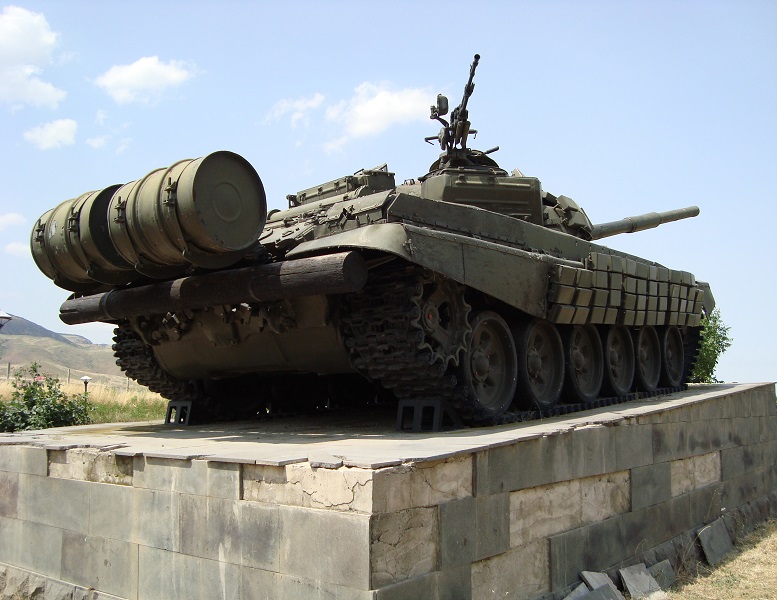
Photo by Adam Jones, Tank Monument – Near Mayraberd (Askerani) – Nagorno-Karabakh, June 2015, https://www.flickr.com/photos/adam_jones/18582153944. No modifications to photo. Creative commons license https://creativecommons.org/licenses/by-sa/2.0/

[1] The last official population count in Nagorno-Karabakh was conducted in 2016. The number was 146 260 (https://www.kavkaz-uzel.eu/articles/280021/). However, this number might vary from what the Azerbaijan authorities have.

[2] The number of registered parties have been growing recently, see Caucasian Knot, Non-parliamentary opposition of Nagorno-Karabakh joins presidential campaign, https://www.kavkaz-uzel.eu/articles/333391/

[3] According to the Internal Displacement Monitoring Centre (IDMC), the number of IDPs in Azerbaijan as of 31 December 2018, was 344 000. In addition, 301 000 IDPs had made partial progress towards a durable solution, http://www.internal-displacement.org/countries/azerbaijan According to Nagorno-Karabakh sources, there are more than 30 000 IDPs in Nagorno-Karabakh. https://www.osce.org/odihr/344716

[4] Russia-Armenia Info, Armenians in Russia, http://www.russia-armenia.info/node/16443

[5] Caucasian Knot, Nagorno-Karabakh after the truce: A two-year war, April 2018, https://www.eng.kavkaz-uzel.eu/articles/42824/

[6] As noted in footnote 3 there are a larger number of Azerbaijani IDPs from Nagorno-Karabakh and the surrounding territories in Azerbaijan.

[7] Ani Mejlumian, Armenia beings probe of 2016 war, June 2019, Eurasianet, https://eurasianet.org/armenia-begins-probe-of-2016-war

[8] Caucasian Knot, Refugees in Nagorno-Karabakh talked about housing problem (in Russian only), June 2019, https://www.kavkaz-uzel.eu/articles/336960/

[9] Ibid.

[10] According to a recent report, “official figures shows that more than 313 thousands IDPs still live in unfit buildings in emergency state in Baku, Sumgait, Ganja and other cities and districts”. Human Rights Club, The Human Rights Situation of Internally Displaced People in Azerbaijan, November 2018, p. 10, available at: https://www.humanrightsclub.net/en/news/2019/human-rights-situation-of-internally-displaced-persons-in-azerbaijan/

Footnotes
    Related Articles

    On Crimea

    Article by Anton Nemlyuk

    On Crimea

    At the end of March 2019, 20 people were detained in Crimea on one day, with 23 people arrested in total.[1] These were Crimean Muslims accused of participating in the Islamic party Hizb ut-Tahrir, recognised as a terrorist group in Russia since 2003. The next dayin the Russian town of Rostov three more Crimean Muslims, who were not found during searches the day before, were detained on the same charge. A couple of weeks later, Raim Ayvazov was detained at the border. He was about to leave Crimea, going to the Ukrainian city of Kherson in order to get documents. The Federal Security Service officers took him to a field near the border, put him on his knees and began to shoot a gun close to his head, forcing him to confess and to incriminate the other detainees. He agreed of course, although he later recanted and told the court about the imitation of the shooting, which he was subjected to by the Russian secret services. Before telling what had happened to him in public, Raim Aivazov, though very afraid, was able to transmit the information to his lawyer Maria Eismont. She, in turn, handed the story over to Crimean human rights activists, who told it to the journalists including me, the author of this essay. This scheme, a cooperation between the lawyer, the human rights activist and the journalist, is the most effective one from the point of view of both journalism and human rights protection. As experience shows it is most effective from the point of view of protection of persons prosecuted unlawfully for political or other reasons. Before Eismont, Ayvazov had a lawyer appointed by the state, who intimidated him and persuaded to ‘admit’ his guilt. If Eismont had not listened to him, then the information about what he had been subjected to would not have appeared at all. The remand hearing concerning Aivazov, like almost all political proceedings in Crimea, was held behind closed doors, and it was impossible for journalists, observers, and even relatives to get in the court room. If the activists whom the lawyer had told about Ayvazov’s ‘shooting’, had not contacted the journalists, this information would have remained only on social networks and would not have spread beyond them, causing a reaction from the supervisory authorities.

    My journalistic activities in Crimea began in the summer of 2016. Since then I have spent almost all of my time on the peninsula: one month on a business trip, the next on various trips and working with material, then returning back to Crimea again, covering almost all political trials that are held there of Crimean Tatar and Ukrainian activists. This experience forms the basis of the ideas in this essay about the most effective interaction with lawyers and human rights activists in Crimea.

    In the spring of 2015, when mass detentions of Crimean Tatars and politically motivated abductions of activists became a reality brought by the Russian authorities, the human rights organisation ‘Crimean Solidarity’ was formed on the peninsula and still operates successfully there. It united lawyers, relatives of political prisoners and those activists who engaged in providing legal assistance to prisoners, helping families and children left without fathers because of an arrest or an abduction. Activists carry out the information gathering work as well – they cover court hearings, searches, detentions, and generally those activities conducted by Russian security forces that are related to violation of human rights on the peninsula. Several representatives of the Ukrainian Cultural Center, the remnants of Ukrainian society in Crimea, who are subjected to constant persecution, take part in the monthly meetings of Solidarity, but all the activists are Crimean Tatars, Muslims. They have been persecuted since the beginning of 2017, not only for their political disloyalty to the Russian authorities (as was the case of ‘February 26’, when participants of the February 26 rally, 2014, were persecuted; they had demanded the local parliament deputies to retain Crimea as a part of Ukraine), and not only for disobeying the Crimean Muftiat, which is the Muslim governing body that is fully controlled by the Russian security services, but, above all, for their civil and human rights activities. ‘Solidarity’ rather quickly formed a structure in which there are groups of ‘streamers,’ that is, ‘civil journalists’ who cover the persecution by Russian authorities in social networks; a group of ‘civil defense counsels’, lawyers who had acted as defense counsels in court cases with non-criminal charges, for example, because of protest pickets; and a separate group was engaged in providing everything the prisoners needed. This final group helped families and, above all, children, many of whom needed psychological support after having experienced a search, an arrest at home and the trials of their fathers. 18 people out of the 24 detainees, accused of participating in Hizb ut-Tahrir mentioned at the beginning of this essay, are activists of ‘Crimean Solidarity’.

    Generally speaking, ‘Crimean Solidarity’ took over the functions of a human rights community on the peninsula. Representatives of international human rights organisations can not work legally on the peninsula because Russia has made their presence in Crimea dependent on the actual recognition of the annexation. “Please come to work in Crimea, if you want to,” Russia says, for example, to the Organisation for Security and Co-operation in Europe (OSCE) Observer Mission, which has a mandate to monitor Crimea, but which is based in Odessa. “However you must get a permission from us, because this is our territory.”[2] It is obvious that human rights organisations cannot do that. However, in 2015, the Turkish human rights mission visited Crimea and published a report after the visit, where it severely criticised the actions of the Russian authorities and security forces, specifically relating to human rights violations including politically motivated prosecutions, abductions of activists, infringement of the Crimean Tatar language in education and so on.[3] Over the past year, two joint human rights teams were able to work in Crimea. They met with the families of political prisoners and activists of ‘Crimean Solidarity’, but they entered the peninsula while preserving their secrecy, which of course limited their activities. Likewise, Ukrainian human rights activists rarely work in Crimea, entering under the guise of tourists. But in this case, they are often surveilled by Federal Security Service (FSB) officers, that keep them under observation and wiretap their phones. The last time an employee of a Ukrainian human rights organisation (the author omits the names of the organisation and the employee for security purposes) had worked in Crimea and was traveling back to mainland Ukraine, an FSB Border Guard officer warned her directly: “Today we release you, but if you come again, you will get problems due to unauthorised activities of a foreign organisation.”[4] All Ukrainian human rights organisations are forced to follow what is happening in Crimea from Kyiv, receiving information from the activists from ‘Crimean Solidarity’, a small number of journalists and local lawyers. In turn, they can only covertly help activists and lawyers, constantly endangering those whom they are helping. Russia has developed a large law-enforcement practice of persecution for contacts with ‘undesirable organisations’ and ‘foreign agents’.

    At the same time, Russian human rights organisations are not very eager to work in Crimea. A reaction from Ukrainian colleagues almost always follows activities carried out by Russian human rights defenders on the peninsula, reminding them that Crimea is part of Ukraine, even if annexed by Russia at present, and that Russian organisations should appear there only with the sanction of Ukraine. There are not many Russian human rights activists, including those who believe the same, who are willing to engage in a political scandal. A few Russian human rights activists, who systematically work in Crimea, need in addition to get a work permit from the Ukrainian authorities each time they go to the peninsula. They must submit an application to the Foreign Ministry, carry the documentation package personally to the migration service, come personally and get a special permit, and then travel exclusively through Ukrainian border posts on the isthmus that connects Crimea with the Kherson region. Usually, in order to obtain such a permit, it is necessary to wait between three days to a week. Despite all attempts to facilitate the procedure, for example, to be able to get permission remotely, without coming to Kyiv personally, the situation has not changed for the past five years. The direct arrival of Russian human rights defenders by plane from Moscow or across a bridge connecting Crimea and Russia, most often does not cause official Kyiv to react, even though it violates Ukrainian border legislation. There is however no guarantee that Ukraine will not remember these violations in the future. Few are willing to risk relationships with Ukrainian colleagues and authorities. Despite constant evidence of torture used by FSB officers, the ‘Committee against Torture’, for example, headed by Igor Kalyapin, does not work in Crimea. The same Russian human rights activists who have been working here since 2014 are in fact, still working on the peninsula; no new ones have appeared on the scene during the last five years.

    The community of lawyers in Crimea remains in a similar situation. Ukrainian lawyers cannot work on the peninsula at all, and they can only provide support to the Crimeans who complain to the European Court of Human Rights (ECHR), or in Ukraine itself, if required. They cannot defend clients in Crimean or Russian courts. Their interaction with Ukrainian law enforcement agencies, which initiate cases against Russian secret service officers and law enforcement agencies in Crimea, turns them into enemies of the Russian authorities on the peninsula. In 2016, Russian border guards barred Ukrainian lawyer Yevgenia Zakraska from entering Crimea until the end of 2020.

    Inside Crimea there has developed a community of lawyers working on political judicial processes primarily relating to Crimean Tatar activists, the most heavily prosecuted group. These lawyers are either Ukrainian, who lived in Crimea in 2014 and have undergone a re-certification, or those who have received that status during the past five years. From the point of view of their work, they are considered in the same way as those Russian lawyers who come to Crimea from Russia. Nikolay Polozov, who first defended Nadezhda Savchenko, and then the Mejlis deputy chairman (the Crimean Tatar People´s self-government body, forbidden by Russia) Akhtem Chiygoz in the ‘February 26’ case, is one example.

    Since 2014, the legal association ‘Agora’ has been working in political judicial processes in Crimea. Agora is probably the most well-known Russian association, with the biggest counsel stories. Dmitry Dinze, who was then part of Agora, defended the Ukrainian director Oleg Sentsov, while Svetlana Sidorkina defended the anarchist Alexander Kolchenko. However, the lawyers of Agora did not live in Crimea until 2016. The lawyer Alexey Ladin moved to the peninsula later, he joined Agora and became their representative in Crimea. The activities of Agora on the peninsula are also important, because the association pays great attention to information support in relation to their affairs and to cooperation with journalists. However, Russian lawyers, as well as human rights activists, have faced a reaction from Ukraine due to the fact that they had entered Ukrainian Crimea.

    As Pavel Chikov, head of Agora explained it was a little unexpected: you think you are trying to bring good things to people, and then you get criticised by your colleagues. The logic is clear: by participating in the protection of these people, you legitimise annexation, but we acted out of the considerations that there is a person, he has problems, respectively, he needs help. Everything else is secondary.[5]

    In the spring of 2016, seven journalists in Crimea were searched on the same day. They were all witnesses in the case of their colleague Nikolay Semyona, who was accused by Russian authorities of separatism for an article published on Radio Free Europe/Radio Liberty, where he spoke positively about the energy blockade of Crimea.[6] The blockade had been organised by Ukrainian nationalists and Crimean Tatars in the autumn of 2015. Mass searches forced some journalists to leave Crimea and follow their colleagues, who had mostly left earlier, while others abandoned journalism. According to lawyer Alexander Popkov “with the help of the Semyona case, the Russian authorities crushed the network of independent journalists on the peninsula”.[7] Even earlier, the editorial offices of the Crimean Tatar TV channel ATR, the Radio Free Europe/Radio Liberty project ‘Crimea Realia’, the Black Sea TV Company and other independent journalistic groups were forced to flee Crimea. After that, independent correspondents in Crimea worked unsystematically, except for the time when the journalist from the Russian ‘Novaya Gazeta’, Ivan Zhilin, lived in Sevastopol. In order to get to Crimea without violating Ukrainian border legislation, foreign journalists had to go through the same procedure as human rights activists. However they had to submit an application to the Ukrainian Ministry of Information and Press and not to the Foreign Ministry. This procedure takes up to a week, so the journalist first has to spend that time in Ukraine, then he must go across the isthmus, being subjected to interrogations and additional verifications, first by Ukrainian secret services, then by the Russian ones. When he leaves the peninsula, everything happens in the reverse order, but the interrogation by the FSB officers is more often quite harsh, especially if the journalist has met with activists, lawyers and families of political prisoners. FSB officers check the correspondents´ equipment and phones, that they download information from. They take fingerprints and interrogate about all of their contacts on the peninsula. These obvious risks, as well as the fact that Crimea has gradually, over the past five years, left the media agenda, lead to the fact that foreign journalists travel to the peninsula less and less frequently. From a Ukrainian perspective Russian independent journalists do not from other foreign ones, but in order to not to get involved in the procedure of obtaining permits and passing the administrative border, they travel from Russia directly, hiding under a pseudonym. There just are no independent journalists among the Crimean media, that are controlled by Russian authorities and secret services.

    The challenges that human rights defenders, lawyers and journalists in Crimea are facing, also have determined the nature of their cooperation. First-hand information about the events taking place is  most often obtained by lawyers from their clients and their clients´ families. They are called upon for help during searches and detentions. They transmit this information to the activists of ‘Crimean Solidarity’ and human rights activists, who disseminate it on social networks and transmit it to professional journalists. And it does not really matter where these journalists are located – in Crimea, on mainland Ukraine or in Russia. Much more important is the personal confidence in the media and journalists, with whom lawyers and human rights activists work. Such an arrangement gives rise to problems for all of its participants.

    A journalist, that receives information from activists or human rights defenders, cannot actually check it immediately if he is not in Crimea. He is forced to rely on the information as trustworthy and he can only verify it later, either through judicial documents or on the spot through contact with the prisoners´ relatives. At the same time, it is clear that human rights activists and, even more so, lawyers, have their own goals, namely to protect the persecuted person. Based on that, a lawyer may not share all information, activists may not want to disseminate facts that can harm a person. A journalist has a goal to inform the public, but it is impossible to do so if providing information only partially. If the information is socially significant, it has to be complete. In 2018, one of the Crimean Tatars (the name is kept out for security purposes) was arrested by Russian secret services, accused of participation in the Crimean Tatar volunteer troop named after Noman Chelebedzhikhan. That troop operates in the area of ​​the administrative border with Crimea, and Russia qualifies participation in it as participation in an illegal armed formation. Already in custody he managed to get in touch with activists, who then found me, so that I could cover his case and his trial. I rechecked his story with the leader of the troop, who confirmed that the Crimean Tatar really had wanted to join the troop, but was not accepted because of a criminal prosecution for robbery, from which he had to flee from Crimea. When the text was ready, the lawyer and his client suddenly changed their position, stating in court that he had never wanted to join the troop and had not even left the peninsula. And it was precisely this position that they had wanted to see reflected in the reporting. It was clear that the publication of the article could harm the defense strategy of the Crimean Tatar in court, but it was also impossible to publish deliberately false information. This apparent contradiction between the work of a journalist and a lawyer or human rights activist occurs quite often while working on issues of human rights violations and political persecution.

    The Crimean Tatar Eden Bekirov is now kept in a detention facility in Simferopol, accused of illegal handling of explosives and ammunition. He has one leg and a first-degree disability, as well as a severe form of diabetes. His health has been deteriorating since he was arrested in the December 2018, but each time a remand hearing concerning the extension of his custody for the investigation period, is approaching, the defense counsel informs that he is dying in custody. This fact is impossible to check. Both human rights activists, most journalists and Ukrainian media use it very actively, referring to the defense counsel, but the reliability of this information is however not confirmed by anything else than the lawyer´s words. For him it is of course beneficial for the defense of Bekirov.

    Nevertheless, an effective interaction between lawyers, human rights defenders, activists and journalists has developed in Crimea. After many years of working in Crimea, and in fact, no new journalists or human rights activists have appeared on the scene during the last five years, all participants of this system have developed confidence in each other. The main question that Russian secret services ask me when I cross the administrative border is: “Who provided you with information? Where did you get the documents for your article? Whom of the lawyers were you in contact with?” It is clear that the effectiveness of our interaction with lawyers depends on our silence in response to that question. The objectivity and completeness of the articles depends on how effective that interaction is. This will, in turn, affect how effectively the human rights defenders will be able to use those texts for advocacy. All these interactions are based on trust – there are risks for any of the participants in this scheme. A lawyer risks when he delivers documents and information from a classified case to journalists and human rights activists. A journalist risks responsibility for disclosing this information if he refuses to name his source. In addition he also risks his own authority because he often cannot verify the information. The human rights activist can neither check this information and risks using materials from a journalist for advocacy purposes and, for example, for writing monitoring reports. It is quite possible that this effective scheme would not have developed in Crimea if the brunt of political persecution had not fallen on the mono-ethnic community of the Crimean Tatars. They have both the experience from the national movement following the deportation in 1944, and the religious solidarity of an Islamic community. Lawyers working on political affairs, and human rights activists from ‘Crimean Solidarity’ appeared first among the Crimean Tatars. They were only subsequently joined by professional journalists.

    Author’s recommendations:

    • To create an informal association of journalists, who focus on religious and political persecutions, lawyers and human rights defenders on the basis of a Russian human rights organisation (for example, ‘Memorial’) or an international organisation. Such an association would be able to provide a base of experts and lawyers for certain cases. This will, in turn, provide lawyers and human rights defenders with an opportunity to address journalists directly. It will also give them an idea of whom they can trust in relation to cooperation.
    • To seek from Ukraine a simplification of the entry procedure to Crimea for journalists, human rights activists and Russian lawyers. Ideally, to be able to apply for and receive permission remotely, as well as to be able to enter Crimea not through mainland Ukraine, without violating the border legislation.

    Author’s bio: Anton Nemlyuk is a Russian historian and journalist. He graduated from Saratov State University (Russia). Until 2012 he worked as a teacher, and thereafter, as a journalist. Since 2016 Anton has been working in Crimea, covering human rights violations, also as a court reporter.

    [1] Human Rights Watch,  Escalating Pressure on Crimean Tatars, April 2019, https://www.hrw.org/news/2019/04/02/ukraine-escalating-pressure-crimean-tatars

    [2] Victor Lyashchenko, In Crimea, they said that the UN mission could come, but constantly refused, RIA Novosti, September 2017, https://ria.ru/20170927/1505682403.html

    [3] TRT Russian, Turkish delegation released a report on human rights in Crimea, June 2015,  https://www.trt.net.tr/russian/iz-rossiiskogo-i-turietskogo-mira/2015/06/15/turietskaia-dielieghatsiia-obnarodovala-doklad-o-pravakh-chielovieka-v-krymu-304805

    [4] Based on Anton’s own interview – conversations with the representative from Ukrainian organisation

    [5] Anton Naumluk, Dark times in the Crimea. Agora Protects Dissenters, Svoboda, February 2019, https://www.svoboda.org/a/29760481.html

    [6] Valentin Gonchar, The blockade is a necessary first step towards the liberation of Crimea, Radio Free Europe/Radio Liberty, https://ru.krymr.com/a/27240750.html

    [7] Popkov mentioned it at the interview to the author, but also repeated this to Novaya Gazeta, Collapse networks, July 2016, https://www.novayagazeta.ru/articles/2016/07/11/69229-svorachivayte-seti

    Footnotes
      Related Articles

      Education and Information – the golden passport for young Transnistrians

      Article by Alina Radu

      Education and Information – the golden passport for young Transnistrians

      Imagine that you are young, hardworking and have just been accepted to one of the best universities in Europe, you even got a scholarship that covers your expenses, but your passport is closing all the doors. No, you did nothing wrong, you were just born in a difficult place. Imagine you have opportunities to study in good schools and you want to bring back all the knowledge you will obtain back to your people, but your region is not on official maps, nor on official lists of passports to get a visa or a travel permit. Imagine that the leaders of your homeland travel to the most beautiful and developed countries, for business and/or vacations, but you cannot leave to go study. Is that right? Does that align with human rights?

      This is what has been happening for the last few decades in the Transnistrian region. For more than 20 years, some thousands of people born in this territory get passports that represent, in a way, their identity but not their opportunities. With a Transnistrian passport someone can travel to a very limited number of places, almost nowhere, because not one United Nations (UN) country recognises it as a country.[1]

      Being born on a territory that limits educational (and any other) opportunities should not be a source of guilt, but a synonym for the fight for personal rights. ‘Everyone has the right to leave any country, including his own’ says the Universal Declaration of Human Rights (Article 13). But, there are territories that are not state parties to UN covenants, or other standards of human rights.[2] 

      If a passport does not allow you to travel abroad for University, ask yourself how do the leaders of the Transnistria region travel?[3] A video filmed last year at Chișinău (capital city of Moldova) Airport, shows the arrival of Transnistrian leaders from Germany with a large load of goods, while their bodyguards were blocking reporters from filming and asking questions. Transnistrian leaders hold passports from other countries. So, if they lead a de facto state but travel with the passport of another country, people deserve to know how they have achieved this and how it could also work for themselves.

      After decades of this unrecognised reality, some people in the Transnistrian region have as many as four to five passports from different entities: the Soviet one – for memories, the Transnistrian – for local identification, the Russian – to travel to Russia and former Soviet Union territories, the Moldovan – to travel to up to 70 countries, and some people also have the Romanian passport, that allows them to travel to 118 states without a visa.

      Travel abroad is possible only with the last three passports, with the last two there are no visa requirements to travel to the European Union (EU), and with the last one you have the possibility to work in the EU and be exempt of educational taxes for student fees in many universities.

      It has been almost five years since the start of the Visa Free Regime between Moldova and the EU, and any person born in the Transnistrian region is welcome to get a Moldovan passport. By having that passport they also find it easier to directly access their rights, including those specified in the UN Charter, the Council of Europe charters, and specifically the European Court on Human Rights (ECtHR). And this form of access works, with the support of Moldovan lawyers and NGOs to raise matters with the international mechanisms.

      Having a right does not mean it is automatically respected in such unrecognised areas. But it does mean that there is a system of rights and institutions with obligations to uphold those rights. Thomas Hammarberg, in his role as UN Senior Expert on Human Rights in Transnistria, did a monitoring visit to Transnistria back in 2013.[4] The conclusions were not the most positive and there were many recommendations for improvements. Five years later, Hammarberg returned to Transnistria and found an amazing thing.[5] Yes, the territory is still unrecognised and the institutions are not efficient, but he noticed ‘a growing human rights awareness in the Transnistrian region. In several key areas’. It is obvious that in the Transnistrian region more and more people know what their rights are and where to look for truth and justice, but the way to go is still long.

      While many of the Transnistrian people use Moldovan passports, they cannot use the Moldovan judicial system to fight for their rights. But they may ask for help from the ECtHR.

      The Media Center in Tiraspol does the hard job of amplifying the voices of citizens in the region. A special online project ‘No Torture!’ helps citizens to understand their rights, how not to be punished unlawfully and how to get help.[6] A specially-made video aids in informing citizens from the region how to appeal to the ECtHR.[7]

      There is a long list of cases won by citizens from the Transnistrian region at the ECtHR. It started in 2004, when a group of prisoners of war detained since 1992 in different prisons in the region won their case at the ECtHR. The Ilascu Case was the first case to prove at an international court that the Russian Federation was involved in the war of 1992 and in the further separation of the region.[8] The Russian Federation accepted the decision and payed damages to all four prisoners of war.

      After that, many other groups from the region claimed justice at the ECtHR and won. Among these numerous groups were parents and children attending Romanian language schools in Transnistria that had been prohibited to study in their mother language in their home cities. The Russian Federation was found guilty of obstruction of education rights in eight schools in the region.[9] The decision was pronounced in 2012. The Russian Federation has not yet paid damages, but there has still been a decision and all the pupils, their parents and teachers have learned that they have rights in this issue. Many of those pupils have already finished school and many of them got into European Universities, including Romanian establishments that provide scholarships to young people in difficult conditions. Through the ECtHR case people involved have learned to have a better future, a future with fulfilled human rights.

      The violation of human rights in the region never stopped, but the number of people looking for justice in respect to their rights is higher. The 2018 list of decisions from the ECtHR about citizens living in the Transnistrian region is long enough, and the guilty countries are the Russian Federation and the Republic of Moldova.[10] Transnistria, not being considered a country, is not named guilty, but a list of local officials are named guilty for breaking fundamental human rights. The names of officials include Igor Smirnov, former president of the region and his son Vladimir Smirnov – the former head of local customs. People complained against them for multiple reasons, including inter-alia; unlawful detention, torture, limited access to properties, right to education; and all of them won. Many of the complainants received financial damages paid by the Republic of Moldova and the Russian Federation. All of them made the complaints to the ECtHR as citizens of the Republic of Moldova or the Russian Federation. Not one person made a complaint on the basis of Transnistrian identity. Citizenship is a right and a tool for enforcing rights – a lesson learned by all sides.

      A short look at the official news webpage of the Transnistrian administration shows that Moldovan citizenship is largely recognised. At the end of April 2019 a Moldovan athlete, Lilia Fisikovich was selected to participate at the Olympic Games in Tokyo in 2020.[11] She was born in Tiraspol, the capital of the Transnistrian region. But she won under the Moldovan flag and she is congratulated on both sides of the river Nistru. Recently, a group of children from Transnistria won medals at an international swimming competition in Ukraine.[12] How could people from a disputed territory participate in competitions in Ukraine that is suffering from territorial disputes? The young swimmers competing under the Moldovan flag, and most probably, with Moldovan passports.

      So did ‘DoReDoS’, a band from the region who won the national Moldovan Eurovision contest and represented the whole of Moldova in Portugal in the 2018 ‘Eurovision’ international contest.[13] Some days ago, the same state agency informed the public that the title ‘Miss Europe’ belongs to a Transnistrian girl.[14] While the word ‘Europe’ is used in music, sports and cultural events, in politics it is seen as a problem in many cases.

      Looking at the same official press agency from Tiraspol, ‘Novosty Pridnestrovia’ we find many ‘bad news’ articles of events happening in EU countries: ‘press freedom in EU is worse than ever’, ‘death because of air pollution doubled’, ‘tourists in Europe are unhappy’.[15] All of these negative news articles are based on real facts and no doubt do contain some information citizens should be informed about. But, for example, on the same press agency webpage we could not find one article about freedom of the press in the Transnistrian region.[16] Reporters from the region have come a long way from the Soviet era of journalism to modern reporting. They have participated in hundreds of media trainings in Chișinău, Brussels, Riga, Stockholm, Washington DC, and Chicago. They have visited newsrooms worldwide and they have learned how to make balanced news, visual journalism, and investigative reporting. Thus, their inability to work at home and the lack of freedom of the press in the region is among the worst problems for Transnistria. One of the few articles in the region about freedom of the press argues that it is much worse in Transnistria than everywhere else in Europe.[17]

      While Article 10 of the European Convention on Human Rights (ECHR) guarantees ‘freedom to hold opinions and to receive and impart information and ideas without interference by public authority and regardless of frontiers’, reporters in the region claim that they cannot publish any critical article about the ruling administration, that many editors-in-chief and journalists were fired because of their wish to use freedom of speech. It is not enough to have the freedom to criticise the Moldovan Government or European governments. Journalists and society should be able to analyse and debate problems at the local level. For now, one good thing in the region for journalists is that they can travel to many places with Moldovan passports to learn. Back at home, they, as holders of Transnistrian passports, cannot write free news if they are critical about the local government, and they might not be able to publish positive news if it is about Moldova as a whole or about the EU. Despite these issues, there is the Internet for sharing and publishing news that has no borders.

      Freedom of the press is complex and involves many responsibilities. One of them is to bring to attention the voices of the unheard. The Media Center in Tiraspol helps journalists and citizens to shed light on their lives, including the difficulties. ‘Who are human rights defenders in Moldova?’[18] ‘What is a freelance journalist and how (s)he works?’[19] ‘What is the right to information?’[20] – The answers to all these questions are online, and in the Transnistrian region almost every household has access to the internet. There is also information about how to look for information and how to use databases from local government to the Moldovan government.[21] Information in the public realm does not have boundaries. Holders of any passport are able to check public information and databases in Moldova. And when there is a lack of journalists, anybody can learn how to do citizen journalism in Transnistria.[22]

      While modern democratic principles are more and more accepted by citizens of the region and most of the people have and use other countries passports, the authorities of Transnistria stick to the old concept of keeping the region in the list of unrecognised territories. Recently, the president of the region, Vadim Krasnoselsky, promised the citizens that “Pridnestrovie will be recognised. Foreigners should get used to the real name of the country”, adding that “we are a successful modern state”.[23]

      The last meeting between Krasnoselsky and the EU Ambassador to Moldova, Peter Michalko showed again the pleasure to have opened doors to the EU. Krasnoselsky confirmed that the “EU is among the most important trade partners of Transnistria”, while Michalko mentioned that he is glad that “Transnistrian businessmen use the opportunity to have access to [the] EU market and the volume of commercial transactions is growing”.[24] Transnistria does not have any commercial agreements with the EU, the only way for regional businesses to access to European market is to hold official Moldovan documents, including passports. And everybody knows about that fact, including the office of the leader of the region.

      For now, people living on the left bank of Nistru river may get Moldovan passport without any difficulty, have access to education, the health system, pensions, and other services, as well as travel and conduct with business the EU. However, Krasnoselsky claims that any unification with Moldova is impossible. “I am for the unification of Moldova, but without Pridnestrovie. This is fundamental”, claims Krasnoselsky in an official statement.[25]

      Nevertheless, thousands of people living in the Transnistrian region, being holders of Moldovan passports, participated actively in Moldovan elections in February 2019, electing their MPs to the Chișinău Parliament. Despite the rumours that the voters were organised by some politicians, and possibly bribed to vote, the ice was broken and people from the area attained new skills – voting for members of the Parliament of an EU partner country.[26]

      Who wins in this territorial dispute? Russia? Moldova? The EU? The Transnistrian administration?  The real winners are those who obtain access to education and information. Every year thousands of young people from Transnistria, having passports from other countries, travel to study, to visit, to participate in international competitions, conferences, symposiums. Some of them come back to bring their knowledge and experience home, some of them choose to stay in other places. And this effects their personal lives and the life of their region for example by setting up NGOs or working as freelance journalists or independent experts.


      Author’s bio: Alina Radu is the Manager of the biggest investigative reporting group in Moldova – Ziarul de Gardă (ZdG). ZdG is affiliated to GIJN (Global Investigative Journalism Network),WAN-IFRA (World Association of Newspapers – through Moldovan Association of Independent Press), SEEMO (SouthEastEuropean Media Network), RLNE (Russian Language Media News Exchange).ZdG covers Moldova, Romania, former Soviet countries, conflict areas, corruption and human rights – worldwide.

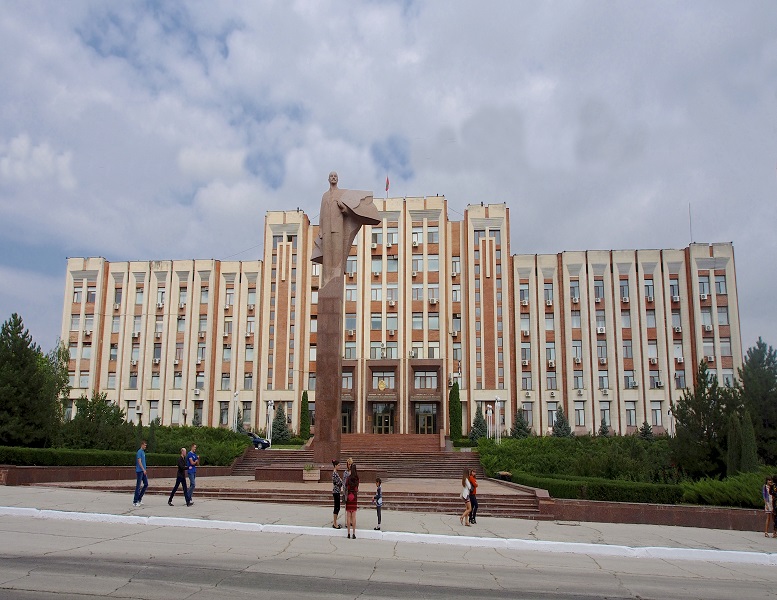
      Photo by Clay Gilliland, Transnistrian Parliament House, September 2013, https://www.flickr.com/photos/26781577@N07/11384632876/. No modifications to photo. Creative commons license https://creativecommons.org/licenses/by-sa/2.0/

      [1] The President Pridnestrovsk Moldavian Republic, About Citizen’s Passport Pridnestrovsk Moldavian Republic, Zakon-pmr.com, March 2002, http://zakon-pmr.com/DetailDoc.aspx?document=62492

      [2] United Nations General Assembly, Universal Declaration of Huma Rights, United Nations, December 1948, https://www.un.org/en/universal-declaration-human-rights/

      [3] Correspondence From Chisinau, Journalists assaulted in Chisinau. The body guard of the Tiraspol leader forbade them to shoot, Stirile TV, October 2014, http://stiri.tvr.ro/jurnalisti-agresati-la-chisinau–paza-de-corp-a-liderului-de-la-tiraspol-le-a-interzis-sa-filmeze_50766.html#view

      [4] Thomas Hammarberg, Report on Human Rights in the Transnistrian Region of the Republic of Moldova, United Nations in Moldova, February 2013, http://www2.un.md/key_doc_pub/Senior_Expert_Hammarberg_Report_TN_Human_Rights.pdf

      [5] Thomas Hammarberg, Statement by Senior UN Human Rights Expert Thomas Hammarberg on the conclusion of his visit on 28 May – 1 June 2018, United Nations in Moldova, June 2018, http://md.one.un.org/content/unct/moldova/en/home/presscenter/press-releases/statement-by-senior-un-human-rights-expert-thomas-hammarberg-on-.html

      [6] Media Center of Transnistria, No Torture! – The main, Media Center of Transnistria, https://pitkamnet.mediacenter.md/

      [7] ProtivPytok, If you are tortured and decide to appeal to the European Court, Youtube video, February 2014, https://www.youtube.com/watch?v=S6r9E1V1BD0

      [8] Human Rights House Foundation, Ilascu and Others vs. Moldova and Russia, Human Rights House Foundation, July 2004, https://humanrightshouse.org/articles/ilascu-and-others-vs-moldova-and-russia/

      [9] Natalia Munteanu, Schools in Transnistrian Region Teaching in Romanian Language Waiting for Solutions to their Problems, PromoLEX, December 2018, https://promolex.md/14094-problemele-scolilor-cu-predare-in-limba-romana-din-stanga-nistrului-raman-in-asteptarea-rezolvarii/?lang=en

      [10] PromoLEX, List of Persons Responsible for Violations of Human Rights in the Transnational Region, PromoLEX, March 2019, https://promolex.md/wp-content/uploads/2019/03/Lista_2018_persoane-responsabile-de-violare_Promo-LEX.pdf

      [11] Sport News, Lilia Fiskovich has passed the selection for the Olympic Games – 2020, Novosty Pridnestrovia, April 2019, https://novostipmr.com/ru/news/19-04-28/liliya-fiskovich-proshla-otbor-na-olimpiyskie-igry-2020

      [12] Sport News, Transnistrian swimmers won medals in the Championship of Ukraine, Novosty Pridnestrovia, April 2019, https://novostipmr.com/ru/news/19-04-29/pridnestrovskie-plovcy-zavoevali-medali-na-chempionate-ukrainy

      [13] Ephraïm Beks, Moldova chooses DoReDoS for Lisbon, Eurovision, February 2018, https://eurovision.tv/story/doredos-to-represent-moldova-in-eurovision-2018

      [14] Society News, The participant of the Dubossary Team ‘Serpentine’ won the title ‘Miss Europe’, Novosty Pridnestrovia, April 2019, https://novostipmr.com/ru/news/19-04-06/uchastnica-dubossarskogo-kollektiva-serpantin-zavoevala-titul-miss

      [15] Site Search, Search query ‘Europe’, Novosty Pridnestrovia, https://novostipmr.com/ru/search/site/%D0%95%D0%B2%D1%80%D0%BE%D0%BF%D0%B0?page=5

      [16] Site Search, Search query ‘Freedom of press’, Novosty Pridnestrovia, https://novostipmr.com/ru/search/site/%25D0%25A1%25D0%2592%25D0%259E%25D0%2591%25D0%259E%25D0%2594%25D0%2590%2520%25D0%259F%25D0%25A0%25D0%2595%25D0%25A1%25D0%25A1%25D0%25AB

      [17] Vladik Magu, Freedom of speech in Tansnistria, NewsPMR.Com, February 2018, http://newspmr.com/novosti-pmr/obshhestvo/17409

      [18] Michael Forst, On the situation of human rights defenders in the Republic of Moldova, Media Center of Transnistria , July 2018, https://mediacenter.md/prava_celoveka/1356-o-polozhenii-pravozaschitnikov-v-respublike-moldova.html

      [19] Media Center of Transnistria, Freelance journalist: specifics of work in Transnistria, Media Center of Transnistria, December 2017, https://mediacenter.md/dostup_k_informacii/1286-zhurnalist-frilanser-specifika-raboty-v-pridnestrove.html

      [20] Media Center of Transnistria, The result of the verification of the violation of the fundamental right – the right of access to information, Media Center of Transnistria, May 2017, https://mediacenter.md/dostup_k_informacii/1216-rezultat-proverki-narusheniya-fundamentalnogo-prava-prava-na-dostup-k-informacii.html

      [21]Media Center of Transnistria, Databases to assist investigative journalists, Media Center of Transnistria, October 2016, https://mediacenter.md/dostup_k_informacii/1138-bazy-dannyh-v-pomosch-zhurnalistam-rassledovatelyam.html

      [22] Media Center of Transnistria, Recruitment to the School of Citizen Journalism, Media Center of Transnistria, March 2019, https://mediacenter.md/obiavleniya/1410-nabor-v-shkolu-grazhdanskoy-zhurnalistiki.html

      [23] Press Officer, Vadim Krasnoselsky: “Transnistria will be recognised. Foreigners need to get used to pronouncing its true name”, President.gospmr, April 2019, http://president.gospmr.org/press-sluzhba/novosti/vadim-krasnoseljskiy-pridnestrovje-budet-priznano-inostrantsam-nado-privikatj-proiznositj-ego-istinnoe-nazvanie-.html

      [24] PSPPMR, President of the PMR met with the Head of the EU Delegation to Moldova Peter Mihalko, Youtube video, April 2019, https://www.youtube.com/watch?v=T6eq9H0Tf4k

      [25] Special Opinion News, Vadim Krasnoselsky: I am for a united Moldova, but without Transnistria, Novosty Pridnestrovia, February 2019, https://novostipmr.com/ru/news/19-02-11/vadim-krasnoselskiy-ya-za-edinuyu-moldovu-no-bez-pridnestrovya

      [26] Reporter de Garda, How people voted in Varnita / Parliamentary Elections, Youtube video, February 2019, https://www.youtube.com/watch?v=bpXMneHPEWc&t=4s

      Footnotes
        Related Articles

        Conclusions and Recommendations

        Article by Gunnar M. Ekelove-Slydal, Adam Hug, Ana Pashalishvili and Inna Sangadzhiyeva

        Conclusions and Recommendations

        This collection of essays has sought to provide a platform for a range of different views about some of the most challenging debates in human rights and peace building. It does not make any claim to be exhaustive or definitive, indeed there are many important perspectives that will need to be part of future work, but it does attempt to be a starting point for conversations about the competing rights and responsibilities at play in this challenging area. It also seeks to remind all parties to the conflicts and the international community at large that all people have human rights irrespective of where they live.

        Neither the editors of this publication nor their respective organisations, the Foreign Policy Centre (FPC) and the Norwegian Helsinki Committee (NHC), are endorsing any views on the intractable issues of status set out by a number of the other essay contributors. However, it is important that local voices are heard, while recognising and understanding that their positions can be painful to hear for those from the states from whom they are trying to formally separate and particularly for those from internally displaced persons’ (IDP) communities whose lives have been changed irrevocably by the conflicts that forced them to flee. Nevertheless, the issues around status remain intractable at an intergovernmental level and the subject of much substantive research by peacebuilders and academics that we do not attempt to replicate here. It is with that in mind that the conclusions that we attempt to draw here and the suggested recommendations for action look to proceed as much as is possible, given the challenges of doing so, from a status-neutral position.

        At the heart of this debate is the question of whether and how the international community should engage with the de facto authorities, local civil society and civil society. Georgia, Azerbaijan and Ukraine in particular[1] robustly defend against any initiatives that would be seen to lend credibility to the de facto authorities or their policies. As a result, engagement on these issues by international governments and institutions from the Organisation for Security and Co-operation in Europe (OSCE) to the European Union (EU) is couched in terms of reiterating and reinforcing the parent state’s position on territorial integrity. The de facto authorities in turn similarly robustly defend their own claims to independence and regularly reject initiatives and attempts at international monitoring that seek to assess the situation in the breakaway regions formally as part of the international community’s work in the parent state. For example, efforts by the United Nations (UN) Human Rights Council and special rapporteurs to visit Abkhazia and South Ossetia as part of their mandate investigating the situation in Georgia have been rejected a number of times.

        Recent efforts to change facts on the ground that only create further challenges on the issue of status, such as the attempts at ‘borderisation’ through barbed wire fences and other means, between both South Ossetia and Georgia and between Abkhazia and Georgia, risk undermining the human rights of people living in or near the Administrative Boundary Lines (ABLs). Such changes create specific challenges for members of the two disputed territories’ Georgian communities and those living in Georgian controlled territories. Stopping ordinary people from physically crossing the ABLs or making it more difficult for them to travel by preventing them from getting the relevant documents both impinges on their human rights and undermines efforts at confidence building that would be a necessary part of any path to conflict resolution. The Government of Georgia may also want to consider however that particularly in Abkhazia the inability of the de facto authorities to build their own capacity, partially as a result of international pressure, has led to an expansion in Russian control and influence beyond what would have been desired by many in the local power elites.

        In this essay collection a number of different authors make suggestions for engagement to address both human rights challenges and to build local capacity to address every day needs, some of which are more status neutral than others. While these are all worth considering on their own merits the editors wish to narrow the focus of our conclusions overall to three areas: engagement with civil society such as non-governmental organisations (NGOs), journalists, lawyers and other non-state actors; access to international law; and the rights of national minorities and IDPs.

        Civil Society

        This collection has made clear that finding ways to engage with and support local NGOs, journalists and lawyers to learn, strengthen and push back against those that would curtail their activities are central to efforts to improve human rights in unrecognised states. International NGOs and donors can face a significant challenge in making contact with their counterparts in de facto states through a mixture of bureaucratic hurdles, political pressure and legal restrictions or sanctions by both status conscious ‘parent’ states and wary de facto authorities. Physically getting access to de facto states can be challenging, particularly for those seeking to do so in a manner that doesn’t antagonise the parent states (accessing the de facto states from Georgia, Azerbaijan and Ukraine rather than the quicker routes via Armenia and Russia). Azerbaijan has been known to blacklist people that have visited Nagorno-Karabakh via Armenia without permission and organisations that do not follow the procedures set out by Georgia and Ukraine will face a significant backlash that would create problems for their work in those countries. In his essay Anton Nemlyuk specifically called on Ukraine to find ways to request permission to access Crimea remotely and if possible find ways to allow permission for access via Russia rather than Ukraine’s land border, while the NHC and others have called for greater flexibility from all parties to facilitate people-to-people contact both to allow status-neutral field research and to work directly with local counterparts.

        Access issues include attempts to restrict the international funding of NGOs by the South Ossetian (and of course Russian) foreign agents laws, Transnistrian legislation on reporting requirements and funding approval by the Coordination Council of Technical Aid[2], as well as other official and unofficial pressures from the parent state against local NGOs collaborating with international groups. The precarious legal and security situation facing the de facto authorities, as well as Russian pressure in a number of cases, is a key factor in the wariness towards international collaboration. However, given that these de facto administrations regularly call for international engagement, the EU and international governments need to be proactive in defending the right of international civil society to gain access. Efforts at improving access for human rights NGOs will of course sit alongside similar efforts to defend Track-2 peacebuilding initiatives, with efforts to improve human rights potentially creating more space for honest and open dialogue on conflict issues. 

        A range of different types of civil society engagement that would be beneficial have been suggested throughout this publication. These include supporting independent reporting and newsgathering efforts to draw attention to the activities of the de facto authorities, improving awareness and accountability amongst the residents of the de facto states, within the public and elites of their metropolitan state patrons, ‘parent’ states and to the international community. There are also calls to back efforts that bring together lawyers, journalists and NGOs to encourage collaboration. Such collaboration is believed to be important in addressing human rights issues, disseminating knowledge about human rights and building pressure on authorities (de facto and de jure) to address issues. This work could be through joint trainings, ad hoc collaboration or assisting with the development of more structured, though still informal, associations to help build networks and trust.

        Donors, whether philanthropic or governmental, need to be clear that though targeted funding at groups unlikely to receive local support can be helpful, skill sharing and helping give a platform for local voices is also important. This is because particularly in the cases of South Ossetia, Abkhazia, Transnistria and to a lesser extent for Nagorno-Karabakh any financial or economic incentives the international community might be able to bring to the table will be dwarfed by the scale of financial transfers being provided by Russia or to some extent by Armenia and its diaspora communities. As Thomas De Waal points out, as part of a recent study of a number of unrecognised entities, in Abkhazia ‘Moscow’s spending on pensions alone was more than ten times the EU’s aid program in 2008–2016.’[3]

        Efforts to directly improve the performance of the de facto human rights ombudspeople, while potentially beneficial, would face significant hurdles for international governments or international institutions. There may however be space to strengthen the capacity of local NGOs and lawyers to improve their abilities to influence and where necessary push back against de facto agencies and bodies, empowering people and reducing the power imbalance between them and the de facto institutions rather than empowering the institutions themselves.

        A number of contributors have argued in favour of finding ways to improve the provision of public goods such as health care, education, social services, youth provision, and housing to improve the wellbeing of local people. However, if the de facto authorities are the ones providing the service there is a significant challenge that capacity building efforts even in these areas would be seen as enhancing their capacity to govern and therefore not be status neutral. A possible alternative might be to find ways to expand the capacity of local civil society to deliver such services, so that in theory such provision could continue irrespective of who controlled the area.

        Accessing international law

        The second main dimension for protecting people’s rights is through international law, and while international bodies may set challenges for the de facto authorities[4] ultimately the rights and duties flow through and reinforce the importance of the recognised states who are signatories to the relevant treaties. A number of essays but particularly that by Ilya Nuzov show the importance of applying international law, particularly the European Convention on Human Rights to abuses committed in the breakaway entities. As set out above improving capacity of local lawyers working on the ground in the de facto states and in the border and IDP communities impacted by the conflicts, improving technical expertise and legal knowledge is a vital first step. However, it is also essential to help support lawyers in the metropolitan states (Georgia, Russia, Armenia, Azerbaijan, Ukraine and Moldova) who are able to take cases of abuse and seek remedies through the European Court of Human Rights (ECtHR).

        Both improved legal documentation and other information gathering efforts may open up opportunities for ‘Global Magnitsky’ type legislation in a number of important international jurisdictions including the US, UK and the Baltic states that could target the international assets of local human rights abusers and their enablers in the governments of occupying powers. Similarly, such documentation may help facilitate cases in third country courts operating under universal jurisdiction to holder abusers to account. Donors need to consider how they can best assist with supporting efforts to access the ECtHR, courts of universal jurisdiction and to trigger international sanctions.

        As the NHC have set out in their essay earlier in this publication both the patron and the parent state as well as de facto authorities have a responsibility to respect, protect and fulfil human rights to the extent that they have effective control over a territory. They should co-operate in facilitating access to international human rights mechanisms and in the implementation of international decisions. While ‘parent states’ can be challenged over ways in which they may be inflexible in their approach, the ultimate responsibility for allowing access by international human rights mechanisms lies with the de facto authorities and their international patrons. Failure to provide access to monitoring by UN, OSCE and Council of Europe human rights mechanisms will continue to be seen as a sign of defensiveness about local standards, undermining international perceptions of the de facto authorities’ capacity to effectively provide governance to the areas under their control.

        Minorities and IDPs

        Protecting the human rights of minority communities within the areas controlled by de facto authorities is not only one of the most important areas for improving human rights standards in these areas but will be an essential component for any future peace process or discussions on status. Whether future paths on status lead towards reunification, independence, annexation[5] or perpetual limbo, the credibility of the de facto authorities and occupying powers will be judged by the international community by how they treat minority groups who live in the territories they control. In the case of Abkhazia, however one defines the issue of status, the challenges facing members of the Georgian community in the Gali region will continue to be particularly sensitive and practical steps to improve the situation for the local population are urgently needed. 

        The IDP dimension has been less of a focus for this publication given other work in this area but it remains no less important. There is more that the international community can do to raise awareness of the continuing plight of IDPs in Georgia, Azerbaijan and Ukraine, particularly those whose future remains uncertain. This can include more concerted efforts to improve financial and technical support through the office of the UN High Commissioner for Refugees (UNHCR) and other mechanisms, and ensuring that issues around protecting the property rights of IDPs pending any agreed peace settlement remain a core dimension of any international dialogue with the de facto authorities. 

        Recommendations

        To the de facto authorities and recognised state governments

        • Abide by all relevant European and UN human rights standards irrespective of status as a formal signatory to these statutes;
        • Remove onerous official and unofficial pressures on NGO activity including those on international funding;
        • Protect the rights and welfare of IDPs and minority groups;
        • Facilitate access by UN, OSCE, Council of Europe and other international human rights mechanisms irrespective of the status under which they operate; and
        • Reduce bureaucratic hurdles for independent human rights groups, NGOs, lawyers and activists to gain access to disputed territories without fear for their future ability to work elsewhere in the region.

        To the International Community and Global Civil Society

        • Ensure that human rights issues are a central part of any dialogue with the de facto authorities and the state parties to the conflicts;
        • Support capacity-building and information sharing, both technically and financially, for civil society in unrecognised states;
        • Support independent reporting and newsgathering efforts about the activities of the de facto authorities;
        • Assist local lawyers to develop their capabilities within local de facto legal systems and to build partnerships with NGOs and journalists;
        • Work both locally and internationally to build cases that can be brought to international legal mechanisms such as the ECtHR and courts of universal jurisdiction;
        • Utilise sanctions, including Global Magnitsky type provisions, against both individuals and entities involved in carrying out or enabling human rights abuses in unrecognised territories;
        • Submit amicus curae communications to international enforcement mechanisms expressing the need for clearer delineation of obligations and responsibilities between de facto and de jure authorities; and
        • Improve support for IDP communities both in terms of living conditions and defending their rights.

        Authors’ bios:

        Gunnar M. Ekeløve-Slydal is Deputy Secretary General, Norwegian Helsinki Committee, and a Lecturer at the University of South East Norway. He studied philosophy at the University of Oslo and worked for many years for the Norwegian Centre for Human Rights at the University of Oslo and as Editor of the Nordic Journal on Human Rights. He has written extensively on human rights, international institutions, and philosophical themes, including textbooks, reports, and articles.

        Adam Hug became Director of the Foreign Policy Centre in November 2017. He had previously been the Policy Director at the Foreign Policy Centre from 2008-2017. His research focuses on human rights and governance issues particularly in the former Soviet Union. He also writes on UK foreign policy and EU issues.

        Ana Pashalishvili is a lawyer with a broad spectrum of expertise in international law and human rights. She joined the NHC in April 2014 and since then has been actively working on topics related to human rights, international public and criminal law as well as data privacy, documentation and project management.

        Inna Sangadzhieva is a Senior Advisor at the Norwegian Helsinki Committee (NHC). She is a linguist from the Kalmyk State University (Russia) and has MA at political science from the University of Oslo.  Inna has been working at the NHC for 15 years, she is an author of several articles and reports, mostly regarding the political and human rights situation in Russia and the former Soviet Union.

        Photo by Lene Wetteland, Norwegian Helsinki Committee

        [1] The Moldova-Transnistria situation is somewhat more fluid and flexible, albeit that status issues do still pose major challenges.

        [2] Freedom House, Freedom in the World 2019: Transnistria, https://freedomhouse.org/report/freedom-world/2019/transnistria

        [3] Recent works by authors such as Thomas De Waal and the International Crisis Group have set out ideas for status neutral engagement in a range of different spheres that stretch beyond the human rights focus of this publication. For example https://carnegieeurope.eu/2018/12/03/uncertain-ground-engaging-with-europe-s-de-facto-states-and-breakaway-territories-pub-77823

        [4] For example as noted by Ilya Nusov ‘Resolution 2240 on access to ‘grey zones’ by CoE and UN human rights monitoring bodies, the Parliamentary Assembly of the CoE (PACE) considers that: the exercise of de facto authority brings with it a duty to respect the rights of all inhabitants of the territory in question, as those rights would otherwise be respected by the authorities of the State of which the territory in question is a part; even illegitimate assumption of powers of the State must be accompanied by assumption of the corresponding responsibilities of the State towards its inhabitants.’ http://assembly.coe.int/nw/xml/XRef/Xref-XML2HTML-EN.asp?fileid=25168&lang=en

        [5] In the case of Crimea Russia has already taken this step but at present it seems unlikely that the international community is willing to acquiesce to Russian demands for recognition of its annexation in the near future.

        Footnotes
          Related Articles

          FPC Briefing: Rethinking ‘Wider Europe’ in Times of Liberal Crisis

          Article by Dr Kevork Oskanian

          September 24, 2019

          FPC Briefing: Rethinking ‘Wider Europe’ in Times of Liberal Crisis

          Introduction

          During much of the preceding decade wider Europe’s strategic landscape, from the Atlantic-to-the-Urals, has been marked by two interrelated phenomena. On the one hand, the continent has seen a continuous deterioration in relations between Russia and the West. On the other, as elsewhere, it has witnessed an ebbing of the once unassailable confidence in liberal[1] institutions that emerged in the immediate aftermath of the end of the Cold War. Both of these processes have now reached crisis point. Russia’s annexation of the Crimean peninsula, its ongoing involvements in Eastern Ukraine and Georgia, its subversion of political processes in liberal-democratic states have so far been only partially addressed. While Brexit and its complications have to some extent decreased the continental electorates’ Eurosceptic tendencies, the liberal regional order’s longer-term challenges remain, as witnessed in the populist-authoritarian rollback in member states like Hungary and Poland, and a continuing populist challenge in Europe’s core.

          The responses to these crises have so far been marked by incoherence. On the one hand, Russia has been subjected to economic and personal sanctions; both Ukraine and Georgia have continued their integration into the European Union (EU)’s norms and North Atlantic Treaty Organisation (NATO) military frameworks; and comprehensive strategies have been worked out at both the national and international institutional levels against Russia’s hybrid forms of warfare.[2]  On the other hand, large-scale energy projects like Nord Stream 2 have been pushed ahead; the Treaty on Conventional Armed Forces in Europe (CFE) and the Intermediate-Range Nuclear Forces (INF) Treaty have been declared defunct;[3] defence spending by most European NATO allies has remained well under the two per cent target (much to the consternation of the current administration in Washington DC); neither Ukraine nor Georgia have been offered concrete timelines for full NATO membership; and only piecemeal measures have been taken in response to money-laundering by former Soviet elites, notably in the United Kingdom’s (UK) overseas territories.[4]

          Neither have the weaknesses internal to ‘wider Europe’s’ institutional infrastructure been addressed. In spite of numerous earlier pledges, fundamental reforms to the EU institutions have been postponed. Ambitious proclamations notwithstanding, the EU and many of its constituent states have remained vulnerable to authoritarian backsliding and populist disruption. The other elements of ‘wider Europe’s’ organisational order don’t present a more coherent picture. Rivalry between Moscow and the West has turned the Organisation for Security and Co-operation in Europe (OSCE) – once touted as the core provider of ‘comprehensive security’ in post-Cold War Europe – largely irrelevant to high politics (although some of its components and programmes have retained their usefulness in monitoring the continent’s more problematic spaces).[5] The Council of Europe (CoE) – the central institutional plank of Europe’s Human Rights regime – has lost much of its effectiveness, and, in fact, legitimacy, through various corruption scandals in its Parliamentary Assembly – not to mention the ability of various, more illiberal members states, including Russia, to flagrantly violate its precepts without much consequence.[6] While the credibility of NATO’s core function – collective defence under Article V – has remained intact, earlier hopes that it would spread peace and security throughout the continent as it expanded have run up against the realities of an assertive Russia in Ukraine, and Georgia.

          Russia’s unwillingness to abide by normative and institutional frameworks created in the 1990s has often been identified as a key problem in the charged strategic landscape of contemporary Europe. While, indeed, much of the weakening of these structures has to do with the disinclination of an increasingly alienated Moscow to recognise their legitimacy, there is another side to the story: in fact, the assumptions on which Europe’s current legal-institutional order was founded were specific to a particular era – the liberal 1990s – whose historically contingent conditions were projected far in to the future. Times have changed, and many of the assumptions that initially underlay these institutions have either been contradicted, or have become outdated; as a result, the institutions they engendered have been left vulnerable to attack, or become counter-productive to their original aims.

          Much has to do with the internal crisis in which the liberal world order at large has found itself since the 2008 financial meltdown. As many prominent scholars of this world order have argued, it appears to be shifting from a once firmly established – some would say hegemonic – liberal system, to something less cosmopolitan, less dominant, with many of the precepts of liberal ideology – including the trinity of democracy, international law/institutions, and interdependent free markets – being subjected to, at the very least, reinterpretation and reconfiguration. Even stalwart supporters of liberal internationalism – like G. John Ikenberry – have acknowledged the role of internal contradictions in weakening liberal frameworks.[7] While few have predicted a wholesale collapse of liberal institutions, many have suggested modifications of varying aspects of that order, based on new, less liberal realities.[8]

          What might such a reinterpretation of the liberal world order look like in the wider European context? As suggested above, the continent’s current institutional makeup was mainly a product of the liberal 1990s, when Central and Eastern Europe became the focus of what was probably the greatest transformational project since the Marshall Plan. Times have changed, and many of the assumptions made during that decade of transformation have ebbed away. In light of that reality, the next three sections will be asking the following three questions on the future of ‘wider Europe’s’ institutional order, concentrating on its implications for the four organisations central to it: the EU, NATO, the CoE, and the OSCE: firstly, as to the liberal assumptions driving the relevant organisations in the post-Cold War period; secondly, as to the effect of current realities on those assumptions; and, thirdly, as to the possibility of adapting these institutions to those new realities.

          Liberal Assumptions and the Post-Cold War Wider European Order

          Most of the institutions listed above – all, in fact, except the OSCE – can be traced back to the beginnings of the Cold War. Their unifying liberal logic combined efforts at pacifying the Western half of the continent through economic integration (EU) and a strengthening of civic and political rights (the CoE). These were supplemented through a transatlantic military alliance (NATO), aimed at ‘keeping the Americans in, the Germans down, and the Russians out’. The predecessor organisation to the OSCE was the child of a different age – of détente – when the Helsinki Process resulted in a quest for ‘comprehensive security’ through the Commission on Security and Cooperation in Europe (CSCE), including, importantly, the ‘human dimension’ as a prerequisite of security thus defined. As the Cold War came to an end, these institutions and their liberal normative foundations were deepened and expanded to include the ‘lost’ – Central and Eastern – portions of a reunited ‘European Family of Nations’.

          The EU, NATO and the CoE were widened to include states in this regained part of Europe. Their and the OSCE’s scopes were also deepened to embrace the new possibilities that the ‘End of History’ was supposed to have opened up. Simultaneously with eastward expansion, EU integration continued apace, moving towards the abolition of internal borders through Schengen and the adoption of a common currency, in addition to Common Foreign and Security Policies. NATO also enlarged, after having proved its value as the upholder of the new international order on the post-Cold War continent in the former Yugoslavia. The CoE was expanded to bring most of the former Soviet bloc under the umbrella of the European Convention on Human Rights (ECHR), and the jurisdiction of the Strasbourg Courts. The OSCE emerged from the CSCE at the 1990 Paris Summit, finally able to realise the ‘human’ element within its central concept of ‘comprehensive security’, long stymied by very different interpretations on either side of the iron curtain during the Cold War.

          The assumptions behind these institutional-normative expansions and reconfigurations were inherently liberal; they were late twentieth-century adaptations of the Kantian idea that democracy, free trade, and international institutions held the promise of an ever-more peaceful world. Institutions that had been a product of the Cold War were thus integrated into a higher idea, as components of a Kantian ‘pacific federation’ that would expand eastward, and bring the benefits of these three legs of the ‘tripod of the Liberal peace’ to the once shackled nations of the former Soviet bloc. All of this occurred within the broader context of globalisation: the idea that the nation-state had withered away – or was, at least, far less relevant in the global world order – was common currency up to the financial crisis of the previous decade.[9] Spurred on by ever-deeper and complex interdependence, the world was moving towards a global market in commodities and ideas, with unified – liberal – norms governing the behaviour of its actors.

          Democratic conditionality was part and parcel of this deepening and widening of the liberal zone of peace. From the mid-1990s, policymakers in the ‘old’ West adopted the adage that the rewards of institutional membership – first and foremost, in the EU – would drive candidate members towards adopting the norms embodied in the Copenhagen Criteria, eventually cementing their status as mature democracies within a broader supra-national polity, their societies made part of an admittedly elusive and controversial demos of European citizens.[10] NATO also maintained an element of democratic conditionality in its promise of safety from – certainly in Eastern European eyes – a possibly resurgent Russia.[11] A similar democratising logic – but one that included rather than excluded Russia – underlay the OSCE and CoE: here, the narrative was one of established democracies helping their less fortunate counterparts in their progression towards political maturity through the OSCE’s Office for Democratic Institutions and Human Rights (ODIHR) and the CoE Venice Commission. Their inclusion into these organisations was as much a prerequisite for, as a result of, their ongoing transition to democracy.

          The peace-making feature of this transition would be strengthened through institutionalised interaction and socialisation: all organisations mentioned above therefore offered a number of fora which allowed both political and technocratic elites to interact and integrate, apart from supervisory mechanisms gauging new or prospective members’ compliance with wider Europe’s emerging ‘thick’ normative regime. The numerous mechanisms and institutions established by the EU to that effect were seen as so successful that they came to be viewed as part of its status as a ‘normative power’; NATO’s Partnership for Peace and Parliamentary Assemblies (PAs), and the CoE’s PA and Venice Commission functioned according to that same logic, as did the OSCE’s own PA, along with its aforementioned ODIHR.[12] Of course, membership in these organisations and their ‘thick’ legal-normative environment was also seen as providing a crucial institutional barrier to conflict, as well as a further foundation for democracy and human rights, with the CoE’s Court of Human Rights one particularly important example for this line of thought.

          Such peace would, finally, be assured by making European economies inextricable: what had started with the integration of Germany and France’s Coal and Steel industries ended in the creation and expansion of an increasingly integrated Common Market, where goods, capital and labour would be freed from the shackles of international borders – the logic behind Schengen – and the unpredictability of currency rates – the argument behind the Euro.[13] Expanding this integration Eastward – through EU membership, TACIS[14], and the European Neighbourhood Policy and Eastern Partnership – would allow neighbouring countries to be subjected to these pacifying effects.[15] These peace-making assumptions also drove broader global developments as well: the 90s were the heyday of globalisation, a time when it was assumed by many – not least in the policymaking community – that integrating ‘transitioning’ economies – including Russia and China – into win-win trade and financial flows would foster an interdependence that would encourage a self-interested submission to a peaceful, liberal global order.[16]

          From Mistaken Assumptions to Institutional Mismatch

          Considering the series of assumptions outlined above, it would be a mistake to trace the problems in the contemporary European liberal order solely to choices made in Moscow. While the Putin regime and its irredentism have undoubtedly played an efficient role in the weakening of this regime, questions must also be asked of the permissive context created by increasingly outdated expectations. Firstly, the assumptions on democratisation have made this order unprepared for the possibility of rollback and crisis with mature democracies, whose stability was largely assumed to be assured – based in no small part on the linear view of history posited by liberalism itself. Secondly, the inclusion of illiberal, authoritarian states in normative institutions like the CoE and the OSCE has proved highly subversive, in some cases resulting in ‘reverse socialisation’ of parts of the Western elite. The EU and NATO have, moreover, continued relying on the logic of deepening and expansion when the geopolitical context allowing for the pacifying effects of the nineties has disappeared. Thirdly, a blind faith in economic interdependence has become increasingly outdated at a time when economic interaction should – contrary to liberal assumptions – increasingly be seen as liable to the creation of unwelcome dependencies on illiberal states which persistently maintain a zero-sum view of geo-economics – like Russia.

          Firstly, the assumed linear development of Europe’s various states towards democracy and less relevance – under the benign influence of these institutions – has not proceeded as projected. In fact, some young democracies previously classified as ‘mature’ – including Hungary and Poland – have experienced authoritarian rollback, while even long-established liberal democracies – including the UK – have entered a period of protracted polarisation and crisis, partly based on a revalidation of state sovereignty.[17] Far from a linear transition to democracy – played up at various points in the previous decades, following 1989, and the colour revolutions in Ukraine and Georgia, for instance – most post-Soviet states have seen ups and downs, a mixture of progress and regress, often hampered by the heavy structural and social realities of their Soviet legacies.[18] Added to this comes the failure of the democratic project in an autocratic Russia that, however imperfectly, has been able to emerge from the economic chaos of the 1990s while at the same time moving away from liberal political reform, in an outcome unforeseen by much of Western thinking during the previous decades.

          This is important in three ways, especially over the longer term. Firstly, the democratic peace is robustly confirmed only between mature democracies, and does not allow for rollback – since this would, over the longer term, obviate much of the confidence generated in the shared norms and expectations underlying the phenomenon.[19] In a ‘wider Europe’ of immature, or reversing democracies, the stabilising factor of democratisation therefore risks becoming less pronounced, putting a question mark on the logic of ‘pacification through democratisation’ underlying the democratic conditionalities of the past. Secondly, political models in prolonged crisis do not attract emulation as easily as their well-functioning counterparts. The crises of liberal democracy, if sustained, will affect the West’s much-vaunted normative power as they sap its ‘social capital’ both within its boundaries, and beyond.[20] Thirdly, democratic stagnation and reversal has led to normative institutions like the CoE and OSCE being weakened substantially by their inclusion of states that promote values diametrically opposed to the organisations’ own.

          This brings me to my second point, on the mistaken assumptions behind the functioning of Wider Europe’s institutions. Their expected socialisation of the elites of prospective members and neighbours into a shared culture of political and civic rights has not quite fared as expected. In the case of the expressly normative CoE, for instance, instead of undergoing such socialisation, authoritarian member states like Russia and Azerbaijan have ended up subverting many of the fundamental tenets the organisation is ultimately supposed to uphold. For example, multiple corruption scandals have rocked the organisation’s parliamentary assembly, in what could be seen as instances of reverse socialisation.[21] Meanwhile, authoritarian states in the former Soviet space have become quite successful in tailoring their repressive policies around the long timelines required for the ECHR, or have, in some cases – notably in cases involving Ramzan Kadyrov’s Chechnya – simply ignored their provisions altogether, bolstered by a controversial 2015 law stipulating the primacy of Russian constitutional over international law.[22] With the full restoration of the Russian Federation’s voting rights within the organisation, the CoE is now also confronted with a situation in Eastern Ukraine and Crimea that cannot possibly be reconciled with its most basic principles (leading to its further discrediting in places whose governments – contrary to Russia – do hold democratic aspirations). These moral inconsistencies ultimately hold the danger of hollowing out the credibility and effectiveness of an organisation defining itself primarily in normative rather than realpolitik terms.

          The OSCE hasn’t fared any better. Once touted as the premier organisation providing the triple benefits of comprehensive – that is international, economic and human – security to its members, its role has been largely reduced to the monitoring of legacy conflicts. Part of the reason is its late recognition of the ways in which semi-authoritarian regimes in the former Soviet space had perfected their hollowing out of the effectiveness of the Office for Democratic Institutions and Human Rights (ODIHR) and its observer missions, either through innovative methods, or their exclusion from electoral processes in their ‘sovereign democracies’.[23] Beyond the ‘low politics’ observation missions in Ukraine and elsewhere, the organisation has therefore lost its relevance partly because it underestimated the determination and ability of these regimes to push back rather than follow a linear, teleological movement towards inclusion into a now-weakened liberal order.  Another reason was the West’s decision to rely mainly on an expanded NATO – rather than an organisation like the OSCE, encompassing a Europe ‘From the Atlantics-to –the-Urals’, and beyond – for the provision of security on the continent.

          And indeed, when measured according to its core function – as an alliance providing collective defence for its member states – NATO has arguably been the most successful of the four elements Europe’s post-Cold War institutional regime. Mounting challenges notwithstanding, the credibility of Article V remains intact, as the Russian Federation continues to largely respect NATO’s current eastern boundary. In that sense, the previous bouts of NATO expansion can be termed a success, but the same cannot be unequivocally said about NATO’s proposed expansion into the former Soviet Union. While those under Article V protection have indeed benefited from strategic stability, the potential inclusion of former Soviet states beyond the Baltics has elicited pushback from Moscow, now resulting in the exact opposite of its initial intent.

          The problem here is that NATO eastward expansion was based on a dual, potentially contradictory logic. On the one hand, Western policymakers saw it as the cementing of stability in Central and Eastern Europe through the cementing of democratic conditionality. On the other, there was the more realist logic – most strongly expressed by the Eastern European states themselves – of securing the region from a possibly resurgent Russia.[24] As long as an internally incoherent Russia was unable to push back and the alliance in effect expanded into a strategic vacuum, this logic functioned without much contradiction: it was possible to stabilise Eastern Europe while at the same time providing it with its desired protective shield against Moscow. This changed with the inclusion of former Soviet states in the list of potential members, and the stabilisation of the Russian economy under Vladimir Putin. Russian pushback meant that, far from providing the stability it had in previous waves of expansion, NATO expansion collided with Russian zero-sum thinking and restored power to produce instability, exposing aspiring members – still outside the protection of Article V – to Russian revanchism.

          Finally, on the economic front, the integration and geographic expansion of the commercial ‘zone of peace’ has not worked as expected. Internally, the great integration projects of the 1990s – Schengen and the Euro – have created imbalances that, far from ensuring greater stability and security, have left the EU vulnerable to destabilisation, both internally and by outside players. The imbalances internal to the EU have led to crisis after crisis, and the unequal distribution of benefits and burdens to which responses have been only piecemeal, and partial.[25] The Schengen agreement was not conceived for a world where increased migration flows would combine with right-wing populism and Jihadist terrorism to ‘undermine the European project’ through an easily kindled culture of fear, and an unequal sharing of burdens.  The 2008 financial crisis, moreover, laid bare the very real structural distortions that emerged from integrating Europe’s northern and southern economies into a monetary union, without the added element of fiscal integration and institutional reform. Both these crises stressed the idea of pan-European solidarity to the brink, also revealing the extent to which ideas of a common European polis, with a commensurate European demos – once prevalent in the halls of power in Brussels[26] – were beyond reach: the perceived lack of control of national electorates over a supra-national institution further weakened the European project’s legitimacy in the eyes of many of its citizens, leaving it open to subversion by outside powers, including Russia.

          Externally, the assumed stability that would emerge from the integration of the former Soviet space – Russia included – has not come to pass. Much ink has already been spilt on the failure of the European Neighbourhood Policy and the Eastern Partnership in creating a ‘belt of stability’ around the EU; and in that sense, the problems with these initiatives run parallel to NATO expansion, stemming as they do from a tendency of a liberal West to view economic reform and modernisation in primarily positive-sum terms, as opposed to the zero-sum geo-economic thinking prevalent in Moscow. Moscow zero-sum thinking also subverted the assumptions made in giving Russia a stake in Europe’s economies, not least through Western energy and financial markets. Rather than moving Russia away from zero-sum thought through the mitigating effects of interdependence, they have created dangerous dependencies and sources of corruption, which powerful internal constituencies are invested in maintaining: witness German lobbying in favour of the Nordstream 2 pipeline, or the resistance in the City of London when it comes to tackling illicit financial flows from Russia and the former Soviet space, even in light of major scandals like Danske Bank and the ‘Russian laundromat’.[27]

          Wider Europe Beyond the End of History: towards a Pragmatic Pluralism

          What, then, is to be done in light of this disjuncture between an institutional setup founded on multiple outdated assumptions that survive by inertia, and the changed realities of an increasingly illiberal world? Many Western policymakers have been relatively slow in discarding or revising the above-mentioned assumptions governing the continent’s institutional structure; even when faced with dramatic demonstrations of their outdated and counterproductive effects in changed times, they have insistently held on to them, arguing that their abandonment would imply a capitulation, a relinquishment of the norms that had, to a great extent, become the centrepiece of the rules-based international (and regional) order established following the end of the Cold War. This reluctance is all the more understandable in view of the promises of regional peace offered by democracy, the rule of international law, and economic integration, a promise that has, to a significant extent, been spoiled by Russia.

          But such a fundamental rethink is overdue: after all, the decay in the liberal order goes beyond malicious Russian agency, being also the result of fundamental structural changes in the regional and global contexts acting as the permissive causes of global and regional liberal decline. To cling to unchanging assumptions in the face of these very real structural changes that have transformed the world away from the ‘End of History’ would, in fact, leave many of the vulnerabilities that have opened up unaddressed. Over time, it would result in a superficial addressing of the symptoms of a deeper malaise and, continuing, potentially dangerous policy failures in an increasingly unpredictable strategic environment. The 1990s were called the ‘unipolar moment’ for a reason, and to pretend that moment has stretched into the current decade is untenable.

          Firstly, there must be a recognition that liberal democracy – even in its mature form – is more fragile than thought in its 1990s heyday, and that, internally, it would have to be constantly guarded against inconsistency and decay. The goal should be to maintain the liberal Western European core as a ‘security community’: a group of states where relations based on trust are regulated through a dense network of rights and responsibilities, centred on the EU and NATO. This would, most probably, require a period of introspection and reconstruction aimed at addressing the tensions and vulnerabilities affecting the bodies politic of its member states, and its central supranational institution – the EU. Difficult choices would have to be made, not least regarding the adherence of democratically recalcitrant members states to commitments made when joining the security community’s ‘social contract’, or the nature of the EU’s source of democratic legitimacy, its demos (or its many demoi?). Considering the road already travelled – the depth of integration between the societies of the Western ‘security community’ – these challenges would not be insurmountable.

          Such introspection would also require a re-examining of the limits and possibilities of the main military component of that community – NATO – as a defensive alliance of liberal-democratic states, rather than an ever-expanding Kantian project. On the one hand, as hinted at above, the organisation has been immensely successful in ensuring the security of its existing members. On the other hand, however, the extension of its post-Cold War expansionist logic to the former Soviet Union has manifestly not resulted in the promised peace that it was so successful in delivering in Central and Eastern Europe. A strong case could now be made for reinforcing the alliance in its quite effective original defensive role, by finally addressing long-delayed thornier issues, like the longer-term untenable nature of Western Europe’s free-riding on US defence expenditures for its security.[28] But this would also imply a reconsideration of the Alliance’s expansive ‘Kantian’ mission: added on because of the demands of Central and Eastern European states, and a crisis of purpose following the fall of the USSR[29], it has now arguably been made counterproductive by the resurgence of Putin’s Russia, and the unrealistic expectations of the long-dominant, more activist versions of the liberal world-view.

          This brings be to my second point: the period of introspection would also require a reconsideration of the other outward-facing Kantian ‘grand projects’ of yesteryear, and the limiting effects of one-size-fits-all conditionality on the flexible and pragmatic foreign and security policies needed in a world where a liberal order no longer unequivocally rules the roost. If chosen, such a move away from normative and geopolitical expansion as the centrepiece of statecraft outside the liberal-democratic security community would simply be an acknowledgment of the limits of top-down democratisation in an increasingly illiberal outside world, or of military or commercial expansion into regions that are no longer a geopolitical quasi-vacuum. Engagement would depend on the demands and requirements of the relationships between the Western security community – EU, NATO – and its members on the one hand, and the states on the outside on the other, based on both  individual sovereign choices, and the limitations of a new, less favourable 21st-century geopolitics.

          Arguably, the beginnings of such a flexible approach are already visible in EU and NATO policies towards former Soviet states;[30] more of the same would possibly be needed to tackle the challenges of this new age, combined with a measure of honesty towards those states aspiring liberal states left outside the Western security community – in the contested spaces ‘in between’. Such candour about the limitations of NATO and EU expansion and the values of strategic patience would, no doubt, be a difficult pill to swallow, but it would also be an open acknowledgment of realities that have, for too long, remained unspoken, leading to unfairly heightened expectations, and inevitably broken promises. Very few in the West see either Georgian or Ukrainian NATO or EU membership as realistic propositions in the short or medium term. Efforts should thus centre on using all instruments of statecraft in favour of stability as a collective interest, rather than expansion as an end in itself, pending a reopened window of opportunity at some indeterminate point in the future. 

          Conversely, this emphasis on safeguarding rather than expansion may also require an end to the long-surviving fiction that expressly illiberal states and powers continue to be part of (or a prospective part of) a community of liberal-democratic values. From that perspective, the subversive, reverse-socialising membership of autocratic states like Russia and other ‘illiberals’ in expressly normative, values-centred institutions like the CoE would have to be queried. With the liberal order in crisis, the wisdom of maintaining the membership of clearly anti-liberal states in organisations with the specific aim of supporting and bolstering liberal values – in hope of a Damascene conversion of some sort – appears increasingly counterproductive. Instead of such normative institutions, illiberal states could be engaged with through a redefined OSCE, so-called ‘interstitial institutions’[31] between those of the security community and non-liberal alternatives. For example, the Eurasian Economic Union, or entirely new, ad-hoc frameworks for interaction, that would not require their adherence to democratic norms, but would be limited to a common interest in managing and reducing instability, and reconstructing a ‘thin’ rules-based order adapted to contemporary circumstances.

          Thirdly, this institutional reimagining would also have to question the assumed advantages of economic interdependence. The same inside/outside divide between a to-be-safeguarded liberal security community, and the world beyond would have to be reinforced in the wider European political economy. Within the Western security community, again, introspection would likely have to focus on restoring the legitimacy and effectiveness of existing institutions: there would, for instance, have to be a clear re-examination of the unequal distribution of costs and benefits emanating from the grand projects of the previous decades (the Euro, Schengen), lest they reinvigorate populist opponents of a liberal, integrated Europe. Outside of the ‘democratic circle’, geopolitical considerations and demands for reciprocity would have to play a major role in shaping economic links. Again, policies would have to be flexible – but, especially in the case of illiberal powers like Russia, they would have to more explicitly include costs of dependence and corruption in addition to the hitherto assumed benefits of an often distorted ‘interdependence’ in their calculations. The assumption that unencumbered trade is the norm, and that any diversions from this are ‘sanctions’ would have to be discarded. Outside a narrow circle of trust afforded to fellow liberal states, a collective delineation of interest and security would have to govern, and, if required, limit, economic interaction. In what is no more than the adoption of a stance reciprocal to that seen in statist, illiberal entities like Russia.

          I shall conclude with a few important caveats: the above should be seen as a highly speculative reimagining of wider Europe’s institutional makeup in light of a trend that will probably continue in the 21st century: a move away of international society’s centre of gravity from the liberal West. This will require a commensurate move away from assumptions made in the hegemonic 1990s, when much of the contemporary institutional infrastructure was shaped. In essence, it accepts the transition from the promise of a Kantian wider Europe – based on democracy, institutions, trade – to one that the great scholar of International Relations, Hedley Bull, referred to as ‘Grotian’; a wider Europe where norms and rules interact with power in often messy ways to nevertheless produce a modicum of ‘International Society’.

          The specifics of such a move may turn out different from those touched upon above, but such a Grotian pan-regional order will still, by nature, be far from the heady ideals of ‘Perpetual Peace’ contained in liberal thought. And while many of the institutions that emerged and developed during its heyday will probably survive, they will have to adapt to the more realist logics of a less cosmopolitan age. While such a Kantian system has arguably been established in Western, Central and part of Eastern Europe, it remains elusive in the world beyond: acknowledging this by safeguarding Kantian accomplishments in the core, and toning down one’s ambitions on the outside may be the way forward if the liberal order is to survive, and perhaps revive, in reformed and reinvigorated form.

          While this reinforcement of the Westphalian principle of ‘cuius rex, eius religio’ outside a well-defined liberal security community implies a ‘thinning’ of the institutions outside that core, it also makes the coherence more important: the call for introspection emerges from that concern. Challenges like the Trump presidency, Brexit, populism – all of which will probably reverberate far beyond 2019 – will have to be tackled with the strategic coherence of that core in mind; by addressing the underlying internal factors driving the current societal malaise in the West, including the de-legitimation of domestic political institutions; and a skewed political economy working for a small, privileged minority. Failing that, if the core falls, and centrifugal forces take over, all bets – including those formulated above – will be off.


          Photo by Alexrk2, published under Creative Commons with no changes made.

          [1] Within the context of this paper, ‘liberal’ and ‘liberalism’ refer to the ideologies underlying the global and regional orders established under US hegemony following 1945 and consolidated after 1991; these were defined by Ikenberry as being based on ‘open markets, international institutions, cooperative security, democratic community, progressive change, collective problem solving, shared sovereignty, the rule of law’ – principles also underlying ‘wider Europe’s’ post-Cold war regional order. See: Ikenberry GJ. (2012) Liberal Leviathan: The Origins, Crisis, and Transformation of the American World Order: Princeton University Press.

          [2] NATO. 2019. Cyber Defence [Online]. Brussels: NATO. Available: https://www.nato.int/cps/en/natohq/topics_78170.htm, COUNCIL OF THE EUROPEAN UNION 2017. Council conclusions on the Implementation of the Joint Declaration by the President of the European Council, the President of the European Commission and the Secretary General of the NATO. Brussels: European Union,.

          [3] TEBIN, P. 2018. No Peace – No War: the Future of the Russia-NATO Relationship, Brussels, European Leadership Network, SELIGMAN, L. & GRAMER, R. 2019. What Does the Demise of the INF Treaty Mean for Nuclear Arms Control? Foreign Policy.

          [4] BULLOUGH, O. 2018. How Britain Let Russia Hide Its Dirty Money. The Guardian, 25 May, RYBACKI, P. 2019. Nord Stream 2: Russia’s Geopolitical Trap. Harvard Political Review.

          [5] CSS – ETH ZÜRICH & GENEVA CENTRE FOR THE DEMOCRATIC CONTROL OF ARMED FORCES 2017. Empowering the OSCE in Challenging Times: Reflections and Recommendations. OSCE Focus 2017. Geneva: Geneva Centre for the Democratic Control of Armed Forces.

          [6] DZEHTSIARIOU, K. 6 November 2018. Between a Rock and a Hard Place: The Dilemma of Continuing or Ceasing Russian Membership in the Council of Europe. Verfassungsblog: On Matters Constitutional [Online]. Available from: https://verfassungsblog.de/between-a-rock-and-a-hard-place-the-dilemma-of-continuing-or-ceasing-russian-membership-in-the-council-of-europe/

          [7] IKENBERRY, G. J. 2018. The End of Liberal International Order? International Affairs, 94, 7-23.

          [8] Buzan B and Schouenborg L. (2018) Global International Society: a New Framework for Analysis, Cambridge: Cambridge University Press; Cooley A and Nexon D. (2020, forthcoming) Exit from Hegemony: the Unraveling of the American Global Order, Oxford: Oxford University Press; Walt SM. (2018) The Hell of Good Intentions: America’s Foreign Policy Elite and the Decline of U.S. Primacy, New York: Farrar, Straus and Giroux.

          [9] HABERMAS, J. 1998. The European Nation-State: On the Past and Future of Sovereignty and Citizenship. Public culture, 10, 397-416.

          [10] NICOLAÏDIS, K. 2004. “We, the Peoples of Europe …”. Foreign Affairs, 83, 97-110.

          [11] SAROTTE, M. E. 2019. How to Enlarge NATO: the Debate Inside the Clinton Administration, 1993-95. International Security, 44, 7-41.

          [12] FLOCKHART, T. 2004. ‘Masters and Novices’: Socialization and Social Learning through the NATO Parliamentary Assembly. International Relations, 18, 361-380, MANNERS, I. 2002. Normative Power Europe: A Contradiction in Terms? Journal of Common Market Studies, 40, 235-258, FLOCKHART, T. (ed.) 2005. Socializing Democratic Norms: the Role of International Organizations for the Construction of Europe, Basingstoke: Palgrave.

          [13] JOVANOVIĆ, M. N. 2013. The Economics of European Integration, Cheltenham, Edward Elgar.

          [14] Technical  Assistance to the Commonwealth of  Independent States and Georgia

          [15] EUROPEAN PARLIAMENT. 2019. The Enlargement of the Union [Online]. Brussels: European Parliament. Available: https://www.europarl.europa.eu/factsheets/en/sheet/167/the-enlargement-of-the-union, EUROPEAN COMMISSION 2007. Communication from the Commission: A Strong European Neighbourhood Policy. Brussels: European Union

          [16] WEEDE, E. 2004. The Diffusion of Prosperity and Peace by Globalization. The Independent Review, 9, 165-186, PLATTNER, M. F. & SMOLAR, A. (eds.) 2000. Globalization, Power, and Democracy, Baltimore: Johns Hopkins University Press.

          [17] BURAS, P. 2018. Poland, Hungary, and the Slipping Façade of Democracy [Online]. London: ECFR. Available: https://www.ecfr.eu/article/commentary_poland_hungary_slipping_facade_of_democracy, MCCOY, J., RAHMAN, T. & SOMER, M. 2018. Polarization and the global crisis of democracy: Common patterns, dynamics, and pernicious consequences for democratic polities. American Behavioral Scientist, 62, 16-42.

          [18] HUTCHESON, D. & KOROSTELEVA, E. A. (eds.) 2017. The Quality of Democracy in Post-Communist Europe, London: Routledge.

          [19] The importance of these shared norms is pointed at by constructivist explanations of the ‘democratic peace’, including: RISSE-KAPPEN, T. 1995. Democratic Peace – Warlike Democracies: A Social Constructivist Interpretation of the Liberal Argument. European Journal of International Relations, 1, 491-517, OWEN, J. M. 1994. How Liberalism Produces Democratic Peace. International Security, 19, 87-125.

          [20] SØRENSEN, G. 2016. Cultural Challenges to the Liberal World Order. In: BÖSS, M. (ed.) Bringing Culture Back In: Human Security and Social Trust. Aarhus: Aarhus University Press.

          [21] HUG, A. (ed.) 2016. Institutionally Blind? International Organisations and Human Rights Abuses in the Former Soviet Union, London: Foreign Policy Centre.

          [22] ROBINSON, T. & SMITH, B. 2018. Russia and the Council fof Europe. London: House of Commons Library.

          [23] GOWAN, R. 2018. Muddling Through to 2030: The Long Decline of International Security Cooperation [Online]. New York: United Nations University. Available: https://cpr.unu.edu/muddling-through-to-2030-the-long-decline-of-international-security-cooperation.html, FOROUGHI, P. & MUKHTOROVA, U. 2017. Helsinki’s Counterintuitive Effect? OSCE/ODIHR’s Election Observation Missions and Solidification of Virtual Democracy in Post-Communist Central Asia: the Case of Tajikistan, 2000–2013. Central Asian Survey, 36, 373-390.

          [24] SAROTTE, M. E. 2019. How to Enlarge NATO: the Debate Inside the Clinton Administration, 1993-95. International Security, 44, 7-41, MARTEN, K. 2017. Reconsidering NATO Expansion: a Counterfactual Analysis of Russia and the West in the 1990s. European Journal of International Security, 3, 135-161.

          [25] DE ANGELIS, G. 2017. Political Legitimacy and the European Crisis: Analysis of a Faltering Project. European Politics and Society, 18, 291-300.

          [26] BARTHOLOMEUSZ, J. 2017. Juncker’s White Paper Has the Answers – and That is the Great Tragedy [Online]. Brussels: Heinrich Böll Stiftung. Available: https://eu.boell.org/en/2017/03/23/junckers-white-paper-has-answers-and-great-tragedy

          [27] POPŁAVSKI, K. 2016. German Energy Companies Lobby for Nord Stream 2 [Online]. Warsaw: OSW. Available: https://www.osw.waw.pl/en/publikacje/analyses/2016-09-21/german-energy-companies-lobby-nord-stream-2, S.N. 2018. The Government May Want Oligarchs Out but It Can’t Bank on City Sanctions. The Guardian, 15 April.

          [28] DEMPSEY, J. 2018. NATO’s Relevance [Online]. Brussels: Carnegie Europe. Available: https://carnegieeurope.eu/strategiceurope/76774

          [29] Union of Soviet Socialist Republics

          [30] FURNESS, M. & SCHÄFER, I. 2015. The 2015 European Neighbourhood Policy Review: More Realism, Less Ambition. Bonn: German Development Institute.

          [31] THE GB TEAM. 2019. Considerations on Global Governance [Online]. Global Brief. Available: https://globalbrief.ca/2019/08/considerations-on-international-governance-2-0/

          Footnotes
            Related Articles

            FPC Briefing: In Defence of Multilateralism

            Article by Helen Goodman MP

            July 25, 2019

            FPC Briefing: In Defence of Multilateralism

            Brexit is an attempt to tackle domestic problems by altering our relationship with our European neighbours. Some feel that this is doomed to fail because our economy and security is so integrated with our neighbours and we should therefore concentrate on avoiding it or getting the least-worst option while tackling with renewed vigour the discontents – about housing, unstable jobs and incomes, and rapid cultural change which brought this populist wave. Others believe that through the projection of a ‘Global Britain’ we can rebuild our prestige and renew our international relationships. But what if the domestic discontents are part of the unfolding of international developments?

            After all, Britain is not the only European country facing tough economic competition from the Far East; or large-scale immigration; or the pressure on its youth from an apparently ungovernable internet and social media. And if this is the case, what does it mean for the way we conduct our foreign policy?

            This essay aims to look at three things: the nature of the modern world, what we want to achieve in it and thirdly at the levers we can pull and the resources we can bring to bear to achieve our aims.

            The Modern World

            Interconnectedness beyond national boundaries is not a new phenomenon. Once England was part of the Roman Empire, then we were ruled from Scandinavia; even as the Kingdom united and grew we were part of the Roman Catholic Church. Later we became a phenomenally successful trading nation with an Empire which stretched across the globe bringing cultural as well as financial exchange.

            Perhaps unsurprisingly, the proportion of our economy which is traded remained constant between 1900 and 2000. In 1900 exports constituted 24.9 per cent of the economy and in 2000 it was back at 24.9 per cent. But the degree of interconnectedness today seems far more immediate and intense – at the click of a button we can be in touch with people thousands of miles away; huge movements of people flow – some motivated by economic opportunities, others forced by war, desperation and climate change.

            We in the UK are fortunate for the last 75 years to have lived in a largely peaceful and prosperous environment. This is frequently attributed to the very successful institution-building in the immediate aftermath of the Second World War (WWII), in which we played a significant part: the United Nations (UN), the UN Declaration of Human Rights, North Atlantic Treaty Organisation (NATO) and the economic institutions – the International Monetary Fund (IMF) (to which we had recourse ourselves in 1976), the World Bank, the General Agreement on Tariffs and Trade(GATT) which developed into the World Trade Organisation (WTO) – and, of course, the European Union (EU).

            One of the high points in this period came on 9th November 1989. I can remember watching the TV coverage of the crowds breaking the Berlin Wall and writing in my diary – “this is the most important day of my life.” Those were heady days, to be young was very heaven. It felt like the completion of the liberation of May 1945. The bipolar world and the threat of nuclear war, which that had meant, was lifted. We were certain we could be safer, and some of us on the Left looked forward optimistically to the development of new economic models, negotiating a path that would take seriously the Eastern European commitment to equality and the West’s enterprise and openness. Russia was invited to the G7 meetings in London. We discussed the possibility of using co-ops and the Yugoslav model.

            However Yugoslavia was the first country in the 1990s to collapse in a bloody and violent war; refugees from its horrors began arriving in London and we were shaken from our optimism.

            The political right claimed victory – market liberalism was declared to be the both the cause and the destination of this new world – the alpha and the omega – even in China Deng Xiaoping was following its tenets.

            Again, of course, their confidence was overblown. The rise of religious fundamentalism – of Islam as a political force in the Middle East and Christian Evangelicals in the US – pushed back against the idea or possibility of one totalising ideology.

            The advent of climate change and the collapse of the markets in 2008 show both that we have not achieved a secure and sustainable way of life and that developments across the globe affect our day to day lives. Badly regulated US mortgage markets means queues outside Northern Rock; the destruction of the Amazon rainforest brings floods in Cumbria.

            Following the Brexit vote, there has been a lot of soul searching about the failures of domestic policy – why were those outside the major cities feeling particularly disempowered? Why were some of those with the most to lose from rupturing economic relationships with Europe amongst some of the most inclined to vote Leave? But not so much attention has been paid to international policy.

            The fact is that the world in 2019 is not as it was in 1945 – or indeed 1913 or 1989. Yes, we are not in a bipolar world, but nor are we in a world which can be dominated by the Americans.

            The biggest international story is the rise of China. Forty years ago, China was a struggling middle-sized power with a poor, inefficient and stagnant economy. Since the implementation of major economic reforms in 1979, it has experienced a staggering economic transformation. According to the World Bank, China’s Gross Domestic Product (GDP) growth has averaged nearly 10 per cent a year—the fastest sustained expansion by a major economy in history.[1] It is now the world’s second largest economy as measured by nominal GDP and has established itself as a geopolitical superpower.  

            The other big story is the emergence of the other BRICS (Brazil, Russia, India, China and South Africa). First conceived of in 2001 by Goldman Sachs during an economic forecasting exercise, the BRICS together contain three billion people – over one third of the world’s population – and account for between 25-30 per cent of global GDP.[2]  The grouping has evolved from a popular concept to a formal grouping – holding their first summit in 2009 – and present a direct challenge to the hegemony of the G7 nations.  

            Progress on human well-being paints a mixed picture. On the one hand, we have seen a discernible improvement in people’s lives over the past three decades. According to the UN Development Programme (UNDP) data, between 1990 and 2017 nearly every country in the world (with a few notable exceptions, such as Syria and Yemen) has seen a net increase in their Human Development Index (HDI) scores and life expectancy.[3] World Bank Data also indicates a continued (albeit slowing) decrease in poverty levels, with the percentage of people living in extreme poverty globally falling to a new low of 10 per cent in 2015.[4]

            On the other hand, there is plenty to overshadow this progress. According to the UNHCR, the UN Refugee Agency, the number of people fleeing war, persecution and conflict exceeded 70 million in 2018.[5] This is the highest level that UNHCR has seen in its almost 70 years. There is also still plenty to be done on human rights and democracy. The Universal Declaration of Human Rights turned 70 in 2018, yet in the past two years alone, we have seen nearly 700,000 Rohingya Muslims forced to flee state oppression in Myanmar, over one million Uighur Muslims detained in re-education camps in Xinjiang and over 300 human rights defenders have been murdered.[6] According to Freedom House, 37 per cent of the world’s population live in countries categorised as ‘not free’, and out of a possible score of 100, two thirds of countries scored less than 50 on the Corruption Perception Index (CPI).[7]

            Britain may have thefifth largest economy today, but the inexorable rise of the emerging economies with larger populations could see us drop down to 10th in 2050, behind Indonesia and Mexico.[8] This is simply not under our control. This is not to say we cannot adopt both domestic and foreign policy stances which are positive and constructive – we can. But as the psychotherapists say: the art of growing up is coming to terms with the world as it is, not as we would like it to be.

            These big prospective changes also explain why countries beyond the victors of the Second World War are discontent with the governance arrangements of the existing institutions – why, for example, China set up the Asian Infrastructure Investment Bank to rival the International Bank for Reconstruction and Development (IBRD- part of the World Bank Group) and why there are calls to expand the UN Security Council.

            But it’s not just a question of whether the right people are sitting at the table. An even bigger question is whether we have the right institutions tackling the right problems.

            The Bretton Woods institutions were far sighted and strong, but they were established to tackle the world’s problems in 1945 and as we have seen, these are changing. Let me give some examples: the internet; climate change; the impact transnational corporations have on human rights; drugs; migration and the rights of refugees.

            We are often enjoined to defend the rules-based international order and explain its benefits and virtues. This is usually in response to a populist attack from President Donald Trump. President Trump is particularly irritating, because he is good at identifying actual weaknesses – Chinese theft of intellectual property or European countries’ failure to pay a fair share of NATO costs – which no one can deny, while at the same time proposing solutions which are totally counterproductive: a trade war or US disengagement from a shared defence alliance.

            So it is true that the UN has been much stronger than the League of Nations in providing a forum for resolving disputes peacefully and that the WTO has, up until now, prevented the ‘beggar thy neighbour’ policies which dogged economies in the 1930s, but it’s also true that big issues like how to govern the internet and tackle climate change effectively have not been cracked. And that, especially post-2008, a sense of insecurity has brought to the fore strong men – Trump, Putin and Ji and right-wing populists – Matteo Salvini and Viktor Orban whose proposals are to build up walls, whether physical, legal or metaphorical, against outsiders.

            Brexit is our own special national brand of populism. This then is the hostile environment in which we are seeking to tackle our problems.

            What do we want to achieve in our Foreign Policy?

            Citizens regard the first duty of government as being to provide security and stability. This does not of course mean that foreign policy needs to be an exercise in crude nationalism such as ‘America First.’ There is a huge appetite for policies which bring security and stability but are also socially responsible.

            Two points are worth making here. Firstly, security and social responsibility are not necessarily in conflict. We can afford to spend two per cent of our national income on defence and 0.7 per cent on overseas aid; we can share our intelligence resources with our NATO allies and run a BBC World Service which broadcasts truthful fact-based news into closed countries like North Korea. We can do both. Secondly – and it flows from this socially responsible policy framework – promoting development and tackling climate change effectively will increase our security, because they will increase the security of others and promote a shared worldview.

            Emily Thornberry spoke at length about this to the Institute for Government recently: “[We should] champion certain values as well as commercial interests” and “by putting values back at the heart of our diplomacy [we will] help to transform what Britain is seen to stand for as a country.”

            And Jeremy Corbyn has said “Labour will speak for democratic values and human rights” and “will be driven by progressive values and international solidarity”[9]

            Whatever the rights or wrongs of the misadventure of Iraq – it clearly did not make the British people more secure.

            So we want to pursue security, stability and social responsibility.

            The prime security alliance the UK enjoys is through NATO – itself based on shared interests and values.

            Key to this for us has been the US-UK ‘special relationship’, and this has been put under considerable pressure lately. Firstly by revulsion among the public at the aftermath of the Iraq War; then by the election of Trump who seems to embody most of what the British Left dislikes about the US and little of what it does like, and finally by Brexit – which potentially means that when the US want to contact Europe the first phone they ring is no longer going to be the one in King Charles Street.

            What this tells us is not that we no longer share objective interests with the US or that our strong cultural and historic ties are worthless – but that, perhaps like a marriage that’s gone through a bad patch, the relationship needs a bit of work. It’s not going to be what it was, so we need to find a new balance. An interesting study recently published by the UN Association[10] looking at international perceptions of the UK found that a relationship in which the two countries are seen as too close reduces our prestige. If we merely follow the US – there’s no point in anyone asking for our help in influencing them.

            Labour is committed to NATO membership and the two per cent and this essay is not about defence policy but refashioning the relationship so it is positive without being subservient on trade (chlorinated chicken) or culture (our children shouldn’t be exposed to bad cartoons. Britain has much higher standards for children’s television than the US, with less violence and more rounded and diverse characters. The US film moguls would like to swamp our TV stations). This is not about Brexit, but it is worth noting that the current government as part of its Brexit preparations has increased the number of diplomatic positions in European countries by 50.

            This of course is part of a more general re-focussing which will be required if we leave the EU. An assessment and review of the impact and significance of the change means working that bit harder to be heard elsewhere.

            Individual bilateral relationships matter. But I hope just two examples will illustrate that alone they cannot deliver our aims.

            China is a global power and as we have noted it is growing rapidly. But the truth is we are conflicted. We want and need the trading opportunities offered, this will help our economic stability, but this is tempered by our concerns over Chinese political culture and human rights record. We look for opportunities to co-operate – like climate change – but sometimes the conflicts become sharp – as when we look at developments in Hong Kong or investment from Huawei. These bring into relief, as it were, the dilemma. Could we hope to persuade the Chinese that if they are to move from global power to global leadership, they need to adopt more liberal global norms?

            Simply to pose the questions is to invite a negative answer. Britain is no longer big enough to effect major change through a series of bilateral relationships. This may even be true with small and middle-sized countries like say Vietnam. Relatively speaking, we may have more leverage, but they too are tied in to regional organisations and power structures – Associate of South East Asian Nations (ASEAN) and China in the case of Vietnam.

            In other words, given the UK’s place in the world the way to make Britain safer and more stable is to contribute to the development of a safer and more secure international environment through the introduction of new norms, better international legal frameworks and institutions which do tackle at source underlying causes of power imbalances.

            Furthermore, this is not just a question of relations between nation states: it is also about preventing a big beast jungle where private actors – banks, new technology firms, extractive industries –  ride roughshod over countries and their citizens.

            It is important to have a positive and proactive stance in order to avoid foreign policy descending into endlessly reactive crisis management.

            What are the levers we can pull and the resources we can bring to bear to achieve our aims?

            The UK has significant resources – it is the fifth largest economy in the world. Our ranking is projected to fall to 10th in 2050, but we’ll still be a wealthy country in the top quartile.

            We have considerable military strength. The UK has the largest military budget in the EU, has a navy bigger than the French, Italian and German Navies combined – and possesses the fifth largest military stockpile of nuclear warheads.[11] There is an argument to be had about whether we devote too much or too little resource to our military and what the balance should be between conventional, nuclear and cyber resources. For the purposes of this analysis I am going to assume a steady state.

            Our soft power is remarkable, and our history has given us positional power in key institutions: permanent member of the UN Security Council; executive directorships in the IMF and IBRD; a key role for the Governor of the Bank of England in the Bank for International Settlements.

            We also have strong alliances through NATO and the Anglosphere. The Joint Intelligence Committee (on which I served in humble capacity as a junior civil servant during the 1983 Iran-Iraq War) still relies on shared intelligence with the United States, Canada, New Zealand, Australia and the UK.

            Perhaps the most important is the English language – spoken by approximately 20 per cent of the world’s population.[12] World class universities such as Oxford, Cambridge and the London universities attract students from across the world. The UK has renowned cultural resources and media influence through the BBC World Service.

            Under Labour, some sources of soft power were enhanced significantly and consequently we are well respected for our overseas aid programme, our debt forgiveness initiative and climate change leadership. We have a large and highly regarded diplomatic service, the power of connectivity and the network of Commonwealth nations.

            But our history is also a liability. Almost every former colony has resentments as well as warm memories. The tension between this chequered colonial past and how we move beyond it is played out in unusual context: the Commonwealth.

            For some, the Commonwealth will never be able to shake off its colonial roots and is therefore dismissed as a relic that is not fit for modern times. Others see such criticism as unfair and argue that the Commonwealth is a very different institution to what it was in the 1970s. The Commonwealth gives us an opportunity to express what Lord Rickets called “convening power”[13]. The Commonwealth consists of 53 countries and contains 2.4 billion people[14] – one third of the earth’s population – of which more than 60 per cent are under the age of 29. As of 2017, the combined GDP of the Commonwealth was US$10.4 trillion and bilateral intra-Commonwealth trading costs are on average 19 per cent less than those between non-member countries.[15] The Commonwealth boasts five G20 economies (Australia, Canada, India, South Africa and the UK) and four out of five of the Five Eyes intelligence alliance are Commonwealth Members (Australia, New Zealand, Canada and the UK). And of course, members of the Commonwealth club also populate the other major international institutions, such as the UN General Assembly.

            The Commonwealth Charter lists human rights, international peace and security, democracy, sustainable development and gender equality as among its core values. While it certainly has its limitations and baggage, if approached as an equal and voluntary association of states rather than a post-colonial toy, the Commonwealth’s vast network and sheer size can act an important network within which we can build progressive alliances and networks.

            Conclusion 

            In this environment, the idea of Global Britain – a Britain reaching out across the world to influence events seems to be a throwback to the 1950s – an idea constructed on the fantasy of England as a seafaring nation almost entirely for the backward-looking domestic audience whose support the Government fears losing to Nigel Farage.

            Instead I think we should start a grown-up discussion about the modernisation of international institutions to tackle 21st Century problems. These are inherently shared and they are not amenable to national solutions. The current framework is biased towards protecting free trade and financial investments at the expense of people and the environment.

            These are the items I would put at the top of the agenda:

            • Strengthening the legal obligations on nation states to meet the Climate Change objective of temperature rise limited to two degrees Celsius and – critically – making trade obligations in the WTO subservient to this, rather than as at present having a ‘trade override’. 
            • Introducing a clear international legal framework for internet governance. Currently the free for all resembles the 16th Century law of the sea as pirates abound – there are no shared controls on terrorism, child protection, IP or tax and as more and more economic activity moves to the web more and more human activity takes place in an anarchic value free vacuum.
            • Tackling financial crime; money laundering; tax evasion; bribery and corruption needs more than the current voluntary approach as exemplified by the Organisation for Economic Co-operation and Development (OECD) codes
            • Strengthening the enforcement mechanisms of the International Labour Organisation (ILO) and Human Rights Council and introducing new norms for the protection of migrants.
            • Introducing a UN Binding Treaty of Human Rights and Transnational Corporations. This would go further than Prime Minister May’s – very welcome – initiative on modern slavery and protect the rights of indigenous people whose land is stolen and exploited, with recourse to an international tribunal. This could also provide for environmental protection.

            Building international institutions takes time and it is a shared enterprise. But we should be inspired by the example of those who went to Bretton Woods in 1944 before WWII was over. It is never too soon to begin. Let us not leave it until it’s too late.


            The views expressed in this essay are those of the author and do not necessarily reflect the views or position of the Foreign Policy Centre. The essay was developed from a speech given at the In Defence of Multilateralism event with Helen Goodman MP, Lord Ricketts, Dr Marina Prentoulis and Steve Bloomfield. This was part of an occasional series exploring Britain’s role in the world and follows on from the Global Britain: Myths, Reality and Post-Brexit Foreign Policy  event with Rt Hon John Whittingdale MP, Dr Judi Atkins, Dr Andrew Glencross and Henry Mance earlier this year.


            Photo by Rob, published under Creative Commons with changes made.

            [1] The World Bank, The World Bank in China, April 2019, https://www.worldbank.org/en/country/china/overview#1

            [2] Agencies, 10 facts about BRICS, South China Morning Post, September 2017, https://www.scmp.com/news/world/article/2109490/10-facts-about-brics

            [3] Human Development Reports, Human Development Data (1990-2017), UNDP, http://hdr.undp.org/en/data#

            [4] The World Bank, Decline of Global Extreme Poverty Continues but Has Slowed: World Bank, September 2018, https://www.worldbank.org/en/news/press-release/2018/09/19/decline-of-global-extreme-poverty-continues-but-has-slowed-world-bank

            [5] UNHCR UK, Worldwide displacement tops 70 million, UN Refugee Chief urges greater solidarity in response, June 2019, https://www.unhcr.org/uk/news/press/2019/6/5d03b22b4/worldwide-displacement-tops-70-million-un-refugee-chief-urges-greater-solidarity.html

            [6] Amnesty International, Amnesty International Annual Report 2017/18, https://www.amnesty.org/en/latest/research/2018/02/annual-report-201718/

            [7] Transparency International, Corruption weakens democracy, January 2019, https://www.transparency.org/news/feature/cpi_2018_global_analysis

            [8] PwC, The World in 2050 – The Long View: How will the global economic order change by 2050?, https://www.pwc.com/gx/en/issues/economy/the-world-in-2050.html

            [9] BBC Politics, Jeremy Corbyn: Labour leader’s speech, BBC, September 2018, https://www.bbc.co.uk/news/live/uk-politics-45653499

            [10] Jess Gifkins, Samuel Jarvis and Jason Ralph, ‘Global Britain in the United Nations’ (United Nations Association-UK, 2019)

            [11] Hans M. Kristensen and Matt Korda, Status of World Nuclear Forces, Federation of American scientists, May 2019, https://fas.org/issues/nuclear-weapons/status-world-nuclear-forces/

            [12] Dylan Lyons, How Many People Speak English, And Where Is It Spoken?, Babbel Magazine, July 2017, https://www.babbel.com/en/magazine/how-many-people-speak-english-and-where-is-it-spoken/

            [13] The Foreign Policy Centre, In Defence of Multilateralism, SoundCloud, July 2019, https://soundcloud.com/foreign-policy-centre/in-defence-of-multilateralism

            [14] Commonwealth Secretariat, Fast Facts on the Commonwealth, The Commonwealth, February 2019, http://thecommonwealth.org/fastfacts

            [15] Ibid.

            Footnotes
              Related Articles

              Seizure of Stena Imperio by Iran raises questions about legality of Gibraltar’s detention of Grace 1

              Article by Michelle Linderman

              July 23, 2019

              Seizure of Stena Imperio by Iran raises questions about legality of Gibraltar’s detention of Grace 1

              The seizure of U.K. flagged tanker Stena Imperio by the Iranian Revolutionary Guard Corps in the Strait of Hormuz in apparent retaliation for Gibraltar’s detention of Grace 1 has unsurprisingly given rise to considerable press reaction. A recurrent theme in news reports is whether the action taken by Gibraltar was legal. Some press reports suggest that the Governments of Gibraltar and the UK were lured into action by the US and have been co-opted into supporting President Trump’s desire to put further pressure on Iran’s economy by squeezing Iranian oil exports. While it may be the case that the US provided the intelligence about the movements and cargo of Grace 1, the Government of Gibraltar was quick to state that there had been “no political request at any time from any Government” to act and that the detention was made “as a direct result only of the Government having reasonable grounds to believe that the vessel was acting in breach of established EU sanctions against Syria”.[1]

              So was the detention of Grace 1 legal?

              There has been a suggestion that the detention was not legal because the vessel was not owned or controlled by EU persons and because the EU doesn’t impose its sanctions on others outside the Union. However, a closer look at the legislation involved shows that there was a legal basis for the detention and that the origins of that legislation were put in place as early as March this year.

              First, in March 2019 Gibraltar enacted the Sanctions Act 2019. That Act provides at Article 6(1) for the automatic recognition and enforcement of ‘international sanctions’. ‘International sanctions’ is defined to include, amongst others, UN sanctions; EU sanctions; and, various restrictive measures imposed by UK.[2] It was intended, according to a newsletter published by The National Coordinator for Anti-Money Laundering and the Combatting of Terrorist Financing of the Government of Gibraltar in April 2019, to ensure that any restrictive measures imposed by both the EU and UK will have effect without the need for further implementing legislation and specifically refers to restrictive measures that may be imposed by the UK under the Sanctions and Anti-Money Laundering Act 2018 .[3]

              Subsequently on the 3rd July Gibraltar published the Sanctions Regulations 2019 which specifically give power to the Chief Minister, under Article 5(3) (a), to designate a ship as a ‘Specified Ship’ and to then detain it where the Chief Minister ‘has reasonable grounds to suspect that the ship he has designated in the Notice as a Specified Ship is, has been, or is likely to be, involved in a breach of the EU Regulation…..’.[4] The EU Regulation in question is defined to be EU Regulation No. 36 of 2012 as amended (the ‘EU Syrian sanctions’) which sets out the EU’s restrictive measures against Syria.[5]

              Pursuant to EU Syrian Sanctions a number of Syrian persons and entities were listed as designated including, Baniyas Refinery in Syria which was listed in 2014. The intelligence provided to the Government of Gibraltar indicated that Grace 1 was heading to Baniyas Refinery with a full cargo of oil.

              The next question that arises is on what basis it can be said that the EU sanctions would have been breached where there was no obvious EU connection in terms of the vessel’s owners or flag state? The answer to that can be found in the EU Syrian sanctions which, like most EU restrictive measures, sets out their scope.

              The EU Syrian sanctions apply: [6]

              (a) within the territory of the Union, including its airspace;
              (b) on board any aircraft or vessel under the jurisdiction of a Member State;
              (c) to any natural person inside or outside the territory of the Union who is a national of a Member State;
              (d) to any legal person, entity or body, inside or outside the territory of the Union, which is incorporated or constituted under the law of a Member State;
              (e) to any legal person, entity or body in respect of any business done in whole or in part within the Union.

              While the precise background to the detention has not been explained by the Government of Gibraltar, subsection (e) is very broad. It applies to ‘any person, entity or body’. There is no requirement here that it must be an EU person or entity. It applies ‘in respect of any business’, again this is very wide – shipment of goods is no doubt a type of business that is covered. Finally, it applies where that business is ‘done in whole or in part within the Union’ and as such, a shipment carrying goods to a designated entity would only have to pass through EU waters to be caught. Against this background, Grace 1 loaded with cargo on her way to a designated refinery in Syria would fall within EU sanctions jurisdiction once she entered EU waters.

              Under the Sanctions Regulations 2019 a Specified Ship ‘must be detained if it is in BGTW (British Gibralter Territorial Waters);’ and ‘may not leave BGTW unless permitted to do so by an order of the court or where the notice designating the ship as a Specified Ship has been revoked’. It would therefore appear that there was a legal basis for the detention and the Sanctions Regulations 2019 specifically give the Government of Gibraltar power to detain vessels suspected of being involved, or likely to be involved, in breaching the EU Syrian sanctions.

              The power to detain vessels given by the Gibraltarian regulations are in contrast to the usual penalties applicable for a breach of EU sanctions. Pursuant to the EU Syrian sanctions, each Member State is required to lay down the penalties that are applicable for breach of the restrictive measures which must be “effective, proportionate and dissuasive”. The penalties vary from Member State to Member State. In the UK, there is a civil penalty regime administered by the UK Treasury’s Office of Financial Sanctions Implementation (OFSI) that gives a scale of penalties of up to £1 million or 50% of the breach, whichever is higher and/or there can be criminal fines or imprisonment. There is currently no power under the UK’s (or other Member States’) Syrian sanctions implementing legislation to detain vessels, however, the UK’s Sanctions and Anti-Money Laundering Act which was passed in May 2018 gave the UK Government power to make sanctions regulations including shipping sanctions.[7] Pursuant to that Act, the UK’s Syrian (Sanctions)(EU Exit) Regulations 2019 were laid before Parliament on 5 April which will take effect after the UK leaves the EU will give power to maritime enforcement officers in certain circumstances to stop and board a ship if the officer has ‘reasonable grounds to suspect that a relevant ship is carrying prohibited goods or relevant goods’.[8]

              The crew of Stena Imperio and their families will take little comfort from the fact that there appears to have been a legal basis for the detention of Grace 1. They and many others will no doubt continue to question the political decision-making that lead to the detention given the inherent risk it posed to UK shipping.

              Michelle Linderman is a partner at Crowell & Moring’s International Trade Group, in the firm’s London office. An English qualified solicitor with over 20 years of experience, Michelle advises clients – such as international businesses, traders, ship owners, charterers, insurers, financial institutions, and energy companies – on U.K.-specific and cross-border sanctions, including matters that concern national and international trade and financial sanctions. Before joining Crowell & Moring, Michelle was a partner and the Global Head of Sanctions at Ince & Co’s London office. She was seconded to Ince & Co’s Hong Kong office from 2001 to 2004.

              [1] Rock Radio, Chief Minister’s statement to Parliament regarding Grace 1, July 2019, https://www.rockradio.gi/local/local-news/chief-ministers-statement-to-parliament-regarding-grace-1/

              [2] Gibraltar Laws, Sanctions Act 2019, March 2019, https://www.gibraltarlaws.gov.gi/articles/2019-06o.pdf

              [3] Newsletter of The National Coordinator for Anti-Money Laundering and the Combatting of Terrorist Financing of the Government of Gibraltar, April 2019, http://www.gfsc.gi/uploads/NCO%20Sanctions%20Act%202019%20Newsletter.pdf

              [4] Gibraltar Laws, Sanctions Regulations 2019, July 2019, https://www.gibraltarlaws.gov.gi/articles/2019s131.pdf

              [5] Council Regulation (EU) No 36/2012 of 18 January 2012 concerning restrictive measures in view of the situation in Syria and repealing Regulation (EU) No 442/2011, Official Journal of the European Union, https://eur-lex.europa.eu/LexUriServ/LexUriServ.do?uri=OJ:L:2012:016:0001:0032:EN:PDF

              [6] Ibid. [See Article 35]

              [7] UK Government, The Syria (Sanctions) (EU Exit) Regulations 2019, http://www.legislation.gov.uk/uksi/2019/792/regulation/90/made

              [8] Ibid.

              Footnotes
                Related Articles

                Spotlight on Turkmenistan: Executive Summary

                Article by Adam Hug

                July 12, 2019

                Spotlight on Turkmenistan: Executive Summary

                Turkmenistan is a country often overlooked on the world stage. When attention is paid the focus tends to be either on the size of its bountiful gas reserves or on the eccentricities of its leadership. This research however shines a spotlight on a country in the middle of a sustained economic crisis that has seen hyper-inflation in the lives of ordinary people and widespread food shortages. This economic crisis has in turn led to the regime’s repression becoming ever tighter and its personality cult becoming ever more grandiose. 

                While investors may be initially attracted to Turkmenistan due to its enormous gas wealth it has huge structural challenges. It is a ‘Potemkin economy’, with marble facades, respectable official gross domestic product (GDP) figures and tightly regulated state shops, which mask a huge and chaotic black economy. Potential investor risks include: the whims of the President, leading to arbitrary behaviour by a sclerotic bureaucracy; a high risk of non-payment for goods or services; endemic corruption; insecurity of legal title or contracts; the lack of rule of law and independent judiciary; and reputational risks from being associated with severe human rights abuses.

                This research documents the vast range of Turkmenistan’s human rights abuses but draws particular focus to the issues of forced labour, ‘disappeared’ activists in the prison system and restrictions on independent journalists and human rights activists. While exerting international pressure on the regime is hard, the publication argues that the current economic turmoil creates new opportunities to leverage engagement and investment for vital reform on a ‘more for more’ and ‘less for less’ basis.

                Given the human rights crisis the research argues that the European Union (EU) should adopt the European Parliament’s proposed human rights benchmarks for Turkmenistan and that these principles should be applied by all international institutions working with Turkmenistan. It suggests that the United Kingdom (UK) should reconsider the position of Prime Ministerial Trade Envoy to Turkmenistan and whether it should be expending political capital on promoting trade ties through the Turkmenistan-UK Trade & Industry Council (TUKTIC). It also argues that the European Bank for Reconstruction and Development (EBRD) should not expand its lending in Turkmenistan, avoiding expansion to the public sector or state enterprises. The international community should push for a strongly mandated International Labour Organisation (ILO) presence to map, monitor and reduce the extent of forced labour. Pressure must be placed on Turkmenistan to abide by its UN and international investment treaties, and to allow greater access to UN Special Rapporteurs and international NGOs.

                Key recommendations to the Government of Turkmenistan:

                • Notify all families about the condition of their imprisoned loved ones and allow visitor access
                • Free political prisoners and jailed journalists
                • Improve prison conditions and end the use of torture in the detention system
                • End forced labour in the cotton harvest
                • Allow access by UN Special Rapporteurs and other UN mandate holders, as well as visas for representatives of international non-governmental organisations (NGOs)
                • Enhance judicial independence in the criminal and commercial sector, while honouring its international treaty obligations  

                Recommendations to the international community:

                • Ensure the EU adopts and applies the European Parliament human rights benchmarks
                • Require the EBRD’s lending to Turkmenistan to reflect the need to improve human rights and avoids expansion to the public sector in the absence of genuine reforms
                • Push for the presence of the ILO with a strong mandate to tackle forced labour
                • Reconsider international trade promotion efforts to Turkmenistan, such as the UK’s TUKTIC

                Photo by David Lundberg, published under Creative Commons with no changes made.

                Footnotes
                  Related Articles

                  Introduction: Putting the spotlight on Turkmenistan

                  Article by Adam Hug

                  Introduction: Putting the spotlight on Turkmenistan

                  Turkmenistan is a country often overlooked and one that has often courted its own isolation. When international attention is paid the focus tends to be either on the size of its bountiful gas reserves, the sixth largest in the world, or on the eccentricities and excesses of its leadership. This research seeks to shine a spotlight into a country that despite the former, and in no small part because of the latter, finds itself in the middle of a sustained economic crisis that has seen hyper-inflation in the lives of ordinary people and widespread food shortages. This economic crisis has in turn led to the regime’s repression of its people becoming ever tighter. Turkmenistan has always been a country that takes the standard tropes of authoritarian rule in Central Asia and takes them to extremes, turning it ‘up to 11’ when it comes to the scale and scope of its abuses. However its current woes have seen the personality cult of its leadership and the intrusion into the lives of its citizens both rise to new heights as the regime seeks to maintain control of the situation. This publication examines the country’s recent history, political structures, economic performance and international relations to try to understand how Turkmenistan reached this point and discusses what can be done to improve the situation.

                  A brief history of Turkmenistan

                  The area covered by modern day Turkmenistan has historically been inhabited by tribes of pastoral nomads, notionally falling under the influence of the Seljuk Empire, the Mongol Khanates of Khiva and Bukhara and the Russian Empire before their incorporation into the Soviet Union. The largest group is the Teke, including the Mary Teke and the Ahal Teke subgroups, the latter which had dominated political life before and after the Soviet Union and to which current President Gurbanguly Berdimuhamedov is a member and former President Saparmurat Niyazov was affiliated, alongside the majority of senior officials.[1] The others include the Yomut (with historic links to fishing and modern linkages in the oil and gas sector), Ersari, Chowdur and Saryk. Under the Soviet Union Turkmenistan was established as a Soviet Socialist Republic in 1925 and attempts were made not only to share power more widely amongst the existing clan structures but to build a sense of shared Turkmen identity. This was met with limited success and was an identity to be subsumed within the larger Soviet identity. Demands for local control had been on the rise as the Union of Soviet Socialist Republics (USSR) unravelled, for example with the Supreme Soviet of Turkmenistan claiming the sovereignty of its laws over those of the USSR in 1990, but its identity remained relatively inchoate.[2]  The Agzybirlik (unity) movement of local intellectuals helped spark a revival in the Turkmen language and in the promotion of tribal cultural practices, before being banned as a potential source of political competition.[3]

                  So the structural challenges facing President Niyazov, who was elected as the chairman of the Supreme Soviet of the Turkmenistan in January 1990 and declared as President of Turkmenistan in October 1991 before formally achieving recognised independence that December, was the same as those facing many of the other leaders of the newly independent Soviet successor states, keeping the country together and independent from domination by its larger neighbours. These strategic challenges remain central to the present day, to some extent providing the method to the madness of the leadership cults that have helped define Turkmenistan.

                  Niyazov had been one of the least reforming members of the final pre-independence Soviet leadership, backing the coup against Gorbachev and initially resistant to calls for independence. However once independence came he took to the task of not only building a new state but of trying to create a shared national history and national identity, inextricably weaving it around his own personality and presenting himself as the embodiment of those national ideals. He drew inspiration from the legacy of Mustafa Kemal Ataturk, whose honorary surname means ‘Father of the Turks’, in shaping the identity of Turkic peoples, and in 1993 would give himself the honorific he is most widely remembered by, Turkmenbashi (‘Head of the Turkmen’).

                  The Ruhnama (‘the book of soul’), written by Niyazov in two volumes released in 2001 and 2004, which would be seen as totemic of the excesses of his rule, was at its origin a collection of Turkmen history and folklore that aimed, at least in part, to provide a previously non-existent national story.[4] The publication of course was used to glorify Niyazov and his family and to outline what could be loosely described as his thoughts on politics and morality. During his leadership knowledge of the contents and even the ability to recite passages was a standard part of the curriculum and a requirement for passing exams, even for obtaining a driving licence or joining the civil service. These requirements were only phased out gradually after his death.[5] Between 2002 and 2008 the stories from the Ruhnama were used as names for months of the year, including directly naming January as ‘Türkmenbaşy’ and September ‘Ruhnama’.  A giant mechanical monument of the book was built in Ashgabat that opens at 8pm each night with a light display and a reading of a passage of its content.[6] The idiosyncratic attachment to Turkmen folklore was also on display in the US $50 million Turkmenbashi’s Land of Fairy Tales theme park in Ashgabat.

                  Other grandiose projects include the US $75 million golden Arch of Neutrality, a tripod topped by a golden statue of Niyazov that rotated to constantly face the sun, originally in the centre of Ashgabat. Other than glorifying Niyazov the arch sought to celebrate Turkmenistan’s loudly declared international neutrality, uniquely endorsed by the United Nations (UN) General Assembly in 1995, and aimed to demonstrate to its larger neighbours, Iran and Uzbekistan as well as to Russia and the West, that it posed no threat to their interests and therefore should be left alone. The arch was moved to a new location away from the Presidential Palace in 2010 but is still standing.[7]

                  At a more direct human level under Niyazov ballet, opera and gold teeth were banned, alongside beards for the young and a prohibition of smoking in public places, an anti-smoking campaign that has been intensified under his successor.

                  The extent of the bizarre behaviour was so extreme that there was, and is, a tenancy to believe anything and often overlook its purpose and the more prosaic problems. A 2004 story about an ‘ice palace’ provides an illustrative example where a number of international sources heard President Niyazov announce that he wanted to build a ‘palace of ice’ that could house a 1,000 people and assumed he was proposing building a giant igloo.[8] The reality, a €135 million 10,000 seater Winter Sports Complex and ice rink, may not necessarily be the best use of public money in a country with such challenges and clearly speaks to a desire to deliver large, ‘statement’ public projects, but it is in keeping with authoritarian practice elsewhere in the region. [9] Under both of Turkmenistan’s Presidents such grand projects are often underused or empty despite the significant economic and social cost, such as from the home demolition programmes discussed below. In a closed society it is simple to project and maintain an image that even, if it does not persuade the entire population, makes the regime’s rule seem all encompassing and inevitable.

                  Upon taking office in 2006 at Niyazov’s death President Gurbanguly Berdimuhamedov’s initially maintained key elements of Niyazov’s personality cult whilst gradually toning them down or side-lining them. This was not however to make space in a meaningful sense for liberalisation but to provide room to develop his own personality cult.

                  At time of writing President Gurbanguly Berdimuhamedov’s public behaviour is becoming increasingly erratic and as widely mocked internationally as his predecessor. Stunts aiming to show the vitality of the President have ranged from videos of a solo gym session with Berdimuhamedov to the internationally mocked footage of him weightlifting a solid gold bar at a cabinet meeting. These displays dovetail in with the campaign to eradicate smoking by 2025, and other efforts aimed to make healthiness a mandatory part of Turkmen culture.[10] A focus on horses and horsemanship is both a strong reference to Turkmenistan’s nomadic heritage and a personal obsession of the President, who is regularly portrayed riding and preforming ‘feats of skill’ atop a horse, as now immortalised by a large gold and marble statue of him in Ashgabat.[11] The bizarre musical performances, sometimes featuring his grandson, lack an equivalent rationale although one of his more recent efforts was about his favourite horse.[12] The President’s public escapades are all set to the backdrop of furious clapping from whichever group of people has the misfortune of being forced to watch on. Like his predecessor he has collected self-bestowed honorifics, from the ‘people’s horse breeder’ to the more regularly used ‘Arkadag’ (the protector).

                  Though their outlandishness may provide a distraction, both externally and to some extent internally, the personality cults of Turkmenistan’s leaders highlight how the regime operates and what it means for those living and working in Turkmenistan.[13] Erratic behaviour atop a highly centralised political power structure that dominates the economic, social and political life of the country, creates a paranoid approach to governing. This structure, where the whim and caprice of the leader leads to overreactions and excesses by the cabinet and government functionaries, fearful of finding themselves on the wrong side of the leadership, has obvious repercussions for the lives of Turkmenistan’s citizens and presents huge risks for those seeking to invest in the country. So despite the perception of stability and regimented order, bureaucratic chaos swirls under the surface, buffeted by an increasingly bleak economic picture to which there are no easy answers.

                  An economy in crisis

                  Turkmenistan’s economy is reliant on gas with total proved reserves of 19.5 trillion cubic metres or 9.9 per cent of total world reserves.[14] It also has a smaller amount of oil, though at 10.6 million tons per year this only marginally exceeds domestic consumption (7.1million tons per year). Based on internationally comparable statistics it is also the world’s 9th largest cotton producer.[15] The economy is heavily centralised and state dominated. Its performance is so weak as not to be listed in the World Bank’s 189 country ‘Doing Business’ rankings, a metric often touted by other authoritarian regimes as a sign of their effectiveness.[16] The European Bank for Reconstruction and Development (EBRD) describes it as being the ‘least competitive economy among the EBRD’s countries of operations’ and argues that a ‘heavy state presence dominates economic decision-making’ and that ‘corporate governance is hampered by a lack of managerial independence even in private firms’.[17]

                  Currently Turkmenistan is in the grip of its worst economic crisis since the immediate post-independence period, driven in part by low gas prices, the suspension of gas exports to Russia between 2016 and 2019 (when they have notionally been reinstated) and poor harvests.[18] The headline GDP growth figures and other metrics do not convey the scale of the challenge. As the UK’s Department of International Trade dryly puts it ‘no reliable economic data are published in Turkmenistan. Most sources cite figures which the government releases to the international financial institutions. These do not always square with observation on the ground.’[19]

                  For example the World Bank recorded growth of 6.2 per cent in 2018 and projects a slight decline to 5.6 per cent in 2019 and 5.1 per cent in 2020.[20] The Asian Development Bank forecast a slightly higher 6 and 5.8 per cent for 2019 and 2020.[21] However these notional growth figures are not enough to overcome even the official rate of inflation based on official statistics which is running at 9.4 per cent in 2018 and is projected to be 9 per cent and 8.2 per cent for 2019 and 2020 respectively. However given the combination of the lack of credible official statistics, currency pressures (as discussed below) and an enormous black market many experts, such as Professor Steven Hanke of the Cato Institute, placed the real rate of inflation as experienced by consumers outside of the tightly rationed state sector as being as high as 294 per cent as of June 2018.[22]

                  At the heart of this inflation crunch is the collapse in the real exchange rate of the manat, Turkmenistan’s currency. While the manat’s official exchange rate has remained pegged at 3.5 manat to the dollar in the summer of 2018 the unofficial exchange rate, through which citizens of Turkmenistan can meaningfully access dollars, fell from 10 manat to the dollar at the start of 2018 to 29 manat to the dollar by June 2018.[23] As of spring 2019 the black market rate was still hovering at around five times the official rate (18 manat to the dollar) according to the EBRD.[24] Inflation and product scarcity has been driven by the dramatic reduction in gas revenue and the hard currency that it had previously brought into Turkmenistan’s import reliant domestic economy, as well as the poor domestic harvests discussed below. The resulting currency controls and shortage of physical cash in circulation have seen the amount of money that Turkmen citizens can take out of their bank accounts or receive via money transfer significantly reduced, with limits of between 400-700 manats.[25] Access to hard currency is more limited to outlets such as the State Bank for Foreign Economic Activity. Those Turkmen able to travel abroad (or to send their bank cards abroad) face retractions in withdrawing money from their bank accounts but when they are able to do so there is a significant money making opportunity by being able to obtain dollars or other international currencies at the official state rate and being able to convert these currencies back home into manats at the black market rate.[26]Attempts to regain control of the domestic currency situation by moving transactions to a Turkmenistan only debit card system have had limited success.

                  The currency and inflation crises have hit sectors particularly reliant on imported components. For example the chief executive of Coca Cola Turkmenistan is believed to have committed suicide due to financial problems caused by the bottler facing raw material shortages and black market price spikes, which was making Coca Cola unaffordable for most Turkmen.[27]

                  The government resources are highly strained. One of the casualties of economic crisis has been the provision of previously free electricity, water and natural gas that were phased out by the start of 2019.[28] Furthermore in January 2019 President Berdimuhamedov announced the privatisation of much of the state run transportation system, though it is unclear if it will be open to international investment.[29] Irrespective of the nature of ownership clearly reform of the sector is needed as for example in February 2019 the European Aviation Safety Agency withdrew permission for the state run Turkmenistan Airlines to fly within the EU for safety reasons, leaving thousands of travellers stranded.[30]

                  Foreign investment risk and corruption

                  The current economic environment combines with deep and longstanding structural problems to create an environment for foreign direct investment (FDI) that is fraught with risk. For example the lack of available funds and hard currency feed into a major problem of underpayment and non-payment. This has been a major problem for international investors with the Turkmen government and its business subsidiaries prioritising payments on the basis of political connections (including corruption) and strategic importance, leaving some debts for work completed unpaid for years. For example Turkish construction company, the Cakiroglu Grup,[31] suspended operations in Turkmenistan in the summer 2018 due to non-payment of several million dollars, owed to it for up to five years.

                  Where businesses have had success in Turkmenistan it has tended to be firms that are not making significant capital investment in the country, those that are not reliant on sustained market stability and access to it to obtain a return, or where their services are essential for the government to extract their own revenue.[32] For example the farming equipment manufacturer, John Deere, has had a long-standing relationship with Turkmenistan, with a current phased deal due to export 1350 combine harvesters, tractors and ploughs.

                  The official regulatory environment has a degree of stability on paper due in part to the founding laws in many sectors mostly unchanged since the immediate post-Soviet period. These are for the most part poorly drafted but their lack of revision (or reform) does provide some perverse reassurance in an uncertain environment. However the system remains reliant on working with government officials both officially and through informal channels (both legal and illegal) to get things done. It is at this level where the Berdimuhamedov regime’s practice of regularly and repeatedly reprimanding, side-lining and shuffling officials, from senior ministers to junior functionaries, in order to blame them for the governmental failings creates a fundamental instability of interlocutors. For most firms this just creates instability, political risk and further adds to the opportunities for corruption. However some argue that this gives some larger investors greater ability to shape the agenda of joint project boards as the internationals partners have the understanding of issues that incoming officials can often defer to. As Eimear O’Casey’s article in this collection argues there is also the de facto requirement for international investors in Turkmenistan to be members of the ‘Union of Industrialists and Entrepreneurs’ to contend with.[33] The union is run by the President’s long-time friend Alexander Dadayev. [34]

                  Unsurprisingly for a system reliant on official fiat, corruption is an endemic feature of Turkmenistan’s economic life, with Transparency International ranking it 161st out 180 countries surveyed.[35] Relatives of the ruling family have been seen to benefit from state expenditure. For example, despite the current economic crisis at least US $2.3 billion is being spent on a ‘Turkmen Autobahn’, an 8 lane motorway between Ashgabat and Turkmenabat that is being funnelled through a consortium of four companies, two of which are mostly unknown and of the other two one is being run by the President’s brother-in-law and his nephew and the other by a former Construction minister. The joint venture firm is being supported by Austrian technical advisers Vienna Consulting Engineers (VCE) ZT GmbH.[36]

                  As the UK Government puts it, in Turkmenistan ‘the law does not adequately protect contracts, and can be changed by decree or ignored with impunity by vested interests. Both domestic and foreign businesses can be forced out of the market for specious, or undisclosed, reasons.’[37] Turkmenistan’s legal system is extremely inexperienced in dealing with matters of commercial law, not that their lack of capacity would be the primary issue when trying to take on politically connected or state affiliated defendants. It has been argued that were international companies more willing to attempt to try the cases through the Turkmen legal system this would be an important capacity building exercise and may create openings for political pressure to unblock cases. Few international investors have been willing to act as a training exercise for the Turkmen legal system, instead preferring opportunities for international arbitration to seek redress when they believe their rights have been abused. The World Banks’ International Center for the Settlement of Arbitration Disputes (ICSID) is where many of the larger disputes are litigated, with five cases currently pending.[38] If Turkmenistan is serious about trying to attract increased FDI in the absence of robust domestic mechanisms it will need to show investors that it is complying with the provisions of bilateral investment treaties and other international frameworks such as the 2010 EU-Turkmenistan Interim Agreement on trade and trade related matters and the US-Central Asia Trade and Investment Framework Agreement (TIFA).[39]

                  Despite the UK listing the country as a country of concern in its human rights report, detailing the deep structural challenges in its trade advice and the self-evident economic chaos, one of its main points of ongoing diplomatic and political interaction in Turkmenistan is through the Turkmenistan United Kingdom Trade and Industry Council (TUKTIC), established by the British Embassy in Ashgabat and the Government of Turkmenistan in 2010.[40] TUKTIC receives sponsorship from British firms interested in the Turkmen market such as Shell, BP, Buried Hill, De La Rue, Aggreko, JCB, Petrofac and Rolls Royce, with organisational support from the Mayfair based Strategy International and Business Expertise International who run the Central Asia and Transcaucasus Business Information Group (CATBIG).[41] TUKTIC works closely with Baroness Nicholson who serves as the UK Prime Minister’s Trade Envoy to Turkmenistan.[42] Warm words of praise for the regime including praise for Ashgabat’s marble buildings, and only tangential comments about the importance of human rights frame the nature of the relationship.[43]

                  The EBRD is currently finalising its country strategy for Turkmenistan covering the period 2019-2024, a strategy described as ‘engaged but calibrated’.[44] Its involvement so far has wholly been in Turkmenistan’s private sector with loans to what it classes as small and medium-sized enterprises (SMEs) such as breweries Berk and Yager, Turkmenistan’s Coca Cola bottling company, the TOPAK paper company and PVC window manufacturer Turkmen Penjire.[45] Human Rights Watch, Transparency International and the International Partnership for Human Rights (IPHR) have argued that the EBRD should adopt the European Parliament’s proposed benchmarks on human rights in Turkmenistan and not expand lending to the public sector until there is clear progress against them, a conditional approach that this author would endorse.[46] At present the EBRD is considering a conditional expansion to support municipalities, a risk given the extent of forced labour amongst local government workers, with possible long-term expansion into transport and energy projects. Question marks remain even over existing support to the local private sector which needs to be set in the context of the deeply corrupt and politically beholden nature of large swathes of the Turkmen private sector.

                  Record harvests or wide spread hunger?

                  The common Turkmen story of authoritarian self-promotion, imaginary statistics and barely discussed chaos come together in the regular announcement of record crop yields. The 2018 harvest figures were dutifully announced by cabinet Deputy Chairman Esenmyrat Orazgeldiev who reported that Turkmenistan had harvested some 1.099 million tons of cotton, more than the target figure of 1.050 million tons. However, opposition websites have claimed the records from the Agriculture and Water Resources Ministry, showed the real amount collected as being less than half that at 450,000 tons,[47]while the International Cotton Advisory Committee puts the 2018 cotton production figure at 300,000 tons.[48] These lower figures tally much more closely with the patterns relating to forced labour discussed below. Similarly it is believed that the wheat harvest had failed by only achieving a yield of 538,000 tons (rather than the 1.6 million target) of which 30 per cent was unfit for consumption.[49] Given the lack of external verification it is difficult to know for sure the real situation but given the widespread reports of rising food prices, rationing, drought, salt penetration into arable land and salt storms it seems plausible.[50]

                  The reduction in domestic production combined with imports being hard to come by and the currency crisis mean that staple food products are no longer subsidised, as set out above, but have also been subject to supply shortages. Lines to receive bread have been reported since the autumn of 2017 as well as increased rationing since the spring of 2018. As of a recent report, state run stores have been limiting flour sales to 50 kilogram per family per month. [51]

                  The prodigious black market has seen food bypass the state run stores where prices are nominally regulated, but instead be sold at significant mark ups. For example chicken legs at almost double the official price led to rioting in the summer of 2018.[52] Official vendors have taken to requiring passports or other identity documents to prevent people from taking multiple rations. [53] Despite this the President has announced that the recent generous harvest has enabled Turkmenistan to become an exporter of wheat. Neither of the two most relevant UN agencies, the World Food Programme and the Food and Agriculture Organisation, have a presence on the ground in the country to provide independent verification or assistance.

                  Trapped?

                  As Bruce Pannier’s essay points out the food shortages are believed to have led to further restrictions on internal movement, with those from the regions finding it difficult to visit Ashgabat since October 2018 and those trying to bring food out of the city being penalised. This builds on pre-existing restrictions that make it difficult for citizens of the regions to change their residency to allow them to live in Ashgabat. Further efforts to stem population inflow have included Presidential decrees urging Ashgabat officials to choose existing Ashgabat residents for employment rather than those currently residing outside the city.[54]

                  Turkmens are not only being restricted in their internal movement but face challenges when leaving. Despite exit visas being ostensibly removed in 2004, citizens of Turkmenistan often find it difficult to get out of the country. The substantial Migration Service blacklist that had targeted regime critics has grown to encompass other groups trying to leave as the economy has worsened.[55] In 2018 it was widely reported that potential economic migrants, particularly from outlying regions such as Dashoguz and Lebap, that are particularly struggling, were being prevented from boarding planes.[56] A particular focus had been placed on stopping those trying to exit to Turkey and Dubai where there are communities of Turkmen migrant workers, leading to an expansion of migrants heading to Uzbekistan and Kazakhstan and a growth in people smuggling on the border with Uzbekistan.[57] Where workers have gone abroad the regime is putting pressure on their families in order to demand their return.[58] These restrictions provide a significant opportunity for bribery by the migration service with reports from RFE/RL that the going rate for bribes to make it past passport control had risen from the old rate of US $200 to an extortionate rate of 60,000-70,000 manat ($3300-$3800 at the black market rate).[59]

                  For a long time Turkmen students have faced significant restrictions in studying abroad. In 2009 restrictions were placed on attending the American University of Central Asia (AUCA) in Bishkek (Kyrgyzstan), KIMEP in Almaty (Kazakhastan) and then on attending the American University of Bulgaria.[60] This restriction was itself a concession after earlier attempts to impose a blanket ban on attendance to all foreign ‘private universities’, a term covering everything from elite US institutions to placements like AUCA. This was a move impacting around 150 students at AUCA and many others beyond,  particularly from ethnic minority groups, who had been able to study abroad in large part due to international funding grants and scholarships. The restrictive climate towards international study has continued ever since and in April 2019 the Government of Turkmenistan published a list of international universities (and courses) whose degrees would be recognised from September 2019. The list excludes many universities where students from Turkmenistan are currently studying including no institution from Tajikistan leaving the estimated 4,000 students based there in limbo.[61] No university in Western Europe or the United States is listed, though there is a somewhat nebulous exception stated that qualification from the ‘Top 1,000’ most respected universities in the world will, as an exception, be recognized, though without any clarity as to how these institutions would be identified. Given the limited nature of Turkmenistan’s domestic education system, replete with rote learning and a narrow focus on official texts (including the pronouncements of their leaders), this approach limit’s the country’s pool of highly skilled workers essential for improving its productive capacity. It also ignores the experiences of neighbouring Azerbaijan and Kazakhstan who have both used internationally trained young workers to enhance their bureaucracies and internationally focused businesses without undermining the authoritarian character of those states.

                  How many citizens have actually been able to permanently leave Turkmenistan is the subject of much debate and uncertainty. Recent claims, which need to be treated with some caution, have been as high as almost two million, around a third of the official population figures, not including short-term labour migrants.[62] There certainly are risks for family members who remain in Turkmenistan with pressure placed upon them to encourage migrant relatives to return to the country, an atmosphere that militates against the further development of an open-remittance system, something that would be helpful for the economy but embarrassing for the regime. At present the official figures suggest that less than 1 per cent of GDP is sourced from remittances, though the reality is likely to be higher.[63] Of course if the Turkmen diaspora was to come out of the shadows more there might also be opportunities for mobilising dissent that the regime would find unwelcome.

                  Home Demolition

                  Turkmenistan is not alone in conducting home demolition as part of delivering major vanity projects[64], however it has been seen to do so on a massive scale, brutally (with residents sometimes given only hours’ notice of eviction) and often for no apparent purpose. In 2015 Amnesty International documented the displacement of up to 50,000 people in Ashgabat.[65] One of the main drivers for demolition of neighbourhoods and the related construction boom was the Asian Indoor and Martial Arts Games (AIMAG) 2017, whose Olympic village was believed to have cost US $5 billion to build, along with a US $2.3 billion new international airport and the related construction and beautification works. [66] A common thread is the lack of support given to those displaced by these schemes, even in situations where their land title and other legal rights were clear, again drawing attention to the lack of effective property rights and rule of law.

                  Forced Labour

                  Turkmenistan remains reliant on the widespread use of forced labour to bring in its cotton harvests. At the heart of the process is the continuation of the Soviet-era practice of Subbotnik work (‘Saturday’ work) where civil servants and other government linked professions such as doctors, dentists, teachers, students and military personnel are required to pick cotton under threat of dismissal, salary reductions, or other penalty. For example the 2016 cotton harvest was believed to involve about 49,000 teachers. [67]The luckier workers are bussed in and out from local fields in a day. Others, often from lower status jobs or sectors such as the postal service or energy companies, may be required to be posted over night or for longer stretches in squalid makeshift accommodation in more remote farms. Those on higher salaries are able to pay people to pick cotton on their behalf. 

                  As a practice it is both ubiquitous and a source of official embarrassment. One farcical example recently saw such workers asked to hide for several hours ahead of the arrival of the President’s motorcade. [68] Not only is the practice immoral and the source of significant disruption to the lives of Turkmenistan’s citizens, but clearly requiring large swathes of public sector workers to undertake arduous manual labour leaves institutions either closed or understaffed, and with exhausted workers, undermining bureaucratic efficiency.

                  At the heart of the problem is a rigid and centralised national harvest quota system that springs from the mouth of the president down to regional governors and local officials, whom do their best to deliver, irrespective of how ridiculous the quota figure is. The local quota is then parcelled up amongst schools, hospitals and other public institutions, whose staff are then given their own personal quotas (such as 50 kilogram per person per day).

                  Local administrators face losing their jobs if they fail to deliver and farmers face the threat of land being taken away if quotas are not met. So perversely the poor harvest in 2017 saw an increase in forced labour due to the pressure on local farmers and administrators to show they were doing all they could to meet their unreachable quotas despite ever diminishing returns from labour.

                  Child labour is notionally prohibited but children may end up working the fields alongside their parents during school holidays and other times when childcare is not available or where they are under pressure to meet their quotas. There have been isolated reports the local administrators have required school children to participate in a coordinated fashion during school holidays.[69]

                  Groups such as Anti-Slavery International, the Cotton Campaign and the Responsible Sourcing Network through their Turkmen Cotton Pledge and Investor Statement have been increasing awareness of the forced labour problem in Turkmenistan’s cotton industry.[70] While the pressure has yet to have the transformative change that similar action is seen to have had in Uzbekistan their work is increasing pressure on companies that might seek to use cotton from Turkmenistan, such as the US $300 million exported to Turkey each year.[71] In May 2018 US Customs and Border protection officials announced that they would be formally banning the import of goods made with or containing cotton from Turkmenistan.[72]

                  There have been a number of announcements about efforts to increase mechanisation in Turkmenistan’s agricultural sector, not least in the announcement of the purchase of hundreds of mechanised cotton harvesters from John Deere mentioned above. However there have been limited signs so far that this equipment has been deployed in significant enough numbers to alter Turkmenistan’s approach to forced labour. [73]

                  Unlike in Uzbekistan the International Labour Organisation (ILO) has yet to establish a presence on the ground in Turkmenistan. While there is understandable concern that without guarantees on freedom to operate such a presence could be used as a fig leaf or propaganda tool but if an ILO office was able to provide a proper mapping and monitoring of forced labour in the country then it would have potentially important transformative effect. Negotiations have been underway for several years but seem focused around a less ambitious agenda of monitoring more general compliance with the ‘Decent Work and Economic Growth’ Sustainable Development Goal.

                  Human rights

                  The country is ranked 119th out of 129 countries in the Bertelsmann Transformation Index[74] and 204th out of 210 in Freedom House’s Freedom in the World Index.[75] The Foreign and Commonwealth Office’s (FCO) most recent Human Rights and Democracy Report listed Turkmenistan as one of its Human Rights Priority Countries and summaries its key concerns as ‘the continuing allegations of torture and poor prison conditions, a lack of freedom of opinion and expression (including access to information), limited freedom of religion or belief, significant gender discrimination, and a failure to protect the rights of LGBT people.’[76] Turkmenistan has historically been the worst performing country in the human rights blackspot that is Central Asia. 

                  Unsurprisingly the Organization for Security and Cooperation in Europe’s Office for Democratic Institutions and Human Rights (OSCE ODIHR) report on the 2018 Parliamentary elections stated that Turkmenistan ‘lacked important prerequisites of a genuinely democratic electoral process. The political environment is only nominally pluralist and does not offer voters political alternatives. Exercise of fundamental freedoms is severely curtailed, inhibiting free expression of the voters’ will. Despite measures to demonstrate transparency, the integrity of elections was not ensured, leaving veracity of results in doubt’.[77]

                  47 of the deputies in the 125 Mejlis were elected from the President’s Democratic Party of Turkmenistan with the remainder been elected on behalf of Parties representing large stakeholder groups:  the Organisation of Trade Unions of Turkmenistan with 33 deputies, the Women’s Union of Turkmenistan with 16, The Party of Industrialists and Entrepreneurs 14 deputies, the Magtymguly Youth Organisation with eight deputies and seven other ‘citizens’ representative who are all fully loyal to the President. 

                  Turkmenistan’s prison system can be a black hole for those imprisoned on long sentences, with family and friends unable to contact loved ones for many years. The Prove They Are Alive campaign argues that hundreds of people have been victims of enforced or involuntary disappearances within the Turkmen prison system with a list of 121 specific named cases. Of these named cases there has either been no verifiable information about their whereabouts and condition since trial or for some since arrest; no contact with or information provided to their family; and/or no access to legal representation, external medical experts and international monitoring organizations.[78] The group have also documented prison beatings and other forms of torture amid unsanitary and inhuman conditions in the prison system.[79]

                  Gulgeldy Annaniyazov was initially arrested in 1995 over a peaceful protest, served four years of a 15 year sentence but fled to Kazakhstan in 2002 after years of surveillance and harassment. Under pressure from the Turkmen authorities he was arrested under claims of traveling on a false passport but was able to obtain asylum in Norway in 2002 after international pressure. After unfortunately misreading the political climate in the wake of Turkmenbashi’s death he returned to Ashgabat in 2008, was promptly arrested and then disappeared without any contact until 2015, when in a report to the UN Human Rights Council Government officials stated that he was serving an 11 year sentence for illegal border crossing and holding false documents. However shortly before his notional release date this year his sentence was extended by a further five years. [80]

                  Turkmenistan’s security services are active in trying to suppress protest by exiled activists. Akmukhammet Baikhanov was attacked the street in Moscow in what was seen to be a failed abduction attempt shortly after the publication of a report about his experiences in the notorious Ovadan Depe jail.[81] The Central Asian Political Exiles (CAPE) database has identified 40 well known activists at risk,[82] while we know pressure is placed on the relatives of those not even involved in politics to encourage their return.

                  Turkmenistan has only recently appointed a human rights ombudsman. Embarrassingly significant sections of the ombudsman Yazdursun Gurbannazarova’s first report were borrowed from a Master’s thesis about the ombudsman of Kazakhstan.[83] The content of her work so far unsurprisingly contains mostly reports of relatively uncontroversial issues, such as direct requests for assistance in housing issues, overturning court decisions and the migration service rather than the more challenging human rights abuses.[84]

                  Turkmenistan’s women face increasing enforcement of rules requiring them to wear traditional national clothing, a long embroidered dress. This is particularly being enforced amongst public sector workers who have also faced instructions not to dye their hair, wear nail varnish, or use eyelash and nail extensions. They also face periodic efforts to prevent them from driving or from buying and smoking cigarettes. The rules managing personal behaviour fluctuate depending on the whims of the leadership and how they are interpreted by functionaries at any given time.[85]

                  The LGBTI community in Turkmenistan remains heavily repressed by the state. Consensual sex between men remains criminalised and subject to a two year prison sentence.[86] It remains one of the eight countries in the world where ‘law enforcement officials, working in tandem with medical personnel subject men and transgender women who are arrested on homosexuality-related charges to forced anal examinations, with the purported objective of finding “proof” of homosexual conduct’.[87] The legal situation provides a significant bribery and extortion opportunity for law enforcement officials and LGBTI people are at risk of assault, including ‘honour’ based violence from family members and their local communities.

                  Freedom of Media and Speech

                  For a long period Turkmenistan has been amongst the most repressive states for journalists, alongside North Korea and Eritrea. However in 2019 Turkmenistan found itself at the coveted bottom spot as the lowest ranked country in the Reporters without Borders (RSF) World Press Freedom rankings. Freedom House’s Freedom and the Media 2019 report concurs by placing Turkmenistan in its worst ranked group of countries.[88] RSF note that over the last three to four years the situation has deteriorated with further crackdowns on journalists and efforts to limit access to media.

                  Nominally as part of the wide ranging efforts at ‘beautification’ outlined above there has been major crackdown on satellite dishes, which were banned in Turkmenistan in 2015.[89] Satellite is the main point of access to Radio Free Europe/Radio Liberty’s (RFE/RL) Turkmen service ‘Radio Azatlyk’, the most widely accessed source of independent news on the country, and it is no surprise that as the economic situation on the ground has deteriorated the Government is intensifying its efforts to block access to independent news. Satellite dish removal is particularly important in the context of Turkmenistan’s persistently low internet penetration rate, believed to be less than 20 per cent. [90]

                  Turkmenistan is believed to be using German technology, from Rohde &Schwarz who have an office in Ashgabat, to flag and block websites and spyware and to monitor phone and internet use.[91] It is also believed to be able to identify users that are deploying a Virtual Private Network (VPN) to avoid censorship and are targeting them for reprisals. The scope of sites and apps that are blocked at any one time is evolving but RFE/RL and news sites run by Turkmen exiles such as Turkmen News and[92] Chronicles of Turkmenistan remain heavily restricted, while encrypted messaging apps such as Signal and WhatsApp are currently blocked.[93]

                  For those brave enough to work on the ground as journalists for, or activists who collaborate with, RFE/RL or the exile websites the human cost can be steep. Saparmamed Nepeskuliev, a freelance contributor to RFE/RL has recently completed a three year prison term for drugs charges that were denounced as politically motivated by the UN and the international community. [94] Nepeskuliev was accused of possession of tramadol, banned in Turkmenistan, something he claims was planted in his hotel when working a story. He was held for weeks without contact with the outside world prior to his conviction. Former RFE/RL affiliated freelancer Soltan Achilova, who now works for the Chronicles of Turkmenistan, has been given a travel ban that bars her from leaving the country, while in the past she has been assaulted and harassed by the security forces numerous times, including recently in both 2016 and 2018.[95]Gaspar Matalaev, an activist who provided photographs documenting child labour in the cotton harvest to Alternative News of Turkmenistan (the forerunner to Turkmen News), is currently serving a three-year sentence in a labour camp on bogus fraud charges.[96] Further back RFE/RL contributor Ogulsapar Muradova died in custody in 2006, with the UN Human Rights Committee finding the Government responsible for her death in a 2018 ruling.[97] 

                  Civil Society

                  The UK FCO’s 2017 Human Rights and Democracy Report bluntly noted that ‘in Turkmenistan, independent human rights NGOs were unable to operate’.[98]As Turkmenistan transitioned directly from Soviet to local authoritarians so there was limited space for independent civil society to gain a foothold in the 1990s and the subsequent regime consolidation has limited the space for government critical civil society action to a few very brave activists. For example, with the Government conducting mass extermination of stray dogs and cats, notably around the Asian Indoor Games in 2017, animal rights activist Galina Kucherenko[99] was arrested and detained for her activism. Similarly one of the few independent civil society activists who works openly in Turkmenistan Natalya Shabunts, also faced harassment for her work in attempting to stem the dog cull, having previously been under house arrest and constant surveillance for her activities.[100]

                  This is not to say there are no civil society organisations at all, as with many other authoritarian states there is a limited space available for those addressing sport and cultural, and in a more tightly defined way, women’s and environmental issues, provided that any activity does not challenge the structures of power in Turkmenistan. Large centrally organised groups such as the Magtymguly Youth Organisation, the Women’s Union of Turkmenistan and the National Centre of Trade Unions of Turkmenistan remain major organising blocks in the civic space and partners for international donors. As set out above they also provide the frameworks for the ‘alternative’ political parties recently elected to the Mejlis.[101] The national Red Crescent Society of Turkmenistan is a major provider of healthcare services in the country and its executive director is Gulnabat Dovletova, a sister of the President. [102]

                  The legal environment for NGOs remains restrictive with registration with the Ministry of Justice required and with penalties for unregistered groups. Any organisation seeking to operate nationally must have 400 members in order to receive registration. Foreign funding also needs to be documented with the Ministry of Justice. Notice of holding a large event requires formal permission that must be given no earlier than 15 days before such an event and no later than 10 days creating significant risks and restrictions on free assembly. [103]

                  There have been some limited collaborations between Turkmenistan’s official civil society and state institutions with international organisations. Examples include the UN Development Programme (UNDP) on environmental issues,[104] and with the UN Educational, Scientific and Cultural Organization (UNESCO) and University College London (UCL) over the archaeological excavation and preservation of the ancient city of Merv.[105]International donors USAID and the German development agency GIZ also are active on the ground. The OSCE’s presence is limited to a ‘centre’ in Ashgabat involved primarily security matters such as the training of border patrol agents under the leadership of Ambassador Natalya Drozd from Belarus.

                  Freedom of Religion

                  As with many other Central Asian states religion is tightly regulated through a centralised state controlled Turkmenistan Muslim Religious Board (Muftiate). In Turkmenistan it is taken to even greater extremes with regards to interference in personal religious life. The official religious institutions did not publicly announce the start of Ramadan and there was no coverage about it on state media. There have been a number of reports that people have felt unable to observe the fast or meet for Iftar meals due to the risk of being perceived as extremist, with city curfews that can prevent people being away from home after 11pm and a general government aversion to groups of people congregating causing problems around breaking the fast.[106] There have even been reports of police attempting to intimidate and block worshipers from attending Mosques.

                  The use of anti-extremism legislation and language has been used to arrest and imprison non-violent religious groups such as five followers of Turkish Cleric Said Nursi who were jailed for 12 years in the summer of 2018.[107] Despite the country’s widely publicised neutrality there is compulsory military service of two years for men aged between 18-27 and with no mechanism of alternative service there has been regular jailing of conscientious objectors, with 12 objecting Jehovah’s Witnesses in Seydi Labour camp as of June 2019.[108] The fallout from the 2016 attempted coup in Turkey has seen pressure in Turkmenistan increase on the Gulen movement, including over 100 members and school teachers arrested with some sentenced to long-periods in prison.[109] The 2016 law on religion required all religious groups to re-register with the authorities, which was used to close down a number of groups, and it imposed a restriction on registration for groups with fewer than 50 members.[110]

                  Younger men face potential police harassment and fines if those under 40 are found to have a beard[111], something that has its roots in a 2004 decree by former President Niyazov but is used primarily today to limit outward signs of religious piety.[112] The conservative cultural practices in relation to women and LGBTI rights noted above are as much rooted in the regime’s conception of traditional Turkmen culture than the specifically in Islam, devotion to which could potentially undermine a citizen’s ability to prioritise support for the President’s personality cult.

                  The regional dimension and gas politics

                  For years, Turkmenistan’s enormous gas reserves and strategic location made it an important part of discussions around a potential Trans-Caspian pipeline that would connect Central Asian gas resources directly to the EU’s Southern Gas Corridor, without using Russian networks. This would spark periodic western interest in Turkmen gas as a silver bullet for Europe’s energy security woes but the project has been stalled for a generation. Often talked about but never appearing it is the Godot of international projects. Historically the sticking points have been opposition from Russia and Iran that centred on disputes over ownership of the Caspian seafloor that in part acted as a cover for their fears over competition and the diversion of gas away from their own pipeline networks and markets. After 25 years of wrangling the five littoral states surrounding the Caspian signed the Convention on the Legal Status of the Caspian Sea in 2018, which while not resolving all potential legal issues does provided a framework that could allow the construction of such a pipeline.[113] However this has finally taken place at a time where the European energy security situation is rapidly changing due to the expansion of Liquefied Natural Gas (LNG) terminals which when combined with the related weak gas prices makes it widely seen as an uneconomic project to deliver.

                  The gas fields that would provide any Trans-Caspian route are predominantly in the east of Turkmenistan and the export focus for these fields has been eastward rather than westward through two main routes: the Chinese built and very real Central Asia–China pipeline network; and the as yet illusory Turkmenistan–Afghanistan–Pakistan–India pipeline (TAPI).

                  China has been Turkmenistan’s primary, and at times only, gas export market for the last ten years. Chinese demand for natural gas, oil and other resources has placed Turkmenistan as an important part of Beijing’s Belt and Road strategy that seeks to further develop economic ties, improve infrastructure and increase political influence in the wider region. As the result of a push for cleaner burning fuel Chinese gas demand is growing rapidly, by 30-40 billion cubic metres (BCM) per year, something which should be good news for its largest gas supplier Turkmenistan. However China is rapidly expanding its access to LNG and the Asian LNG market is experiencing a major supply glut, with spot prices falling by 60 per cent since the summer of 2018 making it more competitive against land based suppliers, giving Beijing more options.[114] It means that while China may well have increased demand for gas, this does not translate to a need to pay more for it. Indeed reports suggest that it has been able to persuade its Turkmen counterparts to lower their prices in 2017 although all details of the deal remain secret.[115] In the first quarter of 2019 analysts have suggested there may have been a significant (26 per cent) spike in exports,[116] after a previously depressed supply in 2018.[117]

                  However, at least in the short-to-medium term, sales of gas to China are not seen as a major source of revenue due to a significant portion of the sales believed to be servicing and paying down debts Turkmenistan owes China, including for the development of the Galkynysh Gas Field (formerly South Yolotan) and the infrastructure that connected it to Chinese gas markets.[118] The Chinese building the infrastructure themselves and sending Turkmenistan the bill at least ensured that the project was delivered swiftly and efficiently. Other projects seen as helpful to the development of China’s Belt and Road strategy, including new port facilities at Turkmenbashi, are believed to have been funded by Chinese investment. Not all of the loan amounts given have been made public but as Dr Luca Anceschi’s essay suggests the figures are believed to be around or above US $10 billion.

                  Like its spiritual cousin the Trans-Caspian TAPI remains mostly on the drawing board, game changing in theory but far from being put into practice. If ever completed the project could be transformative for Turkmenistan, Afghanistan and South Asia as a whole. It could provide access to markets for 33 BCM of Turkmen gas per year, it could enable Pakistan to resolve its gas shortages, provide opportunities for gasification in Herat and other Afghan cities along the route (as well as much needed transit fees) and provide opportunities to further diversify India’s growing gas market. The Government of Turkmenistan has made a series of confusing and contradictory claims about progress on the sections within its territory. In February 2018 the CEO of the Turkmen consortium working on the project announced that work in Turkmenistan had been completed, yet later that year announcements were made of more deliveries of materials, notably 35 km of pipeline, needed to complete the building works.[119] In April 2019 a contract for further 214km of piping was announced, while a Turkmen State News Agency story about the success of the gas sector in Turkmenistan noted that work on the Turkmen sections of TAPI were under construction.[120] Progress reports for the Afghan section of the project are just as vague, with little sign that significant progress is being made. Helpfully for the security of project on the Afghan side, though yet another area of concern from a human rights perspective, Turkmenistan has long cultivated a working relationship with the Taliban, as evidenced by them forcing up to 150 Afghan Army Soldiers, who had fled over the boarder after losing a confrontation with Taliban, back into Taliban custody and it is believed for many to their deaths.[121]

                  Unhelpfully for Turkmenistan Pakistan appears to be seeking to reduce the proposed gas sale price before taking any action to build pipeline on its territory, potentially stalling notional plans to break ground in October 2019 and completion by the end of 2020.[122] India too has been attempting to renegotiate the price structure which was set in 2013 between the four participating states at 55 per cent of the current oil price plus transit fees.[123] India also may need to further expand its LNG options to give a diversity of supply options before it allows itself to become reliant on a route coming from Pakistan.

                  At present Turkmenistan is the project manager and notionally committed to providing 85 per cent of the project’s equity, investment capital it self-evidently lacks.[124] The Islamic Development Bank has provided US $700 million loan but this is far from enough to enable project completion, with potential UAE or Saudi financial backing and an experienced project manager perhaps required to turn it from pipedream into reality.[125]

                  With the Chinese export routes not providing significant cash in hand and TAPI far from complete the government of Turkmenistan has been searching around for other options to diversify its export routes. As of April 2019 it was announced that gas supplies to Russia had resumed, albeit with very little detail.[126] It subsequently transpired that an initial short-term deal was in place for 1.2 BCM of gas, ahead of a more substantial five year deal that would restore supplies of 5.5 BCM per year going to Russia announced in July 2019. This amount, while helpful to the desperate Turkmen economy, pales in comparison to the 40 BCM that it used to supply before the first round of tensions in 2009 over a gas explosion, or even the 10-11 BCM it exported between 2011 and 2015 before the dispute over prices that led to the 2016-19 export freeze.[127] Most analysts believe that the restoration of Russian gas supply is first and foremost ‘political gas’, a supply Gazprom doesn’t really need but which helps to bring Turkmenistan back into closer alignment with Russia in return for hard currency that Turkmenistan desperately needs. While the details of the deal remain confidential, given the current sale price for Gazprom gas to its neighbours and on European Markets it is likely that the unit price Turkmenistan is getting will be well below the levels it received in the 2000s, not least when factoring in Turkmenistan’s weak bargaining position. [128]

                  US engagement with Turkmenistan is limited compared to that of some of its neighbours due to relatively few US players in the Turkmen energy sector and Turkmenistan’s wider military and diplomatic posture of neutrality. However President Trump has publically urged progress on the Tran-Caspian Pipeline, while its incoming Ambassador to Ashgabat has identified border security, particularly with Afghanistan and Iran, as being on the US agenda. [129]

                  Strong relations between Turkmenistan and the UAE have seen Dragon Oil, owned by the Emirates National Oil Company, become one of the more successful players in the Turkmen energy market. As mentioned above Dubai has been a focus for Turkmen migrant workers and the close relations enable Ashgabat to put pressure on migrants to return.

                  The EU’s engagement in Turkmenistan has been seen as relatively limited, but is likely to expand as it has recently opened a delegation in Ashgabat to give it a full diplomatic presence in the country. The newly updated EU-Turkmenistan Partnership and Cooperation Agreement (PCA) is pending ratification by the European Parliament. The relationship is also framed by the new EU-Central Asia strategy, with a better than expected focus on human rights but unambitious on trade.[130] The new EU Special Representative to the region in Peter Burian is also well-respected.[131]

                  The European Parliament is importantly seeking to set a series of concrete human rights benchmarks as its condition for the ratification of the EU-Turkmenistan PCA.[132] The EU has conducted 11rounds of its standard format human rights dialogues with Turkmenistan, such as in March 2019. However no public mention about the economic or human rights crisis was made by EU High Representative, Federica Mogherini, at the opening of the new EU Delegation in Ashgabat, though she was more forthcoming at the subsequent EU-Central Asia summit in Bishkek.[133]The EU has been undertaking education initiatives and is running a joint project aimed at supporting SME’s in partnership with the EBRD.[134]

                  What our authors say

                  Bruce Pannier argues that it is clear Turkmenistan’s economy has been in sharp decline for more than four years, but the full extent of the country’s economic problems remains unknown. Turkmenistan’s government claims the country continues to prosper. Authorities regularly tout growth and continue to spend lavishly on vanity projects – white marble hotels and government buildings, even a golf course. Independent verification of such claims is impossible as Turkmen authorities severely restrict the entry of foreigners into the country. But Turkmenistan’s people have found ways of telling to people outside the country, the story of the situation inside Turkmenistan. Their tale is one of chronic shortages of basic goods, rationing, lines outside stores and banks, cuts in benefits, and rising prices.

                  Eimear O’Casey examines the challenges facing businesses in the country.  She outlines the entrenched nepotism, cronyism, lack of recourse to justice and increasing reputational concerns that define the investment environment. She cites examples of the formal and informal obstacles that have faced foreign businesses as they seek to navigate the country’s opaque and restrictive regulatory climate, and argues that increasing pressure on the economy in recent years, rather than encouraging liberalisation or reform, has only reinforced these barriers.

                  Dr Luca Anceschi explores the nexus between Turkmenistan’s foreign economic relations and the country’s national gas industry, which represents the core sector of the Turkmen economy as a whole. The rentier logic of economic development promoted by the regimes that led Turkmenistan since the collapse of the USSR entrenched a relationship of dependency on natural resources that, at international level, translated into a dependency on energy export infrastructure, and pipelines more in particular. This brief article looks at four pipelines—some already existing, some nothing more than a project—to describe the precarious economic juncture at which Turkmenistan has found itself since the commercialisation of its gas ties with the People’s Republic of China.


                  Photo by David Lundberg, published under Creative Commons with no changes made.

                  [1]According to the 2008 US State department cables released by WikiLeaks at the time 26 of 31 top Government of Turkmenistan officials are descended from the Ahal  Teke tribe see WikiLeaks, Turkmenistan: Ahal Teke Tribe Dominates Government, January 2008, https://wikileaks.org/plusd/cables/08ASHGABAT55_a.html

                  [2] Facts and Details, Turkmenistan Becomes Independent, http://factsanddetails.com/central-asia/Turkmenistan/sub8_7a/entry-4803.html and David Roger Smith, Edward Allworth, Denis Sinor, Viktor Borisovich Zhmuida and Gavin R.G. Hambly, Turkmenistan, Encyclopaedia Britannica,  https://www.britannica.com/place/Turkmenistan#ref342789

                  [3] Something that similar groups in Armenia, Azerbaijan and elsewhere would become.

                  [4] Suparamat Niyozov, Ruhnama, 2001-2004  http://intersci.ss.uci.edu/wiki/eBooks/Asia/BOOKS/Ruhnama%20Niyozov.pdf

                  [5] Atlas Obscura, Giant Ruhnama, https://www.atlasobscura.com/places/giant-ruhnama

                  [6] See Louis Lafferty, Ruhnama Statue Opening-Turkmenistan, YouTube, December 2011,  https://www.youtube.com/watch?v=h1WhLZp_ocg also read Chronicles of Turkmenistan, Turkmenistan Is Finally Putting the ‘Ruhnama’ Behind Them, August 2014, https://en.hronikatm.com/2014/08/turkmenistan-is-finally-putting-the-ruhnama-behind-them/

                  [7] Richard Orange, Turkmenistan rebuilds giant rotating golden statue, Daily Telegraph, May 2011,  https://www.telegraph.co.uk/news/worldnews/asia/turkmenistan/8533427/Turkmenistan-rebuilds-giant-rotating-golden-statue.html

                  [8] Monica Whitlock, Turkmen leader orders ice palace, August 2004, http://news.bbc.co.uk/1/hi/world/asia-pacific/3554626.stm [Plans for an accompanying ski resort have been put on hold due to economic conditions]

                  [9] Turkmenistan.ru, Winter sports Center to be built in Ashgabat, August 2009, http://www.turkmenistan.ru/ru/node/26521

                  [10] Chronicles of Turkmenistan, Turkmenistan still experiences a shortage of cigarettes, January 2017, https://en.hronikatm.com/2017/01/turkmenistan-still-experiences-a-shortage-of-cigarettes/; BBC News, Turkmenistan: The regime that throws cigarettes on bonfires, December 2016,  https://www.bbc.co.uk/news/magazine-38266078 and Bruce Pannier, The Perils Of Smoking Cigarettes In Turkmenistan, RFE/RL, May 2016,  https://www.rferl.org/a/qishloq-ovozi-turkmenistan-smoking-crackdown/27728410.html

                  [11] Shaun Walker, A horse, a horse … Turkmenistan president honours himself with statue, The Guardian, May 2015, https://www.theguardian.com/world/2015/may/25/horse-turkmenistan-president-statute-berdymukhamedov

                  [12] ITV, Turkmenistan president all singing and dancing in bizarre video ‘dedicated to his horse’, April 2019, https://www.itv.com/news/2019-04-30/turkmenistan-president-gurbanguly-berdymukhamedov-singing-grandson-horse/ https://www.youtube.com/watch?v=JsNioEnxeNs

                  [13] Most citizens are not thoroughly inured to the excesses of their leaders

                  [14] BP, Statistical Review of World Energy 2019, https://www.bp.com/en/global/corporate/energy-economics/statistical-review-of-world-energy.html

                  [15] Statistica, Cotton production by country worldwide in 2017/2018 (in 1,000 metric tons),  https://www.statista.com/statistics/263055/cotton-production-worldwide-by-top-countries/

                  [16] World Bank Group, Doing Business 2019: Training for Reform, October 2018, https://www.worldbank.org/en/region/eca/brief/doing-business

                  [17] EBRD, Turkmenistan Country Strategy 2019-2024,   https://www.ebrd-consultations.com/assets/Country-Strategies/Turkmenistan/67961d1592/turkmenistan-strategy-2019.pdf

                  [18]Bruce Pannier, Is Turkmenistan Being Pulled Into Russia’s Orbit?, RFE/RL, January 2019, https://www.rferl.org/a/iqshloq-ovozi-turkmenistan-pulled-into-russia-s-orbit/29713898.html

                  [19] UK Government, Overseas Business Risk – Turkmenistan, June 2019,   https://www.gov.uk/government/publications/overseas-business-risk-turkmenistan/overseas-business-risk-turkmenistan

                  [20] World Bank Group, Europe and Central Asia Economic Update, Spring 2019 : Financial Inclusion, April 2019,  https://openknowledge.worldbank.org/handle/10986/31501

                  [21]Turkmenistan: Rebuilding bridges, April  2019, https://eurasianet.org/turkmenistan-rebuilding-bridges and https://www.adb.org/sites/default/files/publication/492711/ado2019.pdf

                  [22] Kanat Shaku, Bread sellers demand passports as Turkmenistan’s economic crisis goes from bad to worse, BNE News, June 2018, https://www.intellinews.com/index.php/bread-sellers-demand-passports-as-turkmenistan-s-economic-crisis-goes-from-bad-to-worse-143613/

                  [23] Ibid.

                  [24] EBRD, Turkmenistan Country Strategy 2019-2024,  https://www.ebrd-consultations.com/assets/Country-Strategies/Turkmenistan/67961d1592/turkmenistan-strategy-2019.pdf

                  [25] Turkmen News, Turkmenistan: Customers Pay Bribes to Withdraw Cash, February 2019, https://en.turkmen.news/news/turkmenistan-customers-pay-bribes-to-withdraw-cash/

                  [26] Turkmen News, Turkmenistan: In the conditions of economic crisis, people are fighting for their money, June 2019,  https://turkmen.news/news/valyutnyy-krizis-turkmenistan/

                  [27] Eurasianet, Turkmenistan: Suicide of Coca-Cola executive casts more gloom, February 2019, https://eurasianet.org/turkmenistan-suicide-of-coca-cola-executive-casts-more-gloom  

                  [28] RFE/RL, Turkmenistan Cuts Last Vestiges Of Program For Free Utilities, September 2018, https://www.rferl.org/a/turkmenistan-cuts-last-vestiges-of-program-for-free-utilities/29511308.html

                  [29] Turkmenistan: More Cuts and Bad Business, The Diplomat, February 2019,  https://thediplomat.com/2019/02/turkmenistan-more-cuts-and-bad-business/

                  [30] BBC News, Banned Turkmenistan Airlines leaves thousands stranded, February 2019, https://www.bbc.co.uk/news/business-47115732

                  [31] Turkmenistan: More Cuts and Bad Business, The Diplomat, February 2019,  https://thediplomat.com/2019/02/turkmenistan-more-cuts-and-bad-business/

                  [32] An example of this latter case would be the oil and gas services company Petrofac has had an extended presence in the country

                  [33] CIS Legislation, LAW OF TURKMENISTAN About the Union of Industrialists and Entrepreneurs of Turkmenistan, May 2011, http://cis-legislation.com/document.fwx?rgn=43515

                  [34] WikiLeaks, TURKMENISTAN: LOCAL BUSINESS COUNCIL MEETING TOOK PLACE, January 2009,  https://wikileaks.org/plusd/cables/09ASHGABAT110_a.html

                  [35] Transparency International, Turkmenistan, https://www.transparency.org/country/TKM

                  [36] Turkmen News, Turkmen President’s Brother-in-Law Involved in Construction of $2.3bn Expressway, July 2019,  https://en.turkmen.news/news/turkmen-president-s-brother-in-law-involved-in-construction-of-2-3bn-expressway/ and Chronicles of Turkmenistan, Turkmenistan’s Union of Industrialists and Entrepreneurs, which received a $3 billion government loan for the construction of motorway, seeks additional investments in Austria, September 2018,  https://en.hronikatm.com/2018/09/turkmenistans-union-of-industrialists-and-entrepreneurs-which-received-a-3-billion-government-loan-for-the-construction-of-motorway-seeks-additional-investments-in-austria/

                  [37] UK Government, Overseas Business Risk – Turkmenistan, June 2019,  https://www.gov.uk/government/publications/overseas-business-risk-turkmenistan/overseas-business-risk-turkmenistan

                  [38] Catherine Putz, Turkmenistan Faces 2 New Arbitration Cases, October 2018, https://thediplomat.com/2018/10/turkmenistan-faces-2-new-arbitration-cases/

                  [39] UNCTAD, Investment Policy Hub – Turkmenistan, https://investmentpolicy.unctad.org/country-navigator/223/turkmenistan

                  [40] UK Government, Turkmenistan United Kingdom Trade and Industry Council in Ashgabat, April 2019, https://www.gov.uk/government/news/turkmenistan-united-kingdom-trade-and-industry-council-in-ashgabat

                  [41] Strategy International, Turkmenistan-UK Trade & Industry Council (TUKTIC),  January 2018, https://www.strategyinternational.co.uk/programme/2018/1/22/9g7ea13aggryxpmnhnxlnw97o5q5u3

                  [42] UK Government, Trade Envoys, https://www.gov.uk/government/groups/trade-envoys

                  [43] Abassador Thorda Abbott-Watt, Britian and Turkmenistan, August 2018, http://www.ocamagazine.com/britain-and-turkmenistan

                  [44] EBRD, Turkmenistan Country Strategy 2019-2024,  https://www.ebrd-consultations.com/assets/Country-Strategies/Turkmenistan/67961d1592/turkmenistan-strategy-2019.pdf

                  [45] Svitlana  Pyrkalo, EBRD loan supports Turkmen brewer Berk’s move into snacks, September 2016,  https://www.ebrd.com/news/2016/ebrd-loan-supports-turkmen-brewer-berks-move-into-snacks.html; Svitlana  Pyrkalo, EBRD funds first private mill for production of recycled cardboard in Turkmenistan, July 2013, https://www.ebrd.com/news/2013/ebrd-funds-first-private-mill-for-production-of-recycled-cardboard-in-turkmenistan.html; Svitlana  Pyrkalo. EBRD finances first PVC profile maker in Turkmenistan, January 2017, https://www.ebrd.com/news/2017/ebrd-finances-first-pvc-profile-maker-in-turkmenistan.html

                  [46] IPHR, Joint Letter: Turkmenistan Country Strategy Review by the EBRD, June 2019,  https://www.iphronline.org/joint-letter-turkmenistan-country-strategy-review-by-the-ebrd.html  

                  [47] Bruce Pannier, Turkmenistan’s Unreal Harvest, February 2019, RFE/RL, https://www.rferl.org/a/turkmenistan-s-unreal-harvest-wheat-cotton/29772430.html

                  [48] International Cotton Advisory Campaign, Cotton this month, January 2019,  https://www.icac.org/Content/PublicationsPdf%20Files/4b1e0c03_e012_4e94_abf2_e1afd5404b2d/cotton-this-month-e1_18.pdf.pdf

                  [49] Bruce Pannier, Turkmenistan’s Unreal Harvest, February 2019, RFE/RL, https://www.rferl.org/a/turkmenistan-s-unreal-harvest-wheat-cotton/29772430.html

                  [50] Alternative News of Turkmenistan, As grain harvest ends in Turkmenistan, media are silent about harvest victory, July 2018, https://habartm.org/archives/9318 and Alternative News of Turkmenistan, Once fertile Dashoguz turns into Turkmenistan’s salty wasteland, April 2018, https://habartm.org/archives/8956

                  [51] RFE/RL, Turkmen Leader Hails ‘Generous’ Harvests Despite Food Shortages, May 2019, https://www.rferl.org/a/turkmen-leader-hails-generous-harvests-despite-food-shortages/29947575.html

                  [52] Alternative News of Turkmenistan, Security services quell a riot in a Turkmen market, July 2018, https://habartm.org/archives/9324

                  [53] Kanat Shaku, Bread sellers demand passports as Turkmenistan’s economic crisis goes from bad to worse, BNE News, June 2018, https://www.intellinews.com/index.php/bread-sellers-demand-passports-as-turkmenistan-s-economic-crisis-goes-from-bad-to-worse-143613/

                  [54] Alternative News of Turkmenistan, Apartheid “in Ashgabat.” President-approved document discriminates residents of regions, February 2018, https://habartm.org/archives/4564

                  [55] Eurasianet, Turkmenistan protests too much as citizens are halted from leaving country, April 2019, https://eurasianet.org/turkmenistan-protests-too-much-as-citizens-are-halted-from-leaving-country

                  [56] Pete Baumgartner, Turkmenistan Clips Wings Of Citizens Fleeing Economic Woes, April 2018, https://www.rferl.org/a/turkmenistan-clips-wings-of-citizens-fleeing-economic-woes/29170508.html

                  [57] RFE/RL, Turkmenistanis now go to Uzbekistan and Kazakhstan to earn money, April 2018, https://rus.azathabar.com/a/29142683.html

                  [58] RFE/RL, Turkmen authorities discuss measures to bring Turkmen migrant women home, March 2018, https://rus.azathabar.com/a/29124851.html

                  [59] RFE/RL, At Ashgabat airport, passengers are removed from flights, “assistance” is more expensive to leave, March 2019, https://rus.azathabar.com/a/29833886.html

                  [60] Eurasianet, Turkmenistan: Students Slapped with Five-Year Travel Ban, November 2009, https://eurasianet.org/turkmenistan-students-slapped-with-five-year-travel-ban and Rebecca Stonawski, (Not) Leaving Turkmenistan? A Survey of Students from Turkmenistan at the American University of Central Asia, April 2012, https://journals.sagepub.com/doi/pdf/10.2304/power.2012.4.2.196

                  [61] Pete Baumgartner, ‘Killing Hope’: Turkmenistan’s List Of ‘Accepted’ Universities Deals (Another) Blow To Students, Radio Free Europe/Radio Liberty (RFE/RL), April 2019, https://www.rferl.org/a/killing-hope-turkmenistan-s-list-of-accepted-universities-deals-(another)-blow-to-students/29901588.html

                  [62] Farangis Najibullah, Escape From Turkmenistan: Almost 2 Million Have Fled, But The President Looks The Other Way, June 2019, https://www.rferl.org/a/escape-from-turkmenistan-almost-2-million-have-fled-but-the-president-won-t-hear-of-it/29987972.html

                  [63] The World Bank lists it as 0.0%, https://data.worldbank.org/indicator/BX.TRF.PWKR.DT.GD.ZS, but other sources also suggest lower than 1% Federal Reserve Bank of St. Louis, Remittance Inflows to GDP for Turkmenistan, https://fred.stlouisfed.org/series/DDOI11TMA156NWDB and Turkmenistan-Migrant Remittance, https://countryeconomy.com/demography/migration/remittance/turkmenistan

                  [64] Azerbaijan for example -see Adam Hug (ed.),  Spotlight on Azerbaijan, May 2012, https://fpc.org.uk/publications/spotlight-on-azerbaijan/

                  [65] Amnesty International, Turkmenistan: Satellite images reveal how mass forced evictions blight upcoming Asian Games, October 2015, https://www.amnesty.org/en/latest/news/2015/10/turkmenistan-satellite-images-reveal-how-mass-forced-evictions-blight-upcoming-asian-games/

                  [66] Human Rights Watch, Turkmenistan: Hosting Asian Games Amid Widespread Repression, July 2017, https://www.hrw.org/news/2017/06/07/turkmenistan-hosting-asian-games-amid-widespread-repression

                  [67] Anti-Slavery International, Turkmen cotton and the risk of forced labour in global supply chains,  April 2019, https://www.antislavery.org/wp-content/uploads/2019/04/Turkmenistan-Turkey-report.pdf

                  [68] Fergana News, Subbotnik participants in Turkmenistan were forced to hide from the president, May 2019, http://fergana.agency/news/107520/

                  [69] Solidarity Centre, Children, Pregnant Teachers Forced to Pick Turkmenistan’s Cotton, February 2018,  https://www.freedomunited.org/news/children-teachers-turkmenistan-cotton/

                  [70] Responsible Sourcing Network, Turkmen Cotton Investor Statement, June 2019, https://www.sourcingnetwork.org/turkmen-investor-statement

                  [71] Anti-Slavery International, Forced Labour Tainted Cotton: from Turkmenistan via Turkey,  April 2019, www.antislavery.org/forced-labour-tainted-cotton-from-turkmenistan-via-turkey/

                  [72] Responsible Sourcing Network, U.S. Customs Halts Imports of Forced Labor Cotton and Cotton Goods from Turkmenistan, May 2018,  https://www.sourcingnetwork.org/press-release-turkmenistan-imports

                  [73] Alternative News of Turkmenistan, Cotton pickers struggle with low pay, poor crop in southern Turkmenistan, November 2018, https://habartm.org/archives/9737

                  [74] Bertelsmann Stiftung Transformation Index, BTI 2018- Turkmenistan Country Report, https://www.bti-project.org/en/reports/country-reports/detail/itc/TKM/

                  [75] Freedom House, Freedom in the World Index 2018, https://freedomhouse.org/report/freedom-world-2018-table-country-scores

                  [76] FCO, Human Rights and Democracy: the 2018 Foreign and Commonwealth Office report, https://assets.publishing.service.gov.uk/government/uploads/system/uploads/attachment_data/file/806851/human-rights-democracy-2018-foreign-and-commonwealth-office-report.pdf

                  [77] OSCE, Turkmenistan Parliamentary Elections, 25 MARCH 2018 ODIHR Election Assessment Mission Final Report, https://www.osce.org/odihr/elections/382915?download=true

                  [78] Prove They Are Alive, The Disappeared List, http://provetheyarealive.org/the-disappeared/

                  [79] Prove They Are Alive, Ovadan Depe Medieval Torture in modern Turkmenistan, http://provetheyarealive.org/ovadan-depe-medieval-torture-in-modern-turkmenistan/

                  [80] Rachel Denber, End A Dissident’s Ordeal in Turkmenistan, Human Rights Watch, May 2019, https://www.hrw.org/news/2019/05/13/end-dissidents-ordeal-turkmenistan

                  [81] Exeter Central Asian Studies Network, Central Asian Political Exiles (CAPE) database- Bayhanov, Akmukhammet,  https://excas.net/exile/bayhanov-akmukhammet/ and The Borgen Project, The realities behind human rights in Turkmenistan, July 2017,  https://borgenproject.org/human-rights-in-turkmenistan/   

                  [82] Exeter Central Asian Studies Network, Central Asian Political Exiles (CAPE) database, https://excas.net/exiles/

                  [83] Eurasianet, Turkmenistan: What’s left of rights?, June 2018, https://eurasianet.org/turkmenistan-whats-left-of-rights and Alternative News of Turkmenistan, The Turkmen Ombudsman submitted her first report. Half of the document – plagiarism, June 2018, https://habartm.org/archives/9222

                  [84] Turkmen News, Housing, Court Rulings — Main Targets of Public Complaint, Turkmen Ombudswoman’s Report Shows, July 2019, https://en.turkmen.news/news/turkmen-ombudswoman-2018-report/

                  [85] Amnesty International, Turkmenistan- Submission to the United Nations Committee on the Elimination of Discrimination Against Women, July 2018, https://www.amnesty.org/en/documents/eur61/8474/2018/en/ and Turkmenistan still experiences a shortage of cigarettes, Chronicles of Turkmenistan, January 2017, Turkmenistan still experiences a shortage of cigarettes, https://en.hronikatm.com/2017/01/turkmenistan-still-experiences-a-shortage-of-cigarettes/

                  [86] Amnesty International Public Statement, Amnesty International urges  Turkmenistan to resolve all enforced disappearances and end criminalization of same sex relations, September 2019, https://www.amnesty.org/download/Documents/EUR6191262018ENGLISH.pdf

                  [87] Human Rights Watch, Dignity Debased- Forced Anal Examinations in Homosexuality Prosecutions, July 2016, https://www.hrw.org/report/2016/07/12/dignity-debased/forced-anal-examinations-homosexuality-prosecutions

                  [88] Sarah Repucci, Freedom and the Media: A Downward Spiral, 2019,  https://freedomhouse.org/report/freedom-media/freedom-media-2019

                  [89] Chris Forrester, Satellite dishes banned in Turkmenistan, April 2015, https://advanced-television.com/2015/04/22/satellite-dishes-banned-in-turkmenistan/

                  [90] Freedom House had listed it at 15% in 2017 according to the Freedom of the Press 2017, https://freedomhouse.org/report/freedom-press/2017/turkmenistan while others put the figure at 18% in 2018 according to a  We are Social/Hootsuite, Digital 2018, https://www.slideshare.net/DataReportal/digital-2018-turkmenistan-january-2018 and a similar figure for 2016 from the CIA World Factbook-Turkmenistan, https://www.cia.gov/library/publications/the-world-factbook/geos/tx.html

                  [91] RFE/RL, German Tech Firm’s Turkmen Ties Trigger Surveillance Concerns, February 2019, https://www.rferl.org/a/german-tech-firm-s-turkmen-ties-trigger-surveillance-concerns/29759911.html and Human Rights Watch, Turkmenistan: Report of Inquiry to German Cybersecurity Firm, June 2018, https://www.hrw.org/news/2018/06/25/turkmenistan-report-inquiry-german-cybersecurity-firm

                  [92] Who are supporting the FPC with this project.

                  [93] Committee to Protect Journalists, Turkmenistan journalist Soltan Achilova barred from traveling abroad, March 2019, https://cpj.org/2019/03/turkmenistan-journalist-soltan-achilova-barred-fro.php

                  [94] RFE/RL,  Jailed, Harassed RFE/RL Correspondent Leaves Turkmenistan, March 2019, https://www.rferl.org/a/jailed-harassed-rfe-rl-correspondent-leaves-turkmenistan/29839464.html    

                  [95] RSF, Turkmenistan bans journalist Soltan Achilova from travelling abroad, March 2019, https://rsf.org/en/news/turkmenistan-bans-journalist-soltan-achilova-travelling-abroad and RFE/RL, RFE/RL Correspondent Forcibly Detained In Turkmenistan, May 2018, https://www.rferl.org/a/rferl-correspondent-achilova-detained-brutalized-security-forces-turkmenistan/29220474.html

                  [96] Gaspar Matalaev is a relative of the editor of Turkmen News, the FPC’s partner for this project. Joanna Ewart-James, Gaspar Matalaev: serving time for reporting on forced labour in Turkmenistan’s cotton fields, Independent, February 2018,  https://www.independent.co.uk/voices/campaigns/voicesindanger/serving-time-for-reporting-on-forced-labour-in-cotton-fields-a8194961.html

                  [97] Human Rights Watch, Turkmenistan: UN Blames Government for Activist’s Death, August 2018, https://www.hrw.org/news/2018/08/09/turkmenistan-un-blames-government-activists-death

                  [98] FCO, Human Rights and Democracy: the 2017 Foreign and Commonwealth Office report, October 2018, https://www.gov.uk/government/publications/human-rights-and-democracy-report-2017/human-rights-and-democracy-the-2017-foreign-and-commonwealth-office-report

                  [99] RFE/RL, Jailed Turkmen Animal Rights Activist Visited By Daughter After Days Held Incommunicado, December 2017, https://www.rferl.org/a/turkmenistan-kucherenko-animal-rights-activist-arrested/28912076.html

                  [100] Eurasianet, Has Turkmenistan Learned to Love Dogs? (Hint: No), August 2017, https://eurasianet.org/has-turkmenistan-learned-to-love-dogs-hint-no and Institute for War and Peace Reporting, Rights Activists Say World Must Act on Turkmenistan Abuses, March 2011,  https://iwpr.net/global-voices/rights-activists-say-world-must-act-turkmenistan-abuses

                  [101] Turkmenistan, Results of the elections to the National Parliament, December 2013, http://www.turkmenistan.gov.tm/_eng/?id=3069

                  [102] Chronicles of Turkmenistan, Turkmen Red Crescent to be funded by residents, February 2017, https://en.hronikatm.com/2017/02/turkmen-red-crescent-to-be-funded-by-residents/ and Red Crescent Society of Turkmenistan, https://www.ifrc.org/en/what-we-do/where-we-work/europe/red-crescent-society-of-turkmenistan/

                  [103] The International Center for Not for Profit Law, Civic Freedom Monitor: Turkmenistan, July 2018,  http://www.icnl.org/research/monitor/turkmenistan.html

                  [104] UNDP, Turkmenistan, http://www.tm.undp.org/content/turkmenistan/en/home.html

                  [105] UCL, Ancient Merv Project, https://www.ucl.ac.uk/archaeology/research/ancient-merv-project

                  [106] Forum 18, TURKMENISTAN: In Ramadan, Muslims fear “extremism” accusations, May 2019, http://www.forum18.org/archive.php?article_id=2481

                  [107] Felix Corley, TURKMENISTAN: Appeals against 12-year jail terms fail, July 2018, http://www.forum18.org/archive.php?article_id=2399

                  [108] CIA, World Factbook- Turkmenistan, https://www.cia.gov/library/publications/the-world-factbook/geos/tx.html and Felix Corley, TURKMENISTAN: Second 2019 conscientious objector jailing, Forum 18,  June 2019,  http://www.forum18.org/archive.php?article_id=2483

                  [109] Naz Nazar, The tragic echoes of Turkey’s anti-Gülen campaign in Turkmenistan, Open Democracy, April 2018,  https://www.opendemocracy.net/en/odr/anti-gulen-campaign-in-turkmenistan/

                  [110] Felix Corley, TURKMENISTAN: Appeals against 12-year jail terms fail, July 2018,  http://www.forum18.org/archive.php?article_id=2399

                  [111] The Chronicles of Turkmenistan, Turkmenistan re-launches the anti-beard campaign, January 2019, https://en.hronikatm.com/2019/01/turkmenistan-re-launches-the-anti-beard-campaign/

                  [112] Monica Whitlock, Young Turkmen face beard ban, BBC News, February 2004, http://news.bbc.co.uk/1/hi/world/asia-pacific/3486776.stm

                  [113] Freshfields Bruckhaus Deringer, Legal Status of the Caspian Sea: New Opportunities and New Challenges, November 2018, http://knowledge.freshfields.com/en/Global/r/3848/the_new_convention_on_the_legal_status_of_the_caspian_sea and Robert Cutler, Third time lucky for Trans-Caspian Gas Pipeline?, Petrolium Economist, June 2019, https://www.petroleum-economist.com/articles/politics-economics/europe-eurasia/2019/third-time-lucky-for-trans-caspian-gas-pipeline

                  [114] Chen Aizhu and Henning Gloystein, China gas demand to surge in 2019, but maybe not enough to sop up LNG glut, Reuters, April 2019, https://uk.reuters.com/article/us-china-gas-beijinggas/china-gas-demand-to-surge-in-2019-but-maybe-not-enough-to-sop-up-lng-glut-idUKKCN1RK0BW

                  [115] Chen Aizhu and Henning Gloystein, China gas demand to surge in 2019, but maybe not enough to sop up LNG glut, Reuters, April 2019, https://uk.reuters.com/article/us-china-gas-beijinggas/china-gas-demand-to-surge-in-2019-but-maybe-not-enough-to-sop-up-lng-glut-idUKKCN1RK0BW

                  [116] Sam Bhutia, Twitter traffic- Turkmenistan’s Goods Exports to China, May 2019,   https://twitter.com/sam_bhutia/status/1130819093286641664/photo/1

                  [117] Expert views on the reason for this vary from unexpectedly reduced Chinese demand given the rise of LNG and capacity/supply problems, notably in November 2018- for the latter see Chu Daye and Zhang Hongpei, Natural gas supply shortage from Turkmenistan driving up prices in China amounts to ‘hype’: NDRC, Global Times, January 2019, http://www.globaltimes.cn/content/1135213.shtml. It is possible that both factors were in play. 

                  [118] Eurasianet, China Figures Reveal Cheapness of Turkmenistan Gas, October 2016, https://eurasianet.org/china-figures-reveal-cheapness-turkmenistan-gas

                  [119] Bruce Pannier, Analysis: TAPI And Other Turkmen Tales, December 2018, RFE/RL  https://www.rferl.org/a/tapi-turkmen-tales-pipeline-qishloq-ovozi-pannier/29632356.html and Bruce Pannier, Another Turkmen Pipe Mystery, RFE/RL, April 2019,  https://www.rferl.org/a/qishloq-ovozi-tapi-turkmen-pipe-mystery/29862029.html

                  [120] State News Agency of Turkmenistan, Turkmenistan is actively developing new forms of international energy business, February 2019,  http://www.turkmenistan.gov.tm/?id=18454

                  [121] Najim Rahim and Rod Nordland, Taliban Capture About 150 Afghan Soldiers After Chase Into Turkmenistan, New York Times, March 2019,  https://www.nytimes.com/2019/03/17/world/asia/afghanistan-soldiers-taliban-turkmenistan.html

                  [122] Khalid Mustafa, Pakistan links TAPI work initiation with gas price review, The News, June 2019, https://www.thenews.com.pk/print/481480-pakistan-links-tapi-work-initiation-with-gas-price-review

                  [123] The Economic Times, India seeks re-negotiation in gas price from TAPI pipeline, August 2018, https://economictimes.indiatimes.com/industry/energy/oil-gas/india-seeks-revision-in-gas-price-from-tapi-pipeline/articleshow/65497724.cms?from=mdr

                  [124] Business Recorder, Equity in TAPI: proposal approved by ECC, December 2015,  https://fp.brecorder.com/2015/12/201512191257147/

                  [125] Alex Forbes, Turkmenistan sees light at the end of the tunnel, June 2019, https://www.petroleum-economist.com/articles/upstream/exploration-production/2019/turkmenistan-sees-light-at-the-end-of-the-tunnel

                  [126] NEBIT-GAZ, Turkmenistan resumed natural gas supplies to Russia, April 2019, http://www.oilgas.gov.tm/blog/2653/turkmenistan-vozobnovil-postavki-prirodnogo-gaza-v-rossiyu

                  [127] RFE/RL, Gazprom Reaches Five-Year Gas Deal With Turkmenistan, July 2019, https://www.rferl.org/a/gazprom-reaches-five-year-gas-deal-with-turkmenistan/30035528.html

                  [128] A discussion between Dr Luca Anceschi, Bruce Pannier, political analyst Sam Butia and energy analyst Laurent Ruseckas, https://twitter.com/anceschistan/status/1144606148273852417?s=11

                  [129] Dr Victoria Clement, What Are US Interests in Turkmenistan?, The Diplomat, June 2016, https://thediplomat.com/2019/06/what-are-us-interests-in-turkmenistan/

                  [130] Sam Bhutia, The EU’s new Central Asia strategy: What does it mean for trade?, Eurasianet, June 2019, https://eurasianet.org/the-eus-new-central-asia-strategy-what-does-it-mean-for-trade

                  [131] EEAS, Joint Communication on the EU and Central Asia: New opportunities for a stronger partnership, May 2019, https://eeas.europa.eu/headquarters/headquarters-homepage/62411/joint-communication-eu-and-central-asia-new-opportunities-stronger-partnership_en

                  [132] IPHR, The EU adopts important benchmarks, as repression continues in Turkmenistan, May 2019, https://www.iphronline.org/the-eu-adopts-important-benchmarks-as-repression-continues-in-turkmenistan.html and the European Parliament resolution of 12 March 2019 on the draft Council and Commission decision on the conclusion by the EU and the European Atomic Energy Community of the Partnership and Cooperation Agreement establishing a Partnership between the European Communities and their Member States, of the one part, and Turkmenistan, of the other part (12183/1/2011 – C8-0059/2015 – 1998/0031R(NLE)), http://www.europarl.europa.eu/doceo/document/TA-8-2019-0146_EN.html?redirect

                  [133] European External Action Service, Mogherini Full Intervention, July 2019, https://twitter.com/eu_eeas/status/1147545602391248897

                  [134] EU Project: Support to the Education Sector in Turkmenistan, https://education-turkmenistan.eu/

                  Footnotes
                    Related Articles

                    Food lines in a land of marble

                    Article by Bruce Pannier

                    Food lines in a land of marble

                    On June 5th 2019 in Turkmenistan’s capital Ashgabat, dozens of people lined up outside a state store where they heard there was sugar for sale.[1] Four years ago, there were no lines outside state stores. Now there are lines for almost everything, and it is worse outside the capital.

                    The folly of depending on exports of natural gas for revenues is evident now in Turkmenistan, though it has not stopped the government from its profligate spending on projects that seem to be of little, if any, value to the people of the country. The people of Turkmenistan increasingly bear the burden of trying to keep the regime of President Gurbanguly Berdimuhamedov financially afloat, awhile they live through the worst period in Turkmenistan’s nearly 28 years as an independent country. Alongside the decreases in the standards of living, Turkmenistan’s people face increases in restrictions.

                    The price of natural gas in 2014 averaged about US $350 per 1,000 cubic metres. By 2016, the price was closer to US $200. Turkmenistan’s system is opaque and such figures, which the state provides, are often suspect. It is believed between 70 and 80 per cent of Turkmenistan’s revenue comes from the sale of natural gas. Turkmenistan lost Russia as a customer at the start of 2016, and Iran as a customer at the start of 2017, leaving China as the only country currently purchasing any large volumes of Turkmen gas.

                    Toward the end of 2016, information started leaking out of Turkmenistan, suggesting shortages of basic food items in some areas of the country. In September 2016, in the northern Dashoguz Province there was a shortage of flour. Of nine districts in the province, only one (Gorogly district) had flour and that was at the flour mill.[2] More than one million people live in Dashoguz Province, some residing 200 kilometres from the Gorogly district. One Dashoguz resident said the line outside the flour plant was “so long it can take three to five days. People sleep in front of the mill“.[3] There was a limit of one 50-kilogram sack of flour per family, but the price at the mill was about 50 manat (a bit more than US $14) while the other option, flour from neighbouring Kazakhstan, cost 190 manat (more than US $50). By December, there were reports many state stores in Dashoguz were short of sugar and cooking oil. People wishing to purchase such items often had to put their names on waiting lists, and the wait could be as long as four to five weeks.[4]

                    In December 2017, high quality flour had practically disappeared from many parts of Turkmenistan. In Ashgabat, and in the Mary and Lebap provinces, the price had reportedly risen from 50 manat per sack of flour to 100 manat.[5] In February 2018, people seeking to purchase bread in Dashoguz were reportedly required to prove they had paid their gas and electric bills.[6] By the end of that month flour was being rationed to one five-kilogram sack per customer in Dashoguz. In Mary Province flour was limited to one sack (still 50 kilograms) per family and it had to be pre-ordered.[7] Even in Ashgabat, there was a limit of one one-kilogram bag of flour and a half kilogram of sugar per customer. It had previously been five kilograms of flour and one kilogram of sugar per customer.[8] In November 2018, the Hronika Turkmenistana website posted a video, said to be filmed in Ashgabat, showing people waiting for a bread truck to arrive at the local state store and being limited to no more than two loaves of bread (the flat bread that Turkmen call ‘chorek’).[9] Despite a report from a television channel in Kazakhstan that said Turkmenistan had imported some 100,000 tons of grain from Kazakhstan.[10]

                    Goods such as sugar, flour, and cooking oil are available at private stores and at bazaars, but the price can be anywhere from three to 10 times what it would be at a state store, so many people chose to wait. There were reports in October 2018 that people from the regions were coming to Ashgabat hoping to buy bread, flour, and cooking oil and that police were stopping and inspecting cars with license plates from the regions looking for food. Those caught taking food out of Ashgabat were fined.[11]  It became increasingly difficult to enter Ashgabat. By February 2019, vehicles from the regions were forced to halt anywhere from five to 25 kilometres outside Ashgabat’s city limits.[12]

                    Money, actual cash, is in short supply in Turkmenistan. The government attempted to make Turkmenistan a cashless country by issuing bank cards to citizens and directly depositing salaries, pensions, and other social benefit payments into bank accounts. But many stores still do not have the necessary machines to accept card payments. Bazaars certainly are not set up for accepting bank cards. So, people take money out of automated teller machines (ATMs). These ATMs are not regularly stocked with cash, especially in the regions. When an ATM is replenished, word quickly spreads and lines form, everybody hoping the machine will still have cash when their turn comes to make a withdrawal. Security forces and police often watch lines outsides banks now since scuffles have broken out in lines and, on occasions, people have complained loudly about the government and the president.[13] Even when there is money, there are limits as to the amount of cash that can be withdrawn. Exchange bureaus in Turkmenistan stopped selling hard foreign currency in January 2016.[14] The rate of the manat on the black market at that time was between 4 to 4.2 manat to US $1. The official rate was and remains 3.5 manat to U.S. $1, but as of the start of June 2019, the black market rate is between 18.5 to 19 manat to US $1.

                    Unemployment is high. Turkmen authorities have never released figures for unemployment, but it is estimated 60 to 70 per cent of the eligible workforce is unemployed or underemployed. The last four years have seen layoffs in almost every sector of the country, from state employees to workers in the key gas and oil industry.

                    Turkmen authorities have gradually tightened restrictions for those wishing to fly out of Turkmenistan. In April 2018, there were reports authorities at the Ashgabat airport, the only airport in Turkmenistan with international flights, were preventing people under 30 years of age from boarding international flights.[15] By late June 2018, the age restriction had reportedly increased to people under 40.[16]

                    Women’s rights have diminished since 2016. In October 2016, women were forbidden from buying cigarettes. This restriction was eased into force in Turkmenbashi City so only women with notes from doctors saying they were addicted to tobacco could purchase cigarettes.[17] In May 2018, a dress code was introduced for non-Turkmen women in Ashgabat, obligating them to wear traditional long Turkmen dresses. Later a ban on miniskirts was introduced.[18] In February 2019, there were reports police in Ashgabat were confiscating drivers’ licenses from women.[19] And in June 2019, there was a report authorities were refusing to renew the expired drivers’ licenses of women.[20]

                    Students studying abroad are required to return to Turkmenistan during school breaks. Also, when they are studying abroad students from Turkmenistan have limited access to funding from home. In July 2017, parents back in Turkmenistan were limited to sending only 1,050 manat (US $300 at the official rate) per month through Western Union.[21] Some Turkmen students in Belarus, Russia, Turkey, Kazakhstan, and Tajikistan were forced to withdraw from universities because they did not receive money in time to pay tuition.[22]

                    Allotments of water, gas, and electricity that the government has provided for free to the population since shortly after independence, were reduced starting in 2017, then totally canceled at the start of 2019. Residents were expected to pay for the installation of metres to measure their household usage of gas and water. The cost of sending children to kindergarten has also increased. In October 2017, the cost of kindergarten in Dashoguz increased from eight to 80 manat per month, with increases across Turkmenistan.[23] A group of outraged mothers went to the city administration building to complain, an act that just a few years ago would have been unthinkable. The special police unit OMON was called to the scene. The deputy head of municipal education came out and told the women he could not do anything for them, and recommended they take their concerns to the mayor’s office, which they did. Later the same day, the deputy education head was arrested and charged with calling for an overthrow of the government.[24]

                    To listen to Berdimuhamedov and state media, one would get the impression Turkmenistan was a paradise, the envy of countries around the world. Despite a deepening economic crisis with the accompanying shortages affecting the country’s people so much, Turkmen authorities continued spending money on projects of questionable benefit.

                    In December 2010, Turkmenistan was chosen to host the 2017 Asian Indoor Martial Arts Games (AIMAG). When Turkmenistan was selected as the AIMAG host, the country was exporting gas to Russia, Iran, and had just completed two (of four planned) gas pipelines to China. Gas prices were rising on global markets. By 2015, gas was half the 2010 price. Authorities had approved construction of a US $2.3 billion airport outside Ashgabat for AIMAG. The cost of construction for the AIMAG facilities, including a circular five-kilometre monorail system, was estimated at more than US $5 billion. As gas revenues fell, the government started garnishing workers’ wages as ‘voluntary donations’ for AIMAG.[25] Non-residents of Ashgabat, many of whom had been there to help build the AIMAG facilities, were chased from Ashgabat before the games opened on September 17th, 2017. Thousands of citizens were organised as volunteers to help with AIMAG or as spectators to keep event halls full so that media coverage, especially foreign media, showed images of packed stadiums and indoor gyms.

                    20 days after AIMAG ended, Turkmenistan’s first golf course opened in Ashgabat, despite the fact few in Turkmenistan know anything about the game, and Turkmenistan is nearly 90 per cent covered by desert, so water is scarce. In May 2018, the Caspian port in Turkmenbashi City reopened after US $1.5 billion in renovation and modernization work. In July 2018, Turkmen authorities announced the completion of a 170-hectare artificial island in the shape of a crescent off Turkmenistan’s Caspian coast.[26]

                    When state media is not boasting about these achievements, it often covers President Berdimuhamedov’s exploits. Berdimuhamedov claims to have authored more than 40 books on topics ranging from tea to the native Akhal Teke horse, as well as books such as ‘Arkadag’s Doctrine. The basis for health and inspiration.’ State television shows Berdimuhamedov riding bicycles, horses, lifting weights, playing guitar or piano, singing songs, etc., sometimes with his grandsons. Among state television’s recent favourites are clips showing the president twisting and turning expensive automobiles around racetracks and in the desert, or dressing in military fatigues to participate in military drills, and sometimes demonstrating how to fire weapons and throw knives.[27]

                    Small wonder some of Turkmenistan’s citizens have chosen to leave the country. According to a recent report, some 1.9 million people, more than one-third of Turkmenistan’s population, might have already left in the last decade.[28] It is difficult to know if this is true. Turkmenistan never released the results of its last census in 2009. But it is known that many thousands of Turkmenistan’s citizens have left for Turkey, Cyprus, Russia, and other countries looking for work and they have not returned to Turkmenistan.


                    [1] Radio Azatlyk, В Ашхабаде продолжается дефицит продуктов, сохраняются очереди за сахаром (The deficit of products continues in Ashgabat, the lines for sugar are still there), Radio Free Europe/Radio Liberty, June 2019, https://rus.azathabar.com/a/29982598.html

                    [2] Qishloq Ovozi, Turkmenistan’s Reality: Unpaid Wages And Shortages Of Food, RFE/RL, September 2016, https://www.rferl.org/a/turkmenistan-reality-unpaid-wages-food-shortages/28016347.html

                    [3] Ibid.

                    [4] Qishloq Ovozi, On The Waiting List For Sugar, Cooking Oil In Turkmenistan, RFE/RL, December 2016, https://www.rferl.org/a/qishloq-ovozi-waiting-list-for-sugar-cooking-oil/28154447.html

                    [5] Radio Azatlyk, В Туркменистане наблюдается дефицит муки (Turkmenistan is witnessing a flour shortage), RFE/RL, December 2017, https://rus.azattyq.org/a/28894201.html

                    [6] Radio Azatlyk, В Туркменистане для покупки муки требуют справку об отсутствии задолжности за газ и электричество (To purchase bread in Turkmenistan one must bring a form showing they have no debts for gas and electricity), RFE/RL, February 2018, https://rus.azathabar.com/a/29043406.html

                    [7] Radio Azatlyk, В Дашогузе на одного взрослого члена семьи можно купить 5 килограмм муки, а в Мары нужно отстоять долгую очередь (In Dashoguz one adult family member can purchase 5 kilogram of flour, and in Mary one must wait in long lines), RFE/RL, February 2018, https://rus.azathabar.com/a/29063701.html

                    [8] Туркменистан: Продовольственный кризис добрался до столицы (Food crisis reaches the capital), Turkmen.news (formerly the Alternative News of Turkmenistan), March 2018, https://habartm.org/archives/8729

                    [9] В Ашхабаде по-прежнему наблюдаются очереди за хлебом (As previously, there are queues in Ashgabat for bread), Hronika Turkmenistana, November 2018, https://www.hronikatm.com/2018/11/v-ashhabade-po-prezhnemu-nablyudayutsya-ocheredi-za-hlebom/

                    [10] Казахстан отправил на экспорт более 5 млн тонн зерна (Kazakhstan exported more than 5 million tonnes of grain), Khabar 24 TV, September 2018, https://24.kz/ru/news/economyc/item/264623-kazakhstan-otpravil-na-eksport-bolee-5-mln-tonn-zerna

                    [11] Полицейские штрафуют водителей за вывоз продуктов из Ашхабада в регионы (Police are fining drivers for taking food from Ashgabat to the regions), Hronika Turkmenistana, October 2018, https://www.hronikatm.com/2018/10/politseyskie-shtrafuyut-voditeley-za-vyivoz-produktov-iz-ashhabada-v-regionyi/

                    [12] В Ашхабад по-прежнему не пропускают машины из регионов (They are still not allowing vehicles from regions into Ashgabat), Hronika Turkmenistana, February 2019, https://www.hronikatm.com/2019/02/ashhabad-po-prezhnemu-zakryt-dlya-inogorodnego-transporta/

                    [13] Qishloq Ovozi, The Sights And Sounds Of Discontent In Turkmenistan, RFE/RL, October 2018, https://www.rferl.org/a/the-sights-and-sounds-of-discontent-in-turkmenistan/29555377.html

                    [14] Olzhas Auyezov, Turkmenistan exchange bureaus stop selling foreign currency, Reuters, January 2016, https://www.reuters.com/article/turkmenistan-forex/turkmenistan-exchange-bureaus-stop-selling-foreign-currency-idUSL8N14W2XY20160112

                    [15] В Туркменистане с международных рейсов снимают молодых людей (Young people are being taken off international flights in Turkmenistan), Hronika Turkmenistana, April 2018, https://www.hronikatm.com/2018/04/v-turkmenistane-s-mezhdunarodnyih-reysov-snimayut-molodyih-lyudey/

                    [16] Radio Azatlyk, Из Туркменистана не выпускают граждан моложе 40 лет (They are not allowing people under 40 to leave Turkmenistan), RFE/RL, June 2018, https://rus.azathabar.com/a/29323179.html

                    [17] Туркменбаши: Женщинам продают сигареты по справке из наркологии (Turkmenbashi: Cigarettes are sold to women if they have a note from narcology), Alternative News of Turkmenistan, January 2017, https://habartm.org/archives/6282

                    [18] Radio Azatlyk, В Ашхабаде от женщин не туркменской национальности требуют носить длинные платья. (In Ashgabat women who are not of Turkmen nationality are required to wear long dresses), RFE/RL, May 2018, https://rus.azathabar.com/a/29261043.html

                    [19] Radio Azatlyk, Ашхабадская полиция отбирает водительские права у женщин (Ashgabat police confiscating drivers’ licenses from women), RFE/RL, February 2019, https://rus.azathabar.com/a/29776458.html

                    [20] Radio Azatlyk, В Туркменистане женщинам не продлевают водительские удостоверения (They are not prolonging drivers’ licenses for women), RFE/RL, June 2019, https://rus.azathabar.com/a/29978517.html

                    [21] В Туркменистане выстраиваются очереди из желающих перевести деньги за рубеж (In Turkmenistan lines are forming for those wishing to send money abroad), Hronika Turkmenistana, July 2017, http://www.chrono-tm.org/2017/07/v-turkmenistane-vyistraivayutsya-ogromnyie-ocheredi-iz-zhelayushhih-perevesti-dengi-za-rubezh-2/

                    [22] Azatlyk, Родители студентов, отчисленных из-за неуплаты по вине туркменских банков, не могут вернуть свои деньги (Parents of students who were expelled for not paying tuition because of Turkmen banks cannot get their money back), RFE/RL, July 2018, https://rus.azathabar.com/a/29360779.html

                    [23] Radio Azatlyk, В Дашогузе 10-кратное увеличение оплаты детсада вызвало стихийную акцию протеста. (A 10-time increase in the cost for kindergarten sparks spontaneous action), RFE/RL, October 2017, https://rus.azathabar.com/a/28791955.html

                    [24] Radio Azatlyk, После протеста против повышения оплаты детского сада чиновника в Дашогузе обвиняют в «призыве к восстанию против власти» (After the protest against the increase in fees for kindergarten, an official is charged with “calling for the overthrow of the government”), RFE/RL, October 2017, https://rus.azathabar.com/a/28802325.html

                    [25] Qishloq Ovozi, Milking Turkmenistan’s People To Pay For The Games, RFE/RL, March 2017, https://www.rferl.org/a/qishloq-ovozi-milking-turkmen-people-pay-for-games/28403657.html

                    [26] Turkmenistan creates artificial island near Caspian coast, Trend,  July 2018, https://www.azernews.az/region/134953.html

                    [27] Президент Туркменистана принял участие в военных учениях (The president of Turkmenistan took part in military exercises), Hronika Turkmenistana, August 2017, https://www.youtube.com/watch?v=OtLxYyf8K8I

                    [28] Radio Azatlyk, Источник: За 10 лет из Туркменистана выехало почти 1,9 миллиона человек (Source: During the last 10 years almost 1.9 million people have left Turkmenistan), RFE/RL, May 2019, https://rus.azathabar.com/a/29969698.html

                    Footnotes
                      Related Articles

                       Join our mailing list 

                      Keep informed about events, articles & latest publications from Foreign Policy Centre

                      JOIN