Skip to content

The different risks of Saudi and Iranian aid to Lebanon

Article by Dr Hannes Baumann

November 12, 2018

The different risks of Saudi and Iranian aid to Lebanon

Lebanon is a battleground of Saudi-Iranian rivalry. Both provide aid. While Iranian aid to Hizballah creates a military fighting force, Saudi aid is notable for its economic impact. Iranian aid is already widely discussed[1] so this article will focus on the risk of Lebanon’s over-dependence on Saudi development aid funding.

 The goal of Hizballah’s network of religious institutions, schools, youth associations, health clinics, women’s associations and of course its military wing is to build a ‘resistance society’. The all-encompassing range of services offered to Lebanon’s majority Shi’a community entrenches sectarianism. Hizballah funding is necessarily opaque.[2] Iran is said to fund Hizballah through cash and charities, training and logistical support. Bashar al Assad’s Syria is a crucial geographic conduit for Iranian aid, which goes a long way to explaining the movement’s support for the regime’s survival. Another source of funding is from wealthy Shi’a donors within Lebanon and the overseas diaspora. Finally, Hizballah allegedly runs various licit and illicit business ventures inside and outside of Lebanon. Recent media reports suggested that the movement is facing financial difficulties due to the cost of fighting in Syria and Iran’s economic difficulties in the face of renewed US sanctions.[3]

In the 1980s, Rafiq Hariri emerged as the main conduit of the Kingdom’s aid to Lebanon. After Hariri’s assassination in 2005 his son and current Prime Minister, Saad Hariri took over. Saad Hariri pursued no holistic goal such as ‘resistance society’. Hariri did not overcome political fragmentation within his own Sunni community as Hizballah did among the Shi’a, he simply put himself at the head of the disparate communal scene. The Hariri Foundation’s schools and health centres have played a role in parliamentary elections since 2000. Hariri became a typical confessional political boss, furnished with extraordinary resources through his own wealth and Saudi largesse. Saad Hariri’s military ambitions appear to have been limited to funding a largely ineffective force run under the guise of a private security company.[4]

Riyadh did not just sponsor Hariri’s clientelism but also Lebanon’s Central Bank. In the midst of the Israeli war with Lebanon in 2006, Saudi Arabia and Kuwait deposited $1.5 billion to support the Beirut Central Bank’s currency chest. In 2008 the Central Bank received another $1 billion from Saudi Arabia. These funds proved vital to the maintenance of the Lebanese pound’s peg to the dollar, which has been in place since 1997 but has come under increasing pressure. In 2017 Lebanon’s government debt stood at 153 per cent of GDP, the third highest rate in the world. Its current account deficit of 25 per cent of GDP was also among the highest globally. The country needs to constantly attract capital inflows to maintain the peg.  But why do investors keep pouring money into this questionable financial proposition?  A 2008 IMF working paper found that Lebanese investors perceive an ‘implicit -guarantee’ by donors – and Saudi Arabia has historically been the most prolific among them.[5] The expectation that Saudi Arabia and other Gulf states would provide funds to stabilise the currency during a crisis has helped the country weather a succession of financial storms.

A recent weakening of Saudi support for Lebanon’s economy therefore puts the country’s financial system in grave danger. Hariri seems to have fallen out of favour with Riyadh. His construction company Saudi Oger began to collapse in 2015 after a new guard of Saudi royals under now Crown Prince Mohammad bin Salman slashed state contracts and was wound up in 2017.[6] This eroded Hariri’s ability to dole out patronage. Riyadh also created doubt over its commitment to support Lebanon’s financial stability when, in February 2016, it withdrew a promised $3 billion aid package to the Lebanese army over perceived Lebanese government unwillingness to distance itself from Iran.[7] The Lebanese Central Bank had to turn to increasingly adventurous financial ‘engineering’, at one point offering 40 percent interest on a one-year loan to attract the foreign currency it needed to maintain the dollar peg.[8]

In November 2017, Saudi Arabia brought Lebanon to the brink of both military and economic crisis. Just when Hariri was in Riyadh to ask the Kingdom to support donor conference, the Saudi rulers appeared to strong-arm Prime Minister Hariri into a televised resignation, in which he accused Hizballah of plotting to assassinate him.[9] The episode prompted fears of Riyadh forcing a confrontation of its local clients with Hizballah. Rumours swirled that Riyad was going to impose an economic blockade on Lebanon akin to the action taken against Qatar in 2017. This would have strangled Lebanon’s fragile economy. France worked to resolve the political crisis and Riyadh stepped back from the brink. At a donor conference in Paris in April 2018, Saudi Arabia restored a previously pledged credit line of $1 billion to Lebanon.[10]

To conclude, Saudi and Iranian aid to Lebanon is similar in some respects: Both countries finance the confessional clientelism of local allies. Yet Saudi Arabia also plays a pivotal economic role, creating a different kind of risk. While Iranian weapons increase the danger of military confrontation, Lebanon’s dependence on Saudi economic aid means that Riyadh can destabilise the Lebanese financial system at any time.

[1] For an overview of Iran’s role in Hizballah’s history, see: Augustus Richard Norton, Hizballah: A Short History, 2007, Princeton: Princeton University Press, pp. 29-46. For Hizballah’s view on the relationship, see: Naim Qassem, Hizbullah: The Story from within, 2007,  London: Saqi: London, pp. 387-393.

[2] Matthew Levitt, Hezbollah finances: Funding the party of god, Washington Institute for Near East Policy, February 2005, https://www.washingtoninstitute.org/policy-analysis/view/hezbollah-finances-funding-the-party-of-god

[3] Ibrahim Bayram, Hezbollah turns to charity amid economic woes, An Nahar, August 2018, https://en.annahar.com/article/847815-hezbollah-turns-to-charity-amid-economic-woes

[4] Borzou Daragahi and Raed Rafei, Private force no match for Hezbollah, Los Angeles Times, May 2008, http://articles.latimes.com/2008/may/12/world/fg-security12

[5] Axel Schimmelpfennig and Edward H. Gardner, Lebanon – Weathering the perfect storms, IMF Working Paper, 08/17, January 2008, https://www.imf.org/external/pubs/ft/wp/2008/wp0817.pdf

[6] Matthew Dalton and Nicolas Parasie, With Saudi Ties Fraying, Lebanese Premier’s Construction Empire Crumbles, Wall Street Journal, November 2017, https://www.wsj.com/articles/with-saudi-ties-fraying-lebanese-premiers-construction-empire-crumbles-1511519402

[7] Tom Perry, Laila Bassam, Hezbollah signals no end to Saudi crisis; central bank reassures on currency, Reuters, 26 February 2016, https://uk.reuters.com/article/uk-mideast-crisis-saudi-lebanon/hezbollah-signals-no-end-to-saudi-crisis-central-bank-reassures-on-currency-idUKKCN0VZ1KO

[8] The Economist, Lebanon’s economy has long been sluggish. Now a crisis looms, August 2018, https://www.economist.com/middle-east-and-africa/2018/08/30/lebanons-economy-has-long-been-sluggish-now-a-crisis-looms

[9] David Ignatius, Saudi Arabia forcibly detained Lebanon’s prime minister, sources say, Washington Post, November 2017, https://www.washingtonpost.com/opinions/global-opinions/saudi-arabia-forcibly-detained-lebanons-prime-minister-sources-say/2017/11/10/b93a1fb4-c647-11e7-84bc-5e285c7f4512_story.html?noredirect=on&utm_term=.f855aa7d2a8a

[10] John Irish, Marine Pennetier, Lebanon wins pledges exceeding $11 billion in Paris, Reuters, April 2018, https://www.reuters.com/article/us-lebanon-economy-france/lebanon-wins-pledges-exceeding-11-billion-in-paris-idUSKCN1HD0UU

Author: Dr Hannes Baumann is a lecturer at the University of Liverpool. His research interests are in international political economy, development, and the politics of ethnicity and nationalism. His current research project is the first comprehensive study of the politics of Gulf investment in non-oil Arab states. He is the author of Citizen Hariri: Lebanon’s Neoliberal Reconstruction.

Footnotes
    Related Articles

    Bahrain: The epicentre of the Saudi-Iranian rivalry?

    Article by Dr Simon Mabon

    Bahrain: The epicentre of the Saudi-Iranian rivalry?

    For many, the archipelago of Bahrain is at the epicentre of the geopolitical and sect-based struggle between Saudi Arabia and Iran. Situated 16 kilometres from the eastern coast of Saudi Arabia, linked by the King Fahd Causeway, and 768 kilometres from the west coast of Iran, with a Sunni minority ruling over a Shi’a majority, it is easy to see how such conclusions are reached. Bahrain’s geographic location and demographic makeup mean that political events on the island often take on additional meaning within the context of the rivalry between the island’s two more powerful neighbours.[1]

    A brief glance at the country’s past reveals a history of social unrest and political upheaval, viewed anxiously by many in Manama and Riyadh. These concerns are furthered when coupled with allegations of perfidious Iranian interference across Shi’a communities in Bahrain, long viewed as 5th columnists by the Sunni ruling family. Long-standing Iranian claims to Bahrain increase fears amongst regime loyalists. In Kayhan, an Iranian newspaper with close links to the government, an editorial suggested that Bahrain remained ‘an inseparable part of Iran’, dating back to the 18th century.[2]

    Whilst a history of protest in Bahrain is found far earlier than 1979, there is little doubt that revolutionary fervour in Iran had a dramatic impact on the island. In the years after the revolution, elite military units from Iran provided support to a number of organisations across the region including Hizballah in Lebanon and the Islamic Front for the Liberation of Bahrain, who undertook a coup d’etat in 1981. Although ultimately unsuccessful, the group’s actions and their Iranian sponsor created conditions that helped the narrative of nefarious Iranian behaviour take hold.

    With the apparent rising influence of Shi’a groups across the Middle East, captured by the concept of the ‘Shi’a Crescent’,[3] many in Bahrain were concerned about the repercussions for the island’s equilibrium amidst shifting geopolitical currents. An unpublished government report documented the extent of such fears:

    the marginalization of Sunnīs and the lessening of their role in Bahrain is part of a larger regional problem […] Thus there is a dangerous challenge facing Bahraini society in the increased role of the Shīʿa [and] the retreat of the role of the Sunna in the Bahraini political system; namely, the problem concerns the country’s [Bahrain’s] national security, and the likelihood of political regime change in the long term by means of the current relationships between Bahrain’s Shīʿa and all the Shīʿa in Iran, Iraq, Saudi Arabia’s eastern region, and Kuwait.[4]

    When protests began in February 2011, the very survival of the Al Khalifa regime appeared at stake. The protesters were initially driven by a widespread demand for greater political representation and they were quick to stress their non-sectarian nature. As the protests escalated, a regime crackdown began which featured the cultivation of a narrative that positioned Iran as the driving force of unrest.[5]

    One month after protests began, the Saudi-led Gulf Cooperation Council forces under the guise of the Peninsular Shield Force, crossed the King Fahd Causeway into Bahrain in support of the government. The force supported the regime’s crackdown on opposition movements, in an attempt to prevent increased Iranian involvement on the island, but also to prevent democratic aspirations from spreading into the Eastern Province of the Kingdom of Saudi Arabia. Allegations of Iranian involvement in the uprisings were later rejected by the Bassiouni Independent Commission Inquiry. Upon receiving the report, King Hamad delivered a speech asserting that Iran was responsible for “supporting anti-government protests”.[6]

    The years that followed were characterized by a process that is now commonly referred to as sectarianization, the manipulation of sect-based identities in an attempt to ensure regime survival which involved widespread restriction of civil society, mass arrests of Shi’a protesters and the banning of Al Wefaq. Whilst sectarian identities were seen as a threat to political stability in Bahrain, the sectarianization process circumvented calls for political reform and ensured the loyalty of Sunnis on the island and beyond by locating events within the rivalry between Saudi Arabia and Iran, along with a broader meta-narrative of perfidious Iranian manipulation that runs across the Gulf.[7] Amidst a region increasingly shaped by sectarianization, events in Bahrain provide what Toby Matthiesen has called the ‘most salient’ example of the sectarianization process,[8] leaving opposition groups decimated and the Saudi-backed Al Khalifa regime in a position of supremacy.

    Photo by Francisco Anzola, published under Creative Commons with no changes made.

    [1] Simon Mabon, Saudi Arabia and Iran: Soft Power Rivalry in the Middle East, 2013, London: I.B. Tauris

    [2] Simon Mabon, ‘The Battle for Bahrain: Iranian-Saudi Rivalry’, Middle East Policy

    [3] Ian Black, Fear of a Shia full moon, The Guardian, January 2007, https://www.theguardian.com/world/2007/jan/26/worlddispatch.ianblack

    [4] Salah Al-Bandar, ‘Al-bah. rayn: al-khiyār al-dīmūqrātī wa āliyāt al-iqs.a’, unpublished report prepared by the Gulf Center for Democratic Development, September 2006), in Justin J. Gengler, ‘Royal Factionalism, the Khawalid, and the Securitization of ‘the Shi’a Problem’ in Bahrain’, Journal of Arabian Studies, 3:1, 2013

    [5] Toby Matthiesen, Sectarian Gulf: Bahrain, Saudi Arabia and the Arab Spring that Wasn’t, 2013, Stanford: Stanford University Press

    [6] Joost Hilterman, and Kelly McEvers, “Barricaded in Bahrain,” The New York Review of Books (blog), December 2011, http://www.nybooks.com/blogs/nyrblog/2011/dec/27/barricaded-bahrain/.

    [7] Simon Mabon, ‘The End of the Battle of Bahrain’, Middle East Journal (Forthcoming) and Sossie Kasbarian and Simon Mabon, ‘Contested spaces and sectarian narratives in post-uprising Bahrain’, Global Discourse 6:4 (2016) 677-696

    [8] Toby Matthiesen, ‘Sectarianization as Securitization: Identity Politics and Counter-Revolution in Bahrain’, in Nader Hashemi and Danny Postel (eds) Sectarianization: Mapping the New Politics of the Middle East, 2017, (London: Hurst

    Footnotes
      Related Articles

      The Yemen war: a proxy sectarian war?

      Article by Dr May Darwich

      The Yemen war: a proxy sectarian war?

      The diffusion of protests against authoritarian regimes across the Arab world in 2011 reinvigorated Yemen’s marginalized social movements and united different geographical and political factions in Yemen, such as the northern Houthi movement and the southern secessionist movement Hiraak.[1] The Saudi Kingdom, along with other Gulf monarchies, swiftly designed a transitional plan for the country to ensure that President Ali Abdullah Saleh wass replaced with a friendly government led by President Abd Rabo Hadi. Disillusioned by the transition, the Houthis took military control of the capital Sana’a in September 2014, and Yemen descended into a civil war. On 26 March 2015, Saudi Arabia launched airstrikes on Yemen with the aim to restore the Saudi-backed Hadi government and destroy the Houthi movement. What was initially planned as a limited operation degenerated into a war of attrition without a conclusion insight. Scholars and policy analysts moved quickly to examine the Yemen war as a by-product of Saudi-Iranian rivalry and another manifestation of a region-wide war between Sunni and Shi’a Muslims. Yet, the crisis in Yemen is more complex; it is neither an international proxy war nor a sectarian confrontation.

      First, the Iranian role in Yemen has been exaggerated and even deliberately distorted by the Saudi Kingdom to legitimize its military intervention. The Houthi movement is a tribal group that is rooted in the Yemeni political context, and the group’s decisions and political goals are rooted in its local Yemeni leadership.[2] Some evidence suggests that Iran’s links to the Houthis might have increased at the end of 2014.[3] Yet, this evidence remains suggestive at best. The UN Panel of experts on Yemen has stated in January 2017 that there was ‘no sufficient evidence to confirm any large-scale direct supply of arms from the government of the Islamic Republic of Iran’.[4] Instead, the Houthis have received military support from their most important ally, the former President Saleh, whose army was equipped with US weapons. In other words, Iran’s marginal involvement has no effect on the underlying structure of the conflict.[5]

      Second, depicting the political struggle in Yemen as a mere sectarian binary is simplistic. Although the Houthi movement belongs to the Zaydi sect, a branch of Shiism, it is wrong to assume that the Yemen crisis is driven by primordial identities. Zaydism is distinct from the ‘Twelver Shiism’ found in Iran both in doctrine and practice, and the theological difference between both Zaydi and Twelver Shiism leaves the Zaydis closer to Sunni Islam. The Zaydis present themselves as a separate sect distinct from both Shiism and Sunnism. It is also worth noting that Saleh’s supporters from the Yemeni army fighting with the Houthis are Sunnis.[6]

      Instead, the recent crisis in Yemen can be viewed as a civil war between groups in a political struggle, and with international interference. Although sectarianism is alien to Yemeni religious culture, several observers have noticed a growing sectarian polarization in Yemen that relies on borrowing sectarian slurs from the conflicts in Iraq, Syria and Lebanon. The Houthi movement is often called as ‘Twelver Shiites’, ‘the new Hizballah of the Arabian Peninsula’ or an ‘Iranian puppet’. The Houthis have also used sectarian terms to refer to their opponents, such as takfiris and daeshites.[7]

      Iran’s ambitions in Yemen are limited and do not wish to escalate the conflict with Saudi Arabia. Yet, local actors involved in the conflict have an interest in borrowing sectarian narratives to mobilize international support and resources by situating their struggle in the regional meta-narrative. President Hadi has adopted an anti-Shiite narrative in his confrontation with the Houthis to maintain the support from Gulf countries, who perceive the Iranian expansion in the region as the most dangerous threat. The Houthis would like more support from Iran by adopting slurs from the ‘’Twelver Shiite’’ vocabulary and using famous historical symbols, such as the name of Hussein. The Saudi Kingdom is also interested in providing legitimacy for its military operation, especially at home, and sectarianism provides a wide support for the operation. In short, sectarianism in Yemen remains alien to the local culture but has grown as a strategic war narrative used by local and international actors.

      Although Yemen lacks the sharp sectarian divides found in Iraq, Bahrain, and Syria, the sectarianisation of the political transition in Yemen generates distinct junctures, which are likely to have long-lasting implications on Yemen and the region. First, this venom of sectarian hatred that speeded into the Yemen conflict has destroyed centuries of tolerance between the Islamic schools in Yemen, which might take decades to rebuild. Furthermore, the sectarian violence in Yemen made the conflict less localized and increasingly internationalised, which renders the conflict resolution more difficult.

      Photo by Ibrahem Qasim, published under Creative Commons with no changes made.

      [1] For more details on the movement and its development, see International Crisis Group, Breaking Point? Yemen’s Southern Question, October 2011, https://www.crisisgroup.org/middle-east-north-africa/gulf-and-arabian-peninsula/yemen/breaking-point-yemen-s-southern-question

      [2] Joost R. Hiltermann and April Longley Alley, The Houthis Are Not Hezbollah, Foreign Policy, February 2017, https://foreignpolicy.com/2017/02/27/the-houthis-are-not-hezbollah/

      [3] W. Andrew Terrill, Iranian Involvement in Yemen, Orbis vol. 58, no. 3 (2014), p.438; Thomas Juneau, Iran’s Policy towards the Houthis in Yemen: A Limited Return on a Modest Investment, International Affairs vol. 92, no. 3 (2016), p. 657.

      [4] UN Security Council, Final Report of the Panel of Expert on Yemen, January 2017, http://www.securitycouncilreport.org/atf/cf/%7B65BFCF9B-6D27-4E9C-8CD3-CF6E4FF96FF9%7D/s_2017_81.pdf

      [5] Elizabeth Kendall, Iran’s Fingerprints in Yemen: Real or Imagined?, Atlantic Council, October 2017, http://pushback.atlanticcouncil.org/papers/irans-fingerprints-in-yemen-real-or-imagined/

      [6] Anna Gordon and Sarah Parkinson, ‘How the Houthis Became ‘Shi‘a,’ Middle East Report Online, January 2018, http://www.merip.org/mero/mero012718

      [7] Al-Muslimi, Farea, How Sunni-Shia Sectarianism Is Poisoning Yemen. Carnegie Middle East Center, December 2015,  http://carnegie-mec.org/diwan/62375

      Author: Dr May Darwich is an Assistant Professor in International Relations of the Middle East in the School of Government and International Affairs (SGIA) at Durham University, in the United Kingdom. She holds a PhD in Politics and International Relations from the University of Edinburgh (2015), an MA in International Politics from Science Po Bordeaux (2010), and a BA in Political Science from Cairo University (2009). Dr Darwich held a Research Fellowship at GIGA German Institute of Global and Area Studies, within the IDCAR-Network ‘The International Diffusion and Cooperation of Authoritarian Regimes’ (2014-2016).  She was also a Teaching Assistant at the University of Edinburgh (2012-2014) and Cairo University (2010-2011). Her current research projects focus on regional military interventions in the Middle East, with a particular focus on the Saudi-led intervention in Yemen since 2015, the diffusion of sectarianism in not so sectarian societies in the Middle East, and the concept of ‘shame’ in international relations and its impact on state identity formation.

      Footnotes
        Related Articles

        Sectarianism as Plan B: Saudi-Iranian identity politics in the Syria conflict

        Article by Dr Christopher Phillips

        Sectarianism as Plan B: Saudi-Iranian identity politics in the Syria conflict

        Saudi Arabia and Iran have both been deeply involved in the Syrian civil war from its beginning in 2011, each sponsoring rival sides. Both have utilised sectarian identity politics to further their goals and both have contributed to the growth of violence along sectarian lines. This has led to a characterisation by many that both are sectarian actors that immediately reach for identity politics as a tool of influence. However, a closer examination of the Syrian case would challenge this. Drawing on research by myself and Morten Valbjorn that examines the relationship between Syrian fighting groups and their external sponsors, this article argues that in Syria identity politics was not the immediate policy pursued by either Saudi Arabia or Iran.[1] Instead, sponsoring sectarian actors was a plan B after backing other, more inclusive actors failed. This suggests a degree of pragmatism from both governments, rather than being driven exclusively by sectarian zeal.

        The Syrian conflict is often characterised as sectarian, but this is one strand of several driving the civil war.[2] There has been variation across Syria and over the course of the conflict. In some areas, the war has been driven more by political, economic and international factors than sectarianism. That said, an identity component has often been present, with violence, sexual assault and looting taking place along sectarian lines. Saudi Arabia and Iran have contributed to this. Saudi Arabia has sent arms and money to overtly sectarian Sunni Islamist fighters. Its government turned a blind eye for the first few years of the war to private Saudi donors sending money to radical Sunni groups, and it did little to clamp down on its sectarian preachers appearing on satellite television watched in Syria.

        Iran’s sectarian activity was even more pronounced. From 2012 it sent Islamist Shi’a militia to Syria to fight for President Bashar al-Assad, with up to 8,000 fighters from its Lebanese ally Hizballah and 12,000 Afghani and Pakistani fighters present by 2017. It sent its own Islamic Revolutionary Guards Corps Quds Force officers, led by Major General Qassem Suleimani, to direct the war effort and retrain Syria’s military. Several of these retrained units were based around sectarian identities, as were the non-governmental pro-Assad militia they encouraged. The presence of Shi’a militia in the Syria conflict, many with an explicitly anti-Sunni agenda, helped to radicalise anti-Assad fighters, who were overwhelmingly Sunni, and further sectarianized the conflict.

        However, it is important to note that turning to sectarian fighters was neither Iran nor Saudi Arabia’s first reaction, and their policies evolved from the failure of earlier options. Riyadh, initially sponsored moderates among those who took up arms against Assad. From early 2012 Saudi Arabia backed the Free Syria Army (FSA), which had a national Syrian rather than a Sunni sectarian focus, even though most were Sunni Muslims. Unlike other sponsors of the opposition like Qatar and Turkey who turned to more Islamist and sectarian fighters earlier, Saudi Arabia feared Islamists like the Muslim Brotherhood and preferred the mostly secular former army officers of the FSA.

        It was only after the FSA proved unable to defeat Assad and its fighters started joining more radical Islamist groups that Riyadh looked for alternatives. It eventually backed the Salafist Jaysh al-Islam in Damascus in late 2013, led by Zahran Alloush whose father was an imam in Saudi Arabia. This connection also led to it briefly backing the mostly Islamist Jaysh al-Fatah coalition in Idlib in 2015. Both included Sunni sectarianists. However, it encouraged Alloush and his successors to moderate their slogans.[3] This suggests that Saudi Arabia was pragmatic enough to recognise that ultra-sectarian actors would struggle to win in multi-faith Syria and must compromise. Moreover, Saudi did not abandon the FSA completely and maintained its sponsorship of the Southern Front, a south Syria FSA militia until 2017 at the same time. This shows a degree of expediency from Riyadh. It turned to Alloush in desperation, when plan A of backing the FSA failed. Yet even then it stuck with the southern FSA in the hope it would still triumph.

        Iran was also more nuanced, turning to sectarian actors only after others failed. Tehran first sent weapons and advisers to help Assad’s army, the nominally inclusive Syrian Arab Army (SAA). Though its elite units were dominated by members of Assad’s Shi’a-linked Alawi sect, it was no sectarian institution, boasting Sunnis, Shi’as, Alawis and Christians in its ranks and utilising inclusive national symbols and slogans. However, the SAA performed poorly in the first year of the war, prompting Iran to send Suleimani to Damascus to salvage the situation. Within a few weeks, the Quds force commander reportedly stated, “The Syrian army is useless! Give me one brigade of Basij [the IRGC’s paramilitary force] and I could conquer the whole country!”[4] Soon Suleimani turned to Hizballah and other Shi’a militia from Iraq, Afghanistan and Pakistan to come to Syria. Having trained many of them himself, especially in Iraq during the post-2003 campaign against the US, Suleimani saw such sectarian actors as more dependable than the SAA.

        Yet, as with the Saudis, this suggests a pragmatic rather than an exclusively sectarian motivation. These militias were utilised for their reliability and fighting ability rather than purely ideological reasons. Moreover, Iran used these groups to supplement rather than replace Assad’s national forces and the SAA continued to receive support. Indeed, when the Iranians reorganised Syria’s paramilitary forces in 2013 they gave it a national rather than sectarian name: The National Defence Forces (NDF). While the NDF did include sectarian militia, it retained a deliberately national character. Again, expediency may have driven this. Shi’as make up barely 1-2% of Syria’s population, and Alawis are barely 12%. Were Iran to encourage a purely sectarian chauvinistic discourse, they would have isolated key Christian, Druze and Sunni constituents that continued to back Assad.[5] Unlike in Iraq, where over 60% of the population is Shi’a, demographics in Syria were not in Suleimani’s favour. Even had he wanted to adopt a sectarian approach from the beginning, it would have been counter-productive.

        Both Saudi Arabia and Iran, therefore, were not as sectarian as often characterised in their sponsorship of fighting groups in the Syrian civil war. Though both would eventually turn to sectarian militia, each did this only after their first option, more inclusive national-focused fighters, failed. Yet each continued to sponsor national groups alongside these sectarian actors, possibly recognising the impracticality of backing only exclusionary actors in a multi-faith country. In both cases, governments often portrayed as arch-sectarian actors showed a considerable degree of pragmatism and expediency.

        [1] Chris Phillips and Morten Valbjorn, ‘What is in a Name?’: The Role of (Different) Identities in the Multiple Proxy Wars in Syria’, Small Wars & Insurgencies 29 (3), 414-433

        [2] G. Abdo, The New Sectarianism: The Arab Uprisings and the Rebirth of the Shia–Sunni Divide. Brookings, SD: Saban Center for Middle East Policy Paper. April 10, 2013.

        [3] Phillips and Valbjorn, ‘What is in a Name?’

        [4] Dexter Filkins, ‘The shadow commander’, The New Yorker, September 2013, https://www.newyorker.com/magazine/2013/09/30/the-shadow-commander

        [5] Chris. Phillips, The Battle for Syria: International rivalry in the New Middle East, 2016, London: Yale University Press, pp. 50-53.

        Author: Dr Christopher Phillips is Reader in International Relations at Queen Mary, University of London and an Associate Fellow at the Chatham House Middle East and North Africa programme and the Imperial War Museum. He was co-curator of ‘Syria: Story of a Conflict’, a public exhibition at the Imperial War Museum and IWM North in 2017-18. He was previously the deputy editor for Syria and Jordan at the Economist Intelligence Unit. He lived for several years in Syria and conducts frequent research trips to the US, Jordan, Turkey, Lebanon and the Gulf.  His new book, The Battle for Syria: International Rivalry in the New Middle East, was published in September 2016, with a paperback update in 2018.

        Footnotes
          Related Articles

          The securitisation of the ‘Masculinist’ other in the Syrian conflict

          Article by Dr Rahaf Aldoughli

          The securitisation of the ‘Masculinist’ other in the Syrian conflict

          Amidst the violence that has spread across Syria since 2011, most scholarship concerned with the Syrian conflict has focused on questions related to how the rivalry between Saudi Arabia and Iran has shaped the Syrian crisis.[1] The escalated rivalry between Iran and Saudi Arabia over Syria has stemmed from both regional and geopolitical interests in determining the leader of the region. The existing literature has approached this regional conflict using a sectarian lens, yet such account of the development of the Syrian conflict from a secular movement, calling for social justice to be a regional rivalry that brought sect and identity to the fore, needs to be further analysed in relation to how both states and non-state actors define identity and belonging.

          Starting with a simple definition of sectarianism by Makdisi, he elaborates that it is often ‘characterized as the violent and illiberal manifestation of competing, age-old antagonistic religious identities in the region’.[2] This sectarian affiliation is rooted in a fixed, one-dimensional conceptualisation of identity that has evolved in the Arab world very much in tandem with the emergence of modern nation-states. It is worth noting that the Syrian uprising was not a clean-cut sectarian conflict at the outset. While many scholars have argued the securitisation of the ‘other’ as an existential threat that has sectarianised the Syrian conflict, consequently, the pressing question is: What can be done politically to overcome the mobilisation of sectarian narrative in the region and in Syria particularly?[3]

          This research aims to highlight the importance of deconstructing the official rhetoric perpetuated by state actors that designates particular models of national identities and belonging. Asking the question: What role does masculinism play in the shaping, defining or legitimising sectarianism in the Syrian conflict? entails proposing a shift from the standard practice of taking identities (whether Sunni or Shi’a) as given, which might then inform regional politics in the Middle East, toward a more sophisticated one that sees cross-cutting influences in both directions. The simple answer to the question is that men’s dominance of the political and military dimensions of the Syrian conflict has meant that the story of the conflict has generally been a story about men.

          This nationalist and sectarian antagonism reinforced men’s roles as protectors and defenders of national and sectarian communities and shaped violent expressions of masculinities. Due to the primacy of using primordiaism and instrumentalism as key frameworks of analysis in research on sectarianism in the Middle East,[4] the relationships between the construction of identity both before and during the conflict as driven by gender has been overlooked.[5] Therefore, the existing debate on understanding sectarianism in the Middle East overlooks identity formation in tandem with the rise of hyper masculinity and competing masculinities.

          Since the main objective of this publication and the SEPAD project is how to solve this religious tension and how can we go beyond looking at sectarian identities in the Middle East as tool of explanation and analysis, we need to deconstruct and challenge narratives that idealize violence, militarism and masculine prowess. The power of religion in the Middle East, is only one factor among many multilayered and dimensional spectrums in which identity and the sense of belonging become entrenched with characteristics that glorify manliness and masculinist protection as means for survival. The pressing question is: what have instigated, encouraged, provoked and intensified the sectarian divide in the Syrian war?

          My starting point for thinking about the relationship between masculinity and sectarianism in the Syrian context is Iris Young’s proposition about the logic of masculinist protection. Central to the logic of masculinist protection is the subordinate status of those perceived as in need of protection. This logic is based on dominative masculinity that defines protective masculinity as its other. Such conceptualization of masculine men as protectors therefore entails gratification of fighting and sacrificing for the sake of the nation. Employing Young’s model of ‘the logic of masculinist protection’ as being associated with ‘ideas of chivalry’ is central to the subordinate status of those perceived as in need of protection.[6] By constructing and perpetuating an image of the man as courageous, dominating and active, this idealisation of heroism is traced back to Hobbes’s view of the state of nature as a state of war – a dangerous and wild place where men had to rely on their masculine prowess to survive.[7] The Middle East post-Arab Uprisings was deemed to be anarchic and, as such, like a state of nature. Therefore, while ‘othering’ in the Syrian conflict is masked with sectarian affiliation, the attempt to deconstruct how the constructions of identity and belonging are premediated with the ethos of chivalric masculinity is essential. I argue that the perpetuation and gratification of the chivalric male model in Syria, Iran and Saudi Arabia, and depending on militarism (whether in Iran, Syria, and a sheikhdom in Saudi Arabia) in the early formation of the state, instigate violence.

          Evaluating the official narratives of both Saudi Arabia and Iran, the securitisation of the ‘other’ has not been fuelled by using an explicit sectarian rhetoric, rather through perpetuating masculinist traits as the main characteristics of national  belonging and identity. In this sense, belonging to the nation becomes synonymous with the ability to die and kill the other to preserve nation’s dignity. Iran’s official rhetoric is full of references to heroism, strength and physical prowess. For example, the slogan used by the Iranian militias configures Zainab and Ali as symbols of both religious and national significance.[8] Arguing that the use of these two slogans ‘Labik ya Zainab’ and ‘Labik ya Hussein’ is rather not sectarian stems from the fact that both Sunnis and Shi’as love Zainab and Ali, however, have the Iranian militias used the terms Muˈa̅wia or Aisha[9], then it would be said that sectarianism gives the ultimate form of the current conflict.

          At the same time, the Saudi official narrative has shifted in its approach towards defining belonging to the Kingdom. Before 2011, the rhetoric that had dominated most nationalist songs defined belonging to the nation in romantic and soft terms that idealise religious supremacy[10], belonging being measured by your loyalty to religion and the king. However, after 2011, most nationalist songs have substituted this primordial expression that defined belonging to the nation instead with militarised and masculinist notions such as greater use of the words: bullet, fight and act courageously.[11]

          It is a commonplace observation that the sectarian violence in Syria reflects a world of men in that they influence regional affairs through their physical capabilities, through masculinist prowess at both regional levels, and through the symbolic links between sectarianism and masculinity. As soldiering universally disciplines the male body, it determines the national and, at times, sectarian contours of a conflict. Therefore, there is a need to examine the relationship between masculinities and embodiment of national identity in Iran and Saudi Arabia in relation to the Syrian conflict, when conscripting soldiers became intimately bound up with notions of masculinity. This shaping in the Syrian conflict was inflected by sectarianism. Therefore, one approach towards what is needed for a democratic transition in the region is deconstructing and challenging official national narratives that define belonging to the nation in masculinist terms, while seeking to breakdown the gendered hierarchies in these countries.

          [1] Hurd, E. S. 2015. Politics of Sectarianism: Rethinking Religion and Politics in the Middle East. Middle East Law and Governance 7 (1): 61–75

          [2]Makdisi, Usama. The Mythology of Sectarian Middle East. Centre for the Middle East, February 2017,https://www.bakerinstitute.org/media/files/files/5a20626a/CME-pub-Sectarianism-021317.pdf

          [3] May Darwich & Tamirace Fakhoury,2016. Casting the Other as an existential threat: The securitisation of sectarianism in the international relations of the Syria crisis, Global Discourse, 6:4, 712-732

          [4] The primordialist approach attributes the break of sectarianism in the region to the ancient hatred and irreconcilable differences between Sunni and Shi’a. However, the instrumentalist approach focuses on how sectarianism is a constructed narrative used and mobilised by political elites to maintaine regional power and interest.

          [5] See Nasr, V. 2006. The Shia Revival: How Conflicts within Islam Will Shape the Future. New York: W.W. Norton.

          [6] Young, Iris Marion. 2003. The Logic of Masculinist Protection: Reflections on the Current Security State.  Journal of Women in Culture and Society 29 (1): 1-26.

          [7] Hobbes, Thomas. (1668) 1994. Leviathan. Indianapolis: Hackett.

          [8] Zainab is the daughter of Prophet Mohammad and the wife of Ali. They are both perceived as loved religious figures and no sectarian division on their roles by Sunnis or Shi’ia.

          [9]Muˈa̅wia  was the founder and first caliph of the Umayyad Caliphate. He led the Battle of the Camel against Ali which marks the first Islamic civil war. Aisha in turn supported   Muˈa̅wia and further tentions between the two groups led to the emergence of Shi’a and Sunni sects in Islam. Therefore, these two figures are perceived as not true followers of Prophet Mohammad and hated by Shi’a.

          [10] For example, the song (Above the Sky) [Fawq al-sahaab]. https://www.youtube.com/watch?v=urs6_wNmTAE

          [11] An obvious example to this shift is the song (Lions of Al-Jazeera) [Usuud Al-Jazeera] https://www.youtube.com/watch?v=0jueZMHxepE

          Author: Dr Rahaf Aldoughli is Lecturer in Middle East and North Africa studies at Lancaster University. She teaches courses on the Comparative Politics and International Relations of the Middle East and is a Visiting Fellow at LSE Middle East Centre. Her areas of research expertise include identifying the ideological borrowings between European and Arab nationalism, the rise of the nation-state in the Middle East, the Syria crisis, militarism and the construction of masculinity in the Arab world. She is working on her book Constructing the Nation: Masculinism and Gender Bias in Syrian Nationalism.

          Footnotes
            Related Articles

            Conclusion and recommendations

            Article by Dr Simon Mabon

            Conclusion and recommendations

            Understanding the rivalry between Saudi Arabia and Iran goes some way in understanding the uncertainty and instability that plays out across the contemporary Middle East. There is little doubt that the rivalry has shaped regional politics in a number of ways, contingent upon political and socio-economic contexts and agendas of Riyadh and Tehran. Although the rivalry occupies a central role in the construction of regional security, it is overly simplistic to reduce Middle Eastern politics solely to a bi-polar struggle between Saudi Arabia and Iran, with a number of additional actors adding to the complexity of regional politics. Indeed, the role of the UAE, Israel, Turkey, Qatar, and others should not be ignored, as these issues exacerbate an increasingly fraught situation.

            As conflict in Syria and Yemen continues with catastrophic humanitarian impact, ending conflict is of the utmost importance to prevent further devastation. Increasing an awareness of the competing pressures and fears of those involved in shaping regional politics and creating space for discussions of such issues is of paramount importance to reducing conflict across the Middle East. If done correctly this can also facilitate trust building between Riyadh and Tehran. Whilst the rivalry occupies a key role in regional politics, particularly amidst the fracturing of regional politics along sect-based lines, we should not view it purely as an attempt to defeat the ‘other’. Instead, we must combine our analysis of regional aspirations with consideration of domestic pressures on the regimes in both Riyadh and Tehran, who seek to balance challenges from a range of sources to ensure their survival. Moreover, we must also consider the interaction of the myriad pressures that facilitate the construction of political life in spaces where the rivalry occurs. These forces differ across both time and space and must be acknowledged in a responsible manner.

            A key feature of politics in Bahrain, Iraq, Lebanon, Syria and Yemen is the politicisation and securitization of sectarian difference within the context of broader geopolitical currents. In each case are examples of the instrumental cultivation of sect-based difference by regimes or ‘sectarian entrepreneurs’ in an attempt to ensure regime survival or to increase power and influence.  Yet the increasingly instrumentalised use of religious language – albeit increasingly mobilized for political and security reasons – risks becoming all encompassing, a self-perpetuating narrative often repeated by academics and policymakers that must be avoided.

            The cultivation of political projects that transcend communal divisions is one possible way of circumventing this self-perpetuating narrative. Respect for the rule of law and recognition of individual rights above community rights is a key aspect of this strategy. The international community must also do more to support the development of cross-sectarian initiatives and movements such as the YOU STINK movement in Beirut, a movement of civil disobedience against governance failings concerning waste management, which led to garbage being piled in the streets of the Lebanese capital.  International states wishing to improve the political situation must also avoid supporting fringe groups such as MEK (the People’s Mojahedin of Iran) who use violence to challenge political order.

            With that in mind, we propose the following recommendations:

            • Work towards creating a ‘grand bargain’ that brings both Iran and Saudi Arabia into the system of regional states through creating space for discussion of regional issues;
            • Facilitate dialogue and trust building between Riyadh and Tehran;
            • Work towards a cease-fire in Yemen and Syria;
            • Reject the use of language such as ‘Shi’a Crescent’ that plays such a damaging role in deepening divisions within and between communities;
            • Western states must avoid the mobilisation of sect-based groups who advocate violence as proxies or allies;
            • Encourage adherence to the rule of law and recognition of individual rather than community rights;
            • Respect the development of political projects which cut across sectarian, ethnic and tribal cleavages such as those seen in Beirut and the YOU STINK movement;
            • Advocate and support the development of interest-based political projects that cut across social cleavages.
            Footnotes
              Related Articles

              More efforts from the EBRD required to mainstream gender in Kyrgyzstan

              Article by Ryskeldi Satke

              September 25, 2018

              More efforts from the EBRD required to mainstream gender in Kyrgyzstan

              The European Bank of Reconstruction and Development (EBRD) has invested more than €650 million in support of the Kyrgyz Republic since the Central Asian country gained its independence following collapse of the Soviet Union in 1991.

              One of the core objectives of the EBRD in the Kyrgyz Republic is to address inclusion gaps in relation to gender equality.

              EBRD projects in southern Kyrgyzstan

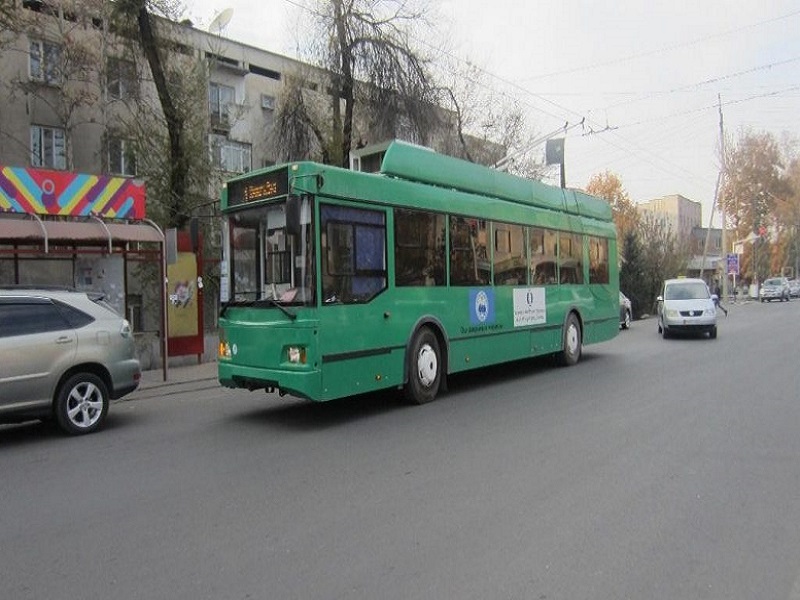
              In line with its goals, the EBRD has provided a loan of €5.7 million and a grant of €3.1 million to implement the modernisation of bus and trolleybus fleets, the introduction of an e-ticket system, staff training and improvement of technical equipment in the country’s second largest city of Osh. In addition to the public transport project, the EBRD has also provided more than €10 million to rehabilitate wastewater and drinking water supply infrastructure in Osh.

              In 2016, the government of Switzerland and EBRD collectively provided funding for a new wastewater plant in the city of Osh. The EBRD extended a €3 million sovereign loan and Switzerland a €5.05 million grant for the project, undertaken by the Osh Water Company, a municipal water and wastewater operator. The works included an upgrade of existing facilities as well as the installation of brand new equipment.

              Screenshot from “5News” report on the drinking water quality in Osh city, 2017

              Researchers, including this author, travelled to Osh to conduct a survey on the impact of these projects on gender equality in the city’s public transportation and water sectors in the month of October 2017. The EBRD’s investments in Osh city were largely welcomed and supported by residents who participated in the field survey. The research survey focused on acquiring data based on age, gender and occupation in the public transportation and water sectors. Whilst the gender-mainstreaming study objective was focused on gender inclusion, the survey has revealed the problems with accessibility for disabled residents and recurrent issues regarding school children’s safety in private transportation.

              The survey underlines common use of public transportation and municipal water supply. Therefore, it is primarily focused on the EBRD funded projects to improve public services in Osh city. However, the poll results for the private transportation sector outline a whole set of separate challenges in contrast to the city’s public transportation.

              In context with the methodology of the research, additional questions have been prepared for the Osh city Mayor’s Office and municipal services. However, the city officials declined to be interviewed citing procedural requirements for the meeting with researchers on initial visit to the Mayor’s administration. In the days and weeks after the first visit, the city administration officials failed to respond in a timely manner or demonstrate their willingness to provide information for this survey during research mission in October 2017.

              Nonetheless, researchers established that the EBRD’s objective to ‘improve human resource policies and practices both from equal opportunities and commercially focused perspectives’  had yet to be fully implemented for both project aims  to include a gender inclusion component.

              Indeed, in a response letter to this study, the EBRD acknowledged the challenges of gender mainstreaming in the Osh city municipality. ‘The Gender Advisory Services Programme for the Osh Auto Public Transport Company started in 2015 and is scheduled to finish in mid-2018. The total cost of the assignment is €179,928. The Programme was developed by the bank after pre-investment due diligence revealed that only 20 of the Company’s 236 workforce were women and only one of their 164 drivers was female. The due diligence revealed that the high staff turnover is one of the big challenges – for example, in 2015 they have reported a loss of 50% of their drivers.’ according to the EBRD.

              The research findings in Osh are consistent with the conclusions of the paper ‘Gender Equality Initiatives in Transportation Policy’ authored by Yael Hasson and Marianna Polevoy who found that ‘The travel patterns of women differ from those of men. These differences are linked to gender inequality within the home and the labor market, urban structures, and the processes of socialisation and education. Women and men make different use of a shared system of transportation’.

              Gender Inclusion Challenges

              According to the bank’s announcement the ‘EBRD-supported gender advisory services programme will see the city’s authorities and the Osh Auto Transport Company work together to offer improved job and career growth opportunities to women in the company’.

              EBRD funded public transport project in Osh city, 2017

              However, the Osh city development plan 2016-2020 does not stipulate career opportunities for women in the public transportation and water sectors or include objectives for the municipal services in the same period.  It does include a chapter which underlines priority for the gender policy and support of women. In the expected outcome, the development roadmap implies more job opportunities will be created for women and youth in Osh, which seemingly has declarative intent rather than a realistic plan based on an agreement.

              Furthermore, the Mayor’s Office pledge, in the development roadmap for greater transparency and open access to public and civil society organisations falls short of actual delivery of policy. The affirmed goal of close cooperation with public and civil society regarding evaluation and monitoring of the city development programs raises questions regarding lack of communication in the Mayor’s Office.

              The city development plan has a detailed description of expenditure for the public transportation sector which includes modernisation of the bus and trolleybus fleet, introduction of an e-ticket system, staff training and improvement of the technical equipment, but a  gender component of the EBRD funded project is not included in the city’s expenditure plans.  In a similar fashion, the city’s plans for the Water Company doesn’t include expenditure for an inclusive  gender policy.

              Previously, the media coverage of the Mayor’s Office roadmap 2016-2020 highlighted deficiencies in the city development plan. The RFE/RL Kyrgyz language service (Azattyk) report stressed the city administration’s immediate focus on infrastructure projects and the lack of human development programs in the plan itself. It is unclear how the city authorities conduct or implement their original development target goals with respect to gender-mainstreaming.

              It is even less clear whether a commitment on gender equality is part of the city administration’s long-term planning for the public transportation and water sectors, despite the official narratives.

              The research team was unable to verify or observe the EBRD’s ‘work-in-progress’ in the Osh municipal services regarding gender inclusion, due to the city administration’s failure to collaborate with observers on the ground.

              Recommendations

              Throughout the month-long research, the team has discovered acute concerns and problems regarding functionality of the public and private transportation and water services. Just as in the country’s capital Bishkek, the city of Osh may require expansion of the public transportation routes within city limits in addition to existing geographical coverage.

              Among critical concerns which were raised by the survey participants: the discrimination and harassment of pupils in the private transportation sector; unsafe rides on private minibuses underscored by both gender groups; lack of capacity of the existing transportation system due to traffic congestion and the insufficient number of public transportation units; a report of sexual harassment in one specific case; untrained staff in both, public and private transportation; disparity of communication between the authorities and city residents; and an unsatisfactory level of service for the disabled residents in public and private transportation.

              Respectively, the Water Municipal Company will require enhancement of the communication policy with city residents which seems inadequate at its present level, more efforts to maintain an uninterrupted supply of water throughout the year, improvement of the quality of drinking water during rainy seasons, cooperation with local civil society organisations and activist groups on the promotion of water conservation practices in the city.

              The gender-mainstreaming study objective of the research mission couldn’t be fully achieved as a result of the Osh city administration’s failure to communicate with the team after the Presidential election. It appears the EBRD funds are prioritised on the first-need service basis rather than the long-term strategy goals identified by the EBRD in both the public transportation and water sectors.

              It is recommended that the EBRD conducts further consultation with clients on bringing focus back to the gender component in the decision-making process in the local administration and municipal companies; facilitates open access for civil society organisations to the information on gender equality in the municipal companies of Osh city; take steps to undertake annual research and analysis in the public transportation and water sectors based on gender component; improve the city administration’s communication strategy with the public and civil society organisations;  include the perspectives of women and youth in the decision-making process;  integrate more women in planning and implementation of development plans for the municipal services; and  introduce annual target goal parameters for gender equality in the public transportation and water sectors.

              This essay summary of a report produced for Bankwatch and available here.

              Footnotes
                Related Articles

                FPC Briefing: Rule of Law in China: A priority for businesses and Western Governments

                Article by David Lawrence and Johnny Patterson

                September 24, 2018

                Download PDF
                FPC Briefing: Rule of Law in China: A priority for businesses and Western Governments

                On the eve of China’s ‘4th of May Day’ in 2017, President Xi Jinping announced that “the rule by law is our historical mission.” It is a sentence which harks back to a centuries old legal system which many Chinese have regarded with pride. And yet its utterance was only necessary because, even over 30 years after China began its journey towards a capitalist, rules-based economic system, rule of law is still a source of tension in China. Indeed, many Western commentators noted and mocked the phrase ‘rule by law’ as fundamentally missing the point of ‘rule of law’, even if in Mandarin they mean the same thing.

                The central argument of this essay is that Western governments and businesses should take seriously rule of law in China and devote their diplomatic and lobbying powers to seek better Chinese legal institutions. Through examining China’s legal history and exploring recent interactions between foreign investors and China’s legal system, the authors argue that many historical and current diplomatic tensions between China and the West – including the trade war and disputes around intellectual property rights – are related to China’s poor legal infrastructure, which does not meet Western standards of rule of law. Looking to the future, this poses serious problems as China expands its geopolitical visions and looks to export its own values and institutions.

                Ultimately, the authors argue that the rule of law has the potential to be an effective point of diplomatic engagement with China. There is an appetite within China and among foreign investors for change, and Xi Jinping’s Government should take advantage of the economic and diplomatic opportunities presented by reforming China’s legal system. Chapter 1 looks at China’s rich legal history and how rule of law has failed to take root in China, giving us the system we see in China today. Chapter 2 looks at contemporary disputes between Western businesses, governments and China, and argues that many of these are closely linked to issues around rule of law. Chapter 3 argues that the rule of law offers an excellent opportunity to engage productively with China and that the opportunity should be seized by Western governments and businesses.

                Download the full article here.

                About authors:

                Johnny Patterson works for a human rights NGO and is studying a Human Rights MSc at the London School of Economics. His research focuses on the rule of law in China.

                David Lawrence is Senior Political Adviser at the Trade Justice Movement and previously worked in Parliament. He has an interest in China having grown up there, and previously studied at the London School of Economics and the University of Oxford.


                Footnotes
                  Related Articles

                  Post-Brexit: What could a transformative, values-based EU and UK partnership in Foreign Policy look like?

                  Article by Jacqueline Hale

                  September 21, 2018

                  Post-Brexit: What could a transformative, values-based EU and UK partnership in Foreign Policy look like?

                  As like-minded partners, sharing many policy traditions, norms and standards the EU and UK have every strategic interest in working together on a values-based foreign policy post-Brexit.

                  In the ongoing white noise of the Brexit negotiations, we hear very little spoken about UK-EU relations on foreign policy and development assistance. Yet this is an area where the UK and the EU have every interest in working closely together, in a way which recognises the strong alignment of the UK and EU on norms, values and priorities. The UK can work with the EU post-Brexit to ensure its vision remains at the heart of a future relationship, and that the vision remains based on shared values, grounded in human rights, democracy and the rule of law. The UK should also recognise where in the past it has been able to capitalise on its membership to advance its normative vision and seek ways to recreate the relationships that emulate this.

                  A closer cooperation to pursue interests and values

                  The UK has long been a key shaper of EU foreign policy. British thinking lay behind the EU’s enlargement policy, which aimed to reach out to former Warsaw Pact countries and transform their societies and norms through engagement and regulatory approximation. On tough foreign policy issues, the UK has led innovative work to convene like-minded member states and to win decisions to impose sanctions on Syria and Russia, using the EU’s strength-in-numbers to deliver a more impactful message than it could through applying its own bilateral sanctions. It has also used the EU to deliver tougher messages than it is willing to do bilaterally, as when the EU recently imposed sanctions on Myanmar. (This influence works both ways: the UK has also held back the ambition of EU common positions as a blocking minority, for example regarding Saudi Arabia on the Yemen conflict. This is an example of UK power amplification in the opposite direction, as a blocker).

                  In terms of foreign assistance, the UK – as a top development donor – has shaped and led many initiatives that have been adopted across the EU from prioritising poverty eradication to the focus on global health and education initiatives such as the Global Fund, GAVI (providing cheaper vaccines to poorer countries) and the Global Partnership for Education. The UK played a critical role in supporting and shaping a generous EU response to the humanitarian crisis in Syria, and to the Ebola outbreak in West Africa. The UK also influenced the European Council’s vote in 2015 to re-affirm the EU’s commitment to sustain a development assistance target of 0.7%.[1] DFID’s (UK’s Department for International Development) multilateral aid review in 2016 found European aid to be particularly impressive and closely aligned to UK aid priorities.[2] It is not clear that another multilateral donor is as well aligned to UK priorities as the EU, therefore, the case for continuing funding and programmatic collaboration is high.

                  The UK annually channels about £1.3 billion, equivalent to 8% of its total ODA (Official Development Assistance) budget of £12.1 billion via the EU institutions[3], and also leverages the EU’s funding, networks and delegations. DFID often works in Joint Actions with the EU, notably in West Africa and on the flagship Joint Programming at scale, such as the Bangladesh Suchana programme on Ending Undernutrition. Together with its member states, the EU is the largest development donor and much of EU development and humanitarian policy thinking, as well as in-country operations, has been shaped by DFID’s policy approaches.

                  With regard to the EU’s most substantial development funding pot, the European Development Fund[4] both the EU and the UK benefit from the current situation with the UK currently contributing up to 15% towards the EU’s European Development Fund and in return uses its seat on the relevant technical committees to set the EU’s aid priorities through the fund. The challenge the EU post-Brexit will be to make less funding go further in transforming lives and supporting change, whilst the UK may face a new hurdle of seeking buy-in for its ideas in a more competitive and fractured normative market without direct influence over the spending of the largest development donor in the world.

                  After Brexit, what next?

                  Whilst a UK-EU partnership is no substitute for UK membership of the EU, there are ways which, even without a vote, the UK can still cooperate with the EU to amplify each other’s voice and impact as well as jointly promote their shared values: As likeminded partners, the UK and the EU mostly share a legacy of policy alignment in multilateral fora such as the UN. The majority of EU members are members of NATO, EU member states have collaborated with likeminded non-EU member states at the Human Rights Council (where the EU does not have a formal seat), and the UK could continue to play an active role in those groups as part of a continued burden-sharing arrangement.

                  In the current era of budget cuts and donor fatigue, the pooling of funding via the EU offers possibilities for the UK to continue to work to achieve its development policy objectives, while the EU could also still support UK led initiatives if it chose. This could be via voluntary Trust Funds, which are new pooled funding vehicles with flexibility to provide individual EU members states and third countries the opportunity to ‘buy-in’ to the fund and are worth around 2.3 billion Euros from European Development Fund and EU budgets[5].   Alternatively, a modality could be developed which allows the UK to ‘pay to play’ so that the UK can contribute to shaping the bloc’s spending priorities in its former colonies (along with the lines of the existing off-budget European Development Fund). The UK has already indicated in a non-paper earlier this year that this is something of interest. [6] Even outside the EU funding structures there would continue to be complementarity – i.e. the EU could rely on the UK as a quicker mover in crisis situations. For its part, the UK could also make use of the structures of the EU to complement its own activities – notably accessing the 120 EU Delegations and diplomatic offices in third countries where the UK may not be present, or likewise the dedicated European humanitarian aid field offices in over 40 countries.

                  The EU and UK can also build on existing strategic alignment on foreign policy priorities. The EU’s 2016 Global Strategy focuses predominantly on security threats and societal challenges in the EU’s immediate neighbourhood, particularly the Southern Mediterranean and the Middle East. This aligns with the priorities the UK government is pursuing through its Stabilisation Unit. The UK has a strong interest in continuing to work to shape funding mechanisms, such as EU Trust Funds, to ensure that they are complementary to its own efforts. In Eastern Europe, the fact that the EU continues to exercise a power of attraction through its promise of higher standards: clean water, safe transport, travel opportunities through easier access to Europe and potential to sell goods to a market of, currently, 500 million is also of interest to Britain. On the one hand, it’s no small irony that countries from the Western Balkans to Ukraine are queuing to join the bloc and enjoy the benefits which the UK is on the cusp of foregoing. Yet the reality is that the UK and the EU will have a shared interest in a stable neighbourhood to which the EU will have complementary reach and a viable offer.[7]

                  Further afield, the UK and the EU will need to find agreements to operate in a complementary manner – from coordinating as donors to ensure adequate coverage of different countries and issues to sharing strategies and hosting UK embassies in EU delegations and vice versa. It will be important that the UK is able to cooperate and contribute to EU geographical and thematic development programming in the new long-term EU budget (Multi-Annual Financial Framework) to ensure funding continues to reach priorities the UK has pursued: such as poverty eradication, education and tackling infant mortality. Involving civil society groups in implementing and monitoring funding would achieve twin objectives of ensuring accountability for UK and EU taxpayers’ funding whilst making recipient governments more responsive to their own citizens.

                  Common values – human rights, support for civil society

                  If the tone and tactics of the Brexit negotiations are anything to go by, the UK-EU relationship will stand or fall by the extent to which values shared by the UK and EU are at the heart of joint working on external relations. Here there is notable pedigree: the UK and the EU have pursued highly aligned positions together and separately on upholding norms and standards, the importance of human rights and the role of civil society. This has been the case not only as part of EU common positions but also at the UN, the G7 and G20 and the WTO. The UK is a key contributor to EU coordination meetings in Geneva and New York and as part of burden sharing frequently acts as spokesperson for the Union on human rights issues. As one of the EU’s two leading diplomatic powers, the UK has been able to carry EU28 positions on political and security questions at the UN Security Council, together with France (and with the support of EU non-permanent UNSC members).

                  The EU’s 2016 Global Strategy spells out the EU’s commitment to a rules-based international order. This is a position that British strategists – whichever side of the Brexit debate they fall on – should want to hold dear as we enter an increasingly uncertain world where rules are more frequently broken, and norms and standards of conduct set during the Bretton Woods era are increasingly challenged by rising powers, notably China.

                  The EU also has a well-developed global human rights policy[8], and in many cases is the key actor in this area, on behalf of its member states. The UK has used this to its advantage, most recently in the case of recent sanctions on Myanmar, where it preferred the EU to take a stronger position than it was prepared to take bilaterally. For many civil society actors as well as third countries, the EU has been traditionally seen as a more ‘honest broker’ than its member states either because of colonial heritage or perceived national interest[9]: Whereas Russia cut off USAID funding in summer 2012, EU funding for civil society has continued under EIDHR and other programmes. With networks mattering more than ever in foreign policy, the EU27’s combined network reach through EU delegations, together with member states embassies, create multiple nodes in third countries for connecting with civil society groups and transmitting European values. British involvement and engagement with EU counterparts in shaping the principles and norms transmitted by EU diplomatic networks would continue to ensure that shared values, interests and priorities prevail.

                  The UK has also had one of the strongest civil society sectors among EU member states, particularly in the fields of international development and conflict prevention, mediation and peacebuilding. Many of those same players have been active in Brussels in shaping the EU’s external policies and building networks with counterparts from other EU member states. The UK is the largest recipient of EU grants to its CSOs. UK CSOs received 356.9 million Euros in new development and humanitarian funding from the EU in 2016[10]. These CSOs are delivering EU policies and programmes at scale and the UK and EU should reach an agreement to allow them to continue to do so. Correspondingly the UK has driven previous EU efforts to offer a ‘partnership with societies’ (such as during the 2012 revised European Neighbourhood Policy following the Arab Spring). Civic participation and civil liberties remain key to British political life and its self-image – one of the reasons the UK, with notable leadership from Winston Churchill, played such a key role in establishing the separate (non-EU) European institutions that have formed the unofficial ‘aquis’ of rights and values underpinning the Union, notably the Council of Europe and the European Convention on Human Rights. For its part, the EU is among the few actors to have elaborated policies for civil society support through several initiatives ranging from the European Endowment for Democracy, to the European Instrument for Democracy and Human Rights. These pursue compatible goals to well-established UK bodies, such as the Westminster Foundation for Democracy and could reach agreements to burden share in future in parts of the world ranging from Eastern Europe to the Southern Mediterranean.

                  Finally, and by extension, the UK should also think more seriously about how to use the capacity its diaspora provides to spread its vision beyond its borders. Whereas other countries frequently cultivate and connect with their diaspora the UK – arguably the best- networked diplomacy in the world in terms of government level contacts – has consistently underused its diaspora in the post-colonial era. This group of UK-educated, internationally connected citizens has much to offer ‘Global Britain’ if efforts are made to reconnect them, and providing the idea behind Global Britain is sufficiently cosmopolitan in its outlook[11].

                  The risk of ‘transactionalism’

                  By most accounts, the UK is likely to suffer the fall-out from Brexit – at least in the short term – much more than the EU. Yet, the negotiations, currently stuck in zero-sum posturing, would be better served by the UK building bridges in those policy areas like foreign policy and development where there are incentives to cooperate. Instead, the negotiations are dogged by transactionalism – focused on what the UK stands to lose to the EU through any of the scenarios on the table. Yet like transactionalism is at the root of the malaise which has increasingly dominated UK’s approach to relations with other countries since the 1980s be it towards the EU, or in the UK’s relations with bilateral partners (arguably linked to Thatcher’s “rebate” on UK contributions to the EU budget) and lies behind the Brexit decision itself. Whilst the UK foreign policy establishment espoused the European Neighbourhood and Enlargement policies as a means to transform the East normatively, and in effect transform the EU itself along the UK vision of a wider and less deep union, the outlook of Westminster’s political class towards Brussels was and remains very much led by  a transactional, quid pro quo approach.

                  This ‘UK Plc’ approach has the effect of restricting the UK’s foreign policy ambition and its presence, by equating a country with a big history and legacy of ideas, to a corporation. There is a question mark over whether the UK can exercise a transformative or agenda-setting role on the global stage if it does not have a mission and a vision beyond security and markets? The insular foundations of the Brexit idea, and the current circularity of the negotiations, already risks diminishing Britain’s ability to shape the thinking of governmental and non-governmental allies on its doorstep. In a multi-polar world, this bodes ill for Global Britain’s ability to project ‘soft power’ of its ideas in cases where its policymakers feel the UK’s norms and values are under attack down the line.

                  With its 65 million people, speaking the world’s (and the EU’s) lingua franca, with thriving cultural industries, leading universities and strong tradition in civil liberties, the UK’s leaders would do well to ensure that Global Britain is truly global, offering global opportunities to its citizens to shape the future beyond the coastline of this relatively small island. This means politicians who are prepared to cultivate and exercise the soft power of aspirational ideas to shape outcomes and policies that are sufficiently ambitious to set standards, rather than merely cutting deals and selling its goods and services at knock-down prices or to the highest bidder.   Since values and therefore rules are set to be increasingly contested in a multi-polar world, British people therefore have a strategic interest in ensuring that others think and behave like us, but also that our own standards of living and behaving are not lowered through conceding that norms and standards are being set (and undercut) by the likes of China. The EU is a natural ally, having developed a normative posture on the global stage, one which is most closely aligned to the British thinking, after 40 years of close association. But with its own tendency to focus more narrowly on its interests in its backyard, witnessed by its 2016 Global Strategy, and facing a populist backlash elsewhere within its ranks the EU will also need strong allies to remind it to have an active strategy behind the norms and values it is promoting. With the abdication of global leadership by the US, the UK will have more success via cooperating closely with like-minded EU partners on foreign policy than going it alone.

                  Conclusion

                  History shows that Britain is at its best as a transformative foreign policy actor and EU partner when it asks more than “What will you give me in return for…?” It should not ignore the power of attraction that the EU continues to exercise. The fact that people risk their lives to enter the EU, and that people in the EU’s neighbourhood would like to be on an Erasmus or attend Bologna-accredited institutions exchange in their own country; find labour in Europe; buy products easily from European countries or go on holiday there cheaply testifies to the EU’s enduring role as a global standards-setter whose citizens enjoy an enviable social contract and a set of rights and freedoms. Continuing to align with these standards – and promoting them globally – should be of interest to British citizens, now that Britain too is set to become a neighbour of the EU. Ensuring that British ‘values’, norms and by extension our way of life can measure up to this gold standard – embodying a better quality of life upheld by democracy, human rights and the rule of law – is essential not only for UK soft power projection, but also for fostering our citizen’s development, which is greatly enhanced through exchange with others.

                  With the world set to become more multi-polar, and ideas more contested among a range of powers, there is a lot at stake in ensuring that a UK-EU foreign policy partnership remains  anchored in shared values and that a potential ‘’Special Relationship’’ on these issues does not become a victim of bad blood in the Brexit negotiations. Let’s hope that the negotiators do not downplay the importance of UK-EU cooperation on a normative foreign policy and pay more attention to this less contentious policy area. To that end, there would be five practical headline recommendations for them to consider:

                  Recommendations to UK and EU

                  Diplomatic burden-sharing and collaboration at UN levels. The EU and the UK could work together by instituting ‘European friends’ or ‘like-minded’ coordination groups in New York and Geneva in which the UK is systematically included along the lines of existing practices, and as part of a burden-sharing agreement which allows the EU to continue to benefit from UK technical expertise and networks with non-Western States, and enables otherwise stretched UK diplomats to prioritise key dossiers.

                  Joint strategies, deployments and shared resources at the field level. The UK and the EU could work together in selective contexts on both programming and outreach at field level drawing on Memorandums of Understanding. Spelling out the commitment to share and pool resources from an official MoU for joint working in development policy to the deployments of UK staff into EU services, would provide a basis for joint cooperation. Efforts should also be made to ensure that UK and EU aid remains complementary and playing to their relative strengths, through an overarching MoU, or joint strategies and through sharing resources such as field offices where it is complementary to do so.

                  UK observer status in Brussels decision-making. Recognising that the UK’s role in efforts at multilateral level and ad hoc formats – such as Security Council, the E3 (France, Germany, UK) on political and security issues as well as the G7 and HRC and development and human rights and UK peacekeeping – will continue to have a bearing on EU foreign policy formation, the EU and UK should agree a modality to provide for UK ‘observer status’ at EU Foreign Ministerial and working level Council discussions on key areas of collaboration – including on human rights and democratisation. A joint strategic planning committee would be a great confidence building measure to support this.

                  Flexible arrangements to pool funding. It will be important that the UK is able to cooperate and contribute to EU geographical and thematic development programming in the new long-term EU budget (Multi-Annual Financial Framework) to ensure funding continues to reach priorities the UK has pursued as a top donor: such as poverty eradication, education and tackling infant mortality. The EU should ensure its future funding rules allow sufficiently flexibility for the UK to contribute to and shape pooled funding vehicles, such as EU trust funds, or the European Development Fund. The UK and the EU could continue an existing practice of matching UK and EU funds at the programming level on context-specific Joint Actions where appropriate.

                  A continued role for UK civil society as experts and deliver on the EU values agenda. The UK and EU should reach an agreement to allow the UK’s often highly expert, professionalised and effective CSOs to continue to deliver EU policies and programmes at scale in sectors ranging from development assistance and humanitarian aid to conflict prevention, mediation and peacebuilding. For its part, the UK should develop a more proactive strategy to engage its diaspora, including in Brussels, as a part of efforts to ensure ‘Global Britain’ remains connected and networked with partners in Europe.

                   [1] European Commission, Press Release: European Commission calls for renewed commitments to reach targets on official development assistance, April 2015,  http://europa.eu/rapid/press-release_IP-15-4747_en.htm

                  [2] UK Government 2016 Multilateral Aid Review: https://www.gov.uk/government/uploads/system/uploads/attachment_data/file/573399/EC-Humanitarian-aid-Civil-Protection-dept-review.pdf

                  [3] DFID, Statistics at DFID, https://www.gov.uk/government/organisations/department-for-international-development/about/statistics. See also Impact of Brexit on UK and EU development and humanitarian policy, BOND, July 2017, https://www.bond.org.uk/resources/the-impact-of-brexit-on-uk-and-eu-international-development-and-humanitarian-policy

                  [4] A post-colonial fund which pre-dates the EU’s development policy and dedicated development instrument in the EU’s central budget and is run by bigger EU member states, targeting many of their former colonies

                  [5] Impact of Brexit on EU Funding for UK CSOs, British Overseas NGOs for Development (BOND), 2018

                  [6] The EU beyond 2020 – Future Development Instruments: A UK Perspective https://www.bond.org.uk/sites/default/files/dfid_uk_non_paper_on_instruments_draft_final20_feb.pdf

                  [7] In the past the UK has used the EU to fill strategic gaps in foreign and security engagement in regions such as the Baltics, the Caucasus and Central Asia. An enhanced cooperation on foreign and security policy could enable this burden-sharing arrangement to continue.

                  [8] EU Strategic Framework on Human Rights and Democracy (2012) and successive Action Plans

                  [9] Though the EU’s stance on trade negotiations with African countries, and more recently its hawkish approach to migration prevention, particularly in the African context, has led many in those countries to view the EU increasingly negatively.

                  [10] The impact of Brexit on EU funding for CSOs, British Overseas NGOs for Development (BOND), 2018

                  [11] For a further examination, see IPPR, Global Brit: Making the Most of the British Diaspora, 2010 https://www.ippr.org/files/publications/pdf/global-brit_2010.pdf

                  Topics
                  Footnotes
                    Related Articles

                    The China-Pakistan Economic Corridor (CPEC) and the Security Risks of Infrastructural Expansion

                    Article by Foreign Policy Centre

                    September 18, 2018

                    The China-Pakistan Economic Corridor (CPEC) and the Security Risks of Infrastructural Expansion

                    China’s draconian approach to the Uighur Muslim minority in its far-western province of Xinjiang is currently – and rightly – receiving a substantial amount of media attention. Less discussed are the vast infrastructural changes also underway in the region, particularly in Xinjiang’s southern city of Kashgar, an economically deprived, religiously conservative and hitherto deeply isolated area, in which approximately 90% of the population are Uighurs. The centrepiece of this construction frenzy is the China-Pakistan Economic Corridor (CPEC). With a total financial outlay of around US$51 billion, CPEC is expected to be completed by 2030, and will connect China’s far-western Xinjiang Province with Pakistan’s Gwadar port via a network of highways, railways and trading hubs, providing China with important trading access to the Middle East and Africa.[1] While the expansion of infrastructural networks will doubtlessly bring significant economic benefits to the region, the possibility of connecting militant and terrorist networks in the two regions presents a substantial security risk for the two states and the wider region.

                    The level and pace of infrastructural development underway in southern Xinjiang is unprecedented. A railway extending from Kashgar, passing through Afghanistan, Kyrgyzstan and Tajikistan to connect with railways in Iran, is currently in the first phase of construction. A second railway project linking Kashgar with the Uzbekistani city of Pap in the Ferghana Valley is also under construction. Highway projects connecting Andijan (Uzbekistan) with Osh (Kyrgyzstan) and Kashgar are also underway. Xinjiang already boasts the most airports of any Chinese province, and their number is expected to expand from 17 to 28 by 2020.[2]  However, the most significant projects in this sphere are part of CPEC: the Karakoram Highway, which links Kashgar with Hassan Abdal in Pakistan and was originally constructed in the 1970s, is being upgraded with parts to be expanded into a 4-lane motorway and extensions to the Khunjerab railway that will also link the Pakistani rail network to China’s Kashgar-Hotan railway, allowing rail links from the Gwadar Port into Xinjiang.  In the next few years, Kashgar will become a major transit hub for mainland China, with rail and road infrastructure connecting it directly with Pakistan and Central Asia. This will have far-reaching consequences for the local way of life, which has remained virtually unchanged for centuries.

                    Perhaps the most significant security threat concerns the expansion of the East Turkestan Islamic Movement (ETIM), the primary terrorist organization driving the Uighur separatist cause, across the region. After al Qaeda and the Islamic Movement of Uzbekistan (IMU), ETIM has become the third largest foreign militant group located on the porous Pakistan-Afghan border region, known as the Federally Administered Tribal Areas (FATA). ETIM is in alliance with local and international militant terrorist organizations, including al Qaeda and the Taliban, not only sharing their ideology, but also operating with their assistance.  ETIM’s primary aims are the liberation of Xinjiang from Chinese rule and the implementation of sharia’ in the region, goals which are increasingly shared by the other militant groups in the region. As such, China has become an important target for militant groups, not only for ETIM, but also for al Qaeda and the Taliban.

                    Following the July 2009 riots in the Xinjiang capital of Urumqi, al Qaeda leader Abu Yahiya al Libi released a video threatening China. Pakistani security officials believe that in the aftermath of the riots, hundreds of Uighurs joined ETIM in FATA. In 2013, ETIM released a video showing Uighur children being trained in militant camps somewhere in FATA. The following year, the IMU’s Mufti al Burmi released a video entitled ‘Let’s disturb China’, in which he directed all militant groups affiliated to the Taliban and al Qaeda to target Chinese interests in Pakistan. Thus, close and expanding connections between Uighur and non-Uighur militants is driving the latter to take up the cause of the former, and growing trade and infrastructural connections between Xinjiang and Pakistan will doubtlessly facilitate militant connections between these groups. Beijing’s current project to transform Xinjiang into what has been termed by Western media reports as a ‘surveillance state’ constitutes its illiberal response to this threat.

                    Islamic radical organizations are deeply rooted in Pakistani society and militant activities are threatening longstanding Pakistan-China relations. Following pressure from the Chinese leadership to take action against ETIM, in 2014 the Pakistan Army launched a military operation codenamed Zarb-i-Azb. However, although this massive military offensive destroyed militants’ command and control systems in FATA, numerous splinter groups have formed a new command system across the border in Eastern Afghanistan. The battle to eradicate these militant groups is therefore far from over.

                    Despite popular concern about the growing levels of Chinese activities in Pakistan, with some Pakistani senators comparing CPEC to the East India Company, formal China-Pakistan relations have never been better. Both Pakistani and Chinese leaders have repeatedly referred to their relationship as ‘sweeter than honey’ and ‘stronger than steel’.[3] And the two big Pakistani religio-political parties, Jamiat Ulama i Islam (JUI) and Jamat i Islami (JI) have signed agreements with China. The Pakistani government has even defended Chinese policy towards Muslims in Xinjiang in the Organization for Islamic Co-operation.

                    Such allegiance by Pakistan to its Communist neighbour is driven primarily by economics: the Pakistani economy is highly dependent on Chinese trade and investment. According to the 2017 edition of the annual government-authored Pakistan Economic Survey, the volume of trade between Pakistan and China, which was approximately US$4 billion between 2006 and 2007, reached an all-time high at US$13.77 billion in 2015-16. Pakistan’s exports to China have increased by almost 200 percent since the implementation of the FTA, from US$575 million in 2007 to 1690 million in 2016, making China the second largest importer of Pakistani goods after the United States.[4] It is highly unlikely that Pakistan will reduce its co-operation with China.

                    The Chinese authorities are, of course, well aware of the threats posed by this cross-border infrastructural expansion – and the on-going repression of Muslims in Xinjiang must be seen in this context. In Pakistan, the threat against Chinese activity has become so severe that the Pakistani Army has created a special division whose sole purpose is to protect CPEC and its Chinese workers, and comprises nine army battalions, six civil wings and nearly 13,700 personnel.[5] It therefore seems likely that as CPEC gains momentum, so will the crackdowns on those deemed to pose security risks to the high stakes project. And this of course includes the entirety of Xinjiang’s Uighur population. As crackdowns against practicing Muslims in Xinjiang increase, however, the growing infrastructural connections between Pakistan and China will not only facilitate the transfer of goods, but also the transfer of militant and anti-Chinese ideology.

                    Note:  The essay was written by two academics who wish to remain anonymous.

                    [1] Andrew Small (2017) ‘First Movement: Pakistan and the Belt and Road Initiative’, Asia Policy, 24: 80-87.

                    [2] Cui Jia (2016) ‘Work to start on rail link with Iran’, China Daily, 15 January 2016. Available at: http://www.chinadaily.com.cn/china/2016-01/15/content_23096031.htm

                    [3] See Times of India (2017) ‘Our friendship is sweeter than honey: Chinese vice premier to Pakistan’, Times of India, 14 August 2017. Available at: http://timesofindia.indiatimes.com/world/china/our-friendship-is-sweeter-than-honey-chinese-vice-premier-to-pakistan/articleshow/60057468.cms; Tribune (2014) ‘“Pak-China friendship is ‘sweeter than the sweetest honey”: Nawaz’, Tribune, 21 April 2014. Available at: https://tribune.com.pk/story/698409/pak-china-friendship-is-sweeter-than-the-sweetest-honey-nawaz/.

                    [4] Pakistan Economic Survey 2016-17, May 2017. Available at: http://www.finance.gov.pk/survey_1617.html.

                    [5] Xinhua (2017) ‘Pakistan army chief vows to protect China-Pakistan Economic Corridor’, Xinhua, 11 March 2017. Available at: http://news.xinhuanet.com/english/2017-03/11/c_136121332.htm.

                    Footnotes
                      Related Articles

                       Join our mailing list 

                      Keep informed about events, articles & latest publications from Foreign Policy Centre

                      JOIN