Skip to content

The unique extra-parliamentary power of Ukrainian radical nationalists is a threat to the political regime and minorities

Article by Volodymyr Ishchenko

July 18, 2018

The unique extra-parliamentary power of Ukrainian radical nationalists is a threat to the political regime and minorities

Editor’s Note (February 2022): It has come to our attention that this piece has been used in online debate seemingly to give credence to Russian propaganda that Ukraine or its Government is a ‘neo-nazi’ state or that there is some legitimacy to President Putin’s claims that his central war aim is ‘denazification’. This essay does not make that case so we would urge it not to be used for that purpose.

Written by Volodymyr Ishchenko (a Ukrainian academic and activist writing from a left anti-fascist perspective) it is a serious study of the real concerns about the levels of organisation, activism and influence posed by far-right groups (whose strength had been bolstered since Russia’s 2014 invasions), that also makes clear their reasonably limited political popularity, and makes no claim that their influence dominates the Government of Ukraine (indeed the title notes that such groups pose a threat to it). It should also be noted that it was written in 2018, prior to the change of Presidency in 2019 that saw the election of a President of Jewish heritage in Volodymyr Zelenskyy.  It formed part of this publication on The rise of illiberal civil society in the former Soviet Union?, which also covers different (though still critical) perspectives on the issue of the far-right in Ukraine as well as the rise of socially conservative, anti-feminist, anti-LGBTQ+ movements across the region, written predominantly by local authors.

The Ukrainian far right and Euromaidan

Electorally Ukrainian far-right parties have not been successful in comparison with their Western European counterparts. Before 2012 only a few MPs from any Ukrainian radical nationalist parties succeeded in entering the Parliament.[1] A major reason for this was the split Ukrainian national identity leading to polarized political attitudes on history, language, geopolitical issues in western-central and south-eastern regions.[2] Support for Ukrainian radical nationalists was the strongest in three Galician (Lviv, Ivano-Frankivsk, and Ternopil) regions and used to be negligible outside of western Ukraine. Nevertheless, the Svoboda (‘Freedom’) party was gradually increasing its support after successfully ‘moderating’ and re-branding itself from the Social-National Party of Ukraine in 2004. In the 2009-10 local elections the party made a breakthrough winning majorities in three Galician regions and the mayor’s office in Ternopil. In 2012 Svoboda for the first time entered the Parliament with 10.4 per cent of votes.

In 2013-14 Ukrainian radical nationalists played a crucial and indispensable role in the Maidan uprising that was triggered by President Viktor Yanukovych’s decision to postpone signing an Association Agreement with the EU, which violently escalated in response to inefficient repression and ended in a change of government. Nevertheless, Svoboda supported less the idea of European integration but rather an opportunity for Ukraine to break away from Russia.[3] In the case of The Right Sector’s (Pravyi Sektor) – an umbrella coalition of even more extreme radical nationalist and fringe neo-Nazi groups – their spokesmen have been always quite open that they did not support the EU but exploited the opportunity of the mass anti-governmental mobilization to push forward their own agenda of the ‘national revolution’.[4]

Since the start of massive violence in January 2014, the far right’s role in the Maidan protests has been systematically downplayed and distorted for the sake of the information warfare against Russian propaganda.[5] The far right was indeed a minority amongst the Maidan protesters, however, according to systematic protest event data Svoboda was the most active collective agent in Maidan protest events, while the Right Sector was the most active collective agent in violent protest events.[6] The far right possessed a unique combination of resources that allowed them to play such a prominent role in Maidan’s mobilization, coordination, radicalization processes and eventual transfer of power. Unlike any other opposition party, Svoboda combined thousands of ideologically committed activists, resources of a parliamentary party, and control over local councils in the western regions with the highest support for Maidan. The Right Sector combined violent skills, a revolutionary ideology, and political organization making its violent actions more strategic and efficient compared to other groups with experience of violence like football ultras and Soviet Afghanistan war veterans.[7]

Their critical contribution to the uprising’s success had important consequences: they mainstreamed radical nationalist symbols and slogans amongst the protesters, in this way pushing the sceptical majorities in south-eastern regions further away from supporting Maidan;[8] the far right escalated violence with Anti-Maidan protesters, contributing to the war in Donbass;[9] the formation of autonomous armed paramilitary groups challenged the state monopoly on violence and contributed to the weakening of Ukrainian state capacity.[10]

Extra-parliamentary power of Ukrainian radical nationalists

In 2014 Svoboda and Right Sector leaders scored low at the presidential elections and later the parties failed to get into Parliament, although a dozen far-right MPs were elected in the single-member districts and on the lists of the ‘centrist’ parties.[11] References to their electoral defeat became a popular argument ‘proving’ supposed ‘irrelevance’ of the far right in Ukraine continuing the propaganda line taken in defence of the Maidan uprising.

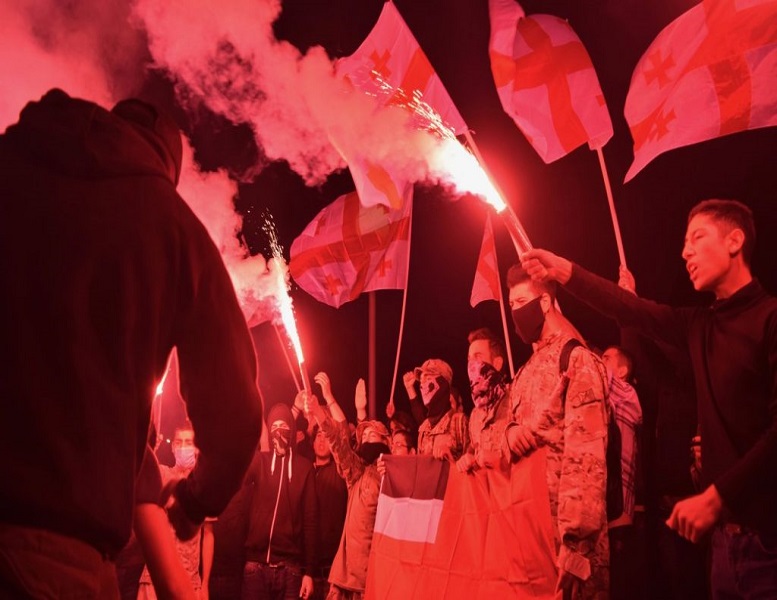
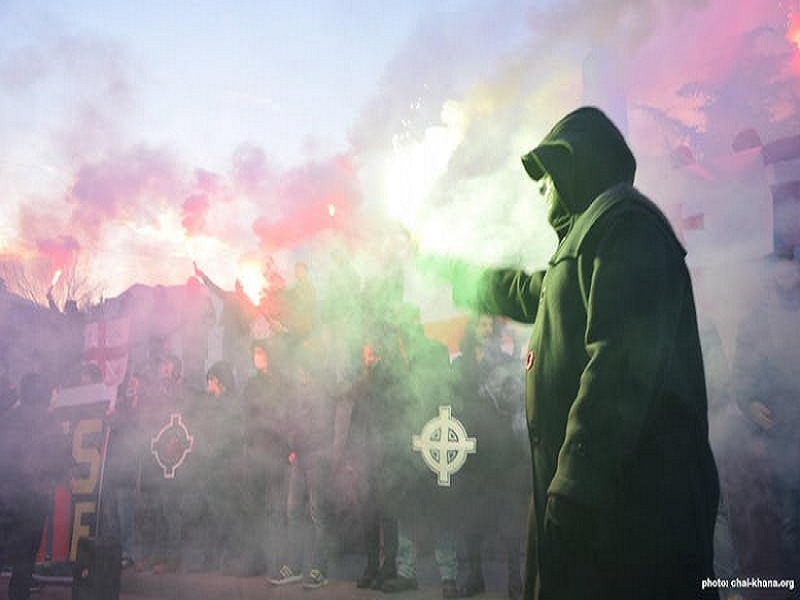
However, the extra-parliamentary power of the Ukrainian far right is uniquely strong in the whole of Europe. In no other European country do radical nationalists control large politically loyal armed units relatively autonomous from the official military and law enforcement structures. The most notorious of them is the ‘Azov’ regiment formed in 2014 by activists of neo-Nazi ‘Patriot of Ukraine’ and ‘Social-National Assembly’ organizations. In 2016 Azov formed its own party the National Corps (Natsionalnyi Korpus) and in 2018 presented a paramilitary wing the National Militia (Natsionalni druzhyny). Svoboda-affiliated armed units had been disbanded by 2016 and their combatants integrated individually into official military and law-enforcement units, however, Svoboda united all the party members with combat experience into ‘Svoboda’s Legion’ association. Despite pressure from the government, the Right Sector has not even integrated its ‘Voluntary Ukrainian Corps’ (Dobrovolchyi Ukrainskyi Korpus) into official enforcement structures.

There is no reliable estimate of the total number of the combatants in the far right-affiliated military and paramilitary units; five thousand men under arms could be an approximate count. This does not mean that they are all ideologically extreme right, however, the ideological party activists usually form the core of such units and they control the commanding heights. Moreover, even demobilized combatants usually retain their connections with former commanders on whose patronage networks and finances they often continue to depend.[12]

The result is tightly interpenetrating networks of veterans, volunteers, and radical nationalists active in the local politics. There have been several cases of the far right paramilitary interference in the voting of local councils and intimidation of judges forcing them to issue decisions in favour of the radical nationalists.[13] Another problem is the successful cooperation of the far right with the law enforcement in patrolling the streets in a number of regions[14] and penetration of the law enforcement structures at the highest positions. For example, the deputy Minister of Interior and the former acting Chief of the National Police is Vadym Troian, a former activist of the ‘Patriot of Ukraine’ organization and a deputy commander of Azov.

The extra-parliamentary power of Ukrainian far right is aggravated by the overall weakness of Ukraine’s liberal civil society. The far right performed poorly at the recent elections, however, they lost to oligarchic electoral machines with no commitment to any specific ideology but with far greater media and financial resources that opportunistically exploited nationalist and Euro-liberal rhetoric. The ideological liberal parties – like Democratic Alliance or Syla liudei (‘People’s power’) – are much weaker than the far right and are usually not even included in the polls now. In comparison to other Ukrainian political parties, NGOs and civic initiatives, the radical nationalists have the strongest street mobilization potential.[15] Moreover, the ideological tradition of Ukrainian liberalism is underdeveloped and many of self-declared Ukrainian liberals are simply moderate nationalists in the crucial historical and language questions of Ukrainian national identity. The lack of institutionalized political and ideological boundary between the far right and liberal segments of Ukrainian civil society combined with the overall ‘fortress under siege’ atmosphere of the country at war contributes to the legitimacy for the far right and impunity of their radical stance and violent actions.

The political impact of the far right

The extra-parliamentary strength of Ukrainian far right, the political weakness of liberal civil society within the framework of the unreformed political regime of competing ‘oligarchic’ patronage pyramids results in significant impact of the far right on historical and language politics, and on contraction of political freedoms after 2014.

Nationalist and anti-Communist policies usually lacked the majority public support[16] within Ukraine, even when limited to the governmental-controlled territories. Moreover, they deteriorated relations with strategically important neighbours like Poland and Hungary. However, they were the easiest way for the ruling oligarchic pyramids to simulate changes after the ‘Revolution of Dignity’ and split the opposition sustaining intense patriotic hysteria, while resisting socio-economic and political reforms that would threaten their own material interests. At the same time the radical nationalists were exploiting their legitimacy within society and overlapping interests with the ruling elite, and have been raising the bar of nationalist demands.[17]

For example, issues which used to be the hobbyhorse of the far right, like banning the Communist Party of Ukraine became state policies in 2015. They were also combined with criminalizing ‘propaganda of the criminal totalitarian (Soviet) regime’, comprehensive dismantling of all Soviet monuments[18] and renaming geographical places that sometimes had only a slight relationship to Soviet ideology. The national-patriotic education penetrating the education system on all levels – from kindergartens to higher education institutions – is based on the nationalist historical narrative glorifying the Organization of Ukrainian Nationalists (OUN) and Ukrainian Insurgent Army (UPA)[19] – the tradition which almost all Ukrainian radical nationalists build on but majorities in Ukraine’s south-eastern regions still are opposed to.[20] In 2015 together with criminalizing ‘propaganda of the Communist regime’ the Ukrainian Parliament recognized OUN and UPA as ‘fighters for Ukrainian independence’ and a public display of disrespectful attitude against them is punished under the law. The mythical day of the UPA foundation October 14 – previously a holiday only for the radical nationalists – became a national holiday. OUN’s greetings and symbolism that were mainstreamed by the radical nationalists during the Maidan uprising became semi-official in post-Maidan Ukraine. Although admiration of OUN and UPA among the general public does not necessarily mean xenophobic attitudes towards Poles or Jews, it is usually based on ignorance and denialism about their mass murders and collaborationism with the Nazis.[21]

The far right has also been the harshest critics of the Minsk Accords with Russia and Donbass separatists. They also strongly opposed any reconciliatory dialogue or even tolerance to the voices sceptical about or hostile to the official pro-Maidan narrative about 2013-14 events, which comprise a significant proportion of the public even in the governmental-controlled territories.[22] On August 31, 2015 the rally against the parliamentary vote for a special status for the separatist-controlled Donbass ended in a bloodshed when a Svoboda activist threw a hand-grenade killing four and injuring over 150 policemen and National Guard soldiers. There have been multiple cases of the far right mobilization, intimidation, and violent attacks against media, journalists, and public figures dissenting from the official narrative about Maidan and the war.[23] They typically went unpunished, while the Government is itself pressing against the opposition media and employs selective political repression.[24]

Radical nationalists and liberal values

As mentioned above, Ukrainian far- right support for pro-EU protests in 2013-14 was largely strategic. The radical nationalists retained Eurosceptic position. The ‘National Manifesto’ presenting strategic program of Ukrainian radical nationalists and signed in 2017 by Svoboda, the National Corps, Right Sector and several minor far-right organizations called for a ‘new vector of Ukrainian geopolitics’ against both Eastern and Western orientations – for a union of nations in the Baltic-Black Sea region.[25] However, Euroscepticism is not a primary issue of Ukrainian far right mobilizations as in the polarized geopolitics exacerbated by the war this position can be easily criticized as ‘pro-Russian’. Besides, sometimes radical nationalists try to exploit pro-European attitudes appealing to the ‘true’ ‘traditional’ Europe eroded by contemporary liberal values.[26]

The latter has become recently the target of escalated violence by the far right who benefit from their legitimacy within civil society, interpenetration with the law-enforcement, and enjoy impunity for their violent actions. Amnesty International Ukraine listed over 20 violent attacks on feminist, LGBT or human rights discussions and rallies committed by the radical nationalists during the recent year and criticized the Government’s connivance in these actions.[27] Since April the far right pogromed at least four Roma camps; in one incident several people got serious injuries and one Romani man was killed.[28] These pogroms were openly publicized and in some cases policemen, and journalists even joined the radical nationalists. The left movement is forced into a semi-underground situation. For example, despite the Communist party appealed against its ban in 2015 and is not technically banned at the moment of writing, it reduced all public activities to the minimum, rightfully expecting the violent attacks. Victory Day rallies on May 9, 2017 ended in massive clashes with the nationalists with multiple arrests for public demonstration of Soviet symbols.

These attacks against the marginalized left, ethnic and gender minorities maintain the militant tone of the groups of young nationalists giving them an ersatz of radical activity against ‘internal enemies’ while there is no major escalation on the frontline in Donbass. At the same time, these victims are the easiest targets who are usually unable to defend themselves physically and are stigmatized by large anti-Communist and conservative publics. The far right is also able to present their victims as foreign agents pointing to sometimes real, sometimes alleged support from Western liberal or left foundations and NGOs. Despite a significant segment of Ukrainian feminist and LGBT communities being loyal to the patriotic consensus,[29] often espousing a kind of ‘progressive’ legitimation of the war with the conservative Russian government and Donbass separatists and ‘pink-washing’ the post-Maidan regime,[30] it does not stop the far right violence against them.

Policy implications

  1. Recognize the problem that is neither a fiction of Russian propaganda, nor it can be reduced to the inevitable but temporary effects of the war. Ukrainian radical nationalists’ unique extra-parliamentary power, which is aggravated by their interpenetration with the law-enforcement and weak liberal civil society, present a real danger to human rights and political liberties in Ukraine. The far right contribute to self-destructive nationalist radicalization dynamics destabilizing the political regime in Ukraine which is especially dangerous on the eve of Ukrainian presidential and parliamentary elections in 2019 with unpredictable results.
  2.  As a minimum the Ukrainian government must: a) disband all armed units affiliated with political organizations; b) use all efforts to prevent, prosecute and punish all violence and intimidation against political, ethnic, and gender minorities; c) thoroughly investigate and consistently punish law enforcement’s support for radical nationalist violence and its failure to enforce the law against such groups; d) abstain from any further nationalist policies in history, language, and education alienating large segments of the population in a culturally diverse country and cancel at least some of the most criticized (including by international human rights institutions) and discriminatory laws.
  3. Considering the weakness of local opposition to the nationalist radicalization, Western powers should put these demands on the table in any future negotiations about support for the Ukrainian government.
  4. Ukrainian gender and ethnic minority communities, the political left and cosmopolitan liberals should form a broad front of solidarity of all those endangered by far right violence and nationalist policies in Ukraine.

About the author: Volodymyr Ishchenko is a Kiev sociologist who authored a number of articles and interviews on radical right and radical left participation in Ukrainian Maidan uprising and the following war in 2013-14. He is currently working on analysis of the Maidan uprising from the perspective of sociology of social movements and revolutions theories.

[1] Melanie Mierzejewski-Voznyak, The Radical Right in Post-Soviet Ukraine. The Oxford Handbook of the Radical Right. Oxford: Oxford University Press. Chapter 30 in The Oxford Handbook of the Radical Right (ed. Jens Rydgren), Oxford University Press. 2018. http://www.oxfordhandbooks.com/view/10.1093/oxfordhb/9780190274559.001.0001/oxfordhb-9780190274559-e-30

[2] Ivan Katchanovski, Cleft Countries: Regional Political Divisions and Cultures in Post-Soviet Ukraine and Moldova. Stuttgart: ibidem-Verlag, 2006.

[3] Andrii Mokhnyk: Nastupna khvylia revoliutsii, v yakii i ‘Svoboda’ bratyme uchast, bude antyoliharkhichnoiu, MIR, February 2018, https://iamir.info/52105-andrij-mohnik-nastupna-hvilja-revoljucii-v-jakij-i-svoboda-bratime-aktivnu-uchast-bude-antioligarhic

[4] Viacheslav Likhachev, The ‘Right Sector’ and others: The behavior and role of radical nationalists in the Ukrainian political crisis of late 2013 – Early 2014. Communist and Post-Communist Studies 48(2-3): 263. 2015.

[5] Volodymyr Ishchenko, Ukrainian protesters must make a decisive break with the far right, The Guardian, February 2014, https://www.theguardian.com/commentisfree/2014/feb/07/ukrainian-protesters-break-with-far-right

[6] Volodymyr Ishchenko, Far right participation in the Ukrainian Maidan protests: an attempt of systematic estimation, European Politics and Society 17(4): 453-472, 2016.

[7] Volodymyr Ishchenko, Denial of the Obvious: Far Right in Maidan Protests and Their Danger Today, Vox Ukraine, April 2018, https://voxukraine.org/en/denial-of-the-obvious-far-right-in-maidan-protests-and-their-danger-today

[8] Andreas Umland, How spread of Banderite slogans and symbols undermines Ukrainian nation-building, Kyiv Post, December 2013, https://www.kyivpost.com/article/opinion/op-ed/how-spread-of-banderite-slogans-and-symbols-undermines-ukrainian-nation-building-334389.html

[9] Serhiy Kudelia, Domestic Sources of Donbass Insurgency, PONARS Eurasia Policy Memo No. 351, September 2014. http://www.ponarseurasia.org/memo/domestic-sources-donbas-insurgency

[10] Volodymyr Ishchenko, Denial of the Obvious: Far Right in Maidan Protests and Their Danger Today, Vox Ukraine, April 2018, https://voxukraine.org/en/denial-of-the-obvious-far-right-in-maidan-protests-and-their-danger-today

[11] Volodymyr Ishchenko, Ukraine has ignored the far right for too long – it must wake up to the danger, The Guardian, November 2014,  https://www.theguardian.com/commentisfree/2014/nov/13/ukraine-far-right-fascism-mps

[12] Kimberley Marten and Olga Oliker, Ukraine’s volunteer militia may have saved the country, but now they threaten it, The War on the Rocks, September2017, https://warontherocks.com/2017/09/ukraines-volunteer-militias-may-have-saved-the-country-but-now-they-threaten-it

[13] See, for example, Marc Bennets, Ukraine’s National Militia: ‘We’re not neo-Nazis, we just want to make our country better, The Guardian, March 2018, https://www.theguardian.com/world/2018/mar/13/ukraine-far-right-national-militia-takes-law-into-own-hands-neo-nazi-links; See also: Kirill Malyshev, Vitalii Gubin, Delo Kokhanivskogo. Radikaly spravili pominki po reforme pravosudiia v Sviatoshinskom sude, Strana.ua, October, 2017, https://strana.ua/articles/analysis/100755-natsionalisty-razhromili-sud-v-ukraine-spljasav-na-eho-ostankakh.html

[14] See Joint Letter to Ukraine’s Minister of Interior Affairs and Prosecutor General Concerning Radical Groups signed by Human Rights Watch, Amnesty International, Frontline Defenders, and Freedom House, June 2018 https://www.hrw.org/news/2018/06/14/joint-letter-ukraines-minister-interior-affairs-and-prosecutor-general-concerning

[15] Volodymyr Ishchenko, Nationalist Radicalization Trends in post-Euromaidan Ukraine, PONARS Eurasia Policy Memo No. 529, May 2018, http://www.ponarseurasia.org/memo/nationalist-radicalization-trends-post-euromaidan-ukraine

[16] With exception of Ukrainianization policies primarily aimed at limiting or eliminating completely the use of Russian language in the governmental, education and media institutions. See Volodymyr Kulyk, Ukrainians are ready to shed the legacy of Soviet Russification, Kyiv Post, October 2017, https://www.kyivpost.com/article/opinion/op-ed/volodymyr-kulyk-ukrainians-ready-shed-legacy-soviet-russification.html

[17] Volodymyr Ishchenko, Nationalist Radicalization Trends in post-Euromaidan Ukraine, PONARS Eurasia Policy Memo No. 529, May 2018, http://www.ponarseurasia.org/memo/nationalist-radicalization-trends-post-euromaidan-ukraine

[18] Initiated precisely by the far right during and right after the Maidan uprising, see Haidai, Oleksandra. 2018. Kamianyi hist. Lenin u Tsentralnii Ukraini. Kiev: K.I.S., pp. 172-90.

[19] See Stanislav Serhiienko, Choho chekaty vid vrpovadzhennia natsional-patriotychnoho vykhovannia?, Commons: Journal of Social Criticism, July 2015, https://commons.com.ua/uk/chogo-chekati/

[20] Pidtrymka vyznannia OUN-UPA uchasnykamy borotby za dershavnu nezalezhnist Ukrainy, Kiev International Institute of Sociology, October 2017, http://www.kiis.com.ua/?lang=ukr&cat=reports&id=718&page=2

[21] OUN was pretty close both politically and ideologically to fascist movements of the interbellum Europe. UPA was formed by OUN in 1943 after the Stalingrad battle in order to fight for the independent Ukrainian state in anticipation of the Nazi retreat. Ukrainian nationalists collaborated with the Nazis in the beginning of the WWII participating in the Holocaust and counter-insurgency activities against Soviet partisans, organized the ethnic cleansing of the Polish population in Volhynia and terrorized Soviet citizens in Western Ukraine after the WWII.

[22] Survey of Russian Propaganda Influence on Public Opinion in Ukraine Findings, Media Sapiens, February 2017, http://ms.detector.media/detector_media_en/reports_eng/survey_of_russian_propaganda_influence_on_public_opinion_in_ukraine_findings .

[23] The level of public ignorance and indifference towards the violent actions of the far right is well illustrated by the fact that a neo-Nazi group C14 receives state grants on ‘national patriotic education’. The group is well known for their beatings, attacks, and intimidation of dissident journalists, bloggers, and activists, they openly boast about in popular media. C14 initiated a recent wave of anti-Roma pogroms. Two of their members are under trial suspected in the murder of a pro-Russian journalist Oles Buzyna in 2015. See Christopher Miller, Ukrainian Militia Behind Brutal Romany Attacks Getting State Funds, RFE/RL, June 2018, https://www.rferl.org/a/ukrainian-militia-behind-brutal-romany-attacks-getting-state-funds/29290844.html

[24] Maryna Stavniichuk, Freedom of Speech: Between Power and Truth in Ukraine, Kennan Institute Focus Ukraine, February 2018, http://www.kennan-focusukraine.org/freedom-of-speech-between-power-and-truth-in-ukraine .

[25] Natsionalisty pidpysaly ta predstavyly Natsionalnyi manifest, Svoboda, March 2017, http://svoboda.org.ua/news/events/00114270 .

[26] Pravyi Sektor: ‘My rasskazhem Yevrope, kuda yei idti’, LSM, February 2014, https://rus.lsm.lv/statja/novosti/mir/praviy-sektor-mi-rasskazhem-evrope-kuda-ey-idti.a78435 .

[27] Ukraina: vlada poturaie eskalatsii nasylstva z boku radykalnykh uhrupovan, Amnesty International Ukraine, May 2018 http://amnesty.org.ua/nws/ukrayina-vlada-poturaye-eskalatsiyi-nasilstva-z-boku-radikalnih-ugrupovan .

[28] Chris Scott, Roma’s murder by far right reveals deep wounds in Ukraine, Al Jazeera, June 2018, https://www.aljazeera.com/indepth/features/attack-roma-killed-laid-rest-180629175419541.html

[29] A good example would be the ‘Invisible battalion’ initiative (http://uacrisis.org/57284-nevidimij-bataljon) that started with a sociological survey of social problems and gender discrimination of the women fighting on Ukrainian side in Donbass and developed into a well-received documentary based on six cases of female combatants including a known Right Sector activist. The initiative is challenging traditional gender stereotypes while reproducing the nationalist narrative about the war.

[30] See more detailed criticism of these tendencies in Mariia Maierchyk, Deshcho pro praid ta pravykh, Krytyka, 2015 https://krytyka.com/ua/community/blogs/deshcho-pro-prayd-ta-pravykh and Popova, Dariia. 2016. Viina, natsionalism ta zhinoche pytannia: poshuk shliakhiv feministychnoho aktyvizmu v Ukraini. Commons: Journal of Social Criticism 10: 72-90, https://commons.com.ua/uk/vijna-nacionalizm-ta-zhinoche-pitannya .

Footnotes
    Related Articles

    Moldova: How can we get back to the future?

    Article by Mihaela Ajder

    Moldova: How can we get back to the future?

    The evolution of the illiberal/conservative discourse in the former Union of Soviet Socialist Republics (USSR) is similar to what is happening in the rest of Europe: a rise of xenophobia, nationalism, radical groups and political parties becoming popular and winning seats in parliaments. One perspective on these trends is that these form part of a natural historical dynamic, when after a massive advancement or progress in any area there comes a time of ‘reaction’. The illiberal backlash can be seen as a general reaction in Europe to the advancement of human rights and democratic values, the liberal agenda at large. Any society at any time has a diversity of opinions and attitudes, either openly expressed or supported tacitly but the key question in a time of an illiberal backlash is “Why these groups, parties, politicians are getting popular? Why do citizens support them?” Having radical opinions or attitudes is nothing new or rare, and spreading them in a democratic society is also acceptable. The danger emerges when these radical, and sometimes unacceptable opinions, become a criminal behaviour supported by a large part of the population, often in the context of weak rule of law, poor legislation and where the state or factions within it support such activates.

    Background

    The Republic of Moldova is emerging from centuries of political dependence and dominance first from the Turkish Empire, Russian Empire and the Soviet Union, historically being part of Romanian state for centuries. Given this longstanding domination, it is understandable that independence and self-determination are two very important concepts in the process of re-establishing Moldovan national identity. An identity rooted in part in by language and religion the ‘lost old days ways of living’. In this context there is clearly a risk that all the ‘new ways’, alongside external pressure for international standards in human rights, democracy, or EU accession requirements – when framed as “western” concepts & values – could be perceived as another attempt to be conquered and assimilated, which of course feels like a threat to quite a number of people who are thinking in terms of a re-emerging nation.

    Civilizational crash 

    The situation in Moldova today is deeply polarized. High levels of emigration among working-age Moldovans leaves a permanent population skewed towards both the young and old, with a challenging relationship to a more progressive diaspora. Trust in the Government and Judiciary is undermined by corruption, with the idea of European values compromised by the actions of the current ‘pro-European’ Alliance Government. The Media is highly politicized and dependent on political patrons. The Moldovan Orthodox Church is deeply intertwined with state institutions and is authoritarian in outlook. Sexism[1] and homophobia are rampant across society, with the latter in particular used by politicians such as President Dodon and former President Voronin to win support. While the nation is still dealing with social division caused by the Transnistria conflict. Human Rights Defenders and independent journalists may still be persecuted. In all a challenging time for the promotion of liberal values and an encouraging one for the conservative reaction.

    Illiberal civil society in the Republic of Moldova: identifying the groups

    The resistance to liberalism in Moldova is not homogenous in form. So it is important to examine some of the key players and contributors. This research divides them into three notable categories: the far right, conservative groups and the Church.

    Far right and ‘ultras’ groups

    • Noua Dreapta (the New Right) – a radical group operating in Moldova.[2] It has been inspired, supported and led by a similar organisation in Romania.[3] The group is pro-Romanian Christian nationalistic in outlook, a ‘unionist’ group supporting a political union between Moldova and Romania. It is xenophobic and homophobic and actively promotes concepts of the ‘traditional family’ and ‘normality’.
    • Occupy Paedophilia – a radical group of vigilantes operating in Moldova, inspired by a group based in Russia and with similar copycat groups in Ukraine and Kazakhstan.[4] In Moldova the group it is led by Stanislav Ghibadulin, the main suspect in several administrative and criminal investigations regarding the Occupy Paedophilia gang’s homophobic activity, as reported by GENDERDOC-M and other human rights groups.[5] The members of his groups are often teenagers or underage persons, operating in a small gang of around 8-10 people that allegedly go after ‘paedophiles’, in reality, a gay bashing group with a homophobic agenda. ‘Occupy’ members pose as gay or bisexual men who wish to meet their peers. The groups set up meetings with their future victims to entrap them, and humiliate, beat, sexually assault or torture them before posting a video of the encounter online. At least seven videos of this kind were posted in Moldova. At least three criminal investigations were initiated following victims’ complaints but despite years of their extremist activity in Moldova no one has been successfully jailed for their crimes. Emboldened by their own impunity these extremists have continued and escalated their attacks against Moldovan LGBT rights activists and gay men, moving from verbal threats and insults to physical assaults.

    It is worth noting that these two groups hold significantly different geo-political outlooks, one looking to Romania and the other to Russia, however, they share a common narrative around the ‘traditional’ (male dominated, heterosexual) family and hatred of LGBTI rights.

    Conservative pressure groups

    • Stop Ham – an informal group operating in the Republic of Moldova, playing the role of societal police and acting in situations where the ‘police are missing or not taking action’. Led by a couple of people, one of them Alexander Ciolac.[6] This group has been inspired and supported by a similar ‘Stop Ham’ group in Russia.[7] Their agenda in Moldova has ranged from combating bad or illegal parking and other similar social nuisance focused campaigns to protesting against the advertisement of certain products for women, such as stockings, on the grounds of ‘immorality. They have been active in promoting a Conservative vision around issues of gender and sexuality.  They have undertaken a lawsuit against a local human rights NGO and its managers, for displaying pictures on homosexual relationships within a public photo exhibition (a picture of a Swedish author with 2 homosexuals in their bedroom, provided by Civil Rights Defenders, Swedish NGO operating in Moldova). Their Facebook page is liked by 79,600 people.
    • Moldova Crestina – a fundamentalist Christian protestant group,[8]whose agenda involves ‘pro-life’ campaigning and opposition to comprehensive sex education, instead advocating in favour of abstinence and against contraception, as well as supporting gay ‘conversion therapy’.[9] They also questioned and opposed laws preventing domestic violence against children and opposed the anti-discrimination law. They invited Scott Lively, President of US Christian Conservative organisation the Abiding Truth Ministries and founder of International evangelical campaign group Watchmen on the Walls, to speak about “the danger” of an AD legislation, addressing the Parliament, Government and larger audience. [10] Similarly they invited anti-gay psychologist Paul Cameron to speak about the ‘danger’ of homosexuality.[11] Their Facebook page has gathered 39,000 likes despite Protestants only forming a small section of the Moldovan population.
    • ProFamilia – an NGO affiliated to Moldova Crestina and headed by Pastor Vasile Filat. They also invited the UK based lawyer Alex Spak and Miss Ukraine 2007 Lika Roman, now an expert in diplomacy and international relations, to speak about “New European policies on Diversity and Equality and their consequences for society and culture”.[12] They also called on the Mayor of Chisinau to ban Gay Pride Parades in the city.[13] Vitalie Marian, who is both a member of Moldova Crestina and Deputy President of the Pro Familia published on his website in 2011 a list containing the names of eight public figures (the Moldova’s Ombudsman, six members of the Council of the National Radio-TV Institution and a law lecturer at a law university in Moldova), along with their photo and quotations of their public previous declarations on LGBT issues. He did this to publicise who had ever publically expressed opinions favourable to the LGBT community and their rights, exposing them as ‘the gay supporters’. Taking into account the general outcry against the LGBT community and their rights in the context of the Anti-Defamation Law ADL adoption, this was an attempt to create a blacklist.  After being sued and losing the case nationally, Vitalie Marian filed a complaint to the ECtHR with support from the Christian Conservative legal group the European Centre for Law and Justice, claiming a freedom of speech violation.[14]
    • Anti-abortion Initiative-founded by Valery Ghiletki, a Moldovan Politician, Baptist priest and member of the Parliamentary Assembly of the Council of Europe,[15], where he chairs the Committee on the Election of Judges to the European Court of Human Rights and sits on the Equality and Non-Discrimination Committee. This group cooperates closely with Vasile Filat from Moldova Crestina.
    • Veterans of the (1979-89) Afghanistan War- a paramilitary group. This group has been involved in mass protests on a range of different topics, such as the anti-discrimination law and other issues on LGBT rights. They were involved in a 2008 attack on a bus of LGBT protestors, where the police failed to intervene to protect the LGBT group.
    • The Moldovan Orthodox Lawyers Movement – a group with 21,000 likes on Facebook and an active website hosting a mix of conspiracy theories and extreme headlines such as ‘Blasphemy: Unity in Satan’ lambasting a June meeting between Ecumenical Patriarch Bartholomew (spiritual leader of the Eastern Orthodox Church) and the Pope.[16]

    Moldovan Orthodox Church

    The Moldovan Orthodox Church (MOC- the Metropolis of Chișinău and All Moldova), a self-governing part of the Russian Orthodox Church, is the dominant religious institution in the country with huge influence. As an institution it has used its influence to crack down on rival religious groups, challenge the advance of LGBT rights and secular sex education/pushed life skills course out of school curricula and been seen to support political figures that back its agenda.

    Religious intolerance towards other cults 

    There are a number of examples of the Moldovan Orthodox Church using its influence to restrict the rights of minority religions. In the early days of Moldovan independence the Metropolis of Bessarabia, an Orthodox Church under Romanian Patriarchate, had its registration process denied by state institutions, as the result of influence and opposition of the dominant Moldovan Orthodox Church, a case resolved only after a ECtHR decision in favour of the Bessarabian church after a decade of delays.  Similarly, in 2005 the Spiritual Organisation of Muslims, led by Talgat Masaev had its official registration denied due to pressure from the Church and again this situation required intervention from the European Court in 2009 to force the authorities to facilitate registration.[17] In a high profile incident in 2009 a protest led by Protoiereu (senior priest) Anatolie Cibric, the Moldovan Christians’ Orthodox Association Fericita Maică Matrona and other protesters from Sfânta Paraschiva church, pulled down a publically displayed Hannukah candle and replaced it with a wooden cross.[18] When the protestant Seventh-Day Adventist Church attempted to have its own public action dedicated to Bible study a number of Orthodox priests prevented them from unfolding the event by occupying the designated space and urging local authorities to prevent Protestant displays in Central Square of an Orthodox country.[19]

     Opposition to the Anti-Discrimination Law

    During the contentious debates over the passage of the EU backed Anti-Discrimination Law (ADL) in 2013 the leader of the Moldovan church Metropolitan Vladimir spoke in the Moldovan Parliament and referred to the sexual orientation criteria as unacceptable in the law, claiming the Christian population in RM is 98 % and cannot be equated with the 2% of homosexuals.[20] He also issued a public address to the state authorities and then President, demanding the modification of the law and withdrawal of the homosexuality criteria.[21] Similarly, Bishop Marchel spoke against the ADL in a press conference and threatened the MPs who voted for it with excommunication from the church if they failed to take sexual orientation out of the text of the law.[22]

    After the adoption of the ADL, further pressure was organised by regular church goers speaking in a press conference and handing Metropolitan Vladimir a signed petition urging him to take action on the matter,[23] and threatened Vladimir with protests. On May 19 2013, at the Great National Assembly Square in Chisinau Metropolitan, Vladimir read the Church Synod declaration, which demanded the annulment of the ADL in within a month, otherwise threatening that the Church would continue to protest.  This was the decision that Synod of the church agreed earlier.

    An interesting evolution is the coalition of the Orthodox and some Protestant Churches against the ADL and Pride events, given that the Orthodox Church does not otherwise normally recognise these churches, calling them ‘sects’ and putting them under continued pressure. Hate became the perfect glue for old enemies.  Also, the anti-Pride protests gathered together Christians, neo-Nazis, and far- right groups.[24] All these groups have found a common enemy in the LGBT community and are militating against their rights. This is, in fact, the best illustration of the de facto values and principles that these apparently different groups share.

    School curricula influenced by the Church

    The life skills course was pulled out of school curricula under the huge pressure of the church because of a chapter on homosexual couples. Sexual education is still missing in schools thanks to the opposition of the Orthodox Church, while information about the Holocaust is also still missing in the schools’ curricula, an issue often suppressed by the Moldovan state thanks to hostile attitudes of the church. Gender stereotyping in textbooks and school occupational practices continue. Christian Orthodox Religion is taught in schools and most of the time by priests. Making religion a Mandatory course in school has been used as a tool for re-entering the political arena by Valeriu Pasat, ex-director of the Moldovan Secret Service, who proposed an attempted referendum on this issue.[25]

    Bodies and individuals active within the church illiberal agenda 

    While Moldova’s major churches are deeply institutionally conservative in their approach and doctrine there are a number of groups and individuals associated with the church that is active in pushing it to be more proactive on these social issues. These include the Moldovan Christians’ Orthodox association Fericita Maică Matrona[26] and the ASCOR Chisinau- Association of Romanian Christian Orthodox Students in Moldova whose leading member Octavian Racu has built a public profile,[27] both groups which have mobilised on LGBT, anti-abortion and other reproductive rights issues. There is also Pro-Ortodoxia, whose President Ghenadie Valuta is a vocal orthodox priest who has directly challenged Metropolitan Vladimir to take a tougher line on LGBT rights issues. [28] His spat with the church leadership that includes allegations he was involved in a leak of photos linking Metropolitan Vladimir, who is supposed to be celibate, to holidaying with Nelli Tcaciuc,[29] has led to Valuta facing a ban from preaching within the church.[30]Despite official church rules preventing priest from explicit political campaigning Valuta has openly backed President Dodon’s election campaign by donating 50,000 lei.[31]

    Conclusions

    Small, underdeveloped countries such as Moldova with little or no tradition in democracy have become the stage for the battle over the liberal agenda, a platform for fringe and extreme figures from larger countries such as Americans Paul Cameron and Scott Lively. This year a host of such figures will be attending the World Congress of Families in Chisinau that will be held on 14-16th of September 2018, under the patronage of the President of Moldova. To support the event President Dodon has met with the president of the International Fund for Orthodox Nations Unity, Valeri Alexeev, with financial support coming from a range of donors, including the Moldovan First Lady’s Fund.

    The Congress is focused on protection of the “traditional family” and Christian values. Unfortunately, most of the time, the pursuers of these goals understand achieving them by attacking everything else that falls outside of this definition. So liberal perspective and attitudes continue to be under a great threat in Moldova, especially with this ‘heavy duty’ artillery being involved, such as conservative, traditionalist church and struggling with democracy state actors or institutions. [32]

    In his announcement of the event, the President has made a number of comments regarding the LGBT community and Pride Parades, stating his condemnation of the latest pride parade, criticising state authorities and the police for protecting the LGBT protestors, and restricting and arresting the counter-demonstrators. The President stated his major objective is the preservation of the traditional family and has accused the Government and the Parliamentary majority of “promoting draft laws and values that do not belong to us”.[33] He mentioned that not only would Patriarch Kyrill of the Russian Orthodox Church be present at the event on his personal invitation, but also a high Vatican representative. So this event, an export of American fundamentalism, is providing a platform the local Orthodox Church and its Russian colleagues to further project their fundamentalist message to the Moldovan population.

    The main actors of the illiberal society are the sections of the state and Moldovan Orthodox Church under the Russian Patriarchate, plus some vocal fundamentalist Protestant churches. Many of the other groups without such affiliations are smaller and have little political influence-. Politicians abusing their Parliamentary mandates for personal gain, using scapegoating and ‘divide and rule’ strategies within Moldovan society, supported by a high level of corruption, the lack of efficient and independent justice system and almost no free media. This, of course, includes the current notionally pro-European Governing coalition, the alliance of Liberal, Democratic and Liberal-Democratic Parties. While declaratively promoting the standards and values of liberalism, mostly driven by external political demand such as from the EU, the main target is financial support that comes with such agreements. A most notorious example of the government’s attitude was the 2014 corruption scandal of one billion dollars (equivalent to 12% of Moldovan GDP) that was stolen from three Moldovan banks, where there was seen to be close ties between members of the government and led to the eventual imprisonment of former Prime Minister Vlad Filat.[34]

    The church is the greatest ally or even counterpart of the state where there is no clear separation of the state and church institutions in Moldova. For example, the Orthodox doctrine is taught in public schools during the ‘optional course’ on Religion, have turned out to be largely mandatory, with massive enrolment being largely done at the schools’ authority’s initiative and participation.

    Following the collapse of the Soviet system the bubble burst and all the censored and tabooed issues broke in, while accurate, scientific and up to date information and education is missing. So the issues are associated with something foreign to our societies, which only appeared to be here after the fall of the wall, so had to be “imported” artificially. As a result – the denial of acknowledgment of the state of affairs in the country on a number of issues and resistance in accepting the new models and patterns is generally the reaction of the population. It includes aggressive and violent attempts to defend the outlook that used to be the pillar and guideline in the past. This is true too for some of the liberal civil society actors and individuals that struggle with their own homophobic, nationalistic, xenophobic or other illiberal attitudes.

    Illiberal messages, and in some cases the groups supporting them, are thriving in Moldova thanks to a context created by corrupted authorities of different sorts, that are discrediting the idea of democracy/liberalism in the attempt to hold on to their power. They have managed to achieve this by playing on people’s fears and anxieties, and some post-totalitarian submissive mentality or on hopes and dreams of ancient rules and order.

    The current players in the Moldovan political landscape are:

    • State authorities – seen as corrupt
    • Church – traditionally controlling and holding the power to heavily influence both state and people
    • People – traditionally heavily oppressed and struggling to survive
    • Human Rights defenders and liberal civil society – ´watch dogs´ and agents of change, following the democratic and human rights based model
    • Illiberal groups and civil society – pursuers of the ‘old good times’ idea, who are impeding the social evolution to modernity and are dragging it back to a ‘middle ages’ societal model
    • International bodies/structures willing to impact RM evolution in democratic/liberal direction
    • International bodies/structures willing to impact RM evolution into the conservative direction

    After the collapse of USSR, the Republic of Moldova exited one totalitarian regime and has not truly established a new one, torn between east and west, conservative and liberal. Taking into the account the long -established conservative and totalitarian tradition in this territory, huge pressure from a number of highly influential actors, such as Orthodox Church, Russia’s political interest in the country, the traditionalist mentality of the general public, the chances for the instalment of a liberal society in the near future is very small, even with the efforts of the international community and local supporters.

    On the other hand, the Diaspora is becoming more and more of a voice, especially in the context of election procedures, whose active involvement was triggered by the manipulations of votes during last Parliamentary elections and the annulment of the last Mayoral election in Chisinau. Also, there is a part of the local population who is fed up with government corruption and financial scandals, a difficult financial existence and separation from family members working abroad to make a living. The last decade has been tough on the population: the 8 years of harsh communist government during the 2000s has been followed by a pro-European government famous for its corruption and deepening economic crises. The situation has all the signs of a revolution but requires a lot of strength and resistance from the citizens, and substantial support from international partners to address the situation.

    Recommendations

    The role of Diasporas and migrant workers in influencing social attitudes

    There is scope to build on the influence of those who have traveled, studied (especially the social sciences) or who have worked abroad, who are more receptive to liberal values after having witnessed and experienced the benefits of it while overseas. Similarly, young people who speak English/other foreign language and are curious to learn about other cultures and societies, developing their own personal experiences. Part of a strategy for improving understanding of more liberal approaches should include more cultural and educational opportunities abroad, and not only for intellectual elites.

    Working with liberal civil society

    Local civil society: only a part of it is concerned with the liberal agenda, is divided upon particular topics; in competition for resources from international donors, and which somewhat reinforce the perception of liberalism as a foreign import.

    There is a further need for the:

    • Education of general society and state officials on democracy and liberalism
    • Sharing best practices and how best to cope with challenges
    • Creation of a robust democratic system with check and balances that doesn’t allow easy misuse/abuse of this system
    • Exploration of opportunities for dialog with illiberal groups through well-regulated UN and EU forums, with religious or cultural groups willing do so – a grouping that does not include many organisations identified in this essay.
    • International support to be bottom up, both financial and capacity building: money and expertise should go straight to the people, local organisations and public administration who have demonstrated that they are implementing the democratic and Human Rights based approach.

    Ending of any partnerships with the corrupted and compromised government and support new generations of leaders and initiatives committed to the country and the people’s benefit, with proven formation and supporters of democracy and a human rights-based approach.

    About the author: Mihaela Ajder is an independent expert working for defending the human rights of people in R. Moldova for more than 10 years now. Specialization in non-discrimination and social justice. Born in Moldova in 1975 she graduated from State University of Moldova in 1999, with a degree from the Journalism and Communication Science Department. She has been involved in Moldovan civil society since 2000 working with human rights organizations such as Amnesty International, Winrock International, Human Rights Information Center (CIDO), HomoDiversus. In her activity held positions as a volunteer, program coordinator, consultant and expert in Diversity and Non-Discrimination, including as Executive Director.

    [1] As part of Moldova’s UN Universal Period Review on Human Rights in2016  the UN Committee on the Elimination of Discrimination against Women reiterated its concern about the persistence of patriarchal attitudes and deep-rooted stereotypes regarding the roles and responsibilities of women and men in the family and in society and the persistent stereotyping of older women and women with disabilities. The Committee was concerned that, although the Republic of Moldova was a secular State, religious institutions often perpetuated traditional gender roles in the family and in society and influenced State policies with an impact on human rights. It urged the State to ensure that local authorities promoted policies based on gender equality principles, without interference from religious institutions. It also urged the Republic of Moldova to develop a comprehensive strategy across all sectors, targeted at women and men, girls and boys, to overcome patriarchal and gender-based stereotypical attitudes.  See: https://www.crin.org/en/library/publications/republic-moldova-childrens-rights-references-universal-periodic-review

    [2] Website of the New Right group https://nouadreapta.md/

    [3] Website of the Romanian New Right https://www.nouadreapta.org/

    [4] Information about Tesak, a Russian neo-Nazi activist, white power skinhead and the leader of the far-right youth group Format 18 https://en.wikipedia.org/wiki/Maxim_Martsinkevich

    [5] EuropaLibera, Moldova in the ILGA-Europe report on respect for the rights of sexual minorities, May 2016 https://www.europalibera.org/a/27728603.html

    [6] About Alexander Ciolac, StopHam Moldova Coordinator,  https://www.facebook.com/alecsandr.ce,  StopHam Moldova and StopHam Bukharest Facebook pages https://www.facebook.com/stopham.md/?ref=br_rs and https://www.facebook.com/stopbadbucuresti/

    [7] Russian Stopham (StopXam) Facebook page https://www.facebook.com/StopXamTv/ ,

    [8] Website of Moldova Crestina group, https://moldovacrestina.md/

    [9] Pastor Vasile Filat, LGBT Rescue Strategy, Moldova Crestina, July 2018, https://moldovacrestina.md/strategia-de-salvare-a-oamenilor-lgbt-pastor-vasile-filat/

    [10] Gay Rights at Center Stage in Battle over Moldova Antidiscrimination Bill, RFE/RL, March 2014 https://www.rferl.org/a/gay_rights_take_center_stage_in_moldova/2337579.html. Also see: Cathy Kristofferson, First Pride ever in Moldova- Huge Scott Lively Fail, Oblogdee, May 2013, https://oblogdee.blog/2013/05/19/first-pride-ever-in-moldova-huge-scott-lively-fail/

    [11] Paul Cameron in Moldova, October 2011 https://paper-bird.net/2011/10/25/paul-cameron-in-moldova/

    Also see: Sociologist Paul Cameron says in a press conference: Promoting homosexual rights leads to increased acceptance of homosexuality among young people. Empirical evidence, October 2011,

    [12] Invitation to the conference, April 2010, http://comunicate.md/index.php?task=articles&action=view&article_id=3047

    [13] Pro-Family, Open Letter to the Mayor of Chisinau regarding the prohibition of the parade of homosexuals in Chişinău, April 2010 http://comunicate.md/index.php?task=articles&action=view&article_id=3021

    [14] Marian Vitalie, Marian Vitalie Case: A Violation Of Freedom Of Expression In Moldova, ECLJ, July 2014 https://eclj.org/free-speech/echr/the-case-of-marian-vitalie-a-violation-of-freedom-of-expression-in-moldova

    [15] Information about Valeriu GHILETCHI on PACE website: http://assembly.coe.int/nw/xml/AssemblyList/MP-Details-EN.asp?MemberID=4055 See also Parliament in Chişinău could restrict abortion. Will there be EU and US conditions?, March 2012

    http://www.teologie.net/2012/03/06/parlamentul-restrictii-avort/  and The Moldovan Political Church https://www.zdg.md/editia-print/politic/biserica-politica-din-moldova-2

    [16] Moldovan Orthodox Lawyers Movement, People are often unconscious of the psychological, emotional, and spiritual dangers of the sects, July 2018  https://www.aparatorul.md/oamenii-deseori-sunt-inconstienti-de-pericolele-psihologice/

    [17] European Court of Human Rights – Case of Masaev v. Moldova, 12 May 2009.

    http://www.legislationline.org/documents/id/15778

    [18] Moldovan Orthodox Church: Jews to blame for menorah incident, December 2009 https://www.ynetnews.com/articles/0,7340,L-3824287,00.html and Orthodox Believers To Not Impede Hanukah Celebration, If Menorah Is Installed Not In Center Of Chisinau, November 2010, http://www.infotag.md/reports-en/767265/ and The strategic activity program of the Association, Toaca. http://toaca.md/?&page=AsociatiaFericitaMaicaMatrona

    [19] Image: Anti-Adventist protest in Moldova, Europe, August 2009 https://www.dreamstime.com/stock-photography-anti-adventist-protest-moldova-europe-image10563972

    [20] HE Metropolitan Vladimir, against the Anti-Discrimination Act: “The Metropolitan does not want, but our whole society, April 2016, http://ortodox.md/ips-mitropolit-vladimir-impotriva-legii-antidiscriminare-nu-doreste-mitropolitul-dar-intreaga-noastra-societate/

    [21] Addressing the Synod of the Moldovan Orthodox Church to the top authorities of the country, amending the Anti-Discrimination Act, May 2013, http://ortodox.md/adresarea-sinodului-bisericii-ortodoxe-din-moldova-catre-autoritatile-de-varf-ale-tarii-pentru-modificarea-legii-anti-discriminare/

    [22] Bishop Marchel: Politicians who voted anti-discrimination law risk being excluded from the Church, May 2013, http://ortodox.md/episcop-marchel-politicienii-care-au-votat-legea-antidiscriminare-risca-sa-fie-exclusi-din-biserica/

    [23] Certain explanations from the Metropolitan, September 2013

    http://ortodox.md/cer-explicatii-de-la-mitropolit/

    [24] The gay parade was stopped, May 2008, http://logos.md/2008/05/13/parada-gay-lor-a-fost-oprita/

    [25] The Secular State Initiative Group seeks the annulment of the decision on the registration of the initiative group for the Republican referendum

    http://www.civic.md/stiri-ong/9454-grupului-de-iniiativ-pentru-promovarea-statului-secular-solicit-anularea-hotrarii-cu-privire-la-inregistrarea-grupului-de-iniiativ-pentru-desfurarea-referendumului-republican.html

    [26] The strategic activity program of The Association of Moldovan Orthodox Christians “Blessed Mother Matron”http://toaca.md/?&page=AsociatiaFericitaMaicaMatrona  See also:

    http://toaca.md/?&page=aboutus

    [27] National Appeal for Teaching Religion at schools, November 2009.  https://octavianracu.wordpress.com/2009/11/04/apel-national-pentru-predarea-religiei-in-scoala/

    [28] Ghenadie Valuţa is publicly apologizing to Metropolitan Vladimir, July 2014,http://www.realitatea.md/ghenadie-valuta-aduce-scuze-publice-mitropolitului-vladimir-ce-pacate-a-facut_6720.html

    Priest Ghenadie Valuţa: We were shocked and traumatized by the actions of the LGBT march, May 2018, https://adevarul.ro/moldova/social/preotul-ghenadie-valuta-ramas-socati-traumatizati-actiunile-fortelor-ordine-marsul-lgbt-1_5b055ee2df52022f7552f72a/index.html

    [29]Robert Coalson Moldovan Newspaper Threatened Over Orthodox Metropolitan’s Vacation Pics, RFE/RL, September 2014,  https://www.rferl.org/a/moldovan-newspaper-threatened-metropolitan-vladimir/26581497.html

    [30] After being banned from office, priest Ghenadie Valuta says the decision is revenge for the appearance of some pictures in the press, with the metropolitan in the company of a woman at sea – VIDEO, Pro TV, September 2015, http://protv.md/stiri/actualitate/dupa-ce-i-a-fost-interzis-sa-oficieze-slujbe-preotul-ghenadie—1119481.html

    [31] Priest Ghenadie Valuţa sponsored the socialist leader’s campaign with nearly 50,000 lei: Personal money, from three couples, wedding, November 2016, https://unimedia.info/stiri/preotul-ghenadie-valuta-a-sponsorizat-campania-liderului-socialistilor-cu-aproape-50-000-de-lei-sunt-bani-personali–de-la-trei-cumatrii–nunta-123858.html

    [32] The 2018 World Congress of Families will be held in Chisinau under the aegis of the President of the Republic of Moldova , November 2017, http://www.presedinte.md/rom/presa/congresul-mondial-al-familiilor-din-anul-2018-se-va-desfasura-la-chisinau-sub-egida-presedintelui-republicii-moldova

    [33] VIDEO. Dodon Announces World Family Congress in Chisinau: There will be participants from over 50 countries, May 2018,  http://agora.md/stiri/45721/video–dodon-anunta-un-congres-mondial-al-familiei-la-chisinau-vor-fi-participanti-din-peste-50-de-tari

    [34]Tim Whewell, The great Moldovan bank robbery, BBC News, June 2015, https://www.bbc.com/news/magazine-33166383

    Footnotes
      Related Articles

      The rise of illiberal civil society in Moldova

      Article by Dumitru Sliusarenco and Ion Foltea

      The rise of illiberal civil society in Moldova

      The Republic of Moldova is a former Soviet country, caught in internal and external conflicts, powered by geopolitics and with a strong division of society. Different social groups are divided by moral and religious values (such as ‘traditional family’ or ‘tolerance’), in a strong connection with their geopolitical grounds. Two of the major geopolitical sides are split between Pro-Russian and Pro-European (or Pro-Western) values.[1]

      A case study to analyze in this context is the annual gay march (Pride). Representatives of the United Nations in Moldova, Embassies from western countries (such as Sweden, USA, Great Britain and the Netherlands) and some NGOs participated in Pride 2018. Counter-demonstrations organized by civil society groups linked to the Moldovan Orthodox Church and the Moldovan Socialist Party. They demanded stopping the alleged ‘homosexual propaganda’ in the country. The same requests had been made a week before, during the ‘March for Families’ organized by the President of the Moldovan Republic and former Socialist Party leader, Igor Dodon.[2]

      These events emphasize the strong divisions that characterize Moldovan society. Civil society, supported by Western governments, the EU and international NGOs are asking for respect of the rule of law and liberal reforms. They have to compete with groups pursuing illiberal and conservative values. As we will show, in many cases these groups are directly linked to the Socialist Party and the Orthodox Church and, for this reason, have an indirect connection with Russia. In fact, Moldovan Orthodox Church is part of the Russian Church, alternatively legally known as the Moscow Patriarchate. In addition, the Moldovan Socialist Party is backed by Russian government and it doesn’t deny its strong affiliation to Russian Federation. Moreover, the activities of these ‘illiberal civil society groups’ are echoed by the Russia-controlled mass media in Moldova such as Sputnik.md.[3]

      The Moldovan legal framework

      The legal framework for ensuring equality and non-discrimination of civil society actors is based on a number of constitutional clauses. The equality of the citizens before the law and public authorities is stipulated in Article 16, which also sets the main criteria for equality and non-discrimination: (2) All citizens of the Republic of Moldova shall be equal before the law and public authorities, regardless of the race, nationality, ethnic origin, language, religion, sex, opinion, political affiliation, property or social origin.

      The norms established in the articles of the Constitution mentioned above have been further developed by the following special laws:

      • Law no. 5 on the equality of opportunities for women and men of 09/02/2006[4],
      • Law no. 60 on the social inclusion of persons with disabilities of 30/03/2012[5],
      • Law no. 64 on freedom of speech of 23/04/2010[6],
      • Law no. 121 on ensuring equality of 25/05/2012[7],
      • Law no. 298 on the activity of the Council on Prevention and Elimination of Discrimination and Ensuring Equality of 21/12/2012.[8]

      Law no. 121 on ensuring equality, which was adopted on 25.12.2012 after period of controversial debates during which the initial draft has been modified (but not necessarily improved) and came into force on 1st of January 2013, is the only special normative framework regulating the prevention and elimination of discrimination and ensuring of equality. The law defines the basic concepts (discrimination, types of discrimination), sets the protected criteria, the worst forms of discrimination and the fields of discrimination. In addition, the Law also sets the institutional framework for resolving the cases of discrimination, the procedures and the task of evidence collection, as well as a list of remedies. This law works in conjunction with a number of other special laws as Law no. 5 on the equality of opportunities for women and men. It regulates the discrimination on the basis of sex and gender criteria. Law no. 60 on the social inclusion of persons with disabilities defines the concepts of “disability” and disability-based discrimination. Also the Law no. 64 on the freedom of expression defines the concept of hate speech.

      These laws are in turn supplemented by explanatory decisions, consultative notifications and recommendations issued by the Supreme Court of Justice. The Decisions of the Council on Prevention and Elimination of Discrimination and Ensuring Equality (CPEDEE) are becoming another important source of law in the field of discrimination, as the only public institution empowered with responsibilities in this area.[9]

      MOST DISCRIMINATED

      A 2016 study prepared by the CPEDEE and the Office of the United Nations High Commissioner for Human Rights (OHCHR), on equality perceptions and attitudes[10] emphasizes that Moldova’s population is still prone to intolerance with regard to different vulnerable groups. The study showed that Moldovans most trust the Church (over 81%) and have the least trust in the justice system (14%), the President (11%), Parliament (11%) and Political parties (10%). According to the study, the most discriminated group in Moldova is the LGBT group. It is followed by persons living with HIV, detainees and persons with mental disabilities. Thus, the study shows that while church is the most trusted institution in Moldova, LGBT people are most discriminated.

      Threats to equality

      The legal framework regarding equality and non-discrimination is not seen as a positive step by some actors of Moldovan society. The most vocal opponents of the laws on equality are The Orthodox Church under the Metropolis of Chisinau and All Moldova (Moldovan Orthodox Church) and the Socialist Party of Moldova (PSRM). On numerous occasions, they criticized the law on ensuring equality and those that support it. While the Orthodox Church uses this rhetoric based on doctrinal reasons, the Socialist Party of Moldova uses it to gain political capital and as one of the main arguments against European integration.

      The position of the Church

      The Moldovan Orthodox Church has constantly criticized the law on ensuring equality, both before and since its adoption. The most contentious provision appears to be the one that outlaws discrimination on the basis of sexual orientation. The Church condemned the provision, declaring that it “legalizes harlotry through enabling gay parades and propaganda of the gay life style”.[11]

      The Russian Orthodox Church, of which the Moldovan Orthodox Church is part, also expressed its dissatisfaction with the Law. As mentioned in a statement of the Sacred Synod (the highest authority) of the Russian Orthodox Church, the Church “protests against the legalization of evil and the declaration of sinful behaviour as ordinary activity.” It calls on Moldovan authorities to resist “attempts of propaganda of sexual perversion” and to take steps to amend the law in order to comply with the will of the majority of Moldovan citizens.[12]

      In 2013, in a statement issued after Orthodox leaders met in Chisinau, the church said that it would call for nationwide protests unless the government amended a law protecting homosexuals, bisexuals, and transgender people from discrimination. The church also expressed its will for new laws against what it calls “immoral propaganda” and a ban on “homosexual, lesbian, transsexual, bisexual, paedophilic, zoophilic, incestuous, and perverse behaviour.”[13] Moreover, the Church constantly stands against Gay Prides organized in Chisinau by Genderdoc-M[14] asking for these parades to be banned because of in their view the “absence of any legal, moral and rational reason of such a type of absurd manifestation.”[15]

      The above-mentioned positions of the Church encourage and legitimize intolerance, discrimination and hate speech in Moldovan society. That is reflected in the high levels of social conservatism[16] that characterize Moldovan civil society but also in the increasing number of cases of violence against LGBT community. For instance, in 2013 the participants at the Pride couldn’t march more than 10 minutes because of the violence and danger to the public security. Indeed, the “counter-manifestation” organized by different Orthodox groups and associations forced the police to stop the march and to evacuate the participants.[17]

      With the aim of spreading its conservative position, the Moldovan Orthodox Church founded or sustains a number of different organizations and groups such as: ‘Tineretul orthodox’ (Orthodox Youth)[18], ‘Asociație Moldova pentru viață’ (the Association Moldova for Life)[19]  and the ‘Asociaţia Fericita Maică Matrona’.[20]

      The first one ‘Tineretul orthodox’ – is the youth movement of the Moldovan Orthodox Church and includes sub-groups such as the ‘Asociația Studenților Creștini Ortodocși din Republica Moldova’ (Republic of Moldova Christian Orthodox Students Association)[21], a student union that has its headquarters in Moldova State University church.

      The Orthodox Youth holds a number of conferences and workshops, as well as organizing the ‘March for life’ in collaboration with the Association ‘Moldova for Life’ and ‘Asociaţia Fericita Maică Matrona’ – an event supporting traditional family values.

      Another religious event – ‘March for Families’ was organized by the Moldovan Orthodox Church and its supporters and took place in 2016 to mark the importance of ‘traditional family values’.  Its third edition, called the ‘March of Silence’, was de jure a public action for traditional family values, but de facto it was an event organized in collaboration with socialist-linked groups and sustained by President of Moldova Igor Dodon. It was designed as a public manifestation against homosexuality and Gay Pride, took place one week after.

      On that occasion, as in many others, the association ‘Asociaţia Fericita Maică Matrona’ had a central role in spreading intolerance based on the idea that it is necessary to fight against the current status quo, called by them the ‘atheist-Satanist system’.[22]In May 2018 this group organized another public demonstration against ‘homosexual propaganda in the Republic of Moldova’ and against a bill that aimed to introduce sexual education courses in schools. The participants marched displaying signs with messages such as ‘Moldova needs normal children’ or ‘Our children should grow up as normal ones, not as abominations.’[23]

      As a result, civil society organizations and groups, directly linked and supported by the Orthodox Church promote prejudices and stereotypes, perpetuate intolerance and incite to discrimination among Moldovan society.

      Position of the political parties and politicians

      The Socialist Party of Moldova (PSRM) is the main political power to stand against equality and non-discrimination laws. PSRM repeatedly expressed its position as a pro-Russian party, which aims to protect traditional family values and fight, so called “gay propaganda”, which, according to them is also promoted by the Laws on ensuring and protecting equality.

      In 2012, after the adoption of the Laws, the leader at that time of the PSRM, Igor Dodon challenged the legitimacy of the Laws at the Constitutional Court of Republic of Moldova.[24] The Court rejected his claims as unfounded.[25]

      In 2016, the PSRM tried one more time to repeal the laws on equality by introducing an amendment to the Parliament on this issue. Parliament rejected the bill, but the PSRM continues to use the anti-equality law rhetoric, especially in political campaigns.[26]

      In spring 2016, the PSRM raised in the Parliament a draft law on ‘gay propaganda’.[27] The draft pending in Parliament aimed to amend two national laws. It would add a paragraph to Article 21 of the Law on the Rights of a Child that reads: “The state ensures protection of a child from the propaganda of homosexuality for any purpose and under any form.” It aimed also to amend Article 88 of the Code of Administrative Offenses to define “propaganda of homosexuality” as: “Propaganda of homosexual relations among minors by means of assemblies, mass media, Internet, brochures, booklets, images, audio-video clips, films and/or audio-video recordings, via sound recording, amplifiers or other means of sound amplification.” The bill was also rejected by the Parliament.

      In the 2016 Presidential electoral campaign, Igor Dodon – the candidate from PSRM actively used homophobic and discriminatory speech. It targeted mainly his opponent – Maia Sandu, but also affected 3 major groups: a) refugees/migrants, b) LGBT and c) Unionists (people that advocate for reunion of Republic of Moldova and Romania).

      One of the most discussed and controversial events in this regard, related to news that one of the opposition leaders would bring in Moldova 30,000 Syrian refugees if they were to win.[28] This news escalated the prejudice that “aggressive Muslims” will spread all over the country, “rape women and girls and rob locals”. The same rhetoric was used in the 2018 elections for the Mayor of Chisinau, against a pro-European candidate Andrei Nastase. A lot of fake news were making claims that Chisinau will be leased out to United Arab Emirates if Nastase wins. This news was reported as hate speech by Promo-LEX Association.[29]

      The Socialist Party (similar to the Orthodox Church) is finances civil society groups and associations with the aim of strengthening and promoting its illiberal positions. An example is the Garda Tînără-Молодая Гвардия” (The Young Guard)[30], the youth branch of Socialist Party, which sustains and pursues traditional and orthodox values as “the only way Moldova has to survive”.[31]

      Moreover, the Church linked groups often collaborate with the Socialist linked groups in organizing their protests. In fact, the Garda Tînără participated alongside with the above-mentioned Church organizations and the Foundation Din Suflet Foundation[32] at the March for Families.

      All these organizations and social groups nominally promote their own values. However, when analysed from the general perspective, they all share links to the Orthodox Church and/or the Socialist Party and actively promote a Pro-Russian or Anti-European values agenda.

      Conclusions and recommendations

      In order to tackle social exclusion and discrimination, it is important to understand the processes by which they vulnerable groups are excluded, e.g. inefficient functioning of institutions, behaviour, and traditions, and the specific features that reproduce the prevailing social attitudes, bias, stereotypes and other values.

      The main reason for the frequent violations and threats to equality is the lack of efficient mechanisms and commitment, to implement existing policies and international obligations that Moldova undertook to perform.

      For this, the authors and their organization Promo-LEX recommends that:

      • The government should allocate adequate funding to national policies and action plans aimed at eliminating all forms of discrimination against vulnerable civil society actors, ensuring inclusive education and equal opportunities in employment;
      • Authorities should intensify the efforts to prevent and combat hate speech at all levels, including in electoral campaigns
      • National Audio-Visual Centre should elaborate an efficient monitoring mechanism to identify and sanction discrimination in media; and
      • The Government should develop and conduct systematic raising awareness campaigns to promote diversity and tolerance in Moldova.

      About the author: Dumitru Sliusarenco, is a Human Rights lawyer and attorney at Promo-LEX Association, practicing since 2011 in Moldova. He is specialized on issues on equality and non-discrimination. Since 2017 Mr. Sliusarenco is the leading national expert at Promo-LEX Association within the project “Strengthening a platform for the development of human rights activism and education in order to reduce the social tensions generated by ignorance, manipulation, and the use of hate speech and discrimination

      Ion Foltea, is a Promo-LEX intern and an International Relations student at University of Trento, Italy. He is currently engaged in the monitoring and analysing the issues of hate speech, within Promo-LEX research on the public discourse and hate speech in Republic of Moldova.

      The Promo-LEX Association is a civil society organization with special consultative status with the UN (ECOSOC) based in Chisinau, whose purpose is to advance democracy in the Republic of Moldova through promoting and defending human rights, and monitoring democratic processes and strengthening civil society through a strategic mix of legal action, advocacy, research and capacity building.

      [1] Eugene Rumer, Moldova Between Russia and the West: A Delicate Balance, May 2017

      http://carnegieendowment.org/2017/05/23/moldova-between-russia-and-west-delicate-balance-pub-70056

      [2] Cristi Vlas, President Igor Dodon opposes LGBT March in Moldova, plans march for supporting traditional family, May 2017 http://www.moldova.org/en/president-igor-dodon-opposes-lgbt-march-moldova-plans-march-supporting-traditional-family/

      [3] Sputnik Moldova – Russia’s Moldova & Romanian language news agency, website, and radio broadcast service https://sputnik.md/

      [4] Republic of Moldova, Parliament, Law no. 5 (available in Moldovan and Russian languages) http://lex.justice.md/viewdoc.php?id=315674&lang=1

      [5]Republic of Moldova, Parliament, Law no. 6 (available in Moldovan and Russian languages)  http://lex.justice.md/md/344149/

      [6]Republic of Moldova, Parliament, Law no. 7 ((available in Moldovan and Russian languages) http://lex.justice.md/viewdoc.php?action=view&view=doc&id=335145&lang=1

      [7]Republic of Moldova, Parliament, Law no. 8  (available in Moldovan and Russian languages) http://lex.justice.md/md/343361/

      [8]Republic of Moldova, Parliament, Law no. 9  (available in Moldovan and Russian languages) http://lex.justice.md/md/346943/

      [9] According to Article 12 of Law no. 121, the Council’s responsibilities are focused on the following important dimensions:

      • Analysis and drafting of public policies
      • Raising the society’s level of awareness about discrimination issues
      • International collaboration
      • Direct activities of protection of discrimination victims;

      [10] Study on Equality Perceptions and Attitudes in the Republic of Moldova, Chişinău, 2015 http://md.one.un.org/content/dam/unct/moldova/docs/pub/ENG-Studiu%20Perceptii%202015_FINAL_2016_Imprimat.pdf

      [11]: Rosbalt, The Moldovan parliament passed a law on the protection of gay rights caused a scandal (available in Russian language) May, 2012, http://www.rosbalt.ru/world/2012/05/25/985061.html. Also Moldova: Various Forms of Discrimination Are Banned by Law, November 2012, http://www.loc.gov/law/foreign-news/article/moldova-various-forms-of-discrimination-are-banned-by-law/. See also Rosbalt, The Moldovan parliament passed a law on the protection of gay rights caused a scandal (available in Russian language) May, 2012, http://www.rosbalt.ru/world/2012/05/25/985061.html

      [12]Statement of the Holy Synod of the Russian Orthodox Church in connection with the adoption of the “Law on Ensuring Equality” in the Republic of Moldova, June 2012, http://www.patriarchia.ru/db/text/2270817.html

      [13]Church Pressures Moldova’s Government To Repeal Antidiscrimination Laws, June 2013, RFE/RL’s Moldovan Service https://www.rferl.org/a/moldova-gay-church-rights-discrimination-laws/25024061.html

      [14] Genderdoc-M is a Moldovan non-governmental organization (https://gdm.md/en/), which aims to  create a legislative, legal and social framework for lesbians, gay, bisexual and transgender people in society, by developing LGBT community, by informing, promoting rights and providing services, and expanding organizational capacities.

      [15] From an open letter sent by Mitropol Vladimir, Moldovan Orthodox Church’s head, to Chişinău municipality(in Moldovan language) May 2018 http://mitropolia.md/biserica-ortodoxa-din-moldova-se-opune-categoric-la-organizarea-din-acest-an-al-marsului-solidaritatii-fara-frica/

      [16]Defined as “a cluster of values that emphasize the importance of family, tradition, religious teachings and traditional gender roles”.  Voicu O., Cash J. and Cojocaru V.; (2017); Church and State in the Republic of Moldova.  (p. 18) https://www.soros.md/publication/studiu-biserica-stat-republica-moldova

      [17] Homosexuals were cursed by priests but supported by diplomats, Mary Gay from Chisinau (available in Moldovan language) May 2013, https://adevarul.ro/moldova/social/marSul-gay-chiSinAu-homosexualii-fost-blestemat-preoti-sustinut-diplomati-galerie-foto-1_5199a755053c7dd83fb23cbd/index.html

      [18] Information about ‘Movement of the Orthodox Youth’ (in Moldovan language) http://tineretulortodox.md/miscarea-tineretului-ortodox/

      [19] Website of  the ‘Association Moldova for Life’ http://moldovapentruviata.md/

      [20] Information about the ‘Association of Orthodox Christians of Moldova “Happy Mother Matrona” The Toaca newspaper (in Moldovan language) http://www.toaca.md/?page=AsociatiaFericitaMaicaMatrona

      [21] Information about theChristian Orthodox Christian Students Association of the Republic of Moldova (ASCOR) (in Moldovan language) http://ong.md/index.php/companies/42/15/Asocitia-Studentilor-Crestini-Ortodocsi-Romani-din-Republica-Moldova-ASCOR

      [22] An expression used in  ‘Association of Orthodox Christians of Moldova “Happy Mother Matrona”, The Toaca newspaper ( in Moldovan language) http://www.toaca.md/?page=AsociatiaFericitaMaicaMatrona

      [23] Prayer protest. Hundreds of parishioners and several priests have asked the Legislature to ban the propaganda of homosexuality in the Republic of Moldova (in Moldovan language), canal2.md, May 2018, http://www.canal2.md/news/protest-cu-rugaciuni-sute-de-enoriasi-impreuna-cu-mai-multi-preoti-au-cerut-legislativului-sa-interzica-propaganda-homosexualitatii-in-republica-moldova_87836.html

      [24]Dodon sticks to the word. Appealed to the Constitutional Court the Equality Law (in Moldovan language) May, 2012, Publika,md, https://www.publika.md/dodon-se-tine-de-cuvant-a-contestat-la-curtea-constitutionala-legea-egalitatii_872301.html

      [25]Decision of the Constitutional Court of the Republic of Moldova, (in Moldovan language), October 2013 http://www.constcourt.md/public/files/file/Actele%20Curtii/acte_2013/d_14.2013.ro.pdf

      [26]PSRM calls for the repeal of the law on equal opportunities; Ignored by the parliamentary majority, the Socialists left Parliament (in Moldovan language) Jurnal.md, April 2016 http://jurnal.md/ro/politic/2016/4/27/psrm-cere-anularea-legii-cu-privire-la-egalitatea-de-sanse-ignorati-de-majoritatea-parlamentara-socialistii-au-parasit-sedinta-parlamentului/

      [27]Moldova: Reject ‘Gay Propaganda’ Law, Human Rights Watch, June 2016 https://www.hrw.org/news/2016/06/21/moldova-reject-gay-propaganda-law

      [28] Old Fashioned Skulduggery Overshadows the Elections in Moldova, Emerging Europe, November 2016

      http://emerging-europe.com/voices/voices-intl-relations/old-fashioned-skulduggery-overshadows-the-elections-in-moldova/

      [29] Promo Lex: Report no.2 Observation Mission New Local Election of May 20, 2018, See chapter V,  May 2018 https://promolex.md/wp-content/uploads/2018/05/RAPORT-nr.2_MO-Promo-LEX_ALN_20.05._eng-1.pdf,

      [30] Website of  The Young Guard (in Moldovan language) http://gardatinara.md/md/

      [31] From a Declaration released by Victoria Grosu, leader of The Young Guard, (in Moldovan language) October 2016 http://gardatinara.md/md/top/viktoriya-grosu-vlast-prenebregaet-nravstvennostyu-i-traditsionnymi-tsennostyami/

      [32] The Din Suflet Foundation (https://www.facebook.com/dinsufletrm/) is a non-profit organization, headed by Galina Dodon, the First Lady of Republic of Moldovan. Despite the fact that the foundation claims its independence, it openly sustains Socialists illiberal positions, proving the existence of deep relations between them.

      Footnotes
        Related Articles

        The ‘Nation-Army’ concept: The story of failed national-militaristic propaganda in Armenia

        Article by Anna Pambukhchyan

        The ‘Nation-Army’ concept: The story of failed national-militaristic propaganda in Armenia

        In October 2016, the ‘nation army’ concept was brought onto the agenda of Armenian political life by the then newly appointed Defence Minister Vigen Sargsyan, something that would come to be presented as the core of Armenia’s defence strategy from October 2016 to April 2018. Although the concept was named the core of the government program by Sargsyan himself, it is hard even today to define what the “nation-army” ideology is, two years after the introduction of the concept. According to the now former Defence Minister Vigen Sargsyan, “The idea of “nation-army” is that all the governmental bodies, civilians and anybody else must precisely realize their role in the defence of the country.”[1] Furthermore, almost two years after the launch of the ‘nation-army’ concept and the resignation of Vigen Sargsyan from the post of Defence Minister in May 2018 in the aftermath of the so-called ‘Velvet Revolution’,[2] there are still a number of questions concerning the “nation-army” concept that require answers, in case future governments seek to revive its principles.

        Among the many questions concerning the ‘nation-army’ concept, the most important one refers to its inherent nature. This paper seeks to find an answer to this question. Furthermore, this paper aims to analyse the methods of dissemination of the ‘nation-army’ concept among the population and the current state of affairs regarding its dissemination.

        Nation-army concept

        The idea of the nation-army initiated a wide public debate in the period of October 2016 – May 2018. After that period and despite a large number of discussions on the essence of the ‘nation-army’ model, today it is hard to properly define this concept. The most important reason for this ambiguity is that the concept was never written on paper. Hence, definitions of the concept are based on the speeches of state officials, and one single document – the ‘Seven Year Army Modernization Program’ published in March 2018. The document states that the modernization plan of Armenia should be based on the pillars of the ‘nation-army’ concept. According to the document, the five pillars of “nation-army” are leadership, respect towards law and humanism, progress, innovation and inclusiveness. Among those pillars the first one, leadership, was the most distressing for the civil society. According to it, the Armenian army was supposed to become ‘a smithy of leaders’.[3] Furthermore, according to Vigen Sargsyan himself, the aim of the government was “to make the Armenian army a school for the society, shaping a more patriotic generation.”[4] The nation-army concept was also aimed at erasing the existing institutional division between the army and the society.[5] As Vigen Sargsyan states, “the society cannot be isolated from the army and vice versa.” The ideology was claimed to be about the deep respect and trust for the army, the serious attitude towards the service in the military field, finding each citizen’s proper place in the country’s defence system.[6] These and other similar statements by the government have led to a conclusion that the aim of the ‘nation-army’ concept was to increase the influence of the army within the society, hence, further militarize the country. No wonder the ‘nation-army’ concept was characterized by a number of Armenian civil society organizations as propaganda of an artificial top-to-bottom national-militaristic ideology. Armenia’s liberal civil society groups were particularly criticizing the militarization effect of the concept, the dominant role the concept had planned for the army within society, [7] the anti-democratic essence of the concept[8], the social inequality[9] of the programs offered in the framework of nation-army concept[10] and the silencing of public demands to initiate a fight against the corruption within the army.[11] In sum, civil society, alongside opposition and independent media were claiming that the ‘nation-army’ was not only is failing to solve problems in the army, but strengthening autocratic tendencies in the country.

        The propaganda of the ‘nation-army’ ideology

        According to the Institute for Propaganda Analysis, propaganda is the ‘expression of opinion or action by individuals or groups deliberately designed to influence opinions or actions of other individuals and groups with reference to predetermined ends’.[12] The Encyclopaedia Britannica, defines propaganda as a systematic effort to manipulate other people’s beliefs, attitudes, or actions by means of symbols (words, gestures, banners, monuments, music, clothing, insignia, designs on postage stamps, etc.).[13] Furthermore, the concepts spread by propaganda do not occur naturally and would not exist if they were not created and developed artificially.[14] To sum up, the propaganda is a systematic, deliberately designed effort to influence the opinions and actions of others via dissemination of artificial ideology. Hence, the question is whether the ‘nation-army’ concept can be characterized as propaganda.

        The artificial character of the ‘nation-army’ concept was clear from the moment of its introduction. On May 5th 2017 Vigen Sargsyan mentioned that the nation-army is already a reality because there is one soldier per 40 people, i.e. “we are a nation-army, whether you want it or not”.[15] Although the Minister of Defence had stated on a number of occasions that Armenians already are a nation-army and the ‘nation-army’ ideology is a mere institutionalization of objective reality,[16] these claims did not correspond to reality. In fact, the term ‘nation-army’ itself had appeared in Armenian media only once before October 2016. In October 2014, ‘Founding Parliament’,[17] an Armenian civil initiative, issued a press release suggesting the creation of a Nation-Army Public Committee.[18] However, this suggestion of had never been a topic of public debate prior to the Government’s launch of the concept. Moreover, it was unnoticed to such an extent that when Vigen Sargsyan brought the ‘nation-army’ concept to the core of the Armenian defence agenda in 2016, almost nobody remembered that it had previously been a suggestion of this civic initiative.

        In this context, it should be noted that the army has always enjoyed wide public respect as one of the most valued state institutions within Armenia. According to the annual Caucasus Barometer survey, in 2015, before the introduction of the ‘nation-army’ concept, 76% of the respondents in Armenia fully or somewhat trusted the army.[19] Despite the respect towards the army and war veterans, the Armenian public never formed a public demand for a national-militaristic agenda. Interestingly, after the intense clashes on the borderline with Azerbaijan in April 2016 was widely characterized as the war inside the country, there was a significant increase of patriotic feelings. Simultaneously a public discussion on corruption issues within the army increased to an unprecedented level. Overall public debate in the period between April and October 2016 concentrated on corruption issues in the army. In 2016, military expenditure of Armenia comprised 15.1% of overall government expenditure.[20] Despite the significant amount of funding allocated to the military sphere, the April 2016 fighting showed that there was a significant shortage of weapons and ammunition in the army. The soldiers standing on the frontline had no proper protective equipment; there was also shortage of food and fuel on the frontline. This exposure raised questions concerning the allocation of military expenditure. What particularly sparked the anger of the public was the news and official statements that revealed during the April 2nd-5th2016 fighting in Nagorno-Karabakh the Armenian forces were using weapons and military hardware produced in the 1980s.[21] In April 2016, the opposition and civil society representatives started a public discussion about the multimillion-dollar expenses of government officials and agencies on luxury cars and complexes, as well as their offshore businesses.[22] The corruption issues were widely discussed in different platforms before the introduction of the ‘nation-army’ ideology. After its introduction the public demand to fight the corruption in the army automatically became secondary. The discussion of the concept and its shortcomings suddenly became the main discussion topic for the opposition and civil society. This was natural, as far as the ‘nation-army’ and its anti-democratic value-system became the most significant problem of the Armenian military sphere in the following one and a half years.

        The artificial and top-to-bottom character of this ideology was most visible on social media. Facebook is the main social media platform for public discussions on politics in Armenia. Monitoring of Facebook posts on the topic of the ‘nation-army’ concept in the period from October 2016 to May 2018 reveals that the ideology was widely promoted on the pages managed by state institutions. For instance, the Yerevan municipality’s Facebook page has been the most active in using the #nation_army hashtag on Facebook. A large number of other state institutions and their employees have made centralized propaganda of the ‘nation-army’ concept. The Armenian Police, Yerevan State University, a number of public schools and universities, official student unions, official student debate clubs and councils were also active promoters of the concept. Furthermore, several government-organized non-governmental organizations (GONGOs) were actively participating in the propaganda of the concept along with the state institutions. The ‘For Armenian Soldier’ NGO was the most active organization that promoted the concept on Facebook, Twitter and Instagram. The For Armenian Soldier NGO was founded in late August 2016 and is a youth-oriented NGO working purely on army-related issues. In August 2017 they launched a ‘Nation-army’ project focused on strengthening ties between the army and society, which was financed by the Ministry of Sport and Youth Affairs.[23]

        A number of other government-backed NGOs participated in similar work. For example, the Youth Foundation of Armenia, which is a state-funded foundation, financed a school poster competition entitled ‘Armenian soldier.’[24] The Gevorgyan Martial Art School[25] and VoMa Centre (The Art of Staying Alive Centre)[26] NGOs had special ‘nation-army’ projects. The financial sources of both organizations are not public, but they were both publicly perceived to be associated with the former government. The main characteristic uniting all of the above-mentioned NGOs and foundations is that the beneficiaries of their projects are mostly, the youth (12-25 age range).

        The Armenian Church has also expressed its support for the ‘nation-army’ concept. The head of the Armenian Apostolic Church Catholicos, Karekin II, announced his support for the concept, going so far as announcing, in a October 2016 meeting with Defence Minister Vigen Sargsyan, that every child of Armenian nation must consider himself a part of Armenian army. The Catholicos promised that the Armenian Church will make efforts and will use every opportunity to form that public consciousness. [27] The need to incorporate the church into the presentation of the ‘nation-army’ concept was stressed on a number of occasions also by the Minister of Defence. According to the Ministry of Defence (MOD), the ‘nation-army’ was the “value system that on the firm basis of Armenian Apostolic Holy Church is preparing its soldiers to the service in the domain of morality and principles.”[28] The Armenian Apostolic Church has always been an active supporter of the Armenian army. The active presence of Apostolic Church priests has long been raising concerns among national minorities and human rights defenders, but if formerly this involvement was not officially supported by the government, the ‘nation-army’ concept came to institutionalize the church’s involvement in the armed forces.

        The youth was the main target group of the ‘nation-army’ propaganda. From October 2016 to May 2018, the concept was widely promoted by state-owned education institutions. In this period, the cooperation between the MOD and the Ministry of Education had grown extensively. In February 2017, MoD Spokesman, Artsrun Hovhannisyan, announced during a program on the Ararat TV channel that the ‘nation-army’ concept was also “the work that will be carried out in universities and in schools, through close cooperation with them.”[29]  At the Nation-Army conference on April 20, 2017 the Minister of Education and Science Levon Mkrtchyan stated: “The main goal of the Armenian education system is to ensure the continuity of the Armenian kind.” He emphasized the importance of patriotic ideology and the return of Preliminary Military Training[30] teachers to schools.[31] Deliberate systematic propaganda of the ‘nation-army’ concept has been implemented in the public educational institutions of the republic.  A large number of secondary schools hosted a poster illustration contest called ‘Armenian Soldier’ run by the Youth Foundation of Armenia. The official aim of the contest was -to strengthen ‘nation-army’ ties. Schools all over the country had special lessons on such topics as ‘The Role and the Importance of the Army’ and the ‘Nation-Army Concept’. Officers of the Armenian Police Juvenile Affairs Department also participated in these events. In particular, the police officers delivered lectures on such topics as ‘Army-Soldier-Homeland’, ‘A Student, a Police Officer, and a Soldier – Devotees of the Homeland’. The active participation of the police officers in the dissemination of ‘nation-army’ ideology within schools also proved the concept was deliberately disseminated to the public.

        The Armenian Public TV channel and other media outlets which are publicly perceived to be under the control of former government have also participated in the dissemination of the ‘nation-army’ concept. The case of Armenian Public TV channel is particularly interesting. During its prime-time news and current affairs programs, Armenian Public TV allocated the extensive amount of time to the coverage of ‘nation-army’ concept. The coverage of the concept was always positive, and critical content was never broadcast by the channel. Furthermore, while online media and social media platforms had often been used as platforms for criticizing the “nation-army” concept, its shortcomings have never been discussed in the framework of Public TV channel’s programs or news. The taxpayer-funded Armenian Public TV channel is a part of the Public Television and Radio Company, which, according to its legal obligations, is supposed to be governed by principles of objectivity, democracy, impartiality, diversity and pluralism.[32] Despite this, Armenian Public TV, due to its reluctance to criticize any initiative of the government, has always been publicly perceived as the official channel of ruling governments.

        In the period of October 2016 to May 2018, the Armenian Public TV channel not only refused to provide objective coverage of the “nation-army” concept, but also refused to cover large waves of public criticism of the concept. At least twice, large waves of public criticism of the concept were discussed in the country. The first discussion concerned the introduction of ‘nation-army’ concept and appeared in October 2016, while the second concerned the new military service law in November-December 2017 which deprived students of academic deferment. Both initiatives raised public discord and -described as anti-democratic. Despite the lack of support among wider public circles and within civil society, both initiatives were largely promoted by experts and opinion makers perceived to be pro-governmental. The latter group was trying to justify the initiatives mostly via patriotic claims and attempts to present Vigen Sargsyan as a smart and high-level statesman and a promising strategic thinker. Armenian politics is very much centred on personalities and not ideologies, while Vigen Sargsyan always left an impression of an educated politician. In a country where criminal oligarchs had been dominating the politics for two decades, this was an effective tactic to influence wider public opinion.  The Public TV was also protecting the official position. Critical discussions on the ‘nation-army’ concept were reflected exclusively in social media and online media platforms, but was never broadcast on Public TV. Besides exclusively positive coverage of the topic, the Armenian public TV channel satellite version also prepared and broadcast a separate program under the title ‘Nation-army’. The program could be easily classified as a 20- minute bimonthly promo-video of the concept.

        The dissemination of the ‘nation-army’ concept was also organized via posters, banners, stamps, exhibitions, debates and public discussions organized within a number of universities by the official student unions and student clubs, and even songs. For example, in August 2017, the boy-band Detq, in collaboration with the MOD, while they were still conducting their military service, released a song titled “One Nation, One Army”.[33] The band had a number of videos which were prepared thanks to the financial support of – ex-president Serzh Sargsyan’s wife and a number of state foundations. Later in January 2018, the band released a video for the same song. The band thanked the Pyunik Foundation and MOD for their support in the preparation of the video. The Pyunik Foundation is a famous GONGO with a large number of privileges and whose executive director is Levon Sargsyan, ex-president Serzh Sargsyan’s brother. Before the ‘Velvet Revolution’ the foundation was receiving significant funding from Yerevan municipality and Yerevan Foundation[34] and since the revolution, it has come under investigation for possible tax evasion.[35] Other examples of symbols were posters and banners devoted to the ‘nation-army’ and distributed all over Yerevan by unknown groups.[36]

        Another interesting aspect of the concept was its rapid fall into oblivion. After the resignation of Serzh Sargsyan from the post of Prime Minister on April 23rd 2018[37]and following the resignation of Vigen Sargsyan from the post of Minister of Defence, it was almost forgotten in two weeks. After the Velvet Revolution in Armenia, the concept is slowly being withdrawn from the political discourse of Armenia. Since mid-May 2018 to mid-June 2018, the ‘nation-army’ concept has barely been mentioned in local media. In this period, any mentioning of the concept is in the context of corruption in the army and, hence, is solely negative. Meanwhile, state institutions, including Yerevan Municipality,[38] which prior to the change of government were actively using the nation army hashtag on Facebook, have barely mentioned the concept after the change of the government. The quick withdrawal of ‘nation-army’ concept from the inner political agenda of the country is another proof of its artificial top-to-bottom character.

        Conclusions

        The ‘nation-army’ concept was introduced to the Armenian political agenda by former Defence Minister. Prior to its introduction, despite the high respect towards the Army and high level of patriotism, there has never been any public demand to introduce and accept such a concept as an official ideology. This leads to the conclusion that the concept was driven by artificial top-to-bottom propaganda. After the introduction of the concept, the public debate on corruption cases in the army, which had prevailed inside Armenia after April 2016, was silenced. Hence, the concept had an aim to manipulate public opinion and strengthen the image of the army as an untouchable institution which cannot become – subject to criticism.

        In order to promote the concept, a number of methods and symbols were used, starting with open lessons at primary schools to the writing of songs. Moreover, the active participation of state education institutions and Armenian Public TV channel in the promotion of the ‘nation-army’ concept is a misuse of public funds. A number of GONGOs and the Church have also supported the concept and participated in its promotion among school and university students. Furthermore, the participation of Church was actively welcomed by Vigen Sargsyan.

        Luckily for Armenia, the change of government is leading to the gradual oblivion of the concept. The Velvet revolution has frozen, if not put an end to propaganda of this militaristic concept for an indefinite time. Despite the high level of militarization in Armenia, the new government has so far been reluctant to continue the systematic propaganda of the concept. The newly appointed Minister of Defence David Tonoyan in the last two months has made only two public statements concerning the ‘nation-army’ concept. First of all, in the framework of a meeting with the first participants of the ‘I am’ program, he mentioned that is an important project for the army.[39] Secondly, in an interview with Mediamax, he was asked if the concept will be continued. His answer to this question was not clear. By stressing the objective reality and the need for national consolidation because of the security threats he stated that for him the most important is the essence, not the name.[40] On the other hand, unlike the previous one and a half years, there is no centralized ‘nation-army’ propaganda by state institutions. This allows to conclude that the new government of Armenia so far has been reluctant to continue the propaganda of ‘nation-army’ concept. Moreover, the newly appointed secretary of the Armenian Security Council, Armen Grigoryan in one of his interviews mentioned that he has always had a negative opinion of ‘nation-army’ concept and that an adequate society does not need such an ideology.[41] The new Prime Minister of Armenia Nikol Pashinyan has avoided using the term, once again proving that the propaganda of ‘nation-army’ concept is not in the list of his priorities. This does not mean that Armenia will take the road to demilitarization. Demilitarization of the country can be possible only if Nagorno-Karabakh conflict is resolved, but at the moment Armenia is – slowly not becoming a militaristic state based on the ‘nation-army’ ideology.

        About the author: Anna Pambukhchyan is the Monitoring Programs Coordinator at Union of Informed Citizens NGO. Moreover, as one of the leading experts of UIC she prepares research articles on Armenian foreign policy, EU-Armenia relations and democracy-related issues. Ms. Pambukhchyan holds an MA degree from College of Europe in European Interdisciplinary Studies and from Central European University in International Relations and European Studies.

        [1] Defence Minister of Armenia Elaborated on the “Nation-Army” Principle, Armedia, October 2016, http://armedia.am/eng/news/40901/defense-minister-of-armenia-elaborated-on-the-nation-army-principle.html

        [2] Country-wide protests in Armenia in April-May 2018 that lead to massive political changes and put end to the two decades long rule of the Republican Party of Armenia in the country.

        [3] The Modernization Plan of Armed Forces of Republic of Armenia in 2018-2024. Extension to the decree number NH-103-A of the President of Armenia from February 17, 2018.

        [4] Defence Minister of Armenia Elaborated on the “Nation-Army” Principle, Armedia, October 2016, http://armedia.am/eng/news/40901/defense-minister-of-armenia-elaborated-on-the-nation-army-principle.html

        [5] “Nation-Army” ideology does not lead to the militarization of the state: Vigen Sargsyan, Armenpress, October 2016, https://armenpress.am/arm/news/865849/azg-banak-gaxaparakhosutyuny-bnav-chi-tanum-petutyan.html

        [6] Nation-Army: A model for development of collective potential,  Speech by Armenian Minister of Defence Vigen Sargsyan at “Nation-Army: A model for development of collective potential” session of the Sixth Armenia-Diaspora Forum, Ministry of Defence official website, September 2018, http://www.mil.am/en/news/4953

        [7] The nation-army militarization must not exist in Armenia: it is the guarantee of the Republican Party of Armenia’s endurance, 1in.am, November 2017, https://www.youtube.com/watch?v=c5W3tItXMOk

        [8] Nation-army: Necessary mobilization against danger or deeper militarization?, Armtimes, June 2017, http://armtimes.com/hy/article/113891

        [9] One of the two alternative military service programs, offered in the framework of the ‘nation-army’ concept, was called ‘I am’ was offering financial reimbursement (around 10 thousand USD) for an additional year of military service to the two years of the compulsory military service. The money would be paid by the state at the end of the contract. The second program was called “I have the honor” and was offering academic deferment for 3 years of military service instead of compulsory two as an officer. In both cases the soldiers would serve on the borderline. CSOs have criticized both programs because they could be attractive only for the soldiers from financially insecure families, hence the soldiers standing on the borderline would be mostly from poor families.

        [10] Factor TV, “What issues are solving the new programs of the nation army concept ‘I am’ and ‘I have the honour’ programs, May 2017  https://www.youtube.com/watch?v=mM2vROAoimM

        [11] A1plusnews,  Will the nation-army concept increase the fight efficiency of the Armenian army, May 2017  https://www.youtube.com/watch?v=qLx2EYKKcXo

        [12] Institute for Propaganda Analysis, Inc. 1937. Monthly Letter Volume 1: https://archive.org/stream/IPAVol1/IPA_vol1_djvu.txt

        [13] Propaganda, Encyclopedia Britannica, https://www.britannica.com/topic/propaganda

        [14] Black, Jay. How to Understand Propaganda. 2001. Journal of Mass Media Ethics 16: 121-137

        [15] Orakarg, Public TV, May 2017, https://www.youtube.com/watch?v=U-wmPPjYbm4&feature=youtu.be&t=337%5C

        [16] Nation-Army: A model for development of collective potential,  Speech by Armenian Minister of Defence Vigen Sargsyan at “Nation-Army: A model for development of collective potential” session of the Sixth Armenia-Diaspora Forum, RA Ministry of Defence official website, September 2018, http://www.mil.am/en/news/4953

        [17] Founding parliament is a radical opposition group mostly comprised of Nagorno-Karabakh war (1988-1994) veterans. On July 17 2016, a group of armed men (mostly members of the Founding Parliament) take over a police station in Yerevan, killing a police officer and taking several others hostage. The demands of the gunmen included the release of Jirayr Sefilian, leader of the radical opposition Founding Parliament and Karabakh war veteran, who was arrested one month earlier for allegedly planning an armed insurrection.

        [18] Nation-Army Public Committee is being formed, A1+, October 2014, http://www.a1plus.am/1340975.html

        [19] Caucasus Barometer 2015 Results Presented, Caucasus Research Resource Center, April 2016, http://www.crrc.am/514-Caucasus-Barometer-2015-Results-Presented?lang=en

        [20] SIPRI Military Expenditure Database for 1949-2017, https://www.sipri.org/databases/milex

        [21]Money For Army: Anti-corruption sentiments grow in Armenia amid Karabakh escalation, ArmeniaNow.com, April 2016, https://www.armenianow.com/en/society/2016/04/15/armenia-panama-papers-offshore-scandal-mihran-poghosyan-karabakh/1067/

        [22] Ibid

        [23] Press release by For Armenian Soldier NGO, banak.info, August 2017, https://www.banak.info/2017/08/mamuli-haxordagrutyun.html

        [24] The posters competition entitled ‘Armenian Soldier” was summed up, Armenian Youth Foundation, November 2017, http://heh.am/?module=article&utility=show_article&id_article=3415&lang=am

        [25] A comprehensive military training program will help to strengthen the roots of the ‘Nation-army’ concept, March 2018, https://168.am/2018/03/10/919379.html

        [26] Voma center’s website’s section on ‘nation-army’, http://voma.am/am/army/analytic?url=Azg_Banak

        [27]  Vigen Sargsyan: Nation and Army should be considered as one, Mediamax, October 2016, https://mediamax.am/am/news/society/20153/

        [28] ‘Nation-army’, Ministry of Defence of RA, http://www.mil.am/hy/pages/21

        [29]Cornerstone, Ararat TV channel, February 2017, https://www.youtube.com/watch?v=zcv0JbuawOI

        [30] Preliminary Military Training is a mandatory course in the Armenian high school program, where student are thought history and regulations of the Armenian army and practical military skills, such as how to use Kalashnikov

        [31]Our country does not have a rear or a border, front line or back line. Levon Mkrtchyan, RA Ministry of Education and Science official website,  http://edu.am/index.php/am/news/view/6568

        [32] Law on Television and Radio of Republic of Armenia. Chapter 4, Article 26. http://www.arlis.am/DocumentView.aspx?docid=73839

        [33] Detq – One Nation, One Army, August 2017, https://www.youtube.com/watch?v=jSHburD0Ekw

        [34] Yerevan Foundation was a daughter foundation of the Yerevan Municipality and is currently also under investigation.

        [35]The new revelation of the State Revenue Committee: Damage of 300 million AMD, rummage was performed in Pyunik foundation, News.am, June 2018,  https://news.am/arm/news/458273.html

        [36] Despite a large number of requests to Yerevan Municipality it was not possible to find out who had paid for the banners and posters as the Municipality would not provide the information.

        [37] Former President of Armenia Serzh Sargsyan initiated constitutional changes in Armenia in 2015 to switch from presidential system to parliamentary. In April 2018, he made an attempt to become the Prime-Minister of the country, but was forced to resign as a result of massive decentralized protests all over Armenia.

        [38] The Municipality and Mayor of Yerevan did not change in the aftermath of the Velvet Revolution.

        [39] ‘I am’ is an important program for the armed forces: David Tonoyan, banak.info, May 2018, https://www.banak.info/2018/05/Es-em-zinvac-ujeri-hamar-karevor-cragir-e-Davit-Tonoyan.html

        [40] David Tonoyan: Continuity is a very important factor, Mediamax, May 2018, https://mediamax.am/am/news/interviews/28677/

        [41] Armen Grigoryan, Adequate society does not need a ‘nation-army’, Tert.am, May 2018, http://www.tert.am/am/news/2018/05/21/armen-grigoryan/2690730

        Footnotes
          Related Articles

          The Changing Landscape of Uncivil Society in Kyrgyzstan

          Article by Dr Eric McGlinchey

          The Changing Landscape of Uncivil Society in Kyrgyzstan

          Kyrgyzstan is correctly regarded as among the most democratic leaning of the post-Soviet states. It is the only country in Central Asia that consistently earns a “partly free” rating in Freedom House’s annual Freedom in the World rankings whereas all the other Central Asian countries are rated as “not free.” Kyrgyz citizens, moreover, are themselves inclined toward democratic governance. Seventy-one percent of Kyrgyz surveyed in Gallup’s 2016 World Poll agreed with the statement: ‘democracy is important for the development of the country’.[1] How is it, then, that a polity that with both a democratically-oriented population as well as the region’s most competitive political institutions is concomitantly a polity home to elements of illiberal civil society?

          In recent years Kyrgyzstan has seen growing ethno-nationalism, deadly ethnic riots, and an up-swell in anti-LGBT rhetoric. Kyrgyz citizens, moreover, are more comfortable expressing support for ‘suicide bombing and other forms of violence against civilian targets’ in defense of Islam than are people elsewhere in Central Asia.[2] These illiberal movements and sentiments have different wellsprings. Decades of tension between the titular population and the ethnic Uzbek minority in southern Kyrgyzstan has sparked periodic waves of economic ethno-nationalism in the country. Anti-LGBT alarmism, pervasive in the Russian media, offers ready-narratives for political and social entrepreneurs championing ‘traditional’ Kyrgyz values. And frequent images in the press of civilians dying as a result of US and coalition air strikes in Afghanistan, Iraq and Syria may be driving public support for violence in defense of Islam.

          In addition to these drivers it is necessary, albeit admittedly uncomfortable, to acknowledge one additional reason for why Kyrgyzstan may be witnessing an uptick in illiberal civil society: democracy. Kyrgyz politics, in contrast to more autocratic states elsewhere in Central Asia, is competitive. Illiberalism sells in Kyrgyzstan, just as illiberalism is now popular in Europe and the United States. Illiberal ideas, moreover, find space to circulate in a free press – something Kyrgyzstan has and other Central Asian states do not. This is not to say Kyrgyzstan would do well to abandon competitive politics. Central Asian leaders, most notably Uzbekistan’s first president, Islam Karimov, have used the specter of militant Islam as well as other potential societal ills as justification for autocratic rule and mass repression. Confronting uncivil society in a competitive political environment is far preferable to autocracy and repression. Indeed, illiberalism in Kyrgyzstan, most notably Kyrgyzstan’s flirtations with ethno-nationalism, have proven episodic. As such, there is evidence to suggest deliberative democracy, just as it may facilitate the rise of illiberalism, may also hasten the demise of uncivil social movements.

          Kyrgyz ethno-nationalism    

          Kyrgyzstan has endured two episodes of deadly ethnic conflict. Riots between the titular majority and ethnic Uzbeks in 1990 resulted in over 300 deaths. Ethnic riots in 2010 left nearly 400 people dead. While all sides suffered unspeakable tragedies, the casualties and property loss in both the 1990 and 2010 conflicts were most heavily concentrated among the minority Uzbek population in southern Kyrgyzstan.

          Although both the 1990 and 2010 riots were preceded by specific ‘sparks’—a land dispute arising out of Gorbachev’s economic reforms in 1990 and a fight between an ethnic Kyrgyz and ethnic Uzbek at a casino in 2010— the enduring economic and political disparities produced an environment that have been conducive to episodic conflict. In southern Kyrgyzstan’s largest city, Osh, for example, the 1989 census placed the ethnic Kyrgyz and ethnic Uzbek populations at near parity—32.2 percent Kyrgyz and 32.6 percent Uzbek.[3] The Kyrgyz, however, held the lion-share of the city’s political offices whereas Uzbeks controlled a disproportionate share of the city’s lucrative industries – retail, restaurants, and taxis. Further straining relations was the reality that ethnic Kyrgyz were relative newcomers to Osh and other major southern cities such as Jalal-Abad and Uzgen. Housing stock in these cities was predominantly in Uzbek hands, a reality that the 1990 land dispute and the 2010 destruction of Uzbek property demonstrates the anger at this amongst ethnic Kyrgyz.

          Kyrgyz politicians have repeatedly sought to capitalize on this ethnic-based political and economic disconnect. Osh’s Mayor in the early 1980s, Mukhit Dzhambekov, promised to bulldoze single family homes and, in their place, build high-rise apartments.[4] And Osh’s Mayor in 2010, Melis Myrzakmatov, suggested that a third of Osh’s population had to be removed from ‘seismically active zones’ and resettled in high-rise apartments.[5] Veiled in the language of modernity and safety, both the Soviet and post-Soviet mayors’ proposals were designed to appeal to a titular (Kyrgyz) population that feels economically dispossessed in their home country.

          Although the 1990 and 2010 ethnic riots shared the same enduring structural cause, the political aftermaths of the two events were noticeably different. Kyrgyzstan’s new leader (more precisely, the Kyrgyz Soviet Socialist Republic’s new leader) in 1990, Askar Aakaev, appealed for ethnic unity and the slogan, ‘Kyrgyzstan, our Shared Home’, could be found on billboards in all major towns and cities. In 2010 the message was not unity, but rather, ethno-nationalist one-upmanship. The Kyrgyz parliament rejected the OSCE’s report on the June 2010 riots, arguing that the investigation wrongly concluded that “only one ethnic group has committed crimes, ignoring the victims and deaths of this group…. and unfairly portrayed ethnic Uzbeks as ‘defenseless victims.’”[6] President Otunbaeva’s spokesman, Azimbek Beknazarov, declared the Osh Mayor, Myrzakmatov, not an instigator but, rather, a “hero of the events.”[7] And, as a final punctuation to the deadly episode, in May 2011 the Kyrgyz parliament declared the author of the OSCE report, Kimmo Kiljunen, persona non grata.

          The critical difference between 1990 and 2010 and the reason why ethno-nationalism saw a marked upswing following the second episode of deadly riots and not the first is that Kyrgyz politics in the 2010s had become mass-based and competitive. Stressing one’s nationalist bona fides, even for someone like President Otunbaeva—perceived both in Kyrgyzstan and abroad as a strong supporter of democracy—was essential for any politician who wanted to win or remain in office. Not to appear sufficiently pro-Kyrgyz would have resulted in reformers like Otunbaeva being outflanked by virulent nationalists in Kyrgyzstan’s newly popular Ata-Jurt party.

          Kyrgyz ethno-nationalism has waned in recent years. Ata-Jurt, the leading vote winner in the October 2010 Kyrgyz parliamentary elections, fell to second place behind the Social Democratic Party in the 2015 vote. The decline in Ata-Jurt’s influence and the attraction of ethno-nationalism more broadly can be attributed to several factors. Although difficult to affix firm numbers, the razing of Uzbek neighborhoods and destruction of Uzbek commercial property in Osh and Jalal-Abad shifted the economic balance toward ethnic Kyrgyz in these southern cities. Relations between Kyrgyzstan and Uzbekistan, moreover, have improved under the new Uzbek presidency of Shavkat Mirziyoyev since 2016. As a result, rumors of ethnic Uzbek secession, widespread in 2010, are not credible today. Ethnic Uzbek political leaders, moreover, are far less visible than they were in 2010. Businessman and former MP, Kadyrjan Batyrov, perhaps the most prominent ethnic Uzbek in post-Soviet Kyrgyzstan, was tried in absentia and found guilty of instigating the 2010 riots. Batyrov now lives in exile in Sweden. A final factor driving the decline in Kyrgyz ethno-nationalism is the identification of new threats, for example the perceived threat the LGBT community poses to traditional values, around which Kyrgyz social and political entrepreneurs can mobilize.

          An LGBT community under attack

          As with ethno-nationalism, so too do anti-LGBT movements in Kyrgyzstan draw on deep-rooted societal sentiments. Asked in Gallup’s 2013 World if ‘openly demonstrating a homosexual relationship’ was morally acceptable or morally wrong, only 1.7 percent of Kyrgyz respondents agreed that open homosexuality was morally acceptable. Similarly, in a 2012 survey Pew conducted, only three percent of Kyrgyz agreed homosexuality is morally acceptable.[8] The 2012 Pew survey, moreover, revealed that attitudes toward homosexuality were invariant across demographics. In contrast to public opinion in the United States and Europe, where younger people are more accepting of homosexuality than are older cohorts, in Kyrgyzstan 2.8 percent of respondents under the age of 30 viewed homosexuality as morally acceptable whereas 3.2 percent of respondents 30 and over approved of homosexuality.

          Despite widespread anti-LGBT sentiments in Kyrgyzstan, the LGBT community only recently became a target of political entrepreneurs. In January 2011 the Kyrgyz Ministry of Justice refused to register the LGBT Rights NGO called Pathfinder because the NGO’s full name, the ‘Alliance and Social Services of Gays and Lesbians—Pathfinder’, references homosexuality. Such language, the Ministry of Justice concluded, can lead to the ‘disintegration of moral and ethical norms and national traditions of the people of Kyrgyzstan’.[9] In May 2012 a Bishkek city court ruled a film entitled I Am Gay and Muslim, could not be shown at a human rights festival. In March 2014 150 protesters from the Kalys nationalist youth movement took to Bishkek’s streets to demand parliament pass a law ‘banning gay propaganda in Kyrgyzstan’.[10] A few weeks after the Kalys march, a group of Kyrgyz MPs introduced a bill that would punish ‘calls to unconventional sexual relations’. The bill would make punishable by imprisonment the dissemination of information about ‘non-traditional sexual orientations in the media’ and severely restrict ‘gatherings’ that promote LGBT rights.[11] While Kyrgyzstan’s anti-LGBT law remains under consideration, the question of same sex-marriage has been resolved. In 2016 Kyrgyz voters passed an amendment to the constitution defining marriage as a “union between a man and a woman.”[12]

          This 2011-2016 uptick in anti-LGBT activism can be attributed to two developments: (1) the European Union and the US. government’s emphasis on LGBT rights in foreign policy and (2) Russia’s effective politicization of LGBT rights as a political wedge to mobilize not only Russian society, but also post-communist societies more broadly against the EU and the US. In order to become an EU member or, moreover, in order to receive visa free travel to the EU and other closer agreements with it, countries must accept EU Directive 2000/78, a directive which prohibits ‘discrimination based on religion or belief, disability, age or sexual orientation’.[13] While the prospect of US aid may be considerably less enticing than EU membership, the Obama administration also hinted at conditionality in a December 2011 Presidential Memorandum directing ‘all agencies engaged abroad to ensure that U.S. diplomacy and foreign assistance promote and protect the human rights of LGBT persons.’[14]

          Moscow has gone to extensive lengths to distinguish traditional values from what it portrays as deviant EU and US western values. Dmitri Kiselyov, a Russian television personality widely followed by Russians as well as Russian-speakers across the post-Soviet expanse, opined on Rossiya 1 in 2012 that not only is it appropriate to “fine gays for propagandizing homosexuality”, but also, “they should be prohibited from donating blood or sperm… and their hearts, in the case of a car accident, should be buried, or burned, as unfit for extending anyone’s life.”[15] Notably, a few months after making this statement, Putin elevated Kiselyov to director of the Russian State News Agency. The Russian parliament, for its part, passed a law in June 2013 making the promotion of ‘non-traditional relations’ punishable by a fine of 100,000 Rubles.

          The Russian law is an inspiration for Kyrgyzstan’s ‘traditionalists.’ Kyrgyz MP Kurmanbek Dykanbaev, for example, explains that just like the Russian law, so too with the Kyrgyz law “it’s about promoting these forms of orientation in the media… especially among children.”[16] The Kyrgyz anti-LGBT law, again it is worth noting, has yet to be passed. Dykanbaev explained in 2014 that the Kyrgyz law was necessary because the “European mentality” on sexual orientation is at odds with the Kyrgyz mentality: “What is allowed in Holland contradicts Christianity and Islam. … Both the Russian-speaking population and the Kyrgyz-speaking population do not support such Western standards. We must defend our children.”[17] The rise of the political right both in Europe and in the US may ease Kyrgyz MP concerns. If nothing else, the rise of the right in the US and the EU makes sloganeering against purportedly immoral and non-traditional western acceptance of diverse sexual orientations less politically effective. Paradoxically then, growing illiberalism in the west may prompt a decline of anti-LGBT activism in Kyrgyzstan.

          Support for militant Islam

          Whereas the rise of the political right may point to a decline in the emphasis on LGBT rights in western diplomacy, there is little to suggest that the US or EU countries will curtail efforts to limit the spread of Islamist militancy. Kyrgyzstan, for more than a decade, was a partner to this effort. The Manas Transit Center was, until its closure in 2014, a central staging point for the International Security Assistance Force (ISAF) effort in Afghanistan. Kyrgyz politicians eventually soured on the ISAF’s presence at the country’s main international airport, and demanded western forces depart the Center. This turn in opinion was due in part to Moscow’s pressure, but also to growing suspicion of western tactics in Afghanistan, Iraq, and Syria.

          The vast majority of Kyrgyz, like the majority of other Central Asian populations, self-identify as Muslim. Kyrgyz, however, are an outlier when it comes to expressed support for forms of militant Islam. In its 2012 poll of predominantly Muslim countries, Pew found only 66 percent of Kyrgyz respondents rejected ‘suicide bombing and other forms of violence against civilian targets’ in defense of Islam whereas 93 percent of Kazakh respondents and 76 percent of Tajik respondents rejected violence in defense of Islam. That Kyrgyz appear markedly more tolerant of violence in defense of Islam is likely attributable to two factors: (1) Kyrgyzstan’s comparatively open information space and (2) a considerably less oppressive political environment in which self-censorship is unnecessary. Engaged Central Asians know about the vast civilian casualties first hinted at in the Snowden and Manning leaks. Moreover, western journalists’ documentation of civilian casualties at the hands of coalition airstrikes—the findings of reports such as the New York Times ‘The Uncounted’—have circulated widely in the Central Asian press.[18] While these civilian casualties are widely known, they are not widely discussed across Central Asia. With the exception of Kyrgyzstan, all other Central Asian states are secular autocracies. Voicing Islamist sentiments can land citizens in prison in these countries. In Kyrgyzstan, in contrast, citizens are free on-line and in person to express support of militancy when confronted with reports of civilian casualties in Afghanistan, Iraq, and Syria.

          Critically, there is little to suggest that outward expressions of militancy have translated into substantive Islamist mobilization within Kyrgyzstan. This makes sense in the environs of a competitive political system like Kyrgyzstan’s. In both the case of Kyrgyz ethno-nationalism and anti-LGBT activism, local targets—ethnic Uzbeks and LGBT NGOs—can readily be identified against which to mobilize political support. Frustration at the mounting Muslim civilian casualties in Afghanistan, Iraq, and Syria, while real, has no local target and, as such, limited political utility. There is some evidence that Kyrgyzstanis—approximately 600 according to the Kyrgyz government—have gone abroad to join militant Islamist groups.[19] Cases of domestic Islamist militancy within Kyrgyzstan, however, are rare and Islamist platforms are all but non-existent in Kyrgyz politics.

          Kyrgyzstan in comparative context

          Viewed in the global context, Kyrgyzstan’s periodic bouts with uncivil society are neither unusual nor puzzling. Ethno-nationalism and anti-LGBT sentiments wax and wane in western polities just as these sentiments come and go in Kyrgyzstan. Competitive politics, as the Weimar Germany case so poignantly illustrates, is no defense against illiberalism; just the opposite, competitive politics may time-to-time, prove the genesis of uncivil society.

          This reality presents a dilemma for civil society advocates: democracy promotion, long the mantra of western government and international organization outreach efforts in Central Asia, offers no guarantee civil society will always flourish.  Democracy promotion advances civil society only when paired with sustained local human rights and civil liberties advocacy. This is no small task. Constitutional design is easy; we know how to design institutions that give rise to competitive politics. Less well understood is how to effect cultures of enduring civil society. Increasingly this is not just  a challenge for post-Soviet Central Asia, but also for western democracies, those same countries which, in an earlier, optimistic ‘wave of transition’, were much more enthusiastic and self-confident champions of political reform.

          About the author: Eric McGlinchey is an Associate Professor of Politics and Government in George Mason University’s Schar School of Policy and Government. Dr. McGlinchey is the author of Chaos, Violence, Dynasty: Politics and Islam in Central Asia (2011). He is the Principal Investigator for the study, Russian, Chinese, Militant, and Ideologically Extremist Messaging Effects on United States Favorability Perceptions in Central Asia (Minerva Research Initiative, January 2017 – December 2019). Grants from the National Science Foundation, the National Council for Eurasian and East European Research, the International Research & Exchanges Board, the Social Science Research Council, and the U.S. Department of State have also funded his research. Dr. McGlinchey has published widely in academic journals and the press. He has contributed to U.S. government studies, including the 2007 USAID-funded Study of Political Party Assistance in Eastern Europe and Eurasia as well as three 2013 USAID-funded risk assessments on Violent Extremism and Insurgency in Kyrgyzstan, Kazakhstan, and Central Asia. Dr. McGlinchey received his Doctorate from Princeton University.

          This essay partly draws on research undertaken as part of the project Russian, Chinese, Militant, and Ideologically Extremist Messaging Effects on United States Favorability Perceptions in Central Asia, funded by the US Department of Defense and the US Army Research Office/Army Research Laboratory under the Minerva Research Initiative, award W911-NF-17-1-0028. The views expressed here are those of the author and should not be attributed to the US Department of Defense or the US Army Research Office/Army Research Laboratory.

          [1] Gallup Inc, The Gallup World Poll,Gallup.com, https://www.gallup.com/analytics/232838/world-poll.aspx.

          [2] The Pew Forum on Religion & Public Life, The World’s Muslims: Religion, Politics and Society, Pew Research Center, April 2013, http://www.pewforum.org/uploadedFiles/Topics/Religious_Affiliation/Muslim/worlds-muslims-religion-politics-society-full-report.pdf.

          [3] Eric McGlinchey, Fast Forwarding the Brezhnev Years, Russian History 41, no. 3 (July 21, 2014): 373–91 https://doi.org/10.1163/18763316-04103005.

          [4] Nicholas Daniloff, A Soviet Fiefdom Where Two Worlds Clash, U.S. News & World Report, July 1982.

          [5] Uchkun Tashpaev: Bolee Treti Zhitelei Goroda Osha Prozhivaet v Zone Tektonicheskikh Razlomov, 24.Kg, March 2010.

          [6] Radio Free Europe / Radio Liberty, Head Of Commission On Kyrgyz Violence Declared ‘Persona Non Grata, May 2011, https://www.rferl.org/a/head_of_commission_on_kyrgyz_violence_declared_persona_non_grata/24205930.html .

          [7] Kyrgyz President’s Envoy Slams NGOs over Ethnic Riots, Calls Osh Mayor Hero, Kyrgyz Telegraph Agency (KyrTAg), June 2011.

          [8] The World’s Muslims: Religion, Politics and Society.

          [9] Bektur Iskender, “Minyust otkazalsya registrirovat’ organizatsiyu za «geyev i lesbiyanok» v nazvanii,” KLOOP.KG – Novosti Kyrgyzstana (blog), January 2011, https://kloop.kg/blog/2011/01/21/minyust-otkazalsya-registrirovat-organizaciyu-za-geev-i-lesbiyanok-v-nazvanii/.

          [10] Khloya Geine, “Video: Miting protiv NPO i ‘gey-propagandy’ v Bishkeke,” KLOOP.KG – Novosti Kyrgyzstana (blog), March 2014, https://kloop.kg/blog/2014/03/12/video-miting-protiv-npo-i-gej-propagandy-v-bishkeke/.

          [11] Khloya Geine, “Deputaty predlagayut sazhat’ za ‘prizyvy k netraditsionnym seksual’nym otnosheniyam,’” KLOOP.KG – Novosti Kyrgyzstana (blog), March 2014, https://kloop.kg/blog/2014/03/26/deputaty-predlagayut-sazhat-za-prizy-vy-k-netraditsionny-m-seksual-ny-m-otnosheniyam/.

          [12] “Kyrgyz Voters Back Amendments On Same-Sex Marriage, Presidential Power,” RadioFreeEurope/RadioLiberty, December 2016, https://www.rferl.org/a/kyrgyzstan-constitutional-referendum-voting/28168872.html .

          [13] “Council Directive 2000/78/EC of 27 November 2000 Establishing a General Framework for Equal Treatment in Employment and Occupation,” https://eur-lex.europa.eu/eli/dir/2000/78/oj .

          [14] “Presidential Memorandum — International Initiatives to Advance the Human Rights of Lesbian, Gay, Bisexual, and Transgender Persons,” whitehouse.gov, December 2011, https://obamawhitehouse.archives.gov/the-press-office/2011/12/06/presidential-memorandum-international-initiatives-advance-human-rights-l.

          [15] David Remnick, “Gay Rights and Putin’s Olympics,” The New Yorker, December 2013, https://www.newyorker.com/news/daily-comment/gay-rights-and-putins-olympics.

          [16] Geine, “Deputaty predlagayut sazhat’ za ‘prizyvy k netraditsionnym seksual’nym otnosheniyam.’”

          [17] Geine.

          [18] , https://www.nytimes.com/interactive/2017/11/16/magazine/uncounted-civilian-casualties-iraq-airstrikes.html

          [19] Bruce Panier, Analysis: Are Central Asia’s Militants Already Coming Home From The Middle East?,” RadioFreeEurope/RadioLiberty,  May 2018, https://www.rferl.org/a/qishloq-ovozo-kyrgyzstan-militants-coming-home-central-asia-middle-east-/29251178.html

          Footnotes
            Related Articles

            Illiberal forces put women’s rights under strain in Kyrgyzstan

            Article by Ryskeldi Satke

            Illiberal forces put women’s rights under strain in Kyrgyzstan

            Central Asia is commonly known in the international community as a landlocked and autocratic region of post-Soviet Asia that is sandwiched between the competing geopolitical interests of two world superpowers. Perhaps, rightly so on the surface. More than seventy years under Soviet rule and evident authoritarianism following the collapse of USSR in 1991 are shaping the politics of the countries, to this day. The Kyrgyz Republic in Central Asia is a special case, despite setbacks in recent years. The country has been known for its continuing efforts to adopt democratic norms of governance since the 1990s. This is the only nation in the entire region where power is shared between the Parliament and President whereas the rest of the regional states are governed by authoritarian regimes.

            And yet, even in the Kyrgyz Republic, the rights of women remain a subject of concern regardless of the country’s wider record. In spite of having the domestic laws to protect women’s rights and maintain gender equality, the Kyrgyz state does not seem to have the capacity to sufficiently implement and enforce the legal norms on women’s rights nationwide. More so, it is becoming evident in the last several years that the women’s rights groups and feminist-activists are being targeted by the nationalist and conservative factions; and religious groups increasingly in favour of raising the issues of polygamy, discrimination against women and reproductive rights in the country. The United Nations Development Programme (UNDP) study on combating gender inequality in political participation in the Kyrgyz Republic indicated that conservatives have significantly intensified their activity in the Central Asian nation after 2010. According to the UNDP ‘When discussing the new version of the Constitution, religious groups attempted to remove the definition of Kyrgyz Republic as a secular state. The secular status was maintained thanks to public campaigns organized by women activists’.[1]

            In retrospect, conservatives and religious groups in Kyrgyzstan have taken more proactive steps to influence country’s politics in the years following the second regime change in April 2010, which led to an outburst of mass violence in the North and South of Kyrgyz Republic. Among the most politically active nationalist groups, the Kyrk Choro (Forty Knights) movement is the most aggressive of those whose political activity has become known during and after 2010. Their leader Zamir Kochorbayev claimed Kyrk Choro was part of the ‘April Revolution’ during which movement members protected the Kyrgyz government administration building in Bishkek from looting. He told the local newspaper that the Kyrgyz state agencies collectively financed and supported the Kyrk Choro office in the Kyrgyz capital since 2013.[2]

            This question of murky links between nationalist groups such as Kyrk Choro and the government have been raised in the Kyrgyz Republic’s media. It was reported in 2015 that Kyrk Choro had signed a memorandum of cooperation with seven government agencies, including Ministry of Interior, State Committee on National Security and Prosecutor General’s Office on helping the local population in emergency situations and assisting state border service near the frontier.[3] The spokesman for Bishkek city police even told RFE/RL’s Kyrgyz language service that the law enforcement agency supported Kyrk Choro activists because they “prevent the spread of abnormalities in the society that are not inherent to the [Kyrgyz] people and not consistent with the national mentality”. [4] Kyrk Choro activists have reportedly attacked and physically assaulted Kyrgyz women for dating or socializing with non-Kyrgyz men[5] and have staged protests against legislation on reproductive rights[6] supported by United Nations Population Fund (UNFPA).

            There are also individual politicians, parliamentarians and religious figures that consistently promote conservative ideas. Former lawmaker and leader of the conservative political party ‘Erkin Kyrgyzstan’ (Free Kyrgyzstan) Tursunbay Bakir Uulu is the brightest example among those who have publicly defended polygamy and called for the introduction of religious education in schools as well as removal of sex education literature from the education system throughout the nation.[7] Similarly, Kamchybek Joldoshbayev MP from the ’Onuguu-Progress’ (Development-Progress) political faction in the Kyrgyz Parliament supported the legalization of polygamy and suggested a modification to the Constitution to allow the practice of having more than one spouse in the country.[8] Seemingly, some preachers within the muftiate of Kyrgyzstan are cautious to openly back the proposal while arguing that it is permitted to practice polygamy in Islam if certain conditions are met. According to Ergazy Nurmatov, a representative of the muftiate in Osh province, “in the Koran it is allowed to have 2 or 3 wives. But it also says: ‘If you cannot cope with responsibility, then it is better to live with one wife.’ If we, theologians, say: ‘Sharia admits polygamy’, go for it, then we, it turns out, will infringe the rights of women. If the head of the family is able to treat both wives fairly, then he is entitled to a second marriage. We must not forget about the first wife, marrying the second.”[9]

            In some specific cases, women activists are reluctant to speak out in public due to concerns for their safety. In one reported incident, young women activists were physically attacked in daylight in the country’s capital Bishkek leaving two female campaigners injured.[10] A female activist based in the southern province of Osh, who was interviewed for this essay and requested the concealment of her name, said there have been numerous attempts by the religious establishment and nationalist movements in the Kyrgyz Republic to exert control over women’s rights in their public speeches and campaigns. To prove her argument she said there’s a case of a former grand mufti Chubak Jalilov who called for polygamy in the country last year, openly defying the constitution of the Kyrgyz Republic that prohibits such acts in the nation.[11] Jalilov’s controversial opinion was backed by religious preacher Ozubek Chotonov who said that “wealthy men should have up to four wives”.[12] Surprisingly, legalization of polygamy was also supported by a few Kyrgyz women. Journalist Nazira Begim published her letter to the President Sooronbay Jeenbekov expressing her personal approval of polygamy and urged the government to decriminalize it in the Kyrgyz Republic.[13]  However, a survey in 2017 showed that more than 67% of the population decisively reject the legalization of polygamy in the Central Asian nation.[14]

             The latest example of discrimination against women has come to light in recent months when a conservative-leaning group of Kyrgyz migrant men campaigned[15] for introducing legislation in the Kyrgyz Parliament that would ban young women under 26 from traveling abroad. Previously, parliamentarians had adopted a similar travel ban for women up to 22 years of age[16]to discourage young Kyrgyz women “from traveling to foreign countries and becoming prostitutes”, according to MP who initiated the bill. Meanwhile, Kyrgyzstan remains one of the least developed countries with high unemployment and widespread poverty in the region. According to a study compiled by the Paris-based International Federation for Human Rights, a non-governmental federation for human rights organizations ‘Kyrgyz migrants make up today some 650 thousand to 1 million out of a total population of 5.8 million in Kyrgyzstan. Although migratory flows are mainly comprised of young males, feminization has increased. Currently, nearly 40 percent of Kyrgyz migrants in Russia are women’.[17]

            In addition to potential constraints, the Kyrgyz Republic has put legal barriers for country’s women to participate freely in the labour force. Women are excluded from 400 occupations and tasks that had been traditionally reserved for men only under the existing Labour Code. The disparity is observed in the mining industry, energy and gas sectors, construction, transport and the storage of goods. The European Bank for Reconstruction and Development determined that there is a “growing gap between men and women’s participation in the workforce in the Kyrgyz Republic. Today women comprise only 40 percent of the Kyrgyz workforce, compared with 44 percent in 1990. Women’s participation in the workforce decreased particularly sharply between 2002 and 2006, a period of economic decline”.[18]

            Picture: [19]

            Aida Kasymaliyeva, a female MP in the Kyrgyz Parliament is strongly convinced that politicians and political factions do not see the problem of discrimination of women and gender inequality in the country as a concern and they de-facto oppose real progress with women’s rights. [20]She insists more women in local councils, Parliament and Government will ultimately bring badly-needed change and draw attention to procedural changes that may assist women’s participation in Parliament.

            Female lawmaker said: “From 2020, the law will work, when instead of the woman who left the party list, a woman comes on the list, and instead of the next placed candidate if they were – men. This bill was drafted because women came to the parliament on a 30 percent quota, but they were easier to “expel” from the Jogorku Kenesh [parliament] because of the lack of clan and financial support. Let’s see how the law works. And now in the parliament, a group of women are working on the reservation of 30 percent of seats in ayil keyesh [local council]. From year to year, there are fewer and fewer women in local councils, the statistics are depressing. Our goal – 50/50, not a thirty percent quota. But if we talk about reality, it will be extremely difficult to achieve it.”

            Kasymaliyeva stressed that religious and conservative groups play a role in formulating negative public opinions regarding the rights of women. “They [both groups] strongly influence young people, values and the formation of negative stereotypes about the activity of women” she said.

            Steve Swerdlow, Central Asia researcher for Human Rights Watch, believes women activists in Kyrgyzstan and the greater post-Soviet region face difficult tasks in the process of defending their rights. “Truly confronting the serious violations of women’s rights in Central Asia – severe domestic violence, sexual harassment and sex discrimination in the workplace, rampant sexism and economic inequality, the lack of proportionate political representation – requires challenging the very structures of Central Asian society and the most powerful entrenched systems of patriarchy that form their foundation” he replied in comments for this essay. “This is why women’s rights activists in the region have a truly revolutionary task at hand. They face resistance from many corners, including political bureaucracies, religious authorities, but also sometimes even from other women and people who have not been exposed to an understanding of feminism”.

            Picture: [21]

            Kyrgyzstan has also been known in the international community for its controversial and widely-accepted practice of abducting and forcing women into marriage, known in popular culture as ‘bride-kidnapping’. The scale of it can be beyond conventional wisdom and comprehension to many observers outside the Kyrgyz Republic. “Between 16 and 23 percent of women in Kyrgyzstan are abducted for marriage, but the rate is much higher among ethnic Kyrgyz where a third of all marriages are due to kidnapping.” concluded a 2017 Duke University study.[22]The Women Support Centre in Kyrgyzstan reported that number of kidnapped women reaches nearly twelve thousand annually.

            The United Nations Committee on the Elimination of Discrimination against Women, the body that oversees implementation of the Convention on the Elimination of Discrimination against Women (CEDAW), in its 2015 report on Kyrgyzstan urged the Central Asian nation’s government to do more to stop the “persistent abduction of women and girls for forced marriages”.[23] The UN Committee was especially alarmed by the high number of forced marriages and bride-kidnapping cases in Kyrgyzstan.

            International organizations slammed the government of Kyrgyzstan in recent weeks for doing little to stop bride-kidnapping following the latest incidents in May-June. 20-year-old medical student Burulai Turdaliyeva was murdered by her abductor in a failed attempt of bride-kidnapping.[24] Within weeks after the deadly kidnapping, 18-year-old woman was abducted in the country’s capital and raped by her kidnapper.[25] “The Kyrgyzstani authorities must take action to promptly bring all alleged perpetrators of these violent and abhorrent crimes to justice, and send a strong message that gender-based violence will not be tolerated,” said in a statement by Amnesty International when it reacted to violence against women in the Kyrgyz Republic.

            Subsequently, the kidnapping and forcing women into marriage is a crime in the Central Asian nation that can carry prison sentences of up to 7 and 10 years for bride-kidnapping. “But in reality, it goes unpunished, there is a kind of impunity for this crime in the country.” in its report stated The Forum of Women’s NGOs of Kyrgyzstan.[26] Indeed, only one out of 700 abduction cases is investigated and only one out of 1500 bride-kidnapping crimes leads to sentencing in courts of law for the entire country according to a UN Women assessment.[27] The Forum of Women’s NGOs of Kyrgyzstan believes that the main factors of bride kidnapping are “patriarchal acceptance”, deeply-entrenched “social stereotypes”, “poverty and low social status of victims.”[28] A UNFPA survey in 2016 showed that widespread abduction of young women for forced marriage persist due to the existing “customs and traditions” in Kyrgyz Republic.  UNFPA polling indicated that the “vast majority of women (81%) and men (78%) in Kyrgyzstan are negative about bride abduction. At the same time, approximately similar number of women and men (4-5%) are positive about women abducting for marriage and nearly 11% of women and more than 14% of the men are neutral.”[29]

            Strikingly, the dysfunctional judiciary of the Kyrgyz Republic is only exacerbating the issue. Amnesty International report indicated that ‘64% of police officers in the southern city of Osh consider ‘bride kidnapping’ to be ‘normal’ and 82% of them believe that the abduction is ‘provoked’ by the women themselves’.[30] Women’s rights groups are strongly convinced that despite the ratification of international conventions on women’s rights including CEDAW and criminalizing the act of bride-kidnapping, access to justice for victims of bride-kidnapping has not improved. Kyrgyz women’s rights non-governmental organizations believe deterioration of the situation with women’s rights is part of Kyrgyzstan’s challenging transition process after the collapse of the Soviet Union.

            The Forum of Women’s NGOs argues the combined effect of the loss of communist ideology and an increasing impact of the religion in the Kyrgyz Republic resulted in a tendency that is designed to “narrow down women’s roles into positions limited to the role of only mother and wife, thus limiting educational, economic and political rights and opportunities for women in the society”. This assessment highlights the rise of anti-women’s rights conservative politicians and nationalist movements; and growing influence of religious figures that are promoting travel bans for young Kyrgyz women, calling for approval of polygamy nationwide and engaging in political campaigning against the law on reproductive rights in Kyrgyzstan.

            The ultimate question then, is what can be done to reverse the trend and sustain efforts to make real progress with women’s rights in the Kyrgyz Republic? The country’s donors and global organizations must concentrate their efforts on the transparency of aid distribution at all levels of the Kyrgyz state which is the beneficiary of foreign aid assistance programs that are tied to supporting women’s rights initiatives as well. Kyrgyzstan has a vibrant civil society, including women’s rights NGOs that can effectively contribute to the successful delivery of assistance programs on the ground. It is crucial that international organizations should proactively engage in a long-term cooperation and continuous dialogue with the women’s rights groups.

            International development banks, such as European Bank for Reconstruction and Development (EBRD), World Bank, Asian Development Bank and many other financial institutions that are operating in this Central Asian country could play a positive role through their projects that must include gender equality as part of the required procedure. There are good examples of gender mainstreaming in Kyrgyzstan such as EBRD financed gender inclusion project in the municipal services of the second largest city of Osh.[31] However, the local women’s rights activists and NGOs have been critical of ‘financing gender equality commitments’ in Kyrgyzstan due to ‘methodological difficulties on differentiation and integration of financial resources allocated for gender development. The analysis of foreign aid strategies in terms of gender integration showed weak coordination of donor policies and the absence of mandatory accounting and transparency of aid flows in support of gender equality’.[32] Kyrgyzstan has received more than $9 billion in foreign loans (72%) and grants (28%) for social-economic development over the period of two decades.[33]

            Human rights observers say western states and many other governments who traditionally have supported women’s rights in the region need to increase their commitment to programs for early childhood education for girls and women’s empowerment in Central Asia. Steve Swerdlow argued that “they should contribute funds to supporting domestic violence and gender-sensitive training for police. Tajikistan is a good example, where a 2013 law to combat domestic violence on its face is relatively forward-looking and the OSCE has provided gender-sensitive training to staff several police stations with female police officers trained in handling domestic violence complaints. We should see more international support for such initiatives, including further support for shelters and service providers.”

            Essentially, it is important for the international community to determine whether the previous decades of insufficient attention to the rights of women in Central Asia may have had a negative impact on the social and political development of the landlocked region. And as the global women’s rights movement is gaining momentum around the world, there is an opportunity for the international organizations to increase support and assistance to the women’s rights groups and organizations in the politically unstable region to promote gender-friendly policies in the state branches and protect the rights of women from an aggressive nationalist-conservative agenda and religious fundamentalism.

            About the author: Ryskeldi Satke is a journalist and independent researcher based in Bishkek, Kyrgyz Republic. He wrote and published reports from Central Asia and Mongolia with international research institutions and global news organizations. His most recent policy-briefs on the regional topics include -“Between East and West: Kazakhstan and China’s new Silk Road”; Barcelona Centre for International Affairs; 2015; “Kyrgyz Republic’s experience with investment treaties and arbitration cases”; Transnational Institute; 2017.

            [1] UNDP, Case Study on combating gender inequality in political participation in Kyrgyzstan, October 2016 http://www.kg.undp.org/content/dam/kyrgyzstan/Publications/gender/Case%20study_Eng10Oct2016.pdf

            [2]“- ‘’Precedent Partner Group’’: How can ‘Kyrk Choro’ grow? ( in Russian)     The Evening Bishkek, February 2015

            https://www.vb.kg/doc/301989_precedent:_vo_chto_mojet_pererasti_kyrk_choro.html

            [3] Kyrk Choro” – pro-government project? RFE/RL’s Kyrgyz Service (Azattyk), July 2015

            https://rus.azattyk.org/a/27133965.html 

            [4] Ibid.

            [5] Understanding Illiberal Sentiments of Kyrgyz Youth; Gulzhigit Ermatov; Central Asia Program, Institute for European, Russian and Eurasian Studies, Elliott School of International Affairs The George Washington University; 2017,  http://centralasiaprogram.org/wp-content/uploads/2015/11/Kyrgyzstan_.pdf

            [6] Astra Youth, Law on reproductive rights in Kyrgyzstan signed, August 2015 http://www.astra.org.pl/youth/news/289-law-on-reproductive-rights-in-kyrgyzstan-signed.html

            [7] – Tursunbay Bakir Uulu is planning to run for President ( in Russian) Kloop, June 2017 https://kloop.kg/blog/2017/06/24/tursunbaj-bakir-uulu-planiruet-ballotirovatsya-v-prezidenty/

            [8] A member of the Parliament suggests the legalization of polygamy,(in Russian)  Knews, September 2016

            http://knews.kg/2016/09/08/parlamentarij-vnov-predlagaet-uzakonit-mnogozhenstvo/

            [9] Law Journalist.kg ,Who is allowed to have a second wife?(in Russian),  September 2016

            http://law.journalist.kg/2016/09/27/komu-dozvoleno-brat-vtoruyu-zhenu/

            [10] CACI Analyst, Feminist Activist Attacked in Osh, Kyrgyzstan; March 2014;

            https://www.cacianalyst.org/publications/field-reports/item/12938-feminist-activist-attacked-in-osh-kyrgyzstan.html

            [11] My first wife is upset a little’ – Kyrgyz scholar on polygamy; Sherie Ryder and Maruf Siddikov; BBC Social News and BBC Monitoring; November 2017; http://www.bbc.com/news/blogs-trending-42150072

            [12] A Muslim Cleric brings ‘polygamy’ onto the agenda once again , RFE/RL’s Kyrgyz Service (Azattyk), June 2017

            https://rus.azattyk.org/a/28542667.html

            [13] Kyrgyzstan: female journalist asks president to legalize polygamy, The Times of Central Asia, February 2018

            https://www.timesca.com/index.php/news/19300-kyrgyzstan-female-journalist-asks-president-to-legalize-polygamy

            [14] Most of population of Kyrgyzstan against polygamy, 24KG, July 2017 https://24.kg/english/58356_Most_of_population_of_Kyrgyzstan_against_polygamy/

            [15] Prohibition for girls under 26 to work abroad proposed in Kyrgyzstan; Current Time; April 2018;

            https://www.currenttime.tv/a/29187588.html

            [16] Girl Travel Ban Passed in Kyrgyzstan; Aigul Kasymova; CACI; 27 August 2013; https://www.cacianalyst.org/publications/field-reports/item/12795-girl-travel-ban-passed-in-kyrgyzstan.html

            [17] Women and children from Kyrgyzstan affected by migration, An exacerbated vulnerability; FIDH; September 2016;

            https://www.fidh.org/IMG/pdf/rapport_kyrgyzstan_uk-2-web2.pdf

            [18] Legal barriers to women’s participation in the economy in the Kyrgyz Republic; EBRD; October 2015;

            https://www.ebrd.com/documents/admin/legal-barriers-gender.pdf

            [19] EBRD (2015)

            [20] Aida Kasymaliyeva MP was interviewed for the purpose of informing this essay.

            [21] From Bhakti Patel, A Troubling Tradition: Kidnapping Women For Marriage In Kyrgyzstan! Bride-kidnapping in Kyrgyzstan, image d.haberay.net http://womenpla.net/troubling-tradition-kidnapping-women-marriage-kyrgyzstan/

            [22] One in five girls and women kidnapped for marriage in Kyrgyzstan: study, Reuters, August 2017; https://www.reuters.com/article/us-kyrgyzstan-women-bride-kidnapping/one-in-five-girls-and-women-kidnapped-for-marriage-in-kyrgyzstan-study-idUSKBN1AH5GI

            [23] Convention on the Elimination of All Forms of Discrimination against Women; Committee on the Elimination of Discrimination against Women; Concluding observations on the fourth periodic report of Kyrgyzstan, March 2015, https://digitallibrary.un.org/record/791384/files/CEDAW_C_KGZ_CO_4-EN.pdf

            [24] Young Woman’s Murder in Kyrgyzstan Shows Cost of ‘Tradition’ Human Right Watch, May 2018 https://www.hrw.org/news/2018/05/31/young-womans-murder-kyrgyzstan-shows-cost-tradition

            [25] Kyrgyzstan: New rape case highlights need for immediate action to end appalling “bride kidnapping” practice, Amnesty International, June 2018 https://www.amnesty.org/en/latest/news/2018/06/kyrgyzstan-new-rape-case-highlights-need-for-immediate-action-to-end-appalling-bride-kidnapping-practice/

            [26] Access to justice for victims of bride kidnapping in Kyrgyzstan, Forum of Women’s NGOs of Kyrgyzstan, 2011 https://www.karat.org/wp-content/uploads/2012/01/Access_to_justice_Report_Kyrgyzstan_en.pdf

            [27] New law in Kyrgyzstan toughens penalties for bride kidnapping, UN Women, February 2013

            http://www.unwomen.org/en/news/stories/2013/2/new-law-in-kyrgyzstan-toughens-penalties-for-bride-kidnapping#edn1

            [28] Access to justice for victims of bride kidnapping in Kyrgyzstan, Forum of Women’s NGOs of Kyrgyzstan, 2011 https://www.karat.org/wp-content/uploads/2012/01/Access_to_justice_Report_Kyrgyzstan_en.pdf

            [29] Gender in Society Perception Study, National Survey Results 2016 https://kyrgyzstan.unfpa.org/sites/default/files/pub-pdf/GSPS_english.pdf

            [30] Kyrgyzstan: New rape case highlights need for immediate action to end appalling “bride kidnapping” practice, Amnesty International, June 2016, https://www.amnesty.org/en/latest/news/2018/06/kyrgyzstan-new-rape-case-highlights-need-for-immediate-action-to-end-appalling-bride-kidnapping-practice/

            [31] First EBRD-financed buses arrive in Osh, Kyrgyz Republic; EBRD; December 2016; http://www.ebrd.com/news/2016/first-ebrdfinanced-buses-arrive-in-osh-kyrgyz-republic-.html

            [32] Strengthening foreign aid effectiveness in Kyrgyzstan; 24KG;  March 2014; https://24.kg/archive/en/bigtiraj/169423-news24.html/

            [33] The Downside of Foreign Aid in Kyrgyzstan; The Diplomat; June 2017; https://thediplomat.com/2017/06/the-downside-of-foreign-aid-in-kyrgyzstan/

            Footnotes
              Related Articles

              Transnational norm mobilization: The World Congress of Families in Georgia and Moldova

              Article by Kristina Stoeckl

              Transnational norm mobilization: The World Congress of Families in Georgia and Moldova

              The focus of civil society research in the social and political sciences has, for the most part, been on progressive and liberal groups and movements who defend the cause of equal human rights against an unjust state or against oppressive majorities. Progressive norm entrepreneurs trigger debates in the course of which general principles of human rights, such as equality, justice and non-discrimination, become framed as concrete values and demands. A classic example of this is the expansion of the principle of equality from male citizens to all adult citizens through women’s suffrage. The norm entrepreneurs, in this case, were women’s movements. Another example for norm entrepreneurship are gay and lesbian movements, who have become increasingly successful in seeing their demands of equality and non-discrimination written into the law of most Western democracies. Both stories exemplify how a general principle becomes framed in terms of concrete values and demands and how the issues raised eventually translate into new policies. ‘Norm cascade’ is the term which the political scientists Martha Finnemore and Kathryn Sikkink have used to describe this dynamic.[1] Human rights principles need active, discursive and legal implementation, which is always rooted in the choices and actions of concrete actors.

              Today we have to concede that the focus on progressive, liberal civil society in the literature on norm entrepreneurship has been one-sided. Besides liberal NGOs actors on the right also mobilize. The concerns of these groups vary from anti-immigration to gun-promotion, from anti-abortion to religious exemptions. Illiberal civil society uses the very same mechanisms and strategies as a progressive civil society: actors create NGOs and transnational platforms, they employ lawyers and lobby politicians, as well as using the internet and media to attract new followers. In this contribution, I pick out one such illiberal civil society organization – the World Congress of Families (WCF) – and look at its role in two of the countries that are the focus of this compilation: Georgia and Moldova.

              The WCF organizes international and regional congresses in support of the ‘natural family’ across Europe, the United States, and the former Soviet Union. It was founded in 1997 by American and Russian partners, with the Howard Center for Family, Religion, and Society from Rockford, Illinois being the main driving force for the first ten years. The Russian engagement in the WCF coordination became prominent only after 2010. In that year, the late Larry Jacobs, at the time the WCF’s managing director, traveled to Russia on an official visit to speak at an event organized by the Russian pro-life organization Sanctity of Motherhood. “We were delighted by the support we found there”, Jacobs was quoted in the media after this trip. “Russian pro-life/pro-family forces are eager to cooperate with their counterparts in the West. Given its traditional support for faith and family, Russia will play an increasingly important part in the international struggle to preserve the natural family”.[2] The WCF so far has organized two international congresses in the former Soviet Union; one summit in 2014 in Moscow, the other 2016 in Tbilisi. The 2018 Congress will take place in the capital of Moldova, Chisinau, in September.

              The World Congress of Families is the American Christian Right going international. Since 2016 the WCF has become a chapter of the International Organization for the Family (IOF). The organization does not self-identify explicitly as Christian, but the religious character is evident. Congresses are attended by Christians of all denominations, including Mormons, and occasionally also Muslims are invited. The IOF mission statement includes a plea to ‘protect freedom, faith, and family’.[3] Orthodox Christians from Eastern Europe are newcomers in this circle, and they are setting their own agenda.

              The local partners for the Moscow and Tbilisi summits were wealthy businessmen, Konstantin Malofeev from Russia and Levan Vasadze from Georgia. The Moscow Summit was also co-sponsored by the organization Sanctity of Motherhood, which is headed by the wife of the Russian oligarch, and former head of Russian Railways Vladimir Yakunin. Malofeev and Yakunin are on the international sanctions list imposed on Russia after the annexation of Crimea in 2014. The three businessmen present themselves as committed Orthodox Christians: Malofeev runs the St. Basil the Great Charitable Foundation, which sponsors, among other things, an Orthodox private school and a TV-station that promotes Russian Orthodox statehood (tsargrad.tv)[4]; Yakunin is the head of St. Andrew the First Called Endowment Fund, which finances several programs, among them the Russki Mir Foundation and the Sanctity of Motherhood pro-life network[5]; Vasadze likewise founded an Orthodox private school in Tbilisi[6]. Both Vasadze and the Russian WCF representative Alexey Komov have studied in the United States, they know Western languages, culture and politics, and they have adopted the habitus of American Christian conservatives. Now they are importing the American culture wars into their home countries.

              WCF congresses are networking events for social conservative activists, professionals and politicians from across the US, Europe and other parts of the world. Liberalism is the declared opponent. For American participants, the enemies are progressive liberals in their own country. The enemy for the Eastern Europeans is the European Union. The few Western European participants, almost all from the far-right spectrum of the Catholic Church, feature in the WCF congresses as token victims of the EU. A French participant at the Tbilisi Congress went on record in front of a Georgian TV station saying: “Do not join the EU, the EU will destroy your families”, and a notorious German anti-gender activist, Gabriele Kuby, frightened the Georgian audience with the (false) statement that the EU would impose a school curriculum that teaches masturbation.[7] One politician present in Tbilisi in 2016 was Igor Dodon, now the pro-Russian president of Moldova and the host of this year’s congress.

              For the Eastern European sponsors of the WCF events in Georgia and Moldova the ideological battle clearly goes beyond family questions. The larger context is the question whether their countries should orient their political and economic development westwards or eastwards, towards the EU or towards Russia. The way westwards is depicted as capitalist, immoral, anti-religious and anti-family, the way eastwards as path of salvation, complete with state-regulated (and not global capitalist) economies, morality, Orthodox religious education and demographic growth. A recent speech by Vasadze in Moldova published by Visegrad Post outlines the economic and political side of the program.[8] What makes this agenda new with regard to the anti-Westernism of the traditional Orthodox, Russian or Soviet kind is that this anti-liberalism identifies allies in the West. It is not the West as such that is rejected, but the ‘liberal West’. Social conservatives of all denominations from the West are welcome partners.

              This alliance with the Western Christian right constitutes a real innovation in the context of rampant Orthodox anti-ecumenism. The strong message of political support that is sent out by church leaders who attend the WCF cannot be underestimated: just consider that Patriarch Ilia of Georgia, who merely conceded an airport meeting to Pope Francis on his visit to Georgia in 2016, made a personal appearance at the WCF summit in Tbilisi, and that Patriarch Kirill of Moscow announced that he would attend the congress in Chisinau in September 2018. If he will make true on this promise, he will also send a message to the Romanian Orthodox Patriarchate of Bucharest, which competes with Moscow over canonical jurisdiction in Moldova.

              The WCF is a social conservative caravan of always the same people and topics that tours different cities: Prague 1997, Geneva 1999, Mexico City 2004, Warsaw 2007, Amsterdam 2009, Madrid 2012, Sydney 2013, Moscow 2014, Salt Lake City 2015, Tbilisi 2016, Budapest 2017, and Chisinau 2018. The congresses in Eastern Europe, at least those I have followed more closely, have always served a dual purpose of launching a political message and of boosting local civil society activism. Pro-life groups from all over the former Soviet Union had been invited to Tbilisi in 2016, some of them visibly at their first experience of presenting their work in English in front of an international audience. The Budapest WCF featured a family street festival. To local activists, WCF offers a global narrative for concrete grievances (for example high abortion rates) and a promise of influence. It is the ideological alternative to the progressive and liberal civil society that already exists in their countries and that is faced with increasing pressure (the campaign against George Soros in Hungary or restrictive NGO-legislation in Russia). The illiberal civil society promoted by the WCF and its local sponsors retains some of the attractive features of the progressive program – internationality, predominance of English language, the opportunity to access funds and obtain travel grants – but at the same time is it politically conformist, ideologically ‘safe’ in an illiberal, repressive political environment and it appeals to people’s religious feelings.

              The WCF acts as transnational norm entrepreneur, much of the same kind as norm protagonists described in the beginning of this paper, only that it is illiberal and conservative, not liberal and progressive. It contributes to the rise of illiberal civil society in Eastern Europe and the former Soviet Union. It also makes its influence felt in Western Europe, with actors from the Christian Right, who are a minority in their home countries, finding large audiences. It is an open question whether this development will lead to a European scenario of protracted but ultimately stable liberal-conservative culture wars as we know them from the United States, or whether this development has the potential to become fundamentally destructive for EU integration and liberal democracy on the long run.

              Recommendations for action[9]

              In light of the challenge posed by the WCF and the rise of illiberal organizations across Eastern Europe and the former Soviet Union there are two recommendations that may be helpful for the international community to explore. These are:

              • The creation of fora where representatives of liberal and illiberal civil society may engage in dialogue. This will represent a departure from the current situation where liberal and illiberal civil society exists in entirely autonomous conditions. Increased dialogue may help to stem the increasing polarization that has affected democracies in both East and West with the rise of populism.
              • Improving communication on EU non-discrimination policies that are perceived in many Eastern European countries as a threat to traditional values held by the majority of the Eastern populations.

              About the author: Kristina Stoeckl is Associate professor and leader of the ERC funded research project Postsecular Conflicts (https://www.uibk.ac.at/projects/postsecular-conflicts/) at the University of Innsbruck and writes about the role of the Russian Orthodox Church in transnational norm mobilization.

              [1] Martha Finnemore and Kathryn Sikkink, “International Norm Dynamics and Political Change,” International Organization 52, no. 4 (1998).

              [2] Christian NewsWire, “Jacobs Finds Support for International Pro-Family and Pro-Life Movement in Moscow,” Christian News Wire 13 December 2010: http://www.christiannewswire.com/news/4302615709.html.

              [3] International Organization for the Family website: https://www.profam.org/mission/

              [4] St Basil the Great Foundation website: http://fondsvv.ru/about/

              [5] St Andrew Foundation website: http://www.st-andrew-foundation.org/about-found/

              [6] Iakob Gogebashvili School website http://www.kiketischool.ge/?lan=en&p=Njg. For a good background article about Levan Vasadze that is still relevant today, see: Davit Batashvili, “A Political Project,” Tabula, December 2013: http://www.tabula.ge/en/story/78568-a-political-project

              [7] For a good report of the Tbilisi event, see: Masha Gessen, “Family Values. Mapping the Spread of Antigay Ideology,” Harper’s Magazine, March-issue (2017): https://harpers.org/archive/2017/03/family-values-3/

              [8] Levan Vasadze, “About Post-Communist Economies,” Visegrad Post, no. 7 January 2018: https://visegradpost.com/en/2018/01/07/about-post-communist-economies-by-levan-vasadze-georgian-entrepreneur/

              [9] The author wishes to thank Caroline Hill for input on the recommendations.

              Footnotes
                Related Articles

                Conclusions and recommendations

                Article by Adam Hug

                Conclusions and recommendations

                The contributions to this collection make a number of important observations about the social and political landscape in Georgia, Armenia, Ukraine, Moldova and Kyrgyzstan. With the partial exception of Ukraine, illiberal social attitudes remain stubbornly high and entrenched across the societies of the region, particularly in relation to LGBTI rights. This is despite some attempts to introduce important legislation to improve women’s and LGBTI rights, which, while necessary, have provided a focal point for mobilisation in support of less tolerant views by socially conservative forces. This includes in particular both politicians and religious institutions, with the support of conservative or pro-Russian media outlets.[1] While the attractiveness of such ideologies may be boosted by wider global trends, particularly within the post-Soviet space, they are often playing to longstanding national sentiments, which make them attractive for those looking to promote themselves within the local power politics of these countries.

                What the findings of this collection suggest is that political and social forces challenging liberal ideas have been emboldened in these five countries, they still predominately utilise traditional mechanisms of institutional power (such as the church or mosque or existing political elites) rather than fully mimicking the form and function of liberal civil society. At this stage many of the attempts to create illiberal NGOs or think tanks remain comparatively marginal in the political debates on socially conservative causes, or act as window dressing for politicians and priests rather than being the driving force of campaigns.

                That campaign groups or think tanks have a strong relationship with individual political figures or major donors is common practice across the world. The somewhat dependent nature of these organisations in the five countries highlights their institutional fragility and that the politicians, priests and oligarchs involved are the driving forces for the promotion of illiberal values. Other groups are very much ‘one-man bands’ (it still usually is men) providing a platform for a particularly vocal academic or activist to gain media attention, often lacking even a basic web presence or formal registration, and prone to dissolving and reforming. A number of the same faces appear again and again in different groups. While it can be tempting to dismiss some of the more garish and vocal illiberal activists as marginal figures, they are acting to promote messages that unfortunately have a wider resonance, and around the world we live in times where the fringe positions can quite quickly become mainstream.

                What this publication shows that the illiberal energy is on the street rather than in the conference hall. This is an ‘uncivil rights movement’ of overlapping far-right, radical nationalist and anti-LGBTI groups, rather than a simple cut and paste from the technocratic liberal NGO playbook. That the rise of the far and radical right has been most noticeable in the countries that have moved closest to the West – Ukraine and Georgia – is of relevance not only as a reaction to liberalising efforts in those societies but because these are countries with deeply strained relations with Russia. Indeed the active conflict with Russia has been one of the main drivers of far-right support in Ukraine.

                The Russian dimension in this debate can sometimes be amplified to unhelpful levels. The overall findings of this publication make the case that Russian influence is absolutely real, particularly indirectly in terms of ‘norm diffusion’ (promoting and spreading illiberal ideas) and in certain cases media penetration. Moscow does directly support some groups on the ground, with varying degrees of intensity and success (as of course their Western opponents do); however their engagement, both real and perceived, can often be seen to undermine local conservative causes, particularly in the conflict contexts of Georgia and Ukraine. It also leaves these groups open to the same accusation nationalists and others level at Western-backed liberal groups that they are being controlled by outside forces. Overall Russia may help set the tone of debate, but it is not the puppet master of all that Western liberals and their local allies might decry in the region.

                Expecting harmonious collaboration and dialogue between liberal and illiberal civil society in these countries is in many cases unrealistic given the levels of political polarisation, where neither side believes anything could be gained from such dialogue. In truth, liberal and conservative or left and right leaning NGOs, academics and activists in more established democracies often (and increasingly) remain in their own silos, talking to their own audiences for much of the time. However the spaces for interaction are perhaps even more limited in these post-Soviet societies. Changing this will require long-term engagement, identifying well-structured opportunities either through international institutions or respected academic institutions, to bring more emollient liberal and conservative groups together on less controversial topics to attempt to find areas of common ground. As part of this the EU and other international actors should continue to increase their direct engagement with the Orthodox Church and other institutions to reduce the opportunity for accidental misunderstanding of their intentions, while accepting a probably permanent divergence of priorities in relation to social policy and human rights. [2]

                As this publication shows, many governments have been unwilling or slow in reacting to the challenges posed by illiberal street and extremist movements. For example, when faced with pressure from religious or far-right counter-protestors, the Moldovan and Georgian governments have chosen to remove the liberal protestors on the grounds of protecting their safety rather than ensuring their right to free speech by adequate policing of the nationalist counter-demonstrators. It is vitally important to end the culture of impunity where attacks by radical groups are not effectively investigated or prosecuted, due to either nationalist patrons in government or incompetence and lack of interest by the police.[3]These governments must protect liberal civil society campaign groups from the increasing intimidation and in some cases attacks they face from these far-right groups. Furthermore the international community must insist as a condition of continued support that the governments of the region prohibit the state funding of or collaboration with extremist groups, such as the relationships of the Ukrainian state with Azov and C14. More robust measures to tackle corruption must be undertaken to avoid growing cynicism in society, particular in relation to corruption by governments and politicians who claim to be liberal and pro-European.

                We know that evidence-based rebuttals and myth-busting only go so far, and there is a clear need to build a case for equal rights that wins hearts as well as minds. While illiberal social attitudes are widespread within these societies, there remains a clear need to identify how best to build arguments in favour of LGBTI and women’s rights and liberal values of equality that resonate outside elite circles. There is scope for further data-driven research to identify the sections of society who may be described as ‘the moveable middle’;[4] those who may well hold conservative social views but who do not prioritise them or who may be open to changing their opinions over time with the right message and evidence. There is clearly further scope for comparative work on the situation in Eastern Europe,[5] notably in Poland and Hungary, where the slide towards illiberalism has been dramatic.

                The findings of this project make clear that illiberalism is on the rise as a political and social force in these five post-Soviet countries, and that this situation is influenced by the wider trends across the region and the world, but is rooted in the local environments of each country. It identifies that there is a rise of illiberal civil society, but while there has been some growth in illiberal NGOs and think-tanks they have yet to mirror their liberal counterparts. Where there has been a significant growth has been in nationalist, far-right and anti-gay street movements ,whose growing size and self confidence in their agenda has a significant knock-on effect across society. Russian influence on the development of illiberal civil society in the region is an important factor but a far from all-encompassing one, while US evangelicals continue to expand their influence. The research is clear that by far the most influential organisations in the respective societies in relation to the rise of illiberalism are religious institutions – the Orthodox Church and major Islamic bodies – which can collaborate with illiberal or opportunist politicians to pose a major threat to equality and human rights in the region.

                While individual authors make recommendations relevant to each country, the publication makes a series of recommendations for action:

                The Governments of Ukraine, Moldova, Georgia, Armenia and Kyrgyzstan should:

                • Take urgent measures to tackle corruption and improve transparency ;
                • Ensure that attacks on minorities are properly investigated and scrap any formal or informal partnership with nationalist groups that have conducted them;
                • Protect the ability of liberal civil society groups to operate freely without intimidation;
                • Disband any armed militias affiliated to political parties or extremist groups.

                The international community should:

                • Increase political pressure and be willing to sanction the activities of ostensibly ‘pro-European’ or ‘liberal’ allies when their corruption or malpractice brings such principles into disrepute;
                • Insist on action to tackle hate crimes and offer greater support and resources to do so if political willingness to act can be ensured;
                • Look for opportunities for diplomatic dialogue with the dominant religious institutions to reduce the opportunity for unnecessary misunderstanding about respective priorities;
                • Continue to refine and improve ‘myth-busting’ and anti-propaganda responses, while recognising the limits to such an approach;
                • Support efforts to improve survey and research data about illiberal civil society attitudes;
                • Work with liberal-minded NGOs to find new ways to engage the ‘movable middle’ sections of public opinion.

                 [1] For the most part discussion of local and regional media influences is not the focus of this publication. For a more detailed analysis please see the contributions to: Adam Hug (ed.), The information battle: How governments in the former Soviet Union promote their agendas & attack their opponents abroad, March 2017, https://fpc.org.uk/publications/infobattle/

                [2] Adam Hug (ed.) Traditional religion and political power: Examining the role of the church in Georgia, Armenia, Ukraine and Moldova, October 2015, https://fpc.org.uk/publications/orthodox/

                [3] https://eurasianet.org/s/georgian-fascists-step-into-the-spotlight

                [4] A concept used by a number of experts at a private roundtable that the editor coordinated.

                [5] See Human Rights House, Resisting Ill Democracies in Europe, December 2017, https://humanrightshouse.org/articles/launch-resisting-ill-democracies-in-europe/

                Footnotes
                  Related Articles

                  Turkey’s election ahead: A change or continuity?

                  Article by Emre Caliskan

                  June 22, 2018

                  Turkey’s election ahead: A change or continuity?

                  Turkey will hold snap presidential and parliamentary elections on 24 June 2018 under the shadow of a deepening currency crisis and ongoing Emergency Rule. The Turkish Lira has lost more than a fifth of its value against the dollar this year. Also, many observers believe that elections are taking place under unfair and unfree conditions.[1] Imprisonment of Selahattin Demirtas, the presidential candidate of pro-Kurdish the Peoples’ Democratic Party (HDP), without a charge raises questions about the impartiality of the election process. The current Turkish President, Recep Tayyip Erdogan, is widely expected to win the elections. However, for the first time he is under pressure from the worsening Turkish economy and increasingly charismatic Muharrem Ince, the main opposition Republican People’s Party’s (CHP) presidential candidate.

                  Economic difficulties have historically triggered coups and have changed the behaviour of the electorate which has eventually influenced the direction of Turkish politics. Let us consider the relationship between previous military coups and the financial crises. The 1960 coup, the 1971 military intervention and the 1980 coup took place as a result of conflict over economic policy making. Following the balance of payment crises, slowing down of economic progress compared to the previous five-year period and political difficulties in implementing fiscal programmes, the military staged a coup and implemented a new Economic Reform Programme.[2] Only the 28 February 1997 memorandum against the Welfare Party-led coalition government does not fit this trend. However, the Welfare Party’s victory, first in 1994 local elections and later in the 1995 general elections, was related directly to the state if the economy. The party came to power following the 1994 financial crises, as the Turkish Lira lost almost 70 percent of its value against the US dollar in the first quarter. The Turkish Central Bank heavily intervened in the foreign exchange market, resulting in the loss of more than half of its international reserves.[3]

                  Turkey has also witnessed political crises and weak governments in the 1990s. Turkey had 13 prime ministers and 17 foreign ministers and 12 finance ministers between 1980 and 2002.  Following the 1980 coup, the State transformed the Turkish economy, integrating it into the world economy, by creating a new set of institutions, rules and norms that would help the export-oriented economy. However, Turkish industrial policy and new institutions were undermined at the hands of populist politicians. Economic slowdowns either pushed the governments to take an authoritarian approach or led to a succession of weak governments. This created a political vacuum which was mostly filled by the military.

                  Erdogan’s election victory in 2002 was also focused on the economy. Previously, alternative parties had shown themselves not only incapable of dealing with economic disaster but also unable to form stable coalitions at a time when effective leadership was vital.  In 2002 voters were deeply frustrated with government corruption. The AKP, or the AK Party as it was formally known, is a clever abbreviation of its Turkish name: ak means clean (or white) in Turkish, allowing the party to brand itself as the clean party.

                  It is true that the AKP’s economic management was a success. There have been significant improvements in public health, transportation, public services the economy, and a new middle class has emerged. Under the AKP, Turkish GDP (Gross Domestic Product) has tripled, reaching almost US$800 billion in 2014, up from US$231 billion in 2002[4]. In addition, Turkey’s inflation rate fell from 29.7% in 2002 to 6.2% in 2012.[5] The economy experienced what can only be described as a ‘golden age’ between 2002 and 2007, with an average 7% growth rate.[6] Thanks to this economic stability, by 2005 Turkey had removed six zeros from its national currency, with the establishment of the new Lira. This was a sign of optimism in Turkey that the economy was on the right track.

                  By 2008, optimism disappeared first, in relation to the economy, and then in relation to Turkish politics. During the financial crisis, the Turkish economy performed much better than many European economies, but it still shrank. In the following years, structural problems such as a strong current account deficit, high unemployment and economic growth based on domestic demand especially in the construction sector, raised concerns. However, Erdogan still managed to navigate the Turkish economy with two key strategies. First, his party has continued to implement tight public finance management. Second, despite all the political crises, he gave confidence to the international market about the stability of the economy and Turkish politics.

                  Today, this confidence is under attack. In his last visit to the UK in May 2018, Erdogan signalled that he maintains a tight grip on the economy.[7] Following his statement, the Turkish Lira hit at a record low against the dollar for the year. Later, Erdogan sent his market-friendly Minister, Mehmet Simsek, to London, aiming to reassure investors about the direction of monetary policy. Also, the Turkish Central Bank increased the interest rate to stabilise the Turkish Lira, against his will. Erdogan previously described high interest rates as “the mother and father of all evils,” saying they slow investment.[8]

                  In addition to the economy, Erdogan is also facing a political challenge, increasing the popularity of main opposition presidential candidate Muharrem İnce. When İnce announced his candidacy, Erdogan was expected to win the Turkish Presidential elections in the first round. Thanks to his lively campaign and charismatic style, many election polls and international observers think that Turkish Presidential elections will go into the second round and İnce will be the strongest candidate against Erdogan.[9] İnce promises to lift the restrictions on fundamental freedoms and restore the rule of law in Turkey.

                  Having said that, Erdogan is likely to be elected as the President of the new system. His core support group was not affected by the weakening of Turkish Lira. According to a report, 78% AKP voters were not expecting a financial crisis in Turkey. 65% of AKP voters believe that the Turkish Lira is losing its value because of an ‘international operation’ against Turkey.[10] However, Erdogan might lose his party’s majority in Parliament. According to the new Turkish Presidential system, Parliament still holds an important place. For example, the Parliament has the power to overturn a Presidential decree or alter the budget with a simple majority. If the pro-Kurdish HDP manages to pass the 10 percent national threshold to enter the Parliament, the 60 seats would jeopardise Mr Erdogan’s chances of a majority in the new 600-seat Parliament. Subsequently, Erdogan’s power can be challenged.

                  In this scenario, Turkey could stage a fresh election. Erdogan’s ally, the chairman of the Nationalist Movement Party (MHP), Devlet Bahceli and some other AKP members have already started to talk about the possibility of another early election.[11] This scenario would also bring political instability and eventually a financial crisis. At a time when Erdogan lost the Parliamentary majority to form a one-party government in 2015, he drifted into the nationalist line, taking a harder position with Turkey’s Kurdish problem. In the event that he loses the Parliamentary majority, Erdogan would use the financial crisis to call another election, asking to restore stability in the Turkish economy.

                  Regardless of the political and economic challenges, Erdogan seems to dominate Turkey’s politics in the post-elections. But this does not mean the end of politics in Turkey. When the Presidential referendum passed in 2017 with Erdogan’s victory last year, for many this was the ended any hope for change in Turkey.[12] However, this election has been notably lively and brought hope back to Turkish politics. Turkey’s election has many candidates, similar to the 1990s. Despite the shortcomings of Turkish politics, people still believe in change via elections. Maybe this time, the change might come via elections, not the financial crisis.

                  [1] Shivan Fazil Sabr, Turkey’s Snap Elections: A Level playing field, Open Democracy, 24 May 2018, OSCE Office for Democratic Institutions and Human Rights, Election Observation Mission, Republic of Turkey, Early Presidential and Parliamentary Elections, 24 June 2018, Interim Report, 24 May-13 June, 2018, last visited 20 June 2018, www.osce.org/odihr/elections/turkey/384600?download=true

                  [2] Alper H. Yagci, 2018, The political economy of coups d’etat: a general survey and a local theory for Turkey, Turkish Studies, 19:1, 72-96, p. 89

                  [3] Fatih Ozatay, 2000, The 1994 currency crisis in Turkey, The Journal of Policy Reform, 3:4, p. 327

                  [4] Turkish Statistical Institute, http://www.officialstatistics.gov.tr (last visited 01/06/2018).

                  [5] Huzur ve istikrarla Türkiye’nin Yol Haritası, November 1, 2015, Elections, Party Manifesto, p. 123, https://www.akparti.org.tr/site/ haberler/iste-ak-partinin-secim-beyannamesi/78619#1 (last visited 1/06/2018).

                  [6] TOBB Economic Report 2008, http://www.tobb.org.tr/Documents/yayinlar/ekonomik%20rapor.pdf (last visited 1/06/2018), p. 15.

                  [7] Guy Johnson and James Hertling, Erdogan Plans to Tighten His Grip on Turkey’s Economy, Bloomberg, 15 May 2018

                  [8] Adam Samson, Lira rallies sharply after Turkish central bank raises lending rate, Financial Times, 7 June 2018.

                  [9] Kareem Shaheen, Erdoğan has Turkey in his palm as key elections loom, Guardian, 20 June 2018.

                  [10] Seçmen Kümeleri ve AKP Seçmeni, Mayıs 2018, Konda Research. Last visited on 20 June 2018, http://konda.com.tr/tr/rapor/secmen-kumeleri-ak-parti-secmenleri/

                  [11] AK Partili Şentop: Erken Seçim Son Çare, Milliyet, 20 June 2018, Turkey could stage fresh elections if alliance loses parliament: Erdogan all, Reuters, 20 June 2018

                  [12] Dexter Filkins, Turkey’s Vote Makes Erdogan Effectively A Dictator, The New Yorker, 17 April 2017.

                  Footnotes
                    Related Articles

                    UK’s relationship with the Western Balkans after Brexit

                    Article by Cvete Koneska

                    June 14, 2018

                    UK’s relationship with the Western Balkans after Brexit

                    The UK’s departure from the European Union (EU) in 2019 will provide an opportunity for the country to re-define its foreign policy. This opportunity is greatest in regions where the UK can now conduct its foreign policy outside the EU. One such region is the Western Balkans, the six Southeast European states (Albania, Bosnia and Herzegovina, Kosovo, Macedonia, Montenegro, and Serbia) that remain outside the EU, but which are included in the EU’s Enlargement policy.

                    So what could post-Brexit British policy towards the Western Balkans look like? What priorities and objectives could shape the UK’s approach to the region from 2019? Here I discuss several factors that can influence that debate, such as the commercial and strategic importance of the region, as well as historical links and legacies.

                    Commercially, the Western Balkans is not very important for the UK. The region is in the southeast corner of Europe, encircled by EU member states, and does not share a border (maritime or land) with the UK. The countries and markets are small, not fully integrated with each other, and do not provide a major commercial opportunity for the UK.[1] As a result, investing additional resources to strengthen commercial ties to the region is unlikely to lead to significant returns for the UK. In addition, these economies are to a great extent already integrating with the EU and within the next decade are likely to become EU members. Therefore, ultimately, they will fall under the UK’s new external trade and commercial policies with the EU. Drafting a short-term separate external trade and commercial policies towards the Western Balkans will not be an efficient use of British diplomatic resources.

                    Strategically, the region is also of limited importance to the UK. Although security concerns are typically raised in arguments favouring greater involvement with the Balkans, once the UK is outside the EU this argument will partly lose its force. While the Balkans remain important for European security and stability, as the 2015 migration crisis demonstrated when thousands of refugees from the Middle East arrived in the EU through the Western Balkans route, for the national security of the UK this is at best an indirect threat. To the extent that the UK remains invested in European security post-Brexit, mostly through NATO structures, the region will retain some strategic importance, but with the entire European continent between itself and the Western Balkans, the UK will not be directly affected by security developments in that region.

                    Finally, unlike some other regions, such as the Commonwealth countries, the UK does not have strong historical and cultural ties with the Western Balkans. Although the population in the region is increasingly fluent in English, and aspects of British culture and education have become well accepted, UK’s cultural links to many of these countries are weak. Even as the Western Balkans societies over the past decade have become closer to the EU, thanks to increased mobility since the Schengen visa restrictions were lifted in 2010, this has not extended to the UK, which maintains a strict (and expensive) visa regime to the countries in this region, which is unlikely to be relaxed after Brexit. Consequently, the Western Balkans diaspora in the UK is small[2] and not very influential.

                    By and large, due to its small size and the limited strategic and commercial importance to the UK, the Western Balkans countries are unlikely to become a significant priority in British foreign policy after Brexit. Limited diplomatic resources in the UK are likely to be applied elsewhere, to issues and regions perceived to be of higher importance.

                    This is not to argue that the UK should disengage and de-prioritise this region from 2019. After all, there are several important legacies of British foreign policy in the region worth safeguarding and building upon. First, the UK, together with other global actors, has been actively involved in the rebuilding and reconciliation projects in the former Yugoslav states after the conflicts of the 1990s. This UK was directly involved in negotiating and rebuilding peace in Bosnia and Herzegovina and Kosovo, which remain critical to regional stability and peace. Over the past almost thirty years, the UK has developed strong diplomatic and civil society networks with local and regional organisations in the Balkans as well as among the political elite and influencers. It should continue to use these networks and exercise its influence to further strengthen the stability and regional cooperation in the region. The UK should continue to work with the EU and other governments and international organisations in the region to support the continuing peacebuilding and reconciliation efforts there.

                    In the Balkans, the British legacy of the past couple of decades is worth preserving and expanding. This is particularly important in the context of developing a value-based foreign policy. Since the UK’s clout in the international arena is not anchored in commercial or military power, nor driven by large resource reserves, its foreign policy is largely rooted in promoting liberal and democratic values. As the UK seeks to carve out a distinct profile and role in the international arena after its exit from the EU, championing key values, such as human rights and good governance or the rule of law, can provide it with a foundation for its future foreign policy doctrine.

                    Second, continued albeit limited, engagement with the Western Balkans will provide the UK an opportunity to remain involved in Europe and European affairs beyond the EU. The government has often repeated claims that leaving the EU does not mean that Britain will leave Europe, but it will remain invested in European security, cooperation , nd prosperity. The Western Balkans is one area where these claims could be successfully tested, especially given the footprint that British diplomacy already has in the region.

                    Of course, the Western Balkans’ countries key foreign policy priority is EU membership, so this may complicate their relationship with the UK in future. While the UK remains supportive of their accession into the EU, it may see a declining willingness by countries in the region to engage on a bilateral basis. With limited diplomatic resources available, governments in the region may well choose to focus them elsewhere – probably in Brussels or Berlin – where their impact on achieving strategic goals would be higher.

                    Nonetheless, to the extent that British priorities for the Western Balkans coincide with those of the EU, the UK can have a significant voice in the region. In particular, in areas such as rule of law or judicial reforms, where the UK has a long track record of assisting governments in the region, the UK can work alongside the EU in helping governments in the region to improve governance standards.

                    While the Western Balkans is unlikely to become a major foreign policy priority for the UK government after Brexit, it has the potential to be a place where an independent British foreign policy can be tested and developed. Given the positive legacies of British involvement in the region in the past two decades, and the largely overlapping priority areas towards the region with the EU, the UK can continue to play a positive and significant role there, without the need for significant increase of diplomatic and technical resources.

                    Cvete Koneska is a Senior Analyst-Europe at Control Risks.

                    [1] See figures from the Office for National Statistics on trade relationship between the UK and Western Balkans states. https://www.ons.gov.uk/businessindustryandtrade/internationaltrade/articles/whodoestheuktradewith/2017-02-21

                    [2] See data from the Office for National Statistics, with the total of WB6 population in the UK amounting to around 75,000 in 2017 (around 60,000 from Albania and Kosovo). https://www.ons.gov.uk/peoplepopulationandcommunity/populationandmigration/internationalmigration/datasets/populationoftheunitedkingdombycountryofbirthandnationalityunderlyingdatasheets

                    Footnotes
                      Related Articles

                       Join our mailing list 

                      Keep informed about events, articles & latest publications from Foreign Policy Centre

                      JOIN