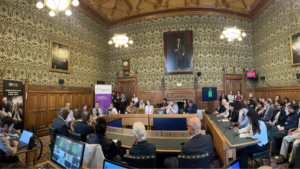
On 15th June 2026, the Foreign Policy Centre (FPC), the Global Disorder Group at City St. George’s, University of London (City), Shout Out UK (SOUK), and the All-Party Parliamentary Group (APPG) on Political and Media Literacy co-hosted a discussion examining the relationship between political rhetoric, information disorder, and democratic resilience.
The event was chaired by Susan Coughtrie, FPC’s Executive Director, and brought together an expert panel including: Dr Sasikumar Sundaram, Senior Lecturer at the Department of International Politics at City; Professor Inderjeet Parmar, Professor of International Politics at City; Effie Webb, reporter on The Bureau of Investigative Journalism’s (TBIJ) Big Tech team; Amelia Fairney, SOUK’s Head of Strategy and Communications; and closing reflections from Matt Bishop MP, Chair of the APPG on Political and Media Literacy.
The discussion explored how increasingly polarised political rhetoric, widening inequality, AI-driven misinformation, and fragmented media ecosystems are reshaping democratic discourse. Speakers examined the structural drivers of democratic strain, the role of technology in amplifying division, and practical approaches to strengthening political and media literacy.
This briefing outlines key themes and insights from the parliamentary panel discussion:
- Political rhetoric is a symptom of deeper structural transformations.
- The concentration of economic and technological power is reshaping democratic discourse.
- AI is accelerating existing vulnerabilities in the information ecosystem.
- Political and media literacy must be treated as democratic infrastructure.
- Strengthening democratic resilience requires systemic responses.
To explore the key thematic takeaways from this expert discussion, you can download the full briefing here.
“Democracy depends on freedom of speech, just as a democratic international order depends on the free flow of ideas and dialogue. Yet rhetoric has become a mainstay of power politics, displacing democratic dialogue. The rhetoric of civilizational glory, decline of the West, technological inevitability, and ideological discontentments among others reflect deeper inequalities between states, societies, actors, and institutions. Specifically, rising wealth inequalities and oligarchies have displaced state entrepreneurism aimed at public well being, which is driving rhetoric, disorder, and the crisis of democracy. Political and media literacy should therefore cultivate social purpose and critical judgment, asking not only how we communicate, but what kind of good life and accountabilities democratic societies ought to pursue.”
Dr Sasikumar Sundaram
“The challenges posed by misinformation, AI, and polarised rhetoric cannot be separated from the wider political economy of contemporary democracy. Extreme concentrations of economic and technological power have contributed to growing public distrust and of political exclusion and alienation. There is a widespread legitimacy crisis which fosters dangerous political movements. Political and media literacy are therefore not optional additions to democracy; they are vital democratic infrastructure. However, lasting democratic resilience will depend not only on helping citizens navigate information environments, but also on addressing the inequalities and imbalances of power that erode trust in the first place.”
Professor Inderjeet Parmar