
Skip to content

Expert Briefing | ‘Rhetoric, Disorder, and the Crisis of Democracy’

Article by Foreign Policy Centre

July 7, 2026

Download PDF
Expert Briefing | ‘Rhetoric, Disorder, and the Crisis of Democracy’

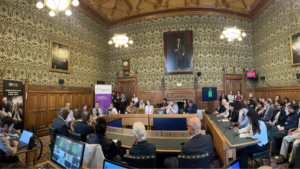
On 15th June 2026, the Foreign Policy Centre (FPC), the Global Disorder Group at City St. George’s, University of London (City), Shout Out UK (SOUK), and the All-Party Parliamentary Group (APPG) on Political and Media Literacy co-hosted a discussion examining the relationship between political rhetoric, information disorder, and democratic resilience.


The event was chaired by Susan Coughtrie, FPC’s Executive Director, and brought together an expert panel including: Dr Sasikumar Sundaram, Senior Lecturer at the Department of International Politics at City; Professor Inderjeet Parmar, Professor of International Politics at City; Effie Webb, reporter on The Bureau of Investigative Journalism’s (TBIJ) Big Tech team; Amelia Fairney, SOUK’s Head of Strategy and Communications; and closing reflections from Matt Bishop MP, Chair of the APPG on Political and Media Literacy.


The discussion explored how increasingly polarised political rhetoric, widening inequality, AI-driven misinformation, and fragmented media ecosystems are reshaping democratic discourse. Speakers examined the structural drivers of democratic strain, the role of technology in amplifying division, and practical approaches to strengthening political and media literacy.


This briefing outlines key themes and insights from the parliamentary panel discussion:

  • Political rhetoric is a symptom of deeper structural transformations.
  • The concentration of economic and technological power is reshaping democratic discourse.
  • AI is accelerating existing vulnerabilities in the information ecosystem.
  • Political and media literacy must be treated as democratic infrastructure.
  • Strengthening democratic resilience requires systemic responses.


To explore the key thematic takeaways from this expert discussion, you can download the full briefing here.


“Democracy depends on freedom of speech, just as a democratic international order depends on the free flow of ideas and dialogue. Yet rhetoric has become a mainstay of power politics, displacing democratic dialogue. The rhetoric of civilizational glory, decline of the West, technological inevitability, and ideological discontentments among others reflect deeper inequalities between states, societies, actors, and institutions. Specifically, rising wealth inequalities and oligarchies have displaced state entrepreneurism aimed at public well being, which is driving rhetoric, disorder, and the crisis of democracy. Political and media literacy should therefore cultivate social purpose and critical judgment, asking not only how we communicate, but what kind of good life and accountabilities democratic societies ought to pursue.”

Dr Sasikumar Sundaram


“The challenges posed by misinformation, AI, and polarised rhetoric cannot be separated from the wider political economy of contemporary democracy. Extreme concentrations of economic and technological power have contributed to growing public distrust and of political exclusion and alienation. There is a widespread legitimacy crisis which fosters dangerous political movements. Political and media literacy are therefore not optional additions to democracy; they are vital democratic infrastructure. However, lasting democratic resilience will depend not only on helping citizens navigate information environments, but also on addressing the inequalities and imbalances of power that erode trust in the first place.”

Professor Inderjeet Parmar
 

Footnotes
    Related Articles

    Expert Briefing: ‘Promoting Inclusive Peace’ Key Takeaways from a Parliamentary Roundtable Discussion

    Article by Alice Copland

    December 20, 2024

    Download PDF
    Expert Briefing: ‘Promoting Inclusive Peace’ Key Takeaways from a Parliamentary Roundtable Discussion

    On 13th November 2024, the Foreign Policy Centre (FPC), in collaboration with the Department of Political Science and International Studies at the University of Birmingham (POLSIS) and the All-Party Parliamentary Group on Women, Peace and Security (APPG-WPS) convened a parliamentary roundtable to discuss how to negotiate, design and implement effective peace processes and how the UK can promote inclusive peace processes abroad.


    The discussion was chaired by Baroness Fiona Hodgson, Chair of the APPG-WPS and was led by a panel of experts who shared their insights from academic research, policy, parliament and practice. Speakers were: Dr Giuditta Fontana, Associate Professor in International Security at the University of Birmingham, Dr Fatiha Serour, Co-founder of Justice Impact Lab and Chair of the Africa Group of Justice & Accountability (AGJA); Eva Tabbasam, Director of Gender Action for Peace and Security UK (GAPS-UK); and Fabian Hamilton, Member of Parliament for Leeds North East. Alice Copland, FPC’s Policy and Parliamentary Affairs Manager, also provided her insights.


    The discussion was prompted by a recently concluded research project led by the University of Birmingham – ‘Learning from Failure: How to Prevent Civil War Recurrence’, which was funded by the United States Institute for Peace (USIP). Previous research has found that 40% of civil wars and conflict relapse into large-scale violence after the signing of a Peace Accord. Furthermore, 90% of conflicts in the first decade of the 21st century occurred in countries that had previously experienced conflict.


    Research, evidence and experience has shown that peace processes are more likely to be stable and resilient when women are included in peace negotiations, and when peace agreements map socio-economic measures to include women in post-conflict society. Despite this, there has been a backsliding of women’s rights and the inclusion of women in peace negotiations remains low. The panel shared their insights from academic research, policy and practice to discuss what makes a peace process successful in ending violent conflict; the role of inclusion, particularly of women, in creating sustainable peace; and how the UK Government can, through its Foreign and Development policies, support the promotion of sustainable, inclusive peace processes globally.


    Four key takeaways emerged from the roundtable discussion

    1. The characteristics of peace settlements matter for preventing the recurrence of civil war;
    2. The inclusion of women and civil society organisations at all stages of a peace process is essential for sustainable peace;
    3. Key lessons for embedding the inclusion of women in peace negotiations and peace processes can be identified;
    4. Distinct challenges to the inclusion of women in peace processes remain.


    As a permanent member of the UN Security Council, penholder for the Women, Peace and Security Agenda (WPS) at the UN, and with a strong WPS National Action Plan (NAP), the UK is in a strong position to support peace agreements that will end conflict and to influence positive change toward the inclusion of women in peace processes. The UK Government should use its influence to ‘lead by example’ as a donor, diplomat and advocate for the WPS agenda, with inclusion as a core principle of a new Foreign and Development policy. Monitoring, adaptation, reform and resources are essential in the long term for conflict transitions, therefore the UK should carefully select in which contexts it will involve itself and be prepared for long-term commitment.


    Download the full summary of the expert briefing here.


    Baroness Hodgson: “Accountability for implementation [is important] because too often it’s words and rhetoric, but it’s not actions, and it doesn’t translate out there on the ground”


    Dr Giuditta Fontana: “The UK is in fact in a very strong position to make a difference… to individual peace processes, but also to the way in which war to peace transitions are conceived of on a broader global scale.”


    Dr Fatiha Serour: “A peace process is there to basically use the logic of confrontation and transform it into one of collaboration. Because when there is conflict, it’s basically not that we are divided, but we have issues to deal with, and a peace process should help us to sit down, look at what unites rather than divides us.”


    Fabian Hamilton MP: “Peace is a process. It’s not a one-off event… It takes time, energy, and commitment. One of the biggest drivers of conflict is inequality…so a more equal world will help considerably in preventing or halting future conflicts.”


    Eva Tabbasam: “We should seize the moment leading up to the 25th anniversary to champion the inclusion of women, marginalized groups, civil society in peace building, to ensure that peace is not just negotiated but also owned and sustained by the people it serves. Together we build a future where peace is not just the absence of conflict, but is the presence of justice, equality and opportunity.”


    Alice Copland:“Inclusion is difficult, or is often failing, because it challenges the status quo. It can be difficult and it takes time, and you cannot expect results quickly. We need tireless, brave, accountable, and committed leadership to support and resource grassroots organisations in genuine partnership, so when things become challenging, we can keep going.”


    Footnotes
      Related Articles

       Join our mailing list 

      Keep informed about events, articles & latest publications from Foreign Policy Centre

      JOIN